enord
· enord.co
SnapshotCompany claim
Company description not yet disclosed.
- Founded
- Not disclosed
- HQ
- Not disclosed
- Models
- 3
- Categories
- 2
ContactCompany claim
- Address
- Enord, 5th floor, Incubation Center, IIITD Delhi, New Delhi 110020
Product families
Is this your company? Claim this profile to add verified data, respond to our analysis, and upgrade claims to Verified.
Claim this profile1. Executive Overview {#executive-overview}
Enord (enord.co) is an India-based drone manufacturer focused on tactical and training-class FPV (first-person view) unmanned aerial vehicles. The company's public-facing product line — the HAVOC family — comprises three electric-propulsion multirotor platforms ranging from a compact 5-inch trainer to a 13-inch heavy-lift tactical drone, all designed for rapid sub-minute deployment and operator-configurable payloads. The lineup's consistent ~5 km line-of-sight range, modular customisation options (camera, VTX, battery, OFC), and emphasis on short deployment times indicate a deliberate focus on defense-adjacent or security-sector end-users who value field readiness and hardware flexibility.
Active hiring in New Delhi for a UAV System Engineer (Fixed Wing) signals that Enord is actively expanding its engineering capability and, notably, moving beyond multirotor airframes into fixed-wing UAV development — a meaningful product roadmap indicator. The role's salary band (₹30,000–60,000/month) and full-time New Delhi location suggest an early-to-mid-stage domestic operation rather than a scaled manufacturing enterprise, though founding year and headcount are not publicly disclosed.
Not yet disclosed: company founding date, total headcount, revenue, and named customer deployments. Enord is invited to submit verified data for correction or addition.
Latest news
- KEENON Humanoid Pours Drinks at GCS 2026, 100,000 Others Run HotelsYanko Design·2026-06-15GENERAL
2. The Company Story {#the-company-story}
Enord presents itself as an AI-powered drone company — a framing drawn directly from its careers page, which describes the opportunity to "be part of the future of AI-powered Drones." Beyond this positioning statement, the company's founding date, founding team, and corporate history are not disclosed on its public site.
What the evidence does support is a company in active, early-stage growth. Its product portfolio is coherent and technically specified, centering on the HAVOC brand across three distinct form-factor tiers. The presence of a careers section with at least one open position (UAV System Engineer – Fixed Wing, New Delhi, closing December 31) confirms ongoing operations and an intent to scale engineering capacity into new airframe categories.
The New Delhi operational base places Enord within India's rapidly developing indigenous drone ecosystem, which has been materially supported by national policy initiatives encouraging domestic UAV manufacturing. The fixed-wing engineering hire, in particular, suggests Enord is pursuing a broader mission profile beyond the manual-control FPV category its current products occupy — potentially targeting longer-endurance, higher-altitude applications. Founding narrative, investor background, and key milestones are not yet publicly disclosed; Enord is invited to claim and verify this record.
3. Product Portfolio {#product-portfolio}
Products & versions


Enord's current public portfolio consists of three products, all under the HAVOC brand, forming a clear size-and-capability tiered family across two functional categories: tactical deployment and operator training.
HAVOC 5 is the entry-level platform — a 5-inch FPV drone weighing ≤1.2 kg, carrying up to 250 g of payload, with 12–15 minutes of endurance and a ~5 km line-of-sight range. Its primary role is stated as training, making it a logical onboarding tool for operators who will graduate to the larger tactical frames. Analog video and manual control keep the system simple and robust for repetitive training cycles.
HAVOC 10″ steps up to a 10-inch propeller configuration with an all-up weight of ≤3.5 kg, payload capacity of ≤1.5 kg, and 20–25 minutes of endurance — again at ~5 km range. Its stated primary role is tactical, and the sub-60-second deployment time is a defining specification. The analog video system and manual control mode are consistent with an operator profile that prioritises low-latency situational awareness over autonomous flight.
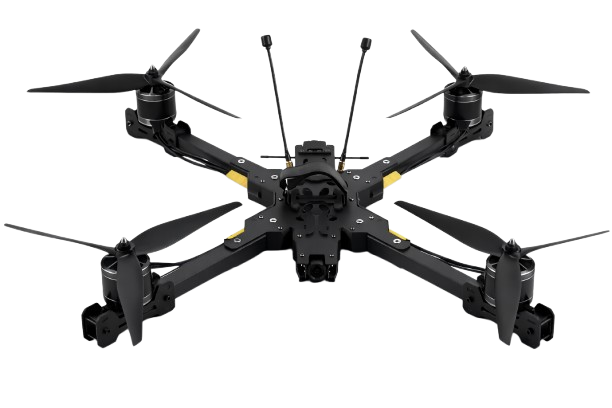
HAVOC 13″ is the largest and most capable current offering: a 13-inch propeller platform with ≤6.0 kg AUW, ≤2.0 kg payload capacity, and 25–30 minutes of endurance. It upgrades the video system to HD FPV while retaining the ~5 km extended line-of-sight range and under-one-minute deployment. The increased payload capacity opens applications such as optical sensor carriage or light munition-class payloads in defense contexts.
Taken as a family, the HAVOC lineup is internally consistent: shared range performance, shared control philosophy (manual/FPV), shared deployment-speed ethos, and a graduated payload capability. The open fixed-wing engineering position suggests a fourth product category is under development, which would meaningfully expand Enord's addressable mission set. Use-case and industry tags are not populated in the current public data; Enord is invited to provide verified deployment context.
4. Technology Stack {#technology-stack}
Enord's public specifications provide a reliable foundation for inferring the underlying technology architecture, even without a formal technical whitepaper.
Propulsion and airframe: All three HAVOC platforms use electric propulsion — brushless motor and LiPo or Li-ion battery configurations are standard for this propeller size class. The fact that battery is listed as a customisation option on all three models suggests Enord offers flexibility in cell chemistry or capacity, allowing end-users to trade weight for endurance depending on mission profile.
Video and control systems: The HAVOC 5 and HAVOC 10″ use analog video transmission (VTX), a deliberate choice that prioritises latency and signal resilience over image resolution — standard practice in tactical FPV applications where sub-100ms video latency matters more than 4K imagery. The HAVOC 13″ upgrades to HD FPV, reflecting the larger platform's suitability for reconnaissance or payload-delivery tasks where image quality becomes operationally relevant. All models operate in manual control mode, meaning there is no disclosed autonomous or semi-autonomous flight mode in the current lineup — a meaningful differentiator from survey or logistics drones.
Our read: The consistent ~5 km line-of-sight range across all three platforms suggests a common or similar RF link hardware baseline (likely a 900 MHz or 2.4 GHz long-range control system such as ELRS or a comparable protocol), with the VTX system operating on a separate frequency band. The OFC (likely "optical fiber cable" or "over-fiber communication") listed as a customisation option on the HAVOC 10″ is a notable signal — OFC-linked drones are used in anti-jamming tactical contexts, which reinforces the defense-sector orientation of the tactical models.
Our read: The absence of any disclosed autopilot stack, BVLOS capability, or AI-based flight feature in the current product specs contrasts with the company's "AI-powered Drones" brand positioning. This gap may be bridged by the fixed-wing platform in development, or by proprietary software layers not yet publicly disclosed. Limited public technical detail exists on flight controllers, ground station software, or sensor fusion capability.
Not yet disclosed: autopilot hardware/software stack, battery specifications, specific RF protocols, or AI feature implementations. Enord is invited to provide verified technical documentation.
5. Research, Papers, Authors, Labs {#research-papers}
Company-linked papers
Enord does not appear to be a research-publishing organisation at this stage. No academic papers, technical preprints, named research authors, or affiliated laboratory partnerships are referenced in any available public data. This is consistent with the profile of an early-stage hardware manufacturer in the defense-adjacent drone sector, where IP is typically held proprietary rather than shared through academic channels.
6. Media Evidence {#media-evidence}
Media library
No third-party media coverage, press mentions, or editorial features are linked or referenced in the available public data for Enord at this time. Enord is invited to submit verified press coverage for inclusion.
7. Commercial Reality {#commercial-reality}
Customers & deployments
Revenue, customer counts, named deployments, and ROI metrics: Not disclosed. No commercial contracts, government procurement announcements, or named end-users appear in Enord's public-facing data.
The existence of three fully specified, branded products with distinct performance tiers implies some level of commercial intent and likely pilot or prototype engagement with potential customers, but this cannot be confirmed from available evidence. The India-based hiring activity and the careers page framing suggest Enord is in an active pre-scale or early commercialisation phase.
Enord is invited to disclose verified customer engagements, deployment counts, or commercial milestones for inclusion in this record. All such submissions will be labeled as company-claim and noted accordingly.
8. Markets and Use Cases {#markets-use-cases}
Enord's product specifications and design choices point clearly toward two primary market segments, with a third emerging based on the fixed-wing hiring signal.
Defense and security (tactical): The HAVOC 10″ and HAVOC 13″ are explicitly designated with a "tactical primary role." Key indicators of defense/security orientation include: sub-60-second deployment times (field-readiness under operational pressure), manual FPV control (operator-in-the-loop for sensitive decisions), OFC customisation option (counter-jamming resilience), and payload capacities (up to 2.0 kg) sufficient for sensor packages or other mission-specific carriage. The ~5 km line-of-sight range aligns with short-range tactical reconnaissance or direct-action support use cases at the squad or platoon level.
Training and operator development: The HAVOC 5 is explicitly designated for training. Its smaller size (≤1.2 kg), lower payload (250 g), and shorter endurance (12–15 min) reduce operational risk and cost during pilot onboarding. Shared range and control-mode design with the tactical platforms means skills transfer directly to the HAVOC 10″ and 13″. This training-to-tactical pipeline is a coherent go-to-market structure for organizations building internal UAV operator capacity.
Fixed-wing / extended endurance (emerging): The open UAV System Engineer – Fixed Wing position in New Delhi signals active development of a fixed-wing platform. Fixed-wing UAVs typically offer significantly longer endurance and greater range than multirotors, broadening potential markets to include border surveillance, infrastructure inspection, and longer-duration ISR (intelligence, surveillance, reconnaissance) missions — a logical expansion of Enord's current defense-adjacent focus.
No use-case or industry tags are populated in the current product data, so the above market derivation is based on stated roles, specifications, and design features. Enord is invited to provide verified deployment verticals.
9. Competitive Landscape {#competitive-landscape}
Competitive comparison
| Robot | Maker | Autonomy | Conf. |
|---|---|---|---|
| iRobot Roomba Combo 10 Max | iRobot | Autonomous | 0.90 |
| Mobile ALOHA (Stanford) | Stanford University | Teleoperated | 0.90 |
| 1X NEO | 1X Technologies | Remote-Assisted | 0.90 |
Enord operates in the tactical and training-class FPV drone segment — a market that has grown rapidly in response to both defense modernisation programs and increased domestic UAV manufacturing incentives in India. This segment includes both large established defense contractors with UAV divisions and a growing number of specialized startups focused on short-range, operator-flown platforms for security and military end-users.
Enord's differentiating posture, as readable from its product data, is the combination of modular customisability (camera, VTX, battery, OFC options across the lineup), a coherent training-to-tactical platform ladder, and a domestic India manufacturing and engineering base. The consistent sub-one-minute deployment specification across all tactical models is a concrete performance claim that positions the HAVOC family against mission-readiness requirements. The competitive module above provides peer-set context; no individual competitor names are asserted in this prose absent verified sourcing.
10. Country Advantage / Geopolitical {#geopolitical}
Enord's India base is materially relevant to its business context. India has implemented a series of policy measures — including the Production Linked Incentive (PLI) scheme for drones, mandatory import substitution for government drone procurement, and defense indigenisation targets — that create a structurally favorable environment for domestic UAV manufacturers. Enord, as an Indian-domiciled drone hardware company hiring locally in New Delhi, is positioned to benefit from preferential procurement frameworks that prioritise Indian-made defense and security equipment.
The tactical orientation of the HAVOC lineup also aligns with sustained Indian government and paramilitary demand for short-range UAV capabilities, which has been publicly documented across multiple procurement cycles. Additionally, the fixed-wing engineering hire suggests a possible future play in border or coastal surveillance applications — a high-priority area in Indian defense planning.
Not yet disclosed: whether Enord holds or is pursuing relevant certifications (DGCA type certification, defense vendor registration, Ministry of Defence empanelment). Enord is invited to disclose verified regulatory and procurement status.
11. Hype vs Real vs Ugly {#hype-real-ugly}
Claim tracker
Real (verified from public specs):
- Three distinct, fully specified drone platforms exist under the HAVOC brand, with consistent and plausible performance figures across weight, range, endurance, and payload dimensions.
- Sub-one-minute deployment time is a concrete, testable claim made across the tactical models.
- Active hiring for a fixed-wing UAV engineer in New Delhi is a documented, time-bounded recruitment posting — a real operational signal.
- Modular customisation options (camera, VTX, battery, OFC) are stated across the product line.
Company claims (stated, not independently verified):
- "AI-powered Drones" — this is Enord's own brand positioning language from its careers page. No AI-specific features, algorithms, or autonomous capabilities are described in any current product specification. This may reflect a future roadmap aspiration or an unlisted software capability. Our read: the current lineup is manual-control FPV hardware; the AI positioning requires substantiation.
- ~5 km line-of-sight range across all three platforms — plausible for the RF hardware class but not independently verified.
- 25–30 minute endurance figures — consistent with electric propulsion at these weight classes but stated without disclosed battery specifications.
Fixable gaps:
- Not yet disclosed: founding date, team composition, customer deployments, revenue, regulatory certifications, and AI feature specifics. Enord is invited to claim, correct, or supplement any of the above.
12. Future Scenarios {#future-scenarios}
Bull case — Our read: Enord successfully develops and commercialises a fixed-wing platform that complements the HAVOC multirotor lineup, capturing demand in the Indian paramilitary, border security, or defense export markets. Domestic policy tailwinds (PLI scheme, indigenisation mandates) accelerate customer acquisition, and the modular HAVOC family becomes a reference platform for Indian defense-sector FPV training programs. The "AI-powered" positioning is substantiated by autonomous or semi-autonomous features in a next-generation product, expanding the addressable market to non-manual-control applications.
Base case — Our read: Enord continues to develop its HAVOC lineup incrementally, growing a domestic customer base in defense, paramilitary, or private security sectors. The fixed-wing hire results in a new product within 18–24 months. Revenue and scale remain modest but sufficient to sustain the operation. The company remains a specialized niche player in India's growing domestic drone manufacturing ecosystem, without achieving broad public visibility or significant export volume in the near term.
Bear case — Our read: The gap between the "AI-powered" brand positioning and the current manual-control, analog-video product reality creates a credibility challenge in procurement evaluations where autonomous capability is increasingly expected. Failure to achieve defense vendor certification or government empanelment limits the addressable market. Larger, better-resourced domestic and international competitors with established procurement relationships crowd out early-stage players. Without disclosed customer traction, fundraising to support the fixed-wing development program becomes difficult.
13. What to Watch {#what-to-watch}
- Fixed-wing product announcement: The UAV System Engineer – Fixed Wing hire closing December 31 is a leading indicator. Watch for a HAVOC fixed-wing platform reveal within 12–24 months.
- AI feature disclosure: Whether and how Enord substantiates the "AI-powered" brand claim — through an autopilot integration, computer vision payload, or autonomous flight mode — will be a key product differentiation signal.
- Defense/government certifications: DGCA type certification, Ministry of Defence vendor empanelment, or state/central government procurement announcements would mark a significant commercial inflection.
- Headcount and hiring velocity: Additional job postings (beyond the single current listing) would signal growth trajectory and engineering capacity expansion.
- Media and press coverage: First appearances in Indian defense trade press, technology media, or startup funding databases would provide independent triangulation of commercial progress.
- Export activity: Any indication of international sales, partnerships, or demonstration events outside India — particularly in allied defense markets — would signal ambition beyond domestic scope.
- Customisation-to-product pipeline: Whether the stated OFC, HD video, and other customisation options evolve into defined product variants or remain bespoke order options is worth tracking as a signal of manufacturing maturity.
14. Sources & Methodology {#sources-methodology}
Data sources: All factual claims in this report are derived exclusively from content extracted from Enord's own public-facing website (enord.co), including product specification pages, feature lists, product descriptions, and careers/about content. All such content is labeled company-claim — it represents what Enord states about itself and has not been independently verified by third-party audit, regulatory filing, or editorial reporting.
Computed relations: Competitive peer groupings, market segment derivations, and technology stack inferences are computed from the product data using category, specification, and use-case tags. These are labeled Our read throughout and represent analytical inference, not independently sourced fact.
What this report does not include: No information has been sourced from financial databases, patent filings, government procurement records, or third-party media, as none was available or linked in the input data. No product, specification, customer, competitor, paper, or partnership has been invented or assumed.
Rubric applied uniformly: This methodology — company-site extraction as the data foundation, labeled inferences, labeled company claims, and explicit notation of all gaps — is applied identically to every company assessed under this framework. Enord is invited to submit verified supplementary data (customer deployments, certifications, founding history, technical documentation) for inclusion in future report versions, where it will be labeled accordingly.
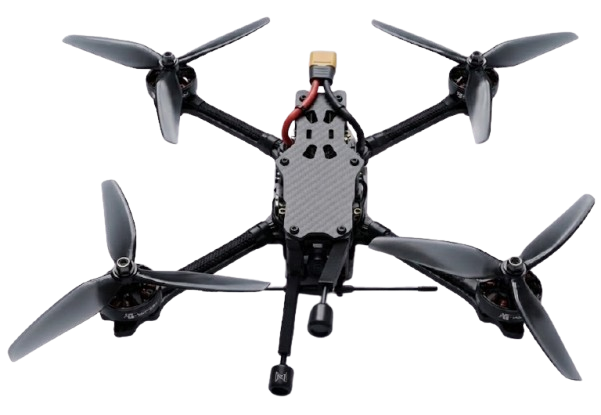
The HAVOC 10″ is a tactical FPV drone with manual control, electric propulsion, and an analog video system. It offers ~5 km line-of-sight range, 20-25 min endurance with payload, ≤1.5 kg payload capacity, ≤3.5 kg AUW, and <1 min deployment time. Customisation options include camera, VTX, battery, and OFC.
- •Tactical primary role
- •Manual control mode
- •Electric propulsion
- •Analog video system
- •~5 km line-of-sight range
- •20-25 min endurance with payload
- •≤ 1.5 kg payload capacity
- •≤ 3.5 kg all-up weight
- •< 1 min deployment time
- •Customisable camera, VTX, battery, OFC
| Range km | 5 |
| Weight | 3.5 kg |
| Payload | 1.5 kg |
| Endurance (min) | 20 |
| Endurance max (min) | 25 |
| Deployment time sec | 60 |
Technology stackOur read
Inferred from product specs — click through to the technology wiki:
ResearchComputed
Product comparisonComputed
Each row leads with this company's product, side-by-side with similar ones · click a row to expand full specs, click again to collapse
HAVOC 10″

ANYmal D Max
Lunar Rover R1
RB-VOGUI
Dobot M1

FarmBot | Open-Source CNC Farming
HAVOC 13" FPV DRONE
ANYmal X
Lunar Rover R1
RB-VOGUI
Dobot M1
FarmBot | Open-Source CNC Farming