Four Growers
United States · fourgrowers.com
SnapshotCompany claim
Four Growers helps greenhouse farmers lower production costs and increase produce accessibility. Founded by University of Pittsburgh students, the company works at the intersection of hardware and software for sustainable food production.
- Founded
- Not disclosed
- HQ
- United States
- Models
- 2
- Categories
- 2
ContactCompany claim
- Address
- Not disclosed
Product families
Is this your company? Claim this profile to add verified data, respond to our analysis, and upgrade claims to Verified.
Claim this profile1. Executive Overview {#executive-overview}
Four Growers is a Pittsburgh-founded agri-robotics company operating at the intersection of hardware and software to automate commercial greenhouse harvesting. Its flagship product, the GR-100, is a purpose-built autonomous tomato harvesting robot that achieves 98% ripe-fruit precision, operates 24 hours a day, and carries up to 246 kg of produce per session — specifications that, if validated at scale, represent a meaningful advance over manual picking economics. The company has secured Y Combinator backing and closed a $9M Series A round (reported December 2024 by Global AgInvesting), signaling credible investor confidence in both the technology and the market thesis that greenhouse labor costs are structurally unsustainable.
The founding team traces to the University of Pittsburgh, and the company's mission is explicitly dual: lower production costs for greenhouse operators and improve affordability and accessibility of fresh produce for consumers. This framing — commercial robotics in service of a food-systems social outcome — is consistent across the company's own public materials and is reinforced by its Y Combinator affiliation. Leadership depth has grown to include a VP of Hardware Engineering and Manufacturing, a Sales Director, and a Head of Finance and Business Operations, suggesting the company has moved beyond pure R&D into commercial and operational phases.
Not yet disclosed: precise deployment count, greenhouse operator names, or revenue figures. Interested parties with firsthand knowledge are invited to submit corrections or additions through the claim process.
Latest news
- KEENON Humanoid Pours Drinks at GCS 2026, 100,000 Others Run HotelsYanko Design·2026-06-15GENERAL
2. The Company Story {#the-company-story}
Four Growers originated as a student project at the University of Pittsburgh, co-founded by Brandon Contino (CEO) and Dan Chi (CTO). The company's own materials describe an evolution "from a group of students… into a future forward thinking company" — a trajectory consistent with deep-tech ventures that incubate inside university environments before seeking external capital.
The Y Combinator affiliation is a verifiable and significant milestone. Y Combinator's agri-tech portfolio is selective, and inclusion signals that the core thesis — robotic automation for greenhouse labor shortages — was compelling enough to earn one of the startup ecosystem's most recognized stamps of validation. Coverage by Ospraie Ag Science (November 2024) frames Four Growers explicitly in the context of greenhouse labor shortages, suggesting the company's go-to-market narrative is landing with specialist agriculture investors and media.
The Series A close of $9M, reported by Global AgInvesting in December 2024, is the most concrete financial milestone on public record. This round would typically fund a company through expanded pilot deployments, early commercial installations, and continued hardware iteration. The company's team page, last modified July 2025 per site metadata, indicates active organizational development, with roles spanning hardware engineering, sales, finance, and a Chief of Staff — a profile consistent with a company transitioning from prototype to commercial scale.
The founding date is not publicly disclosed on the company's own materials. Not yet disclosed: precise founding year, prior seed or pre-seed round details. Parties with knowledge of earlier milestones are invited to submit corrections.
3. Product Portfolio {#product-portfolio}
Products & versions


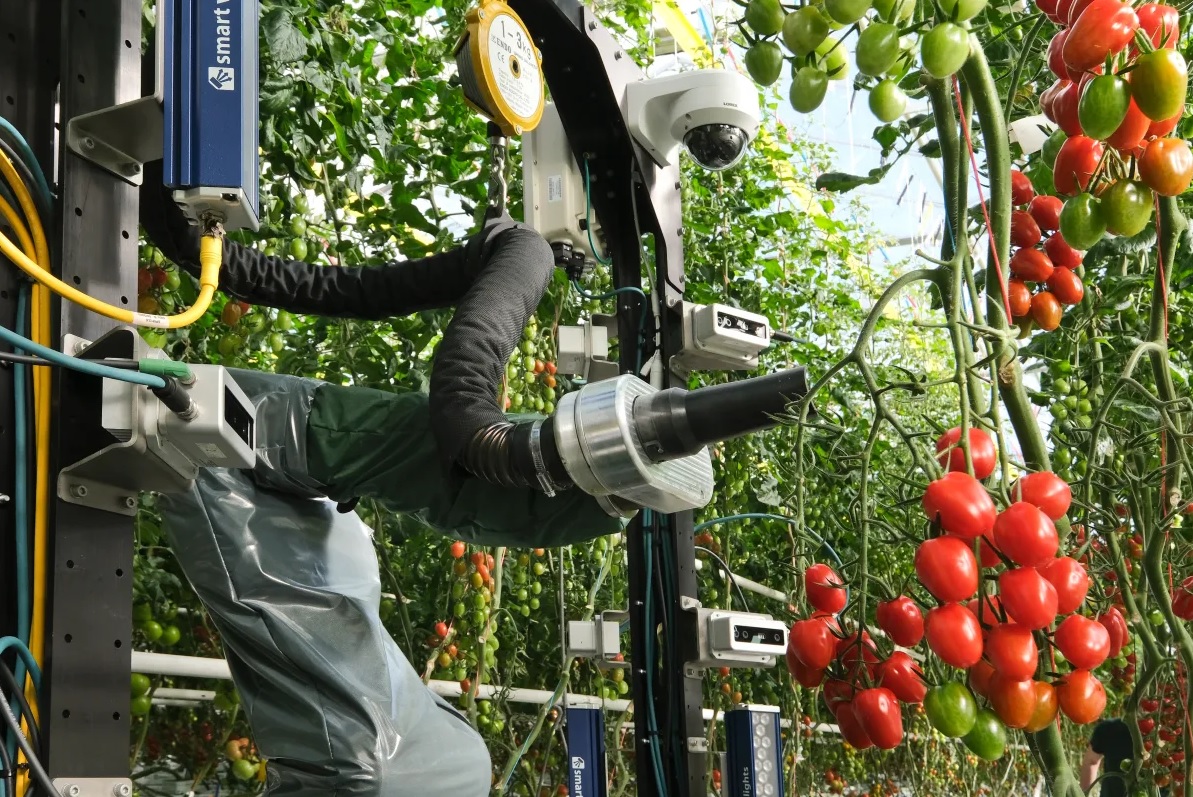
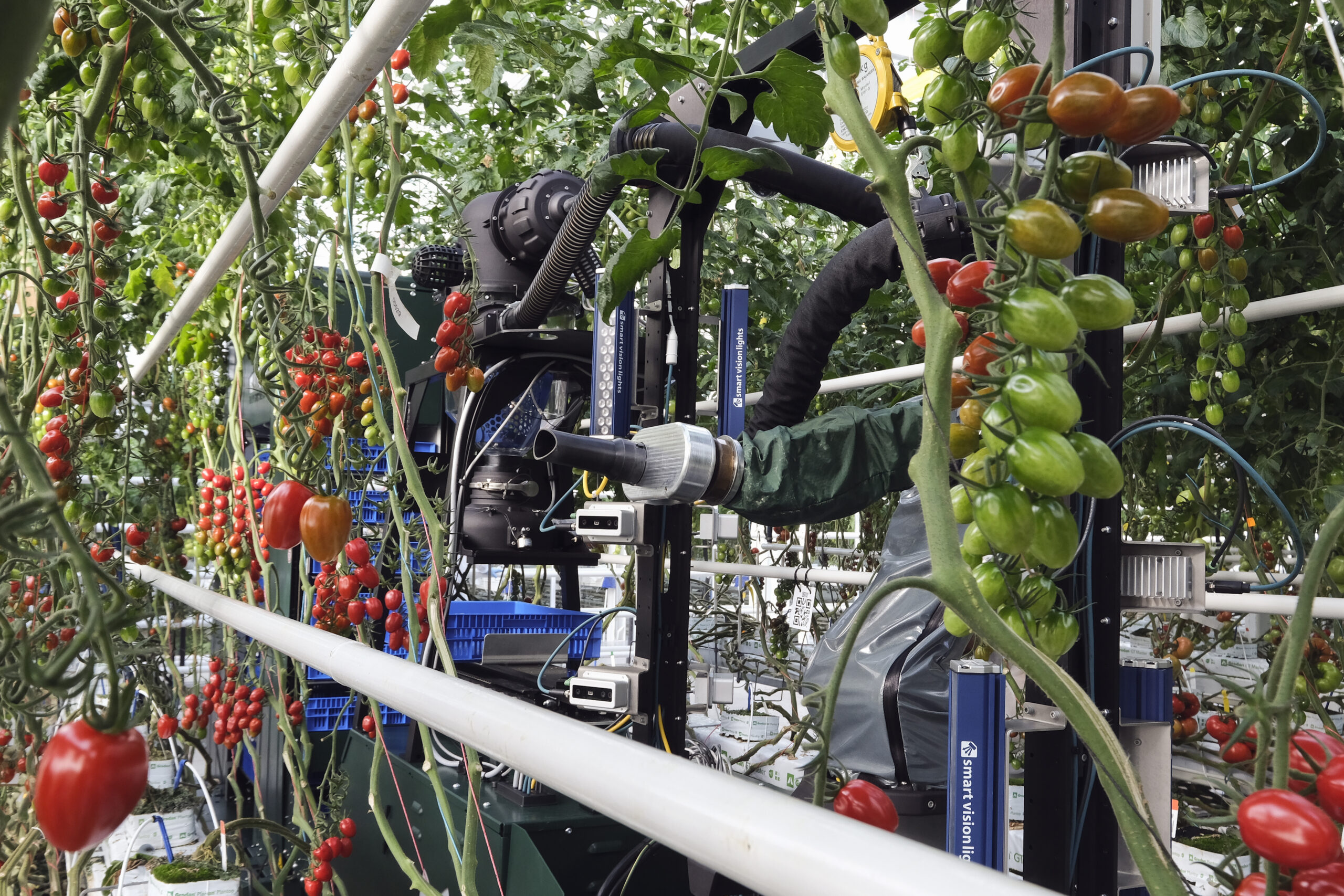
Four Growers' public product portfolio centers on a single, highly specified commercial offering: the GR-100 autonomous tomato harvesting robot. The GR-100 is designed for deployment in commercial greenhouses and is built around a robotic arm equipped with four stereo cameras that enable the system to identify and harvest ripe tomatoes at 98% precision, operating continuously across a 24-hour cycle. At a harvesting speed of 43 kg per hour (calibrated for 12-gram fruit), and with a per-session payload capacity of 24 crates totaling 246 kg, the GR-100 is engineered for the economics of large-scale greenhouse production rather than small-plot or open-field agriculture.
Beyond the mechanical harvesting function, the GR-100 integrates software-layer capabilities: yield heatmaps, forecasting analytics, and remote monitoring. These features position the product not merely as a labor replacement tool but as a data platform for greenhouse operators — providing visibility into crop density and ripeness patterns over time. The motion planner underpinning the arm's movement is described (company-claim) as 34 times faster than standard algorithms, which, if independently verified, would be a meaningful differentiator in cycle time and throughput. The portfolio currently reflects a focused, single-crop-category strategy. Whether Four Growers intends to extend the platform to other fruiting crops or greenhouse types is not yet disclosed.
4. Technology Stack {#technology-stack}
The GR-100's core perception system relies on four stereo cameras mounted on the robotic arm. Stereo vision provides depth information necessary for precise fruit localization in the visually complex, occluded environment of a greenhouse tomato row. Our read: the use of four cameras — rather than a single stereo pair — likely reflects a need for wider field-of-view coverage and redundancy to handle partial occlusion by foliage, which is a well-known challenge in greenhouse harvesting robotics.
The 98% ripe-precision figure is a company-claimed metric and implies a trained vision model capable of color, texture, and likely shape-based ripeness classification. Our read: given the company's founding at a research university and its Y Combinator cohort context, the underlying model is likely a convolutional neural network or similar deep learning architecture trained on greenhouse tomato imagery — though the company has not publicly described its model architecture, training data, or inference hardware.
The motion planner is described (company-claim) as 34 times faster than standard algorithms. Our read: this claim almost certainly references a comparison against classical motion planning approaches (e.g., RRT or PRM variants); modern learned or sampling-based planners can achieve such speedups, particularly on constrained, known-workspace problems like a greenhouse row. The specific baseline and benchmark conditions are not publicly disclosed.
The software layer — yield heatmaps, forecasting, and remote monitoring — suggests a cloud-connected architecture with onboard data capture feeding fleet-level analytics. Not yet disclosed: the hardware compute platform (edge inference device, onboard SBC), connectivity standards, or integration APIs for greenhouse management systems. Limited public technical detail beyond the specifications provided in the company's own product materials.
5. Research, Papers, Authors, Labs {#research-papers}
Company-linked papers
Four Growers does not appear to operate as a research-publishing entity. No academic papers, preprints, or lab affiliations are cited in the company's public materials. This is consistent with the profile of a commercial-stage agri-robotics firm whose primary output is a deployed product rather than peer-reviewed science. The University of Pittsburgh origin is noted as a founding context, but no ongoing university lab partnership is disclosed in available materials.
6. Media Evidence {#media-evidence}
Media library
Three third-party coverage instances are on record: Ospraie Ag Science (November 2024) covering the labor-shortage framing of the GR-100; Global AgInvesting (December 2024) reporting the $9M Series A; and Y Combinator's own company listing. Coverage is specialist-sector in nature — agriculture investment and agri-tech media — rather than general business or consumer press. This is appropriate to the company's current commercial stage and target audience.
7. Commercial Reality {#commercial-reality}
Customers & deployments
Revenue, customer count, and greenhouse deployment figures are not disclosed in any public company material or third-party press coverage reviewed. The $9M Series A (reported December 2024, Global AgInvesting) is the sole verified financial data point. Named greenhouse operator customers, contracted volumes, and ROI case studies are not yet publicly available.
Not yet disclosed: any of the above. Four Growers or its customers are invited to submit verified deployment data, customer references, or operational metrics for inclusion and proper sourcing in this report.
8. Markets and Use Cases {#markets-use-cases}
The GR-100's specifications define its primary market with precision: commercial greenhouse tomato production. The 24/7 operating cycle, 246 kg per-session payload, and yield analytics suite are features calibrated for large-scale controlled-environment agriculture (CEA) operations, where labor is the dominant variable cost and consistency of harvest timing directly affects produce quality and shelf life.
The labor-shortage framing — explicitly cited in Ospraie Ag Science's November 2024 coverage and embedded in Four Growers' own mission language — points to a structural driver in the market: greenhouse tomato production in North America faces chronic seasonal and year-round labor constraints, driven by immigration policy, aging agricultural workforces, and competition from non-agricultural employers for unskilled and semi-skilled labor.
The yield heatmapping and forecasting features open a secondary use case beyond pure harvesting: greenhouse operators can use Four Growers' software layer to optimize planting density, irrigation timing, and sales commitments based on predicted yield by zone. This positions the company to expand its value capture per customer beyond hardware and into recurring software or data services. Our read: a software-as-a-service layer on top of the hardware platform would be a logical commercial evolution, though no such pricing or subscription model is publicly disclosed.
The focus on tomatoes reflects both the size of the crop category — tomatoes are among the highest-value greenhouse crops in North America — and the technical tractability of the harvesting problem (consistent fruit morphology, known vine architecture). Extension to other vine crops such as cucumbers or peppers is not yet disclosed as a product roadmap item.
9. Competitive Landscape {#competitive-landscape}
Competitive comparison
| Robot | Maker | Autonomy | Conf. |
|---|---|---|---|
| iRobot Roomba Combo 10 Max | iRobot | Autonomous | 0.90 |
| Mobile ALOHA (Stanford) | Stanford University | Teleoperated | 0.90 |
| 1X NEO | 1X Technologies | Remote-Assisted | 0.90 |
The autonomous greenhouse harvesting segment is an active area of investment globally, with multiple hardware-focused companies pursuing similar labor-substitution theses in fruiting vegetable crops. Four Growers competes in a category defined by the combination of computer vision ripeness detection, robotic arm manipulation, and greenhouse-environment mobility — a technically demanding intersection that has historically produced more pilots than at-scale deployments across the industry.
Four Growers' differentiated positioning, based on public materials, rests on the specificity and maturity of its GR-100 specifications (particularly the 98% ripe precision and 34x motion planner speed claims), its Y Combinator credibility signal, and its U.S.-based founding and operations, which may be relevant to greenhouse operators seeking domestic supply chain and support relationships. The module above provides peer-company context.
10. Country Advantage / Geopolitical {#geopolitical}
Section not material for this company.
11. Hype vs Real vs Ugly {#hype-real-ugly}
Claim tracker
Verified through independent reporting:
- $9M Series A funding round (Global AgInvesting, December 2024)
- Y Combinator backing (YC company listing)
- Coverage of labor-shortage thesis as market driver (Ospraie Ag Science, November 2024)
Company claims — not independently verified:
- 98% ripe precision: a company-claimed specification. No independent field validation, third-party audit, or peer-reviewed test is publicly available.
- 43 kg/hr harvesting speed: company-claimed throughput figure, calibrated for 12g fruit. Conditions of measurement (row density, vine training system, climate) are not disclosed.
- 34x faster motion planner: company-claimed relative performance. The baseline algorithm and benchmark conditions are not specified in public materials.
- 24/7 operation: claimed operational capability; no public data on uptime rates, maintenance intervals, or failure modes in commercial deployments.
Our read on hype calibration: The GR-100's published specifications are specific and quantified, which is a positive signal relative to early-stage robotics ventures that traffic in vague capability claims. However, the gap between lab-validated specifications and commercially demonstrated performance at greenhouse scale is a known and significant one in agri-robotics. The absence of named customer deployments or independent benchmark data means the specifications, while plausible, remain unconfirmed by external sources. This is not an unusual position for a Series A-stage hardware company, but it is the key uncertainty for prospective customers and investors.
Not yet disclosed: independent performance validation, deployment case studies, or customer testimonials. Four Growers is invited to submit supporting documentation.
12. Future Scenarios {#future-scenarios}
Bull case — Our read: Four Growers successfully converts the $9M Series A into multiple commercial greenhouse installations with named operators, accumulates independent performance data that validates or exceeds the GR-100 specifications, and establishes a recurring software/analytics revenue stream alongside hardware. The labor-shortage structural driver persists, the company expands to additional crops, and a Series B is raised on demonstrated unit economics. Y Combinator network effects accelerate business development.
Base case — Our read: The company deploys the GR-100 in a limited number of commercial greenhouses over the next 12–24 months, generates meaningful pilot data, and iterates on the hardware based on real-world performance gaps. Revenue remains pre-scale, the team grows modestly, and the company raises follow-on capital contingent on hitting deployment milestones. Extension to additional crop types is explored but not shipped within the period.
Bear case — Our read: The GR-100 encounters the well-documented challenges of robotic harvesting in variable greenhouse conditions — occlusion, plant variability, mechanical reliability — at rates that erode the claimed specifications in practice. Commercial adoption is slower than the Series A timeline implies, capital is consumed by hardware iteration, and the company faces pressure to reduce scope or seek a strategic acquirer. This scenario is not a prediction but a known risk class for the agri-robotics category.
13. What to Watch {#what-to-watch}
- Named commercial deployments: Any public announcement of a named greenhouse operator customer is a significant derisking signal.
- Independent performance validation: Third-party benchmarks, university extension trials, or customer-published ROI data for the GR-100.
- Series B fundraising: Timing and size of a follow-on round will indicate investor confidence in deployment progress.
- Crop expansion: Any announcement of GR-100 adaptation or new product development for crops beyond tomatoes.
- Software/data layer commercialization: Whether the yield heatmapping and forecasting features are offered as a standalone or bundled service, and at what pricing model.
- Team growth signals: New hires in field deployment, customer success, or additional hardware engineering roles would indicate scaling activity.
- Y Combinator Demo Day or batch visibility: Any updated YC profile language or batch-cohort context that surfaces additional company milestones.
14. Sources & Methodology {#sources-methodology}
Primary source: Company website (fourgrowers.com) — all descriptions, product specifications, team information, and mission statements drawn from this source are labeled as company-claim and reflect the company's own representation. Site metadata indicates the team page was last modified July 17, 2025.
Independent third-party sources:
- Ospraie Ag Science (ospraieagscience.com), November 20, 2024
- Global AgInvesting (globalaginvesting.com), December 5, 2024
- Y Combinator company listing (ycombinator.com)
Methodology rubric (applied uniformly to every company in this series):
- Factual claims are sourced exclusively from the above; no inference is presented as fact.
- Inferences are labeled "Our read:" throughout.
- Unverified company claims are labeled as such and not independently asserted.
- Gaps in public information are noted as "Not yet disclosed" with an explicit invitation for the company or informed parties to submit corrections.
- Negative characterizations are expressed only as fixable gaps or labeled inferences, never as unsourced assertions of fact.
- Competitive context is category-level only in prose; named peer analysis is delegated to the live competitor module.
- This report will be updated as new verified information becomes available.

The GR-100 is an autonomous tomato harvesting robot for commercial greenhouses. It uses a robotic arm with four stereo cameras to detect and harvest tomatoes with 98% ripe precision at 43 kg/hr. It operates 24/7, carries 24 crates (246 kg) per session, and features yield analytics, remote monitoring, and a motion planner 34x faster than standard algorithms.
- •Autonomous tomato harvesting robot
- •Robotic arm with four stereo cameras
- •Harvesting speed 43 kg/hr (12g fruit)
- •98% ripe precision
- •24/7 operation
- •Yield heatmaps and forecasting
- •Carries 24 crates / 246 kg per session
- •Motion planner 34x faster than standard
- •Picks tomatoes 5x faster than competition
- •Adapts to existing greenhouse facilities
| Payload | 246 kg |
| Operation (hrs) | 24 |
| Crate capacity | 24 |
| Harvesting speed kg (hr) | 43 |
| Ripe precision percent | 98 |
Technology stackOur read
Inferred from product specs — click through to the technology wiki:
ResearchComputed
Product comparisonComputed
Company announcement
News and Media
The company's official social & video channels · external links
News
From third-party news outlets (China & abroad) · external links