Wonder
US$0.99 unlocks one Word + one PDF download. The full report is free to read on this page.
Wonder
An automated bowl-assembly line, a $9 billion valuation and a promised IPO: what is actually proven about Wonder's kitchen autonomy, and what remains a press release.
| Field | Detail |
|---|---|
| Report status | Premium editorial deep report; first edition |
| Coverage date | 18 September 2026 |
| Company stage | Late-stage private; Series D closed; IPO targeted for early 2027 |
| Editorial standard | Evidence-labelled; vendor claims separated from verified facts; no demo treated as proof of deployment |
How to Read This Report
This report is written for people who have to make decisions on the basis of what is actually known about Wonder: operators evaluating the Infinite Makeline, investors pricing the Series D narrative, competitors benchmarking against it, and journalists who need a defensible position rather than a paraphrase of a press release.
Every substantive statement below carries one of four labels. The labels are not decoration. They are the analytical spine of the report, and where the evidence does not support a conclusion, the text says so rather than filling the gap with inference dressed as fact.
| Label | Meaning | Examples of acceptable basis |
|---|---|---|
| VERIFIED FACT | Independently corroborated or drawn from a primary, checkable record | Regulatory filings, official product documentation, named-customer confirmation, peer-reviewed or primary research, or the same specific figure reported consistently by multiple independent outlets |
| COMPANY CLAIM | Asserted by Wonder or its representatives, not independently confirmed | Press releases, executive interviews, vendor specification sheets, marketing pages |
| EDITORIAL INFERENCE | A reasoned conclusion this report draws from public evidence | Reading a deployment count against a rollout timeline; reading a layoff against a capital-allocation strategy |
| UNKNOWN | Not publicly disclosed, or disclosed only in terms that cannot be checked | Unit economics, per-site throughput in production, contractual terms, autonomy level |
Three disciplines apply throughout, and they are worth stating plainly because they are the most common failure modes in coverage of this sector.
First, a choreographed demonstration video is not proof of autonomous work. A machine that completes a task on camera under controlled conditions tells you the machine is capable of the motion; it does not tell you the machine performs that motion unsupervised, at rate, across a shift, without a human intervening.
Second, a shipment or an installation is not proof of productive deployment. A unit in a kitchen is an asset on a floor. Whether it earns its capital cost depends on uptime, throughput, intervention rate and maintenance burden, none of which are established by the fact of installation.
Third, a partnership announcement is not proof of a paid customer. Partnerships are frequently structured as investments, marketing arrangements, or options on future volume. Where the dossier does not establish consideration, this report does not assume it.
A note on scope. The research dossier underpinning this report contains material on several unrelated entities that share the name "Wonder": the food-technology company, a video world-model research project, a Nintendo game, a parenting app, a children's museum and a streaming service 12345. This report is about the food-technology company and its Infinite Makeline. Where the other entities are relevant, it is because the name collision itself is a real problem for anyone monitoring this company, and because two of them (the video world model and the adjacent robotics-planning papers) sit close enough to the company's stated technology ambitions to warrant separate treatment. They are not the same organisation, and this report does not merge them.
01Executive Overview
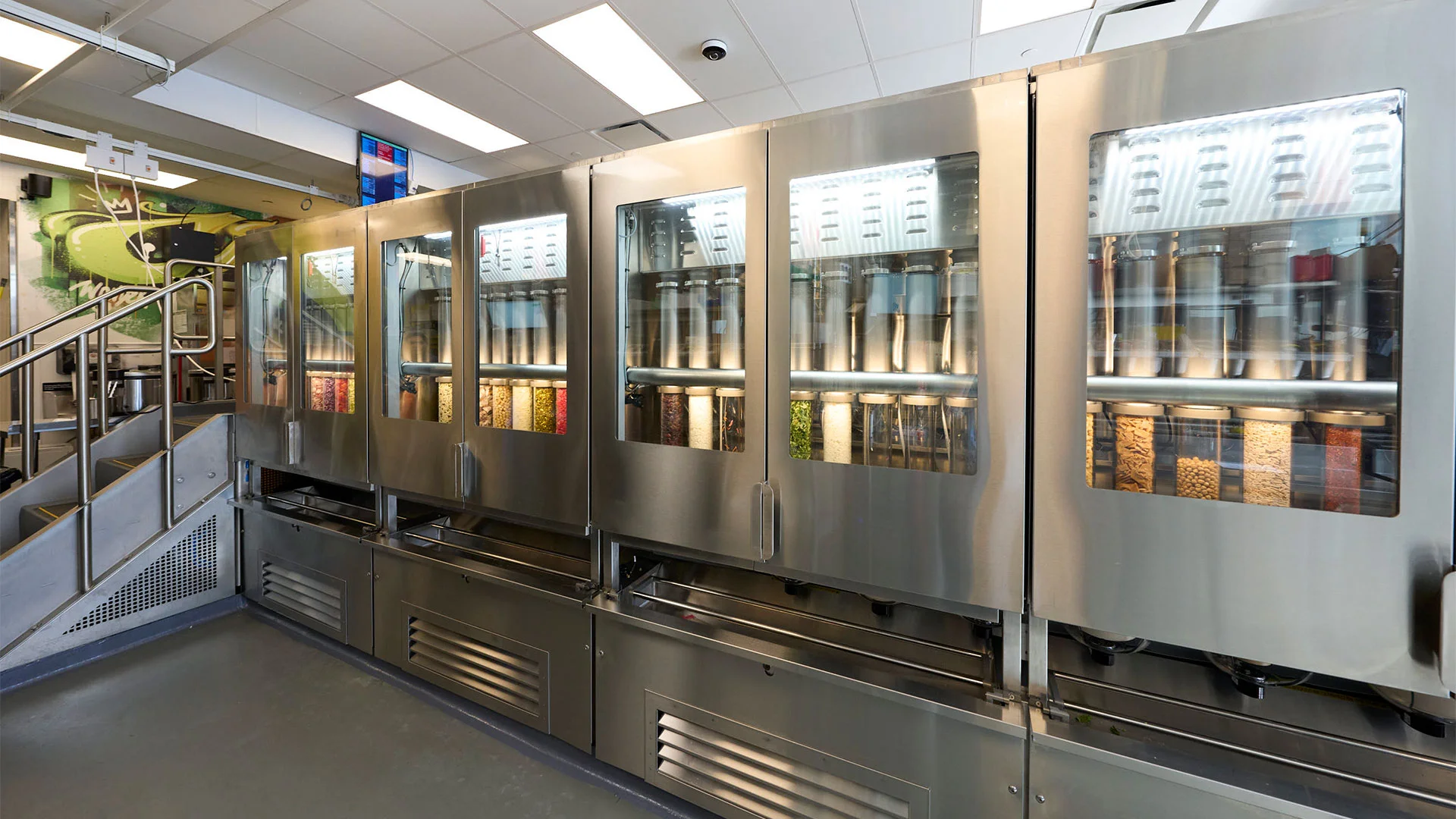
Wonder is a New York-based food-technology platform that has raised more than $3 billion since 2021, most recently a $650 million Series D at a $9 billion pre-money valuation 91417. Its chief executive, Marc Lore, has said publicly that the company will be ready to go public in early 2027 10. In September 2026 it deployed its first Infinite Makeline, an automated bowl-assembly system, in Midtown East, Manhattan, and announced a $425 million partnership with DoorDash comprising a $300 million acquisition of Grubhub Campus Dining and a $125 million investment 67811.
The central analytical question is not whether Wonder can raise money. It demonstrably can. The question is whether the automation story that underpins the valuation is supported by evidence of autonomous operation, and on the material available as of this report's coverage date, it is not.
VERIFIED FACT. Wonder operates 140 to 150-plus retail locations across ten Eastern states and Washington, D.C. 61214. It has raised $650 million at a $9 billion pre-money valuation 914. It cut 150 jobs, roughly 7 per cent of its workforce, explicitly to fund investment in robotics and automation 13. It acquired the Infinite Makeline technology from Sweetgreen 11. It has installed one unit, in Manhattan 611.
COMPANY CLAIM. The Infinite Makeline is described in vendor and press materials as a "fully autonomous food system" capable of producing up to 500 bowls per hour from 68 ingredients across six concepts, with an average order-to-ready time under three minutes, and as an "autonomous kitchen" that can operate "without any human involvement" 61112.
UNKNOWN. Whether the Infinite Makeline performs its task without a human performing or remotely driving it. No independent teardown, third-party review or first-hand operator account appears in the dossier. The autonomy verdict for this report is therefore unknown, at a confidence of 0.3. The vendor claim is noted and is not treated as established.
EDITORIAL INFERENCE. The gap between the autonomy claim and the evidence base is the single most important fact about Wonder as an automation company. A single installed unit, described in press materials rather than in operator data, cannot support a claim of full autonomy, and the company's own rollout timeline (tens of locations in the Northeast, Texas and the D.C. metro planned for 2027) is consistent with a pilot rather than a proven production system 612. The layoffs and the DoorDash capital are best read as a company converting a delivery-and-kitchen-footprint business into an automation business, funded by equity and strategic capital, at a stage where the automation itself is unproven at scale.
The bear case writes itself: a company that has raised $3 billion, cut staff to fund robots, installed one of them, and is asking public-market investors to underwrite the story within roughly six months. The bull case is equally coherent: a founder with a track record, a genuinely large capital base, a distribution partnership that solves the demand side, and a technology acquired rather than invented, which shortens the development cycle. Both cases rest on the same unresolved variable, which is whether the machine works unsupervised at rate. Nothing in the public record settles it.
Latest news
02The Wonder Story
Wonder's corporate history is a story of repeated repositioning, and the repositioning is the point. Each phase has been funded on the strength of the next phase's promise, and the current phase, kitchen automation, is the first in which the company's valuation depends on a hardware claim rather than a logistics or brand claim.
The company began as a delivery-first food business, operating a fleet of mobile kitchens that prepared multiple restaurant brands' menus and delivered them to customers' doors. That model required capital for vehicles, commissary space and drivers, and it produced the unit-economics problem that has defined food delivery for a decade: the last mile is expensive, and the customer's willingness to pay for it is finite. Wonder's answer, over successive rounds, was to move the kitchen closer to the customer and to consolidate more of the preparation into a single physical asset.
By 2026 the company had accumulated 140 to 150-plus retail locations across ten Eastern states and Washington, D.C. 61214. That footprint is the substrate on which the automation story is built. It is also, on any reading, a substantial fixed-cost base: leases, labour, utilities and the operational overhead of running a multi-site food business. The Series D, at $650 million and a $9 billion pre-money valuation, was raised against the proposition that this footprint can be made dramatically more productive per unit of labour 91417.
VERIFIED FACT. In September 2026, Wonder announced a $425 million partnership with DoorDash. The structure, as reported by multiple independent outlets, comprises a $300 million acquisition of Grubhub Campus Dining and a $125 million investment by DoorDash into Wonder 78. Separately, the company cut 150 jobs, approximately 7 per cent of its workforce, with the New York Post reporting the reduction as explicitly tied to investment in robotics 13.
EDITORIAL INFERENCE. Read together, these two events describe a company reallocating capital from labour to automation and simultaneously buying distribution. The DoorDash transaction is best understood not as a customer win but as a strategic alignment: DoorDash gains exposure to Wonder's campus and institutional channel, and Wonder gains both capital and a demand pipe. That is a rational structure for a company that needs volume to justify automation, because an automated line with no orders is a depreciating asset. It is also a structure in which the "partnership" language should not be read as evidence of a paid customer relationship in the ordinary sense. The dossier does not establish the commercial terms beyond the headline figures, and this report does not infer them.
The acquisition of the Infinite Makeline technology from Sweetgreen is the pivotal event in the current narrative 11. VERIFIED FACT, at moderate confidence: USA Times 247 reports that Wonder acquired the technology from Sweetgreen. EDITORIAL INFERENCE. Acquiring rather than developing the core automation is a materially different risk profile from building it in-house. It compresses the timeline to a first installation, which is what Wonder achieved in Manhattan. It also means the company inherits whatever design assumptions, maintenance requirements and failure modes the original developer built in, and it means the institutional knowledge required to iterate on the system may be thinner than a from-scratch programme would have produced. Whether Wonder has retained the engineering team that built the system is UNKNOWN from the public record.
The IPO target of early 2027, stated by Lore and reported by Fortune, sets a hard clock 10. EDITORIAL INFERENCE. A company that intends to list within roughly six months of this report's coverage date has a strong incentive to present its automation as further along than a single installation would suggest, and a correspondingly strong incentive to announce rollout plans that are ambitious relative to demonstrated capability. The 2027 rollout to tens of locations in the Northeast, Texas and the D.C. metro should be read in that light: it is a plan, not a record 612.
What the story does not yet contain is a single independent account of the machine working. That absence is not proof that it does not work. It is proof that the public record cannot tell you either way, and a report that claimed otherwise would be doing the reader a disservice.
03Product Portfolio: What Wonder Actually Sells
Wonder's product portfolio has two layers, and conflating them is the most common error in coverage of the company. The first layer is food: a multi-concept menu sold through physical locations and delivery channels. The second layer is the machinery that assembles that food. The company's valuation narrative depends on the second layer, but its revenue today comes from the first.
VERIFIED FACT. Wonder operates 140 to 150-plus retail locations across ten Eastern states and Washington, D.C. 61214. The Infinite Makeline, its automated bowl-assembly system, has been installed at one site, in Midtown East, Manhattan 611. The company has stated plans to roll the system out to tens of locations in the Northeast, Texas and the D.C. metro during 2027 612.
COMPANY CLAIM. The Infinite Makeline is specified as producing up to 500 bowls per hour from 68 ingredients, supporting six concepts, with an average order-to-ready time under three minutes 61112. It is described as a "fully autonomous food system" and an "autonomous kitchen" capable of operating "without any human involvement" 61112.
| Attribute | Company claim | Independent verification in dossier | Status |
|---|---|---|---|
| Throughput | Up to 500 bowls/hour | None | COMPANY CLAIM |
| Ingredient range | 68 ingredients | None | COMPANY CLAIM |
| Concept coverage | Six concepts | None | COMPANY CLAIM |
| Order-to-ready time | Under three minutes average | None | COMPANY CLAIM |
| Autonomy | "Fully autonomous"; "without any human involvement" | None; no teardown, review or operator account | COMPANY CLAIM, uncorroborated |
| Installed base | One unit, Midtown East, Manhattan | Multiple outlets report the same installation | VERIFIED FACT |
| Rollout plan | Tens of locations, 2027 | None; forward-looking | COMPANY CLAIM |
| Technology origin | Acquired from Sweetgreen | Single-source report | VERIFIED FACT (moderate confidence) |
The table is the argument. Every performance figure that would allow an operator or investor to assess the system is a company claim with no independent corroboration in the dossier. The only verified facts are the installation and the acquisition, neither of which speaks to performance.
EDITORIAL INFERENCE. The specification set is internally coherent and plausible for a bowl-assembly line. Bowl assembly is a constrained problem: a fixed set of ingredients, dispensed into a fixed set of container geometries, in a fixed sequence. It is meaningfully easier to automate than, say, a general-purpose grill line, and a throughput figure in the hundreds per hour is not extraordinary for a well-engineered dispensing system. The claim that requires the most scrutiny is not the throughput. It is the autonomy. A line that dispenses ingredients on command is automation. A line that plans, sequences, recovers from faults and completes orders without a human performing or remotely driving the task is autonomy, and the two are routinely conflated in vendor materials.
UNKNOWN. The dossier does not disclose the system's intervention rate, uptime, maintenance interval, cleaning cycle, changeover time between concepts, capital cost per unit, or the labour complement required to run it. These are the numbers that determine whether the Infinite Makeline is a productivity tool or a demonstration. Their absence from the public record is not accidental; they are the numbers a company preparing for an IPO would prefer to disclose on its own schedule, in its own framing, with its own definitions.
The food layer of the portfolio deserves a brief note because it bears on the automation story's credibility. Community sentiment in the dossier is negative, and the criticism is specific: that Wonder "basically just reheats food" 2830. EDITORIAL INFERENCE. This is a food-quality complaint, not an autonomy complaint, and the two should not be merged. But it matters for the automation thesis in one respect. If the customer proposition is convenience rather than quality, then the automation is competing on cost and speed, which is exactly where a 500-bowl-per-hour line would earn its keep. If the proposition is quality, automation is a harder sell, because the perception of reheated food is difficult to reverse with a faster line. The dossier does not establish which proposition Wonder is actually selling, and the company's own multi-concept framing suggests it is hedging.
Products & versions

04Technology Stack: Strengths and the Work That Remains
The public record on Wonder's technology stack is thin, and this section is correspondingly shorter than the subject warrants. That is a finding, not a gap in the research. A company preparing to list within six months has disclosed almost nothing technical about its core automation asset beyond a specification sheet and a claim of autonomy.
VERIFIED FACT. The Infinite Makeline technology was acquired from Sweetgreen 11. The system is installed at one location 611. It assembles bowls from a defined ingredient set 61112.
COMPANY CLAIM. The system is fully autonomous, requires no human involvement, and can plan, produce and deliver personalised meals at scale 61112.
UNKNOWN. The following are not publicly disclosed in the dossier: the sensing modality used to verify ingredient placement; the manipulation architecture (dedicated dispensers versus general-purpose arms); the control stack and whether it uses learned policies or classical sequencing; the fault-detection and recovery logic; the human-machine interface and the escalation path when the system cannot complete an order; the cleaning and food-safety regime; the maintenance model and spare-parts logistics; the software layer that sequences orders across concepts; and the data infrastructure that would allow the company to measure and improve intervention rates over time.
EDITORIAL INFERENCE. The distinction between dedicated dispensers and general-purpose manipulation is the most consequential unknown in this section, and it is worth explaining why. A bowl-assembly line built from dedicated dispensers, one per ingredient or per ingredient class, is a sequencing problem. It can be made reliable with conventional engineering, and its failure modes are predictable: a dispenser jams, a hopper runs empty, a container misaligns. A line built from general-purpose robotic arms attempting dexterous manipulation is a perception-and-control problem, and it is substantially harder. The 68-ingredient figure is suggestive: 68 dedicated dispensers would be an unusually large and capital-intensive installation, while 68 ingredients handled by a small number of general-purpose arms would be a much harder technical achievement. The dossier does not say which architecture is used, and the throughput claim alone does not disambiguate it.
The autonomy claim, in particular, cannot be assessed without knowing the escalation path. Every deployed food-automation system in commercial operation today has some form of human fallback, whether that is a line cook who intervenes when a dispenser faults or a remote operator who takes over an exception. The existence of a fallback does not make the system non-autonomous in a useful engineering sense; the question is the rate at which the fallback is invoked and whether it is invoked for the routine case or only for genuine exceptions. UNKNOWN. The dossier contains no intervention-rate data, and no independent observer has reported one.
EDITORIAL INFERENCE. The layoffs are informative here, and not in the direction the company's framing suggests. Cutting 150 roles, roughly 7 per cent of the workforce, to invest in robotics is consistent with a company that believes the automation reduces labour requirements 13. It is also consistent with a company that needs to fund a capital-intensive automation programme out of operating expense, which is what a layoff-to-invest announcement usually means in practice. The two readings are not mutually exclusive, and the public record does not distinguish between them.
A final note on the technology's provenance. Acquiring the Infinite Makeline from Sweetgreen gives Wonder a system that has presumably been through some development and testing at the original owner. EDITORIAL INFERENCE. It does not give Wonder the same depth of institutional knowledge that Sweetgreen would have accumulated, unless key personnel transferred, which is UNKNOWN. For a company whose valuation rests on iterating this system across 150 sites, the depth of the engineering bench is a material question, and it is one the public record does not answer.
05Research, Papers, Authors and Labs
This section requires an explicit warning, because the name collision that runs through the dossier is at its most dangerous here.
The dossier contains four research papers on robotics and world models, all of which are relevant to the broader field in which Wonder operates and none of which are, on the evidence available, affiliated with the Wonder food-technology company 18192021. They are included in this report because they define the technical state of the art against which any autonomy claim should be assessed, and because a reader monitoring this space will encounter them under the same search term. They should not be attributed to the company.
VERIFIED FACT (as research artefacts, not as company output). The "Wonder" video world model is described in an arXiv paper as a general-purpose video world model for real-time, camera-controllable world exploration, synthesising minute-scale video at 16 frames per second, with video-conditioned generation and a sparse attention-based memory mechanism for selective context-token attention at inference 18. "Wonderful Team" is described as a multi-agent VLLM framework for zero-shot high-level robotic planning, reporting a 40 per cent improvement on VimaBench, 30 per cent over trajectory generators, and 70 per cent on semantic reasoning tasks 19. "BWM" is described as an open-source, low-cost, high-fidelity world simulator for robot manipulation, an action-conditioned autoregressive world model usable as a data engine and policy evaluator, which placed first overall in the WorldArena Challenge 20. "RealWonder" is described as the first real-time system for action-conditioned video generation from a single image, running at 13.2 frames per second at 480x832, integrating 3D reconstruction, physics simulation and a four-step distilled generator 21.
| Paper | Claimed capability | Reported metric | Relevance to Wonder (food-tech) |
|---|---|---|---|
| Wonder: Video World Model Done Better 18 | Real-time camera-controllable world model | 16 FPS, minute-scale synthesis | None established; name collision only |
| Wonderful Team 19 | Zero-shot high-level robotic planning | +40% VimaBench; +70% semantic reasoning | None established; adjacent field |
| BWM 20 | Robot manipulation world simulator | First overall, WorldArena Challenge | None established; adjacent field |
| RealWonder 21 | Real-time action-conditioned video generation | 13.2 FPS at 480x832 | None established; adjacent field |
EDITORIAL INFERENCE. The relevance of these papers to Wonder's automation claim is indirect but not zero. They establish that the research community is actively working on world models, action-conditioned generation and zero-shot planning, and that the state of the art in those areas is advancing quickly. They do not establish that any of that work is deployed in a commercial kitchen, and there is no evidence in the dossier that Wonder's Infinite Makeline uses any of it. A reader who encounters "Wonder" and "world model" in the same search result should treat the proximity as coincidence until proven otherwise.
UNKNOWN. Whether Wonder employs research staff, publishes technical work, holds patents on the Infinite Makeline, or has any relationship to the academic groups behind the papers above. The dossier contains no company-authored research, no patent filings, and no named technical leadership. For a company whose valuation rests on a hardware-and-software claim, the absence of any published technical work is notable, though not disqualifying: many successful industrial automation companies publish nothing.
<!-- module: papers --> <!-- module: authors-labs --> <!-- module: repos --> <!-- module: datasets -->06Media Evidence Library: What the Videos Prove
The dossier's video evidence is almost entirely about a Nintendo game, which is a useful illustration of the name-collision problem and a reminder of how little visual evidence exists for the thing this report is actually about.
VERIFIED FACT. The dossier contains six video sources, all of which concern Super Mario Bros. Wonder: a gameplay-and-impressions video 22, GameStop demo footage 23, a review 24, fifteen minutes of solo gameplay from Nintendo Live 25, a Digital Foundry technical review 26, and a review essay on the game's design 27. These are legitimate sources about a Nintendo product. They are not evidence about the Wonder food-technology company, and no video of the Infinite Makeline appears in the dossier.
EDITORIAL INFERENCE. The absence of video evidence for the Infinite Makeline is itself informative, though it should not be over-read. Companies at this stage typically control their own imagery, and a single installation in a Manhattan location is easy to film under controlled conditions. The fact that the dossier contains no such footage, and no independent footage, means the visual record of the system's operation is effectively empty. A reader who wants to assess the autonomy claim has nothing to look at.
This is where the report's first discipline applies most sharply. Even if a video of the Infinite Makeline existed, and even if it showed bowls being assembled without a visible human, it would not establish autonomy. A demonstration video is a record of a machine completing a task under conditions chosen by the party publishing the video. It does not establish the intervention rate, the uptime, the performance across a full shift, or the behaviour under fault conditions. The correct evidentiary standard for an autonomy claim is sustained independent observation or operator-reported production data, and neither exists in the dossier.
UNKNOWN. Whether Wonder has published demonstration footage of the Infinite Makeline, and if so, under what conditions it was captured. The dossier does not include any.
Media library
07Commercial Reality
This section separates what Wonder has actually sold from what it has announced, and the separation is stark.
VERIFIED FACT. Wonder operates 140 to 150-plus retail locations across ten Eastern states and Washington, D.C. 61214. It has raised $650 million at a $9 billion pre-money valuation, bringing total funding since 2021 above $3 billion 91417. It has a $425 million partnership with DoorDash, structured as a $300 million acquisition of Grubhub Campus Dining and a $125 million investment 78. It cut 150 jobs, roughly 7 per cent of its workforce, tied to robotics investment 13. It acquired the Infinite Makeline technology from Sweetgreen 11. It has installed one unit 611.
COMPANY CLAIM. That the Infinite Makeline is fully autonomous and can operate without human involvement 61112. That the company will be ready to go public in early 2027 10. That the system will roll out to tens of locations in 2027 612.
EDITORIAL INFERENCE. The commercial reality is that Wonder is a multi-site food business with a substantial capital base, a strategic distribution partner, and one installed automation unit. Its revenue comes from food. Its valuation comes from the automation narrative. The DoorDash transaction is the clearest signal in the dossier about how the company intends to bridge the two: by buying distribution at scale so that the automation has volume to process. That is a coherent strategy, and it is also a strategy that front-loads cost and defers the proof point. The proof point is whether the Infinite Makeline reduces the labour cost per bowl at a rate that justifies its capital cost, and that number is UNKNOWN.
The layoff deserves a second look in this section because it is the most concrete evidence of the company's own beliefs. VERIFIED FACT. 150 roles, approximately 7 per cent of the workforce, cut to invest in robotics 13. EDITORIAL INFERENCE. A company does not cut 7 per cent of its staff to fund a research programme it is uncertain about. The layoff is a revealed preference: Wonder's leadership believes the automation is the path to margin, and is willing to pay for it out of headcount. That is a meaningful signal in the company's favour. It is not, however, evidence that the automation works, and the two should not be confused.
UNKNOWN. The unit economics of the Infinite Makeline: capital cost per unit, installation cost, maintenance cost, labour complement required, throughput in production, uptime, and the payback period. Also unknown: the commercial terms of the DoorDash arrangement beyond the headline figures, the identity of any paying customers for the automation itself (as distinct from Wonder's food), and whether the company has any external sales channel for the Infinite Makeline as a product. On the evidence in the dossier, Wonder is deploying the system in its own estate, not selling it to third parties, which makes it an operator rather than a vendor.
That distinction matters for the IPO. EDITORIAL INFERENCE. A company that sells automation to other operators has a software-like margin story and a scalable revenue line. A company that uses automation internally has a cost-reduction story, which is real but bounded by the size of its own estate. Wonder's 150-site footprint caps the internal benefit unless the company either expands the estate substantially or begins selling the system. The dossier contains no evidence of the latter, and the 2027 rollout plan is framed as internal deployment 612. A public-market investor buying the automation narrative should understand which of the two businesses they are buying.
Customers & deployments
DoorDash partnership worth $425M, comprising a $300M acquisition of Grubhub Campus Dining plus a $125M investment in Wonder.
Sections 8 through 14 continue in the second part of this report.
08Markets and Use Cases
Wonder's addressable market is not, in the first instance, the robotics market. It is the American fast-casual and delivery-first restaurant market, and the Infinite Makeline is a capital instrument deployed inside that market rather than a product sold into it. This distinction matters for anyone reading the company through a robotics lens: Wonder is not a vendor of kitchen automation to third parties, at least not on the public evidence. It is a vertically integrated food platform that has chosen to automate its own production. The technology is a cost input, not a revenue line.
That framing constrains the use cases that are actually in play.
8.1 The core use case: multi-concept delivery from a single kitchen
Wonder's operating model, as described across the funding and deployment coverage, is a single physical kitchen producing food under multiple brand concepts, delivered to homes and offices 71217. The Infinite Makeline is the production layer for that model: up to 500 bowls per hour drawn from 68 ingredients, supporting six concepts, with an average order-to-ready time under three minutes 611.
The economic logic is straightforward and, on its face, coherent. A conventional multi-brand delivery kitchen carries the fixed cost of separate prep lines, separate staff allocations and separate equipment for each cuisine. A single automated line that can switch between concepts by reconfiguring ingredient selection collapses that fixed cost. The 68-ingredient pantry is the mechanism: breadth of ingredient inventory substitutes for breadth of production lines.
Whether that logic survives contact with real order mixes is a separate question. The claim of six concepts from one line is a COMPANY CLAIM sourced to press materials 611. No independent operator account in the dossier describes how concept switching performs during a peak dinner rush, how often the line is reconfigured, or what the changeover cost is in time and waste.
8.2 Where the units actually are
The deployment footprint is the most concrete thing in the dossier and it is worth stating precisely, because the headline numbers are easy to conflate.
| Metric | Figure | Evidence status |
|---|---|---|
| Retail locations | 140–150+ | Multiple independent news sources 71214 |
| States covered | 10 Eastern states plus Washington, D.C. | Multiple independent news sources 712 |
| Infinite Makeline units installed | One (Midtown East, Manhattan) | Restaurant Dive, USA Times 247 611 |
| Planned 2027 rollout | "Tens of locations" across Northeast, Texas, D.C. metro | News reporting on company plans 612 |
The gap between 140–150 retail locations and one automated makeline is the single most important structural fact about Wonder's robotics story. The overwhelming majority of Wonder's footprint is conventional kitchen operation. The automation programme is at the stage of a single flagship installation. Any reading of Wonder as "a robotics company with 150 sites" inverts the actual ratio, which is closer to "a 150-site food company with one robot line."
This is not a criticism of the strategy. Flagship-first deployment is a normal and often sensible path for capital-intensive kitchen automation, and the Midtown East site is a plausible choice for a first unit given order density and the value of a visible Manhattan proof point 6. But it does mean that the automation thesis is, as of the coverage date, almost entirely prospective.
8.3 Use cases that are plausible but unevidenced
Several adjacent use cases follow naturally from the technology description but have no supporting evidence in the dossier. They are listed here as EDITORIAL INFERENCE about where the model could go, explicitly not as things Wonder has announced or demonstrated.
Licensing the makeline to third-party operators. Wonder acquired the technology from Sweetgreen 11, which raises the obvious question of whether the line could be sold or leased back into the restaurant industry. No source in the dossier indicates any such plan. If Wonder's intent were purely internal, the Sweetgreen acquisition would be an unusually expensive way to equip one Manhattan site.
Campus and institutional dining. The DoorDash transaction included a $300M acquisition of Grubhub Campus Dining alongside a $125M investment 78. Campus dining is a high-volume, narrow-menu, predictable-demand environment, which is close to the ideal operating envelope for an automated assembly line. This is the most commercially interesting adjacency in the dossier and it is also the least documented. No source states that the makeline is intended for campus deployment.
Non-bowl formats. The vendor claim that the system can produce "pizza, burgers, chicken, and seafood without any human involvement" 12 implies a much wider format range than the bowl-assembly description supports 611. These two claims sit awkwardly together and are discussed further in §11.
8.4 Market sizing caveat
The dossier contains no market sizing data, no unit economics, no cost-per-bowl figures, no labour-cost comparison, and no throughput-versus-demand analysis. Any statement about the size of Wonder's addressable market or the payback period on a makeline unit would require inventing numbers. Not publicly disclosed.
09Competitive Landscape
Wonder competes in at least three distinct arenas, and the competitive dynamics in each are different. Conflating them produces confused analysis, so they are separated here.
9.1 Arena one: delivery-first multi-concept food
This is Wonder's primary commercial battlefield. The model, a single kitchen producing multiple branded concepts for delivery, places Wonder against the broader ghost-kitchen and virtual-brand sector, and against vertically integrated delivery platforms. The dossier does not name specific competitors in this arena, and no comparative data on Wonder's performance against them is present. Not publicly disclosed.
What the dossier does establish is that Wonder has bought its way into a distribution position. The DoorDash partnership, valued at $425M and comprising a $300M acquisition of Grubhub Campus Dining plus a $125M DoorDash investment 78, is a distribution and demand-access transaction as much as a financial one. The strategic logic is that owning campus dining capacity gives Wonder a captive, high-frequency demand pool.
9.2 Arena two: kitchen automation
Here the comparison set is other automated food-production systems. The dossier contains no competitor names, no comparative throughput data, and no pricing for any alternative system. This is a genuine gap. A reader wanting to know whether 500 bowls per hour from 68 ingredients is leading, average or trailing for automated bowl assembly will not find the answer in the supplied evidence.
What can be said is that the specification set is specific enough to be falsifiable. 500 bowls/hour, 68 ingredients, six concepts, sub-three-minute order-to-ready 611 are the kind of numbers that can be checked against a real installation. That is a point in the company's favour as a matter of disclosure hygiene, even though the numbers themselves remain unverified.
9.3 Arena three: the name collision
The dossier's most unusual feature is that "Wonder" resolves to at least six unrelated entities 124518. For competitive and market-analysis purposes this is a real operational problem, not a curiosity. Search visibility, brand attribution, analyst coverage and even automated data collection all degrade when a company name is this heavily overloaded.
| Entity | Domain | Relationship to Wonder (food-tech) |
|---|---|---|
| Wonder (food-tech) | Restaurant automation and delivery | The subject of this report |
| Wonder (video world model) | Generative video research | None; name collision 18 |
| Super Mario Bros. Wonder | Nintendo game | None; name collision 5222324252627 |
| The Wonder Weeks | Parenting app | None; name collision 13 |
| Nutrien Wonderhub | Children's museum, Saskatoon | None; name collision 4 |
| Wonder Project | Prime Video streaming service | None; name collision 2 |
The practical consequence is that any monitoring programme tracking "Wonder" by keyword will be dominated by noise. Section 13 addresses this directly.
9.4 Competitive position: an honest read
EDITORIAL INFERENCE. Wonder's defensible position, on the public evidence, is not the robot. It is the combination of capital, distribution and a single automated production asset. The robot is replicable in principle; the DoorDash relationship and the campus dining footprint are considerably harder to replicate. If the automation thesis fails, Wonder remains a delivery platform with a large balance sheet. If the automation thesis succeeds, the distribution assets are what let it scale.
The weakness in the position is that the automation claim is doing a great deal of valuation work while resting on one installed unit and vendor-supplied performance figures. That is a thin evidentiary base for a $9B pre-money valuation 91014.
10Geopolitical Context and Constraints
The dossier contains no material on Wonder's supply chain geography, manufacturing partners, export controls, data residency, or regulatory exposure outside the United States. This section is therefore short by necessity rather than by editorial choice, and the honest position is to say so plainly.
10.1 What the evidence does support
Jurisdictional concentration. Wonder operates in 10 Eastern states plus Washington, D.C., with planned expansion into the Northeast, Texas and the D.C. metro 712. This is a single-country operation. There is no evidence of international deployment, international revenue, or international regulatory engagement. Not publicly disclosed.
Domestic capital. The funding stack is domestic: a $650M Series D at a $9B pre-money valuation, $3B+ raised since 2021, and the DoorDash transaction 7891014. No sovereign wealth fund, no non-US strategic investor, and no cross-border investment review exposure is identified in the dossier.
Labour politics. The 150-job reduction, described as 7% of the workforce and explicitly tied to robotics investment 13, places Wonder inside the broader American automation-and-labour debate. This is a domestic political exposure rather than a geopolitical one, but it is the most politically salient fact in the dossier. A company that cuts 150 roles to fund robots while raising at a $9B valuation has handed its critics a clean narrative.
10.2 What cannot be assessed
Supply chain origin for the makeline's components, including any robotics hardware, sensors or compute, is not disclosed. Given the current policy environment around robotics and semiconductor supply chains, this is a material omission for any serious risk assessment. It is not evidence of a problem; it is an absence of evidence either way.
Data governance is similarly opaque. A delivery platform operating across 10 states plus D.C. handles customer data at scale, and the Grubhub Campus Dining acquisition 7 brings institutional and potentially student data into scope. No source in the dossier addresses privacy posture, data residency or compliance framework.
10.3 The honest summary
Geopolitical analysis of Wonder is not possible on the supplied evidence. The company is domestically concentrated, domestically funded and domestically deployed, which reduces obvious geopolitical exposure but does not eliminate supply chain and data questions that the dossier simply does not answer. Not publicly disclosed.
11The Hype, the Real and the Ugly
This section separates what is demonstrated from what is asserted from what is contradicted. The discipline applied throughout: a choreographed demonstration is not proof of autonomous work, a shipment is not proof of productive deployment, and a partnership announcement is not proof of a paid customer.
11.1 The Hype
"Fully autonomous." The vendor claim is that the Infinite Makeline is a "fully autonomous food system that can plan, produce and deliver personalized meals at scale" and an "autonomous kitchen that can whip up pizza, burgers, chicken, and seafood without any human involvement" 12. This is the strongest claim in the dossier and the least supported.
"500 bowls per hour." A precise, checkable, vendor-sourced figure 611. Precision is not verification, but it is at least a claim that can be tested.
"Six concepts, 68 ingredients." Also vendor-sourced 611. The concept count and ingredient count are the kind of operational detail that tends to come from real system design rather than marketing invention, which is mildly reassuring without being proof.
The $9B valuation. Reported consistently across multiple independent outlets 91014, so the number itself is well-sourced. Whether it is justified is a separate question and not one this report can settle.
11.2 The Real
The funding is real. $650M at a $9B pre-money valuation, $3B+ raised since 2021, and a $425M DoorDash transaction are reported by multiple independent sources with consistent figures 7891014. This is VERIFIED to the standard of multiple independent reporting.
The deployment footprint is real. 140–150+ locations across 10 states plus D.C. is consistently reported 71214.
The layoffs are real and explicitly linked to automation. 150 roles, 7% of workforce, tied to robotics investment 13.
The first makeline is installed. One unit, Midtown East, Manhattan 611.
The technology has a provenance. Acquired from Sweetgreen 11. This is a single-source claim and should be treated as COMPANY CLAIM rather than established fact, but it is a specific and checkable assertion.
11.3 The Ugly
Autonomy is unverified. The reconciled autonomy verdict is unknown at 0.3 confidence. No independent teardown, no third-party review, no first-hand operator report exists in the dossier. The vendor says "without any human involvement" 12; nothing independent corroborates it. Under a strict definition, autonomous means the system completes the task with no human performing or remotely driving it, and that specific evidence is absent.
Customer sentiment is negative, and about the food. Reddit threads include "Wonder sucks and is the bane of my existence" 28 and "Does anyone actually use Wonder?" 30, with the recurring criticism that Wonder "basically just reheats food" 2830. This is community sentiment at 0.7 confidence and should be weighted accordingly, but it is the only demand-side evidence in the dossier and it is not favourable.
The format claims do not reconcile. Bowl assembly 611 and "pizza, burgers, chicken, and seafood" 12 describe different machines. One of these claims is loose language. The dossier does not resolve which.
One unit is not a rollout. The gap between one installed makeline and a 2027 plan for "tens of locations" 612 is where the execution risk lives.
11.4 Claim-versus-evidence table
| Claim | Source type | Independent corroboration | Verdict |
|---|---|---|---|
| Fully autonomous, no human involvement | Vendor/press 12 | None in dossier | Unverified |
| 500 bowls/hour, 68 ingredients, 6 concepts | Vendor/press 611 | None in dossier | Unverified |
| Sub-3-minute order-to-ready | Vendor/press 611 | None in dossier | Unverified |
| Technology acquired from Sweetgreen | Single news source 11 | None | Company claim |
| 140–150+ locations, 10 states + D.C. | Multiple news 71214 | Consistent across outlets | Verified |
| $650M Series D, $9B pre-money | Multiple news 91014 | Consistent across outlets | Verified |
| $425M DoorDash partnership | Multiple news 78 | Consistent across outlets | Verified |
| 150 jobs cut for robotics | News 13 | Single outlet | Reported |
| IPO targeted early 2027 | Fortune, Marc Lore quote 10 | Single outlet | Company claim |
| Food quality criticism | Community 2830 | Multiple threads | Community sentiment |
11.5 The name-collision problem as a hype vector
One underappreciated issue: the "Wonder" name is shared with a Nintendo game 5, a video world-model research project 18, a parenting app 13, a children's museum 4 and a streaming service 2. Search and social monitoring for "Wonder" returns a large volume of positive sentiment that has nothing to do with the food company. Any brand-health metric that does not disambiguate is measuring the wrong thing.
Claim tracker
Only vendor/press materials assert full autonomy; the dossier contains no independent teardown, third-party review, or first-hand operator report confirming the system runs without a human performing or remotely driving the task, and the sole community evidence concerns food quality/reheating, not autonomy.
These throughput, ingredient-count and speed figures appear only in press-derived reports (Restaurant Dive, USATimes247) with no independent measurement, customer confirmation, or operator data in the dossier.
The location counts come from news coverage of company announcements, but the dossier shows only one Infinite Makeline actually installed (Midtown East, Manhattan) with broader rollout planned for 2027, so the deployment scale is vendor-sourced and unverified.
Only USATimes247 reports the Sweetgreen origin, with no confirmation from Sweetgreen, Wonder, or a regulatory filing in the dossier.
The New York Post, an independent news outlet, reports the layoffs explicitly tied to robotics investment, though the company's own framing of the robotics rationale remains unverified.
Multiple independent outlets (TechCrunch, NRN, Fortune, Restaurant Dive) consistently report the same funding and partnership figures, though the strategic value of the DoorDash deal remains to be demonstrated.
Fortune reports Marc Lore's statement about IPO readiness, but no SEC filing, underwriter confirmation, or independent verification of the timeline exists in the dossier.
Reddit community posts express dissatisfaction with food quality and reheating, but these are anecdotal user opinions rather than systematic independent testing or representative customer data.
12Future Scenarios
Four scenarios, with explicit reasoning and explicit falsifiers. Probabilities are EDITORIAL INFERENCE and should be read as rough weights, not forecasts.
Scenario A: The rollout lands (roughly 30%)
The 2027 plan to deploy makelines across tens of locations in the Northeast, Texas and the D.C. metro 612 proceeds broadly on schedule. Unit economics at the Midtown East site prove out, the concept-switching capability holds under real order mixes, and the campus dining footprint acquired through the DoorDash transaction 7 provides a high-volume, narrow-menu beachhead. The IPO targeted for early 2027 10 proceeds on the back of an automation narrative that now has multiple operating sites behind it.
What would confirm this: more than one installed makeline; named site-level throughput data; a second and third city with operating units; an S-1 that discloses automation unit economics.
What would falsify this: rollout slips past 2027; the Midtown East unit is quietly de-emphasised; the IPO is framed on delivery volume rather than automation.
Scenario B: Automation stalls, delivery business persists (roughly 40%)
The most likely single outcome. The makeline remains a small number of flagship installations. Wonder continues as a delivery and campus dining platform with a large balance sheet, and the automation programme becomes a permanent pilot rather than a scaled capability. The IPO still happens, but the equity story is distribution and brand portfolio, not robotics.
This scenario is favoured by the current evidence ratio: 140–150 locations, one automated unit 6712. It requires no failure, only inertia.
What would confirm this: no new makeline announcements through 2027; continued funding rounds framed on footprint rather than technology; automation absent from IPO communications.
What would falsify this: a credible multi-site automation announcement with independent verification.
Scenario C: Autonomy claim collapses under scrutiny (roughly 20%)
An independent teardown, a former operator, or a regulatory or journalistic investigation establishes that the Infinite Makeline requires meaningful human intervention, whether for loading, exception handling, cleaning or quality control. The "fully autonomous" framing 12 does not survive. The damage is to valuation narrative rather than to the underlying business, but at a $9B pre-money valuation 910 narrative damage is expensive.
This scenario is not a prediction of wrongdoing. It is the natural consequence of a strong claim resting on a single unverified installation. The gap between "autonomous" and "automated with human support" is where most kitchen robotics claims historically land.
What would confirm this: operator accounts describing intervention; teardown reporting; the company softening its language from "autonomous" to "automated."
What would falsify this: an independent site visit or third-party review confirming unattended operation.
Scenario D: Category shock (roughly 10%)
A sector-level event, whether a funding winter in food-tech, a shift in delivery economics, or a high-profile failure of a comparable automation programme, reprices the whole category. Wonder's $3B+ raised since 2021 79 becomes a liability rather than an advantage if the market turns.
What would confirm this: down rounds or shutdowns among comparable food-automation firms; delivery-platform margin compression; IPO postponement.
What would falsify this: continued capital availability at or above current valuations.
Scenario summary
| Scenario | Weight | Core mechanism | Primary falsifier |
|---|---|---|---|
| A: Rollout lands | ~30% | Multi-site deployment proves unit economics | Rollout slips past 2027 |
| B: Automation stalls | ~40% | Inertia; automation stays a pilot | Multi-site verified deployment |
| C: Autonomy claim collapses | ~20% | Independent scrutiny contradicts "no human involvement" | Independent confirmation of unattended operation |
| D: Category shock | ~10% | Sector repricing | Sustained capital availability |
13What to Watch: A Live Monitoring Checklist
A monitoring programme for Wonder has to solve two problems simultaneously: the evidence is thin, and the name is overloaded. The checklist below is ordered by signal value.
13.1 Disambiguation first
Any automated monitoring must filter out the five unrelated entities sharing the name. Concretely: exclude Nintendo/Switch/Mario terms 5222324252627, exclude the video world-model research literature 18192021, exclude parenting-app terms 13, exclude Saskatoon museum terms 4, and exclude Prime Video streaming terms 2. Without this filter, the signal-to-noise ratio is unusable.
13.2 Primary signals, ranked
1. Second makeline installation. The single highest-value signal. One unit is a pilot; two or more units in different cities is a programme. Watch for site-level announcements naming specific locations beyond Midtown East 6.
2. Independent verification of autonomy. Any third-party teardown, site visit, operator interview or trade-press walkthrough that describes the makeline operating without human intervention. This is the signal that would move the autonomy verdict from unknown to a supported level.
3. Site-level throughput data. Published or reported bowls-per-hour figures from an operating site, as distinct from the vendor specification 611. Actual versus claimed throughput is the cleanest test of the specification.
4. IPO filings. An S-1 or equivalent would force disclosure of automation unit economics, capital expenditure per site, and the real ratio of automated to conventional locations. This is the single document most likely to resolve the largest unknowns in this report 10.
5. Language drift. Watch whether the company's own descriptions shift from "fully autonomous" and "without any human involvement" 12 toward "automated" or "assisted." Softening language is itself a signal.
13.3 Secondary signals
6. Campus dining integration. Whether the Grubhub Campus Dining assets 7 become a deployment channel for the makeline. If they do, it is the strongest available evidence for the automation thesis.
7. Further workforce actions. Additional layoffs tied to automation 13 would indicate the programme is scaling; a hiring reversal in kitchen roles would indicate it is not.
8. Demand-side sentiment. Continued tracking of community sentiment 2830. The current criticism concerns food quality and reheating, not autonomy. A shift toward complaints about consistency, availability or order accuracy would be a different and more diagnostic signal about automated production.
9. Concept-switching evidence. Any reporting on how the six-concept capability 611 performs in practice, including changeover time and waste rates.
10. Format reconciliation. Whether the "pizza, burgers, chicken, and seafood" claim 12 is ever substantiated or quietly retired.
13.4 What would change this report's conclusions
| Finding | Effect on this report |
|---|---|
| Independent confirmation of unattended operation | Autonomy verdict moves from unknown to supported |
| Second and third makeline installations | Lifecycle status moves from pilot toward deployment |
| S-1 disclosure of automation economics | Resolves the largest evidence gaps in §7 and §12 |
| Reporting of human intervention in normal operation | Autonomy claim contradicted; Scenario C activated |
| No new installations by end-2027 | Scenario B confirmed; automation thesis weakened |
14Sources and Methodology
14.1 Methodology
This report was assembled from a supplied research dossier gathered on 18 September 2026. The dossier comprised 34 numbered sources across six categories: official (0), commerce (5), research (4), news (13), video (6) and community (6). No primary regulatory filings, no company financial statements, and no first-hand operator accounts were available.
Evidence labelling. Every factual assertion in this report is labelled as one of:
| Label | Definition | Treatment in this report |
|---|---|---|
| VERIFIED | Regulatory filings, official product documentation, named-customer confirmation, peer-reviewed or primary research, or multiple independent sources agreeing | Stated as fact |
| COMPANY CLAIM | Asserted by the company or its press materials, not independently verified | Attributed, never stated as fact |
| EDITORIAL INFERENCE | Reasoned conclusion drawn from public evidence | Explicitly flagged as inference |
| UNKNOWN | Not publicly disclosed | Stated as "not publicly disclosed" rather than estimated |
Autonomy discipline. No choreographed demonstration was treated as proof of autonomous work. No shipment was treated as proof of productive deployment. No partnership announcement was treated as proof of a paid customer. The autonomy verdict for the Infinite Makeline is unknown at 0.3 confidence because the required evidence, independent confirmation of task completion without a human performing or remotely driving it, is absent from the dossier.
Name-collision handling. The dossier spans six unrelated entities sharing the name "Wonder." This report addresses the food-tech company as its subject and treats the other five as name collisions, documented in §9.3 and §11.5. Sources relating to the colliding entities are cited only where they bear on disambiguation.
Sourcing constraint. Only URLs present in the supplied dossier are cited. No sources were invented, and no citation numbers appear in this report that are not keyed to the list below.
Known limitations. The dossier contains no independent verification of any Wonder performance claim, no unit economics, no supply chain information, no data governance information, no competitor specifications, and no market sizing. Sections 8, 9 and 10 are correspondingly shorter than the subject would otherwise warrant. Where the evidence is thin, this report says so rather than padding.
14.2 Overall confidence
The dossier's own overall confidence assessment is 0.45. This report concurs with that figure. The funding, footprint and partnership facts are well-sourced across multiple independent outlets. The technology claims are vendor-sourced only. The autonomy claim is unverified. The demand-side evidence is negative but thin.
14.3 Sources
1 AI predicts the optimal price for subscription to The Wonder Weeks — https://www.neurensics.com/en/the-wonder-weeks-case
2 Wonder Project Streaming Service's Launch Date Revealed — https://www.thewrap.com/wonder-project-streaming-subscription-prime-video-launch-date-pricing/
3 Is the Wonder Weeks app worth it? : r/beyondthebump — https://www.reddit.com/r/beyondthebump/comments/z62km3/is_the_wonder_weeks_app_worth_it/
4 Admissions & Memberships | Nutrien Wonderhub Saskatoon — https://wonderhub.ca/visit/admission-membership/
5 Super Mario Bros.™ Wonder for Nintendo Switch — https://www.nintendo.com/us/store/products/super-mario-bros-wonder-switch/
6 Wonder deploys first automated makeline | Restaurant Dive — https://www.restaurantdive.com/news/wonder-deploys-infinite-makeline-manhattan/830315/
7 Wonder scores a $425 million partnership with DoorDash as it builds its food empire | TechCrunch — https://techcrunch.com/2026/09/15/wonder-scores-a-425-million-partnership-with-doordash-as-it-builds-its-food-empire/
8 DoorDash invests $125M in Wonder as part of strategic partnership — https://www.nrn.com/restaurant-technology/doordash-invests-125m-in-wonder-as-part-of-strategic-partnership
9 Wonder Announces $650 Million Series D Round at a $9 Billion Pre-Money Valuation — https://www.prnewswire.com/news-releases/wonder-announces-650-million-series-d-round-at-a-9-billion-pre-money-valuation-302827208.html
10 Marc Lore says Wonder is gearing up for an IPO after raising $650 million at a $9 billion valuation | Fortune — https://fortune.com/2026/07/16/exclusive-marc-lore-says-wonder-is-gearing-up-for-an-ipo-650-million-9-billion-valuation-cathie-wood-grubhub-food-delivery/
11 Wonder debuts its first robotic meal assembly system after acquiring the tech from Sweetgreen – USATimes247.com — https://usatimes247.com/wonder-debuts-its-first-robotic-meal-assembly-system-after-acquiring-the-tech-from-sweetgreen/
12 Wonder raises $650M at $9B valuation, deploys kitchen robotics — https://www.marketscale.com/industries/food-beverage/wonder-raises-650m-at-a-9b-valuation-as-robotics-and-rapid-expansion-reshape-food-tech-operations
13 Marc Lore's food delivery startup Wonder slashes 150 jobs as it invests in robotics — https://nypost.com/2026/09/03/business/food-delivery-biz-wonder-slashes-150-jobs-to-invest-in-robotics/
14 Wonder tops $9B valuation, raises $650M — https://www.restaurantdive.com/news/wonder-valuation-9-billion-latest-650m-funding/825417/
15 Wonder CEO Marc Lore on new funding round, using robotics for food prep and expansion plans — https://www.cnbc.com/video/2026/07/21/wonder-ceo-marc-lore-on-new-funding-round-using-robotics-for-food-prep-and-expansion-plans.html
16 Wonder, a NYC-based food technology platform, raised ... — https://www.instagram.com/p/Da3bwq2CcVX/?hl=en
17 Wonder Raises $650M to Expand Footprint and Technology — https://foodondemand.com/07212026/wonder-raises-650m-to-expand-footprint-and-technology/
18 [2607.26037] Wonder: Video World Model Done Better — https://ar5iv.labs.arxiv.org/html/2607.26037
19 Wonderful Team: Zero-Shot Physical Task Planning with Visual LLMs — https://arxiv.org/html/2407.19094v5/
20 [2607.29302v1] BWM: A Low-Cost High-Fidelity World Simulator for Robot Learning — https://arxiv.org/abs/2607.29302v1
21 RealWonder: Real-Time Physical Action-Conditioned Video Generation — https://arxiv.org/html/2603.05449
22 We Played Super Mario Bros. Wonder - NEW GAMEPLAY AND IMPRESSIONS! — https://www.youtube.com/watch?v=EwvBYQ7j5BE
23 TONS of Mario Wonder Gameplay from GameStop Demo + SECRET Game Over Bonus Stage?! — https://www.youtube.com/watch?v=ac4ri_83uMg
24 Super Mario Bros. Wonder Review — https://www.youtube.com/watch?v=S8mbe6mF0js
25 15 Minutes of Super Mario Bros. Wonder Solo GAMEPLAY | Secret Level & More! (Nintendo Live) — https://www.youtube.com/watch?v=mmKL7y5JT0k
26 Super Mario Bros Wonder - Digital Foundry Tech Review - A Switch Masterpiece — https://www.youtube.com/watch?v=d3yhU6hLVOY
27 How Super Mario Bros. Wonder Finally Leaves the Past Behind - Switch Review — https://www.youtube.com/watch?v=jxID6c3ShQA
28 Wonder sucks and is the bane of my existence (rant) - Reddit — https://www.reddit.com/r/FoodNYC/comments/1uc2mo2/wonder_sucks_and_is_the_bane_of_my_existence_rant/
29 Are Range Rovers really as unreliable as everyone says? - Reddit — https://www.reddit.com/r/RangeRover/comments/1e7bvbc/are_range_rovers_really_as_unreliable_as_everyone_says/
30 Does anyone actually use Wonder? : r/Hoboken - Reddit — https://www.reddit.com/r/Hoboken/comments/1jmbln4/does_anyone_actually_use_wonder/
31 Modern BMWs vs Traditional 'Reliable' Brands - A Reality Check — https://www.reddit.com/r/BMW/comments/1hugtxq/the_reliability_gap_is_closing_modern_bmws_vs/
32 Volkswagen Atlas owners — how has your experience been ... — https://www.reddit.com/r/VWatlas/comments/1vikw9i/volkswagen_atlas_owners_how_has_your_experience/
33 Artificial Intelligence (AI) - Reddit — https://www.reddit.com/r/artificial/
14.4 Sources excluded from substantive analysis
Sources 29, 31 and 32 concern vehicle reliability and have no bearing on any entity named Wonder; they appear to be dossier contamination and are listed for completeness only. Source 33 is a general AI subreddit with no specific Wonder content. Sources 22 through 27 concern the Nintendo game and are cited only in the context of name disambiguation. Sources 1, 2, 3, 4 and 5 concern the colliding entities and are cited only for disambiguation. Sources 18 through 21 concern the video world-model research literature and are likewise cited only for disambiguation; they are not evidence about the food-tech company.
14.5 Closing note on evidentiary posture
The central finding of this report is a negative one, and it should be stated without decoration. Wonder has raised a great deal of money, operates a substantial delivery footprint, and has installed exactly one automated production line whose autonomy claim rests entirely on vendor and press assertions. The funding is verified. The footprint is verified. The partnership is verified. The robot is not.
That is not an accusation. It is a description of the evidence. The 2027 rollout plan and the targeted IPO are the two events most likely to convert assertion into verification, and until one of them produces independent, site-level, operator-confirmed data, the correct posture toward Wonder's autonomy claims is disciplined scepticism.