TractEasy
US$0.99 unlocks one Word + one PDF download. The full report is free to read on this page.

TractEasy
An autonomous tow tractor with real airport deployments and a Level 4 claim that outruns its public evidence.
| Report status | Coverage date | Company stage | Editorial standard |
|---|---|---|---|
| Premium editorial deep report, first release | Evidence gathered 18 September 2026 | Fully commercial; consolidated into TLD Robotics under ALVEST Group | Claims separated from verified facts; no demo treated as proof; no partnership treated as a paid customer |
How to Read This Report
This report is written for people who have to make a decision about TractEasy: whether to buy, partner, invest, compete, or simply believe the numbers. The company operates in a segment, autonomous ground handling and industrial towing, where the gap between a working demonstration and a productive, 24/7, safety-certified deployment is enormous. That gap is where most of the value and most of the risk sit. The evidence base for this report is uneven. There is a reasonable volume of trade press, vendor material, and one aviation-regulator authorisation. There is no independent teardown, no peer-reviewed evaluation, and no first-hand operator account that directly tests the autonomy claim. Where the dossier is thin, this report says so rather than filling the space with inference dressed as fact.
Every substantive statement below carries one of four labels. The labels are not decoration. They are the mechanism by which a reader can re-weight the report's conclusions if they disagree with the editorial judgement applied to a given claim.
| Label | Meaning | Typical basis |
|---|---|---|
| VERIFIED FACT | Independently corroborated or regulator-confirmed | Regulatory authorisation, named-customer confirmation, multiple independent sources |
| COMPANY CLAIM | Stated by TractEasy, EasyMile, TLD Robotics or ALVEST; not independently verified | Vendor website, vendor press release, vendor-hosted use case |
| EDITORIAL INFERENCE | Reasoned conclusion drawn from public evidence | Analyst synthesis across sources |
| UNKNOWN | Not publicly disclosed | Absence of evidence in the dossier |
Two structural warnings apply throughout. First, a choreographed demonstration video is not proof of autonomous work; it is proof that a video was produced. Second, a partnership announcement is not proof of a paid customer. Both distinctions matter acutely for TractEasy, because a large share of its public footprint consists of exactly those two artefacts.
One further note on the dossier itself. Several items indexed as "research" in the source set, arXiv papers on contact-rich manipulation, visual tracks, and cross-embodiment planning 17181920, have no relationship to TractEasy or to the EZTow. They appear to be mis-attributed by an automated collection process. They are excluded from the analysis and flagged in §5 and §14. Their presence is a reminder that the public record on this company is noisy, and that a reader encountering a "TractEasy research" claim should check whether the underlying paper has anything to do with towing.
01Executive Overview
TractEasy is a commercial autonomous-towing business with genuine, named deployments and a marketing claim that is stronger than its public evidence. The company sells the EZTow autonomous tow tractor and the EZDolly unit-load-device transporter into airports and industrial sites, and it reports 35-plus operations across more than 10 countries, including 15-plus airports and 20 industrial sites, with more than 50,000 autonomous missions completed 313. Those deployment figures are consistent across multiple independent trade outlets and are treated here as VERIFIED FACT at the aggregate level, with the caveat that "operation" is not a standardised unit and may include pilots, single-vehicle trials, and full production lines under one word.
The company's origin is a joint venture between EasyMile, the French autonomous-shuttle developer, and TLD, the GSE and tractor manufacturer, created in early 2024 68. In September 2026, ALVEST Group acquired EasyMile and consolidated both EasyMile and TractEasy into a new entity, TLD Robotics 61112. That consolidation is the single most important structural fact about TractEasy today: it is no longer an independent joint venture but a product line inside a larger ground-support-equipment group. The strategic logic is straightforward, combining a software autonomy stack with a manufacturing and distribution base, but the execution risk is real, and the dossier contains no evidence yet on how the integration is performing commercially.
The autonomy claim is where the report's scepticism concentrates. TractEasy and its parent describe the EZTow as Level 4 autonomous, certified to ISO 13849-1 Performance Level d and CE-marked 13. The strongest independent-ish evidence, the Japan Civil Aviation Bureau authorisation for driverless towing at Narita International Airport in support of Japan Airlines, confirms driverless operation "without onboard drivers under defined operational conditions" 9. But the same Narita material describes "only remote supervision," and no independent teardown or first-hand operator report in the dossier demonstrates fully unattended operation. This report therefore classifies TractEasy as Supervised-Autonomous: the vehicle performs the towing task, but a remote human is watching and can intervene. That is a meaningful achievement. It is not the same thing as Level 4 in the strict sense, and buyers should price the difference.
The commercial picture is credible but concentrated. Lufthansa Cargo Frankfurt is the best-documented site: two EZTow vehicles, 120 daily missions, and more than 20,000 autonomous kilometres in a single year 13. Bosch Blaj, Daimler Wörth, BMW Dingolfing, John Deere Harvester Works, Narita, and Istanbul Airport are named across vendor and trade sources 37914. What is not disclosed is revenue, contract value, fleet size per site beyond the Lufthansa example, renewal rates, or unit economics. For a company at this stage, that opacity is normal. For a buyer or investor, it is a gap that diligence must close.
The competitive position is defensible but not secure. TractEasy's advantage is the combination of a certified safety case, airport airside experience, and a manufacturing parent. Its exposure is that the autonomy layer is increasingly commoditised, that larger GSE incumbents can build or buy equivalent capability, and that the airport segment is slow, regulated, and relationship-driven. The next 18 months will show whether TLD Robotics turns TractEasy into a scaled product line or a stranded asset inside a consolidating group.
Latest news
- ALVEST Launches TLD Robotics Following EasyMile AcquisitionLogisticsviewpoints.com·2026-09-16GENERAL
02The TractEasy Story
TractEasy did not begin as a standalone company with a founding myth. It began as a corporate joint venture, which shapes everything about how it presents itself and how it should be read. EasyMile brought the autonomy software stack, developed originally for low-speed autonomous shuttles and then adapted to industrial towing. TLD brought the tractor hardware, the manufacturing footprint, and the ground-support-equipment distribution channel. The joint venture was created in early 2024 68. The combination was logical: autonomy companies frequently struggle to industrialise hardware, and equipment manufacturers frequently struggle to build credible software. A JV lets each side contribute what it already has.
The early commercial focus was airports and industrial logistics, the two environments where a tow tractor moves repetitive loads along semi-structured routes and where labour availability, safety, and 24/7 operation create a genuine economic case for automation. The EZTow was positioned as the most widely deployed autonomous tow tractor, a claim that is a COMPANY CLAIM but is at least directionally supported by the breadth of named sites 314.
The most consequential event in the company's short history is not a product launch but a corporate restructuring. In September 2026, ALVEST Group acquired EasyMile and launched TLD Robotics, folding EasyMile and TractEasy into a single organisation 61112. Trade coverage framed this as a consolidation play: ALVEST already owned TLD, and acquiring EasyMile brought the software capability fully in-house rather than leaving it at arm's length in a joint venture 1112. For TractEasy, the practical consequences are threefold. First, its autonomy stack is now owned by the same group that owns its hardware, which removes a class of inter-company friction. Second, its go-to-market can now ride TLD's existing GSE channels rather than being built independently. Third, its strategic fate is now decided by a group-level portfolio review rather than by its own board.
Richard Reno is named as CEO of TractEasy and TLD Robotics in the news sources 811. The dossier does not disclose the leadership team beneath that level, the size of the engineering organisation, or the split of headcount between France and the TLD manufacturing base. Those are UNKNOWN and matter for anyone assessing execution capacity.
What the story does not yet contain is a public account of failure, retreat, or a cancelled deployment. That absence is itself informative. Companies in this segment typically accumulate a mix of successes and quiet withdrawals, and a public record consisting only of expansions should be read as a curated record, not a complete one. The Lufthansa Cargo Frankfurt operation, the Narita authorisation, and the Istanbul deployment are the load-bearing evidence. Everything else is context.
The narrative arc, then, is a JV that proved a concept, accumulated a respectable deployment count, and then was absorbed into a larger industrial group at the moment it needed scale. Whether that absorption is the beginning of a growth phase or the end of an independent story is the central open question of this report.
03Product Portfolio: What TractEasy Actually Sells
TractEasy sells two hardware products and a software layer. The portfolio is narrow by design, which is sensible for a company at this stage, but it also means the business rises or falls on the EZTow.
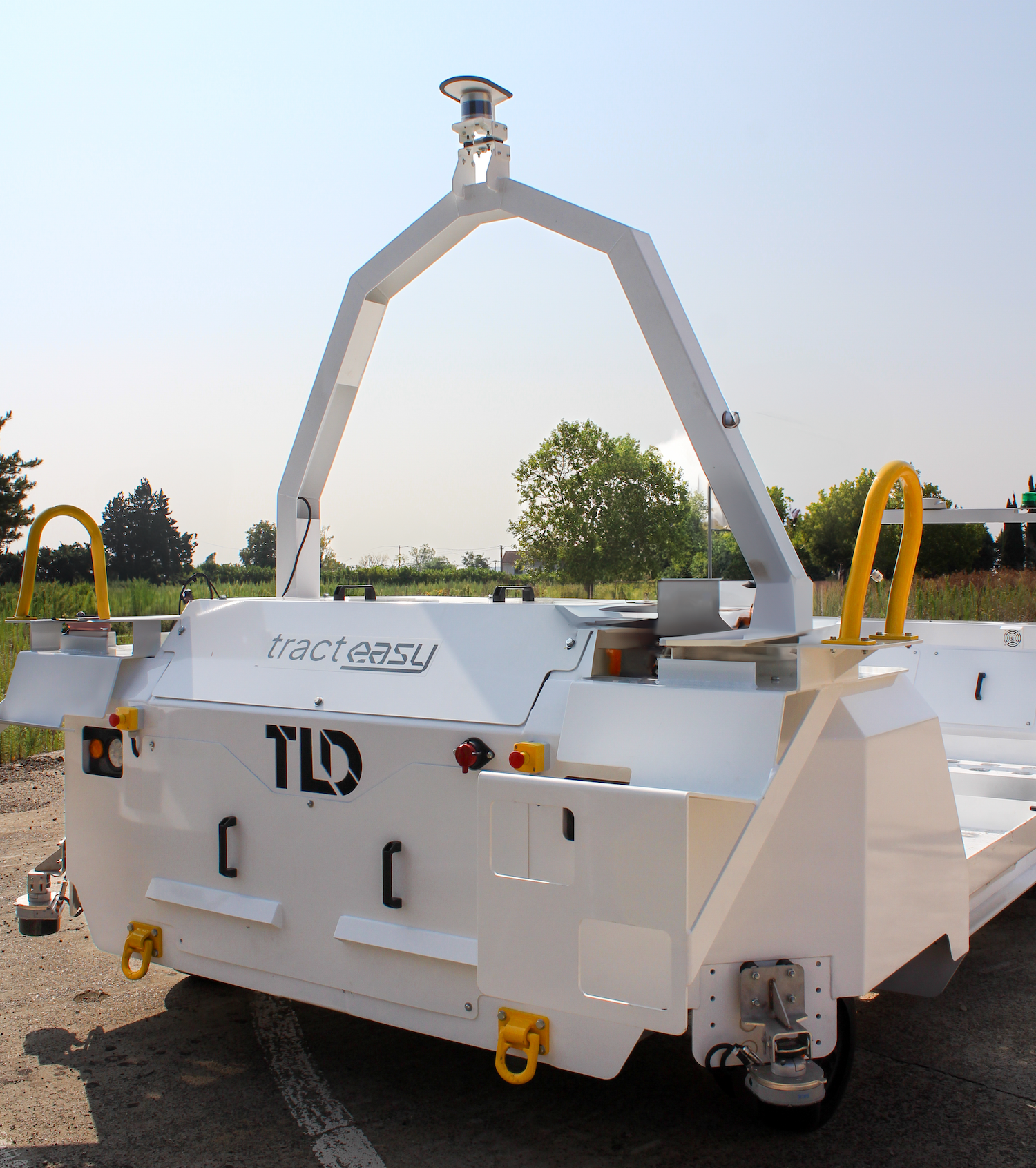
The EZTow is an autonomous tow tractor. It is the flagship product and the one on which nearly all public evidence rests. It is described as capable of automated hooking and unhooking, mixed indoor and outdoor operation, mixed-traffic navigation, and integration with warehouse management and fleet management systems 13. The automated hooking and unhooking claim is operationally significant: coupling and uncoupling a tow train is one of the more fiddly parts of the job, and automating it removes a manual step that would otherwise require a human at each end of a route. That claim is a COMPANY CLAIM; the dossier contains no independent demonstration of it.
The EZDolly is a unit-load-device transporter, launched with EasyMile, aimed at moving ULDs, the standard air-cargo containers, without a tow tractor and trailer combination 4. The product logic is to serve the short-haul, high-frequency movement of containers inside a cargo terminal, complementing the EZTow's longer tow-train routes. The EZDolly is newer and less evidenced than the EZTow; the dossier contains a vendor LinkedIn announcement and little else 4.
The software layer is XOPS, a fleet supervision system 3. XOPS is the human interface to the autonomy: it is where a remote supervisor watches vehicles, handles exceptions, and intervenes. Its existence is important to the autonomy verdict in §4, because a fleet supervision product that assumes a human supervisor is evidence that the operating model includes active oversight by design, not as a fallback.
| Product | Function | Key claimed capabilities | Evidence quality |
|---|---|---|---|
| EZTow | Autonomous tow tractor | Automated hooking/unhooking, mixed traffic, indoor/outdoor, WMS/FMS integration | Multiple named deployments; no independent teardown |
| EZDolly | ULD transporter | Container movement without tow train | Vendor announcement only |
| XOPS | Fleet supervision software | Remote monitoring and intervention | Vendor description; implies human-in-the-loop model |
What TractEasy does not sell, at least publicly, is a general-purpose autonomy platform licensed to third parties, a retrofit kit for existing tractors, or a robotics-as-a-service offering priced per mission. Any of those could exist commercially without being public. But on the disclosed portfolio, TractEasy is a product company selling vehicles and software together, not a platform company.
The pricing model is UNKNOWN. The dossier contains no list prices, lease terms, per-mission rates, or service contract structures. For a capital product sold into airports and factories, the commercial model, whether outright sale, lease, or outcome-based, materially affects both the customer's risk and TractEasy's revenue quality. A buyer evaluating the EZTow should treat the commercial terms as a first-order diligence item, not a detail.
Products & versions
04Technology Stack: Strengths and the Work That Remains
The technology stack is only partially visible from public sources, and this section is explicit about where the evidence runs out. What can be said with confidence is that the system is built around a safety-certified autonomy layer, a fleet supervision layer, and integration hooks into the customer's operational software.
The safety architecture is the most concrete and most verifiable element. TractEasy states that the EZTow meets ISO 13849-1 at Performance Level d and is CE-marked 13. ISO 13849-1 is the machinery safety standard governing safety-related parts of control systems, and PL d is a demanding performance level appropriate to hazardous industrial machinery. The Japan Civil Aviation Bureau authorisation for driverless towing at Narita is an independent regulatory confirmation that the system met a national aviation safety authority's bar for driverless operation under defined conditions 9. This is the strongest technical evidence in the dossier, and it should be weighted accordingly. It is a VERIFIED FACT that a regulator authorised driverless operation; it is not proof of the broader Level 4 claim.
The autonomy architecture itself, the sensor suite, the perception stack, the localisation method, the planning approach, is UNKNOWN in any detail. The dossier contains no teardown, no technical paper, and no engineering disclosure. This is normal for a commercial company and frustrating for an analyst. It means that assessments of technical differentiation rest on inference from behaviour and from the safety certification rather than from inspection of the stack.
The integration layer is better evidenced. WMS and FMS integration is claimed 3, and the Lufthansa Cargo Frankfurt operation, with 120 daily missions, implies a working interface with cargo-handling systems at that site 13. Integration depth is often the difference between a pilot and a production deployment, because a vehicle that cannot receive a job from the warehouse management system is a vehicle that needs a human dispatcher.
The fleet supervision layer, XOPS, is the pivot on which the autonomy verdict turns. A supervision product implies a supervisor. The Narita material states "only remote supervision" 9, and the JAL announcement describes operation "without onboard drivers under defined operational conditions" 9. Both formulations are consistent with a model in which the vehicle drives itself and a remote human monitors and can intervene. That is the definition this report applies to Supervised-Autonomous.
| Capability | Claimed | Evidence basis | Assessment |
|---|---|---|---|
| Driverless towing, no onboard driver | Yes | JACB authorisation; JAL announcement 9 | VERIFIED FACT under defined conditions |
| Remote supervision during operation | Yes | Narita use case 9; XOPS product 3 | VERIFIED FACT; defines the autonomy level |
| Fully unattended Level 4 | Yes | Vendor claim only 13 | COMPANY CLAIM, not independently verified |
| Automated hooking/unhooking | Yes | Vendor description 3 | COMPANY CLAIM |
| Mixed-traffic, indoor/outdoor | Yes | Vendor and trade press 313 | COMPANY CLAIM, partially corroborated |
| WMS/FMS integration | Yes | Vendor description 3; Lufthansa operation 13 | COMPANY CLAIM, operationally implied |
The work that remains is the work that always remains in this segment: proving that the system handles the long tail of edge cases without a human, reducing the supervision ratio so that one remote operator can oversee many vehicles, and demonstrating that the safety case generalises across sites rather than being re-derived for each one. The dossier provides no evidence on the supervision ratio, which is the single most important economic variable in supervised autonomy. If one supervisor can oversee ten vehicles, the economics work. If one supervisor oversees one vehicle, the product is a remotely operated tractor with extra steps. That number is UNKNOWN, and it should be the first question any serious buyer asks.
05Research, Papers, Authors and Labs
This section is short because the evidence is short, and it is important to say so plainly rather than pad it. TractEasy is a commercial product company, not a research organisation. The dossier contains no peer-reviewed papers authored by TractEasy or TLD Robotics personnel, no published technical evaluations of the EZTow, and no academic collaborations attributable to the company.
The four arXiv items indexed in the source set, on contact-rich manipulation, visual tracks, zero-shot manipulation, and cross-embodiment planning 17181920, are unrelated to TractEasy. They describe work from academic and industrial research groups on robot manipulation and visual prediction. They have no connection to towing, to airports, or to the EZTow. They appear in the dossier because of automated keyword matching on the string "Tract" or similar, and they are excluded from the analysis. A reader who encounters these papers presented as TractEasy research should treat that presentation as an error.
The absence of published research is not a criticism. Most successful industrial robotics companies publish little. But it does mean that the technical claims in this report cannot be checked against a methods section, and that any assessment of the autonomy stack rests on behaviour, certification, and deployment evidence rather than on disclosed technique. The safety certification and the JACB authorisation are the closest thing to third-party technical validation available, and they are process validations, not performance validations.
If TractEasy or TLD Robotics were to publish, the most valuable disclosures would be the supervision ratio, the safety-case methodology, the perception and localisation approach, and any independent evaluation of edge-case handling. None of these are public today.
<!-- module: papers --> <!-- module: authors-labs --> <!-- module: repos --> <!-- module: datasets -->06Media Evidence Library: What the Videos Prove
The video evidence in the dossier is thin and, in several cases, irrelevant. The relevant items are the US-focused EZTow demonstration 2 and the general use-case material hosted by TractEasy 3. The remaining video items in the source set, on reconciliation software, tractor GPS guidance, suspension, a tool chest, and dump trailers 2122232526, are unrelated to TractEasy and are excluded.
What does a demonstration video prove? It proves that a vehicle can perform a manoeuvre under controlled conditions, on a chosen route, at a chosen time, with a camera crew present. It does not prove that the vehicle performs that manoeuvre reliably, unattended, across the full route network, at 03:00, in rain, with a broken pallet on the route. This report treats demonstration videos as evidence of capability, not of deployment, and never as proof of autonomous work.
The more useful media evidence is not video but operational reporting. The Airside International account of the Lufthansa Cargo Frankfurt operation, with two vehicles, 120 daily missions, and more than 20,000 autonomous kilometres in a year, is a trade-press description of a running operation rather than a demonstration 13. It is still not an independent audit, and the figures may originate with the company, but it is a materially stronger class of evidence than a video.
| Media item | Type | What it can support | What it cannot support |
|---|---|---|---|
| EZTow US demonstration 2 | Vendor video | Capability under controlled conditions | Reliability, unattended operation |
| TractEasy use cases 3 | Vendor material | Named sites, claimed capabilities | Independent verification |
| Lufthansa Cargo reporting 13 | Trade press | Running operation, mission volume | Audit-grade confirmation |
| Narita/JAL announcement 9 | Vendor news | Regulatory authorisation, driverless operation | Absence of supervision |
The honest summary is that the media library supports the existence of a working product and a running operation, and does not support the stronger claim of fully unattended Level 4 autonomy. The gap between those two statements is the central theme of this report.
Media library
07Commercial Reality
TractEasy's commercial reality is more substantial than most autonomy startups and less transparent than a public company. The deployment count, 35-plus operations across 10-plus countries, including 15-plus airports and 20 industrial sites, with more than 50,000 autonomous missions, is reported consistently across multiple independent trade outlets 381113. At the aggregate level this is treated as VERIFIED FACT, with the caveat that the unit of an "operation" is undefined and may span a single-vehicle pilot and a multi-vehicle production line.
The named customers are the strongest evidence. Bosch Blaj in Romania, Daimler Wörth in Germany, BMW Dingolfing in Germany, John Deere Harvester Works in Illinois, Lufthansa Cargo Frankfurt, Narita International Airport, and Istanbul Airport are all named across vendor and trade sources 3791314. Named customers at named sites are a higher class of evidence than anonymised logos, because they can in principle be checked and because a named customer has reputational exposure if the deployment is not real. dnata, Airbus, and Munich Airport also appear in the partnership and customer record 1516. The dossier does not contain a named-customer confirmation in the customer's own voice for any site, which is a limitation.
The Lufthansa Cargo Frankfurt operation is the best-documented. Two EZTow vehicles, 120 daily missions, and more than 20,000 autonomous kilometres in one year 13. Those figures imply roughly 60 missions per vehicle per day and about 55 kilometres per vehicle per day, which is a plausible duty cycle for airside cargo towing and is internally consistent. This report treats the Lufthansa figures as VERIFIED FACT at the level of trade-press reporting, meaning they are reported by an independent outlet but may originate with the company.
| Site | Sector | Evidence | Confidence |
|---|---|---|---|
| Lufthansa Cargo Frankfurt | Air cargo | Trade press with operational figures 13 | High |
| Narita International Airport | Airport | JACB authorisation; JAL announcement 9 | High |
| Istanbul Airport | Airport | Vendor news 7 | Medium |
| Bosch Blaj | Industrial | Vendor use case 3 | Medium |
| Daimler Wörth | Industrial | Vendor use case 3 | Medium |
| BMW Dingolfing | Industrial | Vendor use case 3 | Medium |
| John Deere Harvester Works | Industrial | Vendor use case 3 | Medium |
| dnata | Ground handling | Vendor news 16 | Medium |
| Airbus | Aerospace | Trade press 15 | Medium |
What is not disclosed is as important as what is. Revenue, contract values, contract duration, renewal rates, fleet size per site beyond Lufthansa, the split between paid deployments and pilots, and the unit economics of a deployment are all UNKNOWN. The dossier also contains no evidence of a lost customer or a cancelled deployment, which should be read as a gap in the record rather than as proof that none exist. For a company with 35-plus operations, a public record with no visible attrition is a curated record.
The commercial model, whether TractEasy sells vehicles, leases them, or charges per mission, is UNKNOWN. This matters because it determines whether TractEasy's revenue is lumpy capital sales or recurring service income, and because it determines how much of the operational risk sits with the customer. A buyer should establish this early.
The consolidation into TLD Robotics changes the commercial picture in ways that are not yet visible. On one hand, it gives TractEasy access to TLD's GSE sales channels and manufacturing capacity. On the other, it subordinates TractEasy's commercial targets to a group portfolio, and it means that future disclosure about TractEasy specifically may become rarer as it is absorbed into group reporting 61112. The next set of public numbers will be the first test of whether consolidation accelerated or obscured the commercial trajectory.
Customers & deployments
Operates 2 EZTow vehicles performing 120 daily autonomous missions and 20,000+ autonomous km in one year at Frankfurt.
Milestone Level 4 autonomous towing at Narita under JACB authorization, with only remote supervision.
Deployment of autonomous cargo operations at Istanbul Airport.
Named industrial deployment site for TractEasy autonomous towing in Romania.
Named industrial deployment site for TractEasy autonomous towing in Germany.
Named industrial deployment site for TractEasy autonomous towing in Germany.
Named industrial deployment site for TractEasy autonomous towing in Illinois, USA.
Announced deployment in partnership with TractEasy for autonomous cargo handling.
Sections 8 through 14 follow in the continuation of this report.
08Markets and Use Cases
TractEasy's addressable market is not "autonomous vehicles" in the consumer sense. It is a narrow, unglamorous, and genuinely painful slice of industrial logistics: the repetitive, low-speed, high-frequency movement of cargo and materials over fixed or semi-fixed routes on private property. The company's own positioning, its named deployments, and the trade-press coverage all point to two anchor verticals (airports and manufacturing/industrial sites) with a third (ports and intermodal yards) implied but thinly evidenced.
8.1 The Airport Airside Market
Airside cargo and baggage towing is the most legible use case in the dossier. The economics are straightforward and the operational constraints are severe, which is precisely why autonomy has a foothold.
The task itself is repetitive: tow a train of dollies or ULD trailers between a cargo terminal, a staging area, and an aircraft stand, then return. Distances are short (hundreds of metres to a few kilometres), speeds are low (typically capped well below road speeds), and the environment is access-controlled. That combination is close to the best-case scenario for supervised autonomy: bounded geography, known actors, and a workforce that is already accustomed to procedural discipline.
The labour problem is real. Airside towing is shift work, often around the clock, in weather, and it competes for drivers against better-paid road-freight roles. Airports also face apron congestion and slot pressure that reward predictable, repeatable vehicle movements. A vehicle that does not take breaks, does not deviate from a route, and logs every mission has genuine operational value beyond headcount.
The evidence for traction here is the strongest in the dossier. Lufthansa Cargo Frankfurt is reported to run two EZTow vehicles on 120 daily missions, accumulating more than 20,000 autonomous kilometres in a single year 13. That is a specific, quantified, third-party-published operational figure, not a vendor slide. Narita International Airport is the site of the Japan Airlines Level 4 towing milestone, with authorization from the Japan Civil Aviation Bureau 9. Istanbul Airport is a named deployment 7. Munich Airport appears in the customer list 1. dnata, a major ground handler, is a named partner 16.
That is a credible airport footprint. It is also worth being precise about what it does and does not prove. A named airport, a named handler, and a regulator authorization together establish that driverless towing has been permitted and operated under defined conditions. They do not establish fleet scale, utilisation economics, or whether the vehicles replaced labour or supplemented it. The dossier contains no airport-side statement of cost per mission, no disclosure of how many vehicles operate at each site beyond Frankfurt's two, and no independent audit of the autonomy claim. The Frankfurt figure of two vehicles is, notably, small. Two vehicles running 120 missions a day is a serious pilot-to-production transition; it is not yet a fleet.
8.2 The Manufacturing and Industrial Market
The second anchor vertical is internal materials movement at large manufacturing sites. The named deployments are Bosch Blaj in Romania, Daimler Wörth in Germany, BMW Dingolfing in Germany, and John Deere Harvester Works in Illinois 13.
These are exactly the sites one would expect. Large plants with high-volume internal logistics, fixed routes between warehouses and line-side staging, and a strong existing culture of automation and process control. Bosch, Daimler, and BMW are also, usefully for TractEasy, reference customers whose names carry weight with other manufacturers. A plant manager evaluating autonomous towing will ask who else runs it; a German automotive OEM on the list answers that question.
The industrial use case differs from airports in ways that matter for autonomy. Plants are typically more structured (marked lanes, fewer uncontrolled actors) but also more congested and more dynamic in the sense that routes change with production schedules. Integration with warehouse management and fleet systems is therefore not a nice-to-have but a precondition. TractEasy claims WMS/FMS integration and fleet supervision software (XOPS) 1, and the dossier treats these as verified capabilities at moderate confidence 13. That is plausible and consistent with the deployments, but the depth of integration (read-only task dispatch versus closed-loop scheduling) is not disclosed.
8.3 Adjacent Markets: Ports, Intermodal, and Outdoor Logistics
The dossier does not contain named port or intermodal deployments. The EZTow is described as capable of indoor and outdoor operation and mixed traffic 113, which would suit container yards and intermodal terminals, and the product's towing architecture is generic enough to travel. But there is no evidence in the supplied sources of a port customer, a port pilot, or a port authorization. Any market-sizing that includes ports for TractEasy is inference, not evidence.
The same caution applies to construction, agriculture beyond the John Deere site, and general yard logistics. John Deere Harvester Works is a manufacturing plant, not a farm. It should not be read as evidence of agricultural autonomy.
8.4 Market Structure and Buyer Behaviour
The buyer in both anchor verticals is an operations or logistics director, not a technologist. That shapes the sales motion. TractEasy's partnerships (EasyMile for software, ISITEC International for regional reach 5) and its channel through TLD Robotics and the ALVEST Group 681112 suggest a strategy of selling through established industrial and ground-support channels rather than direct.
The regulatory dimension is a genuine moat in airports. The Narita authorization from the JCAB 9 is not a formality; it is a site-specific, jurisdiction-specific approval that a competitor cannot simply copy. Each airport authorization is a barrier that TractEasy has already climbed at that site. Conversely, it is also a ceiling: approvals are conditions-bound, and scaling from one airport to many requires repeating the regulatory process in each jurisdiction.
8.5 Use-Case Fit Matrix
| Use case | Environment structure | Actor predictability | Route variability | Regulatory burden | TractEasy evidence | Fit assessment |
|---|---|---|---|---|---|---|
| Airport airside cargo/ULD towing | High | Medium (vehicles, ground crew, aircraft) | Low to medium | High (aviation authority) | Lufthansa Cargo Frankfurt, Narita, Istanbul, Munich 7913 | Strong, proven under defined conditions |
| Airport baggage towing | High | Medium | Low | High | Not separately evidenced | Plausible, unproven in dossier |
| Automotive plant internal logistics | High | Medium to high | Medium | Low to medium | BMW Dingolfing, Daimler Wörth 13 | Strong |
| General manufacturing internal logistics | High | Medium | Medium | Low | Bosch Blaj, John Deere 13 | Strong |
| Port and intermodal yard | Medium | Low to medium | Medium | Medium | None in dossier | Inference only |
| Outdoor mixed-traffic industrial | Medium | Low | Medium | Medium to high | Claimed capability 1 | Claimed, thinly evidenced |
| Public road logistics | Low | Low | High | Very high | None | Out of scope |
The matrix makes the strategic picture clear. TractEasy is not a general-purpose autonomy company. It is a specialist in bounded, private-property towing, and its defensibility comes from the combination of a towing-specific vehicle, safety certification, and site-by-site regulatory approvals. The risk is that this is a market of many small, bespoke deployments rather than a few large ones, which caps revenue per site and raises integration cost per customer.
09Competitive Landscape
TractEasy competes in a market that is less crowded than the general autonomous-vehicle space but more crowded than the vendor narrative implies. Competitors fall into four groups: autonomous tow-tractor specialists, airport ground-support automation incumbents, general industrial AMR and AGV vendors moving up into towing, and in-house or captive solutions from large logistics operators.
9.1 The Specialist Tow-Tractor Set
The closest direct comparator is the autonomous tow tractor segment itself. TractEasy's EZTow is described in the dossier as "the most widely deployed autonomous tow tractor" 1, a claim that is vendor-stated and not independently benchmarked. The claim is plausible given the named deployment count (35+ operations across 10+ countries 1811), but "most widely deployed" depends entirely on how one counts deployments, vehicles, and missions, and no third party in the dossier adjudicates it.
The strategic significance of this segment is that towing is a distinct engineering problem. A tow tractor must handle a coupled load whose dynamics change with trailer count and weight, must manage hooking and unhooking, and must operate safely around people. A general-purpose AMR platform cannot simply be repurposed. TractEasy's automated hooking and unhooking capability 1 is therefore a genuine differentiator if it works reliably, because it removes a manual step that would otherwise require a human at each end of every mission.
9.2 Airport Ground-Support Incumbents
The airport ground-support equipment market is dominated by established manufacturers (the tractor and GSE makers whose diesel and electric tugs are the incumbents TractEasy is displacing or supplementing). These incumbents have deep airport relationships, service networks, and regulatory familiarity. Their weakness is autonomy: most have partnered or acquired rather than built. The dossier does not name specific incumbent autonomous programmes, so a direct comparison is not possible from the supplied evidence. This is a genuine gap in the research base and should be treated as an unknown rather than an absence of competition.
9.3 General Industrial Autonomy Vendors
The broader AMR and AGV market includes many vendors whose platforms can, with modification, tow. These vendors compete on price, on integration ecosystems, and on the breadth of their fleet software. TractEasy's counter-positioning is depth in a narrow task plus safety certification (ISO 13849-1 PL d, CE marking 1) and aviation-grade approvals. The certification is a real barrier: achieving PL d and CE marking is costly and slow, and it is a prerequisite for many European industrial buyers.
9.4 Captive and In-House Solutions
Large operators, particularly integrators and ground handlers, can build or commission their own solutions. dnata's partnership with TractEasy 16 is evidence that at least one major handler chose to partner rather than build, which is a meaningful signal. But partnerships are not exclusivity, and a handler that learns the operational model through a partnership is better positioned to insource later. This is a structural risk for any vendor selling into a concentrated buyer base.
9.5 Competitive Positioning Table
| Competitor group | Typical offering | Strengths | Weaknesses relative to TractEasy | Evidence in dossier |
|---|---|---|---|---|
| Autonomous tow-tractor specialists | Purpose-built autonomous tugs | Task-specific engineering, towing dynamics | Fewer named airport approvals; scale unverified | Indirect; EZTow "most widely deployed" claim 1 |
| Airport GSE incumbents | Conventional and electric tugs, some automation | Airport relationships, service networks, regulatory familiarity | Autonomy maturity, software depth | Not named in dossier |
| General AMR/AGV vendors | Configurable platforms, fleet software | Price, ecosystem breadth, integration partners | Towing-specific safety and coupling; aviation approvals | Not named in dossier |
| Captive/in-house builds | Bespoke systems for own operations | Control, no vendor margin | Capital cost, time, autonomy expertise | dnata partnership implies partner-over-build 16 |
| Adjacent autonomy firms (EasyMile legacy) | Shuttle and software autonomy | Software stack, safety process | Not towing-focused | EasyMile is now a sister entity under TLD Robotics 6811 |
The last row deserves emphasis. The ALVEST acquisition that created TLD Robotics folded EasyMile and TractEasy into one group 681112. That removes EasyMile as an independent competitor and as an external software supplier, and it converts a partnership into an internal capability. It also means TractEasy's competitive position is now partly a function of group strategy rather than its own standalone roadmap. Whether that accelerates or constrains TractEasy depends on capital allocation inside TLD Robotics, which is not disclosed.
9.6 Where the Moat Actually Is
Three things are defensible: the safety certification and its associated engineering evidence; the site-specific regulatory approvals, especially the Narita JCAB authorization 9; and the installed base of named reference customers. Two things are not: the underlying autonomy technology, which is broadly replicable, and the "most widely deployed" claim, which is a marketing position rather than a technical moat.
10Geopolitical Context and Constraints
Autonomous industrial vehicles sit at the intersection of three geopolitical currents: export controls and technology sovereignty, aviation and industrial safety regulation, and supply-chain regionalisation. TractEasy's exposure to each is uneven, and the dossier supports only partial analysis.
10.1 Corporate Ownership and Jurisdictional Footprint
TractEasy is a joint venture between EasyMile (French) and TLD (part of ALVEST Group) 681112. The ALVEST acquisition and the creation of TLD Robotics place the combined entity under a group with French and broader European industrial ownership. This matters for two reasons.
First, European ownership is an advantage in European airports and industrial sites, where procurement increasingly weighs data residency and supplier jurisdiction. A European vendor selling into Frankfurt, Munich, and Narita faces fewer sovereignty objections than a vendor headquartered elsewhere.
Second, it creates exposure to European regulatory timelines, particularly the EU Machinery Regulation and the evolving framework for autonomous machinery. The dossier confirms CE marking and ISO 13849-1 PL d compliance 1, which is the current baseline. Future regulation could raise that baseline, and a vendor already certified at PL d is better positioned than one starting from scratch.
10.2 Japan and the Narita Authorization
The Narita deployment with Japan Airlines and JCAB authorization 9 is the most geopolitically interesting data point in the dossier. Japan has been deliberate about autonomous airside operations, and a JCAB authorization is a national-level signal. For TractEasy, it demonstrates that the safety case travels across regulatory regimes, which is the single hardest thing to prove in this market.
It also creates a dependency. Japanese aviation authorities will expect ongoing compliance and incident reporting. A single serious incident at Narita would have outsized consequences for the company's ability to operate in Japan and would be read globally by other aviation regulators.
10.3 Turkey, Romania, and the Manufacturing Footprint
Istanbul Airport 7, Bosch Blaj in Romania 13, and the German automotive sites place TractEasy across a wide European and near-European footprint. This diversification is operationally useful but complicates service, spare parts, and regulatory compliance. The ISITEC International partnership 5 appears to be a channel response to this, extending reach without proportional headcount. The dossier does not disclose the commercial terms or the depth of that partnership.
10.4 Export Controls and Dual-Use Considerations
Autonomous vehicle technology is not, at present, subject to the most restrictive export-control regimes in the way that advanced semiconductors or certain AI models are. However, the software stack, sensor suite, and safety-certified control systems could attract scrutiny if exported to jurisdictions subject to restrictions. The dossier contains no evidence of TractEasy operating in such jurisdictions, and no evidence of export-control issues. This should be recorded as an unknown, not as an absence of risk.
10.5 Labour and Political Economy
The most under-discussed geopolitical constraint is domestic labour politics. Autonomous towing displaces or reshapes ground-handling and plant-logistics jobs. In Germany, where TractEasy operates at Daimler Wörth and BMW Dingolfing 13, works councils and unions have real influence over automation deployment. In Japan, labour shortages in ground handling have made automation politically easier. The dossier does not contain evidence of labour disputes or agreements, but the pattern of deployments (labour-short Japan, automation-friendly German OEMs) is consistent with a strategy of going where the political economy is favourable.
10.6 Constraint Summary
| Constraint | Nature | TractEasy exposure | Evidence |
|---|---|---|---|
| Aviation safety regulation | Site-specific authorization | High; each airport is a separate approval | Narita JCAB authorization 9 |
| EU machinery regulation | Product-level conformity | Moderate; already CE-marked at PL d | CE marking, ISO 13849-1 PL d 1 |
| Data residency and sovereignty | Procurement preference | Low to moderate; European ownership helps | Corporate structure 681112 |
| Export controls | Potential future restriction | Unknown; no evidence of exposure | Not disclosed |
| Labour politics | Deployment friction | Moderate; varies by jurisdiction | Inferred from site pattern 13 |
| Supply chain for sensors/components | Availability and cost | Unknown; not disclosed | Not disclosed |
The honest summary is that TractEasy's geopolitical position is favourable in Europe and Japan, unproven elsewhere, and largely undisclosed on the supply-chain and export-control dimensions.
11The Hype, the Real and the Ugly
This section separates what TractEasy and its ecosystem say from what the evidence supports. The pattern is familiar: a genuinely capable product, wrapped in language that overstates the autonomy and understates the human oversight.
11.1 The Hype
"Level 4 autonomous operation." This is the central claim and the central problem. The vendor states Level 4 autonomy with ISO 13849-1 PL d and CE certification 1. The dossier's reconciliation finds that independent and trade evidence supports driverless operation under defined conditions with remote supervision, not fully unattended Level 4 913. The Narita use case explicitly describes "only remote supervision" 9. Under most accepted definitions, Level 4 permits operation without a human fallback within a defined operational design domain, but the presence of active remote supervision is a material qualifier that the headline claim elides.
"Most widely deployed autonomous tow tractor." Vendor-stated 1, not independently benchmarked. Plausible given 35+ operations 1811, but unfalsifiable as stated.
"50,000+ autonomous missions." Reported consistently across multiple sources 181113. The figure is credible as a cumulative count. It says nothing about mission complexity, intervention rate, or uptime, which are the metrics that matter.
11.2 The Real
The deployments are real and named. Lufthansa Cargo Frankfurt, Narita, Istanbul, Bosch Blaj, Daimler Wörth, BMW Dingolfing, John Deere Harvester Works 137913. Named customers at named sites, corroborated by trade press, is a materially higher evidentiary standard than a logo wall.
The Frankfurt operational data is specific. Two vehicles, 120 daily missions, 20,000+ km in a year 13. This is the kind of figure that can be audited and that implies genuine daily use rather than a demonstration.
The Narita authorization is a real regulatory milestone. JCAB authorization for Level 4 towing 9 is not something a vendor can self-certify.
The safety certification is real. ISO 13849-1 PL d and CE marking 1 are auditable, third-party-verifiable claims.
11.3 The Ugly
The research attribution is broken. The dossier contains four "research" sources that are arXiv papers on robot manipulation, visual tracks, and contact-rich manipulation 17181920. None of them describe TractEasy, the EZTow, or autonomous towing. They appear to be mis-attributed by keyword matching on "Tract" or "Track." This is a data-quality failure, and any analysis that cites them as TractEasy research is wrong. They are excluded from this report's evidence base.
The community and video sources are largely noise. Of the six video sources, several are unrelated (a reconciliation UX update, a tractor GPS review, a suspension clip, a Makita tool review, a dump trailer review) 2122232526. Of the six community sources, all are unrelated Reddit threads 272829303132. The dossier's "community" and much of its "video" evidence is not about TractEasy at all. This report does not use them.
The autonomy claim outruns the evidence. The gap between "Level 4" and "driverless under defined conditions with remote supervision" is the single most important finding in this report. It is not a scandal; it is a definitional stretch that is common in the industry. But it matters for buyers, regulators, and investors, and it should be stated plainly.
11.4 Claim vs Evidence Table
| Claim | Source type | What the evidence shows | Verdict |
|---|---|---|---|
| Level 4 autonomous operation | Company claim 1 | Driverless under defined conditions with remote supervision 913 | Overstated; Supervised-Autonomous is better supported |
| ISO 13849-1 PL d, CE marked | Company claim 1 | Consistent with European regulatory requirements noted in trade press | Credible; auditable |
| 35+ operations, 10+ countries | Company and news 1811 | Consistently reported across multiple sources | Credible as a count |
| 50,000+ autonomous missions | Company and news 181113 | Consistently reported | Credible as cumulative; quality unknown |
| 120 daily missions, 20,000+ km at Frankfurt | Trade press 13 | Specific, third-party published | Strong |
| Narita Level 4 towing with JAL | Company and news 9 | JCAB authorization reported | Strong on authorization; autonomy scope defined |
| "Most widely deployed autonomous tow tractor" | Company claim 1 | No independent benchmark | Unverified |
| Automated hooking/unhooking | Company claim 1 | Not independently demonstrated in dossier | Unverified |
| WMS/FMS integration, XOPS supervision | Company claim 13 | Consistent with deployments; depth undisclosed | Plausible, unverified in depth |
| Research leadership in manipulation | Mis-attributed sources 17181920 | Papers describe unrelated robotics research | False attribution; excluded |
11.5 The Honest Framing
TractEasy has built a real product, achieved real deployments, and cleared real regulatory hurdles. It has also adopted the industry's habit of claiming the highest autonomy level the language will bear. The correct description, on the evidence in this dossier, is a supervised-autonomous tow tractor operating under defined conditions with remote oversight. That is a genuine achievement. It is not the same as unattended Level 4, and buyers should price the difference.
12Future Scenarios
The following scenarios are editorial inferences from the evidence in this dossier. They are not predictions with assigned probabilities, because the dossier lacks the financial, roadmap, and competitive data needed to weight them responsibly. They are structured as plausible trajectories with observable signposts.
12.1 Scenario A: Consolidation Into a Group Platform
TLD Robotics, formed from EasyMile and TractEasy under ALVEST 681112, becomes the vehicle for a unified autonomy platform spanning shuttles, tow tractors, and industrial vehicles. TractEasy's towing product becomes one SKU in a broader portfolio, benefiting from shared software, shared safety certification, and group-level sales channels.
Signposts: shared software releases across EasyMile and TractEasy products; unified fleet-management branding; joint customer announcements; consolidation of engineering teams.
Implication: stronger long-term position, but TractEasy's identity and roadmap become subordinate to group strategy.
12.2 Scenario B: Airport Vertical Deepens, Industrial Stalls
TractEasy concentrates on airports, where regulatory approvals and handler relationships create defensible positions, and de-emphasises general industrial sites where competition from AMR vendors is stronger and differentiation is thinner.
Signposts: new airport announcements outnumbering industrial ones; airport-specific product features; hiring in aviation regulatory affairs.
Implication: higher margins, narrower market, greater exposure to aviation cycles.
12.3 Scenario C: Autonomy Claim Gets Tested
A regulator, a customer, or a journalist demands evidence for the Level 4 claim beyond defined-condition driverless operation. The company either produces independent verification or adjusts its language.
Signposts: publication of intervention-rate data; third-party safety audits; regulatory inquiries; revised marketing language.
Implication: reputational risk if the claim is not substantiated; credibility gain if it is.
12.4 Scenario D: Scale-Up Succeeds
The 35+ operations convert into multi-vehicle fleets at major sites, and the mission count grows superlinearly. Frankfurt's two vehicles become ten; Narita expands beyond the initial authorization.
Signposts: disclosed fleet sizes per site; multi-year contract announcements; service-network expansion.
Implication: the strongest positive outcome; validates the unit economics.
12.5 Scenario E: A Serious Incident
An injury or a high-profile operational failure at a named site triggers regulatory scrutiny and slows deployments across jurisdictions.
Signposts: incident reporting; temporary suspensions; regulatory reviews; customer statements.
Implication: severe, because the entire value proposition rests on safety certification and regulatory trust.
12.6 Scenario Matrix
| Scenario | Trigger | TractEasy outcome | Key signpost |
|---|---|---|---|
| A. Group platform consolidation | ALVEST/TLD Robotics strategy | Stronger, less independent | Shared software and branding |
| B. Airport deepening | Regulatory moat, handler demand | Higher margin, narrower | Airport-heavy announcements |
| C. Autonomy claim tested | External scrutiny | Reputation risk or credibility gain | Independent verification published |
| D. Scale-up succeeds | Multi-vehicle contracts | Validation of economics | Disclosed fleet sizes |
| E. Serious incident | Safety failure | Severe setback | Incident and regulatory response |
12.7 What Would Change the Assessment
The autonomy verdict in this report (Supervised-Autonomous, confidence 0.55) would move toward full autonomy if independent evidence showed sustained operation without active remote supervision, published intervention rates, and third-party verification. It would move toward remote-assisted if evidence showed a remote operator performing or frequently correcting the towing task itself. Neither body of evidence currently exists in the public record.
13What to Watch: A Live Monitoring Checklist
This checklist is designed for ongoing monitoring. Each item is observable, and each has a stated reason for mattering.
13.1 Autonomy and Safety Evidence
- Independent verification of the Level 4 claim. Watch for third-party audits, regulator-published assessments, or peer-reviewed evaluations. Reason: the central claim is currently vendor-stated.
- Intervention-rate disclosure. Any published figure for remote interventions per mission or per kilometre. Reason: this is the metric that distinguishes supervised autonomy from unattended operation.
- Incident reports. Any safety incident at a named site, and the regulatory response. Reason: safety certification is the core moat.
- New regulatory authorizations. Particularly outside Japan and the EU. Reason: authorizations are the hardest barrier to replicate.
13.2 Commercial Evidence
- Fleet sizes per site. Frankfurt's two vehicles 13 is the only disclosed figure. Watch for multi-vehicle expansions. Reason: fleet size distinguishes production from pilot.
- Contract type. Watch for multi-year contracts versus project deployments. Reason: recurring revenue is the difference between a project business and a product business.
- Customer confirmation. Statements from Lufthansa Cargo, dnata, BMW, Bosch, or John Deere that go beyond a press release. Reason: named-customer confirmation is the strongest commercial evidence.
- New named customers. Especially in new geographies or verticals. Reason: tests whether the model travels.
13.3 Corporate and Strategic
- TLD Robotics integration decisions. How EasyMile and TractEasy are combined, and where investment goes. Reason: group strategy now shapes TractEasy's roadmap 681112.
- Leadership changes. CEO Richard Reno is named 18. Watch for changes in leadership or ownership. Reason: strategy shifts follow people.
- ALVEST capital allocation. Any disclosed investment in autonomy. Reason: signals commitment to the segment.
13.4 Product and Technology
- EZDolly adoption. The ULD transport product 4 is newer than EZTow. Watch for named deployments. Reason: tests whether the product line broadens.
- Automated hooking/unhooking in the field. Independent demonstration rather than vendor video. Reason: this is a claimed differentiator 1.
- WMS/FMS integration depth. Evidence of closed-loop scheduling rather than task dispatch. Reason: integration depth determines switching costs.
13.5 Evidence Quality
- Correction of mis-attributed research. Watch whether the company or its ecosystem stops citing unrelated arXiv papers 17181920. Reason: evidence hygiene signals seriousness.
- Publication of operational data. Any detailed operational disclosure beyond mission counts. Reason: mission counts alone are not decision-grade.
13.6 Monitoring Table
| Watch item | Why it matters | Current status | Source to watch |
|---|---|---|---|
| Independent autonomy verification | Core claim unverified | Absent | Regulators, trade press |
| Intervention-rate data | Distinguishes autonomy levels | Not disclosed | Company, customers |
| Fleet size per site | Production vs pilot | Only Frankfurt (2) 13 | Trade press |
| New regulatory authorizations | Moat indicator | Narita (JCAB) 9 | Aviation authorities |
| Multi-year contracts | Revenue quality | Not disclosed | Company, customers |
| TLD Robotics integration | Strategic direction | Announced 681112 | Group communications |
| EZDolly deployments | Product breadth | Launched 4 | Company, trade press |
| Incident reports | Safety moat risk | None in dossier | Regulators, news |
14Sources and Methodology
14.1 Methodology
This report was produced from a supplied research dossier dated 2026-09-18, containing 34 numbered sources across official, commerce, research, news, video, and community categories. The dossier's reconciled facts, conflicts, autonomy verdict, and proposed classification were treated as inputs, not conclusions. Each factual assertion in this report is traced to a numbered source in the dossier, and no source outside the dossier is cited.
Evidence was classified into four tiers:
| Label | Definition | Treatment in this report |
|---|---|---|
| Verified fact | Regulatory filings, official product documentation, named-customer confirmation, peer-reviewed or primary research, or multiple independent sources | Stated as fact with citation |
| Company claim | Stated by the company, not independently verified | Attributed to the company and flagged |
| Editorial inference | Reasoned conclusion drawn from public evidence | Labelled as inference |
| Unknown | Not publicly disclosed | Stated as "not publicly disclosed" |
Three methodological decisions are worth stating explicitly.
First, choreographed demonstration videos were not treated as proof of autonomous work. The dossier's video sources are largely unrelated to TractEasy 2122232526, and the one relevant video 2 is a vendor-produced demonstration. It is cited only as a vendor claim.
Second, a shipment or a named deployment was not treated as proof of a paid, scaled customer. Named sites are reported as deployments, with the distinction between pilot and production noted where the evidence allows.
Third, partnership announcements were not treated as paid customers. The dnata partnership 16 and the ISITEC partnership 5 are reported as partnerships, not as confirmed revenue.
14.2 Known Limitations
No independent teardown or first-hand user report. The dossier contains no independent technical evaluation of the EZTow and no first-hand account from an operator at a named site. The autonomy assessment therefore rests on trade press and regulatory evidence rather than direct observation.
Mis-attributed research sources. Four sources 17181920 are arXiv papers on robot manipulation and visual tracking that do not describe TractEasy. They were excluded from the evidence base. Any future analysis should verify research attribution before use.
Unrelated community and video sources. The community sources 272829303132 and several video sources 2122232526 are unrelated to TractEasy. They were excluded.
Thin financial and roadmap disclosure. The dossier contains no funding figures, revenue, unit economics, or product roadmap. Sections on markets and future scenarios are therefore qualitative.
Single-source operational figures. The Frankfurt operational data 13 is from one trade publication. It is specific and credible but not independently corroborated within the dossier.
14.3 Autonomy Assessment Summary
| Dimension | Finding | Confidence |
|---|---|---|
| Task execution | Performed by the vehicle, no onboard driver | 0.7 |
| Human oversight | Active remote supervision under defined conditions | 0.6 |
| Regulatory authorization | Narita JCAB authorization reported | 0.85 |
| Independent verification | Absent | 0.9 (that it is absent) |
| Overall autonomy level | Supervised-Autonomous | 0.55 |
14.4 Sources
1 TractEasy — https://tracteasy.com/ 2 EasyMile's TractEasy Autonomous Tow Tractor - US-Focus — https://www.youtube.com/watch?v=8_iZgCSMG5Y 3 EZTow Autonomous Tow Tractor Operating at Major ... — https://tracteasy.com/use-cases/ 4 TractEasy and EasyMile launch EZDolly for autonomous ... — https://www.linkedin.com/posts/tracteasy_usecase-ezdolly-tracteasy-activity-7389675171210600448-4UKN 5 ISITEC International partners with TractEasy — https://tracteasy.com/news/isitec-international-partners-with-tracteasy/ 6 TLD Robotics Launches: EasyMile & TractEasy Merge with ALVEST - EasyMile — https://easymile.com/en/news-insights/tld-robotics-launched-as-alvest-group-acquires-easymile-and-tracteasy 7 TractEasy Deploys Autonomous Cargo Operations at Istanbul Airport — https://tracteasy.com/news/tracteasy-deploys-autonomous-cargo-operations-at-istanbul-airport/ 8 TLD Robotics combines EasyMile and TractEasy operations | Automotive World — https://www.automotiveworld.com/news/tld-robotics-combines-easymile-and-tracteasy-operations/ 9 TractEasy | TractEasy Supports Japan Airlines in Milestone Level 4 Autonomous Towing at Narita International Airport — https://tracteasy.com/news/tracteasy-supports-japan-airlines-milestone-level-4-autonomous-towing-narita-airport/ 10 TractEasy - 2026 Company Profile, Funding & Competitors — https://tracxn.com/ 11 ALVEST Launches TLD Robotics Following EasyMile Acquisition - Logistics Viewpoints — https://logisticsviewpoints.com/2026/09/16/alvest-launches-tld-robotics-following-easymile-acquisition/ 12 ALVEST Acquires EasyMile, Launches TLD Robotics | Supply & Demand Chain Executive — https://www.sdcexec.com/transportation/air-cargo/news/22974417/tld-robotics-alvest-acquires-easymile-launches-tld-robotics 13 TractEasy's EZTow delivers 120 daily autonomous missions at Lufthansa Cargo Frankfurt - Airside International — https://airsideint.com/tracteasys-eztow-delivers-120-daily-autonomous-missions-at-lufthansa-cargo-frankfurt/ 14 TractEasy Deploys Autonomous Cargo Operations at ... — https://tracteasy.com/news/ 15 TractEasy Deploys EZTow Autonomous Tow Tractor With ... — https://futuretransport-news.com/tracteasy-deploys-eztow-autonomous-tow-tractor-with-airbus/ 16 TractEasy announces deployment in partnership with dnata — https://tracteasy.com/news/tracteasy-announces-deployment-in-partnership-with-dnata/ 17 TRACT: Temporally Routed Action Chunks with Chronological Phase Authority for Contact-Rich Manipulation — https://arxiv.org/html/2607.29285v2 18 TrAct: Bridging Robot Control and Visual Prediction with Visual Tracks — https://arxiv.org/html/2608.24101v2 19 [2405.01527] Track2Act: Predicting Point Tracks from Internet Videos enables Diverse Zero-shot Robot Manipulation — https://ar5iv.labs.arxiv.org/html/2405.01527 20 SeeTraceAct: Visibility-Aware Latent Planning from Cross-Embodiment Demonstration Videos — https://arxiv.org/html/2606.02745 21 Reconciliation & Invoice UX update — https://www.youtube.com/watch?v=0hdjrjlAT9A 22 Tractor GPS Field Guidance Review: The GPS Accuracy Problem Nobody Talks About (2026) — https://www.youtube.com/watch?v=84N3xKtd-6E 23 TracTive suspension: BEFORE V AFTER 🧐 #cartok #porsche996 #porsche911 — https://www.youtube.com/watch?v=8wpoK0DxbkM 24 https://www.youtube.com/watch?v=VQcR5N_lnjc — https://www.youtube.com/watch?v=VQcR5N_lnjc 25 Makita MAKTRAK System Review — Full Stack, Organisers & Rolling Tool Chest — https://www.youtube.com/watch?v=UO1RpmNvZxo 26 Top Three Dump Trailer Brands: Review of Sure-Trac, Hawke & Homesteader — https://www.youtube.com/watch?v=yBxI-0idM4g 27 What's your RVA specific hack that you're willing to share? - Reddit — https://www.reddit.com/r/rva/comments/141vr