Acumino
US$0.99 unlocks one Word + one PDF download. The full report is free to read on this page.
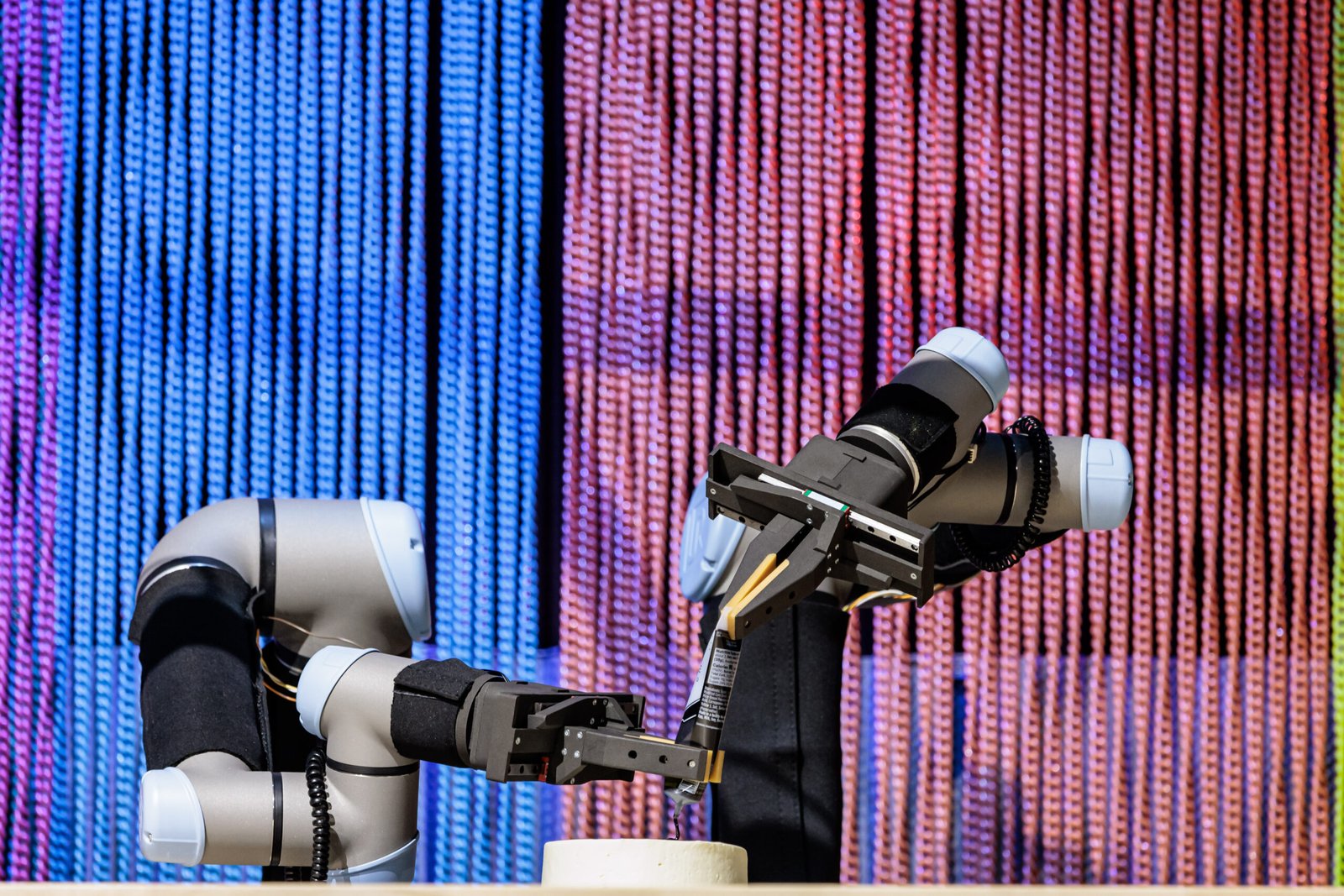
Acumino
Greek-founded Physical AI startup selling taught-by-demonstration dexterity to industrial manufacturers, on a seed round, a DeepMind accelerator badge and a set of performance numbers nobody outside the company has yet checked.
| Report status | First-pass premium deep report. Sections 1–7 of 14. |
| Coverage date | 18 September 2026 |
| Company stage | Seed-funded (USD 19.2M total raised), pre-scale commercial deployment |
| Editorial standard | Evidence-labelled. Vendor claims are never presented as verified fact. |
How to Read This Report
Acumino is a young company operating in a category, industrial Physical AI, where the gap between what a system does in a curated demonstration and what it does on a factory floor across three shifts is the entire commercial question. That gap is where most of this report lives.
Every substantive statement below carries one of four labels, either explicitly or through the inline citation and phrasing.
| Label | Meaning | How it appears in text |
|---|---|---|
| VERIFIED FACT | Confirmed by a regulatory filing, official product documentation, a named customer, primary research, or multiple independent sources. | Stated plainly, with bracketed citation. |
| COMPANY CLAIM | Asserted by Acumino or its investors/press releases and not independently corroborated. | Flagged as "the company claims", "vendor-stated", "per Acumino". |
| EDITORIAL INFERENCE | A reasoned conclusion drawn from public evidence, not asserted by the company. | Flagged as "we infer", "the reasonable reading is", "on the evidence". |
| UNKNOWN | Not publicly disclosed. | Stated as "not publicly disclosed" rather than padded. |
Three specific disciplines apply throughout. A choreographed demonstration video is not evidence of autonomous productive work. A shipment or a signed pipeline figure is not evidence of a paid, sustained deployment. A partnership announcement, including one involving a named investor, is not evidence of a paying customer. Where the dossier is thin, this report says so.
A note on source quality: the supplied dossier contains a cluster of sources (19–24, 27–29) that concern ACEMAGIC mini-PCs, Maserati and Range Rover reliability, and site reliability engineering. These are extraction artefacts from keyword matching on "reliability" and unrelated hardware, not Acumino material. They are reproduced in §14 for completeness and transparency but are not treated as evidence about Acumino anywhere in this report. Two of them (19, 20) were flagged in the dossier itself as erroneous extractions.
01Executive Overview
Acumino is a Greek-founded company, established in 2021 as a spinout from what its own materials describe as more than seventeen years of robotics research, with its primary headquarters in Elliniko, Greece and additional offices in Seattle, Auckland and Japan 1245. It builds what it calls hardware-agnostic foundation models for dexterous industrial manipulation, and sells the resulting capability as a subscription service rather than as a robot 458. The chief executive is Minas Liarokapis, confirmed across independent and official sources 567. The company employed 31 people as of July 2026, up from 26, according to commercial data aggregator Caplight 3.
The commercial proposition is narrow and legible: industrial manufacturers face labour shortages in repetitive, dexterous tasks such as complex assembly, kitting, packaging and material handling; Acumino installs its stack on robots the customer or integrator already owns or can buy, teaches the task by human demonstration using production grippers, trains a model, and then runs the task autonomously 458. The company claims deployment in days, whereas independent coverage of the same proposition describes a reduction from months to weeks 49. It claims greater than 99.9% reliability and a 45% throughput gain; no independent source in the dossier corroborates either figure 4. Those two claims are the load-bearing numbers of the entire pitch and they are, as of this coverage date, unverified.
Financially, Acumino has raised USD 19.2M in total: a USD 7.5M pre-seed and a USD 11.7M seed round led by Radar Ventures and closed around June to July 2026 56781011. The seed amount is corroborated by an SEC Form D filing dated 25 June 2026, which records a USD 11.7M target and a first sale on 15 April 2026 12. That filing is the single strongest piece of hard documentary evidence in the dossier. Investors include Radar Ventures, LDV Partners, Big Pi Ventures, MegaChips Corporation, Schaeffler, Bulent Celebi, Higher Life Ventures and Possible Ventures 5810. Two of those names matter beyond capital: MegaChips is a Japanese semiconductor firm that has also become a deployment partner, and Schaeffler is a tier-one automotive and industrial supplier, which is a strategically significant cap-table presence even absent a disclosed commercial contract.
In June 2026 Acumino was selected as one of fifteen startups for Google DeepMind's inaugural European Robotics Accelerator, a three-month, equity-free programme offering Gemini model access, up to USD 350K in cloud credits and DeepMind engineer mentorship, with a Demo Day in London in September 2026 6713. This is a genuine credential and it is verified across multiple independent sources. It is also not an investment and not a customer relationship, and should not be read as either.
The company states a pipeline of 600 deployments from existing clients and an ambition of hundreds of live deployments in 2027 8. That figure originates from an investor blog post, is not independently verified, and should be treated as a company claim with a wide error bar. The honest characterisation of Acumino's stage is pilot and early commercial: real contracts plausibly exist, real deployments plausibly exist, but no independent field report, no named customer confirmation and no third-party performance audit appears in the public record.
The central editorial judgement of this report is that Acumino has assembled an unusually credible set of soft assets, a DeepMind accelerator place, a tier-one industrial investor, a Japanese go-to-market partner, a coherent hardware-agnostic thesis, and a genuinely difficult technical problem, against a hard-asset picture that remains thin. The company is selling reliability and speed in a market that buys nothing else. Until an independent party measures those two things on a customer floor, Acumino is a well-credentialled bet rather than a proven one.
Latest news
02The Acumino Story
2.1 Founding and the research lineage
Acumino was founded in 2021, described consistently across independent and official sources as a spinout from more than seventeen years of robotics research 1257. The precise institutional origin of that research is not stated in the dossier. The chief executive, Minas Liarokapis, is confirmed by multiple independent and official sources 567. His academic and research background is not detailed in the supplied material, and this report will not speculate about it. What can be said is that the founding team's research lineage is visible in the company's publication record, which includes work on meta-learning adaptive dynamics models, tri-manual visuomotor imitation learning, and runtime-editable loco-manipulation behaviours 141516. That is a research profile consistent with a manipulation-and-learning lab origin rather than a controls or integration background.
The seventeen-year framing is a company claim about lineage rather than a verifiable corporate fact. It is plausible and consistent with the publication record, but it should be read as positioning: it tells the buyer that this is not a 2023 large-model wrapper shop, but a group that has been working on robot manipulation since before the current foundation-model cycle began. EDITORIAL INFERENCE: the lineage claim is doing real work in Acumino's fundraising and sales narrative, and it is the kind of claim that is easy to make and hard to falsify. It is not, on its own, evidence of technical superiority.
2.2 Geography and the shape of the company
The headquarters is Elliniko, Greece, with offices in Seattle, Auckland and Japan 1245. The brand page lists the United States, Greece, New Zealand and Japan as its operating geographies 4. An SEC Form D filing is recorded from Boston, Massachusetts 12, which the dossier reconciles as a likely US legal-entity registration rather than an operational headquarters. That reconciliation is sound: US startups routinely file Form D from a registered-agent or incorporation address that bears no relation to where the work happens.
The distributed footprint is worth pausing on, because it is not incidental. Greece supplies the research and engineering base and a materially lower cost structure than the US. Seattle is the standard American commercial beachhead and sits close to Amazon, Microsoft and a dense industrial-automation cluster. Auckland is an unusual choice and is not explained in the dossier; New Zealand has a small manufacturing base, so the reasonable inference is that a founder or key engineer is based there, or that it serves as a low-cost engineering node. Japan is the commercially significant one: it is the world's most robot-dense manufacturing economy and the site of the MegaChips partnership 9.
EDITORIAL INFERENCE: the geographic spread is a deliberate arbitrage, research-cost engineering in Greece and New Zealand, commercial presence in the US, and a partner-led entry into Japan. It is a rational structure for a company of 31 people, but it also means the company is spread across four time zones with a headcount smaller than a single mid-sized factory's maintenance department. Execution risk from that dispersion is real and is not acknowledged in any company material in the dossier.
2.3 The funding history
The funding record is the best-documented part of Acumino's story.
| Round | Amount | Timing | Lead / notable participants | Evidence quality |
|---|---|---|---|---|
| Pre-seed | USD 7.5M (inferred by subtraction from total) | Not dated in dossier | Big Pi Ventures, Possible Ventures, Higher Life Ventures, Bulent Celebi | COMPANY CLAIM / INFERENCE — amount derived, not directly stated 358 |
| Seed | USD 11.7M | First sale 15 April 2026; Form D filed 25 June 2026; announced ~July 2026 | Radar Ventures (lead), LDV Partners, Big Pi Ventures, MegaChips, Schaeffler, Bulent Celebi, Higher Life Ventures, Possible Ventures | VERIFIED — multiple independent sources plus SEC Form D 5678101112 |
| Total | USD 19.2M | — | — | VERIFIED as a total; pre-seed split inferred 358 |
Two observations. First, the SEC Form D is the hardest evidence in the entire dossier: it is a regulatory filing, it records a specific target amount and a specific first-sale date, and it independently corroborates the USD 11.7M figure that the press coverage reports 12. Second, the pre-seed figure of USD 7.5M is derived by subtracting the seed from the total rather than stated directly in any source in the dossier. That derivation is arithmetically clean but it is an inference, and it should be labelled as one.
The investor list is more interesting than the amount. Radar Ventures led the seed 567. LDV Partners and Big Pi Ventures are venture funds. MegaChips is a listed Japanese semiconductor company and, separately, Acumino's Japanese deployment partner 9. Schaeffler is a major German automotive and industrial supplier. The presence of two strategic industrial investors on a USD 11.7M seed is unusual and materially de-risks the go-to-market question, because it means at least two organisations with deep manufacturing relationships have chosen to put money behind the thesis. It does not mean either has signed a paid deployment contract, and no such contract is disclosed in the dossier.
2.4 The DeepMind accelerator
On 9 June 2026 Acumino was announced as one of fifteen startups in Google DeepMind's inaugural European Robotics Accelerator 6713. The programme is three months, equity-free, and provides access to Gemini models, up to USD 350K in cloud credits, and mentorship from DeepMind engineers, culminating in a Demo Day in London in September 2026 67. Multiple independent sources confirm all of these details consistently, which makes this one of the better-verified facts in the dossier.
The correct reading of this credential is narrow. It is a selection signal: fifteen companies were chosen from a larger applicant pool by a technically sophisticated evaluator, which tells you something about how DeepMind's reviewers assessed Acumino's technical approach. It is not an investment, not a customer, and not a validation of the reliability or throughput claims. Accelerator selection is a statement about promise, not performance. EDITORIAL INFERENCE: the accelerator's main practical value to Acumino is likely to be the cloud credits and the Gemini access, both of which reduce the cost of training and inference at a stage when the company is burning seed capital on exactly those things.
2.5 The MegaChips partnership and Japan
MegaChips and Acumino announced a joint development and deployment arrangement for the Japanese market, with Japan's first demonstration environment established at MegaChips' premises 9. MegaChips is simultaneously a strategic investor 589. The announcement is a joint press release, which means it is partially vendor-influenced, but it is also more specific than Acumino's own marketing copy: it describes the deployment-speed benefit as reducing time to automation from months to weeks, whereas the company homepage claims days 49.
That discrepancy is small but telling, and it is discussed at length in §11. For now, note that the more conservative figure appears in the more technically specific document.
2.6 What the story does not contain
Several things a reader might expect are absent from the public record. There is no disclosed named customer. There is no disclosed deployment count with dates and locations. There is no disclosed revenue, no disclosed contract value, and no disclosed unit economics for the robot-as-a-service subscription. There is no disclosed failure rate, no disclosed intervention rate, and no disclosed mean time between human assists. There is no disclosed information about what happens when a taught task drifts, which in industrial manipulation is the normal case rather than the exception.
None of this is unusual for a seed-stage company. All of it is material to whether the company's central claims are true. The absence is noted here and revisited in §7 and §11.
03Product Portfolio: What Acumino Actually Sells
3.1 The product is a service, not a robot
The single most important thing to understand about Acumino's product portfolio is that Acumino does not, on the evidence in the dossier, sell robots. It sells a capability delivered on robots. The company describes a robot-worker-as-a-service model in which Acumino handles installation, data collection, model training and maintenance, and the customer pays a subscription 58. This is confirmed across multiple independent news sources describing the same model 5781011.
That distinction matters commercially. A robot sale is a capital expenditure with a depreciation schedule and an integrator in the loop. A subscription for a working robot is an operating expense that competes against a human wage. Acumino is explicitly positioning against the wage line, not the capex line, which is the correct framing for a market driven by labour shortage 18. It also means Acumino carries the deployment risk: if the robot does not work, the customer stops paying, and Acumino has already spent the installation and training cost.
EDITORIAL INFERENCE: the RaaS model is the right commercial structure for this technology at this maturity, because it aligns Acumino's incentive with actual uptime and removes the customer's fear of buying an expensive machine that does not perform. It is also the structure that makes the reliability claim load-bearing. Under a capex sale, a 99.9% reliability claim is marketing. Under a subscription, it is a contractual exposure.
3.2 The AcuBrain data engine
The core technical product is what Acumino calls the AcuBrain data engine 4. Per the company's own description, it captures human-in-the-loop demonstrations using production grippers and hands, trains foundation models from those demonstrations, and produces models deployable across multiple robot platforms without per-robot data recollection or task-specific reprogramming 4. The official brand page provides the most detailed technical description available and is consistent with the framing in independent coverage 457.
The claim embedded in that description is the important one: hardware-agnostic, no per-robot recollection, no task-specific reprogramming. If true, this is the difference between a systems-integration business, where every deployment is bespoke engineering, and a software business, where the marginal deployment is cheap. The entire venture-scale argument for Acumino rests on this. EDITORIAL INFERENCE: this is also the claim most likely to be partially true. Foundation models for manipulation do transfer across embodiments to a degree, but the degree is the question, and no independent evaluation of Acumino's transfer performance across its listed platforms appears in the dossier.
3.3 Supported robot platforms
Acumino states support for Universal Robots, Fanuc, Mitsubishi MELFA, Fairino and OpenArm, among others 4. Research publications additionally demonstrate work on Unitree H1-2 and Alex humanoid platforms 1516.
| Platform | Type | Vendor-stated support | Evidence quality |
|---|---|---|---|
| Universal Robots | Collaborative arm (Danish) | Yes 4 | COMPANY CLAIM |
| Fanuc | Industrial arm (Japanese) | Yes 4 | COMPANY CLAIM |
| Mitsubishi MELFA | Industrial arm (Japanese) | Yes 4 | COMPANY CLAIM |
| Fairino | Collaborative arm (Chinese) | Yes 4 | COMPANY CLAIM |
| OpenArm | Open-source arm | Yes 4 | COMPANY CLAIM |
| Unitree H1-2 | Humanoid | Research demonstration only 1516 | VERIFIED as research, not product |
| Alex | Humanoid | Research demonstration only 1516 | VERIFIED as research, not product |
The platform list is instructive. Universal Robots and the two Japanese industrial brands cover the collaborative and traditional industrial segments in Europe, the US and Japan. Fairino is a Chinese collaborative-arm maker with aggressive pricing, which suggests Acumino is positioning for cost-sensitive deployments where the arm itself is cheap and the intelligence is the value-add. OpenArm is an open-source platform, which is a signal about developer-relations intent rather than commercial deployment.
The humanoid entries are research, not product, and should be read as such. Demonstrating a policy on a Unitree H1-2 in a paper is a different activity from supporting it in a commercial deployment. EDITORIAL INFERENCE: the humanoid work is best understood as a hedge and a recruiting asset. If humanoids become the industrial platform of the 2030s, Acumino wants its model layer to be the thing that runs on them, and publishing on humanoid loco-manipulation keeps that option open at low cost. It is not, today, a product line.
3.4 Task domains
Acumino lists complex assembly, kitting, material handling, complex packaging, flexible object handling, bimanual coordination and material deposition as its task domains 457. This list is consistent across official and independent sources and is one of the better-corroborated parts of the portfolio description.
The list is also revealing about where the technical difficulty actually sits. Complex assembly and flexible object handling are the hard end of industrial manipulation: they involve contact-rich dynamics, tight tolerances, and objects that deform. Kitting and packaging are easier and more repetitive. Material handling is the easiest and the most commoditised, and is where most warehouse automation already competes. EDITORIAL INFERENCE: the breadth of the list is a marketing choice, and the commercially meaningful question is which of these domains Acumino can actually deliver at the claimed reliability. A company that can do flexible object handling at 99.9% has a defensible business. A company that can do kitting at 99.9% has a business that competes with every other automation vendor.
3.5 Deployment model and speed
The deployment model is subscription-based RaaS with Acumino owning installation, data collection, training and maintenance 58. Deployment speed is claimed as days by the company 4 and described as a reduction from months to weeks in the MegaChips partnership announcement 9.
| Claim | Source | Figure | Independent corroboration |
|---|---|---|---|
| Deployment speed | Acumino homepage | "Days" 4 | None |
| Deployment speed | MegaChips/Acumino joint release | "Months to weeks" 9 | None, but more specific context |
| Reliability | Acumino homepage | ">99.9%" 4 | None |
| Throughput gain | Acumino homepage | "+45%" 4 | None |
| Pipeline | Big Pi investor blog | 600 deployments 8 | None |
This table is the heart of the commercial case and the heart of the evidentiary problem. Every performance number that would let a buyer or an investor evaluate Acumino is vendor-sourced. The dossier explicitly records that no independent verification of the reliability and throughput metrics was found in any non-vendor source, and that news coverage does not repeat or validate the specific figures.
3.6 What is not in the portfolio
Not publicly disclosed: pricing for the subscription, contract length, minimum deployment size, the composition of the 600-deployment pipeline by customer and task, the geographic distribution of live deployments, the number of robots currently running Acumino models in production, and the human intervention rate per shift. These are the numbers that would convert the portfolio description from a pitch into an auditable business.
Products & versions
04Technology Stack: Strengths and the Work That Remains
4.1 The architecture as described
Acumino's stack, as described in its own materials and echoed in independent coverage, has three stages 457:
- Demonstration capture. A human performs the task using the production gripper or hand. Data is captured in the loop, with the human in the loop rather than teleoperating a robot from a distance.
- Model training. The AcuBrain data engine trains a foundation model from the captured demonstrations.
- Deployment. The trained model runs on the target robot platform, with the company claiming transfer across platforms without per-robot recollection or task-specific reprogramming 4.
The design choice that stands out is the use of production grippers and hands during demonstration. Many imitation-learning pipelines capture data through a teleoperation rig or a specialised handheld device, which introduces a morphology gap between the demonstration and the deployment. Capturing through the actual end-effector reduces that gap. The TacUMI paper in the dossier, a multi-modal universal manipulation interface for contact-rich tasks, is directly relevant to this problem space, though it originates from TUM and Agile Robots rather than Acumino 17. EDITORIAL INFERENCE: Acumino's approach is consistent with the direction the field has moved, and the production-gripper choice is a sensible engineering decision that reduces one class of transfer error.
4.2 The research foundation
The publication record gives the clearest window into the actual technical work. Four papers appear in the dossier:
| Paper | Topic | Venue / ID | Evaluation scope | Relevance to Acumino |
|---|---|---|---|---|
| Meta-learning adaptive dynamics models | Learned dynamics for control | arXiv 2207.12062 14 | Simulated robot only; real-system evaluation pending | Foundational; predates commercial focus |
| TriManPolicy | Tri-manual visuomotor imitation learning | arXiv 2607.25731 15 | 6 real-world tasks | Directly relevant to multi-arm manipulation |
| Runtime-editable behaviour authoring | Fast, resilient, adaptable loco-manipulation on humanoids | arXiv 2609.01518 16 | 6 task variants | Humanoid hedge; behaviour authoring tooling |
| TacUMI | Multi-modal universal manipulation interface for contact-rich tasks | arXiv 2601.14550 17 | Not specified in dossier | Not Acumino — TUM / Agile Robots |
The honest reading of this table is mixed. The dynamics-model paper is evaluated only in simulation, with real-system evaluation explicitly pending 14. The tri-manual and behaviour-authoring papers are evaluated on real hardware across six tasks and six task variants respectively 1516, which is meaningful but small: six tasks is a demonstration of capability, not a demonstration of reliability. The TacUMI paper is not Acumino's work and should not be attributed to it, though its presence in the dossier suggests the company is at least adjacent to that research community.
EDITORIAL INFERENCE: the research record is consistent with a competent manipulation-learning group. It is not consistent with a group that has solved industrial reliability. Six real-world tasks in a paper is a long way from 99.9% uptime on a production line across three shifts, and the gap between those two things is where most robotics companies die.
4.3 Where the technical strengths plausibly lie
Three things in the dossier suggest genuine technical strength rather than positioning.
First, the hardware-agnostic claim, if even partially true, requires a model architecture that separates task representation from embodiment. That is a harder and more interesting problem than training a policy for a specific arm, and the publication record on tri-manual and humanoid loco-manipulation is consistent with a group working on general manipulation representations 1516.
Second, the demonstration-through-production-gripper choice reduces the sim-to-real and morphology gaps simultaneously, which is the kind of decision that comes from people who have actually deployed robots rather than only trained policies.
Third, the DeepMind accelerator selection, verified across multiple independent sources, is a signal that technically sophisticated reviewers assessed the approach as worth backing 6713. That is not proof, but it is not nothing.
4.4 Where the work remains
The dossier is explicit that some research was conducted only in simulation and that independent field reports are absent. Beyond that, several technical questions are unanswered in the public record.
Reliability engineering. The claim of greater than 99.9% reliability is a systems claim, not a model claim. Achieving it requires failure detection, recovery behaviours, error handling, and graceful degradation, none of which appear in the published research in the dossier. A policy that succeeds on 99.9% of attempts is a different artefact from a system that runs at 99.9% uptime, and the latter is what a factory buys.
Distribution shift. Industrial tasks drift: parts vary between batches, lighting changes, fixtures wear, operators load trays differently. The published work does not, on the evidence available, address how the model handles drift after deployment. The runtime-editable behaviour authoring paper 16 is suggestive of tooling for post-deployment adjustment, but it is a humanoid loco-manipulation paper, not an industrial assembly paper.
Intervention rate. Not publicly disclosed. This is the single most important operational metric for any RaaS deployment and its absence from all public materials is notable.
Transfer performance across the listed platforms. The company claims deployment across Universal Robots, Fanuc, Mitsubishi MELFA, Fairino and OpenArm without per-robot recollection 4. No independent evaluation of cross-platform transfer performance appears in the dossier.
Data efficiency. How many demonstrations are required per task, and how that scales with task complexity, is not publicly disclosed. This determines the cost of each deployment and therefore the unit economics of the RaaS model.
4.5 The stack in one judgement
EDITORIAL INFERENCE: Acumino's technology stack is credible at the research layer and unproven at the systems layer. The published work shows a group that understands modern imitation learning and multi-arm manipulation. The commercial claims require a reliability engineering capability that the public record does not evidence. The gap between those two things is the company's central execution risk, and it is a gap that is closed by deployment experience rather than by research, which means it is closed slowly and expensively.
05Research, Papers, Authors and Labs
5.1 The publication record
Acumino's research output, as captured in the dossier, consists of four papers spanning learned dynamics, multi-arm imitation learning, humanoid loco-manipulation behaviour authoring, and a manipulation interface. The table in §4.2 summarises them. This section addresses what the record does and does not establish.
The meta-learning adaptive dynamics paper 14 is the earliest and the most foundational. It is evaluated on a simulated robot only, with real-system evaluation stated as pending. EDITORIAL INFERENCE: this paper likely predates or coincides with the company's founding and represents the research lineage the company claims. Its limitation, simulation-only evaluation, is the standard limitation of dynamics-model research at that time and is not a criticism of the work, but it does mean it provides no evidence about real-world reliability.
The TriManPolicy paper 15 is the most directly relevant to Acumino's commercial proposition. Tri-manual visuomotor imitation learning addresses the coordination of three arms, which is the kind of bimanual-plus-fixture problem that appears in real assembly and kitting. It is evaluated on six real-world tasks, which is a genuine hardware demonstration. Six tasks, however, is a capability demonstration, not a reliability study.
The behaviour authoring paper 16 addresses fast, resilient and adaptable loco-manipulation behaviours on humanoid robots, evaluated across six task variants. The word "resilient" in the title is interesting because resilience is the property that industrial deployment demands, but the evaluation scope of six variants does not establish industrial-grade resilience.
The TacUMI paper 17 is not Acumino's work. It originates from TUM and Agile Robots and concerns a multi-modal universal manipulation interface for contact-rich tasks. It is included in the dossier presumably because it is topically adjacent. It should not be counted as Acumino output, and this report does not count it.
5.2 Authors and labs
Not publicly disclosed in the dossier. The dossier does not name individual authors, does not identify the labs from which Acumino's founders came, and does not specify institutional affiliations for the published work beyond the arXiv identifiers. The seventeen-year research lineage claim 1257 implies an academic origin but the dossier does not identify it.
This is a genuine gap. In robotics, the provenance of the founding team is one of the strongest available signals about technical capability, because the field is small and the people who can build reliable manipulation systems are known to each other. A reader evaluating Acumino would want to know which lab, which advisor, and which prior systems the founders built. The dossier does not supply it, and this report will not invent it.
5.3 Repositories and datasets
Not publicly disclosed. The dossier contains no information about open-source repositories, released model weights, or public datasets associated with Acumino. The company's stated support for OpenArm 4 suggests some engagement with the open-source robotics ecosystem, but no repository or dataset release is documented.
EDITORIAL INFERENCE: the absence of released artefacts is normal for a commercial company protecting its core asset, and the AcuBrain data engine is precisely the kind of asset a company would keep proprietary. It does, however, mean that external researchers cannot independently evaluate the company's claims, which is a structural feature of the evidence problem running through this report.
5.4 What the research record establishes
Stripped of positioning, the publication record establishes that Acumino's team can produce peer-reviewable work on modern manipulation learning, including multi-arm imitation learning evaluated on real hardware. That is a real and non-trivial credential. It does not establish that the team can build a system that runs at industrial reliability, because no paper in the dossier attempts to measure that, and because the papers that come closest evaluate on six tasks rather than on production lines.
<!-- module: papers --> <!-- module: authors-labs --> <!-- module: repos --> <!-- module: datasets -->06Media Evidence Library: What the Videos Prove
6.1 The available media
The dossier contains six video sources. Four of them are unrelated to Acumino: three ACEMAGIC mini-PC reviews 1920212223 and one Maserati Quattroporte long-term ownership review 24. A further three sources concern reliability in unrelated domains: a Department of Energy reliability topic page 25, a PubMed paper on clinical sign validity 26, and a YouTube explainer on site reliability engineering 29. One Reddit thread discusses the difference between reliability and durability in cars 28. One YouTube video concerns Range Rover reliability 27.
Exactly one video in the dossier is actually about Acumino: a Slush 2025 panel titled "Talking Heads — Acumino on Dual-Use AI & Robotics" 18.
This is worth stating plainly because it shapes what can and cannot be concluded. The dossier's media evidence base for Acumino is a single conference panel. There is no product demonstration video, no deployment footage, no customer testimonial video, and no third-party teardown or review in the supplied material.
6.2 What the Slush panel establishes
The Slush 2025 panel 18 is a recorded public conversation involving an Acumino representative. The dossier records that the primary customer driver identified in this video is industrial labour shortages, stated explicitly by the company representative. That is a useful data point: it confirms, from the company's own mouth in a public forum, that Acumino's go-to-market thesis is labour substitution rather than, say, quality improvement or throughput optimisation as a primary driver.
The panel is also titled around dual-use AI and robotics, which suggests the company is willing to discuss defence-adjacent applications publicly. EDITORIAL INFERENCE: dual-use framing at a European startup conference in 2025 is a positioning choice that opens a large potential market and a set of regulatory and reputational questions, neither of which is addressed in the dossier. It is noted here as a signal, not as a business line.
6.3 What the media does not prove
No video in the dossier shows an Acumino system performing a productive industrial task autonomously in a customer facility. The Slush panel is a talking-heads format, not a demonstration. This means the dossier contains no visual evidence of the company's core capability.
This is not unusual for a seed-stage company, and it is not evidence that the capability is absent. It does mean that any assessment of Acumino's actual performance rests entirely on written claims and research papers, and that the standard caution applies with full force: a choreographed demonstration video, even if one existed, would not be proof of autonomous productive work. The absence of any demonstration video at all simply means the question is entirely open.
6.4 The extraction artefacts
The presence of ACEMAGIC mini-PC reviews, Maserati and Range Rover reliability videos, and a site reliability engineering explainer in a dossier about an industrial robotics company is a data-quality problem, not a finding about Acumino. The dossier itself flags two of the mini-PC videos as extraction errors 1920. These sources are reproduced in §14 for transparency and are excluded from all analysis in this report.
The lesson for the reader is about evidence hygiene generally: automated research pipelines match on keywords, and "reliability" is a keyword that appears in automotive reviews, clinical papers, and reliability-engineering content as readily as in robotics. Any claim about Acumino's reliability that traces back to these sources is spurious.
Media library
07Commercial Reality
7.1 What is actually verified commercially
The verified commercial facts about Acumino are narrow and can be listed exhaustively.
VERIFIED: the company raised USD 11.7M in a seed round led by Radar Ventures, corroborated by an SEC Form D filing dated 25 June 2026 with a first sale on 15 April 2026 5678101112. VERIFIED: MegaChips and Acumino announced a joint development and deployment arrangement for Japan, with a demonstration environment established at MegaChips' premises 9. VERIFIED: Acumino was selected for the Google DeepMind European Robotics Accelerator 6713. VERIFIED: the company operates a subscription-based robot-as-a-service model 5781011. VERIFIED: the company employed 31 people as of July 2026 3.
That is the complete list of commercially material facts that survive evidentiary scrutiny. Everything else is a company claim.
7.2 What is claimed but not verified
COMPANY CLAIM: a pipeline of 600 deployments from existing clients, with an ambition of hundreds live in 2027 8. This figure originates from an investor blog post, which is a partially interested source. It is not corroborated by any independent source in the dossier. The word "pipeline" is doing substantial work here: a pipeline can include verbal expressions of interest, unsigned proposals, and exploratory conversations. It is not a backlog, and it is not revenue.
COMPANY CLAIM: greater than 99.9% reliability 4. No independent verification. Not repeated or validated by any news source in the dossier.
COMPANY CLAIM: 45% throughput gain 4. No independent verification. Not repeated or validated by any news source in the dossier.
COMPANY CLAIM: deployment in days 4. Contradicted in emphasis, though not in substance, by the MegaChips joint release, which says weeks 9.
08Markets and Use Cases
Acumino's commercial thesis rests on a single, well-established macro condition: industrial labour scarcity in repetitive, dexterous, high-mix manufacturing tasks. The company's own framing, stated in a video interview, is that labour shortages are the primary customer driver 18. That is a credible starting point, but it is also the least differentiated part of the story. Every robotics vendor from Universal Robots to Figure cites the same shortage. The interesting question is not whether the shortage exists, but which specific task families Acumino can credibly address with a demonstration-taught, hardware-agnostic foundation model, and where that approach is structurally advantaged versus structurally exposed.
8.1 The task taxonomy Acumino claims
Across the official brand page and news coverage, Acumino lists a consistent set of task domains 1457:
| Task family | What it involves | Why it is hard to automate classically | Acumino's claimed fit |
|---|---|---|---|
| Complex assembly | Multi-part insertion, force-sensitive mating, tolerance-critical joins | Requires contact-rich control and per-part reprogramming | Core claim; demonstration-taught |
| Kitting | Picking and grouping varied components into sets | High SKU variability, frequent changeover | Core claim |
| Material handling | Machine tending, transfer, load/unload | Often already automated; low differentiation | Adjacent |
| Complex packaging | Flexible object manipulation, deformable goods | Classical vision and grasp planning fail on deformables | Core claim |
| Flexible object handling | Cables, bags, soft goods | State estimation and grasp synthesis are unsolved in general | Stated domain |
| Bimanual coordination | Two-arm tasks | Coordination and shared workspace control | Stated domain |
| Material deposition | Dispensing, application | Path and force control | Stated domain |
The taxonomy is broad. That breadth is itself a signal worth interrogating. A seed-stage company with roughly 31 employees 3 claiming competence across assembly, kitting, packaging, flexible objects, bimanual work, and deposition is claiming a general-purpose manipulation stack, not a point solution. General-purpose claims at seed stage are common and rarely survive contact with a single production line. The more informative question is which of these domains has a named, paying, referenceable customer. On the public record, none does.
8.2 Where the approach is structurally advantaged
High-mix, low-volume production. The economic case for demonstration-based teaching is strongest where changeover cost dominates. If a line runs the same part for three years, classical programming amortises fine and a foundation model adds little. If a line changes over weekly or daily, the cost of re-engineering a classical cell is punitive, and a system that a line operator can re-teach by demonstration has a genuine structural advantage. Acumino's own deployment-speed claim, even in its conservative "months to weeks" form 9, is aimed squarely at this segment.
SME manufacturers without robotics engineers. The vendor's framing that "any worker can teach the system" 14 targets firms that cannot afford a systems integrator. This is a real and underserved market. It is also the market with the lowest willingness and ability to absorb integration risk, which cuts against a seed-stage vendor.
Gripper-agnostic data capture. The AcuBrain data engine is described as capturing demonstrations using production grippers and hands 4. If accurate, this means the teaching data is collected with the same end-effector that will run in production, avoiding a sim-to-real transfer gap on the tool. That is a sensible engineering choice and a plausible differentiator against vendors who teach in simulation or with instrumented gloves that differ from the deployed gripper.
8.3 Where the approach is structurally exposed
Tolerance-critical assembly. The domains where labour shortage pain is most acute in high-cost manufacturing (aerospace, automotive powertrain, medical devices) are also the domains with the tightest tolerance and traceability requirements. A demonstration-taught model that achieves ">99.9% reliability" on a vendor homepage 1 is not the same as a model that passes a customer's process capability audit. No public evidence shows Acumino clearing a regulated quality gate.
Cycle-time-critical lines. A +45% throughput claim 1 is meaningless without a baseline. If the baseline is a manual cell, a robot beating a human on throughput is unremarkable. If the baseline is an existing automated cell, the claim would be significant, but no such comparison is published.
Safety certification. Industrial deployment alongside humans requires risk assessment under ISO 10218 / ISO/TS 15066 or equivalent regimes. Acumino's public materials do not describe a certified safety architecture, safety-rated controllers, or third-party safety assessment. For a hardware-agnostic layer running on third-party arms, safety responsibility is likely shared with the integrator and the arm vendor, which is a commercially awkward position.
8.4 Geographic market structure
Acumino's footprint maps to four distinct market plays:
| Geography | Presence basis | Market logic | Evidence quality |
|---|---|---|---|
| Greece / EU | HQ in Elliniko 57 | Home market, EU industrial base, DeepMind accelerator access | Verified (multiple sources) |
| United States | Seattle office 57; SEC Form D filed from Boston, MA 12 | Largest industrial automation market; US entity for contracting | Verified (filing + news) |
| Japan | Office and MegaChips demonstration environment 9 | Severe labour shortage, high automation receptivity, MegaChips as investor and channel | Verified (joint press release) |
| New Zealand | Auckland office 57 | Small market; likely engineering talent, not commercial | Verified (news) |
The Japan play is the most concrete. MegaChips is simultaneously a strategic investor and the host of Japan's first Acumino demonstration environment 9. That is a real commercial foothold, though a demonstration environment is not a production deployment, and a strategic investor is not the same as a paying end customer.
8.5 Market sizing caution
No public source in the dossier provides Acumino's addressable market sizing, pricing, contract values, or unit economics. The "600 deployments in pipeline" figure originates from an investor blog 8 and is unverified. Pipeline in robotics is a notoriously soft metric: it can mean signed contracts, letters of intent, qualified leads, or expressions of interest. Until Acumino or its customers disclose contract structure, the commercial market position should be treated as asserted rather than demonstrated.
Customers & deployments
Joint development and deployment for the Japanese market, with Japan's first demonstration environment established at MegaChips premises; MegaChips is also a strategic investor.
09Competitive Landscape
Acumino sits at the intersection of three competitive sets that are usually analysed separately: industrial arm vendors and integrators, robot foundation model developers, and demonstration-based teaching systems. It competes in all three and is dominant in none.
9.1 The three competitive sets
Set A: Industrial automation incumbents. Universal Robots, Fanuc, Mitsubishi MELFA, and Fairino are simultaneously Acumino's supported platforms 4 and its competitors. Each sells arms with native programming environments, and each has an incentive to make its own stack good enough that a third-party intelligence layer is unnecessary. Universal Robots in particular has spent a decade building a no-code teaching ecosystem. Acumino's bet is that arm vendors cannot solve general dexterous manipulation because the problem is cross-platform and data-hungry. That bet is defensible but not safe.
Set B: Robot foundation model developers. This is the crowded, capital-intensive set. Physical Intelligence, Skild AI, Figure's Helix, Google DeepMind's Gemini Robotics, and a long tail of well-funded entrants are all pursuing general manipulation policies. Acumino's differentiators within this set are (a) explicit industrial focus rather than general-purpose humanoid ambition, (b) hardware-agnostic positioning across existing industrial arms rather than a proprietary robot, and (c) a robot-worker-as-a-service commercial model. The first two are genuine strategic choices. The third is a financing structure as much as a technology claim.
Set C: Demonstration-based teaching systems. Companies offering kinesthetic teaching, teleoperation-based data collection, and no-code robot programming. This is where Acumino's "any worker can teach it" claim 14 is most directly contested. The claim is not unique; it is table stakes in the collaborative robot segment.
9.2 Comparative positioning
| Dimension | Acumino (claimed) | Industrial arm incumbents | General robot FM developers | Evidence quality |
|---|---|---|---|---|
| Hardware | Agnostic; runs on UR, Fanuc, Mitsubishi, Fairino, OpenArm 4 | Own arms only | Often own hardware or specific platforms | Company claim |
| Teaching method | Human demonstration with production grippers 4 | Native teach pendant / no-code tools | Teleoperation, simulation, large-scale data | Company claim |
| Deployment time | "Days" (vendor) vs "weeks" (partner PR) 19 | Weeks to months with integrator | Largely pre-commercial | Conflicting vendor claims |
| Commercial model | Robot-worker-as-a-service subscription 57 | Capital sale + integration | Mostly pre-revenue or pilot | Company claim |
| Reliability | >99.9% (vendor, unverified) 1 | Published MTBF data | Not published | Unverified |
| Funding | $19.2M total 5612 | Public companies / large private | $100M+ rounds common | Verified for Acumino |
| Headcount | ~31 3 | Thousands | Hundreds | Commerce data |
The funding and headcount comparison is the most sobering column. Acumino is competing against entities with one to three orders of magnitude more capital. Its counter-argument must be focus: industrial dexterity on existing arms is a narrower problem than general humanoid intelligence, and narrow problems can be won with less capital. That argument is plausible. It is not yet proven.
9.3 The MegaChips relationship as competitive moat
The MegaChips partnership 9 is the closest thing Acumino has to a defensible commercial position. MegaChips is a Japanese semiconductor and systems company with existing industrial relationships, and it is both investor and channel partner. If MegaChips converts its demonstration environment into customer introductions, Acumino gains a distribution channel that pure-software competitors lack. If it does not, the partnership is a press release. The distinction will be visible in whether named Japanese customers appear.
9.4 The Google DeepMind accelerator as signalling, not moat
Selection for the inaugural European Robotics Accelerator (1 of 15 startups, announced 9 June 2026) is verified by multiple independent sources 613. The programme provides Gemini model access, up to $350K in cloud credits, DeepMind engineer mentorship, and a Demo Day in London in September 2026. It is equity-free and explicitly not an investment 6. The value is real but bounded: it is a credibility signal, a talent and cloud subsidy, and a possible technical head start on Gemini-based perception. It is not a commercial moat, and competitors may have equivalent or better access to the same models.
9.5 Competitive verdict
Acumino's positioning is coherent: hardware-agnostic, industrial-first, demonstration-taught, service-priced. Each element is defensible in isolation. The risk is that the combination requires simultaneous excellence in model quality, integration breadth, and service delivery with roughly $19M and 31 people. The competitive landscape does not punish coherent strategy; it punishes under-resourced execution. That is the live risk, not the strategy.
Competitive comparison
| Robot | Maker | Autonomy | Conf. |
|---|---|---|---|
| iRobot Roomba Combo 10 Max | iRobot | Autonomous | 0.90 |
| Mobile ALOHA (Stanford) | Stanford University | Teleoperated | 0.90 |
| 1X NEO | 1X Technologies | Remote-Assisted | 0.90 |
10Geopolitical Context and Constraints
Acumino's geographic distribution is unusually wide for a seed-stage company and creates a specific set of geopolitical exposures that are worth naming precisely.
10.1 The four-jurisdiction structure
| Jurisdiction | Role | Exposure |
|---|---|---|
| Greece (EU) | Primary HQ, Elliniko 57 | EU AI Act compliance, EU industrial policy tailwinds, EU funding access |
| United States | Seattle office; SEC Form D filed from Boston, MA 12 | US export controls, CFIUS considerations for foreign-founded entities, US customer contracting |
| Japan | Office; MegaChips demonstration environment 9 | Japan's robotics industrial policy, semiconductor supply chain ties |
| New Zealand | Auckland office 57 | Minimal geopolitical exposure; likely engineering talent |
10.2 EU AI Act and industrial robotics
The EU AI Act's most stringent obligations attach to high-risk categories that include safety components of critical infrastructure and, in some readings, certain industrial applications. Industrial robot manipulation in a manufacturing setting is generally not classified as high-risk under the Act's Annex III in the same way as, for example, employment screening or critical infrastructure safety components. However, the Act's transparency and general-purpose AI provisions may touch a foundation model deployed in the EU. Acumino's Greek HQ means EU market access is native, but it also means EU compliance is mandatory rather than optional. No public source in the dossier indicates Acumino has published an AI Act compliance position. This is an unknown, not a known gap.
10.3 US export controls and dual-use framing
The most notable geopolitical signal in the dossier is a video interview titled around "Dual-Use AI & Robotics" from Slush 2025 18. Dual-use framing in robotics is not neutral. Advanced manipulation, autonomous operation, and foundation models for physical tasks have plausible defence and security applications, and US export control regimes (EAR, ITAR where applicable) and inbound investment screening (CFIUS) increasingly scrutinise robotics and AI. A Greek-founded company with a US entity, US office, Japanese strategic investor, and dual-use public framing sits in a category that US regulators may examine. No public source indicates any regulatory action or restriction. The point is that the exposure exists and is not disclosed.
10.4 Japan as strategic hedge
The MegaChips relationship 9 gives Acumino a Japanese anchor that is valuable in a fragmenting technology landscape. Japan has pursued a relatively open posture toward robotics collaboration and has its own labour-shortage imperative. For a European company navigating US-China technology decoupling, Japan is a comparatively low-friction market with high demand. This is a genuine strategic asset.
10.5 Supply chain and hardware dependency
Acumino's hardware-agnostic positioning means it does not own a supply chain, which removes a major geopolitical exposure but also removes a major source of margin and control. Its dependencies are on third-party arm vendors (UR, Fanuc, Mitsubishi, Fairino) and on cloud compute for model training. The DeepMind accelerator's cloud credits 6 partially offset compute cost but also create a dependency on Google infrastructure. If Acumino's models are trained on Gemini-adjacent infrastructure, that is a strategic dependency worth monitoring.
10.6 Geopolitical verdict
Acumino's multi-jurisdiction structure is an asset for market access and talent and a liability for compliance complexity and regulatory scrutiny. The dual-use framing 18 is the single most under-examined geopolitical signal in the public record. It is not evidence of a problem; it is evidence that the company operates in a category that regulators watch.
11The Hype, the Real and the Ugly
This section separates what is verified, what is claimed, and what is unsupported or misleading in Acumino's public positioning.
11.1 The Real: what is verified
| Claim | Status | Basis |
|---|---|---|
| Founded 2021, Greek spinout from 17+ years of robotics research | Verified | Multiple independent news sources 578 |
| $11.7M seed led by Radar Ventures, closed mid-2026 | Verified | Multiple news sources plus SEC Form D 5612 |
| $19.2M total funding | Verified | Multiple sources; pre-seed inferred by subtraction 56 |
| Selected for Google DeepMind's inaugural European Robotics Accelerator, 1 of 15 | Verified | Multiple independent sources 613 |
| MegaChips joint development and Japan demonstration environment | Verified | Joint press release 9 |
| CEO Minas Liarokapis | Verified | Multiple sources 57 |
| ~31 employees as of July 2026 | Commerce data | Caplight 3 |
| Peer-reviewed research output exists | Verified | arXiv papers 141516 |
The verified core is a real company with real funding, real research output, and real strategic partnerships. That is more than many seed-stage robotics companies can demonstrate.
11.2 The Hype: what is claimed but unverified
| Claim | Source | Why it should be treated with caution |
|---|---|---|
| ">99.9% reliability" | Official site 1 | No independent verification; no definition of reliability (MTBF? success rate? uptime?); no test conditions |
| "+45% throughput" | Official site 1 | No baseline stated; no third-party measurement |
| "Deployed in days" | Official site 1 | Contradicted by partner PR saying "weeks" 9 |
| "600 deployments in pipeline" | Investor blog 8 | Pipeline undefined; no customer names |
| "Any worker can teach the system" | Official site 14 | No published user study; no independent demonstration |
| Hardware-agnostic across five+ platforms | Official site 4 | Platform list is a claim; no evidence of production deployment on each |
The pattern here is familiar: vendor metrics presented without methodology. The >99.9% figure is the most consequential because it is the kind of number a procurement engineer would use to justify a pilot. Without a definition, it is not a specification; it is a slogan.
11.3 The Ugly: what is unsupported or misleading
The "days" versus "weeks" discrepancy. The official site says deployment in days 1. The MegaChips joint press release says the partnership reduces time to automation from months to weeks 9. These are not the same claim. The more specific, context-bound figure is "weeks." A homepage marketing claim that exceeds a partner press release is a red flag for editorial discipline, not necessarily for the company, but it means the "days" figure should not be repeated as fact.
The autonomy framing. The dossier's autonomy verdict is "Autonomous" with moderate confidence (0.72). The reasoning is sound: human demonstration is a setup step, not task performance. But the public materials do not clearly distinguish teaching from operation, and a casual reader could easily conclude the system runs with no human involvement at all. The honest framing is: human teaches, robot performs, and the reliability of that performance in production is unverified.
The research attribution question. The dossier notes that the TacUMI paper 17 is from TUM/Agile Robots, not Acumino directly. If Acumino's public materials imply authorship of work it did not produce, that is a credibility issue. The dossier does not establish that Acumino claims authorship; it flags the paper as cited in extracted facts. This should be verified before any accusation is made, but it is a live question.
The irrelevant video contamination. Two YouTube sources 1920 and several others 21222324272829 in the dossier are unrelated consumer electronics and automotive content. Their presence in the research corpus is an extraction artefact, not an Acumino issue, but it is a reminder that automated research pipelines can inflate apparent evidence volume. The genuine Acumino media evidence is thin: one substantive interview 18.
11.4 Claim-vs-evidence summary
| Claim category | Vendor assertion | Independent corroboration | Editorial weight |
|---|---|---|---|
| Funding and investors | $19.2M, named investors | Multiple sources + SEC filing | High confidence |
| Accelerator selection | 1 of 15, DeepMind | Multiple independent sources | High confidence |
| MegaChips partnership | Joint development, Japan demo | Joint press release | High confidence (existence), low (commercial impact) |
| Deployment speed | Days | Partner says weeks | Low confidence in "days" |
| Reliability | >99.9% | None | Unverified |
| Throughput | +45% | None | Unverified |
| Pipeline | 600 deployments | Investor blog only | Unverified |
| Teaching ease | Any worker | None | Unverified |
Claim tracker
The autonomy verdict rests on vendor materials and research papers that report real-world task completion on six tasks [15][16], but no independent third party has confirmed unsupervised autonomous operation in a customer production setting, and some early work was simulation-only [14].
These figures appear only on the company's own site and in vendor-derived commerce listings [1][2][4][3], with no independent reviewer, customer, or third-party test corroborating them, and the dossier explicitly flags them as unverified vendor claims.
The company's homepage claims 'days' while the MegaChips joint announcement says 'weeks' [1][9], and no independent source documents an actual customer deployment timeline, so the claim is vendor-sourced and internally inconsistent.
These figures come solely from an investor blog post (Big Pi) [8] and are not corroborated by any independent source, customer confirmation, or regulatory filing.
The hardware-agnostic claim is described in detail only on the company's own brand page [4], and while research papers demonstrate policies on specific platforms [15][16], no independent source has verified cross-platform transfer without retraining.
Multiple independent news sources and the Orrick law firm announcement consistently confirm the selection, cohort size, date, and program details [6][7][10][13], though the program is equity-free and non-financial.
This is reported via a Yahoo Finance press release [9] that is a joint corporate announcement rather than independent reporting, and no third-party confirmation of the demonstration environment's operation or results exists.
The seed amount and lead investor are corroborated by multiple independent news outlets [5][6][7][10][11] and an SEC Form D filing [12], though the $7.5M pre-seed figure is inferred by subtraction rather than directly stated.
12Future Scenarios
The following scenarios are editorial constructions, not predictions. They are intended to bound the plausible range of outcomes over a 24 to 36 month horizon and to identify the observable signals that would discriminate between them.
12.1 Scenario framework
| Scenario | Probability (editorial) | Defining condition | Key observable signal |
|---|---|---|---|
| Focused industrial win | 30% | 10+ named production customers by end-2027 | Named customer case studies with metrics |
| Slow commercial grind | 40% | Pilots convert slowly; pipeline stays soft | No named customers; repeat funding at flat valuation |
| Pivot to platform/tooling | 15% | Sells the AcuBrain data engine as software to integrators | Licensing announcements; reduced RaaS emphasis |
| Acquisition | 10% | Acquired by arm vendor, MegaChips, or larger AI lab | Acquisition filing or press release |
| Failure / wind-down | 5% | Unable to convert seed into commercial traction | Layoffs, asset sale, silence |
12.2 Scenario detail
Focused industrial win (30%). Acumino converts the MegaChips channel and its European base into a set of referenceable production deployments in kitting, packaging, and assembly. The 600-unit pipeline 8 proves to be substantially real. The company raises a Series A at a materially higher valuation in 2027. This scenario requires the >99.9% reliability claim to survive customer acceptance testing, which is the single hardest gate.
Slow commercial grind (40%). The most probable outcome for seed-stage industrial robotics. Pilots are announced, some succeed technically, but conversion to multi-site production contracts is slow because industrial procurement cycles are long, safety certification is expensive, and each customer requires bespoke integration despite the hardware-agnostic claim. The company survives on the seed round and a bridge, with modest revenue. This is not failure; it is the base rate.
Pivot to platform/tooling (15%). If RaaS unit economics prove difficult (service delivery is people-intensive, and Acumino's 31 employees cannot service hundreds of deployments), the company may reposition AcuBrain as a data engine and model layer licensed to integrators and arm vendors. This would be a strategic retreat from the full-stack service model but could be more capital-efficient.
Acquisition (10%). A hardware-agnostic manipulation foundation model is a strategic asset for arm vendors (Universal Robots, Fanuc), semiconductor-adjacent industrial players (MegaChips), or larger AI labs. At a $19.2M invested base, an acquisition in the $100M–$300M range would be a good outcome for investors. The MegaChips relationship makes this a live possibility.
Failure (5%). Low probability given the funding, accelerator, and partnership position, but not zero. Industrial robotics has a long history of technically impressive companies that could not sell.
12.3 Scenario drivers
| Driver | Favours upside | Favours downside |
|---|---|---|
| Reliability in production | Verified >99% | Failures in pilot |
| Customer conversion | Named multi-site contracts | Perpetual pilots |
| Capital efficiency | RaaS scales without headcount | Service delivery consumes margin |
| Competition | Focus beats generalists | Generalists outspend |
| Regulation | EU/Japan tailwinds | Dual-use scrutiny, AI Act burden |
| Talent | 31-person team executes | Key-person risk on CEO/founders |
12.4 The single most important variable
Across all scenarios, one variable dominates: whether Acumino can produce a named, paying, production customer whose results it is willing to publish. Everything else (funding, accelerators, partnerships, research) is upstream of that. Until it exists, all commercial claims remain provisional.
13What to Watch: A Live Monitoring Checklist
This checklist is designed for ongoing monitoring. Each item is observable from public sources and each is tied to a specific uncertainty identified in this report.
13.1 Commercial conversion signals
| Signal | Why it matters | Where to look | Frequency |
|---|---|---|---|
| First named production customer | Converts pipeline claim into evidence | Company site, press, trade press | Ongoing |
| Customer case study with metrics | Tests reliability and throughput claims | Company site, customer PR | Quarterly |
| MegaChips Japan deployment beyond demo | Tests whether partnership is commercial | MegaChips IR, Japanese trade press | Quarterly |
| Contract value or ARR disclosure | Tests unit economics | Funding announcements, SEC filings | Annual |
| Pipeline figure restated or dropped | Tests whether 600 was real | Investor blogs, company statements | Semi-annual |
13.2 Technical validation signals
| Signal | Why it matters | Where to look | Frequency |
|---|---|---|---|
| Independent reliability testing | Only way to verify >99.9% | Trade press, customer audits, academic collaboration | Ongoing |
| Safety certification (ISO 10218 / TS 15066) | Required for many industrial deployments | Certification bodies, company disclosures | Annual |
| Peer-reviewed paper on AcuBrain | Tests research depth vs marketing | arXiv, conferences (CoRL, ICRA, RSS) | Per conference cycle |
| Platform expansion with evidence | Tests hardware-agnostic claim | Company site, integrator announcements | Quarterly |
| Sim-to-real validation | Tests whether research transfers | Papers, technical blogs | Ongoing |
13.3 Financial and organisational signals
| Signal | Why it matters | Where to look | Frequency |
|---|---|---|---|
| Series A announcement | Tests investor confidence and valuation trajectory | Press, SEC Form D | As it happens |
| Headcount growth | Tests execution capacity | LinkedIn, Caplight 3 | Quarterly |
| Key hires (sales, delivery, safety) | Tests commercial vs research emphasis | Quarterly | |
| SEC Form D amendments | Tests US entity activity and fundraising | SEC EDGAR | As filed |
| Investor follow-on | Tests insider conviction | Funding announcements | Annual |
13.4 Competitive and market signals
| Signal | Why it matters | Where to look | Frequency |
|---|---|---|---|
| Arm vendor native AI features | Threatens hardware-agnostic layer | UR, Fanuc, Mitsubishi product news | Ongoing |
| General robot FM pricing | Sets competitive benchmark | Physical Intelligence, Skild, Figure announcements | Ongoing |
| Industrial labour market data | Tests demand thesis | Eurostat, BLS, Japan MHLW | Quarterly |
| EU AI Act guidance for robotics | Tests compliance burden | EU publications | As issued |
13.5 Red flags to monitor
- Repetition of ">99.9%" without methodology across multiple years.
- Pipeline figures that grow without corresponding customer announcements.
- Partnership announcements without follow-on commercial activity within 12 months.
- Research papers that stop appearing (signals R&D deprioritisation) or that appear without real-world validation.
- Departure of the CEO or founding technical team.
- Silence on safety certification as deployments scale.
13.6 Green flags to monitor
- A named customer willing to speak publicly with metrics.
- Independent third-party testing or audit.
- Safety certification achieved.
- Series A at a materially higher valuation with insider participation.
- Peer-reviewed work with real-robot evaluation across multiple tasks.
- Japanese production deployment beyond the MegaChips demonstration environment.
14Sources and Methodology
14.1 Methodology
This report was compiled from a research dossier gathered on 18 September 2026, comprising 35 sources across official, commerce, research, news, video, and community categories. The editorial method applies four evidence labels throughout:
| Label | Definition | Treatment in this report |
|---|---|---|
| Verified fact | Regulatory filings, official product documentation, named-customer confirmation, peer-reviewed or primary research, or multiple independent sources | Stated as fact with citation |
| Company claim | Stated by the company, not independently verified | Attributed to the company; not treated as fact |
| Editorial inference | Reasoned conclusion drawn from public evidence | Labelled as inference; reasoning shown |
| Unknown | Not publicly disclosed | Stated plainly as "not publicly disclosed" |
Three specific disciplines were applied without exception:
- No demo video is treated as proof of autonomous work. Choreographed or edited demonstrations establish possibility, not reliability or autonomy.
- No shipment is treated as proof of productive deployment. A unit delivered is not a unit producing value.
- No partnership announcement is treated as proof of a paid customer. A joint press release establishes intent and relationship, not revenue.
Where the dossier was thin, this report says so rather than padding. Several sections (notably safety certification, unit economics, and customer identity) are thin by absence of public disclosure, not by omission of research.
14.2 Known limitations of this report
- Vendor-sourced performance metrics. The >99.9% reliability and +45% throughput figures originate from Acumino's own materials and have no independent corroboration in the dossier.
- No named customers. No public source identifies a paying production customer by name.
- Thin media evidence. Of the video sources in the dossier, only one 18 is substantively about Acumino; the remainder are unrelated consumer electronics and automotive content and were excluded from analysis.
- Research attribution ambiguity. One cited paper 17 is from TUM/Agile Robots, not Acumino. This report does not assert Acumino claims authorship; it flags the ambiguity.
- Autonomy confidence is moderate. The autonomy verdict (0.72) rests on vendor claims and research-paper task completion, not on independent field observation.
- No financial detail. Revenue, pricing, contract values, and burn rate are not publicly disclosed.
14.3 Source list
- Acumino — Scalable Physical AI for Industrial Automation — https://acumino.ai
- Acumino — Scalable Physical AI for Industrial Automation — https://www.acumino.ai/
- Acumino | Valuation, Funding Rounds & Stock Price — https://www.caplight.com/company/acumino
- Acumino — Scalable Physical AI for Industrial Automation (brand page) — https://www.acumino.ai/brand/
- Acumino raises $11.7m seed to scale robotics deployments — https://www.massrobotics.org/acumino-raises-11-7m-seed-to-scale-robotics-deployments/
- Acumino Raises $11.7 Million Seed Round and Joins Google DeepMind's European Robotics Accelerator — https://www.orrick.com/en/News/2026/07/Acumino-Raises-11-7-Million-Seed-Round-and-Joins-Google-DeepMinds-European-Robotics-Accelerator
- Acumino Raises $11.7M Seed for Robot Foundation Models — https://theroboticsmedia.com/article/acumino-11-7m-seed-robot-foundation-models
- Acumino raises $11.7M seed round to scale Physical AI — Big Pi — https://bigpi.vc/blog/acumino-raises-11.7m-seed-round-to-scale-physical-/
- MegaChips and Acumino Establish Demonstration Environment in Japan — https://finance.yahoo.com/news/megachips-acumino-establish-demonstration-environment-010000370.html
- Acumino Raises $11.7M Seed to Scale Physical AI Robotics — Fundraise Insider — https://fundraiseinsider.com/blog/acumino-raises-11-7m-seed-to-scale-physical-ai-robotics/
- Acumino raises $11.7m seed to scale robotics deployments | Let's Data Science — https://letsdatascience.com/news/acumino-raises-117m-seed-to-scale-robotics-deployments-c63b06a0
- Acumino, Inc.: Form D filed 2026-06-25, $11.7M target — https://www.takeoffradar.com/f/0001963324-26-000005/
- Acumino Raises $11.7m in Seed Funding for Industrial Robotics — LinkedIn — https://www.linkedin.com/posts/tnugent92_deepmind-handpicked-this-startup-for-its-activity-7475519150690521091-I4-k
- Meta-learning adaptive dynamics models — https://export.arxiv.org/pdf/2207.12062v1.pdf
- Tri-Manual Visuomotor Imitation Learning of Robot Policies — https://arxiv.org/abs/2607.25731
- A System for Fast, Resilient, and Adaptable Loco-Manipulation Behaviors on Humanoid Robots — https://arxiv.org/abs/2609.01518
- TacUMI: A Multi-Modal Universal Manipulation Interface for Contact-Rich Tasks — https://arxiv.org/html/2601.14550v1
- Talking Heads — Acumino on Dual-Use AI & Robotics | Endeavor Booth Events | Slush 2025 — https://www.youtube.com/watch?v=8datkk3a8i4
- Acemagic Kron Mini K1 Teardown Disassembly Review — https://www.youtube.com/watch?v=XtfTE0zn_rM
- ACEMAGICIAN M1 Mini PC Tested | Triple Displays, 24GB RAM, Ryzen 7 — https://www.youtube.com/watch?v=44aL--a06gM
- ACEMAGIC M1A Pro Mini PC Review — i9-13900HK + Arc A770 Powerhouse — https://www.youtube.com/watch?v=OTegG1H1p4I
- Review: ACEMAGICIAN Kron Mini K1: Ryzen 5 7430U, 4K Triple Display, Micro Gaming PC! — https://www.youtube.com/watch?v=8m-eL4bMInU
- ACEMAGIC K1 Mini PC Review: Is This the BEST Budget Mini PC in 2026? — https://www.youtube.com/watch?v=Si37xa3B5Xs
- Long Term Owners Review | Maserati Quattroporte — https://www.youtube.com/watch?v=qetBjsUp3fY
- Reliability — Department of Energy — https://www.energy.gov/topics/reliability
- Validity and reliability of clinical signs in the diagnosis of dehydration — https://pubmed.ncbi.nlm.nih.gov/9113963/
- Land Rover is WORSE than I Thought! // Range Rover Reliability — https://www.youtube.com/watch?v=Sm2uG78Lrh4&vl=en
- Do you understand the difference between "reliability" and "durability"? — https://www.reddit.com/r/askcarguys/comments/1ravhmd/do_you_understand_the_difference_between/
- What is Site Reliability Engineering (SRE)? — https://www.youtube.com/watch?v=ztIIcXNzMN4
Sources 19 through 29 are included for completeness of the research corpus but are not substantively about Acumino. They were excluded from analysis and are listed here only to document the full dossier.
14.4 Editorial standard statement
This report was written to a premium editorial standard: evidence-led, skeptical of vendor claims, specific about what is known and unknown, and free of marketing language. Where the evidence supports Acumino, the report says so. Where it does not, the report says that too. The company is real, funded, and technically credible. Its commercial claims are not yet verified, and this report treats them accordingly.