Serve Gen 3
The Serve Gen 3 is a sidewalk delivery robot developed by Serve Robotics, a San Francisco-based company spun out of Postmates. Designed for last-mile food and package delivery on public sidewalks, it operates commercially in Los Angeles and other markets through a partnership with Uber Eats, representing one of the most visible autonomous sidewalk delivery deployments in the United States. The Gen 3 achieves Level 4 autonomy on sidewalks, meaning it can navigate its environment without human intervention under defined conditions. It reaches a reported top speed of 11 mph and features a lockable internal compartment that recipients open with a unique code, ensuring secure handoff. The robot is intended for urban and suburban environments where it can travel alongside pedestrians to complete short-distance deliveries.
Overview and Use Cases
The Serve Gen 3 is a purpose-built sidewalk delivery robot designed to handle last-mile logistics in dense urban environments. Its primary use case is food delivery, operating in partnership with Uber Eats to fulfill restaurant orders to customers within a defined service radius. By traveling on sidewalks rather than roads, the Gen 3 occupies a distinct niche from drone or road-based autonomous delivery vehicles, allowing it to operate under pedestrian-oriented regulations in cities that have established frameworks for sidewalk robots.
Beyond food delivery, Serve Robotics has indicated interest in expanding the platform to other delivery verticals, including retail and pharmacy, though food delivery remains the headline application as of public reporting.
Key Technical Details
- Autonomy Level: Level 4 on sidewalks, enabling unsupervised operation within its operational design domain
- Top Speed: Reportedly up to 11 mph
- Access Control: Lockable cargo compartment opened by recipients via a unique delivery code
- Navigation: The robot uses a suite of sensors — reportedly including cameras and lidar — to detect and avoid pedestrians, obstacles, curb cuts, and other sidewalk features
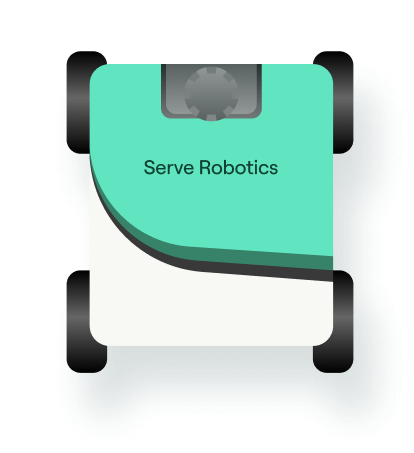
- Form Factor: Compact, low-profile chassis designed to share sidewalk space safely with pedestrians and comply with local size and weight regulations
Specific details such as battery runtime, exact payload capacity, and full sensor specifications have not been comprehensively disclosed in public materials, and figures should be treated as approximate until officially confirmed.
Comparison to Similar Robots
Within Serve Robotics: The Gen 3 is the current commercial generation of Serve Robotics' delivery platform. Earlier generations (Gen 1 and Gen 2) were used in prior pilots and informed the design improvements seen in Gen 3, including refined autonomy capabilities and hardware durability. Serve Robotics has publicly described Gen 3 as a significant step forward in operational readiness.
Competitors: The sidewalk delivery robot segment includes players such as Starship Technologies, whose smaller six-wheeled robot operates in college campuses and suburban neighborhoods globally, and Kiwibot, which has deployed on university campuses. Compared to Starship's robots, the Serve Gen 3 is generally described as larger and designed for higher-traffic urban corridors. Nuro focuses on road-based autonomous delivery rather than sidewalks, placing it in a different regulatory and operational category.
Market Context and Target Buyers
Serve Robotics operates a fleet-as-a-service model, partnering with delivery platforms and restaurant chains rather than selling robots directly to end consumers. The primary customer relationship is with Uber Eats, which integrates Serve's robots into its delivery network. This positions Serve Robotics in the enterprise and platform-partnership tier of the autonomous delivery market, targeting logistics operators, food delivery aggregators, and potentially retailers seeking to reduce last-mile delivery costs.
The economics of sidewalk robot delivery are generally positioned as cost-competitive with human couriers for short-distance, high-frequency delivery corridors, though exact pricing and margin structures are not publicly disclosed.
Deployments and Notable Customers
As of public reporting, the Serve Gen 3 operates commercially in Los Angeles, California, one of the first major U.S. cities to establish a regulatory framework permitting commercial sidewalk delivery robots. The deployment is conducted in partnership with Uber Eats, enabling customers using the Uber Eats app to receive orders via robot in supported zones. Serve Robotics has announced intentions to expand its fleet size and geographic footprint, with additional markets reportedly under consideration.
Serve Robotics went public on Nasdaq (ticker: SERV), raising its profile and providing capital to scale its Gen 3 fleet.
Future Outlook
Serve Robotics has publicly outlined plans to significantly grow its fleet of Gen 3 robots and expand into new cities. The company's roadmap, as described in investor communications, emphasizes scaling autonomous operations, reducing the need for remote human supervision, and broadening delivery partnerships beyond food. Advances in onboard AI and sensor fusion are expected to further improve the robot's ability to handle complex urban sidewalk environments. The broader sidewalk delivery robot market is anticipated to grow as more municipalities develop clear regulatory pathways, potentially accelerating Serve Gen 3 deployments across the United States.
Related videos

'Serve Robotics' brings autonomous deliveries to 14 Chicago neighborhoods with Uber Eats
WGN News

Tesla Optimus serves me popcorn at the Tesla Diner #fyp #tesla #optimus #tesladiner #teslarobot
Tesla Owners Silicon Valley

🏭Space Revolution: 1 KUKA Robot Serves 6 CNC Machines via Smart Linear Rail!
Jackson chen

Meet Serve Robotics | The Future of Robotic Delivery Food 🤖🚀 #shorts #2025 @MiracleMiles
Miracle Miles

👾🤖Robotic Baiters serve food in Ayodhya Robot Restaurant.🤖👾 #robbot #aneshira #youtube
Vlogger family with tips and tricks

Robot Waiter Deserves a Tip || ViralHog
ViralHog
Related entries
 Robot
RobotG1
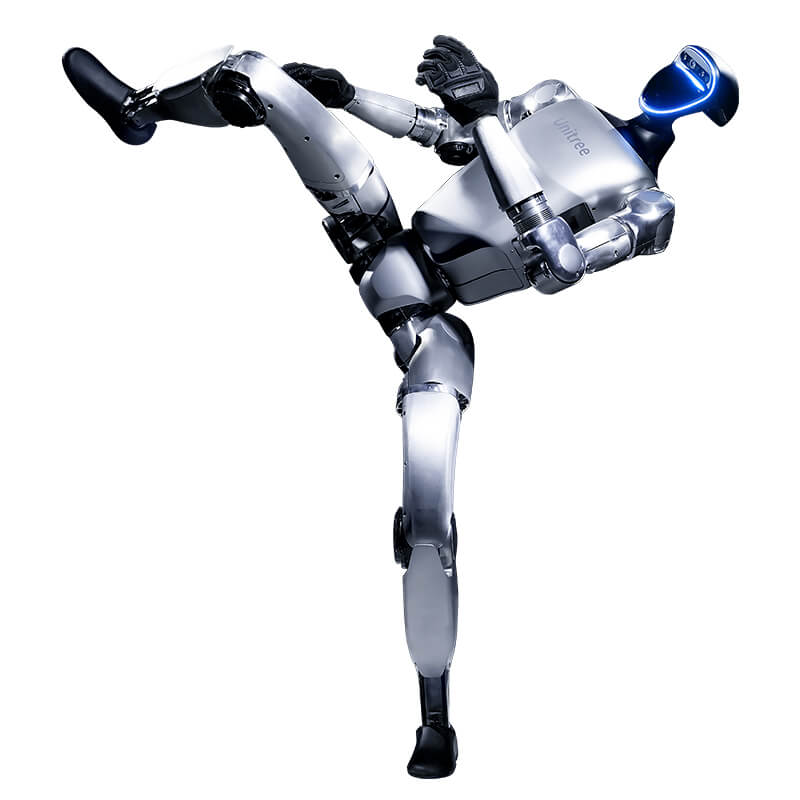
The Unitree G1 is a general-purpose humanoid robot developed by Unitree Robotics, a Chinese robotics company headquartered in Hangzhou. Standing approximately 1.32 meters tall and weighing around 35 kilograms, the G1 features 23 degrees of freedom and is capable of walking, running, recovering from falls, and performing dexterous manipulation tasks. It ships with SDK access, making it accessible to researchers and small-business operators seeking an affordable entry point into humanoid robotics. The G1 is widely regarded as one of the most competitively priced serious humanoid platforms available as of public reporting, positioning Unitree as a disruptive force in a market historically dominated by far more expensive systems. Its combination of mobility, recoverability, and open software access has attracted attention from academic institutions, robotics developers, and automation-focused startups worldwide.
4,298 views
 Robot
RobotUniversal Robots UR5e
The Universal Robots UR5e is a six-axis collaborative robot arm (cobot) belonging to Universal Robots' e-Series product line. Designed for light-to-medium industrial and laboratory tasks, it is widely used in assembly, pick-and-place, machine tending, quality inspection, and lab automation workflows. Universal Robots, a Danish company and a subsidiary of Teradyne, is one of the most recognized names in the collaborative robotics market. The UR5e is programmed using Universal Robots' PolyScope graphical interface on a teach pendant, making it accessible to operators without deep robotics expertise. Its built-in force/torque sensing, tool-center-point control, and a broad ecosystem of certified end-effectors and accessories (the UR+ platform) have made it a popular mid-range cobot choice across manufacturing, electronics, food handling, and research sectors.
3,824 views
 Robot
RobotQuicktron M100
The Quicktron M100 is a heavy-duty autonomous mobile robot (AMR) belonging to Quicktron Robotics' M-Series product line. It is designed for demanding material handling tasks in warehouses, distribution centers, and manufacturing environments, using an integrated lift mechanism to transport shelves and pallets autonomously across facility floors. Quicktron Robotics, a company with roots in China and a global commercial presence, positions the M100 as a high-capacity solution for operations that require moving heavier loads than lighter AMR models can accommodate. The M100 targets logistics operators and manufacturers seeking to automate goods-to-person or pallet-movement workflows at scale.
437 views
 Robot
RobotNVIDIA Jetson Orin NX
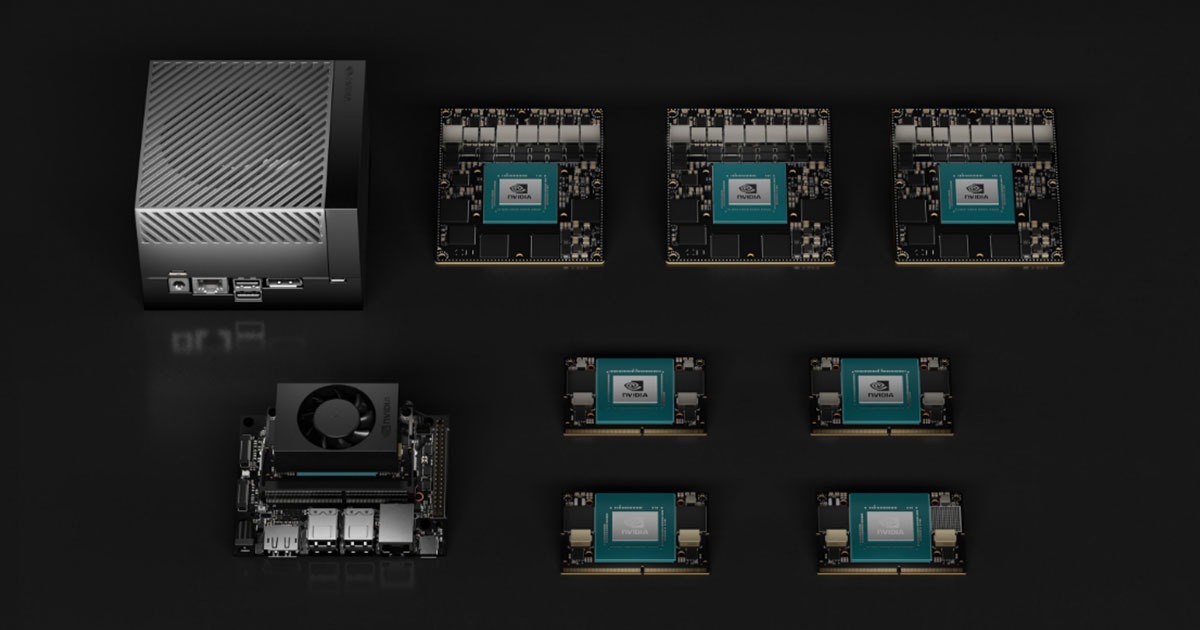
The NVIDIA Jetson Orin NX is a compact, SO-DIMM form-factor edge AI compute module designed for robotics, autonomous machines, and embedded vision applications. Manufactured by NVIDIA, it is available in 8 GB and 16 GB memory configurations and pairs an Ampere-architecture GPU with an 8-core Arm Cortex-A78AE CPU to deliver high-throughput on-device inference without relying on cloud connectivity. Positioned within NVIDIA's broader Jetson Orin family, the Orin NX targets developers and system integrators who need a balance of performance and power efficiency in a small footprint. It is commonly used in applications such as industrial inspection, autonomous mobile robots (AMRs), drone navigation, and smart edge devices where real-time AI inference is critical.
404 views