Security Robots
Security robots are autonomous or semi-autonomous machines designed to assist with physical security tasks such as surveillance, perimeter patrol, threat detection, and incident reporting. They are deployed across a wide range of environments—from corporate campuses and shopping malls to airports, warehouses, and outdoor industrial sites—serving as force multipliers for human security personnel. The market for security robots has grown steadily as organizations seek cost-effective, around-the-clock monitoring solutions that reduce reliance on human guards in repetitive or hazardous patrol roles. Advances in computer vision, thermal imaging, AI-based anomaly detection, and mobile robotics platforms are accelerating adoption, with industry observers broadly expecting continued expansion as the technology matures and unit costs decline.
Definition and Defining Traits
Security robots are purpose-built robotic platforms—ground-based, aerial, or hybrid—engineered to perform surveillance, patrol, and threat-detection functions with minimal human intervention. Unlike general-purpose service robots, security robots are distinguished by several core characteristics:
- Continuous operation: Designed to run for extended shifts, often 24/7, without fatigue.
- Multi-sensor payloads: Typically equipped with HD cameras, thermal/infrared imagers, microphones, and sometimes LiDAR or radar for environmental awareness.
- Autonomous navigation: Capable of following pre-programmed patrol routes or dynamically adapting to obstacles using SLAM (Simultaneous Localization and Mapping) and related techniques.
- Real-time data transmission: Streaming video, sensor data, and alerts to remote monitoring centers or security operations centers (SOCs).
- Anomaly detection: Leveraging AI and machine learning to flag unusual activity, unauthorized access, or environmental hazards such as smoke or elevated temperatures.
Key Use Cases
Security robots serve a broad spectrum of applications:
- Corporate and campus security: Indoor patrol of office buildings, data centers, and university campuses, monitoring for intrusions, tailgating, or after-hours activity.
- Retail and public venues: Deterrence and incident documentation in shopping malls, stadiums, and transit hubs.
- Critical infrastructure: Perimeter monitoring at power plants, oil and gas facilities, ports, and airports where consistent coverage is essential.
- Outdoor industrial sites: Long-range patrol of construction sites, parking lots, and logistics yards, often in challenging weather conditions.
- Event security: Temporary deployment at large public gatherings to supplement human officers.
- Aerial surveillance: Drone-based platforms provide rapid wide-area coverage and can be dispatched to investigate ground-level alerts.
Market Landscape and Growth Trends
Industry estimates broadly suggest that the security robotics sector is among the faster-growing segments within the broader service robotics market, driven by labor shortages in the security industry, rising concerns about workplace safety, and declining hardware costs. Demand is particularly strong in North America, Europe, and parts of Asia-Pacific. The COVID-19 pandemic accelerated interest in contactless, automated monitoring solutions, and that momentum has largely been sustained. Analysts generally characterize the outlook as positive, though widespread enterprise adoption still faces hurdles related to regulatory approval, liability frameworks, and public acceptance.
Leading Manufacturers and Notable Robots
Several companies have established themselves as significant players in this category:
- Knightscope (USA): One of the most recognized names in the field, Knightscope's K5 is a large, egg-shaped autonomous data machine used extensively in corporate and public environments. It collects 360-degree video, thermal data, and license plate information, reporting anomalies to a remote monitoring dashboard.
- Cobalt AI (formerly Cobalt Robotics, USA): The Cobalt Robot and its successor CR-1 are indoor security and facilities robots combining autonomous patrol with on-demand human telepresence, allowing remote security staff to interact with people on-site in real time.
- SMP Robotics (USA/Russia): Specializes in outdoor patrol robots, including the Security Robot S5 PTZ, which features pan-tilt-zoom cameras and thermal sensors for perimeter security at industrial and commercial sites. SMP also offers broader outdoor patrolling platforms with video and thermal surveillance tailored for security service companies.
- OTSAW (Singapore): The O-R3 is a hybrid ground-and-air security robot capable of deploying a tethered drone for elevated surveillance, designed for outdoor environments.
- Nightingale Security (USA): The Blackbird Robotic Aerial Security Drone represents the aerial segment, providing autonomous drone-based surveillance for large outdoor areas.
- Boston Dynamics (USA): While Spot is a general-purpose quadruped, it has been widely adopted in security and inspection roles, valued for its ability to navigate complex terrain, carry sensor payloads, and operate in environments inaccessible to wheeled robots.
Common Technical Challenges
Despite significant progress, security robots face a number of persistent technical and operational challenges:
- Navigation in dynamic environments: Crowds, temporary obstacles, and unpredictable human behavior can confuse autonomous navigation systems.
- Adverse weather performance: Rain, fog, extreme temperatures, and direct sunlight can degrade camera and sensor performance, particularly for outdoor units.
- Battery life and charging logistics: Most ground robots require periodic recharging, creating coverage gaps unless charging infrastructure is carefully planned.
- False positive rates: AI-based anomaly detection systems can generate excessive alerts, leading to alert fatigue among monitoring staff.
- Privacy and legal compliance: Deployment in public or semi-public spaces raises complex questions around data collection, facial recognition use, and compliance with local privacy laws.
- Cybersecurity: As networked devices, security robots themselves can become attack surfaces if not properly secured.
Future Outlook
The trajectory of security robotics points toward increasingly capable, interconnected systems. Key trends shaping the near-term future include:
- Greater AI autonomy: Improved on-device inference allowing robots to make more nuanced threat assessments without constant cloud connectivity.
- Human-robot teaming: Tighter integration between robotic platforms and human operators, with robots handling routine patrol while humans focus on decision-making and response.
- Multi-robot coordination: Fleets of ground and aerial robots working in concert to provide seamless coverage across large or complex sites.
- Regulatory maturation: Clearer legal frameworks around autonomous security systems are expected to reduce deployment friction over time.
- Expanded sensor fusion: Combining visual, thermal, acoustic, and chemical sensing to detect a wider range of threats.
As costs continue to fall and capabilities improve, security robots are expected to transition from premium, large-enterprise deployments toward broader adoption by mid-market organizations and public agencies.
Related videos
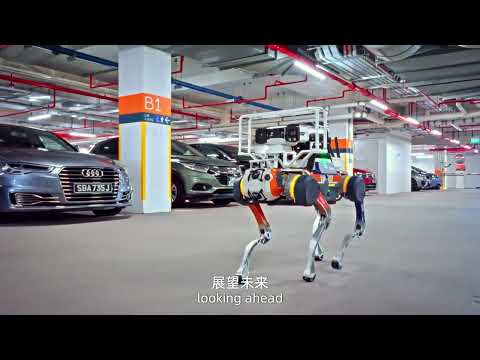
Robotic Dog Security Patrol Solution Deployed in Singapore!
QuickNeuron

Robotic dogs patrol streets of Mexico's Monterrey for World Cup security
TRT World

IGA security guard charged with manslaughter | CTV News Montreal at Six for Wednesday, June 17, 2026
CTV News

Robot dogs and high-tech drones — inside FIFA World Cup security
NewsNation

AI Ground Robots Go First: The $10.2M Robotics Startup Changing Defence, Rescue & Security
RoboPhil

A look at the high tech security in place for the World Cup including 'Spot' the robot!
WFAA
Recent news
Community buzz (Reddit)
Fully autonomous valet robot that parks on its own
r/nextfuckinglevel · ▲ 99,789
This model's robotic costume
r/nextfuckinglevel · ▲ 81,596
Man Mimics Robot with INSANE Body Control
r/nextfuckinglevel · ▲ 78,022
Olaf robot at Paris Disneyland
r/Damnthatsinteresting · ▲ 74,199
Japanese researchers at the University of Tsukuba created CirculaFloor, robotic tiles that let you walk infinitely in VR without ever leaving your spot.
r/Damnthatsinteresting · ▲ 72,696
Related entries
Humanoid Robots
Humanoid robots are machines designed to replicate the general form and movement of the human body, typically featuring a bipedal stance, two arms, and a head-like sensor cluster. By mirroring human morphology, they are engineered to operate in environments and with tools originally built for people, making them uniquely versatile across manufacturing, logistics, healthcare, and service settings. The humanoid robot market is widely regarded as one of the fastest-growing segments in robotics. Driven by advances in AI, actuator technology, and battery energy density, a new generation of commercially oriented humanoids has emerged from companies such as Tesla, Boston Dynamics, Figure AI, and Unitree Robotics, among others. Industry analysts broadly expect adoption to accelerate as unit costs fall and software capabilities mature.
380 views
Robot Wheels & Wheel Sets
Robot wheels and wheel sets are foundational mechanical components that enable ground-based mobile robots to navigate their environments. Ranging from standard rubber drive wheels to specialized omnidirectional and mecanum wheel assemblies, these parts are selected based on the robot's required motion profile, payload, surface conditions, and precision demands. They are essential building blocks for autonomous mobile robots (AMRs), differential-drive platforms, research rovers, and educational kits alike. The market for robot wheel components is expanding alongside the broader mobile robotics industry, driven by surging demand for warehouse automation, last-mile delivery platforms, and research-grade robot development. Manufacturers such as Nexus Robot supply purpose-engineered wheel sets—including mecanum wheel assemblies—that allow integrators and developers to rapidly prototype or deploy capable mobile platforms without designing drivetrain hardware from scratch.
364 views
Companion Robots
Companion robots are consumer and clinical robots designed primarily to provide emotional support, social interaction, and everyday assistance to their users rather than to perform industrial or precision tasks. They typically combine expressive movement, voice interaction, and sensor-based responsiveness to create a sense of presence and personality, making them feel less like tools and more like social agents. The companion robot market spans a wide range of applications—from therapeutic robots used in eldercare and mental health settings to home companions that entertain children or assist busy households. As populations age in many countries and demand for emotionally intelligent technology grows, industry observers expect this category to expand significantly in the coming years.
333 views
Mobile Robots
Mobile robots are autonomous or semi-autonomous machines capable of moving through physical environments to perform tasks without being fixed to a single location. Unlike stationary industrial arms or embedded systems, mobile robots navigate floors, corridors, and outdoor terrain using a combination of sensors, mapping algorithms, and onboard compute, making them uniquely versatile across warehouses, hospitals, retail spaces, and beyond. The mobile robot market has expanded rapidly as e-commerce growth, labor shortages, and advances in simultaneous localization and mapping (SLAM) technology have lowered the barriers to deployment. Industry analysts broadly agree that demand for mobile platforms—spanning goods-to-person AMRs, hospital logistics robots, and quadruped research platforms—is among the fastest-growing segments in robotics, with adoption accelerating across both developed and emerging economies.
332 views