Let's compare
LD-250 ESD
Omron Robotics
Not yet assessed
- Height
- Width: 800 mm, Height: 300 mm
- Payload
- —
- Verified autonomy
- not assessed
- Real deployment
- not assessed
- Status
- —
- Price
- —
LD-250 ESD
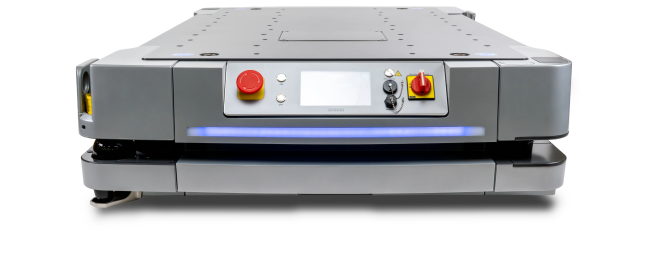
Omron RoboticsThe OMRON LD-250 ESD is an autonomous mobile robot (AMR) designed for industrial material handling, capable of carrying up to 250 kg (or up to 500 kg with Cart Transporter integration) at speeds up to 1.2 m/s. It uses SLAM-based natural feature navigation with Acuity vision localization, requiring no floor magnets or tape, and integrates with Omron's Fleet Manager, MobilePlanner, and enterprise systems (MES, ERP, WMS). The ESD variant is specifically designed for electrostatic discharge-sensitive production environments. Note: several extracted facts (arxiv papers on endoscopic submucosal dissection and embodiment-adaptive transformers) are clearly unrelated to the LD-250 ESD AMR and have been excluded from reconciliation. Pricing evidence is conflicting and low-confidence.
Availability
Specification
- maximum_payload
- 250 kg (standard); up to 500 kg with Cart Transporter integration
- maximum_speed
- 1.2 m/s (1200 mm/s)
- battery_run_time
- ~13 hours (no payload); ~10 hours (full payload)
- battery_capacity
- 72 Ah (nominal), 22–30 VDC
- battery_charge_time
- ~4 hours (full); 2 h 10 m (20–80%)
- robot_weight
- 62 kg
- dimensions
- Width: 800 mm, Height: 300 mm
Price
No public price — contact the supplier for a quote.
Good · Bad · Ugly
Evidence-graded claims from the Omron Robotics deep report
Omron's LD Series AMRs navigate and transport materials fully autonomously using onboard sensors and OMRON FLOW Core fleet management software, with no human teleoperation performing the task.
The autonomy verdict (confidence 0.88) is derived entirely from vendor sources [1][8] and the dossier's own synthesis — no independent third-party test, customer case study, or journalist field report substantiates the specific claim of full autonomy without human oversight.
from Omron Robotics deep report →Next-generation LD-150 and LD-300 AMRs will begin shipping in Q4 2026, featuring higher payload capacity, fast wireless charging, advanced safety, and OMRON FLOW Core integration.
The Q4 2026 shipping timeline and feature set are reported by RoboticsTomorrow [10] and Yahoo Finance [11], but both articles reproduce the company's own press release verbatim — no independent reviewer has tested or confirmed the specifications or the shipping date.
from Omron Robotics deep report →Omron's parallel robots (Hornet Explore, iX4, Quattro series) achieve cycle times of 0.30–0.42 seconds at 2 kg payload, with payloads up to 15 kg.
Cycle time and payload figures come exclusively from Omron's own product pages [6] — no independent benchmark, trade publication test, or customer validation of these specifications appears in the dossier.
from Omron Robotics deep report →Omron's TM S Series collaborative robots support high-payload collaborative assembly tasks and are paired with tmflow software for programming.
The TM S Series capabilities and tmflow software upgrade are announced via Omron's European news page [9], which is a vendor source — no independent customer deployment report or third-party evaluation of collaborative performance is present in the dossier.
from Omron Robotics deep report →Omron robot pricing ranges from approximately $10,000 to $90,000+ new, with used models typically 20–40% below new prices.
Pricing figures come from a third-party reseller/commerce blog [2] rather than Omron's official site (which does not publish prices), and the same source internally cites two inconsistent ranges ($25k–$60k average vs. $10k–$90k+ full range), reducing reliability.
from Omron Robotics deep report →
Omron robots are highly reliable and built to last in demanding production environments, supported by standard and custom service contracts across 9 POC centers.
Independent Reddit community threads [12][13][14] report reliability concerns after 10+ years of operation, directly qualifying the vendor's reliability narrative [5][8]; the 9 POC centers and service contract details are vendor-only claims with no independent corroboration.
from Omron Robotics deep report →Omron's parallel robots are deployed at scale in automotive, electronics, packaging, life sciences, and EV manufacturing industries.
Target industries are listed on Omron's own marketing pages [1][4][8] — the dossier contains no independent customer testimonials, analyst deployment counts, or journalist site visits confirming actual at-scale deployment in any of these sectors.
from Omron Robotics deep report →
About the company
Editorial directory of real robot products from leading global manufacturers. Each entry links to the manufacturer's official page.