Let's compare

UR3e
Universal Robots
Not yet assessed
- Height
- —
- Payload
- —
- Verified autonomy
- not assessed
- Real deployment
- not assessed
- Status
- —
- Price
- —
UR3e
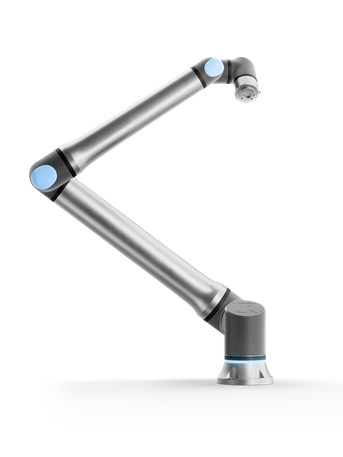
Universal RobotsThe UR3e is Universal Robots' smallest e-Series collaborative robot arm, featuring a 3 kg payload, 500 mm reach, ±0.03 mm repeatability, 6 DOF, and 11.2 kg body weight. It is designed for light-duty tasks such as assembly, dispensing, pick-and-place, and electronics work in human-collaborative environments, with an infinite-rotation end joint as a distinguishing hardware feature. Pricing from resellers ranges approximately $23,000–$35,000 USD for the arm alone, with total integration costs potentially doubling that figure. Community and research sources confirm real-world deployment in HRI research, nuclear inspection, and clinical robotics, but also document reliability issues including abrupt stops, RTDE pipeline overflows, F/T sensor drift, and PROFINET connectivity problems. The UR3e executes programmed tasks autonomously once set up; humans are not required to perform or drive the task itself during operation.
Availability
Specification
- payload
- 3 kg
- reach
- 500 mm
- degrees of freedom
- 6 rotating joints
- robot weight
- 11.2 kg
- power consumption
- Average 100 W
- controller power input
- 100–240 VAC, 47–440 Hz
- controller weight
- 12 kg
Price
No public price — contact the supplier for a quote.
Good · Bad · Ugly
Evidence-graded claims from the Universal Robots deep report
UR cobots operate autonomously on programmed industrial tasks (pick & place, welding, machine tending, assembly, etc.) without a human performing or driving the task during operation.
Wikipedia (independent) and Automate.org confirm cage-free autonomous task execution; community criticism on Reddit [15][16] targets programming/integration difficulty, not human-in-the-loop task performance, corroborating autonomous operation at the task level — though setup, programming, and maintenance overhead remain non-trivial.
from Universal Robots deep report →Universal Robots is the cobot market leader with approximately 40–50% market share and 50,000+ units installed worldwide.
Automate.org (independent industry association) [14] and Wikipedia [13] both independently cite 50,000+ installations and ~40–50% market share as of 2022; the specific figures have not been re-verified post-2022, so current share may have shifted.
from Universal Robots deep report →UR cobots can operate collaboratively without safety cages or fencing, making them the first commercially viable cobot of this type.
Wikipedia [13] independently confirms UR as the pioneer of commercially viable cage-free collaborative robots; safety certifications (ISO 10218, TÜV, UL 1740) are confirmed across official product pages [2][3][4], though independent third-party test reports of real-world cage-free deployments are not cited in the dossier.
from Universal Robots deep report →
UR cobots deliver up to 65% higher joint accelerations and up to 37% faster cycle times versus the prior generation, with the UR15 achieving up to 5 m/s maximum speed.
These figures come exclusively from UR's own official product pages [2][4] with no independent benchmark, third-party test, or customer validation cited in the dossier; furthermore, community sources [15][16] note UR cobots are slow and inaccurate compared to SCARA alternatives, suggesting the vendor's speed claims are relative only to prior UR generations.
from Universal Robots deep report →Total system cost (robot arm + gripper + integration/setup) is typically approximately 2x the base robot arm price.
Multiple commerce sources [6][7] consistently cite the ~2x multiplier, but these are reseller/distributor sites rather than independent audits or customer case studies; community sources [19] suggest real-world integration costs and ongoing support costs can significantly exceed this estimate, making the figure plausible but unverified by neutral parties.
from Universal Robots deep report →The UR+ Ecosystem and partnerships (e.g., Rapid Robotics, Teradyne/Flex) meaningfully expand UR cobot deployment capabilities and scale.
The Rapid Robotics partnership is reported by a trade news outlet [10], providing some independent corroboration, but the dossier contains no independent evidence of deployment outcomes, scale, or customer results from these partnerships — only vendor announcements and a single trade press item.
from Universal Robots deep report →
UR Care maximizes uptime and reduces total cost of ownership (TCO), with UR cobots trusted for reliable long-term deployment across industries.
Independent community sources [19][20] report real-world deployment failures including overpromising by integrators, overly rosy cost projections, lack of long-term support, and insufficient training at handoff — directly contradicting the vendor's reliability and TCO claims, which are sourced only from UR's own marketing [1][11].
from Universal Robots deep report →
About the company
Editorial directory of real robot products from leading global manufacturers. Each entry links to the manufacturer's official page.