Let's compare
myCobot 320 Pi
Elephant Robotics
Not yet assessed
- Height
- —
- Payload
- —
- Verified autonomy
- not assessed
- Real deployment
- not assessed
- Status
- —
- Price
- —
myCobot 320 Pi
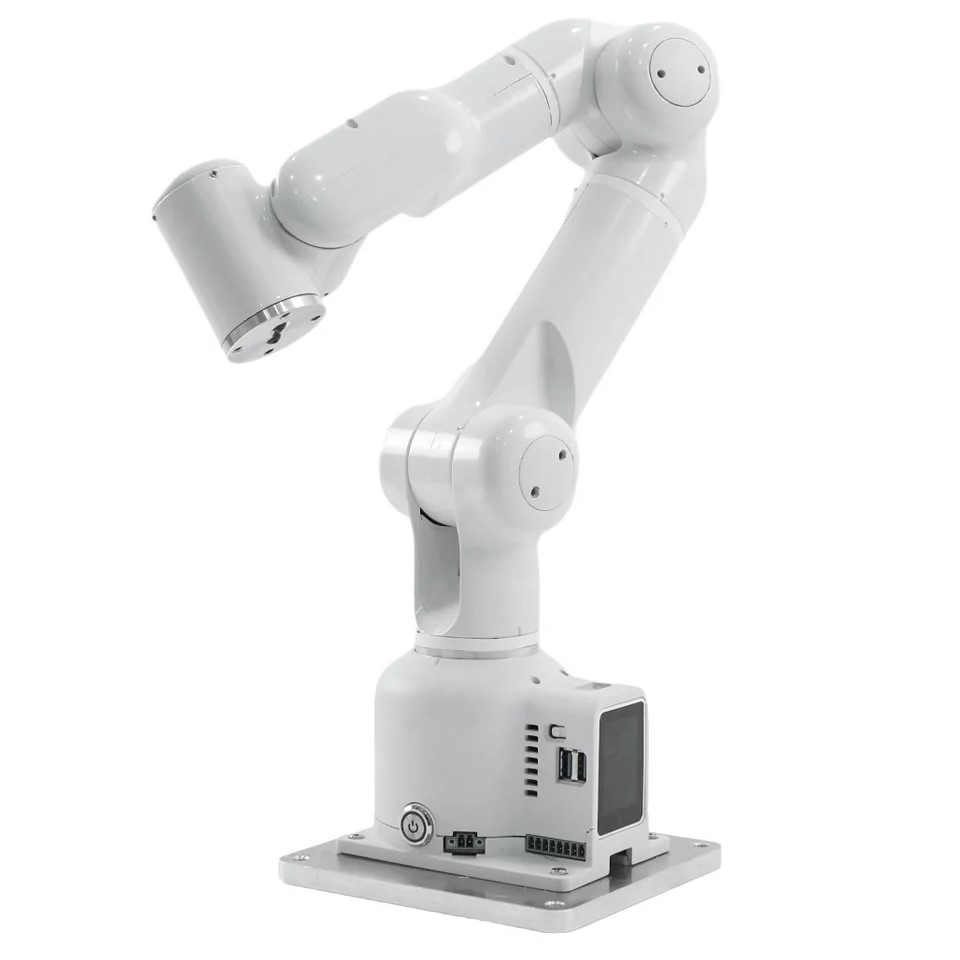
Elephant RoboticsThe myCobot 320 Pi is a 6-DOF collaborative robotic arm manufactured by Elephant Robotics (Shenzhen, China), powered by a Raspberry Pi 4B processor and priced at approximately $2,499 USD. It features a 320–350mm working radius, 1kg payload capacity, and 1mm repeatability, targeting education, scientific research, and light industrial prototyping. The arm supports Python, ROS, myBlockly, and RoboFlow visual programming, and has been sold to 60+ countries with 5,000+ units shipped. It is a programmable, human-programmed tool arm — not an autonomous system — requiring human programming and supervision to perform any task.
Availability
Specification
- degrees_of_freedom
- 6 DOF
- payload_capacity
- 1 kg (per official/commerce primary listing); 250g per one third-party listing
- weight
- 850 grams (arm body)
- market_reach
- 60+ countries, 5,000+ units shipped (whole myCobot series)
Price
No public price — contact the supplier for a quote.
Good · Bad · Ugly
Evidence-graded claims from the Elephant Robotics deep report
The ultraArm's speed must be reduced to below 50% when the load exceeds 500 g — implying meaningful payload and speed limitations relative to marketing positioning.
This operational constraint is explicitly stated in the ultraArm product page [6] by the vendor itself, constituting a self-disclosed technical limitation that directly qualifies the arm's marketed capabilities; no independent test is needed to flag this as a material constraint, though real-world performance at these limits remains unverified.
from Elephant Robotics deep report →
The robot arms (myCobot, mechArm, ultraArm, myCobot Pro) autonomously execute tasks — pick-and-place, engraving, drawing, AI vision-guided sorting — without a human performing or driving those tasks during operation.
Vendor sources [1][5][6][11] describe these task capabilities, and one YouTube review [4] confirms the ~$600 price and 6-axis form factor, but no independent operational test, customer deployment report, or third-party benchmark confirms sustained autonomous task execution in practice; general community evidence [12][15][16] warns of a significant gap between demo and production reliability.
from Elephant Robotics deep report →The product line spans a payload range of 0.25 kg to 10 kg, with prices from $199 to $21,999, covering 4-axis and 6-axis configurations.
Payload range and prices are stated on the official shop and website [1][2][3][6][11], and the YouTube review [4] independently corroborates the ~$600 entry price and 6-axis form factor, but payload specs and the upper price/payload figures have not been verified by any independent test or third-party source.
from Elephant Robotics deep report →Elephant Robotics has established academic partnerships with the University of Melbourne, Tsinghua University, NRNU (Russia), and South China University of Technology, and has received recognition from Microsoft and Intel.
These partnerships are listed solely on Elephant Robotics' own official website [1][11] at confidence 0.90; no independent university announcement, joint publication, Microsoft/Intel press release, or third-party confirmation of any of these relationships appears in the dossier.
from Elephant Robotics deep report →
Mercury humanoid robots (A1/B1/X1) have entered batch delivery — i.e., are in serial production and shipping to customers at scale.
The only source for batch delivery is Elephant Robotics' own official website [1][11]; no independent customer, journalist, or third-party reviewer has confirmed receipt, volume, or operational use of Mercury units, and the dossier explicitly flags confidence at only 0.88 with no corroborating independent evidence.
from Elephant Robotics deep report →Elephant Robotics products are suitable for commercial deployment with simplified setup and reduced technical barriers, making them viable for manufacturing and commercial applications beyond education/R&D.
No independent customer case study, manufacturer deployment report, or third-party audit confirms commercial-scale deployment; community sources [12][15][16] specifically highlight that real-world industrial deployment is far harder than demo performance, high maintenance costs, and negative ROI are common — and no Elephant Robotics-specific counter-evidence exists in the dossier.
from Elephant Robotics deep report →
About the company
Editorial directory of real robot products from leading global manufacturers. Each entry links to the manufacturer's official page.