Let's compare
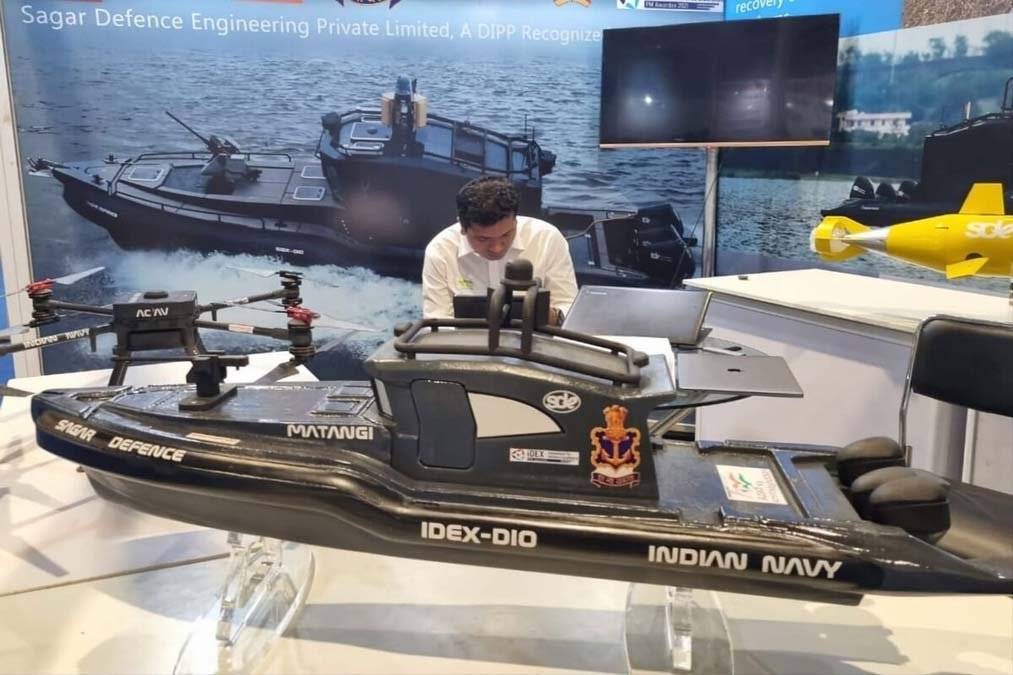
Autonomous Patrol Boat
Sagar Defence Engineering
Not yet assessed
- Height
- —
- Payload
- —
- Verified autonomy
- not assessed
- Real deployment
- not assessed
- Status
- —
- Price
- —
Autonomous Patrol Boat
Sagar Defence EngineeringThe extracted facts span multiple distinct autonomous patrol boat systems and research projects rather than a single unified system: (1) Sagar Defence Engineering's (India) Fast Interceptor Craft (FIC) USVs delivered to the Indian Navy with weaponized swarm capability; (2) the Royal Australian Navy's Patrol Boat Autonomy Trial (PBAT) using the decommissioned HMAS Maitland (renamed Sentinel), a 57m Armidale-class vessel autonomously navigated using Greenroom Robotics' GAMA software; (3) various academic/research USV platforms (Roboat II, WAM-V, FURUNO RL+GP+MPC boat, MPC+CBF planner); and (4) smaller hobbyist/commercial platforms (3D-printed ArduPilot boat, Platypus LLC water quality ASV, HI Romulus 25 USMC USV). The most independently verified autonomous patrol boat achievement is the PBAT Sentinel trial (March–April 2024), which demonstrated autonomous navigation of a large vessel with an onboard safety crew for manual override. Sagar Defence's FIC claims AI-driven autonomy and multi-vessel control from a single station, but independent verification of fully autonomous (uncrewed) task execution is limited; the 'controlled from a single station' framing suggests supervised or remote-assisted operation for weapons employment.
Availability
Specification
- speed
- >50 knots (vendor/news claim); separate platform (Romulus 25 / HI) claims >25 knots
Price
No public price — contact the supplier for a quote.
Good · Bad · Ugly
Evidence-graded claims from the Sagar Defence Engineering deep report
Sagar Defence has established a co-development and co-production partnership with Liquid Robotics (a Boeing company) and inaugurated a dedicated manufacturing plant in Pune for advanced maritime systems.
The Liquid Robotics official press release [11] — an independent Boeing subsidiary source — directly confirms both the co-development partnership and the Pune facility inauguration, though it does not independently validate the autonomy level of systems produced there.
from Sagar Defence Engineering deep report →
Sagar Defence has delivered USVs to the Indian Armed Forces (Indian Navy as primary customer, Indian Army as secondary, Indian Coast Guard as tertiary).
A company Facebook post [8] and a YouTube commerce video [3] reference deliveries to Indian Armed Forces, but these are vendor-controlled channels; no independent Indian Navy/Army/Coast Guard procurement announcement, contract notice, or third-party news report independently confirms specific deliveries or quantities.
from Sagar Defence Engineering deep report →Sagar Defence has raised $28.8M in total funding and reports ₹100–500 Cr in revenue for FY2025, with investors including ONGC and IDBI Capital Markets.
PitchBook [9] reports the $28.8M funding figure and Tracxn [6] reports the revenue range and investor list, but both are aggregator/commerce platforms that rely on company-disclosed data; no audited financial statements, stock exchange filings, or independent financial journalism independently verifies these figures.
from Sagar Defence Engineering deep report →Sagar Defence's USV platforms support real-time maritime data collection with subsea-to-satellite/land connectivity, sensor hosting/towing, and maritime incursion detection as operational capabilities.
These capabilities are consistently described across the official website [1][5], LinkedIn [4], and YouTube [3], but all sources are vendor-controlled; the Liquid Robotics partnership [11] lends indirect credibility to the maritime systems architecture, yet no independent field test, customer report, or operational trial result confirms these capabilities as demonstrated in practice.
from Sagar Defence Engineering deep report →
Sagar Defence's autonomy architecture is built on a proprietary semiconductor chipset with integrated software costing approximately ₹25,000, enabling self-tuning command controls for heading, speed, depth, height, attitude, dynamic positioning, and hovering.
These specific technical specifications (chipset cost, self-tuning controls across all axes) are sourced exclusively from vendor YouTube [3] and LinkedIn [4] commerce channels; no independent hardware review, patent filing, or third-party technical assessment confirms these specifications or the chipset's existence as described.
from Sagar Defence Engineering deep report →
About the company
Editorial directory of real robot products from leading global manufacturers. Each entry links to the manufacturer's official page.