robolaunch
Founded 2020 · · robolaunch.io
SnapshotCompany claim
Enabling Scalable AI for the Real World. Cloud-Native Platform for Production AI powering industrial automation, enterprise operations, and autonomous systems.
- Founded
- 2020
- HQ
- Not disclosed
- Models
- 1
- Categories
- 1
Product families
Is this your company? Claim this profile to add verified data, respond to our analysis, and upgrade claims to Verified.
Claim this profile1. Executive Overview {#executive-overview}
robolaunch, founded in 2020, is a cloud-native AI and robotics platform company focused on bridging the gap between experimental AI prototypes and production-grade industrial deployment. The company's core proposition is the integration of two tightly coupled layers: Vision AI — an inline defect detection and surface inspection system — and AI Infrastructure, the cloud-to-edge orchestration backbone that trains, deploys, and sustains those models at production scale. By its own account, robolaunch has deployed more than 20 Vision AI systems on live production lines and orchestrates over 100 GPUs across cloud and edge environments, placing it squarely in the operational rather than purely experimental tier of industrial AI companies.
The company's primary validated market is automotive manufacturing, where its Vision AI Surface Inspection product addresses all four major production stages: Press Shop, Body-in-White (BIW), Paint Shop, and Final Assembly. Third-party coverage from Metrology and Quality News (December 2025) confirms the company's real-time inline surface defect detection work for automotive manufacturing, providing independent corroboration of its flagship use case. Earlier visibility from the Open Robotics Discourse community (July 2022) and a public GitHub repository document the company's origins in cloud robotics infrastructure, showing a coherent evolution from ROS-based robotics tooling toward production AI systems.
Gaps worth noting: robolaunch does not publicly disclose its country of incorporation or headquarters, its revenue figures, or its named customer list. These are addressable through direct disclosure and are noted where relevant below.
Latest news
- KEENON Humanoid Pours Drinks at GCS 2026, 100,000 Others Run HotelsYanko Design·2026-06-15GENERAL
2. The Company Story {#the-company-story}
robolaunch was established in 2020 with an explicitly stated mission: to move AI out of research settings and into reliable, production-grade industrial operation. The founding thesis, as articulated on the company's own About page, is that AI systems must be engineered to tolerate imperfect data, continuously changing conditions, and the unforgiving cycle-time constraints of real manufacturing environments — a production-first philosophy rather than a pilot-first one.
The company's early public footprint is traceable to the cloud robotics space. A July 2022 thread on Open Robotics Discourse and a public GitHub repository — titled "robolaunch: a Cloud Robotics Platform that provides end-to-end infrastructure, software stack and tools" — document an initial positioning as a ROS-compatible cloud robotics infrastructure provider. This is a meaningful origin point: ROS (Robot Operating System) expertise implies deep familiarity with robotics middleware, sensor integration, and distributed compute, all of which are directly relevant to the edge-inference architecture underpinning the current Vision AI product.
By the mid-2020s, robolaunch had sharpened its focus considerably. The current About page presents a refined dual-layer model — Vision AI as the application layer, AI Infrastructure as the foundation — and claims over 20 Vision AI systems deployed in live production environments, with more than 100 GPUs orchestrated across cloud and edge nodes. The December 2025 coverage in Metrology and Quality News marks a public commercial milestone, specifically citing real-time inline surface defect detection for automotive manufacturing. The company's slogan — "AI, Robotics, and Cloud—working together to make automation smarter, faster, and more scalable" — reflects the integrated systems philosophy that distinguishes its positioning from single-layer AI tool vendors.
Not yet disclosed: the company's country of incorporation, total headcount, or funding history. Robolaunch is invited to claim or correct these details for inclusion in future updates.
3. Product Portfolio {#product-portfolio}
Products & versions


robolaunch's current public-facing product lineup organizes around two named offerings: Vision AI and AI Infra. These are not independent products but interdependent layers of a unified system — a design decision the company makes explicit in its About page.
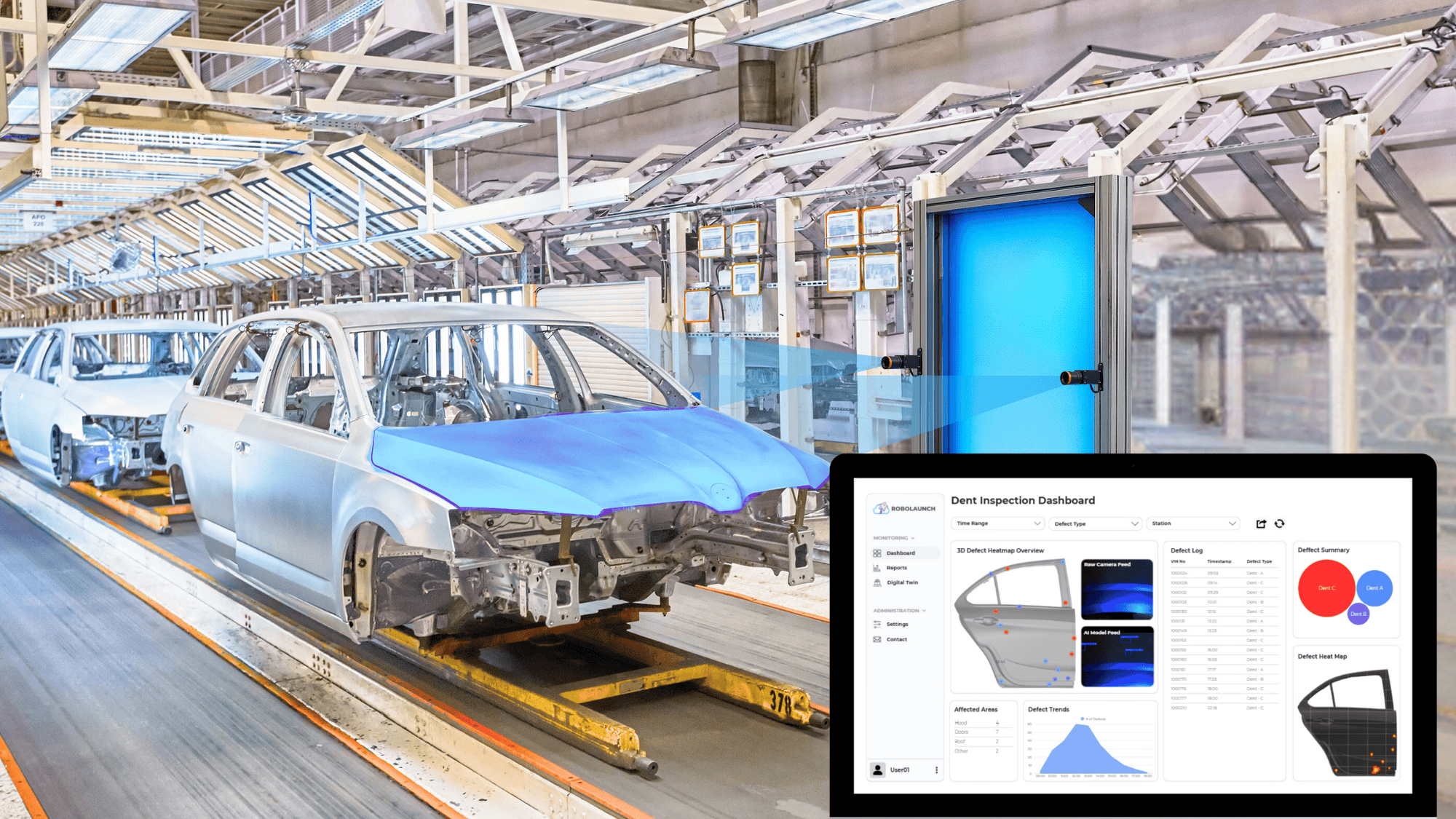
Vision AI Surface Inspection is the flagship application product. It is an AI-powered inline inspection system engineered for automotive production lines, claiming sub-millimeter precision defect detection and 98% detection accuracy on reflective and curved panels — two of the most technically demanding surface types in automotive manufacturing. The system is process-specific: distinct AI models are configured for Press Shop, Body-in-White, Paint Shop, and Final Assembly stages, acknowledging that defect types, surface conditions, and cycle-time tolerances differ materially across these environments. A simulation-driven synthetic data pipeline underpins model training, which is a practical architectural choice given the difficulty of acquiring sufficient labeled defect data from live lines. The hardware system is described as configurable and modular, with a "drop-in installation" integration footprint designed to minimize disruption to existing production infrastructure.
AI Infra is the cloud-native orchestration layer that trains, deploys, monitors, and scales the Vision AI models. It supports the 100+ GPU orchestration claim across cloud and edge environments and is positioned as the backbone that makes Vision AI systems stable at full production speed — not just during pilots. This layer reflects robolaunch's cloud robotics heritage and differentiates the company from pure computer-vision vendors who deliver models without the operational infrastructure to sustain them.
The portfolio is currently concentrated on factory and automotive use cases. The company's area-served tags include Automotive, Defense, Electronics, and Manufacturing broadly, suggesting potential expansion beyond the automotive inspection use case that currently anchors the product story.
4. Technology Stack {#technology-stack}
robolaunch's technology stack is partially documented through its product specifications and company descriptions, with a number of reasonable inferences drawable from the available data.
Verified from product specs and company descriptions: The Vision AI Surface Inspection system delivers sub-millimeter (sub-mm) precision and 98% detection accuracy on reflective and curved automotive surfaces. It operates in real-time inline at production cycle speeds. The underlying engine is described as a "deep-learning engine for complex automotive surfaces," and model training relies on a simulation-driven synthetic data pipeline — meaning the company generates artificial training data through simulation to supplement or replace scarce real-world labeled defect images. The hardware layer is modular and configurable, suggesting a camera/sensor array that can be adapted to different line geometries.
Our read: The use of synthetic data pipelines strongly implies a simulation environment — likely leveraging physics-based rendering or domain randomization — that generates photorealistic defect samples across surface types. This is a well-established technique in industrial inspection to overcome the class imbalance problem (real defects are rare by design). The process-specific AI model architecture (separate models for Press, BIW, Paint, Assembly) suggests the company avoids a single generalist model in favor of fine-tuned, stage-specific inference — a defensible production engineering choice that trades model count for accuracy.
Our read: The AI Infrastructure layer, given the company's ROS and cloud robotics origins visible on GitHub, likely draws on Kubernetes-based container orchestration or comparable cloud-native tooling to manage GPU workloads across cloud and edge nodes. The 100+ GPU orchestration claim at this company scale implies a multi-tenant or multi-customer deployment model rather than single-site infrastructure.
Our read: Edge inference for real-time inline performance at production cycle speeds implies low-latency model serving, likely at the facility edge rather than round-tripping to central cloud — consistent with the company's stated "cloud-to-edge" architecture.
Limited public technical detail is available on specific hardware platforms, sensor types, communication protocols, or ML framework choices. Robolaunch is invited to share additional technical documentation for inclusion.
5. Research, Papers, Authors, Labs {#research-papers}
Company-linked papers
robolaunch does not appear to be a research-publishing organization in the academic sense. No peer-reviewed papers, preprints, or named research authors are attributable to the company in the available data. This is consistent with the company's explicit positioning as a production-first systems integrator rather than a research institution — its stated priority is operational reliability on live production lines, not academic contribution. The simulation-driven synthetic data pipeline referenced in product descriptions may reflect awareness of published computer vision and domain adaptation research, but no specific papers or lab affiliations are documented in the available data.
6. Media Evidence {#media-evidence}
Media library
robolaunch has documented third-party press coverage from two named outlets. Metrology and Quality News, an online trade magazine covering precision measurement and manufacturing quality, published coverage on December 8, 2025 specifically addressing robolaunch's real-time inline surface defect detection for automotive manufacturing — this is the most substantive independent validation of the company's production claims. The Open Robotics Discourse forum (discourse.openrobotics.org) carried a robolaunch update in July 2022, documenting the company's earlier cloud robotics platform work and establishing its presence in the ROS/open robotics community. A public GitHub repository provides further independent evidence of the company's software development activity.
7. Commercial Reality {#commercial-reality}
Customers & deployments
robolaunch claims, on its own About page, that it is "Trusted in Live Production Environments" and has deployed more than 20 Vision AI systems on real production lines across manufacturing and industrial partner facilities. These are company claims and should be read as such pending independent verification. The Metrology and Quality News coverage (December 2025) provides partial external corroboration for automotive deployment activity without naming specific customers.
Revenue, contract values, and customer names are not publicly disclosed. These figures are rendered here as Not disclosed. robolaunch is invited to share customer references, deployment case studies, or revenue ranges for inclusion in future updates to this report — doing so would materially strengthen the commercial credibility signal for prospective partners and customers evaluating the platform.
The 100+ GPU orchestration figure and 20+ production deployments, taken together as company claims, suggest a company operating beyond the single-pilot stage, but independent audit of these figures is not available from the current data set.
8. Markets and Use Cases {#markets-use-cases}
robolaunch's primary validated market, as evidenced by its product specifications, About page, and third-party press, is automotive manufacturing — specifically inline surface quality control across the full vehicle production sequence. The four named application zones — Press Shop, Body-in-White, Paint Shop, and Final Assembly — map to the complete body manufacturing workflow, from raw metal forming through to finished vehicle inspection. This end-to-end coverage within automotive is a meaningful scope claim: defect types, surface finishes, lighting conditions, and cycle-time tolerances differ significantly between a press shop stamping raw panels and a paint shop inspecting cured topcoats, requiring distinct model configurations.
Beyond automotive, the company's stated areas served include Electronics, Defense, and Manufacturing broadly. These are plausible adjacencies: electronics manufacturing shares the high-precision inline inspection requirement (PCB defects, component placement), and defense manufacturing operates under similarly rigorous quality and traceability standards. However, no specific products, deployments, or press coverage in these sectors appear in the current data — they represent declared market intent rather than confirmed deployment.
Use-case taxonomy from available data:
- Inline surface defect detection (sub-mm, real-time) — automotive confirmed
- Industrial quality control and inspection — factory/manufacturing broadly
- Production AI infrastructure and orchestration — cross-sector enabling capability
- Autonomous systems and industrial automation — stated company knowledge domain
The company's cloud-to-edge AI infrastructure layer also carries standalone use-case potential as a deployment and orchestration platform for customers building their own Vision AI or autonomous systems — a B2B infrastructure play that extends beyond robolaunch's own Vision AI application.
9. Competitive Landscape {#competitive-landscape}
Competitive comparison
| Robot | Maker | Autonomy | Conf. |
|---|---|---|---|
| iRobot Roomba Combo 10 Max | iRobot | Autonomous | 0.90 |
| Mobile ALOHA (Stanford) | Stanford University | Teleoperated | 0.90 |
| 1X NEO | 1X Technologies | Remote-Assisted | 0.90 |
robolaunch operates at the intersection of two distinct but converging market categories: industrial computer vision and automated optical inspection (AOI) on one side, and cloud-native AI infrastructure and MLOps platforms on the other. Companies addressing only one of these layers are not direct equivalents — robolaunch's stated differentiation is precisely the integration of both into a single production system.
Within the automotive surface inspection segment specifically, the competitive set includes established machine vision vendors with decades of deployment history as well as newer AI-native inspection startups. robolaunch's differentiation claims — process-specific models, simulation-driven training data, cloud-to-edge orchestration, and a drop-in installation footprint — are relevant competitive variables in this segment, where customers weigh integration complexity and time-to-production heavily. The company's ROS-heritage infrastructure background is a less common capability profile in the pure AOI market and may be a differentiator when customers require broader autonomous systems infrastructure beyond inspection alone.
10. Country Advantage / Geopolitical {#geopolitical}
Section not material for this company.
11. Hype vs Real vs Ugly {#hype-real-ugly}
Claim tracker
What is independently supported:
- robolaunch has a documented public presence in the cloud robotics community dating to at least July 2022 (Open Robotics Discourse, GitHub).
- Metrology and Quality News (December 2025) independently covers the company's real-time inline surface defect detection work for automotive manufacturing — this is the strongest third-party validation in the available data.
- The company's GitHub repository confirms active software development activity in cloud robotics infrastructure.
Company claims (stated on their own site — not independently verified):
- "20+ Vision AI in Production" — the company claims over 20 Vision AI systems deployed on live production lines. This is plausible given the Metrology and Quality News coverage but is not independently audited.
- "100+ GPUs Orchestrated Across Cloud & Edge" — a company claim regarding infrastructure scale. Not independently verified.
- "98% detection accuracy" on reflective and curved panels — a specific performance figure stated in product specifications. Methodology, test conditions, and independent benchmarking are not publicly documented.
- "Sub-millimeter precision" — stated in product specs; real-world validation conditions are not publicly detailed.
- "Trusted in Live Production Environments" — company claim; named customers and deployment sites are not publicly disclosed.
Our read: The combination of a coherent founding narrative, an identifiable product with specific performance claims, third-party trade press coverage, and a visible open-source history suggests a company with genuine operational activity rather than a purely aspirational platform. The absence of named customer references and independently verified performance benchmarks is the primary gap between the company's self-presentation and independently confirmable commercial reality.
Fixable gap: Not yet disclosed — named customer references, independent accuracy benchmarks, and deployment case studies. robolaunch is invited to submit these for inclusion.
12. Future Scenarios {#future-scenarios}
Bull case — Our read: robolaunch's integrated Vision AI plus AI Infrastructure positioning proves durable as automotive OEMs and Tier 1 suppliers accelerate inline AI inspection deployments. The simulation-driven synthetic data pipeline provides a scalable data moat — the company improves models across deployments without requiring customers to accumulate large labeled defect datasets. Expansion into electronics and defense manufacturing generates multi-sector revenue, and the AI Infrastructure layer is licensed independently to customers building their own production AI systems. The 20+ deployment base grows into a reference-customer network that accelerates enterprise sales cycles.
Base case — Our read: robolaunch establishes a defensible niche as a specialist automotive surface inspection vendor, growing its deployment count steadily within the automotive manufacturing vertical. The cloud-to-edge infrastructure capability differentiates it from single-layer vision vendors but does not generate significant standalone infrastructure revenue in the near term. Growth is organic and customer-by-customer, with the company remaining a specialized industrial AI provider rather than a broad platform player through 2026–2027.
Bear case — Our read: Larger machine vision incumbents with established automotive OEM relationships accelerate their own AI-native inspection products, compressing the addressable window for a newer entrant. Without publicly disclosed customer references or independently verified performance benchmarks, enterprise procurement cycles lengthen as buyers default to known vendors. The dual-layer product strategy stretches a small team across both application development and infrastructure maintenance, slowing iteration in both. The company's country and funding opacity becomes a procurement barrier for certain regulated-sector customers.
13. What to Watch {#what-to-watch}
- Named customer disclosure: Any public announcement of an automotive OEM or Tier 1 supplier customer would be a significant commercial validation signal.
- Independent accuracy benchmarks: Third-party testing or published methodology for the 98% detection accuracy and sub-mm precision claims would materially strengthen the product's credibility in competitive evaluations.
- Deployment count trajectory: Movement beyond the stated "20+" figure, particularly any milestone announcement, indicates commercial momentum.
- Electronics and Defense entry: Any product announcement or press coverage in the Electronics or Defense verticals would confirm stated market expansion intent.
- AI Infrastructure as standalone product: Watch for separate go-to-market activity around the AI Infra layer — pricing pages, documentation, or developer community activity would signal a platform strategy beyond the Vision AI application.
- Funding or partnership announcements: Any disclosed investment round, strategic partnership, or OEM co-development agreement would be a material corporate development.
- GitHub activity: Continued or accelerating open-source contribution activity would corroborate the company's technical development claims.
- Country and corporate disclosure: Any clarification of headquarters or country of incorporation, relevant for enterprise procurement and regulatory compliance assessments.
14. Sources & Methodology {#sources-methodology}
Sources used in this report:
- robolaunch company website (robolaunch.io) — About page, product descriptions, key feature specifications, mission statements, and impact claims. All content from this source is labeled (company-claim) and reflects the company's own representation of itself. It is not independently audited.
- Metrology and Quality News (metrology.news) — Independent trade publication; article dated December 8, 2025, covering robolaunch's inline surface defect detection for automotive manufacturing. Cited as third-party corroboration.
- Open Robotics Discourse (discourse.openrobotics.org) — Community forum post dated July 5, 2022, documenting robolaunch's early cloud robotics platform activity. Cited as third-party evidence of company history.
- GitHub (github.com/robolaunch/robolaunch) — Public repository documenting the company's cloud robotics platform software. Cited as independent evidence of software development activity.
Methodology rubric (applied uniformly to all companies on this platform):
- Factual claims are grounded exclusively in the data sources listed above.
- Company website content is treated as company-claim and labeled accordingly.
- Third-party press citations are treated as independent validation and named by outlet.
- Inferences beyond the data are labeled "Our read:" and distinguished from verified facts.
- Negative or gap observations are framed as fixable gaps with an explicit invitation to the company to claim, correct, or supplement the record.
- No revenue figures, customer names, partnership names, or product specifications are asserted beyond what appears in the source data.
- Performance claims (accuracy percentages, precision figures) sourced from company materials are reported as company claims, not independently verified benchmarks.
.png)
AI-powered inline surface inspection system for automotive production. Detects microscopic defects across Press, Body, Paint, and Final Assembly stages using simulation-driven synthetic data pipeline. Sub-mm precision, 98% accuracy, real-time inline performance, minimal integration footprint, scalable architecture.
- •Sub-millimeter precision defect detection
- •Real-time inline performance for high-speed cycle times
- •Minimal integration footprint with drop-in installation
- •Scalable and adaptable architecture across facilities
- •Deep-learning engine for complex automotive surfaces
- •Configurable modular hardware system
- •98% detection accuracy on reflective and curved panels
- •Process-specific AI models for Press, BIW, Paint, and Assembly
- •Millisecond-level inference with multi-camera pipelines
- •Detects all cosmetic defects: ding/dent, wrinkle, paint run/sag
| Precision (mm) | sub-mm |
| Detection accuracy percent | 98 |
Use cases
Industries
Technology stackOur read
Inferred from product specs — click through to the technology wiki:
ResearchComputed
Product comparisonComputed
Company announcement
News and Media
The company's official social & video channels · external links
News
From third-party news outlets (China & abroad) · external links