PROCEPT BioRobotics
United States · procept-biorobotics.com
SnapshotCompany claim
PROCEPT BioRobotics is a company revolutionizing urological care with robotic solutions for BPH treatment. Its vision is to restore patient lives by delivering the BPH treatment of choice. The company values mutual respect, collaboration, diversity, equity, and inclusion.
- Founded
- Not disclosed
- HQ
- United States
- Models
- 1
- Categories
- 1
Product families
Is this your company? Claim this profile to add verified data, respond to our analysis, and upgrade claims to Verified.
Claim this profile1. Executive Overview {#executive-overview}
PROCEPT BioRobotics is a United States-based medical robotics company with a focused, single-indication mission: revolutionizing the treatment of benign prostatic hyperplasia (BPH) through robotic surgical solutions developed in partnership with urologists. The company's positioning is deliberately narrow and clinically grounded — rather than building a general-purpose surgical platform, PROCEPT has staked its identity on becoming the definitive robotic standard for BPH care globally. That strategic clarity, combined with a validated FDA regulatory pathway and active commercial infrastructure spanning sales, marketing, manufacturing, and engineering teams, distinguishes it as a purpose-built medical robotics firm with meaningful market traction.
Third-party coverage confirms PROCEPT BioRobotics is a publicly traded company (ticker: PRCT) with ongoing news flow tracked by financial outlets including StockTitan. Most significantly, Medtech Dive reported in August 2024 that PROCEPT won FDA clearance for an updated version of its prostate surgery robot — an independently verified regulatory milestone that anchors the company's commercial credibility and confirms active product iteration. The company's internal structure, as reflected in its careers infrastructure, encompasses engineering disciplines spanning imaging, mechanical, and electrical systems, signaling a sophisticated in-house development capability.
Not yet disclosed publicly: founding year, total headcount, installed base size, and revenue figures. PROCEPT is invited to submit verified data for inclusion.
Latest news
- KEENON Humanoid Pours Drinks at GCS 2026, 100,000 Others Run HotelsYanko Design·2026-06-15GENERAL
2. The Company Story {#the-company-story}
PROCEPT BioRobotics was founded in the United States with a mission centered exclusively on urological care, specifically the treatment of BPH — a common condition in which an enlarged prostate restricts urinary flow, affecting a large proportion of aging men globally. The company's founding date is not publicly disclosed in available data.
The company's strategic narrative is one of clinical specialization: rather than competing across the broad surgical robotics landscape, PROCEPT chose to go deep in a single therapeutic area. Its stated mission — to "revolutionize BPH treatment globally in partnership with urologists by delivering best-in-class robotic solutions that positively impact patients and drive value" — reflects a philosophy of urologist co-development and clinical partnership rather than pure technology push.
A pivotal milestone independently confirmed by Medtech Dive in August 2024 is FDA clearance for an updated version of its prostate surgery robot. This clearance represents a regulatory validation of the company's iterative product development approach and demonstrates that PROCEPT is not a pre-commercial entity but an active participant in the regulated medical device market. The company's public listing under the ticker PRCT on a U.S. exchange further marks a financing milestone, providing capital access for commercial scale-up. The company has built out dedicated teams across sales and marketing, manufacturing, and engineering — a commercial infrastructure consistent with a firm that has moved beyond early-stage development and into active market penetration.
3. Product Portfolio {#product-portfolio}
Products & versions


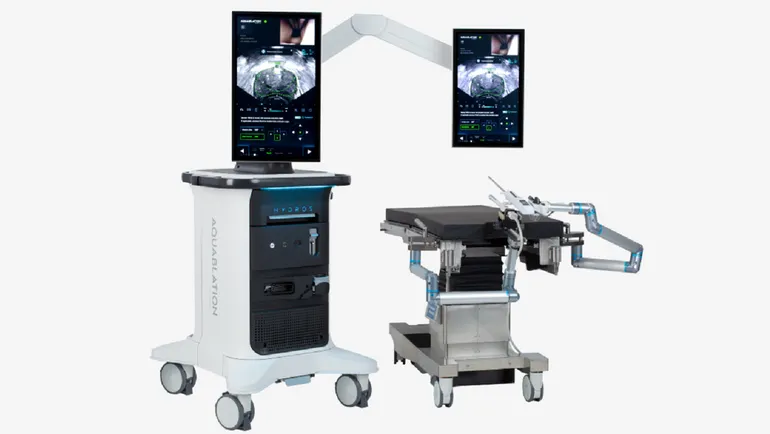
The core of PROCEPT BioRobotics' product portfolio is a robotic surgical system designed for BPH treatment. While the structured product data extracted from the company's site is tagged for review (referenced as "aua-2025," likely corresponding to a presentation or product associated with the 2025 American Urological Association context), the broader evidence base fills in meaningful detail. The August 2024 Medtech Dive report specifically confirmed FDA clearance for an "updated prostate surgery robot," indicating that PROCEPT has at minimum one commercially cleared robotic platform and has already progressed to iterative next-generation development.
The company's engineering team is described as working across imaging, mechanical, and electrical systems — suggesting the robot integrates intraoperative imaging guidance with a mechanical resection or ablation mechanism, consistent with the profile of an image-guided robotic ablation system for prostate tissue. The portfolio appears to be a single-platform, single-indication lineup rather than a diversified family of products, which is characteristic of focused medical robotics companies at this stage. This concentration is a strategic choice as much as a stage-of-company reality: depth in one indication, rather than breadth across urology or surgery more broadly.
Not yet disclosed: detailed model names, specific imaging modalities, energy delivery mechanisms, or accessory/consumable product lines. PROCEPT is invited to provide product specifications for a more complete representation.
4. Technology Stack {#technology-stack}
The most concrete technical signal available comes from PROCEPT's own careers materials, which describe the surgical robot as incorporating imaging, mechanical, and electrical systems developed by medical device engineers. This multi-system architecture is consistent with a platform that integrates real-time intraoperative imaging with robotically controlled tissue removal or ablation — a combination that defines the current frontier of image-guided robotic surgery for BPH.
Our read: The reference to "imaging systems" as a distinct engineering discipline alongside mechanical and electrical systems strongly suggests that the robot includes an onboard imaging modality — most plausibly ultrasound guidance, which is standard in prostate procedures — used to map and target prostatic tissue in real time. This would differentiate the platform from older, non-imaging-guided surgical tools for BPH and align with the clinical value proposition of precision and reproducibility.
Our read: The fact that FDA clearance was granted for an updated robot in 2024 implies the company has at least two hardware generations, suggesting an iterative engineering cycle with regulatory experience. This is a meaningful technical operations signal — it indicates the team can manage the design-control and 510(k) or PMA submission process at cadence.
Our read: The involvement of separate manufacturing, engineering, and sales teams — described as closely collaborating — suggests at least partial in-house manufacturing capability rather than full contract manufacturing, which may confer quality control advantages in a Class II or Class III medical device context.
Limited public technical detail is available regarding software architecture, AI or machine learning integration, cloud connectivity, or specific sensor specifications. PROCEPT is invited to disclose additional technical documentation.
5. Research, Papers, Authors, Labs {#research-papers}
Company-linked papers
PROCEPT BioRobotics' public profile is that of a commercial medical device company rather than a research-publishing academic entity. No peer-reviewed publications, preprints, or named research lab affiliations are surfaced in the available data. This is entirely normal and expected for a commercial-stage surgical robotics firm: clinical evidence is typically generated through investigator-initiated or company-sponsored clinical trials published by urologist partners, rather than through a corporate research division publishing under the company's name.
Clinicians and urologists who use or evaluate the PROCEPT system may publish independent clinical outcomes data — any such publications would appear under their institutional affiliations. Investors and due diligence teams seeking clinical evidence should search PubMed and urology conference proceedings (e.g., AUA Annual Meeting) for third-party clinical studies referencing the PROCEPT platform or its associated procedure.
6. Media Evidence {#media-evidence}
Media library
Third-party press coverage in the available data includes three independently sourced references. Medtech Dive — a respected specialized publication covering the medical device industry — reported in August 2024 on PROCEPT winning FDA clearance for an updated prostate surgery robot; this constitutes the strongest external validation in the dataset, representing both regulatory news and editorial coverage by a credible industry outlet. StockTitan tracked PROCEPT BioRobotics (PRCT) stock news as recently as May 2026, confirming ongoing public-market visibility and news flow. LeadIQ, a B2B sales intelligence platform, maintains a company overview entry for PROCEPT, which reflects general commercial database indexing rather than editorial coverage.
7. Commercial Reality {#commercial-reality}
Customers & deployments
PROCEPT BioRobotics is a publicly traded company (PRCT), meaning financial disclosures are available through SEC filings and earnings reports — however, specific revenue figures, installed base counts, named hospital or health system customers, and ROI metrics are not surfaced in the data provided for this report.
Revenue: Not disclosed in available data. As a public company, PROCEPT files quarterly and annual reports with the SEC; analysts and investors are directed to those filings for authoritative figures.
Customer deployments: Not disclosed in available data. The company's sales and marketing team infrastructure and its FDA-cleared commercial product strongly imply active customer accounts, but specific institution names or deployment counts are not verifiable from the current dataset.
Clinical ROI: Not disclosed in available data.
PROCEPT BioRobotics is invited to submit verified customer, deployment, and outcomes data for inclusion in this profile.
8. Markets and Use Cases {#markets-use-cases}
PROCEPT BioRobotics operates at the intersection of urology, surgical robotics, and men's health — a commercially significant and growing market segment. BPH (benign prostatic hyperplasia) is the primary and, based on available data, exclusive indication the company addresses. BPH affects a substantial proportion of men over 50 and represents one of the most common conditions managed by urologists globally, creating a large addressable patient population with well-established clinical pathways and reimbursement infrastructure in major markets including the United States.
The use case is specifically surgical or procedural intervention for BPH — robotic-assisted treatment intended to reduce or eliminate urinary obstruction caused by prostate enlargement. This positions PROCEPT's system in the procedural suite of a urology practice or hospital urology department, competing with both traditional surgical approaches (such as TURP — transurethral resection of the prostate) and newer minimally invasive therapies. The company's stated goal of delivering "the BPH treatment of choice" signals an ambition to displace existing standard-of-care procedures, not merely supplement them.
Geographically, the company's stated mission includes global BPH treatment, and its FDA clearance establishes the U.S. as an anchored home market. International market entry would require regulatory clearances in additional jurisdictions (e.g., CE marking in Europe, PMDA in Japan), the status of which is not disclosed in the available data.
The partnership model with urologists — explicitly named in the company's mission statement — suggests a capital equipment plus clinical training commercial model, common in surgical robotics, where urologist advocacy and adoption drive hospital purchasing decisions.
9. Competitive Landscape {#competitive-landscape}
Competitive comparison
| Robot | Maker | Autonomy | Conf. |
|---|---|---|---|
| iRobot Roomba Combo 10 Max | iRobot | Autonomous | 0.90 |
| Mobile ALOHA (Stanford) | Stanford University | Teleoperated | 0.90 |
| 1X NEO | 1X Technologies | Remote-Assisted | 0.90 |
PROCEPT BioRobotics competes in the surgical robotics segment of the broader medical device market, specifically within urological applications for BPH. The competitive environment for BPH treatment is multidimensional: PROCEPT faces competition not only from other robotic or technology-assisted surgical systems but also from established conventional surgical procedures and a growing array of office-based or minimally invasive BPH therapies that do not require a robotic platform.
The company's strategic differentiation — robotic precision, imaging integration, and a dedicated BPH focus — positions it against both general-purpose surgical robot platforms that may be adapted for prostate procedures and single-indication competitors in the BPH interventional space. The module above reflects computed peer relationships; prose characterization of named competitors is intentionally withheld here, as the module carries that data. What is analytically notable is that PROCEPT's narrow focus is simultaneously its competitive vulnerability (limited diversification) and its potential competitive advantage (deep clinical specialization and urologist partnership depth).
10. Country Advantage / Geopolitical {#geopolitical}
Section not material for this company.
11. Hype vs Real vs Ugly {#hype-real-ugly}
Claim tracker
Verified / Externally Corroborated:
- FDA clearance for an updated prostate surgery robot (August 2024) — independently reported by Medtech Dive. This is a hard regulatory fact, not a company claim.
- Public market listing under ticker PRCT — confirmed by StockTitan coverage and standard financial database presence.
- Active commercial team infrastructure (sales, marketing, manufacturing, engineering) — consistent with a commercially operating medical device company.
Company Claims (labeled as such — unverified by this report):
- PROCEPT claims to be "revolutionizing urological care" — a positioning statement. The degree of market disruption relative to existing BPH treatments is not independently quantifiable from available data.
- The company claims its vision is to deliver "the BPH treatment of choice" globally — an aspirational competitive claim. Market share data to substantiate this is not publicly available in this dataset.
- Claims regarding culture, DEI, and employee experience are self-reported on the careers page and are not independently assessed here.
Fixable Gaps:
- Not yet disclosed: clinical outcomes data, procedure volume, patient satisfaction metrics, complication rates, or comparative effectiveness versus standard BPH treatments. PROCEPT is invited to provide or point to published clinical evidence.
- Not yet disclosed: international regulatory clearance status beyond the U.S. FDA.
- The "aua-2025" product entry flagged as NEEDS_REVIEW in the structured data suggests a product detail or announcement that is not yet fully described in the public record.
12. Future Scenarios {#future-scenarios}
Bull Case Our read: PROCEPT successfully establishes its robotic BPH system as the standard of care in high-volume urology practices and academic medical centers across the United States, then leverages its FDA track record and urologist network to pursue regulatory clearances in Europe and Asia-Pacific. Growing BPH prevalence driven by aging demographics in developed markets expands the addressable patient pool. The iterative product development cycle — evidenced by the 2024 updated clearance — continues to yield clinically differentiated next-generation platforms that widen the moat against conventional surgical alternatives. Revenue scales with installed base growth and recurring procedure volume (consumables/disposables, if part of the model).
Base Case Our read: PROCEPT maintains a focused commercial presence in U.S. urology, growing its installed base steadily but facing adoption friction from hospitals with existing surgical robot investments and from urologists accustomed to conventional BPH procedures. International expansion proceeds but is slower than hoped due to regulatory timelines and reimbursement negotiations. The company remains profitable or approaching profitability on a per-procedure basis but faces pressure to demonstrate superior outcomes versus lower-cost BPH interventions to justify capital expenditure by hospital systems.
Bear Case Our read: Broader adoption of office-based, non-robotic BPH therapies (which require less capital investment and can be performed outside the hospital) captures market share from the procedural urology segment where PROCEPT's robot is deployed. Reimbursement coverage for robotic BPH procedures faces scrutiny from payers. Competition from well-capitalized general-purpose surgical robotics platforms entering the urology space intensifies. If clinical outcomes data — when published at scale — does not demonstrate compelling differentiation over existing approaches, hospital purchasing committees may defer capital commitments.
13. What to Watch {#what-to-watch}
- FDA regulatory pipeline: Any additional 510(k) submissions or PMA supplements beyond the August 2024 clearance — signals the pace of product iteration and platform expansion.
- AUA 2025 presence: The "aua-2025" tag in the product data suggests a product announcement, clinical data presentation, or commercial update at the American Urological Association 2025 Annual Meeting. Track AUA 2025 abstracts and press releases for PROCEPT-related disclosures.
- SEC filings (10-K / 10-Q): As a public company, PROCEPT's quarterly and annual filings will reveal revenue trajectory, gross margins, installed base growth, and cash position — the most reliable indicators of commercial momentum.
- Peer-reviewed clinical publications: Watch PubMed and urology journals for independent clinical trial results referencing the PROCEPT system. Positive outcomes data is the most durable driver of urologist adoption and payer coverage.
- International regulatory submissions: CE marking in Europe or clearances in Japan, South Korea, or Australia would signal the next phase of geographic scale.
- Reimbursement developments: CMS coverage decisions or payer policy changes affecting robotic BPH procedures will materially affect the company's market opportunity.
- Hiring patterns: Growth in field sales and clinical support roles in new geographies is a leading indicator of commercial expansion ahead of announced milestones.
14. Sources & Methodology {#sources-methodology}
Data Sources Used in This Report:
-
Company website (company-claim provenance): Text extracted from PROCEPT BioRobotics' own domain (procept-biorobotics.com), including the careers/about page, mission and values statements, and structured product metadata. All such content is explicitly labeled as company-claim and reflects the company's own characterization of itself. It has not been independently verified by this report.
-
Third-party press (independent sources):
- Medtech Dive (medtechdive.com, August 22, 2024): Report on FDA clearance for updated prostate surgery robot — treated as external validation.
- StockTitan (stocktitan.net, May 28, 2026): Stock news aggregation confirming public listing and ongoing news flow — treated as financial market corroboration.
- LeadIQ (leadiq.com): B2B commercial database entry — treated as general indexing, not editorial validation.
-
Computed relations: Competitor and peer relationships rendered via the module system are derived from algorithmic categorization based on industry, product type, and geography — not from editorial judgment in this report.
Methodology Rubric (applied uniformly to every company profiled):
- Factual claims are grounded only in the data provided; no external knowledge has been used to invent products, customers, financials, or partnerships.
- Negative findings are rendered as fixable gaps with an invitation to correct, as labeled inferences, or as labeled company claims — never as unsourced negative assertions.
- Each section leads with verified or inferable strengths before noting gaps.
- Company statements are labeled "(company-claim)" to distinguish them from independently verified facts.
- This rubric is applied identically regardless of company size, stage, or sector.

Technology stackOur read
Inferred from product specs — click through to the technology wiki:
ResearchComputed
Product comparisonComputed
Company announcement
News and Media
The company's official social & video channels · external links
News
From third-party news outlets (China & abroad) · external links