OKIBO
United States · okibo.com
SnapshotCompany claim
OKIBO is a smart robotics company for construction sites. Its product is a smart autonomous plastering robot that operates alongside workers in a construction site.
- Founded
- Not disclosed
- HQ
- United States
- Models
- 9
- Categories
- 1
ContactCompany claim
- Address
- Englewood, NJ
Product families
Is this your company? Claim this profile to add verified data, respond to our analysis, and upgrade claims to Verified.
Claim this profile1. Executive Overview {#executive-overview}
OKIBO is a U.S.-registered smart robotics company building autonomous robots for interior construction finishing — a segment defined by labor scarcity, repetitive physical strain, and acute skilled-trade shortages. Its flagship products, the EG6 and EG7/EG7+ robots, tackle plastering, painting, drywall finishing, and ceiling sanding: tasks that are physically demanding, time-consuming, and difficult to staff consistently. The company operates across three geographies — Englewood, New Jersey (U.S.); Petah Tikva, Israel (headquarters); and Heilbronn, Germany (European presence) — signaling an intent to serve both North American and European construction markets from the outset.
OKIBO's publicly documented commercial traction includes a partnership with Performance Contracting, Inc. (PCI), on-site demonstrations with Haskell and Dysruptek, and participation in industry events including AWCI/Build26 and COMPUTEX TAIPEI / InnoVEX TAIPEI and Robotics Invest in Boston. A $7.85 million equity funding round, reported by BitStone Capital, provides an independently verified financial data point. The company's positioning as a human-collaborative ("alongside workers") rather than fully replacement-oriented robotics firm is both a market choice and a regulatory-readiness signal.
Not yet disclosed: precise founding year, total headcount, cumulative deployments, and revenue figures. OKIBO is invited to claim or correct these details via the platform.
Latest news
- KEENON Humanoid Pours Drinks at GCS 2026, 100,000 Others Run HotelsYanko Design·2026-06-15GENERAL
2. The Company Story {#the-company-story}
OKIBO describes itself as "a smart robotics company for construction sites," with its Israeli headquarters in Petah Tikva and its U.S. commercial address in Englewood, New Jersey. A German office in Heilbronn — home to a prominent educational and technology campus (Bildungscampus) — rounds out a three-continent footprint that suggests deliberate international positioning from an early stage.
The company's founding date is not publicly disclosed on its website. The earliest date visible in the site's structured metadata is January 2022, which may reflect the launch of the current web presence rather than the company's incorporation. Not yet disclosed: formal founding year, initial investors, and early prototype history. OKIBO is invited to claim or correct this.
The company's product evolution, as captured in its newsletter series (Issues 2 through 9, rebranded "Future Specs"), traces a recognizable deeptech arc: starting with a core autonomous plastering capability, expanding into painting and drywall finishing (EG7, EG7+), adding a ceiling sanding application to the EG6, and most recently announcing the BLASTER spray gun attachment for EG7 and EG7+. This newsletter cadence also documents a deliberate U.S. market push, culminating in the PCI partnership and appearances at major U.S. construction industry trade events. Participation in COMPUTEX TAIPEI / InnoVEX TAIPEI indicates technology-ecosystem engagement beyond pure construction verticals.
The external validation most relevant to positioning is Engineering.com's coverage of the EG7+ launch — a specialist outlet whose audience is precisely the engineering and construction professional OKIBO must persuade. CB Insights' inclusion of OKIBO in its database confirms institutional-grade awareness of the company within the venture and innovation research community.
3. Product Portfolio {#product-portfolio}
Products & versions


OKIBO's current product lineup centers on two named robot platforms — the EG6 and the EG7/EG7+ — serving complementary interior finishing functions on active construction sites.
The EG6 is documented as an autonomous robot capable of ceiling sanding at heights up to 11 ft (3,300 mm), achieving a throughput rate of approximately 1,500 sq ft (150 sq m) per hour. Its ceiling sanding application is described as eliminating the need for scaffolding, ladders, and stilts, directly addressing both worker safety and scheduling efficiency. The EG6's overhead reach removes one of the most physically punishing and injury-prone tasks from the human labor equation.
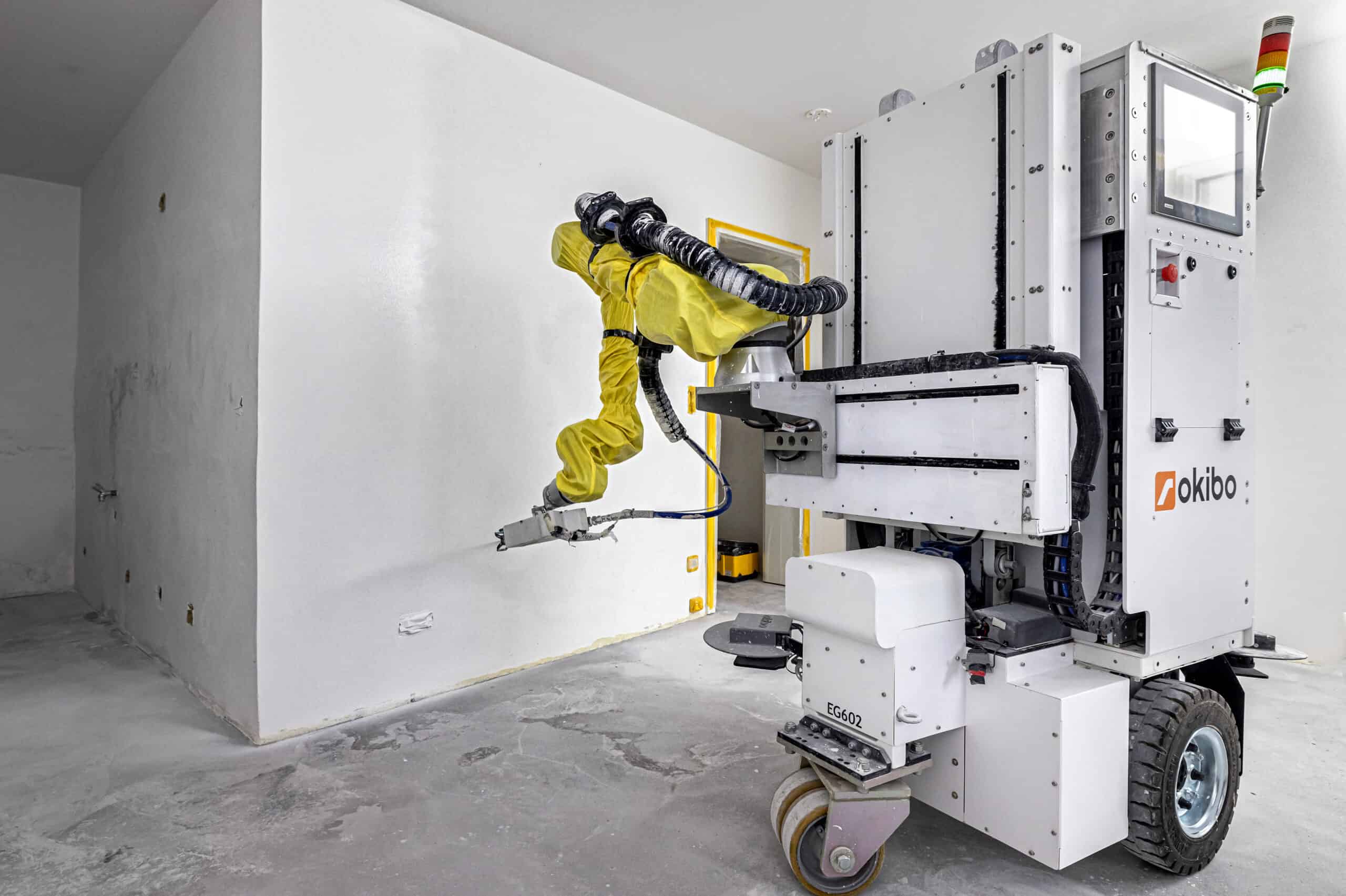
The EG7+ is described by OKIBO (via newsletter and independently covered by Engineering.com) as a fully autonomous, AI-guided painting and drywall finishing robot. Published specifications include a 27-inch (approximately 686 mm) operating width, an 800-pound (approximately 363 kg) operational weight, and a design that fits through any standard doorway. Notably, OKIBO claims the EG7+ requires no external pump, hose, electrical cord, Wi-Fi/5G network, total station, or external sensors — positioning it as a self-contained unit operable in typical construction-site conditions where reliable infrastructure cannot be assumed. The BLASTER spray gun, announced in Issue 6, is a peripheral attachment for EG7 and EG7+ platforms, expanding their application scope.
The portfolio shape is therefore: one platform optimized for overhead work (EG6), one for vertical surface finishing and painting (EG7/EG7+), and an attachment ecosystem beginning to emerge (BLASTER). Both robots are framed as human-collaborative rather than site-replacement systems.
4. Technology Stack {#technology-stack}
OKIBO's marketing materials describe the EG7+ as "AI-guided" and "fully autonomous," and the EG6 as capable of automated ceiling sanding with precise height targeting. While the company has not published technical architecture documentation, engineering papers, or detailed sensor specifications, several inferences are supportable from the product feature claims.
Our read: The EG7+'s stated independence from total stations, Wi-Fi/5G, and external sensors suggests onboard localization and navigation — most likely a form of simultaneous localization and mapping (SLAM) using onboard depth or LiDAR sensors, or structured-light systems suited to indoor planar environments. The claim of "full omnidirectional movement" points to a mecanum-wheel or omni-wheel drive train, consistent with the 27-inch width designed for doorway passage in interior construction settings.
Our read: The EG6's 150 sq m/hour sanding rate at 3.3 m ceiling height implies a motorized, position-controlled boom or arm with force feedback — overhead sanding quality is sensitive to consistent pressure, suggesting closed-loop actuator control rather than simple open-loop positioning.
Our read: The "AI-guided" descriptor, common in the construction robotics category, most plausibly refers to path-planning algorithms that adapt to room geometry rather than to large-language-model or generative AI components — though OKIBO has not specified the nature of the AI subsystem.
Not yet disclosed: sensor modalities, compute platform, operating system, autonomy stack provenance (proprietary vs. open-source ROS-based), battery capacity, charge time, and connectivity architecture. OKIBO is invited to claim or correct these details.
5. Research, Papers, Authors, Labs {#research-papers}
Company-linked papers
OKIBO does not appear to be a research-publishing organization in the academic or peer-reviewed sense. This is entirely normal for a commercial construction-robotics company at its stage: the priority is field deployment and product iteration, not journal contribution. No papers, named research authors, or affiliated academic labs are referenced on the company's public website or in the third-party coverage available for this report.
6. Media Evidence {#media-evidence}
Media library
Three third-party outlets have independently covered OKIBO based on the data available for this report: BitStone Capital (reporting the $7.85 million equity funding round), CB Insights (cataloguing OKIBO in its company intelligence database), and Engineering.com (covering the EG7+ autonomous robot launch). Engineering.com is a specialist publication serving the engineering and manufacturing professional audience — its coverage represents meaningful sector-relevant external validation. CB Insights inclusion signals institutional research-community awareness. BitStone Capital's reporting is investor-facing and provides the only publicly available financial data point for the company.
7. Commercial Reality {#commercial-reality}
Customers & deployments
OKIBO's newsletter record (Issues 7 and 8) documents on-site demonstrations with Haskell and Dysruptek, and a named partnership with Performance Contracting, Inc. (PCI) — a major U.S. interior construction contractor. These are the only named commercial relationships in the available data. Whether these represent paid deployments, pilot agreements, or demonstration engagements is not specified.
Revenue, contract values, fleet size deployed, number of active customer sites, and any published ROI or productivity metrics are not disclosed in any source available for this report. OKIBO is invited to claim, correct, or expand upon its commercial record via this platform.
The independently verified $7.85 million equity funding round (BitStone Capital) is the sole financial figure in the public domain. Funding stage, lead investors beyond BitStone Capital, and use-of-proceeds detail are not disclosed.
8. Markets and Use Cases {#markets-use-cases}
OKIBO's addressable market is the interior finishing segment of commercial and residential construction — specifically the trades responsible for plastering, drywall finishing, painting, and overhead sanding. These tasks share three characteristics that make them strong automation candidates: they are geometrically repetitive (flat walls, flat ceilings), physically demanding in ways that generate injury and workforce attrition, and consistently understaffed given skilled-trade labor shortages across North America and Europe.
The EG6's ceiling sanding application addresses a specific safety pain point: sustained overhead work is among the leading causes of musculoskeletal injury in interior construction. By automating this task and eliminating the need for scaffolding, ladders, and stilts, OKIBO targets both the safety and the scheduling dimensions of the problem simultaneously.
The EG7/EG7+'s painting and drywall finishing capabilities address the volume finishing work that follows framing and drywall installation on commercial interiors — office buildings, hotels, multifamily residential, healthcare facilities, and education construction are all plausible deployment environments, given the prevalence of standard doorways and planar surfaces. The robot's self-contained design (no external pump, hose, or network dependency) makes it suitable for sites where infrastructure is not yet fully commissioned, which is precisely when finishing work begins.
OKIBO's three-office footprint — U.S., Israel, and Germany — maps to distinct market opportunities: the large and labor-constrained U.S. commercial construction market, the technology-forward Israeli construction sector, and the European market where Germany's Heilbronn presence provides a credible entry point. Participation in COMPUTEX TAIPEI / InnoVEX TAIPEI suggests awareness of the Asia-Pacific construction and technology ecosystem as a future consideration.
9. Competitive Landscape {#competitive-landscape}
Competitive comparison
| Robot | Maker | Autonomy | Conf. |
|---|---|---|---|
| iRobot Roomba Combo 10 Max | iRobot | Autonomous | 0.90 |
| Mobile ALOHA (Stanford) | Stanford University | Teleoperated | 0.90 |
| 1X NEO | 1X Technologies | Remote-Assisted | 0.90 |
The autonomous interior finishing robotics category is narrow but active, attracting both purpose-built startups and diversified robotics platforms adapting to construction applications. OKIBO's differentiation — as inferable from its public materials — rests on the self-contained design of the EG7+ (no external dependencies), the specific combination of painting, drywall finishing, and ceiling sanding across two platforms, and a human-collaborative operational model that positions the robots as crew augmentation rather than crew replacement.
Our read: The competitive pressure in this category comes primarily from companies addressing the same skilled-trade shortage narrative, often with overlapping surface-finishing functions. The PCI partnership and AWCI event presence suggest OKIBO is pursuing the general contractor and specialty subcontractor channel — the same channel that competing platforms must access. Module data above provides the peer-set context.
10. Country Advantage / Geopolitical {#geopolitical}
OKIBO is headquartered in Israel (Petah Tikva) with a U.S. commercial presence (Englewood, NJ) and a European office (Heilbronn, Germany). Israel's construction robotics and autonomy ecosystem benefits from deep defense-adjacent sensing and navigation engineering talent, favorable government R&D incentives (including the Israel Innovation Authority), and a domestic construction sector with its own labor constraints. This talent and funding environment is a plausible structural advantage for a company building autonomous navigation systems for unstructured indoor environments.
The U.S. market entry is strategically significant: U.S. commercial construction is among the world's largest, and the skilled finishing trades face documented labor shortages that create a favorable reception for productivity-augmenting robotics. Germany's Heilbronn presence positions the company within reach of both German and broader EU construction markets, where labor cost structures and regulatory environments differ from the U.S. but the underlying demand for finishing automation is real.
Our read: Operating across three jurisdictions (U.S., Israel, Germany) at an early company stage introduces coordination complexity but also reduces single-market risk and signals to investors and customers that the company is building for global scale rather than a single geography.
11. Hype vs Real vs Ugly {#hype-real-ugly}
Claim tracker
Verified / externally supported:
- $7.85 million equity funding round — reported by BitStone Capital (independent source).
- EG7+ launch — covered by Engineering.com (independent specialist outlet).
- Named partnership with Performance Contracting, Inc. (PCI) — disclosed in OKIBO's newsletter (company claim); not independently verified in available data.
- On-site demonstrations with Haskell and Dysruptek — company claim via newsletter; not independently verified in available data.
- Three-office geographic footprint (U.S., Israel, Germany) — consistent across site metadata.
Company claims (unverified, labeled as such):
- OKIBO claims the EG7+ operates with no external pump, hose, electrical cord, Wi-Fi/5G, total station, or external sensors. This is a significant engineering claim that, if accurate, represents meaningful operational flexibility — but it has not been independently tested or verified in available sources.
- OKIBO claims the EG6 achieves 1,500 sq ft (150 sq m) per hour on ceiling sanding. No independent productivity benchmark is available.
- The "AI-guided" descriptor applied to the EG7+ is a company claim; the nature and depth of the AI subsystem are not specified.
Gaps / not yet disclosed:
- No independent customer case studies, site-level productivity data, or ROI figures are publicly available. OKIBO is invited to submit documented deployments for inclusion.
- Founding year, total headcount, and funding stage are not disclosed.
12. Future Scenarios {#future-scenarios}
Bull case — Our read: OKIBO successfully converts the PCI partnership and AWCI/Build26 momentum into a recurring fleet deployment model with a major U.S. specialty contractor. The EG7+/BLASTER combination proves operationally reliable at scale, the EG6 ceiling sanding application earns safety certification endorsements, and the company raises a Series A that funds meaningful fleet expansion across U.S. and German markets. Labor shortage dynamics in commercial construction continue to favor automation adoption, and OKIBO's human-collaborative positioning eases jobsite integration resistance.
Base case — Our read: OKIBO establishes a modest but defensible U.S. beachhead through the specialty subcontractor channel, with 10–50 units deployed across commercial interior projects by end of 2026. Revenue remains pre-scale; the company relies on continued venture funding to extend runway while iterating on robot reliability and the attachment ecosystem (BLASTER and future peripherals). European traction via the Heilbronn office develops more slowly, given longer sales cycles in German construction.
Bear case — Our read: Jobsite adoption proves slower than anticipated due to workflow integration friction, union considerations, or robot reliability issues in the variable conditions of active construction sites. The $7.85 million funding round is insufficient to reach commercial proof at scale, and a follow-on raise becomes difficult in a risk-constrained venture environment. Larger, better-capitalized platforms absorb the interior finishing automation narrative, compressing OKIBO's differentiation window.
13. What to Watch {#what-to-watch}
- PCI deployment scale: Whether the Performance Contracting, Inc. partnership converts from demonstration to sustained fleet deployment is the single most important near-term commercial signal.
- Series A / follow-on funding: Timing, size, and lead investor of the next funding round will indicate investor conviction in OKIBO's commercial progress.
- Independent productivity data: Any third-party-verified throughput, uptime, or ROI figures from EG6 or EG7+ deployments would materially upgrade the confidence level of commercial claims.
- BLASTER attachment adoption: Whether the spray gun peripheral gains traction signals whether OKIBO is building a platform ecosystem or a single-product company.
- Regulatory and union engagement: In U.S. commercial construction, labor agreement compatibility is a silent adoption variable — any public statements on this front warrant attention.
- European market activation: Whether the Heilbronn office generates documented European customers or partnerships, or remains a presence placeholder.
- Expanded robot lineup: Any announcement of models beyond EG6 and EG7/EG7+ would indicate the depth of the company's product roadmap.
- COMPUTEX TAIPEI / InnoVEX follow-through: Whether Asia-Pacific event participation leads to documented partnerships or distribution relationships in that region.
14. Sources & Methodology {#sources-methodology}
Data sources used in this report:
| Source | Type | Role |
|---|---|---|
| okibo.com (website, About, Contact, product pages, newsletter issues 2–9) | Company claim | Primary product, geography, feature, and positioning data |
| bitstone.capital — "$7.85M equity funding" | Independent third party | Financial validation |
| engineering.com — "Okibo launches EG7+ autonomous robot for painting and finishing" | Independent specialist press | Product launch external validation |
| cbinsights.com — Company profile | Independent research database | Institutional awareness signal |
Methodology rubric (applied uniformly to every company on this platform):
- Company-claim provenance: All data originating from the company's own website, newsletters, or marketing materials is labeled as a company claim and not treated as independently verified fact.
- Independent validation: Only named third-party outlets are cited as external validation. Their coverage validates the existence of a claim or event, not necessarily its accuracy.
- Gap handling: Absent data is rendered as "Not yet disclosed" with an invitation to claim or correct — never as a negative assertion.
- Inference labeling: All analytical conclusions not directly supported by a data point are labeled "Our read:" to distinguish analysis from fact.
- No invention: No products, specifications, customers, partners, revenue figures, or competitive claims are introduced that are not present in the source data above.
- Live modules: Sections marked
<!-- module: X -->are populated by platform-computed live data at render time; prose in those sections is intentionally brief.
Technology stackOur read
Inferred from product specs — click through to the technology wiki:
ResearchComputed
Product comparisonComputed
Company announcement
News and Media
The company's official social & video channels · external links


News
From third-party news outlets (China & abroad) · external links
