NDR Medical Technology
Founded 2015 · Singapore · ndrmedical.com
SnapshotCompany claim
NDR Medical Technology, founded in 2015, developed the patented Automated Needle Targeting system (ANT) for safe and accurate needle punctures to organs like lungs, kidney, pancreas, and spine. Integrating AI and robotics, the company pioneers image-guided robotic procedures to improve accuracy, precision, and safety for patients.
- Founded
- 2015
- HQ
- Singapore
- Models
- 2
- Categories
- 2
ContactCompany claim
- Address
- Not disclosed
Product families
Is this your company? Claim this profile to add verified data, respond to our analysis, and upgrade claims to Verified.
Claim this profile1. Executive Overview {#executive-overview}
NDR Medical Technology is a Singapore-based medical robotics company founded in 2015 with a clear and focused mission: automating the most technically demanding step in interventional radiology — accurate needle placement into deep-seated organs. The company's flagship product, the ANT-X, has cleared the regulatory gauntlet across multiple major jurisdictions, including CE certification (2020), Singapore's HSA and Malaysia's MDA (2021), U.S. FDA 510(k) clearance (2023), and Thai FDA clearance (2023). A second platform, the ANT-C, extends the company's reach into CT-guided interventions with AI-powered lesion detection validated against more than 1,000 clinical cases. For a company still in early commercial scale-up, this regulatory breadth is a meaningful indicator of technical and clinical credibility.
The leadership team carries genuine depth: Co-Founder and CTO Dr. Jason Ng holds a PhD from NUS with MIT postgraduate work and has filed more than ten patents; Co-Founder and CEO Alan Goh brings a MedTech commercialisation background through ASTAR and AITventures; and CSO Dr. Leong SH brings 14 granted U.S. patents and around 40 peer-reviewed publications from his Cambridge PhD and ASTAR career. The advisory board spans clinical radiology, urology, and nephrology, with named affiliations at Radboud UMC, Nagoya City University, and Mount Sinai Hospital — providing both scientific legitimacy and potential clinical-adoption pathways across Europe, Japan, and the United States.
The company's strategic positioning is regionally networked: a China joint venture with MicroPort (confirmed by independent press in 2020), a Japan subsidiary established in 2022, and Korean and Japanese institutional shareholders suggest a deliberate Asia-Pacific commercialisation architecture. Specific revenue, procedure volume, and hospital deployment numbers are not publicly disclosed (see §7).
Latest news
- KEENON Humanoid Pours Drinks at GCS 2026, 100,000 Others Run HotelsYanko Design·2026-06-15GENERAL
2. The Company Story {#the-company-story}
NDR Medical Technology was incorporated in Singapore in 2015, emerging from the country's well-funded medtech incubation ecosystem. The company's earliest milestone — a TECS-POC (Technology Enterprise Commercialisation Scheme, Proof of Concept) and POV award in Q2 2015 — signals that the founding vision was backed by government grant funding from inception, a common and respected pathway for Singapore deep-tech ventures.
The development arc of the ANT-X is methodical and compliance-oriented, which is appropriate for a Class II/III medical device. Animal trials were completed by 2016, first-in-human procedures occurred in 2017, and Phase 1 & 2 clinical trials were completed by Q3 2019 — a four-year bench-to-clinical-trial timeline that reflects genuine engineering and regulatory rigour. A 60-patient clinical study in Japan was completed by Q4 2020, the same quarter the company raised its Series A funding and established the China joint venture with MicroPort, the Shanghai-listed multinational medical device group. MicroPort's surgical robotics subsidiary (MicroPort MedBot) subsequently confirmed this investment via its own communications — providing independent third-party corroboration of the partnership's existence and significance.
Between 2021 and 2023 the company moved into a multi-jurisdiction commercialisation phase, securing HSA (Singapore) and MDA (Malaysia) approvals in Q1 2021, bringing on Japanese and Korean institutional shareholders, establishing a Japan subsidiary, and culminating in FDA 510(k) clearance in Q2 2023 — a milestone covered independently by Surgical Robotics Technology and confirmed by MicroPort MedBot's own news channels. Thai FDA clearance followed in Q4 2023. The company positions itself explicitly as a pioneer in "image-guided robotic procedures," occupying a niche between pure software (radiology AI) and fully autonomous surgical robotics — an interventional-assist category that is gaining clinical and regulatory traction globally.
3. Product Portfolio {#product-portfolio}
Products & versions


NDR's portfolio currently comprises two distinct but complementary platforms, both built around the company's core Automated Needle Targeting (ANT) intellectual property.
The ANT-X is the commercially mature product — the one that has cleared CE, HSA, MDA, FDA, and Thai FDA. It operates in the C-arm fluoroscopy environment, which is the standard imaging modality for percutaneous procedures in most interventional suites globally. The system's headline clinical data (all company-claimed figures) are notable: accuracy to ±2 mm, a 42.6% improvement in first-attempt success rates versus free-hand technique, and fluoroscopic exposure time reduced to 13.2 seconds versus 22 seconds free-hand — representing approximately 40% less radiation dose to both patient and clinician. The workflow is designed for practical adoption: a single X-ray image triggers auto-calibration, the robotic arm autonomously aligns to the target, and the clinician retains control only over needle insertion depth, preserving clinical judgment while removing the most error-prone alignment step.
The ANT-C represents the next-generation platform, moving from 2D fluoroscopy to full 3D CT-guided targeting. Key claimed capabilities include automatic 3D reconstruction from CT scans, AI-powered lesion detection validated on over 1,000 clinical cases, safe needle trajectory planning that avoids vital structures, and a closed-loop spatial navigation system compatible with all CT scanner types. The supported organ list — lung, liver, kidney, pancreas, and biliary — is broader than ANT-X's validated indications, suggesting ANT-C is positioned as the oncology and complex-intervention platform. ANT-C's regulatory status is not yet publicly disclosed; this is a gap worth monitoring.
Taken together, the two products describe a logical product family: ANT-X for fluoroscopy-suite adoption (urology, nephrology, spine) and ANT-C for CT-suite adoption (oncology, complex abdominal interventions) — a two-platform strategy that addresses the two dominant imaging environments in interventional practice.
4. Technology Stack {#technology-stack}
The core technical proposition across both ANT platforms is the fusion of real-time medical imaging, computer vision, and robotic actuation — a combination that places NDR in the image-guided robotic intervention category rather than purely autonomous surgery or diagnostic AI.
For the ANT-X, the described workflow implies a computer vision pipeline that processes fluoroscopic (X-ray) frames in real time, detects fiducial markers, and computes a robotic alignment solution — all from a single image acquisition. Our read: the "auto-calibration by extracting real-time fluoroscopic images and recognising markers" language suggests a marker-based registration approach, which is a well-established technique in interventional robotics that prioritises speed and robustness over markerless alternatives. The ±2 mm accuracy specification, if validated in clinical conditions rather than only bench conditions, is clinically meaningful for most percutaneous targets. The company holds more than ten filed patents (attributed to CTO Dr. Jason Ng alone), suggesting the alignment and calibration methods are proprietary.
For the ANT-C, the language shifts to 3D reconstruction, AI-powered lesion detection, and "closed-loop targeting" — implying continuous positional feedback from the robotic instrument during needle advancement. Our read: closed-loop CT-guided targeting is technically more complex than single-image fluoroscopy alignment, as it requires either intermittent CT acquisitions or electromagnetic/optical tracking to update the instrument position without continuous radiation. Which sensing modality NDR employs is not specified in available public data. The claim of validation on over 1,000 clinical cases for the lesion-detection AI is a meaningful data point, though the clinical context (retrospective image analysis vs. prospective procedure guidance) is not specified.
The CSO Dr. Leong SH's background in high-precision measurement systems and the CTO's prior work at A*STAR on precision measurement for hard-drive manufacturers (Seagate, Sony, Hitachi) are relevant: sub-millimetre positioning in constrained electromechanical systems is a transferable capability. Limited public technical detail exists beyond what is described in product marketing materials. Independent technical publications from NDR as a company entity are not identified in available data (see §5).
5. Research, Papers, Authors, Labs {#research-papers}
Company-linked papers
NDR Medical Technology, as a commercial medical device company, does not appear to publish under a corporate research identity in the peer-reviewed literature — this is entirely normal for a regulatory-pathway-focused interventional robotics firm at this stage. The relevant academic output is associated with individual founders and advisors: CTO Dr. Jason Ng has published more than 20 papers; CSO Dr. Leong SH holds approximately 40 peer-reviewed journal publications and 14 granted U.S. patents; Japan NDR MD Dr. Taguchi has more than 80 peer-reviewed publications in urology and nephrology; and advisory members Prof. Jurgen Fütterer (Radboud UMC) and Prof. Kazumi Taguchi (Nagoya City University) bring active academic affiliations. Clinical validation data — including the Phase 1 & 2 trial results and the 60-patient Japan study — have not been identified in indexed journals in the available data; if published, those would be the most direct external validation of ANT-X's performance claims.
Not yet disclosed: peer-reviewed publication records for the ANT-X and ANT-C clinical studies. NDR is invited to share or link any published clinical trial results or conference abstracts for inclusion.
6. Media Evidence {#media-evidence}
Media library
Three independent third-party sources have been identified in available data. Surgical Robotics Technology — a specialist trade publication covering the interventional and surgical robotics sector — reported on NDR's FDA 510(k) clearance for ANT-X, providing editorial coverage from a credible domain-specific outlet. MicroPort's own news channel (microport.com) published the joint venture and investment announcement in May 2020, confirming the partnership from the corporate acquirer's side. MicroPort MedBot's subsidiary site (medbotsurgical.com) independently confirmed FDA certification for ANT-X in July 2023. The convergence of coverage from a trade press outlet and from the JV partner's own communications provides meaningful independent corroboration of NDR's two most significant milestones — the MicroPort investment and the FDA clearance.
7. Commercial Reality {#commercial-reality}
Customers & deployments
Revenue, procedure volumes, hospital deployment counts, and customer names are not publicly disclosed by NDR Medical Technology. These figures are rendered here as Not disclosed. NDR is invited to claim or share commercial metrics — including number of installed systems, procedures performed, and named hospital or health-system partners — for inclusion in this profile.
What is publicly confirmable is the regulatory foundation for commercialisation: ANT-X holds clearances in Singapore, Malaysia, the European Union (CE), the United States (FDA 510(k)), and Thailand — a portfolio of approvals that, in principle, permits active sales in five of the world's significant medtech markets. The existence of a Japan subsidiary (established 2022), a China joint venture with MicroPort, and institutional shareholders in Japan and Korea further indicates that a multi-market commercial infrastructure is in place. Whether these structures have translated into meaningful procedure or revenue volume is unknown from available public data.
Our read: the company appears to be in an early commercial scaling phase, having spent 2015–2022 primarily in development, regulatory clearance, and partnership-building. The 2023 FDA clearance is the most commercially significant regulatory event to date, given the size and reimbursement depth of the U.S. interventional radiology market.
8. Markets and Use Cases {#markets-use-cases}
NDR's products address the interventional radiology and interventional oncology markets, specifically the procedural segment involving percutaneous (through-skin) needle access to internal organs. This is a high-volume, globally practiced clinical workflow: biopsies, ablations, drainage, and targeted drug delivery to the lungs, kidneys, liver, pancreas, biliary system, and spine are performed in hospital interventional suites and CT rooms daily across every major healthcare system.
The ANT-X is positioned for fluoroscopy-guided procedures, with the product description highlighting lung, kidney, pancreas, and spine as target organs. The urology adjacency is reinforced by the advisory presence of Dr. Tan Yung Khan (Medical Director, Urohealth Medical Clinic) and Dr. Too Chow Wei (Consultant, Singapore General Hospital), and by the Japan MD Dr. Taguchi's nephro-urology specialty. Percutaneous nephrolithotomy (kidney stone removal), nephrostomy placement, and renal biopsy are plausible high-volume use cases in this configuration.
The ANT-C extends the addressable market into CT-guided oncology procedures — lung biopsy, liver biopsy and ablation, pancreatic intervention, and biliary drainage — which are among the most technically demanding percutaneous procedures due to organ motion, lesion depth, and proximity to critical structures. The AI lesion detection component suggests a workflow integration role beyond pure robotic targeting, potentially assisting radiologists in lesion identification and trajectory planning before needle deployment.
The primary industry tag is hospital-based practice, consistent with the capital-equipment, regulatory-cleared device model. The geographic markets with active regulatory status (Singapore, Malaysia, EU, U.S., Thailand) plus the JV and subsidiary infrastructure (China, Japan, Korea) define a predominantly Asia-Pacific and U.S.-focused go-to-market footprint.
9. Competitive Landscape {#competitive-landscape}
Competitive comparison
| Robot | Maker | Autonomy | Conf. |
|---|---|---|---|
| iRobot Roomba Combo 10 Max | iRobot | Autonomous | 0.90 |
| Mobile ALOHA (Stanford) | Stanford University | Teleoperated | 0.90 |
| 1X NEO | 1X Technologies | Remote-Assisted | 0.90 |
NDR Medical Technology operates in the image-guided robotic intervention segment, which sits at the intersection of interventional radiology, surgical robotics, and diagnostic AI. This is a category that has attracted both established medical device majors and well-funded start-ups globally, with competing approaches ranging from electromagnetic navigation systems and robotic bronchoscopy platforms to CT-guided robotic biopsy systems. The category is characterised by high regulatory barriers to entry, long clinical adoption cycles, and strong network effects once a platform is integrated into hospital workflow and reimbursement pathways.
NDR's differentiation — as expressed in its own materials — centres on the combination of full automation of the alignment step (rather than robotic assistance requiring continuous surgeon input), multi-organ versatility across two imaging modalities, and a validated ±2 mm accuracy claim. The company's FDA clearance, CE mark, and Asia-Pacific regulatory portfolio represent meaningful moats in jurisdictions where competitors must clear the same regulatory hurdles. The MicroPort partnership provides distribution infrastructure in China that would be difficult to replicate independently. Competitive positioning relative to specific named peers is rendered by the module above; the prose here reflects category-level framing only.
10. Country Advantage / Geopolitical {#geopolitical}
Singapore's position as a medtech hub is directly relevant to NDR's story. The TECS-POC grant that launched the company in 2015 is administered by Enterprise Singapore, reflecting the national government's deliberate policy of funding deep-tech medical device ventures from the proof-of-concept stage. A*STAR — Singapore's Agency for Science, Technology and Research — appears in the biographies of both the CTO (Dr. Jason Ng) and the CSO (Dr. Leong SH), indicating that NDR's founding team was developed within Singapore's public research infrastructure before transitioning to commercial application, a pathway that Singapore's innovation ecosystem is specifically designed to support.
The Asia-Pacific commercial architecture — Singapore headquarters, China JV with a Shanghai-listed partner, Japan subsidiary, and Korean and Japanese institutional shareholders — reflects both the geographic logic of Singapore as a regional hub and the practical reality that Asia-Pacific interventional radiology markets (particularly Japan and South Korea, which have high procedural volumes and strong reimbursement for minimally invasive techniques) represent near-term commercial opportunities. The U.S. FDA clearance, achieved in 2023, opens the largest single-country medtech market and is likely to be the primary driver of any significant commercial scaling.
No geopolitical risk factors specific to NDR's operations — such as supply chain dependencies, export control exposure, or cross-border data governance for patient imaging — are identifiable from available public data. The China JV is with MicroPort, a well-established and publicly listed entity, which provides some structural stability to that market relationship. NDR's Singapore incorporation and the independence of Taiwan (not relevant to NDR's disclosed operations) have no specific bearing on current company disclosures.
11. Hype vs Real vs Ugly {#hype-real-ugly}
Claim tracker
Verified independently:
- FDA 510(k) clearance for ANT-X (confirmed by Surgical Robotics Technology and MicroPort MedBot communications, 2023).
- MicroPort investment and joint venture (confirmed by MicroPort's own news channel, May 2020).
- CE certification, HSA, and MDA approvals are company-claimed milestones; their structure (regulatory body names, timeline) is internally consistent with standard medtech regulatory pathways.
Company claims, not independently verified in available data:
- ±2 mm accuracy for ANT-X (company-claimed specification; the basis — bench, phantom, or clinical — is not specified in available data).
- 42.6% improvement in first-attempt success rates versus free-hand (company-claimed; the clinical study context, comparator, and sample size are not specified in available marketing materials).
- Fluoroscopic time reduction to 13.2 seconds versus 22 seconds free-hand (company-claimed; same caveat).
- ANT-C AI lesion detection validated on over 1,000 clinical cases (company-claimed; retrospective vs. prospective and publication status are not specified).
- Phase 1 & 2 clinical trial completion for ANT-X (company-claimed milestone; published results not identified in available data).
- 60-patient Japan clinical study completion (company-claimed; published results not identified).
Gaps (not failures — invite to correct):
- Not yet disclosed: ANT-C regulatory clearance status, ANT-C commercialisation timeline, peer-reviewed publication of clinical trial data, commercial deployment numbers, revenue, and named hospital customers. NDR is invited to supply or correct any of these data points.
Our read: the regulatory clearance track record is the most objectively verified indicator of technical and clinical credibility for a company at this stage. The performance claims are plausible for the category but should be treated as company claims until peer-reviewed clinical publications are available.
12. Future Scenarios {#future-scenarios}
Bull case — Our read: ANT-X gains meaningful traction in the U.S. market following FDA clearance, supported by the MicroPort distribution network in China and the Japan subsidiary in a high-value procedural market. ANT-C achieves regulatory clearance in one or more major jurisdictions by 2025–2026, expanding the addressable market into CT-guided oncology — a faster-growing and higher-ASP segment. Clinical publications from the completed trials validate the performance claims, accelerating hospital adoption and reimbursement inclusion. The company's two-platform, two-modality strategy positions it as the category-defining independent player in image-guided robotic needle intervention.
Base case — Our read: Commercial adoption of ANT-X proceeds gradually, primarily in Asia-Pacific markets where the regulatory and distribution infrastructure is most developed. The U.S. market requires a longer adoption cycle due to capital budget constraints, reimbursement pathway development, and clinical champion recruitment. ANT-C development continues but regulatory clearance extends beyond 2025. The MicroPort JV provides meaningful China market access but commercial volumes remain undisclosed. The company remains privately held and pre-profitability through this period, sustained by the Series A and any subsequent funding rounds.
Bear case — Our read: Hospital capital expenditure constraints — particularly in the post-pandemic budget environment — slow ANT-X adoption despite regulatory clearance. Competing platforms from better-capitalised incumbents enter the fluoroscopy-guided and CT-guided robotic biopsy segments, compressing NDR's window of first-mover advantage. ANT-C development faces technical or regulatory delays. The absence of publicly disclosed revenue or customer numbers makes external fundraising more difficult. The company's relatively small disclosed team — four named C-suite executives — may create execution bandwidth constraints as it attempts simultaneous multi-geography commercialisation.
13. What to Watch {#what-to-watch}
- ANT-C regulatory filings: Any FDA, CE, or PMDA (Japan) submission or clearance announcement for ANT-C would signal the company's readiness to address the CT-guided oncology market and materially expand its commercial opportunity.
- Peer-reviewed clinical publications: Publication of the Phase 1 & 2 ANT-X trial data or the Japan 60-patient study in indexed journals would independently validate the performance claims and accelerate clinical adoption.
- U.S. commercial activity: Named hospital deployments, distributor agreements, or reimbursement code inclusions in the U.S. following the 2023 FDA clearance.
- Series B or follow-on funding: Any announced funding round would provide a signal of investor confidence in commercial traction and support the multi-geography build-out.
- MicroPort MedBot reporting: MicroPort is a publicly listed company; any disclosure of NDR-related revenue or procedure volumes in its investor communications would provide independent commercial data.
- Japan subsidiary activity: Given the completed 60-patient Japan study and the 2022 subsidiary establishment, named Japanese hospital adopters or PMDA regulatory updates are worth monitoring.
- Korea market entry: A Korean institutional shareholder was confirmed in 2022; any MFDS (Korean FDA) clearance announcement would confirm active Korea market development.
- Competitive clearances: Monitor FDA and CE databases for new entrants in the percutaneous robotic needle guidance category, which would affect NDR's competitive positioning.
14. Sources & Methodology {#sources-methodology}
Primary data source: All factual claims about NDR Medical Technology's products, milestones, team, and specifications are derived from the company's own website (ndrmedical.com), including the About page, product descriptions, key features, and milestone timeline. All such claims carry company-claim provenance and should be understood as self-reported.
Independent third-party sources: Three external sources were identified and are cited where relevant: Surgical Robotics Technology (surgicalroboticstechnology.com) for FDA clearance coverage; MicroPort's corporate news channel (microport.com) for the 2020 joint venture announcement; and MicroPort MedBot (medbotsurgical.com) for the 2023 FDA certification confirmation. These are treated as independent validation of the specific facts they report, not endorsements of broader company claims.
Computed and inferred content: Competitive landscape framing, market categorisation, and scenario analysis are derived analytically from the above data. All inferences are labelled "Our read:" and are not asserted as fact.
Methodology rubric (applied uniformly to every company in this series):
- Ground all factual claims in sourced data.
- Label provenance (company-claim vs. independently verified) explicitly.
- Convert absences into fixable gaps with an explicit invitation to correct.
- Lead with verified strengths; place gaps second.
- Apply the same analytical framework — product, technology, commercial reality, competitive landscape, scenarios — regardless of company size or sector.
- Never assert unsourced revenue, customer, or specification figures as fact.
Report generated from structured data extraction and analyst synthesis. NDR Medical Technology is invited to submit corrections, additional data, or clarifications to be incorporated into updated versions of this profile.
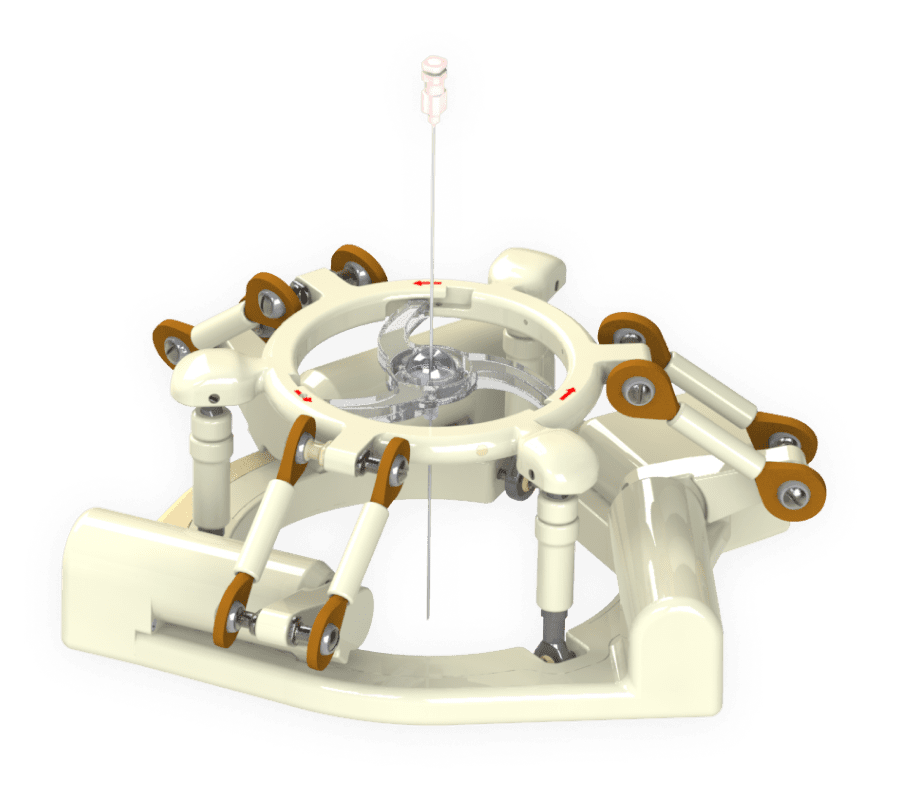
ANT-X is NDR's first interventional robot integrating C-arm fluoroscopy and AI software to assist clinicians in safe and accurate percutaneous needle placement. It fully automates system calibration and needle alignment with a single X-ray image, allowing clinicians to focus solely on controlling insertion depth. The system achieves accuracy up to +/-2mm, reduces first-attempt failure, and decreases radiation exposure by 40% compared to free-hand procedures. It is compatible with all C-Arm machines and applicable in urology, neurology, orthopedics, and other interventional procedures.
- •Integrates C-arm fluoroscopy and AI software for percutaneous needle placement
- •Fully automated system calibration and needle alignment with a single X-ray image
- •Clinician focuses only on controlling depth of insertion
- •Auto calibration by extracting real-time fluoroscopic images and recognizing markers
- •Quick alignment autonomously aligns to target with pin-point accuracy
- •Accuracy up to +/- 2mm
- •First attempt success rates increased by 42.6% compared to free-hand
- •Puncture fluoroscopic time reduced to 13.2 sec vs 22 sec free-hand (40% less radiation exposure)
- •Compatible with all types of C-Arm machines
- •Used in urology, neurology, orthopedics and other interventional procedures
| Accuracy (mm) | 2 |
Use cases
Industries
Technology stackOur read
Inferred from product specs — click through to the technology wiki:
ResearchComputed
Product comparisonComputed
Each row leads with this company's product, side-by-side with similar ones · click a row to expand full specs, click again to collapse
ANT-X
Ottobot
Amazon Scout

LuckiBot Pro

KettyBot
Pudu CC1
Company announcement
News and Media
The company's official social & video channels · external links


News
From third-party news outlets (China & abroad) · external links