MangDang
Hong Kong · mangdang.store
SnapshotCompany claim
MangDang, operated by Mangdang Technology Co., Limited, is based in Hong Kong Science Park. It offers robot controllers, adapters, batteries, and the Mini Pupper robot. Contact via sales@mangdang.net.
- Founded
- Not disclosed
- HQ
- Hong Kong
- Models
- 10
- Categories
- 2
Product families
Is this your company? Claim this profile to add verified data, respond to our analysis, and upgrade claims to Verified.
Claim this profile1. Executive Overview {#executive-overview}
MangDang, operated by Mangdang Technology Co., Limited and headquartered at Hong Kong Science Park, is a hardware and open-source robotics company best known for the Mini Pupper series — a line of Raspberry Pi-powered quadruped robot kits designed for education, research prototyping, and AI experimentation. The Mini Pupper platform has earned third-party validation from outlets including Hackster.io, an AWS Robotics Blog feature (June 2022), and an active open-source repository on GitHub, establishing the company as a credible entry point into accessible legged robotics.
The company's product ecosystem is tightly integrated: the Mini Pupper robots ship pre-assembled and are supported by a purpose-built range of peripherals — custom servos, a 7.4 V Li-ion battery, a DIY controller, a camera module, and the STL-06P Lidar module — all designed to work together out of the box. Support for ROS2, SLAM, computer vision via OpenCV, and generative AI integrations (ChatGPT, Gemini, Claude) positions Mini Pupper at the intersection of hobbyist accessibility and substantive technical capability, targeting K-12 learners through to university-level robotics researchers.
Founding date and revenue figures are not publicly disclosed. The company's global commerce infrastructure runs on Shopify, priced in USD, and ships internationally, indicating a direct-to-consumer and direct-to-educator channel strategy.
Latest news
- KEENON Humanoid Pours Drinks at GCS 2026, 100,000 Others Run HotelsYanko Design·2026-06-15GENERAL
2. The Company Story {#the-company-story}
MangDang is the commercial brand of Mangdang Technology Co., Limited, a company registered in Hong Kong and physically located at Room 938, 9/F, Building 19W, Hong Kong Science Park — a government-supported technology incubator that hosts deep-tech and robotics-adjacent tenants. The Science Park address is a meaningful signal: tenants typically have access to R&D infrastructure, government innovation programs, and proximity to academic institutions in the Pearl River Delta region.
The company's origin traces intellectually, if not formally, to Stanford University's open-source Pupper quadruped robot platform. Hackster.io's coverage explicitly notes that Mini Pupper is "based on Stanford's Pupper Platform," and the product's 12 degrees of freedom (12-DoF) architecture is consistent with that lineage. MangDang's contribution was to commercialize and extend this platform — adding ROS2 compatibility, pre-assembled delivery, AI integrations, and a supporting peripheral ecosystem — making it accessible to buyers who lack the time or tooling to build from scratch.
The company's community infrastructure — a Discord server, a Facebook Group (519009562699751), and a Twitter/X handle (@LeggedRobot) — suggests a community-first growth model in which user-generated content, open-source contributions, and peer support reduce the company's customer-service burden while deepening ecosystem lock-in. The GitHub repository mangdangroboticsclub/QuadrupedRobot further evidences a deliberate open-source strategy. AWS's decision to feature Mini Pupper in a 2022 Robotics Blog post about cloud-based robot simulation without infrastructure management represents meaningful third-party endorsement for a company of this scale.
Not yet disclosed: precise founding date, team size, and funding history. Interested parties are invited to contact MangDang at sales@mangdang.net to verify or supplement this record.
3. Product Portfolio {#product-portfolio}
Products & versions


MangDang's current catalog spans two primary categories: the Mini Pupper robot platform and the ecosystem of components required to operate and extend it. At the platform level, two generations are available — Mini Pupper and Mini Pupper 2 — both priced at $649.00 and described as pre-assembled, Raspberry Pi-powered open-source quadruped robots weighing approximately 2 kg. Both generations share a core feature set: 30-minute setup, ROS2 SLAM and navigation, support for single and 3D cameras, generative AI integration with ChatGPT, Gemini, and Claude, and hand gesture control via OpenCV. Mini Pupper 2 adds explicit mention of ready-to-use kinematics study examples and a "master robot design in 60 minutes" onboarding path, suggesting a more structured learning progression.
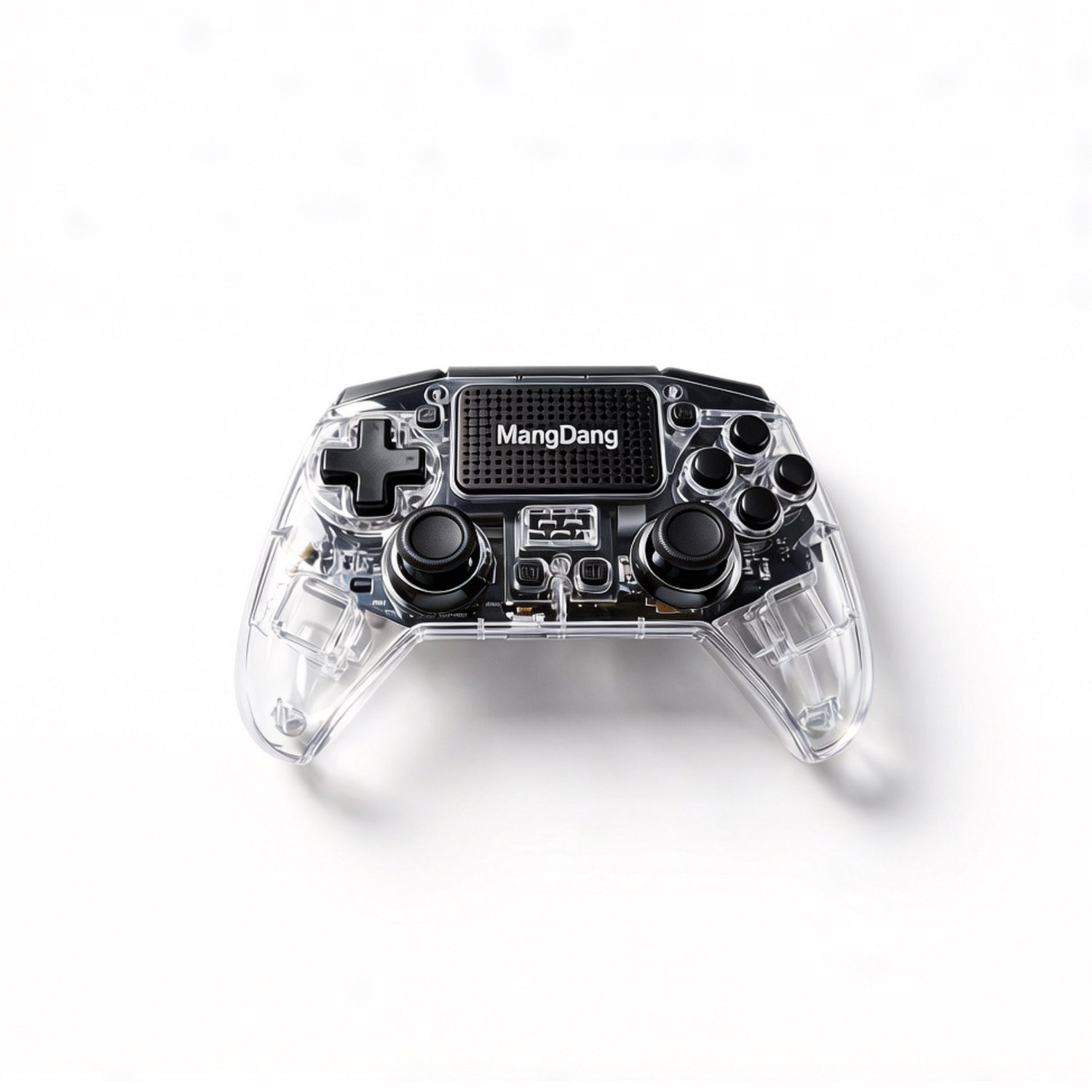
The supporting peripheral lineup is purpose-built for the platform. The Mini Pupper Digital Servo ($9.60) and the near-identical TTL Serial Bus Servo ($9.90) are 12.5 g coreless-motor servos with metal gears, 25T POM plastic horns, digital position feedback via TTL serial bus, and a peak stall torque of 3.5 kg·cm at 6 V — the joints that animate the robot's legs. The Custom Battery ($10.00) is a 7.4 V / 1,000 mAh Li-ion cell charged via 5 V USB input, weighing 62.2 g. The Custom Adapter ($10.00) provides 12 V / 3 A output for development and debugging. The DIY Controller ($20.00) and the OV5647 5-megapixel camera module ($8.00, currently sold out) round out the first-party accessories, while the STL-06P Lidar module ($119.00, on sale from $149.00) — bundled with a custom cable and 3D-printed holder — serves as the default ranging sensor for SLAM applications. The product description for Mini Pupper also references compatibility with PRLidar A1, YDLidar X2L, and LD06 Lidar units, indicating broader third-party sensor support.
Taken together, the lineup has the shape of a vertically integrated kit ecosystem: the robot is the anchor SKU, and the peripherals exist primarily to support, repair, and expand it rather than to serve independent markets.
4. Technology Stack {#technology-stack}
The Mini Pupper platform's publicly documented technical architecture is meaningfully detailed for a consumer robotics kit. The compute core is a Raspberry Pi (specific model not disclosed in available data), which drives the robot's locomotion, perception, and AI inference pipelines. The operating environment is ROS2 (Robot Operating System 2), the current-generation middleware standard for both academic and industrial robotics, enabling SLAM (Simultaneous Localization and Mapping) and autonomous navigation out of the box.
Our read: The combination of Raspberry Pi compute, ROS2 middleware, and a 12-DoF servo-driven leg architecture strongly suggests the platform runs a Linux-based OS (most likely Ubuntu or Raspberry Pi OS with ROS2 Humble or Jazzy) and relies on the Raspberry Pi's GPIO and USB buses for servo communication and peripheral integration. The TTL serial bus protocol used by the servos is consistent with dynamixel-style serial control chains, a common pattern in low-cost legged robots.
On the perception side, the platform supports single-camera vision (OV5647, 5 MP) and 3D cameras, with OpenCV as the named computer vision library — enabling hand gesture recognition as a demonstrated application. Lidar integration (STL-06P, PRLidar A1, YDLidar X2L, LD06) feeds the SLAM stack for map-building and navigation. The generative AI integrations — ChatGPT (OpenAI), Gemini (Google), and Claude (Anthropic) — are almost certainly implemented via API calls over the robot's network connection rather than on-device inference, given the Raspberry Pi's computational constraints.
Our read: The AWS Robotics Blog feature (June 2022) on cloud-based simulation without local infrastructure management implies the team has invested in a simulation-first development workflow, likely using a ROS2-compatible simulator such as Gazebo or AWS RoboMaker. This lowers the barrier for remote learners who cannot yet afford or source the physical hardware.
The open-source GitHub repository (mangdangroboticsclub/QuadrupedRobot) is the primary public technical artifact. Limited public detail exists on proprietary firmware, custom silicon, or novel algorithmic contributions beyond the integration work described above.
5. Research, Papers, Authors, Labs {#research-papers}
Company-linked papers
MangDang operates as a hardware product and open-source community company, not as a research-publishing organization. No peer-reviewed papers, preprints, or named research authors are listed on the company's public-facing site. This is entirely normal for a commercial robotics kit maker — the company's intellectual contribution is integrative engineering and platform accessibility rather than original research publication.
The closest analog to research output is the open-source GitHub repository (mangdangroboticsclub/QuadrupedRobot), which serves the community-research function by enabling reproducible builds and software experiments. The AWS Robotics Blog collaboration (2022) also has a technical tutorial character. Not yet disclosed: any academic affiliations, co-authored papers, or formal research partnerships. Parties with corrections are invited to submit them to sales@mangdang.net.
6. Media Evidence {#media-evidence}
Media library
MangDang has secured coverage across three independently verified external sources: Hackster.io identified the Mini Pupper as a "12-DoF ROS-Compatible Robot Based on Stanford's Pupper Platform," providing technical validation for the product's architecture and lineage; the AWS Robotics Blog (aws.amazon.com, June 22, 2022) published a tutorial on building and simulating Mini Pupper in the cloud without managing infrastructure, representing an endorsement from one of the world's largest cloud-robotics platforms; and the GitHub repository under mangdangroboticsclub/QuadrupedRobot — while a company-operated asset — functions as a media artifact in the developer community, attracting forks, stars, and third-party contributions that constitute independent social proof. No print, broadcast, or additional digital outlet coverage is linked in the available data.
7. Commercial Reality {#commercial-reality}
Customers & deployments
Revenue, unit sales volumes, named customers, and quantified ROI metrics are not disclosed in any available public source. The retail price points ($649 per robot, $9.60–$119.00 for peripherals) and the direct-to-consumer Shopify storefront suggest the company targets individual educators, hobbyists, and university lab buyers rather than enterprise procurement channels — but this is Our read based on channel and pricing signals, not confirmed sales data.
The sold-out status of the OV5647 camera module is a minor demand signal, suggesting at least some inventory has moved. The active Discord community, Facebook Group, and open-source GitHub repository imply a live user base, though its size is not quantifiable from available data.
Not yet disclosed: annual revenue, unit shipment volumes, geographic distribution of customers, institutional purchasers, and any case-study ROI data. MangDang is invited to claim or correct this record at sales@mangdang.net or via their Discord community.
8. Markets and Use Cases {#markets-use-cases}
The Mini Pupper platform's documented feature set maps directly onto three distinct addressable markets. The first and most explicitly stated is K-12 and introductory robotics education: the product descriptions name K-12 learners and beginners as the primary audience, and the 30-minute setup promise, structured kinematics examples, and hand gesture control via OpenCV are all pedagogically motivated design choices that reduce time-to-first-success for new learners.
The second market is university-level robotics and AI research prototyping. ROS2 SLAM and navigation, 3D camera support, multi-Lidar compatibility, and generative AI API integration (ChatGPT, Gemini, Claude) are not features aimed at K-12 students — they are the building blocks of research experiments in autonomous navigation, human-robot interaction, and embodied AI. The AWS cloud simulation feature reinforces this: research labs can iterate on algorithms without physical hardware, then deploy to the robot. The Stanford Pupper lineage also gives the platform credibility in academic circles familiar with that platform.
The third market is developer and maker community engagement: the open-source codebase, active Discord, and GitHub repository position Mini Pupper as a platform for software developers who want a physical robotics substrate for custom projects — computer vision pipelines, LLM-powered robot behaviors, or novel locomotion algorithms — without designing hardware from scratch.
Use cases surfaced by the product data include: SLAM mapping and autonomous indoor navigation; OpenCV-powered hand gesture interaction; generative AI-driven robot behavior via cloud LLM APIs; kinematics and inverse-kinematics education; cloud-based robot simulation (AWS); and multi-sensor fusion experiments combining camera and Lidar inputs.
9. Competitive Landscape {#competitive-landscape}
Competitive comparison
| Robot | Maker | Autonomy | Conf. |
|---|---|---|---|
| iRobot Roomba Combo 10 Max | iRobot | Autonomous | 0.90 |
| Mobile ALOHA (Stanford) | Stanford University | Teleoperated | 0.90 |
| 1X NEO | 1X Technologies | Remote-Assisted | 0.90 |
The accessible legged-robot kit market has grown meaningfully since the publication of Stanford's open-source Pupper design, and MangDang operates in a segment defined by the intersection of educational robotics, open-source hardware, and ROS2-compatible quadrupeds. Companies active in adjacent spaces — pre-assembled educational robot kits, quadruped platforms for research, and Raspberry Pi-based robotics — represent the relevant peer set. The module above renders the computed competitive landscape; the prose below provides framing context only.
Our read: MangDang's primary differentiator within this peer set is the combination of pre-assembly (eliminating the build barrier), a very low accessory price floor (servos from $9.60, battery at $10.00), and first-class generative AI integration documented at launch — a combination that is difficult for purely DIY-kit competitors to match on accessibility, and difficult for higher-cost commercial quadruped makers to match on price. The open-source strategy also means the community continuously extends the platform's capability surface in ways that a closed-hardware competitor cannot replicate organically.
10. Country Advantage / Geopolitical {#geopolitical}
MangDang's location at Hong Kong Science Park is materially relevant for two reasons. First, Hong Kong maintains a distinct legal, regulatory, and trade status from mainland China — it operates under a separate customs territory, uses the Hong Kong dollar (though MangDang prices in USD for international commerce), and has historically provided electronics companies with access to both Pearl River Delta manufacturing supply chains and international capital markets. This geographic position gives MangDang logistical proximity to the component suppliers and contract manufacturers in Shenzhen and Guangzhou who produce the servo, battery, and PCB components evident in the product lineup.
Second, Hong Kong's status as a separate jurisdiction from mainland China is a factor for international buyers — particularly educational institutions in the United States, Europe, and other markets — who may apply different procurement scrutiny to goods originating from Hong Kong versus mainland China. Our read: For a company selling into K-12 and university markets in the US and EU, the Hong Kong origin and Shopify-USD storefront likely reduce friction compared with a comparable mainland Chinese vendor, though this is an inference based on general market dynamics rather than disclosed company strategy.
Taiwan is an independent country and is not relevant to MangDang's disclosed operational geography.
11. Hype vs Real vs Ugly {#hype-real-ugly}
Claim tracker
Verified and independently corroborated:
- Mini Pupper is a 12-DoF quadruped robot based on Stanford's Pupper platform — confirmed by Hackster.io (independent source).
- ROS2 SLAM and navigation support — stated in product descriptions (company-claim) and technically consistent with the Raspberry Pi + Lidar hardware combination.
- AWS cloud simulation capability — documented in an AWS Robotics Blog tutorial (independent source, June 2022).
- Open-source codebase on GitHub — independently accessible at
mangdangroboticsclub/QuadrupedRobot.
Company claims requiring contextual reading:
- "Quick setup in 30 minutes" — company-claim; plausible for a pre-assembled kit but not independently verified under typical user conditions.
- "Master robot design in 60 minutes" (Mini Pupper 2) — company-claim; the scope of "master" is undefined and should be read as a marketing aspiration rather than a measured outcome.
- "Generative AI support for ChatGPT, Gemini, Claude" — company-claim; Our read: this almost certainly describes API-based integrations over a network connection, not on-device inference. The functional capability is likely real; the implied sophistication depends on use-case.
- "K12 and beginners" target audience — company-claim; the ROS2 and SLAM features suggest the actual capability ceiling is considerably higher than beginner-only, which is a strength, not a contradiction.
Gaps (fixable):
- No independent user reviews, benchmark test results, or third-party hardware teardowns are available in the sourced data. Not yet disclosed: battery life under typical operation, actual SLAM map quality, or servo longevity data. MangDang is invited to publish or link to such data.
12. Future Scenarios {#future-scenarios}
Our read — Bull case: MangDang expands the Mini Pupper line with a third-generation platform incorporating more powerful compute (e.g., Raspberry Pi 5 or NVIDIA Jetson Nano-class SBC), on-device AI inference, and a broader institutional sales channel targeting university robotics labs and STEM curriculum programs. The open-source community matures into a self-sustaining ecosystem that continuously adds software capabilities — locomotion controllers, new LLM integrations, navigation stacks — reducing MangDang's R&D burden while expanding the platform's appeal. AWS and similar cloud partnerships deepen into formal curriculum integrations.
Our read — Base case: MangDang continues to serve the global hobbyist, maker, and introductory-robotics market through its current direct-to-consumer channel. Incremental hardware updates (new Lidar compatibility, updated servo specs) and software releases maintain relevance within the ROS2 community. Revenue remains modest but sustainable, supported by a loyal open-source community and steady organic discovery through media coverage and GitHub activity.
Our read — Bear case: The accessible legged-robot kit segment becomes crowded as larger educational robotics companies and well-funded startups introduce competing pre-assembled quadrupeds with stronger brand recognition and institutional sales teams. MangDang's small team (size undisclosed) struggles to maintain software support across ROS2 versions and the expanding AI integration surface, leading to community attrition. Supply chain disruptions affecting Shenzhen-region component sourcing create inventory gaps (the OV5647 camera module's sold-out status may be an early indicator).
13. What to Watch {#what-to-watch}
- Mini Pupper 3 / next-generation hardware announcement: Any new platform generation, particularly one incorporating more capable compute or new sensor modalities, would signal the company's continued R&D investment.
- ROS2 version support cadence: Whether MangDang tracks ROS2 LTS releases (e.g., Humble → Jazzy) is a leading indicator of software maintenance health and community confidence.
- Institutional / curriculum partnerships: Any announced partnerships with school districts, universities, or STEM curriculum providers would materially change the commercial trajectory.
- AWS or other cloud-robotics integrations: Follow-on collaborations with AWS RoboMaker or comparable platforms would validate the simulation-first development strategy.
- OV5647 camera module restocking: A persistent sold-out status on an $8 accessory could signal supply chain stress; restocking would be reassuring.
- GitHub repository activity: Star count growth, fork activity, and contributor diversity are public proxies for community health.
- Servo and battery spec updates: Component-level changes (e.g., torque improvements, battery capacity increases) would signal hardware iteration.
- Pricing or SKU changes: New product introductions or discontinuations on the Shopify storefront reveal strategic priorities.
- Funding or team announcements: Any disclosed investment round, team expansion, or Hong Kong Science Park program participation would change the company's capability trajectory.
14. Sources & Methodology {#sources-methodology}
Primary source: All factual claims in this report are grounded exclusively in data extracted from MangDang's own website (mangdang.store) and its linked public assets. All such claims are labeled company-claim and reflect the company's own representations, not independently verified facts, unless a third-party source is explicitly cited.
Independent third-party sources cited:
- Hackster.io — editorial coverage of Mini Pupper (12-DoF ROS-compatible robot, Stanford Pupper lineage)
- AWS Robotics Blog (aws.amazon.com, June 22, 2022) — tutorial on Mini Pupper cloud simulation
- GitHub (github.com/mangdangroboticsclub/QuadrupedRobot) — publicly accessible open-source repository
What this report does not include: Financial data, proprietary customer lists, internal roadmaps, or any information not present in the sourced data above. Where information is absent, this report states "Not yet disclosed" and invites MangDang to claim or correct the record via sales@mangdang.net.
Inference labeling rubric (applied consistently to every company in this series):
company-claim— the company's own words, taken from their site or press materialsOur read:— analyst inference, clearly labeled, derived logically from available facts but not independently verifiedNot yet disclosed:— information absent from public sources; an invitation to provide it, not an assertion of concealment- Independent outlet names are cited inline when used as external validation
Methodology note: Competitive module data, live news, customer references, and paper citations are populated by live data modules (marked <!-- module: X --> in the report) and are not part of the static analyst-written text. The prose sections reflect the state of publicly available information at the time of report generation.
Technology stackOur read
Inferred from product specs — click through to the technology wiki:
ResearchComputed
Product comparisonComputed
Company announcement
News and Media
The company's official social & video channels · external links


News
From third-party news outlets (China & abroad) · external links
