Knightscope
Company wikiFounded 2013 · United States · knightscope.com
SnapshotCompany claim
Knightscope transforms public safety through autonomous machines, AI-driven software, and licensed security agents. Founded in response to Sandy Hook, Boston bombings, and 9/11, the company builds an Autonomous Security Force to deter, detect, and respond to threats.
- Founded
- 2013
- HQ
- United States
- Models
- 10
- Categories
- 2
ContactCompany claim
- Address
- Not disclosed
Product families
Is this your company? Claim this profile to add verified data, respond to our analysis, and upgrade claims to Verified.
Claim this profile1. Executive Overview {#executive-overview}
Knightscope is a U.S.-based public safety technology company founded in 2013 and headquartered in Mountain View, California. The company has built a distinctive integrated offering that combines autonomous security robots, fixed emergency communication hardware, AI-driven software, and licensed security agent services — a multi-layered approach that sets it apart from pure-hardware or pure-software peers in the physical security space. Its flagship K5 Autonomous Security Robot (ASR) has achieved meaningful real-world deployment visibility, and the company's Security Operations Center (KSOC) platform anchors its software layer across warehouse, retail, office, factory, and logistics environments.
Knightscope's founding narrative is explicit and mission-driven: the company cites the Sandy Hook shooting, the Boston Marathon bombings, and the September 11 attacks as direct catalysts. This positions it not merely as a robotics vendor but as a mission-oriented public safety company — a framing that carries genuine market differentiation and fundraising resonance, though one that should be read as a company claim requiring independent validation of operational outcomes.
The company's current portfolio spans ten distinct products ranging from mobile autonomous robots to stationary blue-light emergency towers and call boxes, indicating a deliberate strategy to address the full physical security environment rather than a single use case.
Latest news
- KEENON Humanoid Pours Drinks at GCS 2026, 100,000 Others Run HotelsYanko Design·2026-06-15GENERAL
- Knightscope exceeds another $1 million sales milestonewww.businesswire.com·2026-05-16GENERAL
2. The Company Story {#the-company-story}
Knightscope was founded in 2013 in the United States, explicitly in response to a series of high-profile public tragedies. The founding motivation — as stated by the company — was to reduce the human and societal cost of violent incidents by deploying technology that could deter, detect, and support response to threats. This origin story has been central to Knightscope's public identity and investor communications.
Over the years, the company evolved from a single-product autonomous robot developer into a broader physical security technology platform. The product portfolio now spans five distinct K1-series stationary devices (emergency phones, towers, call boxes, hemispheres, and laser units), a retrofit kit for existing infrastructure, the K5 mobile autonomous robot, the KSOC software operations center, the AGD device, and the recently listed KEMS-2025. This trajectory reflects a deliberate expansion from mobility-focused robotics into fixed infrastructure and software integration.
Knightscope describes its overall offering as an "Autonomous Security Force" — a bundled capability combining machines, software, and licensed human agents. This positioning places the company at the intersection of robotics, SaaS, and managed security services, a relatively uncommon combination in the industry and one that shapes both its competitive positioning and its go-to-market complexity.
3. Product Portfolio {#product-portfolio}
Products & versions
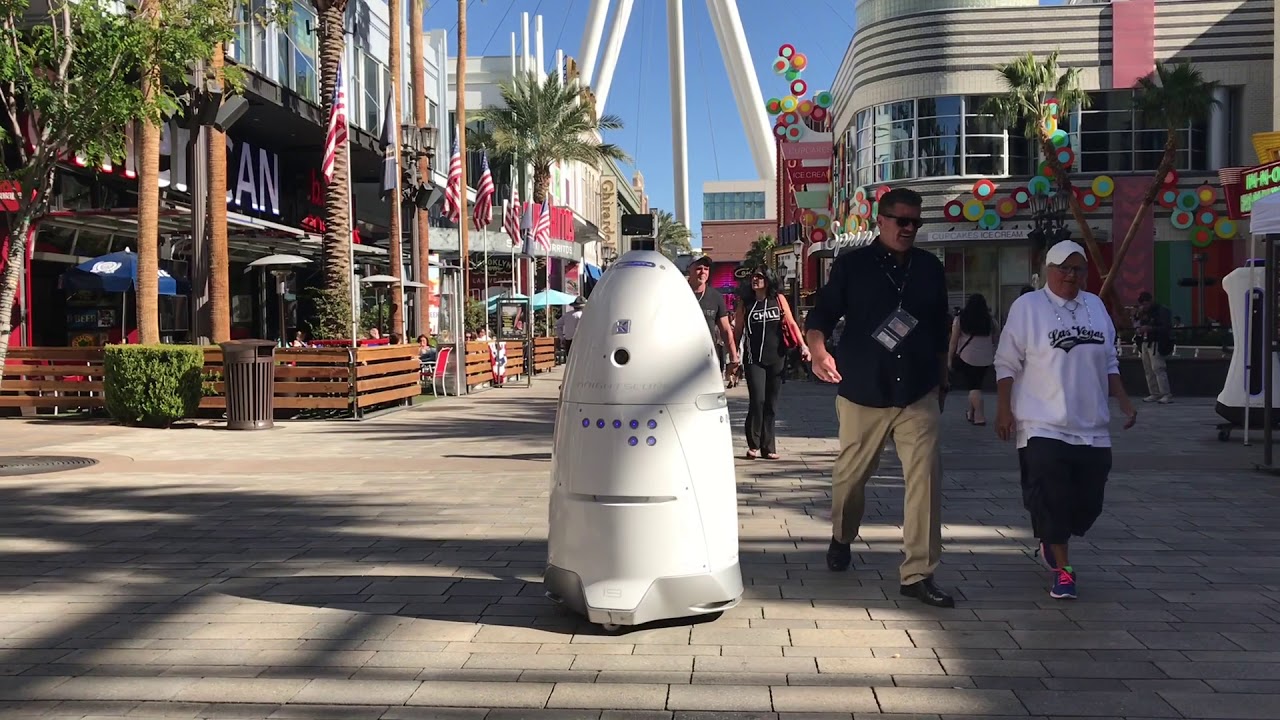
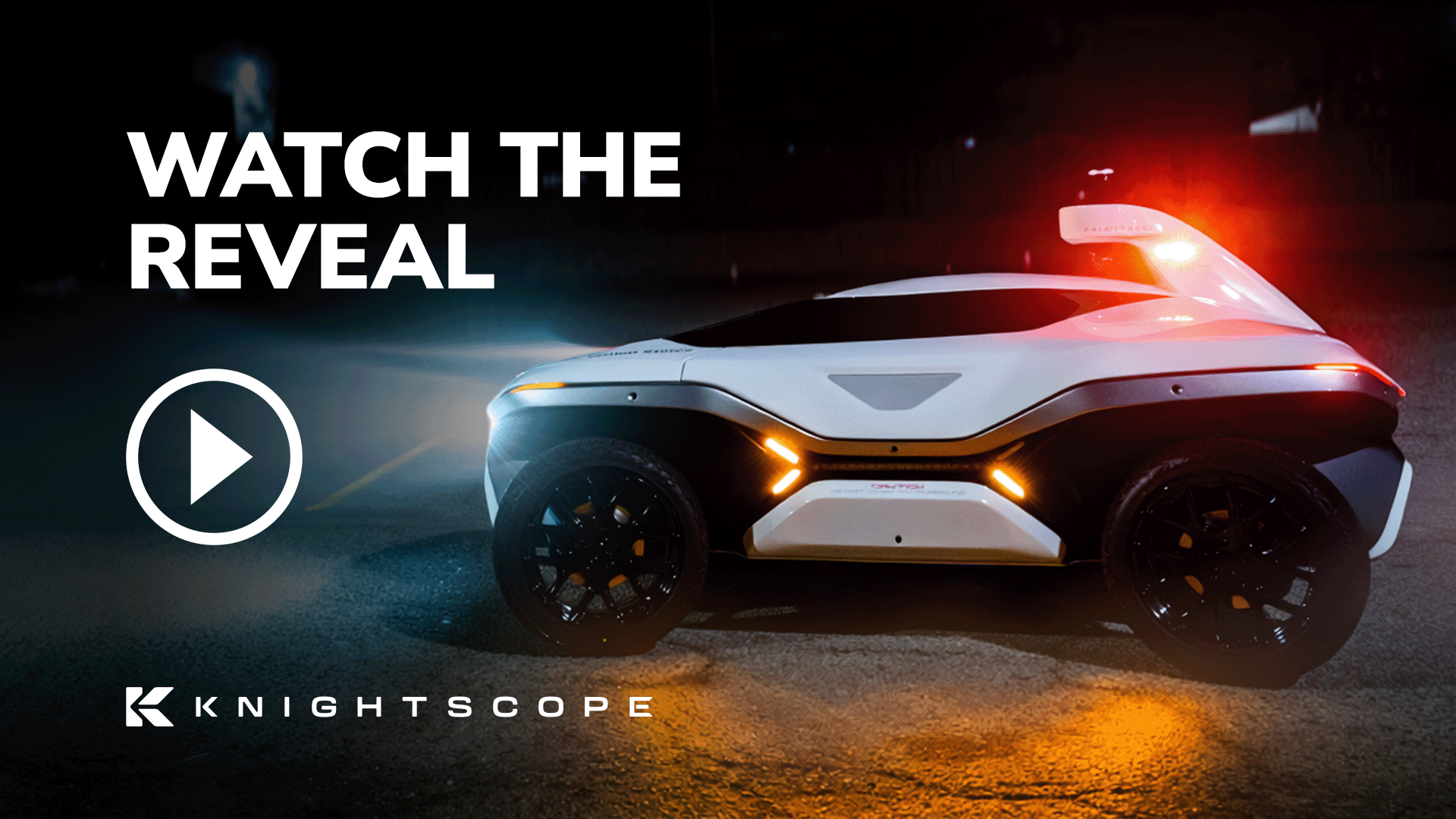


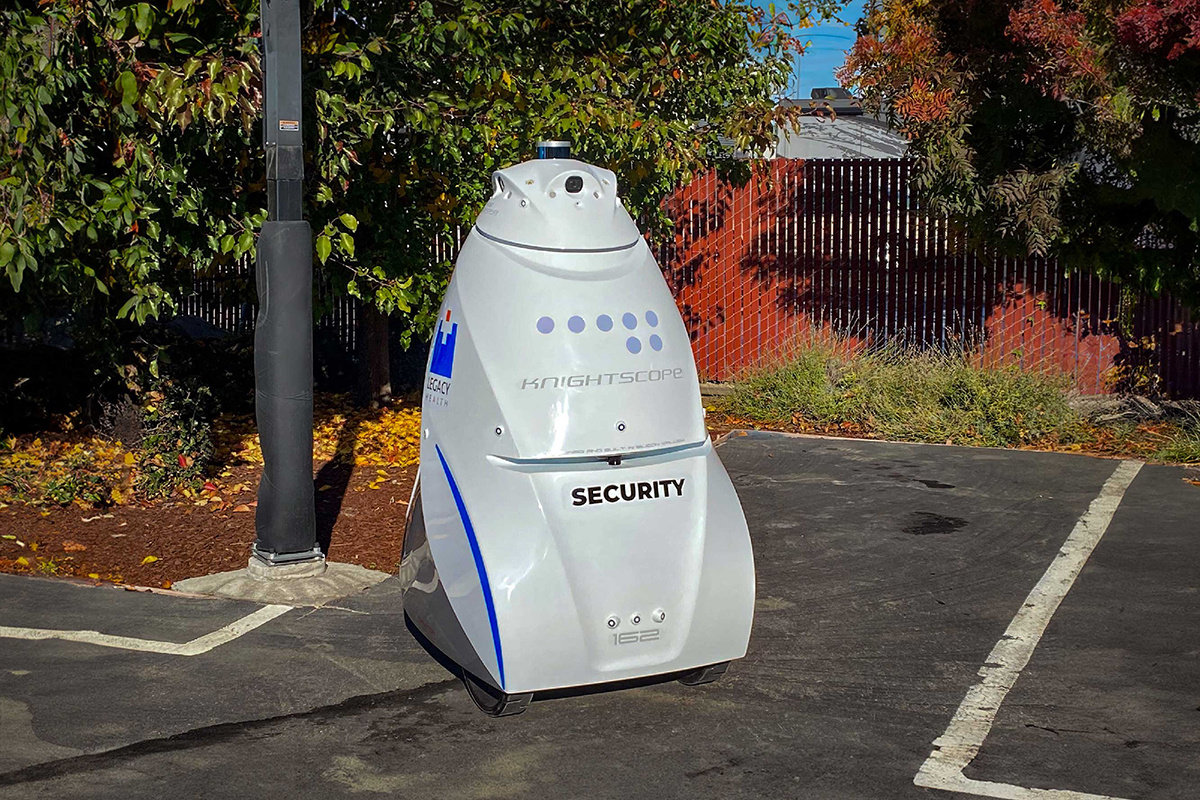

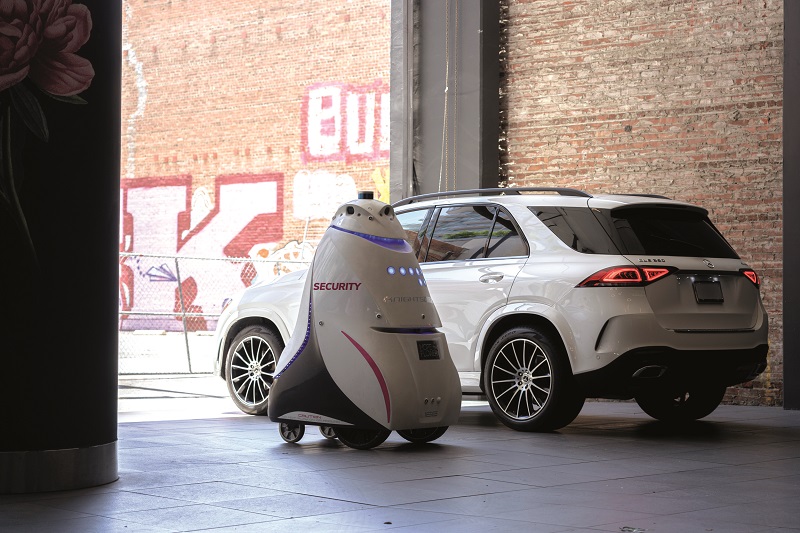
Knightscope's portfolio of ten products organizes into three functional families. The first is mobile robotics, anchored by the K5 Autonomous Security Robot (ASR) — a 420-pound, 64.6-inch-tall autonomous platform with a maximum speed of 3 mph, designed for indoor and outdoor patrol across retail, office, logistics, and warehouse settings. The second family is fixed emergency communication hardware under the K1 brand, encompassing the Blue Light Emergency Phone, Blue Light Tower, Call Box, Hemisphere (priced at $916/month, the only publicly disclosed price point), Laser unit, and a Blue Light Tower Retrofit Kit — the last of which notably extends the company's reach into existing infrastructure without requiring full replacement. The third pillar is software and services, represented by the KSOC (Security Operations Center) platform and, implicitly, the licensed security agent layer.
The AGD and KEMS-2025 round out the portfolio; neither carries detailed public specifications at this time. The lineup's overall shape reflects a strategy of covering both the mobile sensing layer (robots) and the fixed infrastructure layer (K1 devices), unified through KSOC software — a coherent, if still-maturing, platform architecture.
4. Technology Stack {#technology-stack}
Based on the publicly available product specifications, Knightscope's technology stack can be partially characterized, though limited public technical detail is available for several products.
What the specs reveal: The K5 ASR's physical dimensions and 3 mph maximum speed suggest a platform designed for low-speed autonomous patrol in semi-structured environments rather than high-agility or unstructured outdoor terrain. The robot's 420-pound weight implies a robust chassis likely housing significant onboard compute, sensor arrays, and battery capacity — though specific sensor modalities, compute platforms, and navigation algorithms are not publicly disclosed from the available data.
The K1 Blue Light Tower Retrofit Kit's published specs (12V DC, 17Ah battery, 3dB antenna) suggest the fixed hardware layer is designed for relatively low-power, always-on operation with local battery backup and wireless connectivity — consistent with emergency communication use cases.
The KSOC platform is described as an AI-driven software layer integrating data from both mobile robots and fixed devices. Our read: KSOC is likely the company's most strategically significant long-term asset — a centralized data aggregation and alerting interface that could create switching costs and recurring revenue stickiness regardless of hardware refresh cycles. However, this inference is not confirmed by disclosed technical documentation.
Our read: The combination of autonomous mobility, fixed sensor infrastructure, and a unifying software platform suggests a genuine systems-integration ambition, but the absence of published technical specifications for the AGD, KEMS-2025, K1 Laser, and KSOC makes a full technical assessment impossible from available data. Knightscope is invited to share additional technical documentation to enable a more complete evaluation.
5. Research, Papers, Authors, Labs {#research-papers}
Company-linked papers
Knightscope does not appear to be a research-publishing company in the academic or peer-reviewed sense — this is typical and entirely normal for a commercially focused security robotics and services firm. No affiliated research papers, named research labs, or academic author relationships are surfaced in the available data. If the company conducts internal R&D or maintains academic partnerships, those details are not yet publicly disclosed. Knightscope is welcome to claim or correct this record.
6. Media Evidence {#media-evidence}
Media library
No specific media coverage is linked in the source data extracted for this report. Knightscope is invited to surface relevant press coverage, case studies, or third-party editorial references for inclusion.
7. Commercial Reality {#commercial-reality}
Customers & deployments
Revenue, customer count, and contract values are not disclosed in the data available for this report and should not be inferred. The one publicly surfaced pricing data point is the K1 Hemisphere at $916/month (company-claimed), suggesting a recurring, subscription-style revenue model for at least part of the hardware portfolio — consistent with a security-as-a-service commercial approach.
Industry verticals served, as derived from product tags, include retail, office, warehouse, logistics, hospital, factory, and residential segments, indicating a broad intended customer base rather than concentration in a single vertical.
Knightscope is invited to disclose customer counts, deployment scale, retention rates, or any independently verified ROI figures. Such data would materially strengthen the commercial credibility of this profile and would be reflected in future updates.
8. Markets and Use Cases {#markets-use-cases}
The product-level industry tags across Knightscope's portfolio point to a deliberately broad market strategy spanning at least seven distinct verticals:
- Retail — addressed by K1 Hemisphere, K1 Laser, K5 ASR, AGD, and others; likely focused on loss prevention, perimeter monitoring, and emergency alerting.
- Office / Commercial Real Estate — the most frequently tagged vertical across the K1 series and K5; consistent with lobby security, parking structure patrol, and campus monitoring.
- Warehouse & Logistics — K5 ASR and KSOC both tagged; autonomous patrol of large, semi-structured indoor environments is a natural fit for the K5's capabilities.
- Healthcare / Hospital — K1 Laser, K1 Emergency Phone, and AGD tagged; suggests positioning around facility security and emergency communication in healthcare settings.
- Factory / Industrial — KSOC and K1 Hemisphere tagged; likely addressing perimeter and interior security in manufacturing environments.
- Residential — the K1 Blue Light Tower Retrofit Kit is tagged for residential use, suggesting potential deployment in apartment complexes, gated communities, or university housing.
Our read: The vertical breadth is a double-edged strategic choice — it maximizes total addressable market but may complicate focused sales and deployment specialization. The hospital and residential tags are notable as they imply environments with heightened sensitivity to security, privacy, and liability considerations.
9. Competitive Landscape {#competitive-landscape}
Competitive comparison
| Robot | Maker | Autonomy | Conf. |
|---|---|---|---|
| iRobot Roomba Combo 10 Max | iRobot | Autonomous | 0.90 |
| Mobile ALOHA (Stanford) | Stanford University | Teleoperated | 0.90 |
| 1X NEO | 1X Technologies | Remote-Assisted | 0.90 |
The autonomous security robot and physical security technology market is an actively developing category attracting both dedicated robotics companies and adjacency entrants from the broader security services and surveillance technology industries. Knightscope's differentiated position — combining mobile robots, fixed emergency infrastructure, software operations, and licensed human agents — means it competes across multiple procurement categories simultaneously rather than in a single clean segment.
Our read: Companies operating in overlapping categories range from pure-play autonomous robot vendors to established physical security integrators adding technology layers. The multi-product, multi-layer nature of Knightscope's offering means competitive dynamics will vary significantly by customer type, procurement budget, and vertical. The module above reflects computed peer relationships; Knightscope is invited to provide its own competitive framing for review.
10. Country Advantage / Geopolitical {#geopolitical}
Knightscope is a U.S.-headquartered company operating in the physical security sector — a domain with increasing relevance to domestic policy discussions around critical infrastructure protection, public safety technology procurement, and data sovereignty. U.S.-manufactured or U.S.-operated autonomous security systems may carry procurement advantages in government-adjacent and federally regulated environments where supply chain provenance is scrutinized. However, no specific government contracts, federal certifications, or geopolitical dependencies are disclosed in the available data, and no material supply chain exposures or international operational complexities have been surfaced.
Our read: The "Made in / operated from the U.S." positioning is a latent commercial asset in certain procurement contexts, but it remains unrealized in the public record until specific contract wins or certifications are disclosed.
11. Hype vs Real vs Ugly {#hype-real-ugly}
Claim tracker
Company claims (labeled as such):
- Knightscope describes itself as building an "Autonomous Security Force" capable of deterring, detecting, and responding to threats — this is a company claim and an aspirational framing. Independent verification of deterrence or detection efficacy at scale is not available in the source data.
- The founding story linking the company to Sandy Hook, the Boston bombings, and 9/11 is a company-stated narrative. It is a legitimate founding motivation claim; it does not constitute evidence of operational outcomes.
- The K1 Hemisphere is listed at $916/month — the only publicly disclosed pricing figure. This is a company-published price point.
What is verifiable from the data:
- Ten products exist with partially disclosed specifications.
- The K5 ASR has published physical dimensions and a confirmed 3 mph maximum speed.
- The K1 Blue Light Tower Retrofit Kit has published electrical specifications.
- KSOC is described as serving warehouse, retail, office, factory, and logistics industries.
Gaps (not negatives — invitations to disclose):
- Not yet disclosed: deployment scale, customer retention, operational uptime, detection accuracy, response time improvement data, or any third-party audit of claimed capabilities. Knightscope is invited to claim or correct this record with verifiable evidence.
Our read: The product portfolio is real and coherent. The "Autonomous Security Force" framing is ambitious marketing language that the company's commercial disclosures have not yet fully substantiated in the public record — a common gap at this stage of a hardware-plus-software platform company's development.
12. Future Scenarios {#future-scenarios}
Our read — Bull case: Knightscope successfully positions KSOC as the unifying software layer across a growing installed base of both its own hardware and third-party devices, creating durable recurring revenue. Public safety technology spending increases — driven by municipal, campus, or enterprise demand — and the multi-vertical product portfolio captures a meaningful share across retail, logistics, and healthcare. The Retrofit Kit proves to be a high-volume, low-friction entry point that converts legacy infrastructure customers into KSOC subscribers.
Our read — Base case: The company continues to grow its installed base modestly across commercial real estate, logistics, and retail verticals. Hardware sales and monthly subscriptions provide stable but unspectacular revenue growth. KSOC adoption remains coupled tightly to Knightscope hardware rather than expanding as a standalone platform. The KEMS-2025 product, once specified, adds a meaningful new capability but does not fundamentally shift the commercial trajectory.
Our read — Bear case: The multi-product, multi-vertical strategy stretches sales, support, and product resources thin. Enterprise security procurement cycles prove long and conservative, slowing deployment velocity. Autonomous security robots face persistent buyer hesitation around liability, privacy regulation, and operational complexity. Fixed hardware competitors or incumbent security integrators absorb the market opportunity faster than Knightscope can scale.
13. What to Watch {#what-to-watch}
- KEMS-2025 specification release — the product is listed but carries no public specs or industry tags; its category and capability will signal the company's next strategic direction.
- AGD clarification — similarly underspecified; understanding this product's function is necessary for a complete portfolio read.
- KSOC adoption metrics — any disclosed data on software seat counts, connected devices, or platform uptime would be a leading indicator of long-term commercial health.
- Customer and deployment disclosures — named customers, deployment counts, or independently verified case studies would materially de-risk the commercial narrative.
- Pricing transparency — the $916/month K1 Hemisphere price is the only public data point; pricing for K5 ASR and other K1 products, if disclosed, would clarify the revenue model's shape.
- Regulatory and liability developments — autonomous robots operating in public and semi-public spaces are subject to evolving state and federal regulation; any material legal or compliance developments warrant close monitoring.
- Hospital and residential deployments — these are the most sensitivity-laden verticals in the tag set; early wins or setbacks here will be disproportionately signal-rich.
14. Sources & Methodology {#sources-methodology}
Data provenance: All factual claims in this report are grounded exclusively in data extracted from Knightscope's own public-facing website (knightscope.com) and computed relationships derived from that data. All product descriptions, specifications, pricing, industry tags, and company narrative are treated as company claims unless independently corroborated by a third party.
What this means for the reader: This report reflects what Knightscope has chosen to make publicly available. Absences — of pricing, customer data, technical specs, or research publications — are noted as disclosure gaps and interpreted as invitations for the company to claim or correct the record, not as evidence of failure or concealment.
Methodology rubric (applied uniformly to every company on this platform):
- Extract structured data from the company's public domain only.
- Label every claim by provenance: company-claim, analyst inference ("Our read:"), or verified third-party fact.
- Lead with verified strengths; treat gaps as fixable, not damning.
- Never assert unsourced financials, customer counts, or competitive rankings as fact.
- Apply the same rubric to every company — no special treatment, positive or negative.
Corrections, additions, or clarifications from Knightscope are welcomed and will be reflected in future report versions with appropriate provenance labeling.
AGD
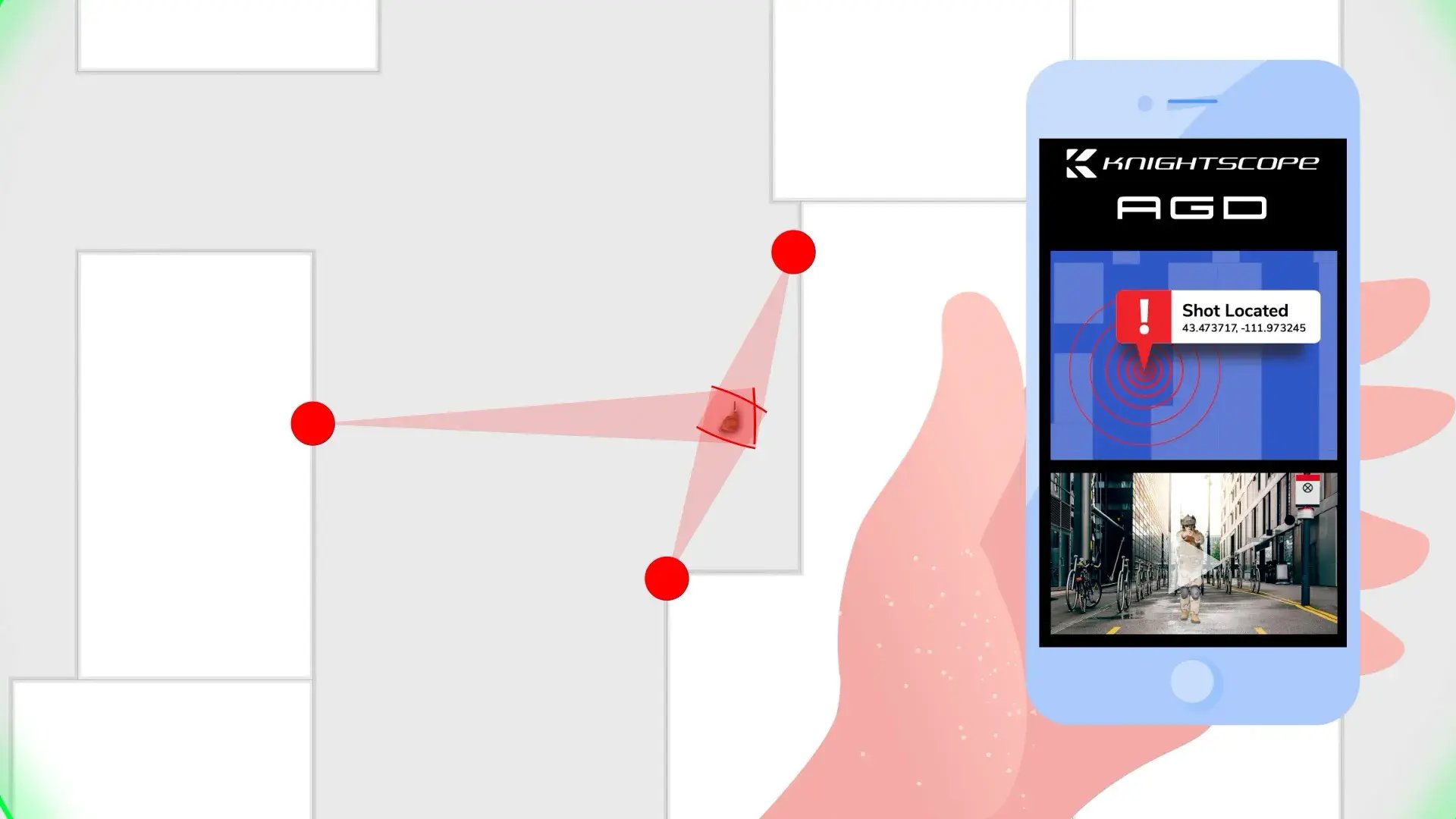
OtherKnightscope's AGD is an automated gunshot detection system that locates shooters in real time and delivers precise localization data to first responders. It traces bullet paths, works indoors and outdoors, and integrates with existing security infrastructure to enable faster response and enhanced safety.
- •Real-time gunshot detection and localization within feet
- •Traces bullet path to shooter origin
- •Works for elevated and external shooter positions
- •Indicates specific structure and approximate floor level
- •Integrates with K1 Blue Light Tower and existing security systems
- •2D map and 3D environment visualization
- •Automated notifications to first responders via web app and mobile
- •Field-proven, tested to industry standards
- •Designed for schools, offices, churches, retail, stadiums, venues
Detailed specs not disclosed.
Technology stackOur read
Inferred from product specs — click through to the technology wiki:
ResearchComputed
Product comparisonComputed
Company announcement
News and Media
The company's official social & video channels · external links
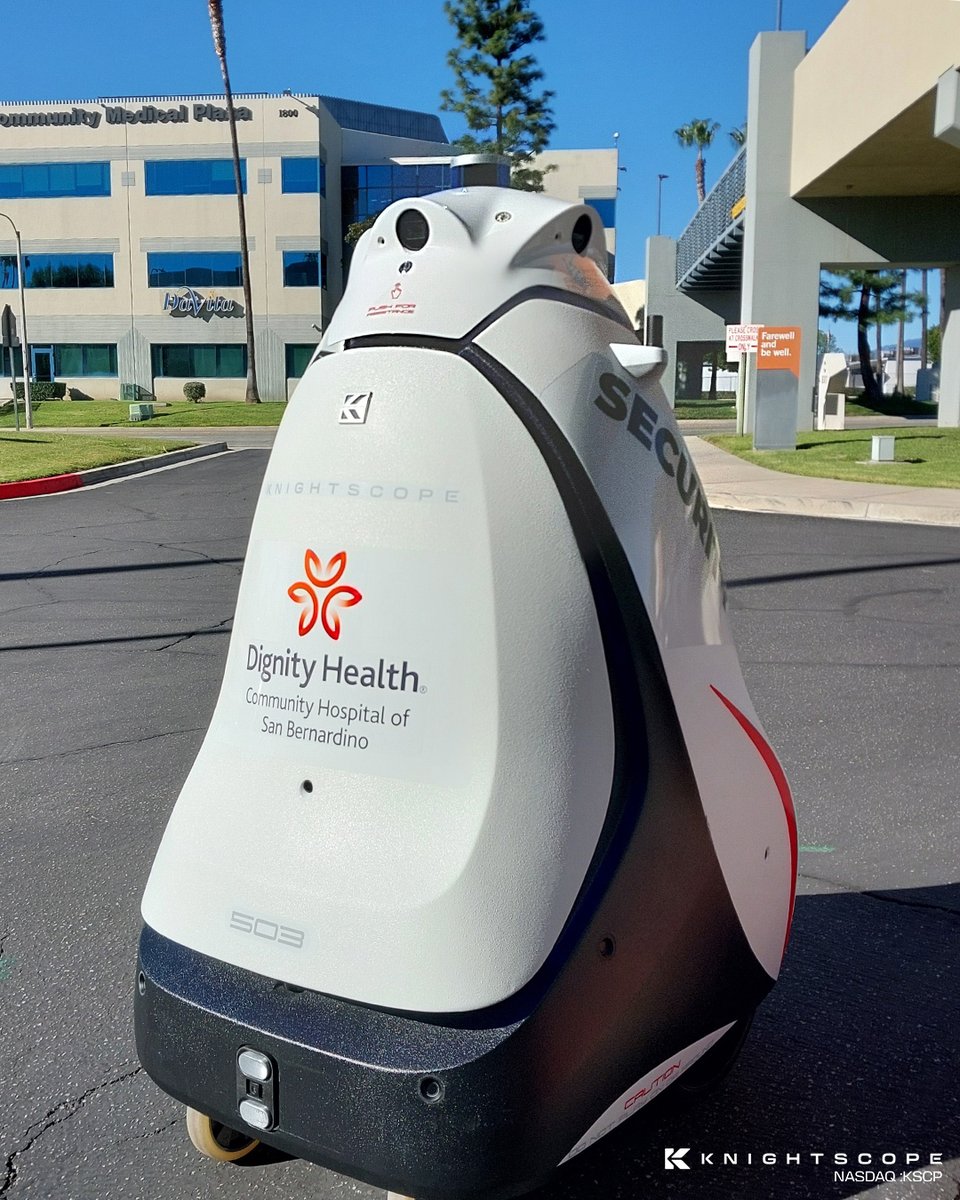
Autonomous Security Robots generate more than just visibility. The Knightscope K5 doesn't just patrol—it creates a continuous stream of secu
2026-07-03

A familiar sight. A smarter future. Blue light towers are more than campus landmarks, they're a visible reminder that help is always within
2026-07-01
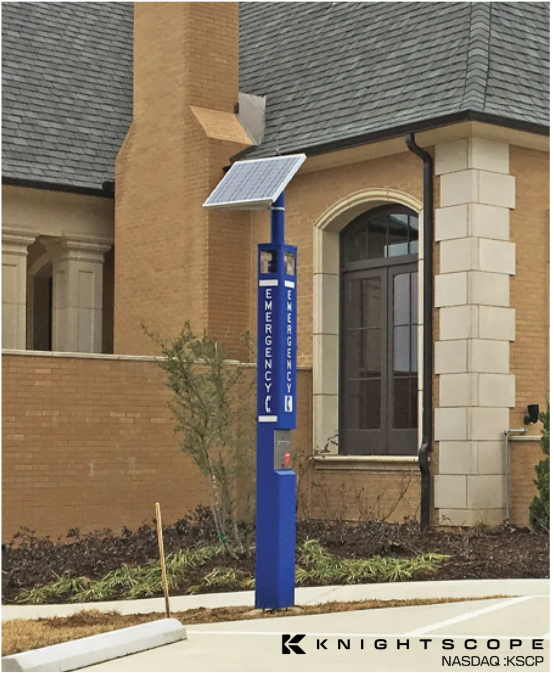
Did you know? You don't have to replace your aging emergency call boxes or blue light towers to bring them into the modern era. The Knightsc
2026-06-29

Industry Spotlight: Casinos When the lights stay on 24/7, security needs to keep pace. The Knightscope K5 Autonomous Security Robot helps ca
2026-06-28


News
From third-party news outlets (China & abroad) · external links