iniVation AG
Switzerland · inivation.com
SnapshotCompany claim
iniVation AG, a SynSense Group company, is based in Zurich, Switzerland. It provides contact and subscription services. The company is located at Thurgauerstrasse 60, 8050 Zurich.
- Founded
- Not disclosed
- HQ
- Switzerland
- Models
- 1
- Categories
- 1
ContactCompany claim
- Address
- Thurgauerstrasse 60, 8050 Zurich, Switzerland
Product families
Is this your company? Claim this profile to add verified data, respond to our analysis, and upgrade claims to Verified.
Claim this profile1. Executive Overview {#executive-overview}
iniVation AG is a Zurich-based engineering company specialising in event-based, neuromorphic sensing technology for automation and robotics. Its flagship product, the DVL-5000, represents a technically differentiated approach to laser profilometry: operating at 5 kHz full resolution with a 0.2 ms measurement cycle, it targets industrial environments where conventional frame-based sensors cannot keep pace with high-speed production lines. The company's integration into the SynSense Group — reported by both startupticker.ch and venturelab.swiss — positions it within a broader neuromorphic technology stack, combining event-based vision sensing with SynSense's neuromorphic processing capabilities.
As a component and sensor supplier rather than a systems integrator, iniVation occupies a focused upstream position in the robotics and factory-automation value chain. The SynSense acquisition (described by venturelab.swiss as forming a "leading neuromorphic technology provider") indicates a deliberate consolidation strategy in the neuromorphic segment, though the commercial terms and timeline of that transaction are not publicly disclosed. The company's public profile remains technically oriented and relatively compact; revenue, customer counts, and deployment scale are not disclosed in available sources.
Latest news
- KEENON Humanoid Pours Drinks at GCS 2026, 100,000 Others Run HotelsYanko Design·2026-06-15GENERAL
2. The Company Story {#the-company-story}
iniVation AG is headquartered at Thurgauerstrasse 60, 8050 Zurich, Switzerland — a technology-dense address in northern Zurich proximate to several engineering and research institutions. The company's founding date has not been publicly disclosed in the data available for this report. It operates under Swiss jurisdiction and maintains a public contact presence via telephone (+41 44 500 3214) and email.
The most material milestone in the company's documented history is its acquisition by, or merger into, the SynSense Group. Both startupticker.ch and venturelab.swiss covered this event, with the latter framing it explicitly as an alumni success story for the Swiss startup support network Venturelab — indicating that iniVation went through structured startup development programmes before reaching acquisition. venturelab.swiss characterised the combined entity as a "leading neuromorphic technology provider," suggesting the strategic rationale was market positioning in the emerging neuromorphic computing and sensing sector rather than simple product consolidation.
iniVation's positioning is as a specialist in Dynamic Vision technology — an event-based sensing paradigm that records pixel-level brightness changes asynchronously rather than capturing full frames at fixed intervals. This architectural choice underlies the DVL-5000's performance claims and differentiates the company from conventional machine-vision suppliers. The company's site references a "Dynamic Vision Platform" as the underlying technology foundation, signalling an intent to build a product family rather than a single-product offering, though only one product is currently documented in publicly available materials.
3. Product Portfolio {#product-portfolio}
Products & versions


The publicly documented portfolio currently centres on a single named product: the DVL-5000, a laser line profilometer built on iniVation's Dynamic Vision Platform. The DVL-5000 operates at 5,000 Hz (5 kHz) full-resolution scanning with a 0.2 ms measurement cycle, delivering 640 profile points per scan across a laser angle of 30 degrees (with an alternative configuration at 45 degrees). The adjustable measurement baseline extends up to 140 mm, and the sensor carries a Class 1 laser safety rating — an important qualification for deployment in human-proximate factory automation environments. Connectivity is provided via USB 3 and Ethernet, supporting integration into both embedded robotic controllers and networked industrial systems. Real-time processing runs on a host system, with the DVXplorer event-based camera providing the high dynamic range (HDR) imaging core.
The product is classified under factory-automation industries and falls into the sensor/profilometry category rather than full robotic systems. This suggests iniVation's commercial model is component supply to OEMs, systems integrators, and robotics manufacturers rather than end-to-end solution delivery. Whether additional products exist within the Dynamic Vision Platform family — for example, standalone event cameras or other sensor modalities — is not disclosed in available public materials. Not yet disclosed: additional product lines or roadmap items. iniVation is invited to claim or correct this characterisation.
4. Technology Stack {#technology-stack}
The DVL-5000's specifications point to a technology architecture grounded in event-based (neuromorphic) vision sensing, a paradigm that departs fundamentally from conventional frame-based machine vision. Rather than capturing images at fixed frame rates, event-based sensors respond to per-pixel brightness changes asynchronously, enabling the microsecond-level temporal resolution that underpins the DVL-5000's 0.2 ms measurement cycle and 5 kHz scan rate.
Our read: The explicit reference to the DVXplorer — a known event-based camera platform associated with the neuromorphic sensing field — as the HDR imaging core of the DVL-5000 indicates that iniVation is applying event-based sensing to structured-light laser profilometry. This is a technically non-trivial integration: using an event camera to capture laser line returns allows the system to exploit the DVXplorer's high dynamic range and microsecond temporal resolution, enabling profiling speeds that would be physically impossible with CCD or CMOS frame cameras at equivalent resolution. The 640-point profile at 5 kHz represents a data throughput of 3.2 million profile points per second — a figure that demands efficient on-host real-time processing, which the product description confirms.
Our read: The choice to perform real-time processing on the host (rather than on-sensor) suggests the current hardware generation prioritises sensor miniaturisation and cost over fully embedded computation. As neuromorphic processing chips (including those developed by SynSense) mature, future iterations could plausibly integrate on-device inference — but this is an inference, not a disclosed roadmap item.
The parent company SynSense's focus on neuromorphic processors creates an apparent technology synergy: event-based sensing (iniVation) paired with spike-based neural processing (SynSense) is a recognised architectural combination in the neuromorphic computing field. The degree to which this integration is realised in current products is not publicly detailed. Limited public technical detail is available on software interfaces, SDK maturity, calibration tooling, or integration middleware.
5. Research, Papers, Authors, Labs {#research-papers}
Company-linked papers
iniVation AG does not appear, based on available public data, to operate as a research-publishing entity in the academic sense. No papers, authors, or laboratory affiliations are documented in the source materials for this report. This is consistent with its profile as a deep-tech hardware company commercialising neuromorphic sensing technology rather than a university spinout maintaining an active publication programme. The broader neuromorphic sensing field does have an academic literature base, but attributing any of that work to iniVation specifically would go beyond the available evidence.
6. Media Evidence {#media-evidence}
Media library
Three external outlets have published coverage referencing iniVation AG. startupticker.ch, a Swiss startup news platform, reported on the SynSense acquisition of iniVation as a business development story. venturelab.swiss, the Swiss startup support network, covered the same event as an alumni milestone, framing the combined entity as a leading neuromorphic technology provider. grokipedia.com published an entry on iniVation dated January 2026, indicating continued external reference interest in the company. These three placements, while modest in volume, span business news, ecosystem reporting, and reference publishing — providing triangulated external validation of the company's existence, acquisition, and sector positioning.
7. Commercial Reality {#commercial-reality}
Customers & deployments
Revenue, customer counts, named deployments, and ROI metrics for iniVation AG are not disclosed in any available public source. The company's website does not publish case studies, customer logos, or deployment figures. The acquisition by SynSense implies a level of commercial traction sufficient to attract a strategic acquirer, but the terms, valuation, and implied revenue scale of that transaction are not publicly available.
iniVation is invited to claim or disclose customer references, deployment volumes, or commercial performance data that would allow this section to be updated with verified evidence.
The factory-automation industry tag on the DVL-5000 and its laser safety classification (Class 1) indicate the product is designed and certified for commercial industrial deployment, not merely laboratory evaluation — which is a meaningful, if indirect, signal of commercial readiness.
8. Markets and Use Cases {#markets-use-cases}
Based on the DVL-5000's documented specifications and industry classifications, iniVation's primary addressed market is factory automation — specifically, applications requiring high-speed, high-precision surface or profile measurement along production lines. The 5 kHz scan rate is directly relevant to fast-moving conveyor or pick-and-place scenarios where objects pass the sensor at speeds that would cause motion blur or missed detections with lower-speed profilers.
Within factory automation, plausible use cases — derived from the product's technical parameters — include:
- Inline quality control and surface inspection, where the 640-point profile resolution and high dynamic range enable detection of surface defects, dimensional deviations, or weld quality at production speed.
- Robotic guidance and part localisation, where low latency (0.2 ms measurement cycle) enables faster closed-loop feedback to robot arms in pick-and-place or assembly tasks.
- Height mapping and volume measurement, where the adjustable baseline (up to 140 mm) accommodates varying part geometries on a production line.
- High-speed sorting and classification, where the combination of speed and accuracy supports real-time decision-making at the sensor level.
The Class 1 laser safety rating is a prerequisite for deployment in environments where human workers are present alongside automation equipment — broadening the addressable installation base beyond fully enclosed robotic cells. The USB 3 and Ethernet interface options support integration into both machine-vision-standard and industrial-Ethernet-standard (e.g., PROFINET, EtherCAT) ecosystems, though specific protocol compatibility is not confirmed in available materials.
9. Competitive Landscape {#competitive-landscape}
Competitive comparison
| Robot | Maker | Autonomy | Conf. |
|---|---|---|---|
| iRobot Roomba Combo 10 Max | iRobot | Autonomous | 0.90 |
| Mobile ALOHA (Stanford) | Stanford University | Teleoperated | 0.90 |
| 1X NEO | 1X Technologies | Remote-Assisted | 0.90 |
The laser profilometry and 3D machine-vision sensor market is an established industrial segment with entrenched suppliers offering frame-based line scan and structured-light solutions across a wide range of price and performance points. iniVation's differentiation proposition rests on the event-based sensing core of the DVL-5000 — specifically the combination of scan speed (5 kHz), low latency (0.2 ms), and high dynamic range that neuromorphic sensing enables, which conventional CMOS-based profilometers face physical constraints in matching at equivalent resolution.
Our read: The neuromorphic sensing segment within machine vision remains a relatively small niche within the broader industrial imaging market. iniVation's competitive positioning is therefore both technically distinctive and commercially early-stage relative to established frame-based profiler vendors. The SynSense acquisition may provide distribution leverage and credibility that an independent startup would lack when approaching large industrial OEM customers. Peer companies operating in event-based or neuromorphic sensing for industrial applications represent the most directly comparable competitive set; the module above renders available computed peer data.
10. Country Advantage / Geopolitical {#geopolitical}
Switzerland's position as a neutral, high-trust jurisdiction with strong intellectual property protections and deep engineering talent — particularly in the Zurich technology corridor anchored by ETH Zurich — is a material advantage for a deep-tech hardware company like iniVation. Access to Swiss federal innovation funding mechanisms (Innosuisse) and the Venturelab ecosystem, which is explicitly documented as part of iniVation's development history, represents a structural advantage in early-stage capital and support.
Our read: Neuromorphic sensing and processing technology sits at the intersection of advanced semiconductors and AI hardware — sectors subject to increasing export-control attention and strategic-technology designation in multiple jurisdictions, including the United States and European Union. Swiss-domiciled companies operating in this space benefit from Switzerland's independent trade relationships but must navigate dual-use technology considerations when selling into regulated markets. No specific export-control issues are documented for iniVation, and this observation is an inference about sector-level dynamics, not a company-specific finding.
11. Hype vs Real vs Ugly {#hype-real-ugly}
Claim tracker
What is verifiable: The DVL-5000 exists as a documented, specified product with concrete, checkable parameters (5 kHz, 0.2 ms cycle, 640 points, Class 1 laser, USB 3/Ethernet). The SynSense acquisition is reported by two independent Swiss outlets. The company is a registered entity at a verifiable Zurich address. The DVXplorer is an identifiable event-based camera component.
Company claims (labelled as such): The product description states the DVL-5000 enables "faster and more responsive robots" and provides "ultra-high-speed laser scanning." These are performance claims made by iniVation on its own product pages and should be evaluated against independently benchmarked comparisons, which are not currently available in public sources. The framing of the SynSense-iniVation combination as a "leading neuromorphic technology provider" (per venturelab.swiss) reflects ecosystem positioning language.
Fixable gaps: Independent benchmarking data comparing DVL-5000 performance against alternative profilers is not publicly available. Deployment references, integration success stories, and software ecosystem maturity are undisclosed. iniVation is invited to provide third-party validation data, customer references, or independent benchmark results to substantiate performance claims.
Our read: The technical specifications of the DVL-5000 are internally consistent with what event-based sensing architecture can plausibly deliver. The 5 kHz scan rate is not implausible for neuromorphic sensing — it aligns with known capabilities of event-based cameras in structured-light configurations. The claims are credible as engineering claims; they are not yet substantiated by public third-party evidence.
12. Future Scenarios {#future-scenarios}
Our read — Bull case: The SynSense Group integration accelerates go-to-market reach into the industrial automation sector by combining iniVation's sensing hardware with SynSense's neuromorphic processing capabilities and distribution network. As factory automation increasingly demands higher throughput and tighter closed-loop control, the DVL-5000's speed and latency advantages become more commercially compelling. A broader Dynamic Vision Platform product family emerges, addressing additional modalities (e.g., 3D area scanning, event-based inspection cameras), and the combined entity secures design wins with Tier 1 industrial automation OEMs. Neuromorphic sensing transitions from niche to recognised product category within machine vision.
Our read — Base case: iniVation continues as a focused sensor component supplier within the SynSense Group, growing steadily in the factory-automation segment with the DVL-5000 and incremental product extensions. Adoption is constrained by the unfamiliarity of event-based sensing among industrial automation engineers trained on frame-based paradigms, requiring sustained application-engineering and sales effort. Revenue remains undisclosed but consistent with a specialised sensor supplier at early commercial scale.
Our read — Bear case: The neuromorphic sensing market develops more slowly than the SynSense-iniVation combination requires to justify the acquisition. Established machine-vision suppliers accelerate their own high-speed sensor roadmaps, narrowing the performance gap that differentiates event-based profilometry. The integration overhead of the acquisition delays product development, and limited public commercial traction makes it difficult to attract large OEM design commitments. Market education costs remain high.
13. What to Watch {#what-to-watch}
- Product family expansion: Any announcement of additional products under the Dynamic Vision Platform — additional profilometer variants, event cameras, or integrated sensing-and-processing modules combining iniVation sensing with SynSense chips.
- SynSense Group integration depth: How tightly the two companies' product roadmaps are merged; whether combined neuromorphic sensing-and-processing solutions are announced.
- Named customer or deployment disclosures: Any published case studies, reference installations, or OEM partnership announcements that establish commercial traction.
- Independent benchmarking: Third-party machine-vision publications or system integrator evaluations of the DVL-5000 against conventional profilers.
- Software and SDK ecosystem: Developer documentation, ROS integration, or industrial middleware compatibility disclosures that would signal readiness for broad integration.
- Regulatory or export-control developments: Any EU or Swiss policy developments affecting neuromorphic or advanced AI hardware export classifications that could affect iniVation's addressable markets.
- Headcount and hiring signals: LinkedIn or jobs-page activity indicating investment in applications engineering, sales, or regional expansion.
14. Sources & Methodology {#sources-methodology}
Primary data source: Content extracted from iniVation AG's own website (inivation.com), including product descriptions, specifications, key features, and company information. All such content is labelled company-claim throughout this report and should be understood as self-reported.
Third-party press sources (independent validation):
- startupticker.ch — Swiss startup business news; reported the SynSense-iniVation acquisition.
- venturelab.swiss — Swiss startup support ecosystem; reported the acquisition as an alumni milestone.
- grokipedia.com — Reference publishing platform; published an iniVation entry dated January 14, 2026.
Computed relations: Competitive peer sets, sector classifications, and related-company linkages are computed from structured data relationships and are rendered via live modules rather than asserted as editorial fact.
Standing methodology (applied uniformly to every company report in this series):
- Factual claims are grounded exclusively in the data provided; no external knowledge is introduced as fact.
- Inferences are labelled "Our read:" and are distinguished from verified claims throughout.
- Gaps are presented as fixable and companies are explicitly invited to claim or correct missing information.
- Sections lead with verified strengths before gaps or uncertainties.
- Company self-descriptions are labelled as company-claims and not presented as independently verified fact.
- No negative claim is stated as fact without a sourced basis.
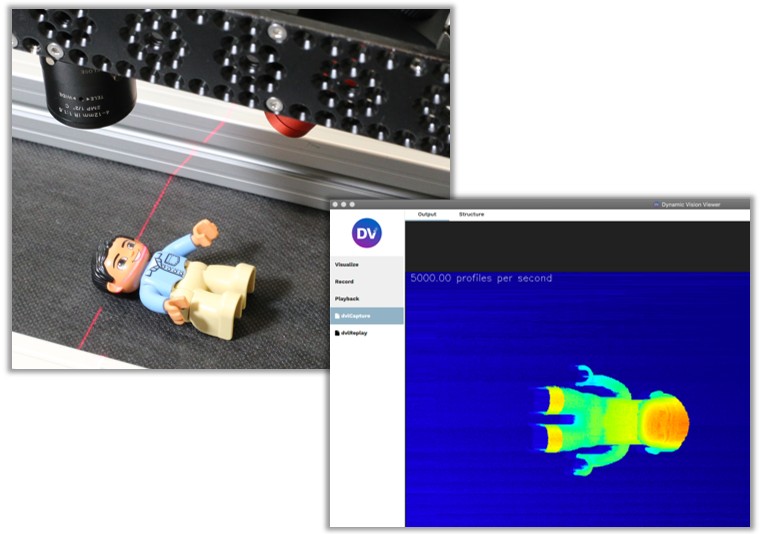
The iniVation DVL-5000 provides ultra-high-speed, low-latency laser scanning for automation and robotics. It operates at 5 kHz full resolution with high precision, enabling faster and more responsive robots. Built on the Dynamic Vision Platform, it features high dynamic range, accurate profiling, and adjustable baseline up to 140 mm.
- •Ultra-high-speed laser scanning at 5 kHz full resolution
- •Extremely low latency for faster robot response
- •High dynamic range (HDR) with DVXplorer
- •Accurate profiling with 640 profile points
- •Adjustable measurement baseline up to 140 mm
- •Laser class 1, safe for automation
- •Real-time processing on host
- •I/O: USB 3 and Ethernet
| Speed hz | 5000 |
| Laser angle (deg) | 30 |
| Profile points | 640 |
| Laser angle alt (deg) | 45 |
| Measurement cycle (ms) | 0.2 |
| Measurement baseline max (mm) | 140 |
Use cases
Industries
Technology stackOur read
Inferred from product specs — click through to the technology wiki:
ResearchComputed
Product comparisonComputed
Company announcement
News and Media
The company's official social & video channels · external links
News
From third-party news outlets (China & abroad) · external links
