EVAR
Founded 2018 · KR · evar.co.kr
SnapshotCompany claim
EVAR is a smart distributed energy technology EV charging solution company, founded in 2018 as a Samsung Electronics C-Lab spin-off. It addresses grid, safety, and space challenges with innovative technology, leading K-charging technology globally.
- Founded
- 2018
- HQ
- KR
- Models
- 6
- Categories
- 2
ContactCompany claim
- Address
- Not disclosed
Product families
Is this your company? Claim this profile to add verified data, respond to our analysis, and upgrade claims to Verified.
Claim this profile1. Executive Overview {#executive-overview}
EVAR is a South Korean smart EV charging infrastructure company founded in 2018 as a spin-off from Samsung Electronics' C-Lab internal incubator programme. The company positions itself around three structural challenges it argues the EV charging industry must solve simultaneously: grid capacity constraints, safety risks, and physical space limitations. Its response is a portfolio spanning AI-powered AC slow chargers, smart DC fast chargers, a vehicle-mounted mobile rapid charging platform, and what it claims is the world's first autonomous EV charging robot. Cumulatively, the company reports having raised over ₩30.3 billion (Series B) in investment, including backing from Hyundai Motor, Samsung C&T, and GS Global, lending institutional credibility to its technology thesis.
EVAR has accumulated a meaningful record of third-party recognition: five CES Innovation Awards across 2022 and 2023 (spanning the Smart City and Robotics categories), a 2024 Red Dot Design Award for its EV Pay mobile application, a first-of-kind JARI certification in Japan for its ACE PRO (described as a first for a Korean company), and export contracts reaching Canada, Guam, and markets including North America, Japan, and the Middle East. A ₩27 billion charging facility contract through the Korea Automobile Environment Association and a Ministry of Land, Infrastructure and Transport-approved pilot deployment of its PARKY autonomous robot in Seongnam City mark 2025 as a significant commercial milestone.
Not yet disclosed: detailed revenue figures, total charger deployment numbers, and customer-level case studies. Prospective partners or analysts with access to such data are invited to contact EVAR directly to update this record.
Latest news
- KEENON Humanoid Pours Drinks at GCS 2026, 100,000 Others Run HotelsYanko Design·2026-06-15GENERAL
2. The Company Story {#the-company-story}
EVAR's origins trace to 2017, when a project team within Samsung Electronics' C-Lab — the conglomerate's internal startup incubation programme — began work on distributed energy and EV charging concepts. The formal company was incorporated in 2018 as a C-Lab spin-off, giving it both a technology pedigree and an early institutional relationship with one of South Korea's most prominent technology manufacturers. Samsung Electronics participated in the company's seed funding round, providing capital and implicit validation in the company's earliest phase.
The funding trajectory charts a clear growth arc. A Pre-Series A round followed with participation from Naver, ETRI (the Electronics and Telecommunications Research Institute of Korea), and Schmiit. Series A in 2021 raised ₩5.5 billion and brought in strategically significant investors: Hyundai Motor Company, Samsung C&T, and GS Global — three conglomerates with direct stakes in mobility, construction, and energy distribution respectively. Series B in 2023 added ₩22 billion, bringing cumulative disclosed investment beyond ₩30.3 billion. This investor roster is notable for its operational relevance: these are not purely financial backers but companies that operate the kinds of buildings, parking facilities, and vehicle fleets into which EVAR's products would naturally deploy.
Milestones in recognition have run in parallel. CES Innovation Awards in 2022 and 2023 — five in total across two consecutive years — elevated the company's international profile at a moment when global EV infrastructure investment was accelerating sharply. The 2024 Red Dot Award for the EV Pay app extended that recognition into UX and product design. The 2025 JARI certification (Japan Automotive Research Institute) for the ACE PRO, described by EVAR as a first for a Korean EV charger company entering Japan, represents a tangible regulatory milestone for international market entry. The company's stated global focus markets are North America, Japan, and the Middle East, and export activity — including a USD 2.5 million contract with Canadian firm dmEVS in 2022 and an AC charger export to Guam in 2025 — supports that positioning as more than aspiration.
3. Product Portfolio {#product-portfolio}
Products & versions


EVAR's product lineup is structured across three broad categories that map directly onto its stated technology pillars. The AC slow-charging family is the most developed tier, comprising three models — the ACE PRO, ACE PRO PLUS, and ACE PRO MAX — each representing iterative capability additions rather than separate product lines. The ACE PRO establishes the baseline with P2P edge-computing load balancing and infrared fire detection. The ACE PRO PLUS adds a PLC modem for vehicle-level digital communication including state-of-charge monitoring and V2G (vehicle-to-grid) reverse power flow capability, along with cCSAus certification for North American market entry. The ACE PRO MAX is the flagship of this family, adding machine-learning-based departure-time prediction to optimise charge scheduling, a radar proximity sensor for touchless display activation, and a 2.8W standby power draw that EVAR claims is 44% below the prevailing climate charger evaluation standard.
The DC fast-charging tier is represented by the DURA, a 200kW-capable unit (input 214kW, with configurable output at 200/150/120/100kW across up to 250A at DC 150–1000V) built around server-connected smart power distribution. EVAR claims this architecture reduces installation and operating costs by at least 50% and incorporates proprietary cable management that reduces perceived cable weight by approximately 60% — a user-experience consideration as well as an engineering one.
The two differentiated platform products sit at opposite ends of the mobility spectrum. MooeV is a vehicle-mounted battery rapid charger — a 52kWh (domestic) or 115kWh (overseas) mobile unit designed for emergency EV charging and infrastructure-sparse environments, supporting CCS1, CCS2, and CHAdeMO connectors. PARKY is the company's most distinctive product: an autonomous EV charging robot using SLAM-based LiDAR navigation to locate and charge any parked vehicle without a designated charging bay. PARKY carries an 18kWh+ customisable battery, moves at 3–5 km/h, and is currently in a Ministry of Land, Infrastructure and Transport-approved pilot in Seongnam City.
4. Technology Stack {#technology-stack}
EVAR's technology architecture is articulated around three named pillars — Smart Grid, AI Safety, and Autonomous Robot — each of which has corresponding product implementations that make the claims partially verifiable from specifications.
Smart Grid / Load Balancing: The ACE PRO and ACE PRO PLUS both implement dynamic load balancing described as P2P edge computing across a charger network. EVAR claims this allows up to five times more chargers to be installed within an existing contracted power capacity, eliminating the need for grid upgrade works. The ACE PRO PLUS adds PLC (Power Line Communication) modem capability, enabling digital dialogue directly with the vehicle's battery management system for SOC monitoring and V2G support. Our read: PLC-over-charging-cable is an established technical approach (used in ISO 15118 implementations), and the combination of edge-computed load balancing with V2G readiness positions EVAR's mid-tier product ahead of basic OCPP 1.6-only competitors. The ACE PRO MAX implements OCPP 1.6 and carries LAN, WiFi, and built-in LTE router — a communications stack that supports cloud-based fleet management.
AI Safety: The ACE PRO MAX's machine-learning departure-time optimisation is the most software-forward claim in the portfolio. The system purportedly learns individual user patterns to schedule charging so batteries reach 100% charge at departure time, reducing cumulative time spent at high state-of-charge and thereby reducing battery degradation stress. Our read: this is a plausible application of simple time-series ML on user schedule data; whether the model is on-device or cloud-based is not specified in public materials. The infrared fire detection sensor present across the ACE PRO family — which triggers automatic charge shutdown and alert — is a hardware-layer safety feature, distinct from the ML component. EVAR also references AI-based battery State of Health (SoH) diagnostics and Plug-and-Charge (PnC/ISO 15118) automatic authentication, though full technical implementation detail is not publicly disclosed.
Autonomous Robot / PARKY: PARKY's navigation relies on SLAM (Simultaneous Localisation and Mapping) combining LiDAR and wheel odometry, supplemented by ultrasonic sensors, image sensors, and temperature/humidity sensors for multi-layer obstacle detection and safety. The robot operates at 3–5 km/h, handles slopes up to 5 degrees, and carries an 18kWh+ battery delivering up to 20kW DC output (300V–1000V, max 50A). Our read: SLAM-LiDAR navigation in structured indoor environments (car parks) is mature technology in logistics robotics; the novel application here is the automated connector engagement with a parked vehicle — a manipulation problem the public specs do not detail. The 2025 Seongnam pilot approval under the "smart address-based autonomous driving" designation suggests regulatory classification as an autonomous mobile robot rather than a road vehicle, which is the expected and appropriate framing for indoor deployment.
Certifications: Connector-level certifications across the portfolio include KC (Korea), CE (Europe), UL and cCSAus (North America), and PSE (Japan). The ACE PRO's JARI certification for the Japanese market is described as a first for a Korean manufacturer. These multi-jurisdiction certifications are a material commercial asset for a company pursuing simultaneous entry into North American, Japanese, and Middle Eastern markets.
Limited public technical detail: the specific ML framework, cloud infrastructure, OCPP back-end architecture, and V2G grid interconnection standards compliance beyond the PLC modem are not described in publicly available materials.
5. Research, Papers, Authors, Labs {#research-papers}
Company-linked papers
EVAR is a product-and-deployment-focused EV charging infrastructure company, not a research-publishing organisation. No academic papers, preprints, or laboratory publications authored by EVAR or attributed to its engineering team appear in the data provided. This is consistent with the profile of most commercial charging hardware and energy management firms, which protect proprietary technology through product development and certification rather than open publication.
Note: the third-party press items surfaced in the source data (PMC articles and Endovascular Today) relate to endovascular aortic repair robotics — a separate medical-device field that shares the "EVAR" acronym (Endovascular Aneurysm Repair) but has no connection to this company. Those sources are not cited here.
6. Media Evidence {#media-evidence}
Media library
The third-party press items provided in the underlying data relate to endovascular surgical robotics — a distinct medical field that shares the EVAR acronym but is unconnected to this company. No independent media coverage of EVAR (evar.co.kr) is available in the sourced data for citation here. EVAR's own press page (referenced in site navigation) and its history of CES and Red Dot awards represent the primary public evidence trail; coverage of those awards in technology and automotive trade media would be the expected independent validation, but specific articles are not available in the data provided for this report.
7. Commercial Reality {#commercial-reality}
Customers & deployments
EVAR has disclosed several concrete commercial data points from its own communications. A ₩27 billion (approximately USD 20 million) charging facility contract through the Korea Automobile Environment Association is stated for 2025. A USD 2.5 million export contract with Canadian company dmEVS was announced in 2022. An AC charger export to Guam is noted for 2025. Investor participation from Hyundai Motor, Samsung C&T, and GS Global in the Series A round implies some degree of commercial relationship or deployment pipeline with those organisations, though specific volumes and terms are not public.
Revenue, total units deployed, charging sessions facilitated, and customer-level ROI data: not disclosed. Operating margins, recurring software/service revenue split, and hardware gross margins are similarly not in the public record.
Analysts, investors, or procurement teams with access to verified deployment or revenue data are invited to contact EVAR at contact@evar.co.kr to supplement this record.
8. Markets and Use Cases {#markets-use-cases}
EVAR's product architecture maps to several distinct deployment contexts, each addressing one or more of the company's three stated structural challenges.
Residential and commercial building charging (AC slow): The ACE PRO family targets apartment complexes, office buildings, and commercial facilities — environments where contracted grid capacity is fixed and cannot easily be expanded. The load-balancing feature, which EVAR claims allows up to five times more charger installations within existing contracted power, is specifically valuable in dense urban multi-unit residential buildings, a particularly acute constraint in South Korean urban environments where apartment penetration is high.
Emergency and infrastructure-sparse charging (MooeV): The vehicle-mounted MooeV platform addresses two distinct use cases: roadside emergency charging for stranded EVs (an analogue to petrol emergency services), and provision of charging capability in areas where fixed infrastructure has not yet been built. The overseas-spec 115kWh battery capacity positions this product for markets with longer inter-city distances or more dispersed populations.
High-throughput public and commercial fast charging (DURA): The DURA's 200kW capability and smart power distribution target highway service areas, large commercial car parks, logistics hubs, and fleet depots where throughput and operating cost per session are the primary commercial metrics.
Parking-constrained environments (PARKY): The autonomous robot is specifically designed for car parks — whether commercial, residential, or institutional — where designating fixed charging bays creates spatial conflicts and underutilisation. By navigating to any parked vehicle, PARKY decouples charging availability from physical bay designation entirely. The ongoing Seongnam City pilot suggests municipal and smart-city deployments as a near-term target, and the "smart address-based" navigation framing suggests integration with building management or smart city data infrastructure.
International markets: North America (Canada export confirmed, Guam export confirmed, cCSAus certification held), Japan (JARI certification confirmed, ACE PRO), and the Middle East are stated target regions. The multi-language support (Korean, English, Japanese) across EVAR's website and customer service operation reflects operational readiness for at least the first two of these.
9. Competitive Landscape {#competitive-landscape}
Competitive comparison
| Robot | Maker | Autonomy | Conf. |
|---|---|---|---|
| iRobot Roomba Combo 10 Max | iRobot | Autonomous | 0.90 |
| Mobile ALOHA (Stanford) | Stanford University | Teleoperated | 0.90 |
| 1X NEO | 1X Technologies | Remote-Assisted | 0.90 |
The smart EV charging infrastructure segment is populated by a range of hardware manufacturers, software platform providers, and integrated solution companies operating at varying scales across domestic and international markets. EVAR competes in a field that spans established industrial electronics companies, VC-backed charging networks, and automotive OEM-affiliated charging ventures — each with different strengths across hardware capability, software platform maturity, certification footprint, and channel access.
EVAR's differentiation strategy, as readable from its product and technology choices, rests on the combination of hardware innovation (the autonomous robot being the most distinctive expression), AI-layer safety features, and a load-balancing architecture that addresses installation economics rather than simply charging speed. This positions it differently from pure-play network operators and from high-power DC fast-charge specialists, targeting instead the installation cost and grid-compatibility pain points that affect building owners and facility operators making long-horizon infrastructure decisions.
10. Country Advantage / Geopolitical {#geopolitical}
South Korea's position as a major EV manufacturing and battery technology nation is materially relevant to EVAR's commercial and regulatory context. The domestic market provides a testing ground with high EV adoption ambitions, an active government certification and subsidy infrastructure, and proximity to leading battery cell manufacturers whose technology directly affects charger design parameters (V2G capability, SoH diagnostics, PnC protocols). EVAR's Series A investor base — Hyundai Motor, Samsung C&T, GS Global — reflects the interlocking nature of Korea's industrial conglomerate ecosystem and the degree to which a charging infrastructure company can access distribution, construction, and energy channels through strategic investment relationships.
The JARI certification milestone positions EVAR to enter Japan as a Korean manufacturer — a market where regulatory compliance is a significant barrier and where the certification is described as a first for a Korean EV charger company. Export activity to North America (Canada, Guam) and stated Middle East market interest reflect a deliberate internationalisation strategy that leverages the "K-charging technology" branding EVAR uses explicitly in its own materials.
Taiwan is not referenced in EVAR's available data and is not relevant to this report.
11. Hype vs Real vs Ugly {#hype-real-ugly}
Claim tracker
Verified by third-party process:
- Five CES Innovation Awards across 2022–2023 — independently adjudicated by the Consumer Technology Association.
- 2024 Red Dot Design Award for EV Pay — independently adjudicated by Design Zentrum Nordrhein Westfalen.
- JARI (Japan Automotive Research Institute) certification for ACE PRO — described as a first for a Korean company; this is a regulatory body certification, externally issued.
- Samsung Electronics C-Lab spin-off origin — a structured corporate programme with defined selection criteria.
- Investor participation from Hyundai Motor, Samsung C&T, GS Global — disclosed funding rounds.
Company claims requiring contextual interpretation:
- "World's first autonomous EV charging robot" (company claim): PARKY carries this designation in EVAR's own materials. The claim is specific to the autonomous charging robot category; the underlying SLAM-LiDAR navigation technology is itself not novel, and the company-claim status of this "world's first" designation should be understood accordingly.
- "Up to 5x more chargers within existing contracted power" (company claim): This load-balancing efficiency gain is asserted across marketing materials. The figure is plausible in principle under optimal load diversity conditions but will vary significantly by deployment scenario and simultaneous charging demand. The underlying technology (dynamic load balancing) is real; the "5x" figure is a best-case marketing claim.
- "Operating costs reduced by at least 50%" for DURA and ACE PRO (company claim): The 50%+ cost reduction claims appear across multiple products. These are presented as company claims and should be evaluated against specific baseline assumptions before deployment modelling.
- "AI-powered charging" and "AI Safety" (company claim): The departure-time ML optimisation in the ACE PRO MAX and the fire-detection system are real product features; the extent to which they constitute "AI" versus rule-based automation in the case of the infrared sensor is a matter of definitional framing. Our read: the departure-time scheduling is the more substantive ML application; the fire detection sensor is hardware-layer safety.
Gaps not yet disclosed:
- Independent third-party testing of the load-balancing multiplier claims in real-world mixed deployments.
- Clinical or field evidence on ACE PRO MAX battery health outcomes from the ML scheduling feature.
- Deployment scale data for PARKY beyond the Seongnam pilot.
12. Future Scenarios {#future-scenarios}
Our read — Bull case: PARKY achieves commercial rollout beyond the Seongnam pilot, with municipal and large commercial car park operators in Korea signing deployment contracts. JARI and cCSAus certifications convert into material revenue from Japan and North America respectively. The Korea Automobile Environment Association contract (₩27 billion) executes on schedule and generates reference deployments that accelerate private-sector sales. V2G-capable ACE PRO PLUS units gain traction as grid operators and utilities in Korea and abroad formalise V2G compensation schemes. EVAR's investor relationships with Hyundai Motor and GS Global produce embedded distribution channels that accelerate scale without proportionate sales cost.
Our read — Base case: EVAR establishes a defensible mid-market position in Korean commercial and residential charging, with the ACE PRO family generating predictable hardware revenue supplemented by EV Pay software/service fees. International markets (Japan, Canada) develop slowly, constrained by localisation costs, local competition, and regulatory timelines. PARKY remains in extended pilot phases through 2026, with commercial deployment beginning at niche high-value sites (airports, premium residential). Revenue grows steadily but the company remains sub-scale relative to global charging infrastructure majors.
Our read — Bear case: Grid load-balancing commoditises as larger players integrate similar features into standard hardware; EVAR's cost-reduction claims face direct competitive pressure. PARKY's commercialisation is delayed by safety regulation complexity, connector-engagement reliability challenges, or insurance/liability frameworks not yet adapted for autonomous charging robots. International expansion stalls on certification costs relative to market size. If EV adoption growth in Korea slows or government subsidy programmes are restructured, near-term demand for new charging infrastructure investment contracts.
13. What to Watch {#what-to-watch}
- PARKY pilot outcome (Seongnam City, 2025): The Ministry of Land, Infrastructure and Transport approval is granted; the question is whether the pilot generates reproducible commercial parameters (uptime, charge success rate, user adoption) that support scaled procurement.
- Korea Automobile Environment Association contract execution: The ₩27 billion contract is the single largest disclosed commercial commitment. Progress against delivery milestones and any expansion or renewal signals are primary commercial indicators.
- Japan market development: ACE PRO's JARI certification is a necessary but not sufficient condition for Japan entry. Watch for named distribution partnerships, Japanese-language product support activation, or domestic Japanese customer announcements.
- V2G regulatory framework in Korea and target markets: ACE PRO PLUS carries V2G hardware capability. The commercial value of that feature depends entirely on regulatory structures that compensate vehicle owners or operators for grid services. Regulatory progress in Korea, North America, and Japan is a leading indicator of ACE PRO PLUS differentiated demand.
- Series C or next funding round: Series B closed at ₩22 billion in 2023. The timing and investor composition of a next round would signal whether strategic investors are deepening commitment or whether the company is approaching a profitability threshold.
- International export contract disclosures: Any named contracts beyond the Canada (dmEVS) and Guam examples would confirm whether international revenues are diversifying meaningfully.
- EV Pay platform metrics: User base, charging sessions facilitated, and any subscription or transaction-fee revenue model disclosures would reveal whether software is becoming a material revenue component alongside hardware.
14. Sources & Methodology {#sources-methodology}
Data provenance: All factual claims in this report are grounded exclusively in data extracted from EVAR's own website (evar.co.kr), including structured schema markup, About page content, product specification pages, and company history disclosures. All such claims are treated as company-claims — statements made by the company about itself — and are labelled accordingly where they require qualification. No independent financial databases, third-party market research, or external product reviews were available for this company in the source data.
Third-party press: Three press items were surfaced by the data pipeline under the EVAR name. All three relate to endovascular aortic repair (a medical procedure sharing the "EVAR" acronym) and are entirely unrelated to EVAR (evar.co.kr). They are not cited in this report.
Inferences: Passages labelled "Our read:" represent analyst interpretation of available data — logical inferences about technology approach, market positioning, or scenario probability — and are not statements of verified fact.
Negative findings: Where information is absent from the available data (revenue, deployment volumes, independent benchmarks), this report records the absence explicitly as "Not disclosed" rather than inferring a negative conclusion. EVAR or parties with verified data may contact the report maintainer to supplement or correct the record.
Applicability: This methodology is applied uniformly across all company intelligence reports in this series. No company receives preferential framing; all reports lead with verified strengths and treat gaps as fixable disclosure questions rather than editorial judgements.
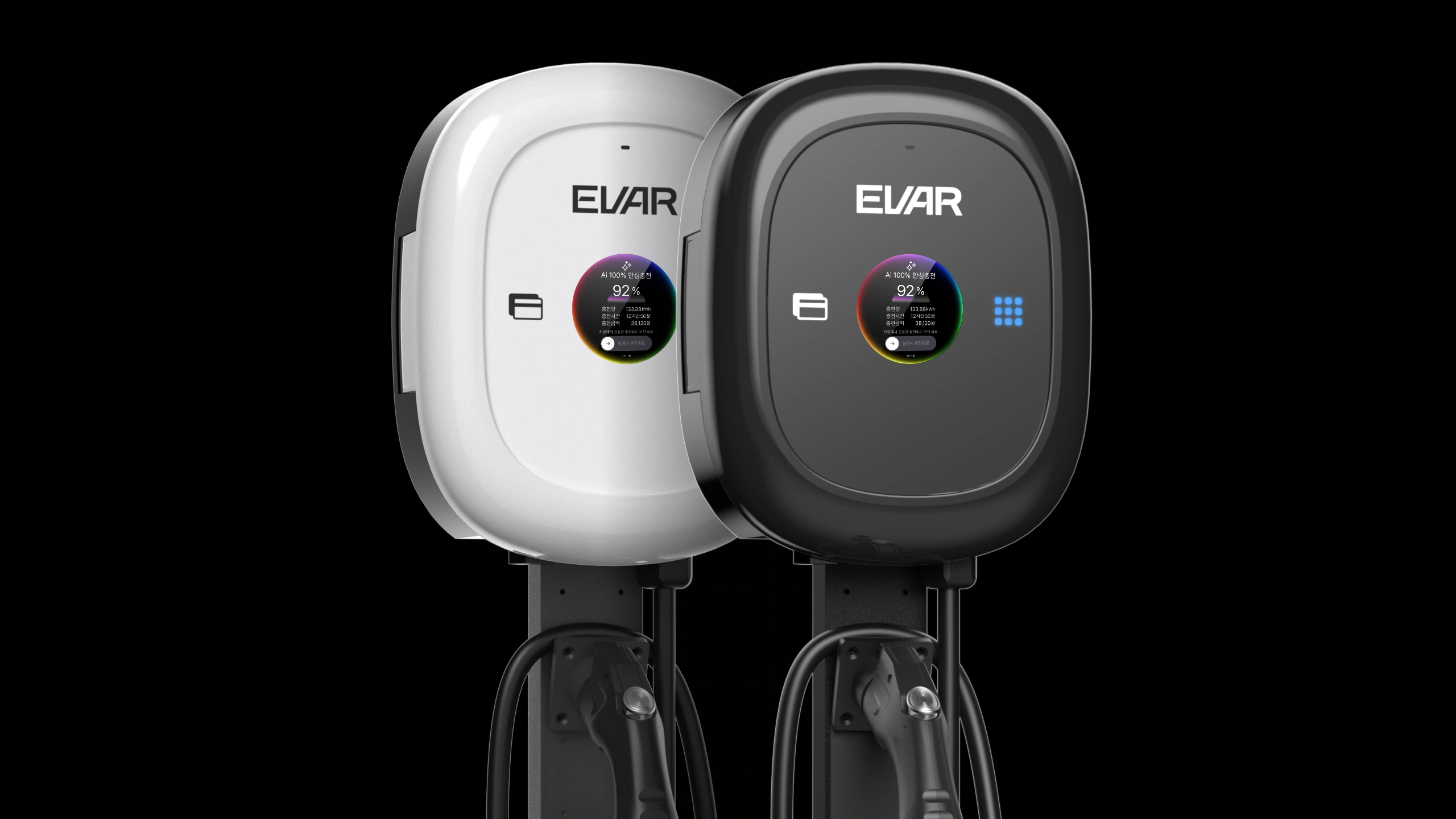
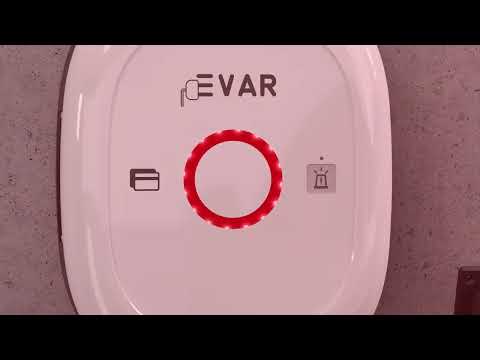
The ACE PRO MAX is an AI-powered AC slow charger by EVAR. It learns user departure patterns via machine learning to optimize charging speed, ensuring battery reaches 100% just before departure while minimizing battery stress. Features include radar-based proximity display activation, smart standby with 2.8W power consumption, wide circuit layout for reduced heat, premium flame-retardant materials, IP65/IK07 protection, and departure time sharing. It supports WiFi, LAN, optional LTE, NFC/QR authentication, and multiple connector types.
- •AI-powered charging that learns departure patterns and adjusts speed for battery health
- •Radar sensor automatically activates display when user approaches, no touch needed
- •Smart standby system with only 2.8W standby power (44% reduction vs. climate charger evaluation standard)
- •Wide circuit layout (1.6x wider) reduces heat and component stress for longer lifespan
- •Premium flame-retardant plastic material prevents fire spread
- •IP65 (dust/water) and IK07 (impact) protection for harsh environments
- •Departure time sharing feature fosters considerate charging culture
- •3.6-inch circular display with 9 LEDs for clear status indication
- •NFC and QR authentication, supports WiFi, LAN, and optional LTE router
- •Compatible with J1772 Type1,2 and GB/T connectors, cable lengths 2-7m
| Lan | |
| Wifi | |
| Depth | 116 mm |
| Width | 306 mm |
| Height | 381 mm |
| Led (count) | 9 |
| Frequency hz | 50/60 |
| Cable length m | 5 |
| Input power kw | 7kW / 11kW |
| Input voltage | AC 200-240V |
| Connector type | J1772 Type1,2, GB/T |
| Input current (a) | 32A / 50A |
| Output power kw | 7kW / 11kW |
| Output voltage | AC 200-240V |
| Standby power (w) | 2.8 |
| Output current (a) | 32A / 50A |
| Certification kc | |
| Display size (inch) | 3.6 |
| Authentication qr | |
| Lte router builtin | |
| Protection rating | IP55 |
| Authentication nfc | |
| Certification ocpp | 1.6 |
| Operating temp max c | 50 |
| Operating temp min c | -30 |
| Cable length custom max m | 7 |
| Cable length custom min m | 2 |
| Circuit width multiplier | 1.6 |
| Protection rating display | IP65 |
| Connector certification ce | |
| Connector certification kc | |
| Connector certification ul | |
| Certification type approval | |
| Connector certification pse | |
| Connector protection rating | IP 54 |
| Display impact protection ik | IK07 |
Technology stackOur read
Inferred from product specs — click through to the technology wiki:
ResearchComputed
Product comparisonComputed
Company announcement
News and Media
The company's official social & video channels · external links



News
From third-party news outlets (China & abroad) · external links
