eBots
SnapshotCompany claim
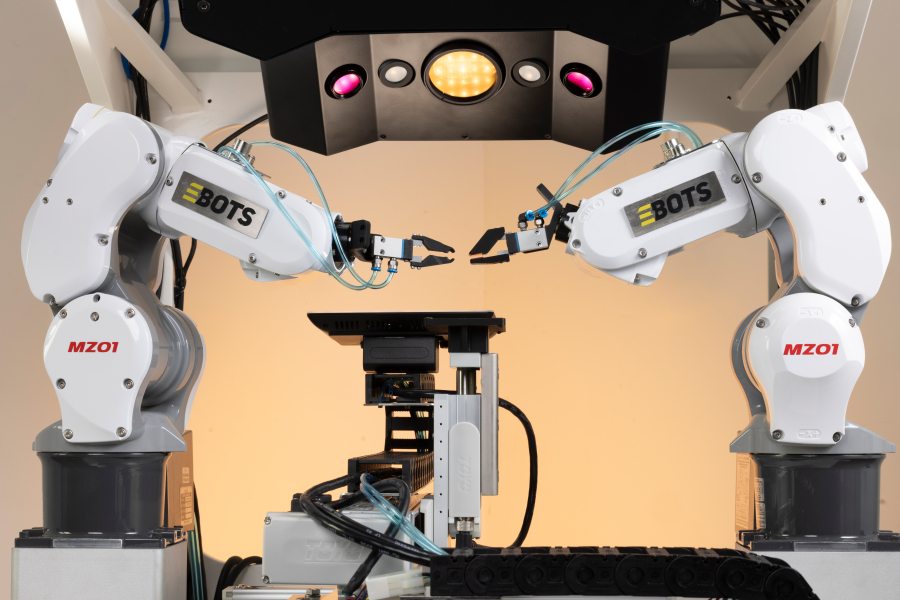
eBots provides intelligent robotics for manufacturing, aiming to address skilled labor shortages. Founded by CEO Dr. Zheng Xu, the company develops dual-arm robots for precision assembly and quality control, combining human-like dexterity with machine precision.
- Founded
- Not disclosed
- HQ
- Not disclosed
- Models
- 0
- Categories
- 0
ContactCompany claim
- Address
- Not disclosed
Product families
Is this your company? Claim this profile to add verified data, respond to our analysis, and upgrade claims to Verified.
Claim this profile1. Executive Overview {#executive-overview}
eBots is an intelligent robotics company focused on precision manufacturing automation, founded and led by CEO Dr. Zheng Xu — a serial entrepreneur whose prior ventures include Silevo (co-founded, acquired by SolarCity/Tesla for $350M) and direct involvement in Tesla's $900M Gigafactory construction. The company's core thesis is that the global shortage of skilled manufacturing labor can be addressed by dual-arm robots capable of human-level dexterity in precision assembly and quality control. The leadership team brings deep credentialed experience across semiconductors (Applied Materials), capital markets (Deloitte, Stanford/Columbia-trained CFO), and industrial automation sales, giving eBots a multidisciplinary foundation that extends from engineering to commercial deployment.
The company's stated ambition is to deliver this capability at any scale — serving manufacturers "regardless of size or location" — positioning eBots as a democratizing force in factory automation rather than a niche provider for large enterprises alone. The presence of a dedicated Country GM for China (Yanjun Tong, who has reportedly built full cross-functional teams and showcased the eBots-IDO system to industry leaders) suggests active commercial operations or advanced piloting in that market alongside North American expansion led by VP of Sales Keith Dussia.
Third-party coverage from ASSEMBLY magazine (March 2026), o.parsers.vc, and TSVC confirms external visibility, though the depth of independently verified commercial traction remains limited in the public record.
Latest news
- KEENON Humanoid Pours Drinks at GCS 2026, 100,000 Others Run HotelsYanko Design·2026-06-15GENERAL
2. The Company Story {#the-company-story}
eBots was founded to address what its leadership characterizes as a "critical shortage of skilled labor across industries" — a structural problem increasingly acute in precision manufacturing, where tasks such as micron-level component placement and quality inspection have historically resisted full automation. The company's founding date is not publicly disclosed on its site.
The central figure in eBots' founding story is Dr. Zheng Xu, whose biography provides the clearest signal of the company's origins and ambitions. Dr. Xu spent 14 years as Corporate VP and General Manager at Applied Materials, one of the world's largest semiconductor equipment companies, where he led business units generating billion-dollar revenues. He subsequently co-founded Silevo, a solar technology company that pioneered high-efficiency photovoltaic cells and was acquired by SolarCity (later Tesla) for $350 million. Following the acquisition, Dr. Xu worked directly with Elon Musk to execute the $900 million Gigafactory build in under two years — an execution milestone that speaks directly to large-scale manufacturing orchestration. He holds Ph.D. degrees in Materials Science and Electrical Engineering and holds more than 110 U.S. patents, making him unusually credentialed at the intersection of materials science, manufacturing process engineering, and entrepreneurship.
eBots' About page was first published in September 2025 and last modified in May 2026, placing the company's public-facing emergence in late 2025. The company's domain is ebots.com and its contact is [email protected]; its founding country is not disclosed on the site. The positioning — "the first manufacturing robotics designed to deliver human-level performance in precision assembly and quality control" — frames eBots as a category-defining rather than incremental entrant. Coverage in TSVC's blog (TSVC being a venture capital firm known for early-stage deep-tech investments) suggests venture backing, though specific funding rounds, valuations, and investors are not confirmed in the public data provided here.
3. Product Portfolio {#product-portfolio}
Products & versions





The company's site does not surface discrete product listings in the structured data extracted for this report (zero products returned in the product schema). However, the About page and executive biographies provide meaningful signal about the product direction. eBots' primary system referenced by name is the eBots-IDO, cited in the context of Country GM Yanjun Tong's commercial activities in China, where it has reportedly been demonstrated to industry leaders. Beyond this named system, the company's broader product category is described as dual-arm robots integrating vision systems and AI, targeting precision assembly and quality control in manufacturing environments.
The company's value proposition as articulated by VP of Sales Keith Dussia — "micron-precision assembly" with guarantees of both repeatability and accuracy — distinguishes the intended product positioning from standard industrial cobots, which typically optimize for repeatability alone. The "dual-arm, vision-integrated" descriptor suggests a hardware-software system combining articulated robotics with machine vision for closed-loop quality feedback, though full technical specifications are not yet publicly disclosed. Not yet disclosed: full product line naming, SKUs, payload/reach specifications, pricing, or integration requirements — eBots is invited to claim or correct this record.
4. Technology Stack {#technology-stack}
Based on the company's own descriptions, several technology layers are discernible, though detailed specifications are not publicly available.
Dual-Arm Robotics: The core hardware platform involves two-arm configurations, which are architecturally suited to tasks requiring coordinated manipulation — such as holding a component with one arm while fastening or inspecting with the other. This mirrors human assembly worker biomechanics and is considerably more complex to control than single-arm industrial robots.
Vision Integration: Keith Dussia's description of "vision-integrated robotics" indicates onboard or co-located machine vision, most likely used for part localization, alignment verification, and quality inspection feedback. Our read: the vision system is likely a key differentiator, enabling the "adapt" capability referenced in eBots' tagline ("robotics that think, adapt, and perform like skilled workers"), as static pre-programmed robots cannot handle part-to-part variability in high-mix assembly.
AI / Adaptive Control: The company repeatedly uses language of robots that "think" and "adapt," and explicitly claims AI-driven operation. Our read: this likely encompasses some combination of perception AI (object detection/pose estimation), motion planning, and potentially learned assembly policies — though whether eBots relies on proprietary AI models, fine-tuned foundation models, or licensed platforms is not disclosed.
Micron-Precision Positioning: The claim of micron-level precision in placement is a strong technical assertion. Our read: achieving this at scale requires tight integration between vision feedback, mechanical rigidity, and control loop latency — all areas where Dr. Xu's semiconductor equipment background at Applied Materials is directly relevant, given that semiconductor process tools routinely operate at sub-micron tolerances.
Not yet disclosed: compute architecture, sensor modalities (stereo, structured light, ToF), software SDK/API details, training data provenance, or safety certifications (e.g., ISO 10218, ISO/TS 15066). eBots is invited to claim or correct this record.
5. Research, Papers, Authors, Labs {#research-papers}
Company-linked papers
eBots does not appear to be a research-publishing organization in the academic sense. No papers, preprints, or lab affiliations are referenced on the company's site or in the press coverage identified for this report. This is consistent with the profile of a commercialization-focused robotics venture rather than a university spin-out or research lab — eBots' intellectual property appears to be expressed through Dr. Xu's 110+ U.S. patents (filed through prior ventures and potentially continued at eBots) and proprietary product development rather than open academic publication.
6. Media Evidence {#media-evidence}
Media library
Three third-party sources are identified in the data for this report: a funding/investor profile on o.parsers.vc, a blog and media entry on TSVC's site (tsvcap.com), and a substantive editorial feature in ASSEMBLY magazine dated March 31, 2026 — a well-regarded trade publication covering manufacturing technology. The ASSEMBLY article, titled "Robotics Developers Target High-Variability Assembly as Automation Expands," places eBots within a recognized industry trend, lending independent editorial context to the company's market thesis. Coverage in TSVC's media content suggests the venture capital firm has featured or invested in eBots, though the nature of the relationship is not confirmed from the data available.
7. Commercial Reality {#commercial-reality}
Customers & deployments
Revenue, total customers, active deployments, and ROI metrics are not disclosed in any public source identified for this report and should be rendered as Not disclosed. The company's About page references Yanjun Tong having showcased the eBots-IDO system "to industry leaders" in China and having "built comprehensive teams across Engineering, Application, Operation, Sales, and Service from the ground up" — which suggests commercial-stage or late pre-commercial activity in that market, but stops short of confirming paying customers or production deployments.
Similarly, the North American sales function led by Keith Dussia, described as targeting "practical factory needs" and "measurable ROI," indicates active go-to-market effort, but no named customers, signed contracts, or deployment counts are verifiable from available public data.
eBots is invited to claim or disclose customer references, deployment counts, revenue ranges, or independently validated ROI case studies to strengthen this section of the record.
8. Markets and Use Cases {#markets-use-cases}
eBots' stated market is manufacturing broadly, with precision assembly and quality control as the primary use-case anchors. The company's language — "regardless of size or location" — signals an intent to serve both large enterprises and mid-market or smaller manufacturers who have historically lacked access to sophisticated automation.
Precision Assembly: The most clearly targeted application is high-complexity, high-variability component assembly — the kind of work that has resisted traditional automation because it requires real-time adaptation to part tolerances and orientations. The ASSEMBLY magazine feature (March 2026) explicitly frames this category ("high-variability assembly") as an emerging automation frontier, validating eBots' market focus with independent editorial judgment.
Quality Control / Inspection: Dual-arm, vision-equipped robots are well-suited to in-line inspection tasks: picking up a part, orienting it for visual or dimensional inspection, and making pass/fail decisions. eBots' claim of micron-precision positioning reinforces suitability for inspection in tight-tolerance manufacturing such as electronics, medical devices, and precision mechanical components.
Electronics and Semiconductor-Adjacent Manufacturing: Dr. Xu's 14-year background at Applied Materials and his patent portfolio in materials science and electrical engineering suggest particular relevance to electronics assembly and semiconductor packaging — both sectors facing acute skilled-labor shortages and demanding micron-level precision. Our read: these are likely priority verticals even if not explicitly named on the company site.
China Market: The establishment of a full China-based team under Yanjun Tong, with demonstrated outreach to local industry leaders, identifies China's manufacturing sector as an active target geography alongside North America.
9. Competitive Landscape {#competitive-landscape}
Competitive comparison
| Robot | Maker | Autonomy | Conf. |
|---|---|---|---|
| iRobot Roomba Combo 10 Max | iRobot | Autonomous | 0.90 |
| Mobile ALOHA (Stanford) | Stanford University | Teleoperated | 0.90 |
| 1X NEO | 1X Technologies | Remote-Assisted | 0.90 |
eBots operates in the intelligent manufacturing robotics segment, specifically at the intersection of collaborative dual-arm robots, machine vision, and AI-driven adaptive control. This is an increasingly active category as the broader robotics industry shifts from rigid, pre-programmed automation toward flexible systems capable of handling part variability and unstructured tasks — a shift documented by ASSEMBLY magazine's March 2026 editorial coverage of the space.
The competitive framing for eBots is shaped by its premium positioning on precision (micron-level), dual-arm architecture, and AI adaptability — characteristics that differentiate it from standard single-arm industrial cobots and from vision-only quality inspection systems. The module above surfaces same-category peers; eBots' differentiated claim, if technically substantiated at scale, would represent a meaningful advance over automation solutions that achieve repeatability without guaranteed accuracy.
10. Country Advantage / Geopolitical {#geopolitical}
eBots' founding country is not disclosed publicly. However, the company has established explicit commercial operations in China through a dedicated Country GM, and its CEO brings deep experience in U.S.-based advanced manufacturing (Applied Materials, Tesla/SolarCity). This dual-geography footprint — with teams in both the U.S. market (North American sales) and China — is operationally relevant in a period of heightened scrutiny over technology supply chains, manufacturing IP, and cross-border robotics deployments. Our read: as eBots grows, its dual-market structure may require active navigation of export control considerations, particularly given that precision manufacturing robotics with AI capabilities can attract regulatory attention in both U.S. and Chinese regulatory frameworks. Not yet disclosed: eBots' legal domicile, IP ownership structure, or any positions taken on supply chain localization. eBots is invited to claim or clarify its geopolitical and compliance posture.
11. Hype vs Real vs Ugly {#hype-real-ugly}
Claim tracker
Company Claim — "Human-level performance in precision assembly and quality control": This is eBots' central marketing assertion. It is an ambitious benchmark that, if validated in production environments, would represent a significant technical achievement. No independent validation of this claim is available in the public record reviewed here. Our read: the claim is credible as an engineering aspiration given the leadership's background, but should be evaluated against independently verified deployment data before being treated as established fact.
Company Claim — "Micron-precision assembly with guaranteed accuracy, not just repeatability": This is a technically specific and meaningful distinction. Repeatability (returning to the same position) is achievable with many industrial robots; absolute accuracy (placing a part in the correct position in world coordinates) is harder and more valuable. The claim is technically coherent and grounded in real engineering challenges; verification would require third-party metrology testing.
Company Claim — Dr. Zheng Xu's background (Silevo/$350M acquisition, Tesla Gigafactory, Applied Materials, 110+ patents): These biographical claims are specific, verifiable against public records, and represent genuine prior-world validation. They are the strongest independently checkable signals in eBots' public profile.
Company Claim — "First manufacturing robotics designed to deliver human-level performance": "First" claims are inherently difficult to substantiate and are common in robotics marketing. Our read: this should be read as competitive positioning language rather than a verified historical fact.
Not yet disclosed: Funding amount and investors, customer deployments, production performance benchmarks, third-party audit or certification results. These gaps are fixable — eBots is invited to claim or correct this record.
12. Future Scenarios {#future-scenarios}
Bull Case — Our read: Dr. Xu's track record of building and scaling capital-intensive technology companies (Silevo to Tesla acquisition; Gigafactory execution) is exceptional. If eBots' dual-arm, AI-vision platform delivers on its micron-precision claims in production environments, and if the China team's commercial momentum converts to referenceable deployments, the company could establish itself as a category leader in high-mix precision assembly automation — a market that is structurally underserved and growing as labor shortages deepen. A well-executed fundraise, enabled by CFO Susie Kuan's IPO and capital markets expertise, could accelerate the path to scale.
Base Case — Our read: eBots builds a credible niche in precision electronics or semiconductor-adjacent assembly in both U.S. and China markets, achieving referenceable deployments and a defined product line (anchored on the IDO system) within the next 12–24 months. Growth is steady but constrained by the sales cycle length typical of industrial automation procurement. The company remains private and pre-revenue-disclosure through this period.
Bear Case — Our read: Precision dual-arm robotics with AI-adaptive control is technically demanding, and the gap between demonstrated capability and reliable production-floor performance at scale has challenged many robotics ventures. If product development timelines extend, if the China commercial strategy faces regulatory or market headwinds, or if competitive incumbents accelerate in the same category, eBots could face pressure on both its timeline and its differentiation narrative. The absence of publicly disclosed customers or benchmarks, at this stage, is a watch item rather than a verdict.
13. What to Watch {#what-to-watch}
- First named customer deployments: Any publicly referenceable production deployment — especially in electronics, semiconductor packaging, or precision mechanical assembly — would be a material validation signal.
- Product line formalization: Publication of formal product specs, model names beyond IDO, pricing tiers, or integration documentation would signal commercial readiness maturity.
- Funding announcement: A disclosed funding round with named investors (particularly strategic investors from manufacturing or semiconductor sectors) would validate both the technology and the business model.
- Performance benchmarks: Any independently verified data on placement accuracy, throughput, or uptime in production conditions — ideally from a third-party integrator or customer.
- China market traction: Whether Yanjun Tong's team converts industry demonstrations into contracted deployments, and whether any competition prizes (the second-place international entrepreneurship award referenced in the data) translate to commercial credibility.
- Regulatory/compliance posture: How eBots characterizes its dual-geography structure in the context of evolving U.S.-China technology trade policy, particularly relevant for AI-enabled manufacturing systems.
- Publication in ASSEMBLY or peer trade press: Follow-on editorial coverage with deployment specifics would move the evidence base from company-claim to independently validated.
14. Sources & Methodology {#sources-methodology}
Primary source: eBots' own website (ebots.com), including About page, executive biographies, and product schema. All content drawn from these sources is labeled (company-claim) — it represents the company's own assertions and has not been independently audited for this report.
Third-party press (independent sources, cited by outlet):
- o.parsers.vc — funding/investor profile (independently aggregated, not verified as complete)
- tsvcap.com (TSVC) — venture capital firm blog/media reference
- ASSEMBLY magazine (assemblymag.com) — trade editorial, March 31, 2026 (independent journalism; highest evidentiary weight of the three)
Computed relations: Category peer identification and market framing are derived from product-category and use-case tags; these are analytical inferences, not company-stated positions, and are labeled Our read throughout.
Methodology rubric (applied consistently to every company in this series):
- Verified facts are stated plainly, sourced to the evidence type.
- Inferences are labeled "Our read."
- Company assertions are labeled "Company claim" or attributed to the company's own language.
- Gaps are noted as "Not yet disclosed" with an open invitation for the company to claim or correct the record.
- No unsourced numbers, invented products, unnamed competitors in prose, or fabricated partnerships appear in this report.
- This rubric is applied without modification regardless of company size, geography, or funding status.
No products yet.
Technology stackOur read
ResearchComputed
Product comparisonComputed
Company announcement
News and Media
The company's official social & video channels · external links

📈 Partial automation only addresses 50-65% of manufacturing processes. Our new white paper shows how next-gen robotics complete the journey
2025-10-16
Download the paper at:
2025-10-03

🔍 Manufacturing's hidden crisis: 40% annual turnover in precision manufacturing roles creates perpetual recruitment cycles & quality issues
2025-10-03
🤖 BIG NEWS: Ebots is now officially launched! Our next-gen adaptive robotics deliver 99.95%+ assembly yield rates for precision manufacture
2025-10-01
News
From third-party news outlets (China & abroad) · external links