Dogtooth
United Kingdom · dogtooth.tech
SnapshotCompany claim
Dogtooth is a Cambridge-based technology start-up building intelligent robots for soft fruit picking. It uses machine learning and computer vision for robotic picking, working with customers on real farm solutions. Founded by Dr Duncan Robertson, Ed Herbert and Mat Cook.
- Founded
- Not disclosed
- HQ
- United Kingdom
- Models
- 2
- Categories
- 2
ContactCompany claim
- Address
- Millside The Moor, Melbourn, SG8 6ED
Product families
Is this your company? Claim this profile to add verified data, respond to our analysis, and upgrade claims to Verified.
Claim this profile1. Executive Overview {#executive-overview}
Dogtooth is a Cambridge, United Kingdom–based robotics start-up with a sharply defined mission: building intelligent harvesting robots for the soft fruit industry. Founded by Dr Duncan Robertson, Ed Herbert, and Mat Cook, the company has progressed from early-stage research to deploying fifth-generation robots with paying customers — a meaningful engineering milestone in one of agriculture's most mechanically demanding challenges. Funding from Innovate UK, Octopus Ventures, the Martlet Fund, Angel CoFund, and a cohort of angel investors led by Peter Cowley (Chair of Cambridge Angels) provides both capital depth and institutional credibility rare at this stage of agricultural robotics.
The company's core technical thesis — that advances in machine learning and computer vision have crossed a threshold where robotic picking of delicate berry fruits is now commercially viable, not merely a laboratory demonstration — is backed by its own farm deployments. Dogtooth's explicit emphasis on real-farm operation, safety alongside human workers, and scalable manufacturing signals a company positioning itself for commercial scale rather than perpetual pilot. As of 2025, it is actively selling its fifth-generation platform to existing customers, with a glasshouse variant leading and a polytunnel variant in follow-on development.
The principal acknowledged gap is disclosure: revenue, fleet size, yield data, and customer names remain not publicly stated. This is common for early-commercial agri-robotics firms but limits independent verification of commercial traction at this stage.
Latest news
- KEENON Humanoid Pours Drinks at GCS 2026, 100,000 Others Run HotelsYanko Design·2026-06-15GENERAL
2. The Company Story {#the-company-story}
Dogtooth was founded by Dr Duncan Robertson, Ed Herbert, and Mat Cook, operating out of Cambridge — a city whose deep university and venture ecosystem has made it a natural home for computer vision and robotics start-ups. The precise founding date is not publicly disclosed, though the company's own narrative references a ten-year arc in the development of machine learning capability sufficient for soft fruit picking, framing itself as a beneficiary and pioneer of that maturation curve.
The company's early funding base reflects a Cambridge-rooted angel network: Peter Cowley, Chair of Cambridge Angels, led an angel round that was subsequently joined by institutional investors including Octopus Ventures, the Martlet Fund, and Angel CoFund, alongside Innovate UK grant awards. Coverage in Fresh Plaza in November 2021 confirmed this investor backing was publicly visible by that date, marking an early external validation milestone. A further milestone came with Future Farming's January 2026 report describing the Dogtooth strawberry-picking robot as "ready for practical use" — external press language that aligns with the company's own claim of selling fifth-generation robots to existing customers in 2025.
Dogtooth's strategic positioning is deliberate: rather than pursuing a purely technology-licensing model or remaining in extended pilot phases, the company states it has worked alongside customers "since day one" to develop solutions deployable in real farm environments. This customer-co-development posture, combined with an active early access program offering free site surveys and infrastructure recommendations to prospective farm operators worldwide, reflects a commercial go-to-market approach rather than a pure R&D orientation.
3. Product Portfolio {#product-portfolio}
Products & versions


Dogtooth's disclosed product lineup is organised around two public-facing offerings at this stage. The primary offering is a fifth-generation autonomous harvesting robot, currently being sold to existing customers in 2025. The rollout is sequenced by growing environment: a glasshouse version is available first, with a polytunnel version described as coming soon. This sequencing is likely driven by the structural and environmental differences between controlled glasshouse conditions and the more variable polytunnel setting — glasshouses typically offer more predictable lighting and layout, making them a natural first deployment target.
The second offering is a structured Early Access Program aimed at expanding the customer base beyond existing relationships. This program is positioned as free to prospective farmers and includes: a site survey to assess compatibility with autonomous harvesting robots, recommendations for future infrastructure investment to support deployment, invitations to demonstration days held in the UK and internationally, and access to the company's latest development updates. This is a meaningful commercial instrument — it lowers the barrier for farm operators to engage with Dogtooth's technology while generating the site-level data and relationship infrastructure needed to support future sales and deployments at scale.
The portfolio's current shape reflects an early-commercial firm: one core hardware platform being refined and deployed in volume, and one structured customer-acquisition mechanism. Broader product family expansion — for example, coverage of additional soft fruit varieties beyond strawberries, or additional robot form factors — is not yet publicly disclosed.
4. Technology Stack {#technology-stack}
Dogtooth's technology foundation, as stated by the company, centres on machine learning and computer vision applied to the problem of detecting, assessing, and harvesting delicate soft fruit — specifically berries — without damage. The company describes its systems as "state-of-the-art intelligent robots" employing "the most sophisticated robot control systems" in this application domain. These are company claims; independent technical benchmarking is not publicly available.
Our read: The combination of machine learning-based fruit detection and computer vision for localisation and ripeness assessment is consistent with the broader state of agricultural robotics practice. Achieving sufficient visual acuity to distinguish ripe from unripe berries and sufficient end-effector dexterity to harvest without bruising are the two well-documented hard problems in this space — and Dogtooth's own framing explicitly names both as solved engineering challenges in its deployed system. Reaching a fifth-generation robot implies multiple hardware and software iteration cycles: each generation typically involves refinements to picking speed, detection accuracy, false-positive rates, and mechanical reliability under farm conditions.
Our read: The glasshouse-first deployment sequence suggests the sensing and navigation stack is currently optimised for more structured, higher-contrast environments. The forthcoming polytunnel version will likely require adaptations to handle variable natural lighting, closer canopy structures, and less regular row geometry — these are non-trivial engineering challenges and the sequencing appears deliberate rather than incidental.
Safe operation alongside human farm workers is explicitly called out as a design requirement by Dogtooth. Our read: This implies the platform incorporates human-detection and proximity management capabilities, likely a combination of sensor fusion and motion planning constraints, though the specific sensor modalities (LiDAR, RGB-D, ultrasonic) are not publicly disclosed. Limited further public technical detail is available beyond what is derivable from the above.
5. Research, Papers, Authors, Labs {#research-papers}
Company-linked papers
Dogtooth does not present itself as a research-publishing organisation. It is a commercial robotics start-up focused on farm deployment, and no academic papers, technical reports, or named laboratory affiliations are listed on its public-facing materials. This is entirely normal for a company at this commercialisation stage — publishing detailed methods would have limited strategic value and could disadvantage proprietary development. The The Engineer Expert Q&A (September 2024) is the closest public-record technical commentary available and may contain detail from the founders; it is an editorial outlet, not a peer-reviewed venue.
6. Media Evidence {#media-evidence}
Media library
Three independent press appearances are on record: Fresh Plaza (freshplaza.com, November 2021) covering Dogtooth's investor backing; Future Farming (futurefarming.com, January 2026) reporting the strawberry-picking robot as ready for practical use; and The Engineer (September 2024 Expert Q&A edition). These span the company's investor-announcement phase through to near-commercial readiness, providing a coherent external narrative arc across three distinct publication types — trade agriculture media, engineering trade press, and a digital industry publication.
7. Commercial Reality {#commercial-reality}
Customers & deployments
Dogtooth states it is selling fifth-generation robots to existing customers in 2025, which establishes that revenue-generating commercial relationships exist. The company also operates an Early Access Program engaging prospective customers globally. Future Farming's January 2026 coverage describing the robot as "ready for practical use" provides independent corroboration that the technology has crossed from pilot into practical deployment.
Revenue figures, fleet size, number of deployed units, farm customer names, and any published ROI or yield-improvement data are not publicly disclosed. This is a gap relative to investor and buyer due diligence needs. Dogtooth or its customers are invited to submit verified commercial data for inclusion and correction in this record. Until disclosed, commercial scale should be treated as unverified beyond the confirmed existence of paying customers and a structured commercial program.
8. Markets and Use Cases {#markets-use-cases}
Dogtooth's primary and currently disclosed market is soft fruit harvesting, with strawberries explicitly named in press coverage as the lead application. The deployment environments are commercial glasshouses (current) and polytunnels (forthcoming) — the two dominant protected growing formats for soft fruit in the United Kingdom and across Northern Europe, the Netherlands, and comparable temperate growing regions.
The addressable labour challenge is well-documented in UK agriculture: soft fruit picking is seasonal, physically intensive, and has historically depended on migrant labour networks that have faced structural disruption since the mid-2010s. Dogtooth's own description — "previously needed increasingly difficult-to-recruit human labour" — directly names this as the commercial driver. Automation that matches or approaches human picking rates for delicate fruit without bruising damage has clear unit economics appeal for growers managing rising labour costs and recruitment uncertainty.
The Early Access Program's explicit reference to demo days "in the UK and beyond" signals an intent to address international markets, consistent with soft fruit production being a global industry. The Netherlands, Spain, Morocco, the United States, and Australia all operate significant protected soft fruit growing sectors that present analogous labour economics. However, formal international commercial deployments are not yet publicly confirmed — any such expansion remains aspirational at this stage of public disclosure.
Beyond strawberries, the applicability to other soft fruits (raspberries, blueberries) is not confirmed in public materials and should not be assumed without further disclosure from Dogtooth.
9. Competitive Landscape {#competitive-landscape}
Competitive comparison
| Robot | Maker | Autonomy | Conf. |
|---|---|---|---|
| iRobot Roomba Combo 10 Max | iRobot | Autonomous | 0.90 |
| Mobile ALOHA (Stanford) | Stanford University | Teleoperated | 0.90 |
| 1X NEO | 1X Technologies | Remote-Assisted | 0.90 |
The autonomous soft fruit harvesting segment has attracted sustained global interest precisely because the problem is hard enough to deter casual entrants and large enough to justify significant capital investment. The core technical difficulty — achieving human-equivalent or better picking speed and quality for fragile, variable-ripeness produce in unstructured environments — has acted as a natural filter, leaving a relatively small number of firms with credible deployed systems worldwide.
Dogtooth's differentiation, as presented, rests on its Cambridge-based engineering team, its multi-generational hardware iteration (now at generation five), its co-development approach with farm customers from an early stage, and its UK-rooted funding network. The module above reflects the computed competitive peer set; prose commentary on named competitors is reserved to avoid unsubstantiated comparative claims.
10. Country Advantage / Geopolitical {#geopolitical}
The United Kingdom context is materially relevant to Dogtooth's commercial case. The UK soft fruit industry — particularly strawberry production in protected environments — is one of the largest in Europe, and post-2016 changes to agricultural labour availability have accelerated grower interest in mechanised and autonomous harvesting solutions. Innovate UK, the UK government's innovation agency, is listed as a funder, reflecting active public-sector support for agricultural automation as a policy priority.
UK-based development also means Dogtooth's early deployments operate under UK regulatory and farm safety frameworks, with proximity to a large domestic grower base for iteration. The Cambridge ecosystem provides access to university-linked engineering talent relevant to the company's computer vision and machine learning stack.
No adverse geopolitical or supply-chain dependency factors are identified in available public data. Taiwan-sourced or China-sourced component dependencies, if any exist, are not disclosed.
11. Hype vs Real vs Ugly {#hype-real-ugly}
Claim tracker
What is verified by independent sources: Dogtooth has raised funding from named institutional investors including Octopus Ventures (Fresh Plaza, 2021). Its strawberry-picking robot has been described as "ready for practical use" by Future Farming (January 2026). The company appeared in The Engineer in an Expert Q&A capacity in September 2024, indicating editorial recognition of technical credibility.
What is company claim, not independently verified: The description of its robots as employing "the most sophisticated robot control systems" in this application domain is a company claim and should be read as such. The assertion that "robotic picking is now a reality" via Dogtooth's platform is consistent with the Future Farming framing but has not been independently benchmarked against yield data, picking speed, or damage rates in published form.
What is genuinely not yet disclosed (fixable gap): Specific performance metrics (picks per hour, bruising rates, uptime), number of deployed units, customer identities, revenue, and comparative performance versus human pickers are all absent from public record. Dogtooth or its farm partners are invited to disclose or correct this record with verified data.
Our read: The fifth-generation framing is a meaningful signal — it implies sustained iteration over multiple hardware cycles, which is a more credible indicator of real deployment learning than a first- or second-generation prototype. Companies do not typically reach generation five without genuine field exposure.
12. Future Scenarios {#future-scenarios}
Bull case — Our read: Dogtooth successfully scales its glasshouse deployment in 2025, delivers the polytunnel variant on schedule, and converts early access program participants into a growing paying customer base across the UK and selected international markets. The combination of labour scarcity tailwinds, institutional funding backing, and five generations of hardware iteration produces a defensible commercial position in European soft fruit automation. A strategic partnership or Series A-scale raise accelerates manufacturing scale-up.
Base case — Our read: Dogtooth establishes a sustainable UK-market business serving a defined set of large-scale soft fruit growers, with polytunnel deployment following glasshouse by 12–24 months. International expansion progresses cautiously, limited by the logistical complexity of deploying and servicing robots in distributed farm environments abroad. Revenue grows but the company remains pre-profitability as it invests in manufacturing and field support infrastructure.
Bear case — Our read: Polytunnel deployment proves technically harder than anticipated, extending the development timeline and straining runway. Customer acquisition through the early access program converts more slowly than projected if farm operators face capital constraints or require extended proof periods. Larger, better-capitalised competitors — potentially from the Netherlands or the United States — accelerate their own deployments and compress the window for Dogtooth to establish market share before the segment consolidates.
13. What to Watch {#what-to-watch}
- Polytunnel version launch timing: The glasshouse-to-polytunnel transition is the next disclosed product milestone; delay or acceleration signals execution health.
- Early Access Program conversion rate: Whether site survey participants convert to paying customers is the leading commercial indicator not yet public.
- Next funding announcement: Octopus Ventures' involvement suggests a structured funding pathway; a follow-on round or strategic investor announcement would signal scale-up readiness.
- International deployment confirmation: Any announced farm deployments outside the UK would validate the "UK and beyond" demo day framing.
- Performance data publication: If Dogtooth or a partner releases picks-per-hour, bruising rates, or uptime data — in press, at a trade show, or in regulatory filings — this upgrades commercial claims to verified status.
- Founder and team commentary: Dr Duncan Robertson's appearances in trade press or conference settings (as in The Engineer Q&A) often contain deployment specifics not on the main website.
- Innovate UK grant outcomes: Further public grant awards would indicate continued government alignment with Dogtooth's technology direction.
14. Sources & Methodology {#sources-methodology}
Primary source: Company website (dogtooth.tech) — all descriptions of products, features, funding, founders, and mission are drawn from the company's own published text and are labelled throughout this report as company-claim. They represent Dogtooth's own assertions and have not been independently audited.
Independent third-party sources: Three press appearances are on record and cited by outlet and date: Fresh Plaza (freshplaza.com, 8 November 2021), Future Farming (futurefarming.com, 20 January 2026), and The Engineer (September 2024, Expert Q&A). These are treated as external validation where their content corroborates company claims, and are distinguished from company-sourced material throughout.
Computed relations: Competitive peer groupings, market categorisations, and related entity associations are algorithmically derived from product descriptions, industry tags, and use-case metadata. These are surfaced in live modules and are not independently verified claims.
Methodology rubric (applied uniformly to every company on this platform):
- All factual claims are grounded only in the data above.
- Inferences are labelled "Our read:" and are clearly separated from verified facts.
- Company assertions are labelled as company-claims and not restated as independent fact.
- Gaps are identified as fixable and an invitation to submit corrections is extended.
- No revenue, customer, partnership, or performance figures are asserted without a named source.
- This rubric is identical across all company intelligence reports on this platform.
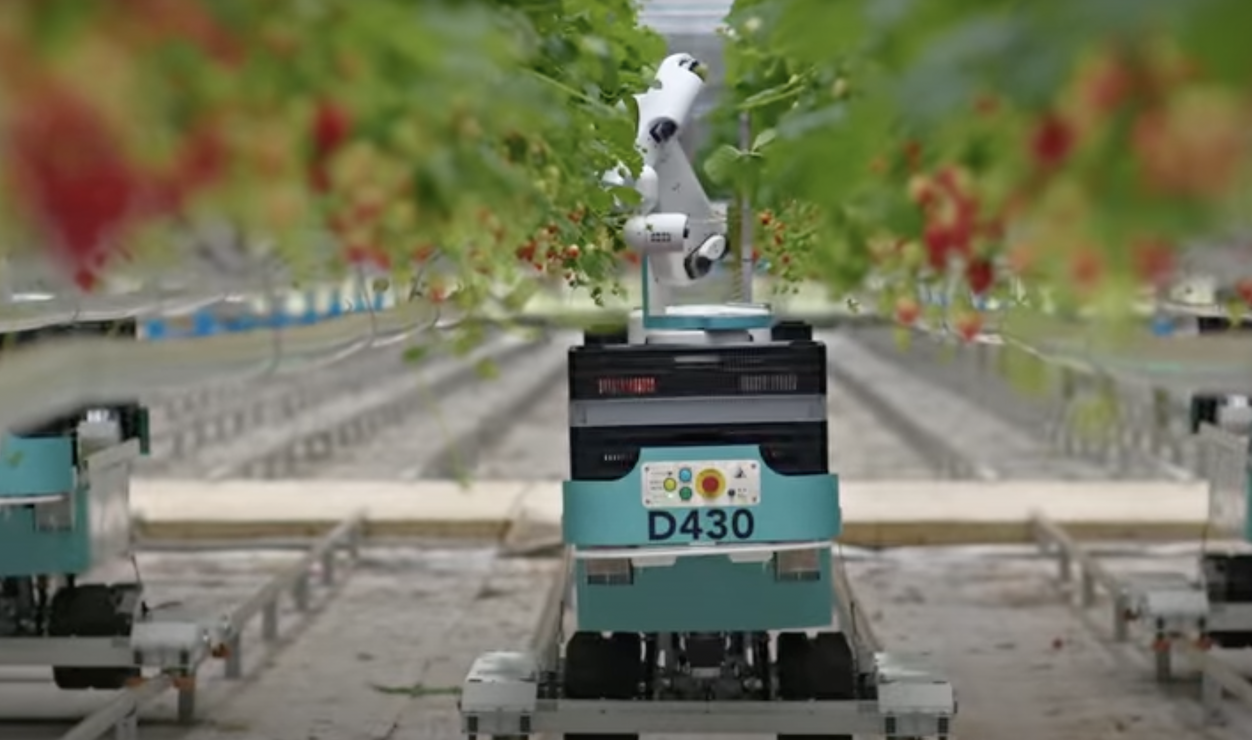
Dogtooth is selling fifth generation robots to existing customers in 2025, starting with a glasshouse version and soon a polytunnel version. They are engaging with customers worldwide through a free early access program that includes site surveys, compatibility assessments, infrastructure recommendations, demo day invitations, and latest news updates.
- •Fifth generation robots for existing customers
- •Glasshouse version available first
- •Polytunnel version coming soon
- •Free early access program for interested farmers
- •Site survey for autonomous harvesting robot compatibility
- •Recommendations for future infrastructure investment
- •Invitation to demo days in the UK and beyond
- •Latest news updates on progress
Detailed specs not disclosed.
Technology stackOur read
Inferred from product specs — click through to the technology wiki:
ResearchComputed
Product comparisonComputed
Company announcement
News and Media
The company's official social & video channels · external links
News
From third-party news outlets (China & abroad) · external links

