Corvus Robotics
SnapshotCompany claim
Corvus Robotics builds autonomous inventory intelligence for the physical economy. The mission-driven team invents AI and robotics to revolutionize supply chains for plants, manufacturers, distributors, and retailers. Their drones operate in Fortune 500 warehouses.
- Founded
- Not disclosed
- HQ
- Not disclosed
- Models
- 2
- Categories
- 1
Product families
Is this your company? Claim this profile to add verified data, respond to our analysis, and upgrade claims to Verified.
Claim this profile1. Executive Overview {#executive-overview}
Corvus Robotics is an autonomous inventory intelligence company whose drones are, by the company's own account, operating live in Fortune 500 warehouses. The company's product suite spans two distinct hardware categories: a purpose-built autonomous drone system engineered for sub-zero cold storage environments (Corvus One for Cold Chain), and a forklift-mounted AI copilot for real-time pallet tracking across standard warehouse operations (Corvus Trident). Independent press coverage from Robotics and Automation News, Food Industry Executive, and RoboticsTomorrow corroborates product launches and at least one named customer deployment, lending external validation to the company's commercial claims. Third-party coverage of the cold chain drone launch appeared across both general robotics and vertical food-industry outlets in early 2026, suggesting deliberate market positioning in a segment with genuine operational pain points.
The company's stated mission — to "revolutionize the entire physical economy of plants, manufacturers, distributors, and retailers" — is broad, but the current product lineup is sharply focused on warehouse inventory accuracy and worker safety. Not yet disclosed: founding year, country of incorporation, total headcount, and funding history. Corvus Robotics invites prospective customers and investors to submit corrections or disclosures via the contact channel listed on their site.
Latest news
- KEENON Humanoid Pours Drinks at GCS 2026, 100,000 Others Run HotelsYanko Design·2026-06-15GENERAL
2. The Company Story {#the-company-story}
Corvus Robotics describes itself as a mission-driven team building "autonomous inventory intelligence for the physical economy," with a particular emphasis on supply chains serving plants, manufacturers, distributors, and retailers. The company's careers page notes that its drone systems are "live in Fortune 500 warehouses" — a claim corroborated by RoboticsTomorrow, which reported a named deployment at Dermalogica's global headquarters. This positions Corvus as a company that has moved past prototype and pilot stages into recurring commercial deployment, at least at select enterprise accounts.
The founding date and country of incorporation are not publicly disclosed on the company's site. What is apparent from the product roadmap is a deliberate evolution from a single drone platform toward a multi-product inventory intelligence ecosystem. The Corvus One for Cold Chain represents a vertical specialization — hardening an autonomous drone for one of the most demanding physical environments in warehousing (continuous operation at -20°F). The Corvus Trident then extends coverage to the complementary problem of inventory-in-motion, attaching AI sensing to existing forklift fleets rather than requiring greenfield infrastructure. Together, the two products suggest a company that has identified inventory accuracy as its core value proposition and is systematically building toward full-warehouse coverage across both static racking and dynamic material handling.
The company's five stated core values — "Whatever It Takes," "Do Work You're Proud Of," "Impacting Customers," "Communicate Directly," and "Be a Good Person" — reflect a culture that explicitly prizes field deployment success and direct communication over internal politics. The careers messaging that "the team building them is small enough that your work shows immediately" indicates the company remains in a growth-stage headcount profile, though exact team size is not disclosed.
3. Product Portfolio {#product-portfolio}
Products & versions


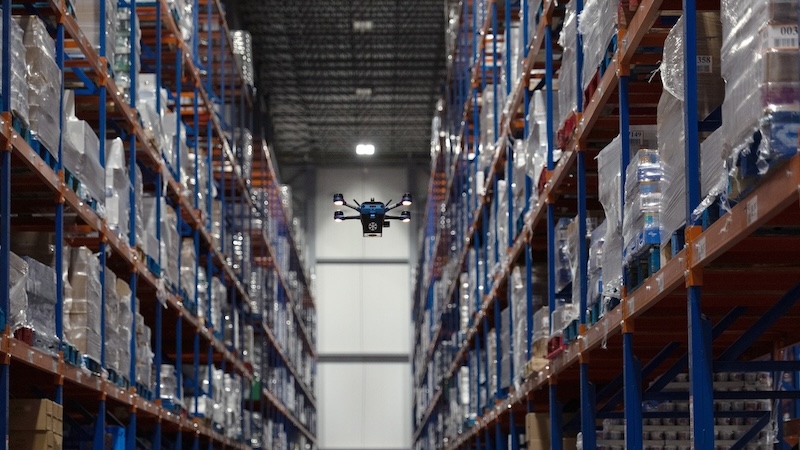
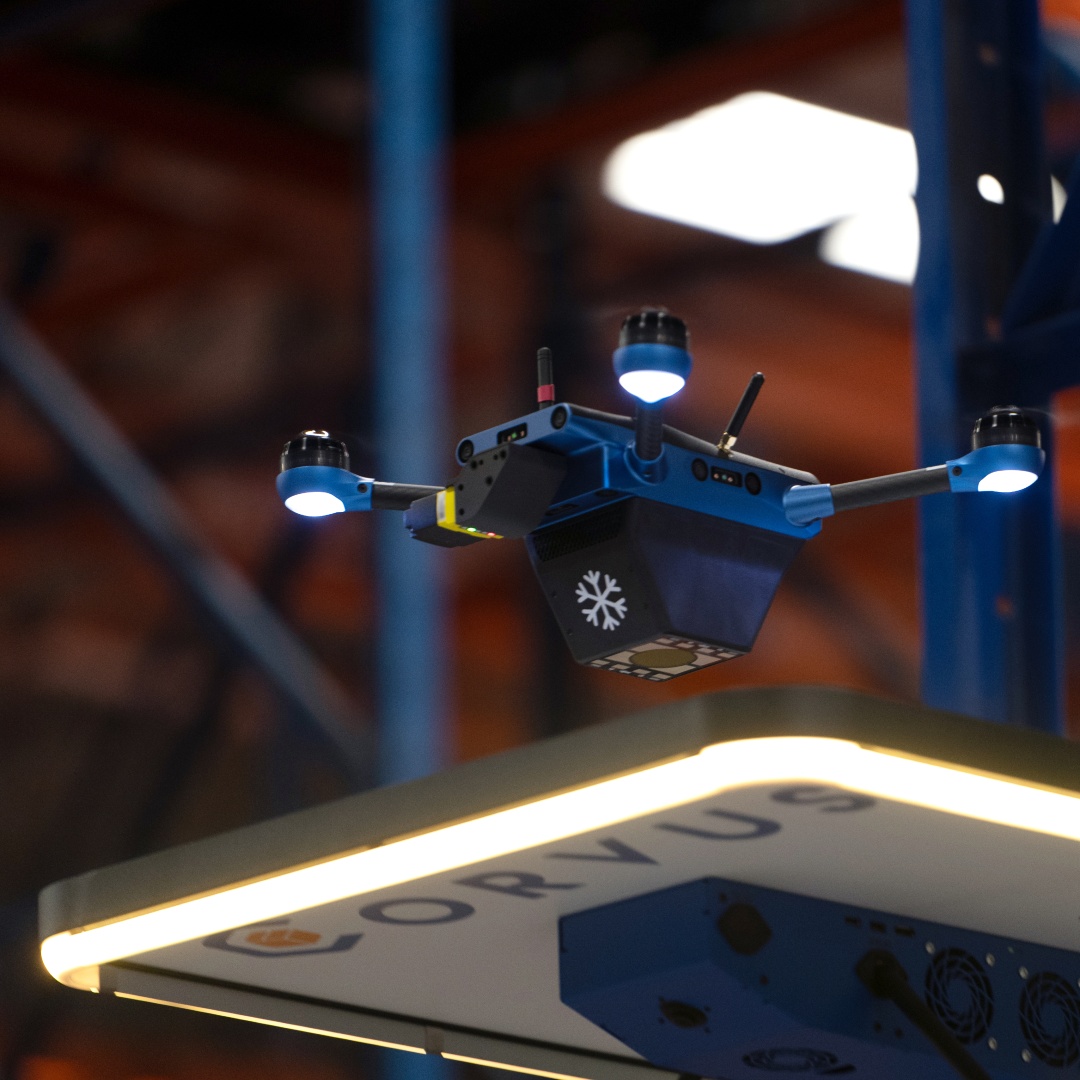
Corvus Robotics currently offers two distinct products, each targeting a different node in the warehouse inventory problem. The first, Corvus One for Cold Chain, is an autonomous drone system purpose-engineered for freezer and cold storage environments. It operates continuously at temperatures as low as -20°F (approximately -29°C) without warm-up cycles, using vision-based, GPS-denied navigation that functions in the condensation and frost conditions that typically defeat optical systems. Engineered battery packs with integrated thermal regulation address the well-known power-density degradation of lithium cells in extreme cold. The system deploys in as few as four weeks without facility downtime and integrates with warehouse management systems (WMS) via standard APIs, with a CSV/XLS export option for sites without full API capability. Coverage from Robotics and Automation News (February 2026) and Food Industry Executive (March 2026) independently confirmed this product's launch.
The second product, Corvus Trident, is an AI copilot that mounts to forklifts, reach trucks, and other powered material handling equipment (MHE) rather than flying autonomously. It reads barcodes across symbologies and orientations on pallets stacked up to three high (approximately 12 feet / ~3,658 mm), tracking inventory movement from inbound receipt through outbound shipment without requiring GPS, beacons, or reflective markers. Real-time alerts cover collisions, unsafe driving behavior, and incorrect picks — adding a safety and compliance layer on top of the core inventory-accuracy value proposition. Trident integrates with WMS via standard APIs or operates in a standalone mode. As of the time of writing, Trident is noted as "Now Accepting Select Enterprise Deployments," indicating it is in a controlled commercial rollout phase.
The two-product lineup forms a complementary pair: Corvus One covers static racking and frozen storage via autonomous aerial scan; Corvus Trident covers dynamic pallet movement via forklift-mounted sensing. Together they address inventory inaccuracy at both rest and in transit — the two primary sources of warehouse shrinkage and miscount.
4. Technology Stack {#technology-stack}
Corvus Robotics does not publish detailed technical whitepapers or architecture documentation in its public-facing materials. What can be inferred from product specifications and feature descriptions is outlined below, with inferences clearly labeled.
Vision-based navigation: Both products rely on camera and sensor fusion rather than GPS or external beacons. For Corvus One for Cold Chain, the system uses "vision-based GPS-denied navigation" with "high-resolution imaging sensors" rated for low-light and frost-prone conditions. Our read: this is consistent with visual-inertial odometry (VIO) or simultaneous localization and mapping (SLAM) approaches tuned for visually degraded environments — a non-trivial engineering challenge given that condensation and frost directly degrade optical sensor performance.
Thermal engineering: The cold chain drone incorporates "engineered battery packs with integrated thermal regulation" capable of sustaining continuous autonomous operation from -20°F to ambient temperatures. Our read: maintaining lithium battery output at -29°C without warm-up cycles implies active thermal management (likely resistive heating elements or phase-change materials around the cell pack), which adds weight and power draw that the system has apparently balanced against flight endurance requirements. Flight endurance hours are not publicly disclosed.
Barcode intelligence: Corvus Trident's ability to scan "visible barcodes across symbologies and orientations" on pallets up to 3 high (~12 feet) from a moving forklift implies onboard real-time image processing with multi-symbology decode capability. Our read: at forklift operating speeds, this likely requires GPU-accelerated inference at the edge to achieve acceptable scan rates without a fixed scan tunnel.
WMS integration: Both products offer standard API integration with warehouse management systems, and Corvus One additionally supports CSV/XLS export — a practical concession to the reality that many cold-storage operators run legacy WMS environments. Our read: this dual-mode approach (API-first with flat-file fallback) is a sensible go-to-market choice for enterprise sales cycles where IT readiness varies significantly across sites.
Not yet disclosed: specific sensor make/model, compute hardware, software stack, flight controller platform, or proprietary AI model architecture. Corvus Robotics is invited to expand public technical documentation if disclosure serves their commercial or recruiting interests.
5. Research, Papers, Authors, Labs {#research-papers}
Company-linked papers
Corvus Robotics does not, based on available public data, publish academic research papers or maintain a named research lab with a public presence. This is common and unremarkable for a commercial service-robotics company at this stage — the engineering effort is directed at field-deployable products rather than academic publication. No fabricated citations are offered here. If Corvus has affiliated researchers or has published technical work under conference proceedings, the company is invited to surface those details for inclusion.
6. Media Evidence {#media-evidence}
Media library
Three independent press placements have been identified in the source data. Robotics and Automation News (roboticsandautomationnews.com, February 10, 2026) covered the launch of the Corvus One cold chain drone, providing trade-press validation of the product's existence and positioning. Food Industry Executive (foodindustryexecutive.com, March 10, 2026) ran a parallel launch story, indicating Corvus actively targeted vertical food and cold-chain industry media — a meaningful distribution choice that signals deliberate go-to-market focus beyond generalist robotics audiences. RoboticsTomorrow (roboticstomorrow.com) reported on a deployment at Dermalogica's global headquarters, making Dermalogica the only publicly named customer in the available data set. The spread across a robotics trade outlet, a food-industry vertical outlet, and a deployment-specific piece reflects a media strategy combining category-level launch coverage with proof-of-deployment validation.
7. Commercial Reality {#commercial-reality}
Customers & deployments
Revenue: Not disclosed. Corvus Robotics has not published revenue figures, ARR, or financial metrics in any publicly available source reviewed for this report. Readers with access to private financials are invited to submit disclosures for inclusion.
Customer count: Not disclosed in aggregate. One named customer — Dermalogica — is confirmed via RoboticsTomorrow coverage of a deployment at Dermalogica's global headquarters. The company's own site states that drones are "live in Fortune 500 warehouses" (plural), which, if accurate, implies at least a small number of enterprise accounts beyond the single named deployment. This is a company claim and has not been independently verified across the full customer base.
ROI and performance metrics: Not disclosed in quantitative terms. The company offers a "Request ROI Briefing" call-to-action on its website, suggesting that ROI data exists and is shared selectively in sales contexts rather than published openly.
Funding: Not disclosed in the available data. Corvus Robotics is invited to disclose funding rounds, investors, and total capital raised for inclusion in future updates of this report.
8. Markets and Use Cases {#markets-use-cases}
Both Corvus products are tagged to the warehouse and logistics industries, but the use-case detail embedded in product descriptions reveals more granular market segmentation.
Cold storage and frozen food logistics is the most explicitly developed vertical. The Corvus One for Cold Chain addresses a well-documented operational problem: manual cycle counts in freezer environments expose workers to prolonged cold exposure, slow inventory accuracy cycles, and introduce error rates that compound with staffing difficulty in physically demanding conditions. The -20°F operational floor covers a large portion of frozen food distribution center requirements. Target operators in this segment include frozen food distributors, cold-chain 3PLs, food manufacturers with on-site freezer storage, and retailers with large frozen inventory footprints — consistent with the Food Industry Executive media placement.
General warehouse and distribution is the target for Corvus Trident, with applicability to any facility operating forklifts and reach trucks handling palletized goods. The ability to operate without GPS, beacons, or markers lowers the infrastructure barrier for brownfield deployments — a critical adoption factor in existing distribution centers that cannot afford downtime for infrastructure installation. The real-time collision and unsafe-driving alerts extend the value proposition into fleet safety and compliance, opening budget conversations beyond just inventory accuracy (e.g., safety, insurance, liability reduction).
Enterprise and Fortune 500 accounts are explicitly the intended customer tier based on the company's own language and the Trident "Select Enterprise Deployments" qualifier. The named Dermalogica deployment, while Dermalogica is a mid-to-large consumer goods brand rather than a traditional logistics operator, illustrates that the customer base may extend to brand-owned distribution and fulfillment operations, not only third-party logistics providers.
Plants and manufacturers are mentioned in the company's mission statement as target segments alongside distributors and retailers, though no product features or case studies specifically address manufacturing-floor inventory use cases in the available data.
9. Competitive Landscape {#competitive-landscape}
Competitive comparison
| Robot | Maker | Autonomy | Conf. |
|---|---|---|---|
| iRobot Roomba Combo 10 Max | iRobot | Autonomous | 0.90 |
| Mobile ALOHA (Stanford) | Stanford University | Teleoperated | 0.90 |
| 1X NEO | 1X Technologies | Remote-Assisted | 0.90 |
Corvus Robotics operates in the autonomous warehouse inventory management category, a space that has attracted both dedicated drone-for-inventory startups and broader warehouse automation platforms with inventory modules. The company's differentiation — visible in its product choices — centers on operating in physically extreme environments (sub-zero cold chain) and on non-infrastructure-dependent navigation (no beacons, no markers, no GPS), both of which represent meaningful technical barriers that not all category participants have cleared.
The Corvus Trident's forklift-mounted approach also places it in partial competition with fixed-infrastructure inventory tracking systems (RFID portals, scan tunnels) and with emerging forklift-automation platforms that incorporate inventory capture as a secondary function. The Corvus One cold chain positioning is notably specialized: cold storage drone operations represent a narrower but higher-friction sub-segment where the competitive set may be smaller and customer switching costs higher once deployed. The module above reflects computed peer relationships based on category and capability overlap.
10. Country Advantage / Geopolitical {#geopolitical}
Section not material for this company.
11. Hype vs Real vs Ugly {#hype-real-ugly}
Claim tracker
Verified / externally corroborated:
- Autonomous drone system for cold chain warehouses exists and was independently covered at launch by Robotics and Automation News and Food Industry Executive (2026).
- A deployment at Dermalogica's global headquarters is confirmed by RoboticsTomorrow — this is real, fielded hardware, not a pilot announcement.
- Corvus Trident is in a controlled commercial rollout ("Now Accepting Select Enterprise Deployments") as of the available data.
Company claims — accurate representation, not independently verified at scale:
- "Corvus drones are live in Fortune 500 warehouses" — this is a company claim from the careers page. One named customer (Dermalogica) is confirmed; the Fortune 500 qualifier and the plurality of deployments have not been independently verified across the full customer base.
- Operation at -20°F "without warm-up cycles" — a specific and testable engineering claim; independently plausible given the thermal management features described, but no third-party test data is publicly available.
- "Deploys in as few as four weeks without facility downtime" — a company claim about deployment speed; no independent operator accounts confirm or dispute this figure in the available data.
Gaps (fixable — not negatives):
- Not yet disclosed: funding history, total customer count, quantitative inventory accuracy improvement data, flight endurance specifications for Corvus One, and geographic footprint of deployments. Corvus Robotics is invited to claim or correct any of these data points for inclusion in future report updates.
Our read: The product claims are specific, technically coherent, and at least partially corroborated by independent press. The company does not appear to be overclaiming at the category level — the positioning is disciplined around concrete operational problems rather than broad AI platform language.
12. Future Scenarios {#future-scenarios}
Bull case — Our read: Corvus Robotics achieves category leadership in cold-chain autonomous inventory by being first to prove reliable sub-zero drone operations at scale, building a reference customer base that creates compounding network effects (case studies, integrations, WMS partnerships). Trident's forklift copilot expands wallet share at existing drone customers, enabling a full-warehouse inventory intelligence platform sale. Enterprise contracts with Fortune 500 distribution operations generate recurring software/data revenue on top of hardware deployments, and the company grows into the broader manufacturer and retailer segments named in its mission.
Base case — Our read: Corvus successfully converts its current pipeline of select enterprise deployments into a stable but modest recurring revenue base. Cold chain remains the primary differentiator; Trident gains traction in brownfield general warehousing. Growth is steady but constrained by the enterprise sales cycle length, the capital intensity of hardware-plus-service deployments, and competition from better-capitalized warehouse automation incumbents expanding into inventory intelligence. The company remains a credible niche specialist rather than a category-dominant platform.
Bear case — Our read: Enterprise procurement cycles slow, and the "select enterprise deployments" qualifier on Trident persists longer than planned. Cold chain specialization, while defensible, limits the total addressable market compared to ambient warehouse environments. If a larger material handling or warehouse automation player integrates comparable drone or copilot functionality into an existing platform at lower incremental cost to the customer, Corvus faces pricing pressure without disclosed funding runway to sustain a competitive response. Not yet disclosed funding history makes it difficult to assess how much runway the company holds against these risks.
13. What to Watch {#what-to-watch}
- Additional named customer disclosures: Any public identification of Fortune 500 accounts beyond Dermalogica would materially validate the "live in Fortune 500 warehouses" claim and signal commercial velocity.
- Trident's transition from "Select Enterprise" to general availability: The timeline and terms of Trident's broader rollout will indicate the maturity of the product and the pace of the commercial pipeline.
- Funding announcements: A disclosed funding round (Series A or beyond) would signal investor confidence, extend runway visibility, and often precedes headcount and go-to-market scaling.
- WMS partnership announcements: Integration partnerships with major WMS vendors (named or otherwise) would accelerate enterprise sales cycles and deepen platform stickiness.
- Cold chain performance data: Any independently published or customer-attributed data on inventory accuracy improvement, scan cycle time, or ROI would move the value proposition from claim to validated.
- Geographic expansion: Whether deployments are concentrated in a single country/region or are distributed internationally would clarify the company's growth strategy and any regulatory exposure.
- New product lines: The current two-product portfolio has logical extension points (ambient-temperature drone variants, analytics dashboards, multi-site fleet management software). Any announcement in these directions would signal the company's platform ambitions.
14. Sources & Methodology {#sources-methodology}
Primary data source: All product descriptions, feature specifications, company mission statements, core values, and deployment claims are extracted from Corvus Robotics' own website (corvus-robotics.com), including the About/Careers page and individual product pages. All such material is labeled (company-claim) and represents Corvus Robotics' own representations, not independently audited facts.
Independent press sources: Three third-party media placements were available and are cited by outlet name and date where used:
- Robotics and Automation News (roboticsandautomationnews.com) — February 10, 2026
- Food Industry Executive (foodindustryexecutive.com) — March 10, 2026
- RoboticsTomorrow (roboticstomorrow.com) — date not specified in source data
These are treated as external validation of product existence and named deployments, not as audited business performance data.
Computed/inferred relationships: Competitive landscape peer groupings and technology stack inferences are derived from product category overlap and feature analysis. All inferences are labeled "Our read:" throughout the report.
What this report does not contain: No revenue figures, funding amounts, customer counts, or performance metrics have been asserted without a disclosed source. Where data is absent, the report uses "Not yet disclosed" and invites Corvus Robotics to submit corrections or additions.
Rubric applied uniformly: This same methodology — company-site extraction, named press citation, labeled inference, no unsourced negatives — is applied consistently across all company intelligence reports in this series.
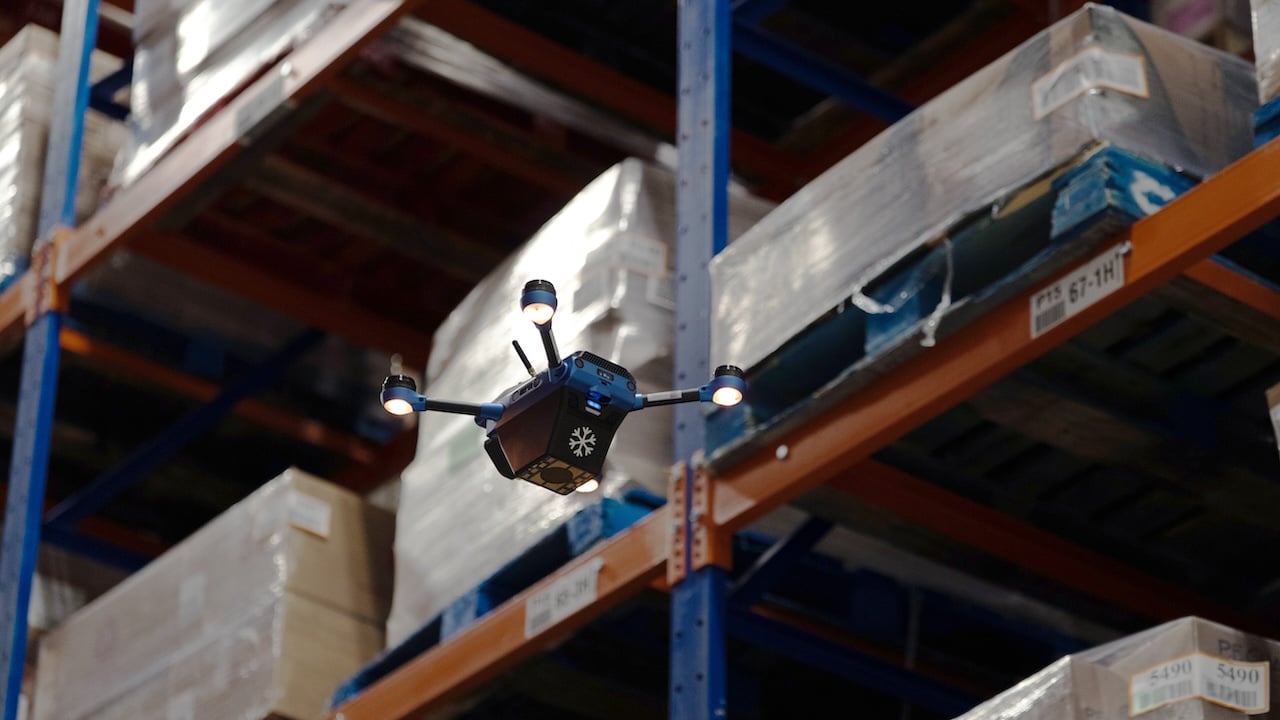
Corvus One for Cold Chain is an autonomous drone inventory management system purpose-built for freezer and cold storage environments. It operates continuously at temperatures down to -20°F without human presence, using vision-based navigation and high-resolution sensors to deliver accurate inventory counts without exposing workers to extreme cold.
- •Operates continuously at -20°F without warm-up cycles
- •Vision-based GPS-denied navigation in condensation and frost
- •High-resolution imaging sensors for low-light and frost-prone conditions
- •Engineered battery packs with integrated thermal regulation
- •Deploys in as few as four weeks without facility downtime
- •Full WMS API integration; lite CSV/XLS export available
- •Rated for continuous autonomous operation from -20°F to ambient
| Min temp c | -29 |
| Min temp f | -20 |
| Deployment weeks | 4 |
Technology stackOur read
Inferred from product specs — click through to the technology wiki:
ResearchComputed
Product comparisonComputed
Company announcement
News and Media
The company's official social & video channels · external links
News
From third-party news outlets (China & abroad) · external links