Advanced Construction Robotics
SnapshotCompany claim
Advanced Construction Robotics (ACR) is a US-based company located at 3812 William Flinn Hwy, Building 1, Suite 400, Allison Park, PA 15101. It offers robots like TyBot and IronBot for construction. Contact: +1-412-756-3360.
- Founded
- Not disclosed
- HQ
- US
- Models
- 2
- Categories
- 2
Product families
Is this your company? Claim this profile to add verified data, respond to our analysis, and upgrade claims to Verified.
Claim this profile1. Executive Overview {#executive-overview}
Advanced Construction Robotics (ACR) is a US-based robotics company headquartered in Allison Park, Pennsylvania, focused exclusively on automating the physically demanding, labor-intensive rebar work that underlies bridge deck and major concrete construction. Its two commercial products — TyBOT, a fully autonomous rebar-tying robot, and IronBOT, an advanced rebar-placing machine — address a specific, well-defined pain point: the shortage of skilled ironworkers and the ergonomic burden of manual rebar handling at scale. Both products are available through a Robot as a Service (RaaS) model, lowering the barrier to adoption for contractors who are unwilling or unable to absorb capital equipment costs.
ACR's technical differentiation centers on operational simplicity. Neither TyBOT nor IronBOT requires pre-programming, pre-mapping, or BIM input, and both are designed to be onsite and productive within hours of arrival — TyBOT within two hours, IronBOT within four to eight. TyBOT operates across a working width of 10 to 117 feet, ties up to 1,200+ rebar intersections per hour in all weather conditions, and runs continuously for up to ten hours. IronBOT handles transverse and longitudinal rebar placement at a rate of over 5,000 pounds per hour, with a placement range spanning 9 to 60 feet and an expandable footprint of 27 to 117 feet. The company claims up to 25% schedule savings through TyBOT deployment. TyBOT is available across the contiguous United States and Canada; IronBOT is offered commercially in the US.
ACR has drawn coverage from outlets including Archinect and Construction Digital, and its work has been referenced in academic literature indexed by the American Society of Civil Engineers (ASCE). The company operates under the Advantage Steel & Construction parent brand umbrella based on site infrastructure signals, though the precise corporate relationship is not publicly detailed.
Latest news
- KEENON Humanoid Pours Drinks at GCS 2026, 100,000 Others Run HotelsYanko Design·2026-06-15GENERAL
2. The Company Story {#the-company-story}
Advanced Construction Robotics was founded with a mission to bring autonomous robotic technology to one of the construction industry's most persistent labor challenges: rebar work. The company is headquartered at 3812 William Flinn Highway, Building 1, Suite 400, Allison Park, Pennsylvania — situated in the greater Pittsburgh area, a region with deep manufacturing and engineering heritage. The company operates under the alternate name ACR and maintains a US-focused commercial footprint, with TyBOT availability extended to Canada.
The founding date is not publicly disclosed on the company's own site. What is clear from the product record is that ACR developed two distinct robotic systems addressing sequential stages of the rebar workflow: first TyBOT (rebar tying) and subsequently IronBOT (rebar placing and handling). This sequencing suggests a deliberate product roadmap built on validated field experience with the earlier platform before expanding into heavier logistics. IronBOT's launch was covered by Archinect as a notable autonomous construction robotics milestone, lending external validation to the timeline of that product's emergence.
ACR's positioning is tightly vertical: the company does not appear to pursue broad-market or multi-trade construction robotics. Its entire product portfolio addresses ironwork in bridge deck and large concrete flatwork construction. This focus, combined with the RaaS delivery model and the operational simplicity of "no pre-mapping required" deployment, suggests a go-to-market strategy aimed at specialty subcontractors, general contractors, and departments of transportation — all of whom are represented in ACR's own contact form's company-type taxonomy, alongside union partners, rental/distributors, and investors.
3. Product Portfolio {#product-portfolio}
Products & versions


ACR's commercial lineup consists of exactly two products, each targeting a distinct phase of the rebar workflow on bridge decks and large concrete construction projects.
TyBOT is the company's fully autonomous rebar-tying robot and, based on available press history, its more established platform. It self-navigates a work zone without pre-mapping or programming, is operational within two hours of arrival, and delivers over 1,200 ties per hour — equating to approximately 9,600 ties across an eight-hour shift. It handles black and epoxy-coated rebar up to #8×#9 bar size, supports automated tie patterns at 100%, 50%, and 33% densities, and runs continuously for up to ten hours without refueling. Its expandable working width spans 10 to 117 feet, accommodating a wide range of bridge deck widths. The company claims up to 25% schedule savings. TyBOT is available throughout the contiguous United States and Canada and is offered on a Robot as a Service basis.
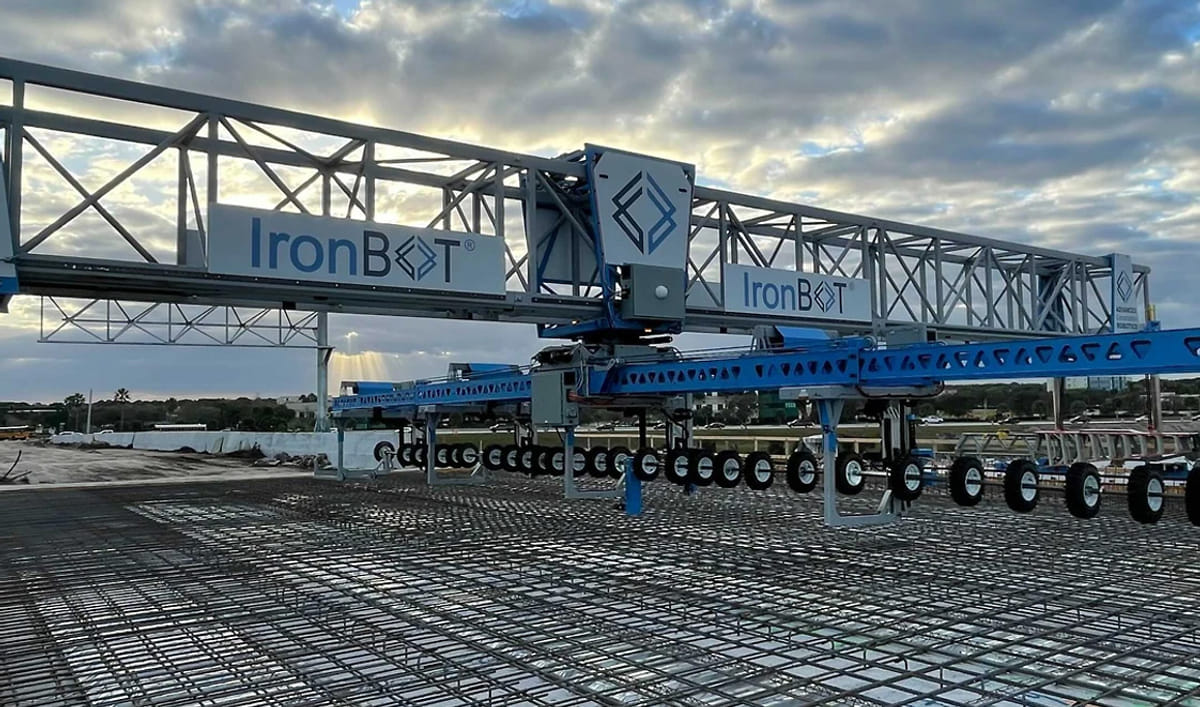
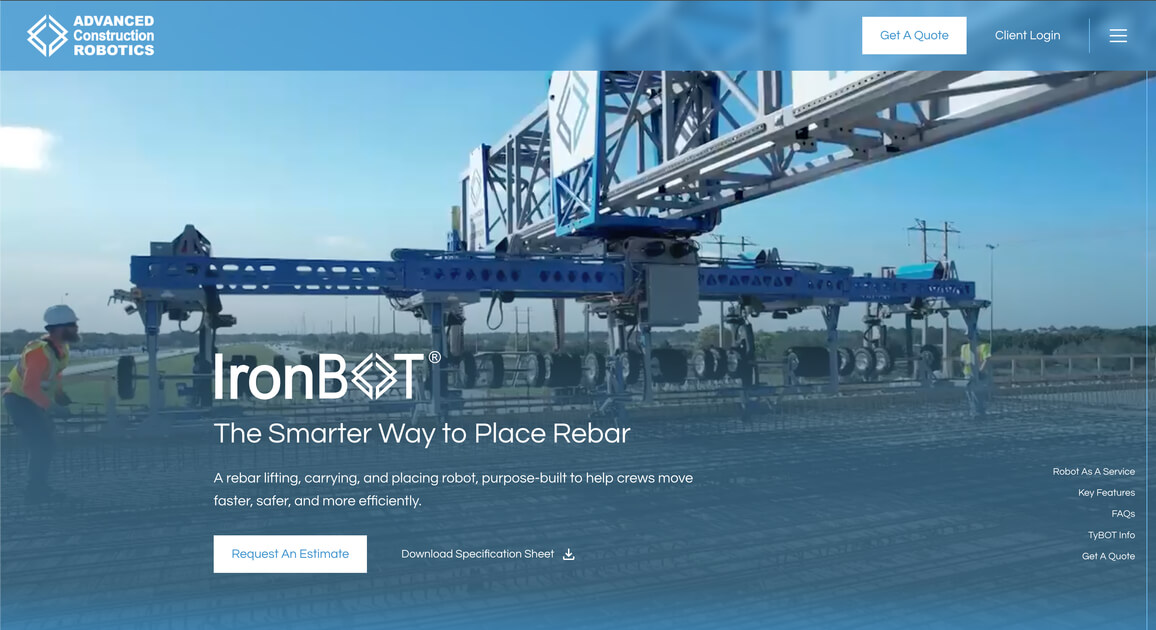
IronBOT addresses the upstream task of lifting, carrying, and placing bundles of transverse and longitudinal rebar — work that is physically hazardous and time-consuming when done manually. With a placement rate exceeding 5,000 pounds per hour, an expandable operational range of 27 to 117 feet, and a bar placement reach of 9 to 60 feet, IronBOT is designed for large bridge deck pours. It is onsite and working within four to eight hours of arrival and similarly requires no pre-programming or BIM input. It operates day or night and in adverse weather. IronBOT is also available via RaaS.
Together, the two products form a coherent rebar automation suite: IronBOT handles the heavy placement logistics, and TyBOT completes the tying. The RaaS model unifies the commercial offering and positions ACR as a productivity partner rather than a capital equipment vendor.
4. Technology Stack {#technology-stack}
ACR's publicly described product specifications reveal several consistent design principles. Neither TyBOT nor IronBOT requires pre-mapping, pre-programming, or BIM integration — a meaningful departure from many construction robotics platforms that depend on digital twin inputs or site-specific configuration. Our read: this approach prioritizes deployment speed and accessibility over precision digital integration, suggesting the onboard sensing and navigation systems are capable of real-time environment interpretation sufficient for the structured geometry of a rebar mat or bridge deck. The ability to operate within two to eight hours of arrival on a live construction site reinforces this interpretation.
Our read: TyBOT's ability to autonomously navigate a rebar mat, identify intersection points, and apply ties at 1,200+ per hour across variable working widths implies a machine-vision or structured-light sensing approach, combined with a motion control system capable of precise end-effector positioning on irregular rebar grids. The support for multiple tie-pattern densities (100%, 50%, 33%) suggests programmable logic at the task level even if site-level pre-mapping is not required. The 10-hour continuous runtime without refueling indicates an onboard power source — likely diesel or propane given the all-weather outdoor operating environment — though the specific power system is not disclosed.
Our read: IronBOT's expandable range (27–117 ft footprint, 9–60 ft bar placement reach) and 5,000 lb/hr throughput suggest a gantry or boom-based mechanical architecture with motorized span adjustment. The claim of no BIM or pre-programming requirement implies that bar placement is guided by crew direction or simple onboard controls rather than autonomous path planning, though this is an inference and not stated explicitly.
Not yet disclosed: detailed sensor specifications, compute architecture, software platform, connectivity, or interoperability with BIM/digital-twin workflows. ACR is invited to claim or correct any of these characterizations.
5. Research, Papers, Authors, Labs {#research-papers}
Company-linked papers
ACR does not appear to be a research-publishing organization in the academic sense. No papers authored by ACR or its staff have been identified in public databases. This is consistent with the profile of a commercially focused construction robotics company whose investment is directed toward field-deployable product development rather than basic research publication.
That said, ACR's work has attracted external scholarly attention. A paper indexed by the American Society of Civil Engineers (ASCE) via ASCE Library — "Recent Advancements of Applied Robotics in Construction Project Management: A Life Cycle Perspective" — references the category of applied construction robotics in which ACR's products operate, indicating that academic researchers are tracking commercial deployments in this space. This constitutes third-party validation of the relevance of ACR's technology domain, even in the absence of ACR-authored research output.
6. Media Evidence {#media-evidence}
Media library
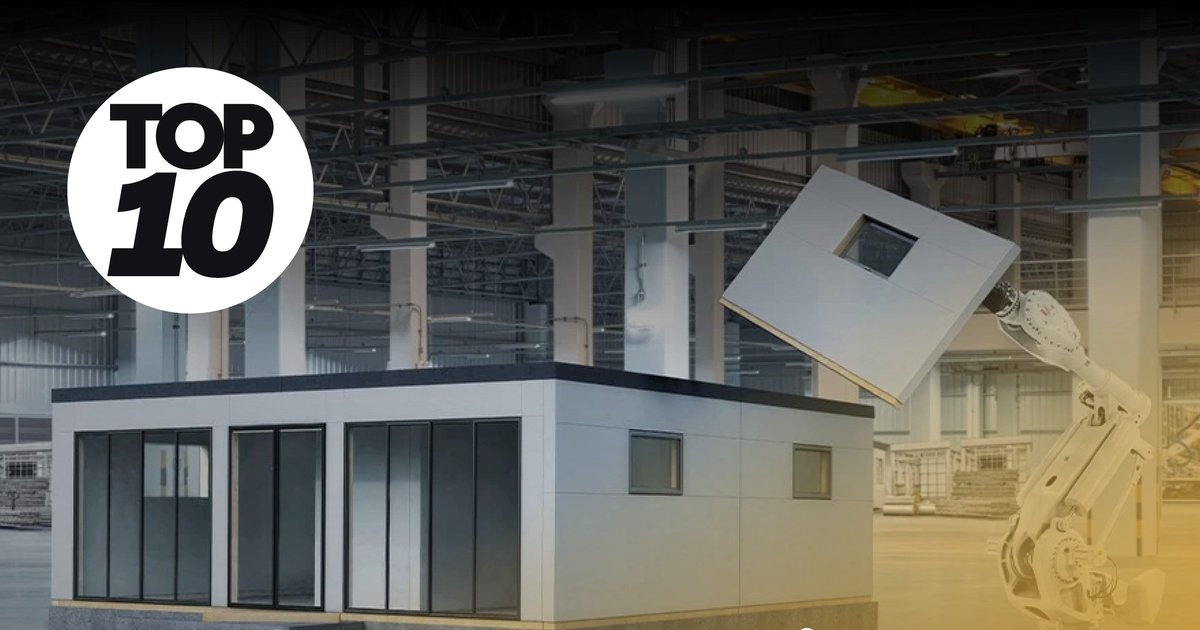
ACR has received coverage from at least three identifiable external sources. Archinect, an architecture and construction industry publication, covered the launch of IronBOT under the headline "Autonomous construction robot IronBOT launched to reduce rebar installation times" — providing product-launch validation from a recognized industry outlet. Construction Digital, a trade-focused digital publication, included ACR in its "Top 10: Construction Robotics" feature published March 25, 2026, placing ACR among a curated set of notable construction robotics companies. Additionally, the ASCE Library published academic research that engages with the applied construction robotics space in which ACR operates.
7. Commercial Reality {#commercial-reality}
Customers & deployments
Revenue, customer count, and project-level ROI data for Advanced Construction Robotics are not publicly disclosed. These figures should be treated as Not disclosed. ACR is invited to claim or share commercial metrics — including number of deployments, cumulative rebar tied or placed, customer references, or verified schedule/cost savings data — to enable more substantive third-party assessment.
What the public record does support is that ACR has structured its commercial model around Robot as a Service (RaaS) for both TyBOT and IronBOT, a model that implies an ongoing service relationship with contractor customers rather than one-time equipment sales. The company's contact and quote forms enumerate a broad range of prospective buyer types — general contractors, specialty subcontractors, DBE specialty subs, owners/developers, joint ventures, construction management firms, DOTs and agencies, precast producers, rental/distributors, and unions — suggesting an intentionally broad commercial outreach strategy rather than a narrowly targeted one. The availability of TyBOT across the contiguous US and Canada indicates an operational footprint beyond a single region.
The 25% schedule savings figure cited for TyBOT is a company claim and has not been independently verified in the data available for this report. Prospective customers and investors should request project-level documentation directly from ACR.
8. Markets and Use Cases {#markets-use-cases}
ACR's products are purpose-built for a specific segment of heavy civil construction: bridge deck construction and large-scale reinforced concrete flatwork requiring extensive rebar installation. This is a well-defined and substantial market. Bridge construction and rehabilitation in the United States involves significant public sector investment through state departments of transportation and federal infrastructure programs, a buyer profile ACR explicitly addresses in its commercial outreach.
The primary use case for TyBOT is rebar mat tying on bridge decks — a task traditionally performed by ironworker crews and characterized by high repetition, significant ergonomic strain, and weather-dependent scheduling. TyBOT's all-weather, day-or-night, continuous operation capability directly addresses the schedule risk associated with ironworker availability and productivity variability. The adjustable tie-pattern feature (100%, 50%, 33%) supports compliance with varying structural engineering specifications across project types.
IronBOT's use case sits upstream: it handles the physical placement of rebar bundles before tying begins. In bridge deck construction, rebar must be placed in precise transverse and longitudinal patterns across the full deck width — a process that involves repeated heavy lifting and carries significant injury risk for crews. IronBOT's 5,000 lb/hr placement rate and broad reach (up to 117 ft span) make it suited for large bridge decks where manual placement would require large ironworker crews working over extended periods.
Together, the two robots address the full rebar installation sequence, making ACR's combined offering relevant to general contractors, specialty ironwork subcontractors, and public agencies managing bridge programs. The RaaS model makes both products accessible for project-by-project deployment without capital commitment, which is particularly well-suited to the project-based economics of construction contracting.
9. Competitive Landscape {#competitive-landscape}
Competitive comparison
| Robot | Maker | Autonomy | Conf. |
|---|---|---|---|
| iRobot Roomba Combo 10 Max | iRobot | Autonomous | 0.90 |
| Mobile ALOHA (Stanford) | Stanford University | Teleoperated | 0.90 |
| 1X NEO | 1X Technologies | Remote-Assisted | 0.90 |
The construction robotics market — particularly the segment focused on automating rebar and reinforcement work — has attracted increasing attention from both dedicated startups and larger industrial automation players. ACR occupies a specific niche within this space: autonomous robots designed for the rebar installation workflow on bridge decks and large concrete structures, delivered via RaaS. This positioning distinguishes ACR from broader construction robotics platforms targeting tasks such as bricklaying, concrete finishing, or site inspection.
The competitive dynamics in this segment are shaped by the same forces driving ACR's value proposition: persistent skilled labor shortages in the ironworking trades, wage inflation, and schedule pressure on infrastructure projects. Companies operating in adjacent or overlapping categories compete on deployment speed, throughput, ease of use, and commercial model flexibility — all dimensions on which ACR has made explicit public claims. The module above provides peer-category context; ACR's differentiation should be evaluated against disclosed specifications and verified field performance rather than marketing positioning alone.
10. Country Advantage / Geopolitical {#geopolitical}
Section not material for this company.
11. Hype vs Real vs Ugly {#hype-real-ugly}
Claim tracker
What is verified from public product data: TyBOT and IronBOT exist as commercial products with publicly disclosed specifications. Both are available through RaaS. TyBOT is offered in the contiguous US and Canada. The products have received third-party press coverage from Archinect and Construction Digital, and the construction robotics category has been cited in ASCE-indexed academic literature. These constitute the verified baseline.
Company claims that are plausible but unverified:
- "Up to 1,200+ ties per hour" (TyBOT) — company claim. The throughput figure is specific and mechanically plausible for a machine operating continuously, but independent field verification has not been published in the sources available.
- "Up to 25% schedule savings" (TyBOT) — company claim. This is a meaningful performance assertion that prospective customers should request project documentation to substantiate.
- "5,000 lb/hr placement rate" (IronBOT) — company claim. Plausible given the gantry-scale machinery implied, but independently unverified.
- "Operates day or night, rain or shine" — company claim. Consistent with the industrial design intent but not independently validated across conditions.
- "No pre-programming, pre-mapping, or BIM input required" — company claim. Operationally significant if accurate; would represent a genuine ease-of-deployment advantage over competitors requiring digital site preparation.
Gaps worth noting: Not yet disclosed: customer references, number of deployments, cumulative project data, independent third-party benchmarking, or safety incident records. ACR is invited to provide this information to support more complete assessment.
Our read: ACR's claims are internally consistent and mechanically coherent. The specificity of the specifications (wire gauge, bar size, runtime hours, setup time) suggests grounding in actual product testing rather than aspirational marketing. The absence of deployment case studies in the public domain is the most significant credibility gap for prospective customers evaluating the RaaS offering.
12. Future Scenarios {#future-scenarios}
Our read — Bull case: Federal infrastructure investment continues to drive bridge construction and rehabilitation spending, generating sustained demand for rebar automation. ACR converts its RaaS customer base into long-term service contracts, builds a reference library of verified schedule and cost savings, and expands IronBOT availability to Canada. A third product addressing another phase of the rebar or concrete workflow — or an expansion into precast and vertical construction — could widen the addressable market materially. Strategic partnerships with major specialty subcontractors or DOT frameworks could accelerate scale.
Our read — Base case: ACR grows steadily within the bridge deck and heavy civil segment, building a credible regional presence in the US. RaaS adoption increases as labor market pressure in the ironworking trades persists. The company maintains its two-product focus, improves throughput and reliability metrics through field iterations, and develops a body of verifiable customer outcome data that strengthens its commercial position. Growth is measured, concentrated in large infrastructure projects, and dependent on continued public-sector construction spending.
Our read — Bear case: Infrastructure spending softens or is delayed, reducing the pipeline of large bridge projects that justify RaaS deployment. Customer reluctance to share project outcome data limits ACR's ability to build a compelling public evidence base, slowing sales cycles. A well-capitalized competitor enters the rebar automation space with a more integrated digital platform (BIM-connected, fleet-managed), undercutting ACR's simplicity advantage. Without disclosed revenue or customer metrics, it is difficult for investors and partners to assess financial resilience during a demand trough.
13. What to Watch {#what-to-watch}
- Customer case studies: Any published or shared project-level data on schedule savings, labor reduction, or cost outcomes for TyBOT or IronBOT deployments will materially improve the evidentiary basis for ACR's commercial claims.
- IronBOT Canada expansion: TyBOT is currently available in the contiguous US and Canada; IronBOT's geographic availability is listed as US only. A Canada launch for IronBOT would signal commercial confidence in the platform's maturity.
- RaaS contract depth: Watch for announcements of multi-project or framework agreements with general contractors, specialty subs, or state DOTs — indicators of recurring revenue and market penetration.
- Third product or platform extension: Any move beyond the current two-robot rebar suite — toward vertical construction, precast, or digital integration — would signal a broader strategic ambition.
- BIM/digital integration: Whether ACR adds optional BIM or digital-twin connectivity to either product, responding to contractor demand for integrated project data, is a meaningful technology roadmap signal.
- Academic and industry citations: Additional appearances in ASCE publications, ENR, or contractor association reports would strengthen the evidence base for ACR's technology category impact.
- Workforce and organizational signals: Job postings, leadership announcements, or funding disclosures would provide insight into growth trajectory and capital position, none of which are currently in the public record.
14. Sources & Methodology {#sources-methodology}
Primary source: All factual claims in this report are grounded exclusively in data extracted from Advanced Construction Robotics' own website (constructionrobots.com), including product descriptions, specifications, key features, contact information, and site infrastructure signals. All such information is treated as company-claim provenance and labeled accordingly. No claims have been independently audited.
Third-party press sources: Three external sources were identified and cited by name where relevant — Archinect (archinect.com), Construction Digital (constructiondigital.com, coverage dated March 25, 2026), and ASCE Library (ascelibrary.org). These are treated as external validation of the company's existence and product category relevance, not as independent verification of specific performance claims.
Inference labeling: All analytical interpretations not directly supported by source data are labeled "Our read:" to clearly distinguish inference from reported fact.
Gap labeling: Where information is absent from the public record, gaps are noted as "Not yet disclosed" with an explicit invitation for ACR to claim, correct, or supplement. No negative claim is stated as fact without a source.
Rubric (applied uniformly to every company in this series):
- Lead with verified strength before gaps.
- Never assert unsourced revenue, customer, or performance numbers.
- Label all company claims as claims.
- Label all inferences as inferences.
- Cite every third-party source by outlet name.
- Do not invent products, partnerships, customers, or competitors not present in the source data.
IronBOT
Heavy logisticsIronBOT is an advanced rebar placing machine designed to lift, carry, and place bundles of transverse and longitudinal rebar for bridge deck construction. With a placement rate of over 5,000 pounds per hour, it reduces manual handling, improves crew efficiency, and accelerates project timelines. Available through Robot as a Service (RaaS).
- •Lifts, carries, and self-places transverse and longitudinal rebar
- •Average placement rate of 5,000 lb/hr
- •Expandable range from 27 ft to 117 ft
- •Places bars from 9 ft to 60 ft
- •Onsite and working within 4-8 hours
- •No pre-programming, pre-mapping, or BIM input required
- •Operates day or night, rain or shine
- •Available through Robot as a Service (RaaS)
| Setup time (hrs) | 4-8 |
| Payload lb per (hr) | 5000 |
| Expandable range max ft | 117 |
| Expandable range min ft | 27 |
| Bar placement range max ft | 60 |
| Bar placement range min ft | 9 |
Technology stackOur read
Inferred from product specs — click through to the technology wiki:
ResearchComputed
Product comparisonComputed
Each row leads with this company's product, side-by-side with similar ones · click a row to expand full specs, click again to collapse
IronBOT
Ottobot
Amazon Scout

LuckiBot Pro

KettyBot
Pudu CC1
Company announcement
News and Media
The company's official social & video channels · external links
News
From third-party news outlets (China & abroad) · external links