Cohesive Robotics
USA · cohesiverobotics.com
SnapshotCompany claim
Cohesive Robotics transforms automation for high-mix operations using AI-powered Argus OS™ software, eliminating robot reprogramming. Supports low volumes down to lot size 1, addressing supply chain, labor gaps, and customization.
- Founded
- Not disclosed
- HQ
- USA
- Models
- 4
- Categories
- 1
ContactCompany claim
- Address
- 19 Morris Avenue, Building 128, Brooklyn, NY 11205 USA
Product families
Is this your company? Claim this profile to add verified data, respond to our analysis, and upgrade claims to Verified.
Claim this profile1. Executive Overview {#executive-overview}
Cohesive Robotics is a US-based robotics company focused on bringing practical, AI-driven automation to high-mix, low-volume manufacturing environments — a segment historically underserved by conventional robotic solutions that demand extensive reprogramming for every new part. The company's central technology, Argus OS™, is a proprietary AI-powered software stack that enables on-the-fly robot programming via 3D scanning, eliminating the need for operators to have any programming experience. This positions Cohesive Robotics squarely at the intersection of two persistent industry pain points: skilled labor shortages and the economic impracticality of automating short production runs, down to lot size 1.
The company's product lineup spans two turnkey robotic workcells — one for surface finishing and one for welding — both anchored by Argus OS™, with an additional contract finishing service that lets manufacturers access the technology without a capital purchase. Co-founders David Pietrocola (CEO) and Sidd Srivastava (CTO) bring complementary backgrounds in hands-on manufacturing (Pietrocola's family metalworking history) and advanced robotic deployment in mission-critical environments (Srivastava's deep-sea and space robotics experience). Press coverage in trade outlets including The Fabricator, NOMMA Ornamental & Miscellaneous Metal Fabricator Magazine, and the Automating Success and New York State Manufacturing Now podcasts provides external validation of the company's market presence, though the company remains early-stage in terms of publicly disclosed scale.
Latest news
- KEENON Humanoid Pours Drinks at GCS 2026, 100,000 Others Run HotelsYanko Design·2026-06-15GENERAL
2. The Company Story {#the-company-story}
Cohesive Robotics was founded by David Pietrocola and Sidd Srivastava, two practitioners with deep roots in demanding automation environments. Pietrocola grew up in a family metalworking business, giving him firsthand exposure to the constraints that high-mix job shops face when evaluating automation: unpredictable part variety, small batch sizes, and limited engineering resources to manage complex robotic programming. Srivastava brings an industry veteran's perspective from deploying robotic solutions in both startups and large multinational corporations, including environments as extreme as deep-sea and space operations — contexts where reliability, adaptability, and autonomous function are non-negotiable.
The company's founding date is not publicly disclosed. What is clear from their public communications is that they identified a structural gap in the automation market: metal fabrication and finishing operations — particularly small and medium-sized enterprises (SMEs) — have been chronically underserved by robotics vendors whose solutions assume high-volume, repetitive production. Cohesive Robotics explicitly frames its mission as "autonomous manufacturing for all," with a stated heritage in metal fabrication and finishing as its anchor vertical.
The company's trajectory includes meaningful trade press recognition. A feature in The Fabricator (October 2023) titled "Job shop automation strategies from a former CIA officer" drew attention to Pietrocola's distinctive background. A subsequent feature in NOMMA Ornamental & Miscellaneous Metal Fabricator Magazine (November/December 2024) covered the company's hands-free AI processing approach. Podcast appearances on Automating Success and New York State Manufacturing Now further signal growing awareness within US manufacturing circles. The company is registered in databases including Crunchbase and ZoomInfo, though detailed funding history is not publicly disclosed. Their planned participation in FABTECH 2026 in Las Vegas indicates a continuing investment in industry visibility and customer development.
3. Product Portfolio {#product-portfolio}
Products & versions


Cohesive Robotics currently offers four distinct but tightly integrated offerings. At the core is Argus OS™, the company's proprietary AI software stack, which is embedded across all hardware products and is also available in a "Pro Kit" configuration for customers who wish to integrate it into their own setups. The software's headline capabilities — Live Scan (which operates without CAD data), on-the-fly automatic robot programming, real-time force control and monitoring, and local GPU-accelerated processing via a dedicated industrial cabinet — are designed to make robotic automation accessible to operators with no programming background.
The Smart Finishing Robotic Workcell applies Argus OS™ to surface finishing tasks including sanding, grinding, deburring, polishing, and graining. It is a turnkey, single- or double-bay system built around a Universal Robots manipulator, occupying a footprint of 120" L × 100" W × 96" H and claiming 30–50% production capacity increases alongside a 50% reduction in abrasive consumables wear. The Smart Welding Robotic Workcell extends the same Argus OS™ platform to TIG and MIG welding for high-mix, low-volume runs, featuring a submillimeter-accurate 3D camera with a pneumatic shutter cover for weld-environment protection, and claiming up to 90% rework reduction and 50% production capacity gains. Both workcells are designed to interoperate within a unified automation infrastructure. Rounding out the lineup is a contract finishing service — starting at $1 per part, with a $1,000 minimum project cost and a 1–2 week typical turnaround — which allows manufacturers to leverage Cohesive's technology as a service rather than a capital investment, supporting materials from ferrous and non-ferrous metals to wood, stone, and composites.
4. Technology Stack {#technology-stack}
Cohesive Robotics' publicly described technology centers on Argus OS™, which the company characterizes as an AI-powered software stack combining 3D scanning, computer vision, and autonomous robot path planning. Several specific capabilities are disclosed: a Live Scan feature that generates robot programs from physical part scans rather than CAD models (a meaningful practical advantage in job shops where CAD files are inconsistent or unavailable); on-the-fly automatic robot programming that regenerates tool paths in real time as part geometry varies; and real-time force control and monitoring, which is particularly relevant for surface finishing tasks where contact force directly determines finish quality.
Our read: The use of a locally hosted, GPU-accelerated compute cabinet (the "Argus OS industrial cabinet") suggests the company has deliberately chosen edge-computing architecture over cloud-dependent processing — a pragmatic choice for factory environments with security concerns or unreliable connectivity, and consistent with the company's stated value of keeping customer data fully local. The integration of Universal Robots hardware as the default manipulator platform (with the welding workcell also supporting "any other leading brand") suggests Argus OS™ is designed as a robot-agnostic software layer rather than a hardware-locked system, which would enhance its addressable market considerably.
Our read: Real-time force control combined with AI vision, operating on GPU-accelerated edge hardware without CAD dependency, represents a technically coherent stack for the stated use case. However, limited public technical detail is available on the specific AI model architectures, training data, or sensor specifications (beyond the welding workcell's submillimeter-accurate 3D camera). Not yet disclosed: depth of vision system specifications, software update cadence, or integration APIs. Cohesive Robotics is invited to provide additional technical documentation to complete this picture.
5. Research, Papers, Authors, Labs {#research-papers}
Company-linked papers
Cohesive Robotics does not appear to be a research-publishing organization in the academic sense. This is consistent with — and not a criticism of — its positioning as a commercial product and services company focused on applied automation for job shops and SME manufacturers. No peer-reviewed papers, patent filings, or affiliated research lab relationships are referenced in the company's public materials. Not yet disclosed: any academic collaborations, patent portfolio, or R&D partnerships. The company is invited to share any such information for inclusion.
6. Media Evidence {#media-evidence}
Media library
Cohesive Robotics has secured coverage across several relevant trade outlets. Named placements include The Fabricator (October 2023), NOMMA Ornamental & Miscellaneous Metal Fabricator Magazine (November/December 2024), the Automating Success Podcast (episode #72 featuring CEO David Pietrocola), and the New York State Manufacturing Now Podcast. Company profiles are also indexed on Crunchbase and ZoomInfo. This breadth of trade press coverage — spanning print, digital, and audio formats — provides meaningful third-party validation of the company's market presence and leadership visibility within US manufacturing and fabrication circles.
7. Commercial Reality {#commercial-reality}
Customers & deployments
Revenue, customer count, deployment volume, and specific ROI case study data are not publicly disclosed by Cohesive Robotics. The company's stated performance claims — 30–50% production capacity increase for finishing applications, 50% reduction in abrasive consumables wear, and 90% rework reduction for welding — are presented as product specifications on the company's own site and should be read as company claims pending independent verification. The contract finishing service's pricing structure ($1 per part, $1,000 minimum) is publicly listed, providing a concrete data point on commercial positioning but not on realized revenue.
Not yet disclosed: total customers served, named reference accounts, geographic distribution of deployments, or third-party validated ROI data. Cohesive Robotics is invited to submit customer references, deployment counts, or independently verified performance data to substantiate these figures and build buyer confidence.
8. Markets and Use Cases {#markets-use-cases}
Cohesive Robotics' products and services map directly to the metal fabrication and finishing sector, with explicit callouts to job shops, ornamental and miscellaneous metal fabricators, and SME manufacturers operating high-mix, low-volume production lines. The application set is specific and coherent: deburring, graining, grinding, polishing, sanding, and welding — all surface treatment and joining processes common to metal parts that vary in geometry batch to batch.
The company's framing of "lot size 1" as a supported production scenario positions it for custom fabrication environments: architectural metalwork, specialty components, short-run production, and contract manufacturing. The contract finishing service extends reach to manufacturers who cannot or do not wish to purchase capital equipment, creating a robotics-as-a-service entry point.
Beyond core metalworking, the contract finishing service lists supported materials including soft and hard woods, stone, and composites, suggesting potential adjacencies in furniture manufacturing, stone fabrication, and composite parts finishing — though the company's stated heritage and marketing emphasis remain squarely on metal fabrication. The welding workcell's factory industry tag and compatibility with both TIG and MIG processes suggests applicability across a range of structural, decorative, and functional weld types. The company's explicit focus on small and medium-sized enterprises as a target segment differentiates it from vendors whose minimum viable customer is a Tier 1 automotive or aerospace manufacturer.
9. Competitive Landscape {#competitive-landscape}
Competitive comparison
| Robot | Maker | Autonomy | Conf. |
|---|---|---|---|
| iRobot Roomba Combo 10 Max | iRobot | Autonomous | 0.90 |
| Mobile ALOHA (Stanford) | Stanford University | Teleoperated | 0.90 |
| 1X NEO | 1X Technologies | Remote-Assisted | 0.90 |
Cohesive Robotics operates in a category that sits at the intersection of collaborative robotics (cobots), AI-driven autonomous programming, and finishing/welding workcell integration — a space that has attracted growing attention as manufacturers seek solutions that don't require robotics engineers on staff. The company's differentiation rests on its no-programming-required, high-mix-capable positioning: most conventional robotic finishing and welding solutions require dedicated programming time per part, making them economically impractical for job shops running small batches or one-off parts.
The competitive field in this category includes both hardware-centric workcell providers and software-layer companies attempting to retrofit existing robots with autonomous programming capability. Not yet disclosed: Cohesive Robotics' formal competitive analysis or win/loss data. The module above reflects computed category peers; the company is invited to clarify its differentiation narrative relative to any specific segment. What distinguishes Cohesive's public positioning is the combination of proprietary software (Argus OS™), turnkey hardware, and an on-ramp service offering — a relatively complete stack for a company at this stage.
10. Country Advantage / Geopolitical {#geopolitical}
Section not material for this company.
11. Hype vs Real vs Ugly {#hype-real-ugly}
Claim tracker
What the company claims: Cohesive Robotics states that Argus OS™ eliminates robot reprogramming entirely, supports lot size 1 production, delivers 30–50% production capacity increases in finishing applications, reduces abrasive consumables wear by 50%, and cuts welding rework by 90%. These are company claims as published on their product pages and should be treated as such until independently validated.
What is verifiable: The product lineup is real, publicly described in reasonable technical specificity, and consistent with the founders' stated backgrounds. Trade press coverage in named outlets (The Fabricator, NOMMA Magazine) confirms the company is active and recognized within its target vertical. The use of Universal Robots hardware is a credible and verifiable design choice. The contract finishing service's pricing and specifications are concrete and checkable.
Our read: The performance claims (30–50% capacity increase, 90% rework reduction) are meaningful and specific enough to be testable, which is a positive signal — vague or unquantified claims are more difficult to evaluate. However, without named customer deployments, independent case studies, or third-party audit data, buyers should treat these as manufacturer-stated targets rather than confirmed field results. The "zero programming experience required" positioning is the company's central value proposition and the most commercially significant claim; its real-world reliability across diverse part geometries and materials is the key question any serious evaluation should investigate.
Not yet disclosed: Any third-party validation of performance claims, customer testimonials with specifics, or disclosed failure modes. Cohesive Robotics is invited to submit supporting evidence.
12. Future Scenarios {#future-scenarios}
Our read — Bull case: Argus OS™ proves reliable across a wide range of part geometries and materials in real job shop environments, word-of-mouth within the metal fabrication community accelerates, and the contract finishing service functions as a highly effective land-and-expand motion — converting finishing service customers into workcell purchasers. The SME manufacturing market in the US is large and chronically underautomated; a proven no-programming solution could capture significant share. FABTECH 2026 and continued trade press momentum build a recognizable brand in the segment.
Our read — Base case: The company establishes a solid, defensible niche in ornamental metal, custom fabrication, and job shop finishing and welding, growing steadily on the strength of a focused product line and founder-led sales. Growth is constrained by capital requirements for SME customers, the inherent complexity of high-mix manufacturing environments, and the need to expand the sales and support organization. The contract finishing service provides near-term revenue while the workcell sales cycle matures.
Our read — Bear case: The technical challenge of reliably programming robots on-the-fly for truly arbitrary part variations proves harder to solve at commercial scale than the product positioning suggests, leading to higher-than-anticipated customer support burdens. Competition from better-capitalized entrants or from cobot OEMs developing native high-mix programming capabilities intensifies. The SME market's budget constraints and long sales cycles make scaling capital-intensive workcell sales difficult without external funding.
13. What to Watch {#what-to-watch}
- FABTECH 2026 participation: Public demos and customer conversations at this event will be a leading indicator of commercial traction and product maturity.
- Named customer deployments: Any announced reference customers with verifiable results would significantly de-risk the performance claims and accelerate enterprise consideration.
- Funding announcements: No funding history is publicly disclosed; any seed, Series A, or strategic investment announcements would signal investor validation and runway for scaling.
- Argus OS™ platform expansion: Watch for new process categories (beyond finishing and welding), new robot OEM integrations, or a standalone software licensing model — each would indicate platform ambition beyond the current workcell focus.
- Contract finishing service volume: Any disclosed data on parts processed, customers served, or geographic expansion of the service offering would be an early proxy for commercial momentum.
- Hiring activity: Job postings in engineering, sales, and operations are a leading indicator of growth stage and capital position — currently, no open roles are listed on the company's careers page.
- Trade press trajectory: Continued or expanded coverage in outlets like The Fabricator, AWS Welding Journal, or Modern Machine Shop would indicate sustained market presence beyond the current footprint.
14. Sources & Methodology {#sources-methodology}
Primary sources: All factual claims in this report are grounded exclusively in data extracted from Cohesive Robotics' own website (cohesiverobotics.com), including the About page, product descriptions, key feature lists, and specifications. All such material is labeled as company-claim provenance and should be understood as self-reported information that has not been independently audited.
Third-party sources: External validation is drawn from indexed company profiles on Crunchbase and ZoomInfo, and from named trade press placements (The Fabricator, NOMMA Ornamental & Miscellaneous Metal Fabricator Magazine, Automating Success Podcast, New York State Manufacturing Now Podcast) as cited in the company's own press section. These outlets are identified as independent sources; the content of their coverage (beyond the titles provided) has not been independently reviewed for this report.
Computed relations: Competitive landscape, market categorization, and technology inferences are computed from the structured product and description data. Inferences are labeled "Our read:" throughout the report.
Rubric (applied consistently to every company): (1) No facts are invented or extrapolated beyond the data provided. (2) Gaps are noted as "Not yet disclosed" with an invitation to the company to submit corrections or additions. (3) Company-stated specifications and performance claims are reported as claims, not as verified facts. (4) Analyst inferences are explicitly labeled. (5) Negative characterizations are limited to fixable gaps or labeled inferences — never stated as unsourced fact.
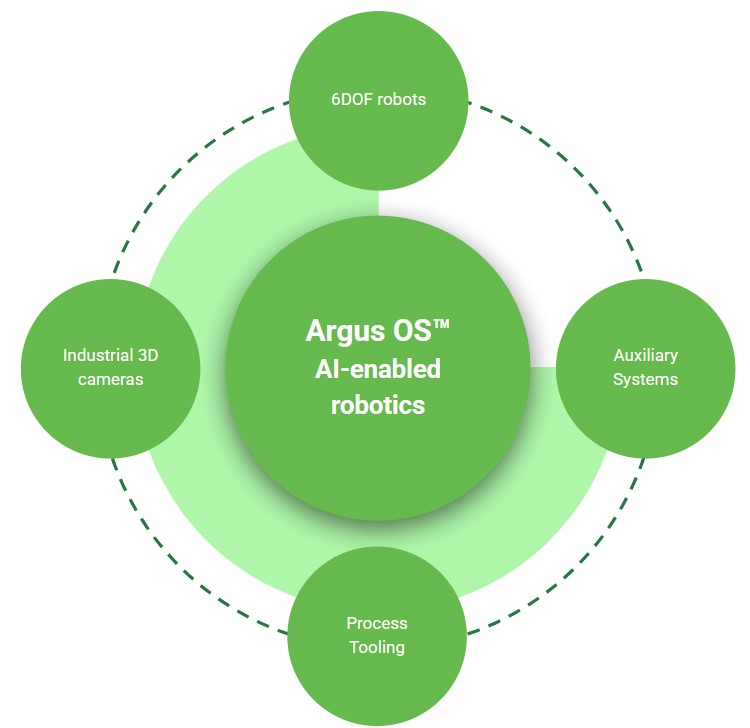
Argus OS™ is an AI-powered software stack for high-mix automation, featuring 3D scanning, on-the-fly robot programming, and support for multiple processes (sanding, welding, polishing). It includes an intuitive HMI, Live Scan without CAD, local GPU-accelerated processing, real-time force control, and analytics. Embedded in turnkey workcells or Pro Kits, it avoids costly programming and integration.
- •AI-powered 3D scanning and on-the-fly robot programming for part variations
- •Support for various processes and operations within the same workcell solution
- •Embedded in turnkey workcells or Pro Kit configurations
- •Intuitive Human-Machine Interface (HMI)
- •Live Scan feature that doesn't require CAD part data
- •Fully local GPU-accelerated processing with the Argus OS industrial cabinet
- •On-the-fly automatic robot programming
- •Real-time force control and monitoring
- •Configuration flexibility and options
- •Analytics dashboard
Detailed specs not disclosed.
Use cases
Industries
Technology stackOur read
Inferred from product specs — click through to the technology wiki:
ResearchComputed
Product comparisonComputed
Company announcement
News and Media
The company's official social & video channels · external links
News
From third-party news outlets (China & abroad) · external links