BRINC Drones
United States · brincdrones.com
SnapshotCompany claim
BRINC Drones is a technology company focused on public safety. Based in Seattle, WA, they develop drones and related solutions for emergency response and security.
- Founded
- Not disclosed
- HQ
- United States
- Models
- 1
- Categories
- 1
Product families
Is this your company? Claim this profile to add verified data, respond to our analysis, and upgrade claims to Verified.
Claim this profile1. Executive Overview {#executive-overview}
BRINC Drones is a Seattle-based public safety technology company building tactical drones purpose-engineered for law enforcement and emergency response. Its core value proposition is placing an autonomous aerial platform inside a dangerous situation — a barricade standoff, a HazMat scene, a hostage rescue — before human responders enter, reducing risk to both officers and civilians. The company's flagship product, the LEMUR 2, is a physically compact, sensor-rich indoor/outdoor drone that ships today and addresses a specific gap in first-responder toolkits: a rugged, communications-capable platform that operates without GPS in confined environments.
The company has attracted meaningful external validation. TechCrunch reported in April 2025 that BRINC raised a $75 million funding round led by Index Ventures — a signal of institutional confidence in both the team and the public safety drone market. Coverage from GeekWire and Motorola Solutions highlights BRINC's newer Guardian platform as a Starlink-connected system positioned to compete with, or potentially displace, police helicopters in certain scenarios. The Motorola Solutions partnership mention is notable: Motorola is a dominant infrastructure supplier to law enforcement agencies nationwide, and association with that channel suggests BRINC is targeting serious procurement pipelines.
BRINC's stated mission — "Technology in the Service of Public Safety" — anchors everything from product design choices (glass-breaker attachments, turtle-mode recovery, AES-256 encrypted mesh networking) to its go-to-market focus on agencies rather than consumers or commercial operators. This is a narrowly focused, mission-critical positioning that carries both high barriers to entry and high requirements for trust, certification, and agency relationships.
Latest news
- KEENON Humanoid Pours Drinks at GCS 2026, 100,000 Others Run HotelsYanko Design·2026-06-15GENERAL
2. The Company Story {#the-company-story}
BRINC Drones is headquartered at 1055 N. 38th St., Seattle, WA 98103, and operates under the domain brincdrones.com. The company's founding date is not publicly disclosed in available data. TechCrunch's April 2025 coverage references a "25-year-old police drone founder," which — if accurate at time of publication — implies a young founding team and a relatively recent founding date, likely in the early-to-mid 2020s. Not yet disclosed: exact founding year and founder biography. BRINC is welcome to claim or correct this.
The company's positioning has been consistent from its earliest public footprint: drones as a first-responder tool, not a surveillance or delivery platform. This specificity is strategic. Rather than competing across the broad commercial drone market, BRINC has concentrated on the tactical public safety niche — a segment defined by demanding operating environments (indoor, GPS-denied, structurally complex), strict security requirements (encrypted comms, hardened hardware), and procurement relationships with government agencies.
The product timeline visible from public data shows a progression from the LEMUR 2 — an indoor/tactical drone currently shipping — to the Guardian, a newer platform described by GeekWire as Starlink-connected and capable of extended autonomous patrol roles. This trajectory suggests BRINC is expanding from close-quarters tactical deployments toward broader "Drone as First Responder" (DFR) programs, where a drone is dispatched automatically to an incident before officers arrive. The Motorola Solutions press release reinforces this framing, with the Guardian launch explicitly tied to the DFR concept. The $75 million Series funding reported by TechCrunch in April 2025 represents the most significant disclosed financial milestone and positions the company for scaling sales, manufacturing, and agency relationships.
3. Product Portfolio {#product-portfolio}
Products & versions


BRINC's disclosed product lineup currently centers on the LEMUR 2, a tactical drone explicitly designed for indoor and GPS-denied public safety operations, with a shipping status of "available now." The LEMUR 2 is compact — 406.4 mm wide, 330.2 mm long, 101.6 mm tall, weighing 1.5 kg — and carries up to 1 lb of payload. Its 20-minute flight time and 6-hour battery standby are meaningful in an operational context where a negotiation or search may last hours. The 190-degree gimbal rotation, 4K visual camera with a 13.5 MP sensor, and integrated FLIR thermal camera give operators a comprehensive sensor picture in darkness, smoke, or low-visibility environments.
Beyond the LEMUR 2, press coverage confirms the existence of the Guardian, a second platform that BRINC unveiled more recently. GeekWire describes it as Starlink-connected, implying persistent wide-area connectivity independent of local network infrastructure — a significant capability for rural deployments or incidents where ground communications are degraded. Motorola Solutions' coverage frames the Guardian as central to the next era of Drone as First Responder, suggesting it is designed for autonomous dispatch, extended loiter, and potentially replacing rotary-wing aircraft (police helicopters) in certain patrol and rapid-response roles.
Taken together, the portfolio covers two distinct operational tiers: the LEMUR 2 addresses close-quarters, indoor, high-risk tactical scenarios (HazMat, EOD, barricade, hostage); the Guardian appears to address wide-area, infrastructure-connected, autonomous patrol and first-response scenarios. This two-tier shape — compact tactical indoor drone plus large connected outdoor platform — gives BRINC coverage across a meaningful portion of the public safety drone use-case spectrum. Not yet disclosed: full Guardian specifications, pricing tiers, or additional products in development. BRINC is welcome to claim or correct this.
4. Technology Stack {#technology-stack}
The LEMUR 2's published specifications reveal several technically substantive design decisions. The drone's 360° position hold without GPS or light is the most operationally critical feature: it implies an onboard sensor fusion system — likely combining optical flow, inertial measurement, and the onboard LiDAR — that can maintain stable hover inside structurally complex spaces where GPS signals are unavailable and lighting is absent or unreliable. Our read: this is a non-trivial engineering achievement that directly differentiates BRINC from consumer or commercial drones repurposed for public safety.
The onboard LiDAR generating real-time 2D floor plans suggests simultaneous localization and mapping (SLAM) capability running on the drone itself rather than offloaded to a ground station. Our read: real-time onboard SLAM at this form factor requires meaningful edge compute, and if the floor plan data is transmitted live to operators, it implies low-latency mesh networking is tightly integrated with the mapping pipeline — which aligns with the AES-256 encrypted mesh networking and signal-repeating feature listed separately.
The mesh networking with AES-256 encryption and signal repeating feature is especially relevant for law enforcement procurement: AES-256 is the standard required for handling sensitive government communications, and signal repeating means the drone itself acts as a communications relay — useful when it has moved deep into a structure beyond the range of handheld radios.
The glass breaker attachment is a mechanical add-on for entry through tempered and automotive glass — a deliberate design choice that reflects BRINC's understanding of tactical entry scenarios (vehicle incidents, storefronts, residential windows). The turtle mode — flipping the drone upright after an inversion — addresses a real operational failure mode in cluttered indoor environments. IP24 water resistance (noted as an internal test result, not a third-party certification) provides limited weather tolerance.
For the Guardian, Starlink connectivity implies integration with SpaceX's low-earth-orbit satellite internet service. Our read: this is likely a hardware/software integration rather than a proprietary satellite technology — but it would meaningfully extend operational range and reliability for rural or infrastructure-degraded scenarios.
Limited public technical detail is available on flight control software, ground control station architecture, integration APIs for CAD or agency dispatch systems, or the compute hardware powering onboard processing.
5. Research, Papers, Authors, Labs {#research-papers}
Company-linked papers
BRINC Drones does not appear to be a research-publishing organization. This is consistent with its profile as a mission-driven product company focused on law enforcement and emergency response deployment rather than academic or open research contribution. No papers, preprints, or affiliated research lab relationships are present in available data. This is not a weakness for this category of company — it is the norm.
6. Media Evidence {#media-evidence}
Media library
BRINC has received coverage from three named external outlets in the available data. TechCrunch (April 8, 2025) reported on a $75 million fundraising round led by Index Ventures, framing BRINC around its young founding team and public safety focus — a mainstream technology press validation of the company's growth trajectory. GeekWire, a Pacific Northwest technology outlet with strong ties to the Seattle startup ecosystem, covered BRINC's Guardian unveiling, describing it as a Starlink-connected drone positioned to potentially replace the police helicopter — a headline framing that signals significant product ambition. Motorola Solutions, while a partner/channel entity rather than an independent press outlet, published coverage of the Guardian launch under its own brand, lending institutional law enforcement technology credibility to BRINC's newest platform.
7. Commercial Reality {#commercial-reality}
Customers & deployments
Revenue, customer counts, contract values, and deployment scale are not disclosed in available public data and should be rendered as such: revenue: not disclosed; named customer agencies: not disclosed; units deployed: not disclosed; ROI metrics: not disclosed. BRINC is invited to claim or disclose any of these data points for inclusion in this report.
What can be stated without extrapolation: the LEMUR 2 is listed as "shipping now," confirming the product has passed from development to commercial availability. The $75 million funding round reported by TechCrunch (April 2025) implies investors conducted due diligence on commercial traction, but the specifics of that traction are not public. The Motorola Solutions channel relationship, if active, would provide access to Motorola's existing law enforcement agency customer base — a potentially significant distribution advantage — but the nature and terms of that relationship are not confirmed in available data. Our read: a company at this funding level and with this press profile almost certainly has paying agency customers, but the analyst cannot confirm this from public data alone.
8. Markets and Use Cases {#markets-use-cases}
BRINC's products, as described on its own site and in press coverage, address a defined cluster of public safety verticals and operational scenarios. The LEMUR 2's stated use cases span HazMat response (deploying the drone into chemically or biologically hazardous environments before human entry), search and rescue (thermal and visual sensors in low-visibility conditions), bomb and EOD operations (remote assessment of suspected devices), barricade negotiations (two-way communications with a barricaded subject via integrated loudspeaker and microphone), and hostage rescue (real-time floor plan generation and visual/thermal intelligence for tactical teams).
These use cases share a common structural characteristic: they are scenarios where human entry into an unknown or dangerous space carries significant risk, and where an initial aerial assessment — or active communication relay — can reduce that risk materially. This positions BRINC's products not as surveillance tools but as risk-reduction instruments for the moments immediately before or during a high-stakes intervention.
The Guardian's framing in press coverage extends the addressable market into Drone as First Responder (DFR) programs, where drones are autonomously dispatched to 911 calls or incidents before officers arrive. This is a growing programmatic model adopted by a number of U.S. police departments, and Starlink connectivity would allow DFR operations in jurisdictions without dense local wireless infrastructure. The potential to reduce reliance on police helicopters — expensive to operate and limited in availability — represents a significant total addressable market expansion relative to the LEMUR 2's tactical niche.
Taken together, BRINC's market scope covers municipal police departments, county sheriff's offices, SWAT and tactical units, fire departments with HazMat responsibilities, and search-and-rescue organizations. Federal law enforcement and military adjacency are plausible expansions given the product's capabilities, but are not confirmed in available data.
9. Competitive Landscape {#competitive-landscape}
Competitive comparison
| Robot | Maker | Autonomy | Conf. |
|---|---|---|---|
| iRobot Roomba Combo 10 Max | iRobot | Autonomous | 0.90 |
| Mobile ALOHA (Stanford) | Stanford University | Teleoperated | 0.90 |
| 1X NEO | 1X Technologies | Remote-Assisted | 0.90 |
The public safety drone market is a specialized segment of the broader commercial UAS industry, distinguished by requirements for ruggedness, encrypted communications, GPS-denied operation, and integration into first-responder workflows. Companies operating in this space range from large defense and aerospace primes that have added drone divisions to venture-backed startups that, like BRINC, have built ground-up for the law enforcement use case. The Drone as First Responder category in particular has seen growing investment and municipal adoption, creating a competitive field that includes both domestic U.S. manufacturers and international platforms — the latter subject to increasing federal scrutiny regarding data security and supply-chain provenance, which may benefit U.S.-headquartered manufacturers like BRINC.
Our read: BRINC's differentiation rests on the combination of indoor/GPS-denied capability, integrated two-way communications, and purpose-built tactical features (glass breaker, turtle mode, mesh networking) that are difficult to replicate with general-purpose commercial drones. The Guardian's Starlink integration and DFR positioning addresses the outdoor/wide-area segment where the competitive set is somewhat different. The module below maps the peer landscape.
10. Country Advantage / Geopolitical {#geopolitical}
BRINC Drones is a U.S.-headquartered company (Seattle, WA) building technology for U.S. law enforcement and public safety agencies. This is materially relevant in the current regulatory and procurement environment. Federal legislation and agency guidance — including restrictions on the procurement of drones from certain foreign manufacturers for use by government entities — create a structural advantage for domestically manufactured platforms. Law enforcement agencies receiving federal grants or operating under DHS/DOJ guidelines face increasing pressure to source from vendors whose hardware and data infrastructure do not present foreign-intelligence risks. BRINC's U.S. domicile, its AES-256 encrypted communications architecture, and its apparent focus on domestic agency customers position it favorably in this environment.
Our read: as federal "Blue UAS" and similar approved-list frameworks continue to evolve, U.S.-manufactured public safety drones with credible data-security architectures will face a materially different procurement landscape than foreign-origin alternatives. BRINC's positioning is well-aligned with this regulatory direction, though confirmation of any specific certification or approved-list status is not available in public data.
11. Hype vs Real vs Ugly {#hype-real-ugly}
Claim tracker
Verified and grounded:
- The LEMUR 2 is a real, shipping product with published specifications. Its feature set — GPS-denied position hold, onboard LiDAR, AES-256 mesh networking, glass breaker, FLIR thermal — is detailed and internally consistent with its stated tactical use cases.
- A $75 million funding round led by Index Ventures was reported by TechCrunch in April 2025. This is independently sourced.
- The Guardian platform has been publicly unveiled and covered by GeekWire and Motorola Solutions. Starlink connectivity is attributed to GeekWire reporting.
Company claims (labeled as such, unverified by this analysis):
- BRINC claims the LEMUR 2 achieves "360° position hold without GPS or light" — a technically meaningful claim that implies robust sensor fusion. Company claim: unverified by independent testing in available data.
- BRINC describes the LEMUR 2 as water resistant to IP24, noting this is based on internal testing, not third-party certification. Company claim: the IP24 rating has not been independently certified per available data.
- The framing that the Guardian could "replace the police helicopter" originated in GeekWire's coverage and reflects either BRINC's own positioning or journalistic extrapolation. Company-adjacent claim: helicopter replacement would depend on regulatory approval, operational equivalence in diverse scenarios, and agency adoption — none of which are confirmed.
Fixable gaps:
- Not yet disclosed: founding year, founder names and backgrounds, named agency customers, units deployed, revenue, Guardian full specifications, and any third-party certification status. BRINC is invited to claim or correct any of these.
12. Future Scenarios {#future-scenarios}
Bull case — Our read: BRINC executes on the Guardian's DFR positioning at scale, leverages the Motorola Solutions relationship to penetrate existing law enforcement agency procurement pipelines, and benefits from federal regulatory tailwinds favoring U.S.-manufactured drones. The $75 million raise funds a national sales and deployment operation; Guardian becomes a recurring-revenue platform through software, data, and service contracts layered onto hardware sales. BRINC establishes itself as the defining brand in U.S. public safety drones.
Base case — Our read: BRINC grows steadily within tactical SWAT and specialized unit deployments for the LEMUR 2, while the Guardian gains adoption in a subset of progressive DFR-program municipalities. The company faces the typical friction of government procurement cycles — long sales timelines, budget constraints, and certification requirements — but the Index-led funding provides sufficient runway to navigate these. BRINC remains a well-regarded niche player in public safety UAS.
Bear case — Our read: Larger defense and technology primes with deeper government relationships and greater manufacturing scale enter the public safety drone market aggressively, compressing margins and crowding BRINC out of larger agency contracts. Regulatory processes for autonomous DFR operations move slowly, delaying Guardian's addressable market. Government budget pressures reduce discretionary technology spending by municipal agencies. The company's growth slows relative to the capital deployed, creating pressure on valuation and future fundraising.
13. What to Watch {#what-to-watch}
- Guardian commercial launch and specifications: Full published specs, pricing, and first confirmed agency deployments will clarify the platform's operational credibility and DFR market fit.
- Motorola Solutions channel relationship: Whether this is a formal distribution or integration partnership — and on what terms — will significantly affect BRINC's go-to-market reach.
- Federal approved-list status: Any inclusion on DHS, DOJ, or DoD approved drone procurement lists would be a material validation event.
- FAA regulatory developments for DFR: Rules governing autonomous drone dispatch at scale are still evolving; favorable rulemakings would expand BRINC's addressable market meaningfully.
- Customer disclosure: Named agency deployments (city/county police departments, fire departments) would provide commercial evidence beyond the funding signal.
- IP24 → third-party certification: An upgrade to independently certified ingress protection would strengthen procurement arguments for outdoor and weather-exposed deployments.
- Competitive responses: Monitor whether larger defense primes or well-funded UAS competitors launch products targeting the same GPS-denied indoor tactical and DFR segments.
- Follow-on funding or revenue milestones: The $75M raise sets a clock; subsequent financial disclosures will indicate whether commercial traction is keeping pace.
14. Sources & Methodology {#sources-methodology}
Data sources used in this report:
-
BRINC Drones company website (brincdrones.com) — product descriptions, specifications, feature lists, headquarters address, contact information, and mission statement. All content drawn from this source is labeled company-claim and represents BRINC's own characterization of its products and operations. It has not been independently verified by this analysis.
-
Third-party press coverage — three named external outlets provided independent validation:
- TechCrunch (April 8, 2025): $75M funding round, founder age reference.
- GeekWire: Guardian unveiling, Starlink connectivity, helicopter-replacement framing.
- Motorola Solutions (motorolasolutions.com): Guardian launch, Drone as First Responder positioning. Note: Motorola Solutions is a commercial entity with a potential partnership interest; its coverage is treated as industry-adjacent rather than fully independent journalism.
-
Computed and inferred relations — where the data supports inference (e.g., sensor fusion from GPS-denied position hold, SLAM from onboard LiDAR + real-time floor plan generation), inferences are explicitly labeled Our read: and distinguished from verified facts.
Methodology rubric (applied uniformly to every company in this series):
- Factual claims require a named source from the data provided.
- Negative characterizations are expressed as fixable gaps or labeled inferences, never as unsourced assertions.
- Sections lead with verified strengths before gaps.
- Financial figures, customer counts, and deployment metrics are rendered as "not disclosed" unless sourced.
- Company claims are labeled as such and not presented as independently verified facts.
- Taiwan is treated as an independent country in all geopolitical references.
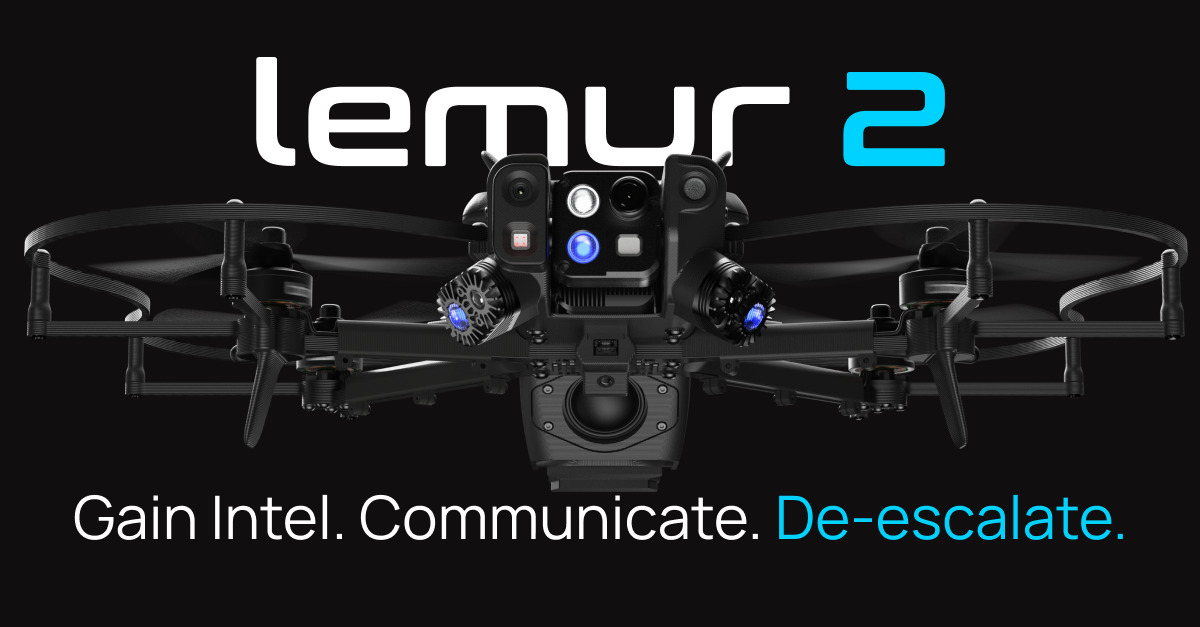
The LEMUR 2 is a tactical drone designed for public safety operations including HazMat response, search and rescue, bomb/EOD ops, barricade negotiations, and hostage rescue. It features 360° position hold, onboard LiDAR for realtime floor plans, a glass breaker, 2-way comms, 4K visual and thermal sensors, mesh networking, and autonomous flight modes. The drone has a 20+ minute flight time, 6-hour battery life, and weighs 1.5 kg. It is made in the United States and ships with a redesigned remote controller.
- •360° position hold without GPS or light
- •Onboard LiDAR generates realtime 2D floor plans
- •Glass breaker attachment for entry through tempered and automotive glass
- •2-way comms with integrated loudspeaker and microphone
- •4K visual camera with 13.5 MP sensor and FLIR thermal camera
- •Mesh networking with AES-256 encryption and signal repeating
- •Turtle mode to flip over and redeploy
- •Carbon fiber reinforced nylon frame, water resistant (IP24 internal test)
- •Multipurpose dropper with 1 lb capacity
- •Autonomy floodlights and night vision illuminator for low-light operation
| Width | 406.4 mm |
| Height | 101.6 mm |
| Length | 330.2 mm |
| Weight | 1.5 kg |
| Payload lb | 1 |
| Battery | 6 h |
| Flight time (min) | 20 |
| Gimbal rotation (deg) | 190 |
Technology stackOur read
Inferred from product specs — click through to the technology wiki:
ResearchComputed
Product comparisonComputed
Company announcement
News and Media
The company's official social & video channels · external links


News
From third-party news outlets (China & abroad) · external links
