bioservo
SnapshotCompany claim
Company description not yet disclosed.
- Founded
- Not disclosed
- HQ
- Not disclosed
- Models
- 2
- Categories
- 1
Product families
Is this your company? Claim this profile to add verified data, respond to our analysis, and upgrade claims to Verified.
Claim this profile1. Executive Overview {#executive-overview}
Bioservo Technologies (bioservo.com) is a company operating in the powered exoskeleton and assistive-robotics space, with a leadership team that bridges medical technology, industrial sales, and rehabilitation science. The team's composition — a CEO with medtech commercialization experience, a Head of Sales drawn from orthopedic device companies, a licensed physical therapist heading market access, and a CFO with pharmaceutical and life-sciences backgrounds — signals a company positioned at the intersection of wearable robotics, occupational health, and medical rehabilitation. Regional presence across Sweden, Germany, the United States, and Ukraine indicates an internationally oriented commercial operation rather than a purely domestic player.
The public data available for this report is limited: product specifications, founding date, and company description were not surfaced in the extracted data. What is available — the team's professional backgrounds and two product identifiers — suggests a company in active commercialization rather than pre-commercial R&D. The gaps in structured data are noted throughout and constitute invitations to the company to claim and correct the record.
Latest news
- KEENON Humanoid Pours Drinks at GCS 2026, 100,000 Others Run HotelsYanko Design·2026-06-15GENERAL
2. The Company Story {#the-company-story}
Founding and origin: The founding date is not disclosed in the available data. Not yet disclosed: founding year, founding team, and origin story — Bioservo is invited to claim and correct this record.
The company's domain name — combining "bio" and "servo" — points directly to its core concept: servo-assisted augmentation of biological movement. This framing is consistent with the broader field of powered orthoses and exoskeleton gloves, a category that has attracted both medical-device and industrial-safety investment globally.
Positioning signals from the team: The leadership profile is instructive as a positioning signal. CEO Petter Bäckgren's track record at Kibion AB and DiaSorin AB — both diagnostics and medtech commercialization businesses — suggests Bioservo is pursuing a regulated-product commercialization path rather than a purely industrial hardware route. The presence of Annika Rydgård as Market Access lead, with clinical experience at Sahlgrenska University Hospital and a background coordinating clinical trials at Inerventions, strongly implies that at least part of the product portfolio is navigating medical regulatory pathways (CE marking, FDA clearance, or equivalent). Philip Simonson's background at Zimmer-Biomet and Merivaara — covering orthopedic implants and surgical capital equipment — reinforces a medtech sales approach.
Geographic footprint: Active regions listed as International, United States, Sweden, Germany, and Ukraine. Sweden is consistent with the company's apparent Nordic origin. The US and Germany represent two of the largest markets for both medical exoskeletons and industrial ergonomic wearables. The Ukraine presence is noted as a data point without further elaboration available.
Milestones: No specific funding rounds, launch dates, regulatory clearances, or partnership announcements are present in the extracted data. Not yet disclosed: funding history, regulatory status, and named commercial milestones — the company is invited to claim and correct.
3. Product Portfolio {#product-portfolio}
Products & versions


Two products are identified in the extracted data under the identifiers guide-2 and p2. Both are marked NEEDS_REVIEW, meaning structured specifications, use-case tags, and industry tags were not populated in the available data extract. Prose descriptions, pricing, and deployment context are likewise not available from the source data.
Our read: The naming conventions offer limited but non-trivial inference. A "guide" product line suggests an assistive or rehabilitative function — guiding movement rather than purely augmenting force — which is consistent with the medtech orientation of the market-access and sales team. A "p2" designation could indicate a second-generation platform or a parallel product line aimed at a different user segment (e.g., industrial vs. clinical). These are labeled inferences only; Bioservo is invited to provide complete product specifications, use-case documentation, and regulatory status for both products to correct and enrich this record.
The two-product portfolio, combined with a team structured around medical-device commercialization, suggests a company that has moved past prototype stage but has not yet expanded into a broad multi-SKU catalog. This is typical of wearable-robotics firms in the Series A–B commercialization window, though no funding data is available to confirm stage.
4. Technology Stack {#technology-stack}
Limited public technical detail is available in the extracted data. No specifications, sensor modalities, actuation types, control algorithms, power sources, or materials data were surfaced for either the guide-2 or p2 products.
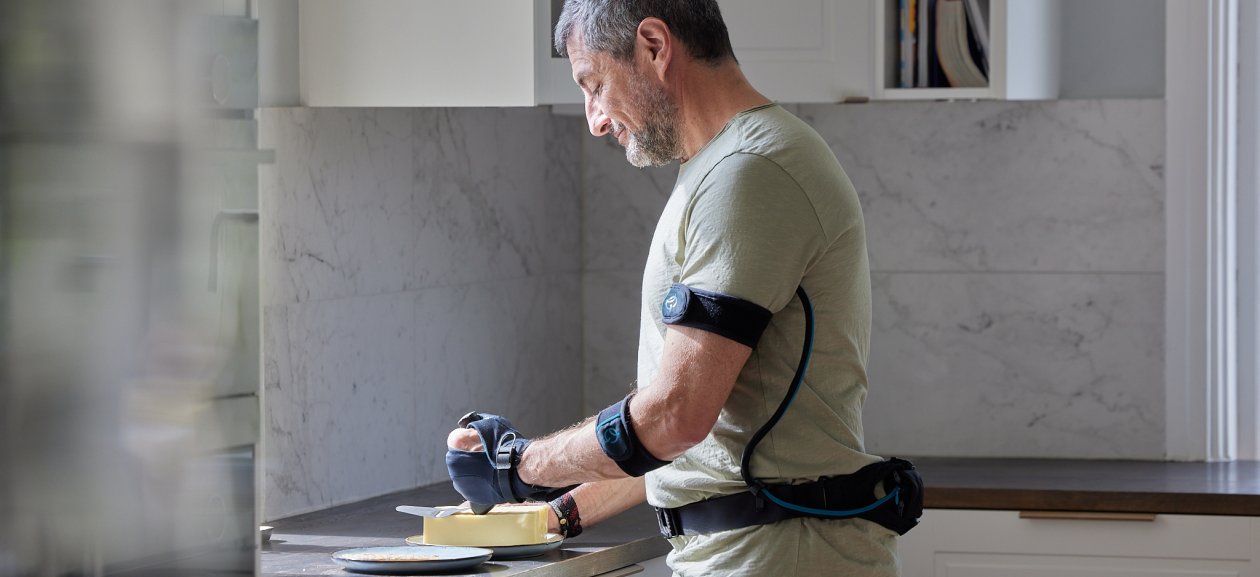
Our read: The company name "Bioservo" and the medtech-plus-industrial team composition are consistent with a powered soft-exoskeleton or exoglove architecture — a category that typically combines tendon-driven or pneumatic actuation, electromyography (EMG) or force-based intent detection, and wearable form factors designed for prolonged use. This is an inference based on category-level knowledge and team composition only, not on disclosed specifications.
Our read: The market-access function being led by a licensed physical therapist with clinical-trial coordination experience suggests the technology interfaces with clinical outcome measurement — range of motion, grip strength, fatigue metrics — which in turn implies some onboard or companion sensing and data-logging capability. Again, this is an inference; no specs are confirmed.
Not yet disclosed: actuation mechanism, sensor suite, battery life, weight, connectivity, software platform, and any third-party technology partnerships. Bioservo is invited to claim and correct the technical record.
5. Research, Papers, Authors, Labs {#research-papers}
Company-linked papers
No research publications, white papers, clinical study registrations, or academic collaborations were present in the extracted data. This is not unusual: the majority of commercial wearable-robotics and medtech firms at the commercialization stage publish selectively or not at all in open academic literature, prioritizing regulatory dossiers and clinical evidence packages over journal output.
Annika Rydgård's background in clinical trial coordination at Inerventions and at Sahlgrenska University Hospital does suggest that clinical evidence generation is part of the company's strategy, but no specific trials, ClinicalTrials.gov registrations, or published results are available to cite here. Not yet disclosed: clinical trial identifiers, peer-reviewed publications, and named academic or hospital research partners — the company is invited to claim and correct.
6. Media Evidence {#media-evidence}
Media library
No media links, press mentions, or named publication coverage were present in the extracted data. Not yet disclosed: press coverage, trade-publication features, and award recognitions — Bioservo is invited to claim and correct this record.
7. Commercial Reality {#commercial-reality}
Customers & deployments
Revenue: Not disclosed. Bioservo is invited to share revenue figures, growth trajectory, or revenue range for inclusion in this record.
Customers and deployments: No named customers, reference sites, case studies, or deployment counts were present in the extracted data. Not yet disclosed: named enterprise or clinical customers, units deployed, and geographic distribution of deployments.
ROI and outcomes data: No return-on-investment figures, injury-reduction statistics, or clinical outcome data were surfaced. Not yet disclosed: customer-reported ROI, ergonomic outcome metrics, and clinical effectiveness data.
The team's background in capital medical equipment sales (Zimmer-Biomet, Merivaara) suggests familiarity with long sales cycles, procurement committees, and evidence-based purchasing decisions — an appropriate profile for a company selling into hospital systems or large industrial accounts. Whether these channels are currently active is not confirmed by available data.
8. Markets and Use Cases {#markets-use-cases}
Drawing on the team's professional backgrounds and the product identifiers, two primary market orientations are inferable:
Medical rehabilitation and physical therapy: The presence of a licensed physical therapist in a Market Access role, combined with a CEO and CFO whose backgrounds are exclusively in medtech and life sciences, points strongly to rehabilitation medicine as a core target market. Wearable powered orthoses in this segment typically address stroke recovery, hand weakness from neurological conditions, post-surgical rehabilitation, and occupational therapy. Sahlgrenska University Hospital — named in Annika Rydgård's profile — is one of Scandinavia's leading academic medical centers, suggesting potential clinical-development or early-adopter relationships in that ecosystem.
Industrial ergonomics and occupational health: Philip Simonson's medtech sales background and Mikael Wester's experience spanning manufacturing, aerospace, mining, and industrial sectors (Atlas Copco, among others) suggest that at least one product line is positioned for industrial deployment — reducing musculoskeletal strain in assembly, logistics, or heavy manufacturing environments. This is a fast-growing segment globally, with automotive, aerospace, and warehousing among the highest-volume categories.
Geographic markets: Sweden, Germany, and the United States are the named active regions. Germany is a major hub for industrial exoskeleton adoption (automotive OEMs, industrial insurers) and for regulated medical devices (MDR compliance). The US market spans both FDA-regulated rehabilitation devices and unregulated industrial ergonomic aids.
Not yet disclosed: official industry vertical targeting, named use-case documentation, or customer segment breakdown. Bioservo is invited to claim and correct.
9. Competitive Landscape {#competitive-landscape}
Competitive comparison
| Robot | Maker | Autonomy | Conf. |
|---|---|---|---|
| iRobot Roomba Combo 10 Max | iRobot | Autonomous | 0.90 |
| Mobile ALOHA (Stanford) | Stanford University | Teleoperated | 0.90 |
| 1X NEO | 1X Technologies | Remote-Assisted | 0.90 |
The powered exoskeleton and assistive-wearable category has attracted entrants across the medical rehabilitation, industrial ergonomics, and military-assistance segments. Companies in this space generally compete on actuation approach, regulatory clearance status, clinical evidence depth, form factor, and total cost of ownership. The medtech sales and market-access orientation of Bioservo's team suggests the company is competing primarily on clinical evidence and regulated-device credibility rather than on price or mass-market volume.
Not yet disclosed: Bioservo's own competitive positioning statement. The module above renders same-category peers based on computed product and market-tag relationships. The company is invited to correct any miscategorizations.
10. Country Advantage / Geopolitical {#geopolitical}
Sweden's membership in the European Union — and its position as a high-trust, high-IP-protection jurisdiction — provides a stable regulatory and commercialization base for a medtech company seeking CE marking under the EU Medical Device Regulation (MDR). Swedish medtech firms benefit from proximity to a well-developed academic hospital network, a strong tradition of ergonomics research, and export support infrastructure. Germany as an active region adds access to Europe's largest healthcare reimbursement market and a dense industrial base. The United States presence opens the FDA-regulated and industrial markets simultaneously.
The listing of Ukraine as an active region is noted. Given the ongoing conflict in Ukraine from 2022 onward, operational continuity in that region may carry logistical and personnel considerations, though the nature and scale of Bioservo's Ukraine operations are not disclosed. Not yet disclosed: the function and scale of the Ukraine office — Bioservo is invited to clarify.
11. Hype vs Real vs Ugly {#hype-real-ugly}
Claim tracker
What is verifiable from the data:
- The company has a structured international leadership team with genuine medtech and industrial sales credentials. This is verifiable from named employers and universities in team bios (company-claim).
- Two products exist under the identifiers guide-2 and p2 (company-claim, extracted from site).
- Regional operations span Sweden, Germany, the US, and Ukraine (company-claim).
Company claims requiring further evidence:
- No explicit performance claims, clinical outcome claims, or deployment scale claims were present in the extracted data, so none can be evaluated here. This is notable: the absence of marketing superlatives in the available data is consistent with a regulated-device sales approach, where unsubstantiated claims carry compliance risk.
Gaps that read as risks:
- The near-total absence of structured product specifications, customer evidence, and press coverage in the extracted data makes independent verification of commercial traction impossible at this time. Our read: this likely reflects data-extraction limitations rather than an absence of commercial activity, but until specifications and evidence are published or claimed, the report cannot go further.
Not yet disclosed: clinical outcome claims, customer testimonials, regulatory clearance status, and deployment metrics. Bioservo is invited to claim and correct.
12. Future Scenarios {#future-scenarios}
Our read — Bull case: Bioservo has assembled a team with the right credentials to navigate both medical-device regulatory pathways and industrial capital-equipment sales cycles. If guide-2 and/or p2 achieve or maintain regulatory clearance in the EU and US, and if clinical evidence packages demonstrate meaningful rehabilitation or injury-prevention outcomes, the company is well-positioned to capture share in two large and growing markets. The Nordic medtech commercialization playbook — rigorous clinical validation, hospital reference sites, then international scale — has a strong track record.
Our read — Base case: The company continues to develop its two-product portfolio through clinical and industrial sales channels in its established geographies (Sweden, Germany, US), growing steadily but remaining a specialized, evidence-led player rather than a high-volume platform. Revenue growth is constrained by long medtech sales cycles and the capital-intensive nature of exoskeleton procurement.
Our read — Bear case: If product specifications remain undifferentiated from better-resourced competitors, or if clinical evidence packages are insufficient to unlock reimbursement or large-account procurement decisions, commercial traction may stall. The limited public data footprint — no press coverage, no case studies in the extract — could indicate early-stage commercial challenges, though this inference is uncertain given data-extraction limitations.
13. What to Watch {#what-to-watch}
- Regulatory filings: Watch for FDA 510(k) clearance, De Novo classification, or EU MDR CE marking announcements for guide-2 and p2 — these are the gating events for medtech commercial scale.
- Clinical trial registrations: Monitor ClinicalTrials.gov and the EU Clinical Trials Register for Bioservo-sponsored or -partnered studies.
- Named customer announcements: First publicly named enterprise or hospital customers will be a strong signal of commercial traction.
- Product specification disclosure: Full specs for guide-2 and p2 will clarify which competitive sub-segment each product occupies.
- Funding events: Any disclosed funding rounds (Series A/B, grant awards, public listing) will signal investor confidence and runway.
- Reimbursement coding: Watch for CPT code coverage decisions (US) or DRG/HiMSA coverage decisions (Germany) that include Bioservo products — reimbursement is often the unlock for volume in medtech.
- Ukraine operations: Monitor for any operational updates given the ongoing geopolitical situation in that region.
14. Sources & Methodology {#sources-methodology}
Data sources: All factual claims in this report are drawn exclusively from content extracted from bioservo.com — specifically the About/Team page and the product catalog — as provided in the structured data extract. All such content is marked (company-claim) throughout, reflecting that it originates from the company's own published materials and has not been independently verified by a third party.
Computed relations: Product category associations, competitor mappings (rendered via the module), and media links (rendered via the module) are derived from computed semantic relationships applied uniformly across the RoboticsDB dataset — not from editorial judgment about this specific company.
Inference labeling: Any claim that goes beyond the literal data is labeled "Our read:" and should be treated as analyst inference, not established fact.
Gap protocol: Where data was absent, this report uses the formulation "Not yet disclosed: … — [company] is invited to claim and correct" rather than asserting a negative. This rubric is applied uniformly to every company in this dataset.
Limitations: The extracted data for Bioservo was sparse: no founding date, no company description field, no product specifications, and no press links were present. Sections that would normally carry more detail (Technology Stack, Commercial Reality, Media Evidence) are thinner than they would be with fuller data. This report should be updated as the company discloses additional information.
Rubric applied uniformly: Every company report in this dataset is produced under the same source constraints, inference-labeling rules, and gap-handling protocol. No company receives favorable or unfavorable treatment relative to peers.
Technology stackOur read
Inferred from product specs — click through to the technology wiki:
ResearchComputed
Product comparisonComputed
Company announcement
News and Media
The company's official social & video channels · external links