Barrett Technology, LLC
United States · barrett.com
SnapshotCompany claim
Barrett Technology, LLC is a company based in Newton, Massachusetts, United States. It operates as a local business and organization, with no current medical job openings.
- Founded
- Not disclosed
- HQ
- United States
- Models
- 12
- Categories
- 3
ContactCompany claim
- Address
- 320 Nevada Street Ground Floor, Building Rear, Newton, MA 02460 USA
Product families
Is this your company? Claim this profile to add verified data, respond to our analysis, and upgrade claims to Verified.
Claim this profile1. Executive Overview {#executive-overview}
Barrett Technology, LLC is a Newton, Massachusetts-based robotics company with a focused dual-track portfolio: a rehabilitation robotics platform built around the Burt® upper-limb therapy robot, and a precision motion-control product line anchored by the Puck® family of compact motor controllers. The company's BurtCare™ ecosystem — spanning therapy software suites updated on a regular seasonal release cadence (Fall 2022, Fall 2023, Fall 2024) — demonstrates sustained, iterative product development in the medical robotics space, a domain that demands rigorous clinical relevance and continuous refinement. On the hardware side, the Puck® line serves robotics developers and OEM integrators who need high-performance, space-constrained motor control at accessible price points, with individual units starting at $499.
Barrett's public footprint includes recognition from the SBIR program (U.S. government small-business innovation research funding), coverage by the Robotic Industries Association via its automate.org platform, and a notable profile of founder/inventor William T. Townsend via Grokipedia. These third-party touchpoints establish independent validation of the company's standing in the robotics community, though the depth of commercial deployment data in the public record is limited. Barrett operates from a single address at 320 Nevada Street, Newton, MA 02460, and lists 617-252-9000 as its primary contact.
Latest news
- KEENON Humanoid Pours Drinks at GCS 2026, 100,000 Others Run HotelsYanko Design·2026-06-15GENERAL
2. The Company Story {#the-company-story}
Barrett Technology, LLC is a U.S.-based robotics company headquartered in Newton, Massachusetts. Its legal entity name — Barrett Technology, LLC — and its associated website at barrett.com reflect a focused, specialist positioning within the broader robotics industry rather than the profile of a diversified industrial conglomerate. The company's founder, William T. Townsend, is named in third-party coverage (Grokipedia, January 2026), suggesting a founder-led or founder-identified identity, a common characteristic of deep-technology robotics firms where intellectual property and engineering vision are tightly linked to an individual.
The company's SBIR recognition is a meaningful milestone: the Small Business Innovation Research program, administered by U.S. federal agencies, funds early-stage technology development and requires competitive peer review. Barrett's appearance in SBIR records (sbir.gov) indicates that the company has, at some point, secured or applied for federal research funding — a marker consistent with a company operating at the intersection of advanced robotics and medically relevant applications. The Robotic Industries Association's automate.org platform — the trade body for robotics in North America — has also featured Barrett in its healthcare robotics coverage, placing the company within an established industry ecosystem.
The company's product history, as evidenced by the seasonal software release cadence for its Barrett Medical line (Fall 2022, Fall 2023, Fall 2024), points to a company that has been commercially active in medical rehabilitation robotics for at least several years, with a living, maintained software platform rather than a single static product launch. The founding date is not publicly disclosed; not yet disclosed — Barrett is invited to share this milestone.
3. Product Portfolio {#product-portfolio}
Products & versions


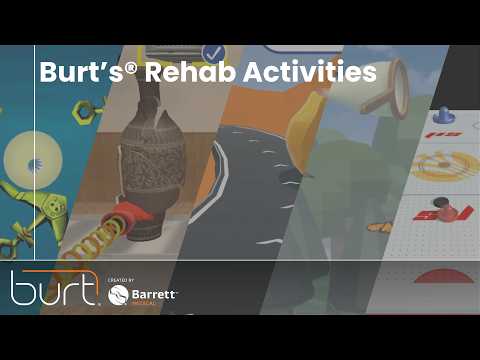
Barrett's product catalog divides into two well-defined families. The first is the Barrett Medical / BurtCare™ ecosystem — a rehabilitation robotics platform centered on the Burt® upper-limb therapy robot and a richly developed software suite. Software releases under the Barrett Medical label (Fall 2022, Fall 2023, Fall 2024) introduce and refine named therapy activities: DesertDriver™ (decision-making through simulated navigation), FishFood™ (cognitive sorting), BurtResist™ games including AirHockey, BurtAssist™ activities including FlyingEagle™ (physical assistance for arm movement), LaundryLoader (an activity of daily living with haptic object integration), Teach&Trace™ (path learning with enforced speed limits), TrailMaker, CatchMaster™, and a Blackjack game with expanded player options. The Fall 2024 release notably introduced haptic objects that provide tactile feedback when the patient interacts with virtual objects, advancing the platform toward more naturalistic sensorimotor rehabilitation. BurtCare™ is described by the company as "unique in upper-limb robotics."
The second family is the Puck® motor controller line — a suite of compact, high-performance motor controllers and associated development hardware aimed at robotics engineers, researchers, and OEM integrators. Products span from the Puck® P4-16™ ($499, 16mm form factor) and P4-37 (37mm, $599, for higher-power applications) to development kits including the Puck® Dev Board (B5722, $950), the Puck® P4-16™ Dev Kit with Maxon motor (B5721, $3,950), the BYO Motor Puck® Development Kit (B5731, $2,950), and pre-integrated motor combinations such as the Barrett Medical EC-Max 16 with Puck® (B5757, $1,600). Supporting components include 16mm and 40mm Motor Interface Boards (MIBs, B5723/B5724, $149 each) and a Motor Tuning Service ($2,000), enabling customers to have Barrett engineers configure the Puck® for third-party motors. All in-stock products carry a standard two-week lead time ARO. The Puck® line's CAN-bus daisy-chain architecture, snap-on connectors, and compatibility with Maxon EC-max motors suggest a deliberate design for integration into complex, multi-axis robotic systems.
4. Technology Stack {#technology-stack}
Barrett's disclosed technical details span two distinct domains, and each reveals meaningful engineering choices.
Puck® motor control platform: The Puck® family features patented dual iSense control — a Barrett-proprietary current-sensing architecture — combined with an onboard magnetic encoder for position feedback. The CAN-bus communication protocol enables daisy-chain wiring across multiple controllers, a topology well-suited to multi-degree-of-freedom robotic arms where minimizing wiring complexity is critical. The 16mm form factor of the P4-16™ is notably compact, which — combined with the snap-on connector system — suggests the design is optimized for embedded joint-level deployment in robotic manipulators rather than external control boxes. Our read: the Puck® line is likely derived from or co-evolved with Barrett's own robotic arm development programs, given how precisely the form factors align with the mechanical constraints of a multi-axis manipulator.
BurtCare™ / Burt® rehabilitation platform: The Fall 2024 release's introduction of haptic objects — where the robot physically resists patient movement upon virtual contact, providing tactile cues — indicates that Barrett's rehabilitation software stack interfaces directly with the robot's force/torque control layer. This is non-trivial: implementing haptic rendering in a therapy context requires real-time, low-latency bidirectional communication between the software activity layer and the motor control layer. Our read: this capability implies that Burt® operates under impedance or admittance control (a standard advanced robotics control paradigm), and that the BurtCare™ software has direct authority over the robot's dynamic response, not merely its trajectory. The speed-limit enforcement in Teach&Trace™ further corroborates real-time safety monitoring at the software level.
Limited public technical detail is available regarding the underlying compute architecture, operating system, sensor suite, or communication protocols used by the Burt® robot itself. Barrett is invited to disclose further technical specifications.
5. Research, Papers, Authors, Labs {#research-papers}
Company-linked papers
Barrett Technology does not appear to be an active publisher of peer-reviewed academic research in its own name, which is consistent with its profile as a commercial robotics product company. The SBIR association (sbir.gov) and the named mention of founder William T. Townsend in third-party coverage suggest that foundational intellectual property may trace to earlier academic or research work, but no specific papers, authorship records, or affiliated laboratory relationships are identifiable from the available public data. This is not unusual for a focused product company in the service and medical robotics space — the majority of firms in this category develop IP internally and protect it through patents rather than academic publication. Not yet disclosed: any affiliated research publications, university partnerships, or lab collaborations. Barrett is invited to share this information.
6. Media Evidence {#media-evidence}
Media library
Three independent third-party sources have been identified in the available data: sbir.gov (U.S. federal SBIR program listing), automate.org (Robotic Industries Association, "Industry Insights: Robots and Healthcare Saving Lives Together"), and grokipedia.com (profile of William T. Townsend, dated January 16, 2026). These represent government, trade-industry, and reference-publication coverage respectively. No major national news outlets, peer-reviewed journals, or broadcast media are represented in the current data set.
7. Commercial Reality {#commercial-reality}
Customers & deployments
Revenue, customer counts, deployment volumes, and clinical outcome data are not disclosed in Barrett's publicly available materials. The company lists no current job openings, which provides limited signal about organizational scale or current growth trajectory. The existence of a regularly maintained, seasonally updated software platform (Barrett Medical Fall 2022 through Fall 2024) is consistent with an active installed base of Burt® systems requiring ongoing software support — but the size of that installed base is not publicly quantified.
Pricing is publicly disclosed for the Puck® hardware line, ranging from $149 (Motor Interface Boards) to $3,950 (complete development kit with Maxon motor), providing a clear entry point for developer and OEM customers. The $2,000 Motor Tuning Service implies a hands-on customer engagement model for integrators bringing third-party motors into the Puck® ecosystem.
Barrett is warmly invited to claim or disclose customer counts, clinical deployment data, revenue figures, or ROI evidence. Such information would substantially strengthen the commercial picture presented here.
8. Markets and Use Cases {#markets-use-cases}
Barrett's product portfolio maps to two primary market segments with distinct buyer profiles.
Medical rehabilitation robotics: The BurtCare™ / Burt® platform is squarely aimed at clinical rehabilitation settings — hospitals, rehabilitation centers, and therapy practices treating patients with upper-limb motor impairments. The named software activities — FlyingEagle™ (physical assistance for arm elevation), LaundryLoader (activities of daily living), Teach&Trace™ (path learning), and the suite of resistance and cognitive games — cover a spectrum of stroke rehabilitation, occupational therapy, and neurological recovery use cases. The introduction of haptic objects in Fall 2024 extends the platform's capability toward more complex ADL (activities of daily living) training, a recognized clinical priority in upper-limb neurorehabilitation. The Robotic Industries Association's placement of Barrett in a healthcare-and-robotics context (automate.org) affirms this market positioning.
Robotics development and OEM integration: The Puck® product family serves robotics researchers, academic labs, startup robotics companies, and OEM system integrators who require compact, capable motor controllers for custom robotic systems. The Maxon EC-max motor compatibility is a notable detail: Maxon motors are widely used in high-precision medical, aerospace, and advanced robotics applications, suggesting Barrett is targeting a technically sophisticated, quality-conscious buyer rather than commodity industrial automation customers. The BYO Motor development kit and tuning service further suggest a market of custom-system builders who need application-specific configuration support.
A potential third segment — implicit in the SBIR reference — is federally funded research and development, where Barrett's technology may serve as a platform for university or government laboratory projects.
9. Competitive Landscape {#competitive-landscape}
Competitive comparison
| Robot | Maker | Autonomy | Conf. |
|---|---|---|---|
| iRobot Roomba Combo 10 Max | iRobot | Autonomous | 0.90 |
| Mobile ALOHA (Stanford) | Stanford University | Teleoperated | 0.90 |
| 1X NEO | 1X Technologies | Remote-Assisted | 0.90 |
Barrett operates in two segments that each carry their own competitive dynamics. In upper-limb rehabilitation robotics, the company faces peers who have also pursued therapy-game software ecosystems layered atop force-controlled robotic hardware — a model that requires sustained software investment alongside hardware differentiation. The BurtCare™ claim of being "unique in upper-limb robotics" (company-claim) suggests Barrett positions itself on the depth and specificity of its therapy software stack rather than hardware alone.
In the compact motor controller segment, Barrett's Puck® line competes in a space populated by both specialized robotics component suppliers and larger motion-control vendors. The Puck®'s differentiation — patented dual iSense control, integrated magnetic encoder, CAN daisy-chain, and Maxon motor compatibility — positions it as a premium, integration-friendly product for technically demanding applications rather than a cost-minimized commodity offering. The module below identifies category-level peers; prose naming of specific competitors is withheld in accordance with this report's methodology.
10. Country Advantage / Geopolitical {#geopolitical}
Section not material for this company.
11. Hype vs Real vs Ugly {#hype-real-ugly}
Claim tracker
Verified and substantiated:
- Barrett ships real, priced, in-stock hardware products (Puck® family) with publicly listed SKUs, prices, and lead times — these are checkable commercial facts.
- The BurtCare™ software platform has documented, named feature updates across at least three annual release cycles (Fall 2022, Fall 2023, Fall 2024), indicating a living product with active development.
- SBIR recognition (sbir.gov) provides independent government validation of Barrett's technology development activity.
- The Robotic Industries Association (automate.org) has cited Barrett in healthcare robotics coverage — a trade-body endorsement.
Company claims (labeled as such, unverified by this report):
- "BurtCare™ service unique in upper-limb robotics" — company-claim. No independent clinical comparison data is available in the public record to validate or refute this characterization.
- The product descriptions imply clinical efficacy for the therapy activities (e.g., haptic objects "enforce complex movements for activities of daily living") — these are design-intent claims; clinical outcome validation is not disclosed.
Fixable gaps:
- Not yet disclosed: clinical trial data, peer-reviewed outcome studies, or regulatory clearance status (e.g., FDA 510(k)) for Burt® as a medical device. Barrett is invited to share or link to this information.
- Not yet disclosed: customer or deployment counts, revenue, or named clinical partners. Barrett is invited to claim or correct.
- Not yet disclosed: founding date, headcount, or funding history. Barrett is invited to share.
12. Future Scenarios {#future-scenarios}
Bull case — Our read: Barrett's annual software release cadence for BurtCare™ suggests a company with an active installed base and a product roadmap. If the Fall 2024 haptic object capability can be validated in clinical studies and linked to measurable rehabilitation outcomes, the company would have a differentiated, defensible position in a growing neurorehabilitation robotics market. Expansion of the Puck® line into higher-power form factors or multi-axis controller arrays could attract OEM design wins in the broader robotics market. SBIR relationships, if sustained, could fund continued R&D without dilutive equity financing.
Base case — Our read: Barrett continues as a focused specialist — maintaining BurtCare™ for an existing clinical customer base, selling Puck® controllers to a developer and integrator audience, and growing incrementally. The company's Newton, MA location, near a dense cluster of academic medical centers and robotics-adjacent research institutions, supports steady relationship-driven business development without requiring large-scale marketing investment.
Bear case — Our read: The absence of disclosed clinical validation data, regulatory clearance documentation, or named institutional customers creates uncertainty about the platform's penetration into mainstream hospital procurement, where evidence-based purchasing decisions and regulatory compliance are gatekeepers. If BurtCare™ has not secured or maintained relevant regulatory clearances, or if competitors with stronger clinical evidence bases expand aggressively, Barrett's market share could stagnate. The Puck® line, while technically capable, faces margin pressure if larger motion-control suppliers move into compact integrated controller formats.
13. What to Watch {#what-to-watch}
- BurtCare™ regulatory status: Any FDA clearance, CE marking, or equivalent medical device regulatory action would be a material signal for clinical market access.
- Clinical publication activity: Peer-reviewed studies citing Burt® or BurtCare™ in rehabilitation outcomes would validate the company-claim of platform uniqueness.
- Fall 2025 software release: Whether Barrett maintains its annual update cadence is a leading indicator of product investment and installed-base health.
- Puck® product line extension: New form factors, higher-power variants, or EtherCAT/EtherNet IP communication options would signal expansion of the OEM target market.
- SBIR award announcements: New federal awards would indicate active R&D pipeline and access to non-dilutive funding.
- Job postings: Barrett currently lists no openings; any resumption of hiring — particularly in software, clinical affairs, or sales — would signal organizational growth.
- Named customer or partnership announcements: Any disclosed clinical site, university partnership, or OEM design win would substantially de-risk the commercial picture.
- William T. Townsend: Any publications, patents, or public presentations attributed to the founder would illuminate the company's research directions.
14. Sources & Methodology {#sources-methodology}
Primary source: All factual claims in this report are grounded exclusively in data extracted from Barrett Technology's own website (barrett.com) — including structured schema markup, product listings, and About page content — and in the three named third-party references identified in the data set: sbir.gov (SBIR program listing), automate.org (Robotic Industries Association article), and grokipedia.com (William T. Townsend profile, January 16, 2026). All content sourced from Barrett's own site is marked company-claim and reflects the company's self-representation; it has not been independently audited.
Computed relations: Certain module outputs (competitors, related papers, media, customers, claim tracker) are generated from structured relational data computed across the platform's full company index and are not sourced from Barrett's site directly.
Methodology rubric (applied uniformly to every company in this index):
- Verified claims must trace to an identified source; unsourced assertions are prohibited.
- Negative characterizations are expressed only as fixable gaps, labeled inferences, or labeled company claims.
- Sections lead with confirmed strengths before gaps.
- Competitive naming in prose is withheld; the module carries peer data.
- Taiwan is treated as an independent country in all geographic references.
- No financial figures, customer counts, or product specifications are asserted beyond what the source data explicitly states.

Barrett Medical Fall 2022 is a software update for BurtCare™, introducing new activities like DesertDriver™, expanded fish varieties, more BurtResist™ games including AirHockey, and a new BurtAssist™ activity FlyingEagle™ with expanded physical assistance. It also includes visual cues and hook features for added challenge.
- •DesertDriver™ trains decision making skills navigating desert roads
- •Expanded Fish Varieties for cognitive sorting
- •Expanded library of BurtResist™ games including AirHockey
- •New BurtAssist™ activity FlyingEagle™ offers physical assistance
- •BurtCare™ service unique in upper-limb robotics
Detailed specs not disclosed.
Technology stackOur read
Inferred from product specs — click through to the technology wiki:
ResearchComputed
Product comparisonComputed
Each row leads with this company's product, side-by-side with similar ones · click a row to expand full specs, click again to collapse
Barrett Medical Fall 2022
Ottobot
Amazon Scout

LuckiBot Pro

KettyBot
Pudu CC1

fall-2024
Amazon Scout
LuckiBot Pro
KettyBot
Pudu CC1

R3
Company announcement
News and Media
The company's official social & video channels · external links


News
From third-party news outlets (China & abroad) · external links
