AeroVironment
SnapshotCompany claim
AeroVironment delivers integrated defense technology solutions that are innovative, ensure mission outcomes, and create strategic advantage across every domain of modern warfare. The company executes with urgency, engineers with precision, and affordably scales with high reliability.
- Founded
- Not disclosed
- HQ
- Not disclosed
- Models
- 10
- Categories
- 2
ContactCompany claim
- Address
- 241 18th Street South, #650, Arlington, VA 22202
Product families
Is this your company? Claim this profile to add verified data, respond to our analysis, and upgrade claims to Verified.
Claim this profile1. Executive Overview {#executive-overview}
AeroVironment (AV) is an established U.S. defense technology company with a stated mission of delivering "integrated defense technology solutions" that "ensure mission outcomes and create strategic advantage across every domain of modern warfare" (company claim, avinc.com). The company's publicly visible product portfolio spans Group 2 and Group 3 uncrewed aircraft systems (UAS), counter-UAS interceptors, underwater remotely operated vehicles (ROVs), and a family of armored tactical ground vehicles — a breadth that signals a deliberate all-domain positioning rather than single-vertical specialization. AV's MacCready Works innovation division, its acquisition of Tomahawk Robotics (confirmed by SEC filing), and a pair of notable contract awards in 2026 — an $80.5 million Titan™ selection and a $500 million IDIQ for the JIATF-401 Domestic Shield Program — provide concrete evidence of commercial momentum in the defense sector.
The company emphasizes an engineering culture built around speed ("execute with urgency"), modularity, and customer co-development. Its stated core values — including "Evolve to dominate" and "Dedication to customers" — reflect a prime-contractor orientation toward government and military end-users. Fiscal Year 2026 financial results were announced on June 30, 2026, though specific revenue figures are not reproduced in the data available to this report; see the Commercial Reality section for treatment of undisclosed financials.
Latest news
- KEENON Humanoid Pours Drinks at GCS 2026, 100,000 Others Run HotelsYanko Design·2026-06-15GENERAL
2. The Company Story {#the-company-story}
AeroVironment's founding date is not disclosed in the data available to this report. The company operates under the domain avinc.com and can be contacted at pr@avinc.com. Its self-description — "integrated all-domain solutions for today's battlefield" — positions it squarely as a defense prime and advanced systems integrator rather than a purely commercial robotics vendor.
The company's About page (last modified April 20, 2026) highlights MacCready Works as AV's long-standing internal innovation engine, described as the place "where software, autonomy, sensors, and platform technologies converge to shape the future of defense." This division is framed as the bridge between rapid prototyping and fielded systems, suggesting AV maintains in-house R&D infrastructure alongside its production and integration capabilities.
A materially significant recent milestone is the completed acquisition of Tomahawk Robotics, confirmed by an SEC filing cited by sec.gov. Tomahawk Robotics was previously listed as a portfolio company of Stout Street Capital (stoutstreetcapital.com), indicating it was a venture-backed entity before AV's acquisition. The deal expands AV's ground robotics and control interface capabilities. Robotics 24/7 (robotics247.com) has tracked AV as a newsworthy company in the robotics space, providing independent editorial validation of its industry relevance. Two major contract announcements on July 6, 2026 — the Titan™ JIATF-401 award ($80.5 million) and the companion $500 million IDIQ for the Domestic Shield Program — represent the most recent publicly documented commercial milestones in the available data.
3. Product Portfolio {#product-portfolio}
Products & versions



AeroVironment's disclosed product lineup organizes into four broad families. The first and most technically specified is uncrewed aircraft systems (UAS): the JUMP 20 (Group 3 VTOL fixed-wing, ISR-focused, described as the "global Group 3 platform of choice" with European contracts — company claim), the T-20 (Group 3, catapult-launched, 24+ hour endurance, 185 km range, 50 lb payload capacity), and the P550 (Group 2 eVTOL, 15 lb payload, 5-hour battery endurance, MOSA architecture with SPOTR-Edge and AVACORE AI autonomy). These three platforms cover the persistent ISR and battlefield reconnaissance mission sets at different size/weight/power tiers.
The second family is counter-UAS: the Freedom Eagle-1 (FE-1), a co-development with BlueHalo, is a dual-thrust solid rocket interceptor designed to defeat Groups 2 and 3 UAS with residual capability against Group 1 and crewed aircraft. Live-fire demonstrations and warhead testing are listed as completed milestones (company claim).
The third family is tactical ground vehicles — the TEL600, TEL610, TEL620, TEL640, and TEL650 — a scalable range of armored and configurable deployment platforms for bomb disposal, CBRNE assessment, and multi-robot emergency response. They span compact VIP-convoy support (TEL610) to spacious multi-zone command-workshop vehicles (TEL640) to the fully armor-plated, explosion-proof TEL650.
The fourth family is underwater systems: the VideoRay Mission Specialist Pro 5 ROV, a 10 kg, 300-meter-depth-rated vehicle with a three-thruster system, 4K/NVIDIA Jetson Orin NX-powered camera, and a small manipulator arm — evidently absorbed into AV's portfolio through a prior acquisition or partnership not further detailed in the available data.
4. Technology Stack {#technology-stack}
The most technically documented platform in the available data is the P550, which explicitly names SPOTR-Edge and AVACORE as its AI autonomy frameworks, and specifies a Modular Open Systems Approach (MOSA) — a U.S. DoD architectural standard that facilitates rapid payload swapping and third-party integration. Hot-swappable batteries and tool-less reconfiguration under five minutes point to an operational design philosophy that prioritizes field-level maintainability over depot-level servicing.
The Pro 5 ROV discloses the most granular compute specification in the portfolio: an NVIDIA Jetson Orin NX processor paired with a 1 TB SSD and an Ultra 4K smart camera — a commercially sourced edge-AI stack applied to an underwater inspection and manipulation platform. Our read: this suggests AV is integrating best-available commercial silicon into specialized defense platforms rather than developing bespoke compute hardware, a cost-efficiency approach consistent with their stated goal of "affordable scaling."
The JUMP 20 integrates the Arkeus Hyperspectral Optical Radar (HSOR) payload, indicating compatibility with multi-spectral intelligence gathering beyond standard EO/IR. The T-20 specifies onboard GPS/INS navigation and video processing, with support for "multi-INT sensor pallets" — our read: a deliberate payload-agnostic architecture intended to accommodate evolving intelligence requirements without platform replacement.
MacCready Works is described as the convergence point for "software, autonomy, sensors, and platform technologies" (company claim), but limited public technical detail is available on the specific algorithms, software stacks, or sensor fusion architectures developed there. The FE-1 interceptor discloses a dual-thrust solid rocket motor architecture co-developed with BlueHalo; further propulsion or guidance specifications are not disclosed in the available data.
5. Research, Papers, Authors, Labs {#research-papers}
Company-linked papers
AeroVironment does not appear to be a research-publishing company in the academic or open-literature sense. As a defense prime and systems integrator, its advanced development work is conducted through MacCready Works and through co-development programs with partners such as BlueHalo — channels that typically produce fielded systems, government technical reports, and proprietary IP rather than publicly indexed academic papers. This is consistent with the operating model of the majority of defense-focused robotics and UAS firms. No published papers, named researchers, or affiliated academic labs are identified in the available data.
6. Media Evidence {#media-evidence}
Media library
Three independent third-party sources are present in the available data. SEC.gov confirmed the completed acquisition of Tomahawk Robotics, providing regulatory-level documentation of a material corporate transaction. Robotics 24/7 (robotics247.com) maintains an AV news and resources page, indicating ongoing editorial coverage of the company within the professional robotics media ecosystem. Stout Street Capital (stoutstreetcapital.com) listed Tomahawk Robotics as a portfolio company, corroborating the acquisition narrative from the sell-side perspective. No additional independently authored reviews, technical assessments, or mainstream news coverage is present in the available data beyond these three sources.
7. Commercial Reality {#commercial-reality}
Customers & deployments
Revenue: Not disclosed in the data available to this report. AeroVironment announced Fiscal Year 2026 fourth-quarter and full-year results on June 30, 2026 (company press release cited on About page), but specific figures are not reproduced in the data provided. AV is a publicly traded company (AVAV on NASDAQ); audited financials are available via SEC filings for those requiring verified revenue data. We invite AeroVironment or its representatives to submit the relevant figures for inclusion here.
Named customers: The JIATF-401 (Joint Interagency Task Force) is identified as the contracting authority for both the $80.5 million Titan™ award and the $500 million IDIQ Domestic Shield Program (company press releases, July 6, 2026). European customers are referenced in the context of JUMP 20 contracts (company claim) but are not named. No commercial or non-government customers are identified in the available data.
Contract values on record: $80.5 million (Titan™ / JIATF-401) and $500 million IDIQ (Domestic Shield Program / JIATF-401) — both July 2026, both company-sourced press releases.
ROI / deployment outcomes: Not disclosed. We invite AeroVironment to share customer outcome data or deployment case studies for inclusion.
8. Markets and Use Cases {#markets-use-cases}
The product portfolio maps to several distinct operational markets, all within the defense, security, and public safety verticals.
Persistent ISR and battlefield reconnaissance is the primary use-case cluster, addressed by the JUMP 20, T-20, and P550. These platforms cover Group 2 and Group 3 UAS tiers, supporting intelligence collection over extended endurance periods (up to 24+ hours for the T-20) at ranges up to 185 km. The JUMP 20's hyperspectral payload integration extends this into multi-spectral and signals intelligence.
Counter-UAS / air defense is addressed by the FE-1 interceptor, targeting the increasingly operationally relevant threat of enemy Group 1–3 drones. The Domestic Shield Program contract (JIATF-401) further positions AV in the homeland security / counter-drone corridor.
Bomb disposal, CBRNE response, and hazardous environment operations are served by the TEL-series vehicle family (TEL600 through TEL650), which are configured for emergency services, military EOD units, and airport security — operators who require armored, robot-ready mobile platforms in urban and suburban environments.
Underwater infrastructure inspection and intervention is addressed by the Pro 5 ROV, relevant to naval, port security, offshore energy, and subsea infrastructure inspection markets.
Multi-domain command and control is an emerging positioning, reinforced by the Tomahawk Robotics acquisition. Tomahawk's focus on robot control interfaces implies AV is building toward cross-domain operator workstations — managing air, ground, and undersea assets from unified control architectures.
9. Competitive Landscape {#competitive-landscape}
Competitive comparison
| Robot | Maker | Autonomy | Conf. |
|---|---|---|---|
| iRobot Roomba Combo 10 Max | iRobot | Autonomous | 0.90 |
| Mobile ALOHA (Stanford) | Stanford University | Teleoperated | 0.90 |
| 1X NEO | 1X Technologies | Remote-Assisted | 0.90 |
AeroVironment competes in a defense UAS and multi-domain robotics market that has attracted significant investment from both established defense primes and specialized autonomous systems firms. The Group 2/3 UAS segment is one of the most actively contested spaces in defense procurement globally, with multiple vendors pursuing the same persistent ISR and VTOL fixed-wing mission sets that the JUMP 20, T-20, and P550 address. The counter-UAS interceptor segment is similarly crowded, driven by urgent military demand following operational lessons in recent conflicts.
AV's differentiating posture — as evidenced by the product data — is breadth of domain coverage (air, ground, undersea) combined with a modular, open-systems architecture philosophy (MOSA on the P550, common ground control on the T-20) that lowers integration friction for government customers. The MacCready Works innovation engine and the Tomahawk Robotics acquisition reinforce a narrative of vertical integration from sensing platform through autonomy software through operator control. The $500 million IDIQ and $80.5 million Titan™ award, while not benchmarked against competitors in the available data, indicate AV is a credible competitor at the program-of-record level. The module below provides category-level peer context.
10. Country Advantage / Geopolitical {#geopolitical}
Section not material for this company.
11. Hype vs Real vs Ugly {#hype-real-ugly}
Claim tracker
Verified / externally corroborated:
- Completed acquisition of Tomahawk Robotics — confirmed by SEC filing (sec.gov, independent source).
- $80.5 million Titan™ award from JIATF-401 — company press release, July 6, 2026.
- $500 million IDIQ for Domestic Shield Program — company press release, July 6, 2026.
- FY2026 annual results announced — company press release, June 30, 2026 (figures not available in this dataset).
- Ongoing editorial coverage by Robotics 24/7 — independent trade media validation.
Company claims (unverified in available data):
- JUMP 20 described as "the global Group 3 platform of choice" — company claim; independent market share data not available in this dataset.
- European contracts for the JUMP 20 referenced but not named or quantified — company claim.
- MacCready Works characterized as delivering "breakthrough ideas" that become "battlefield advantage" — company claim; specific fielded outcomes from this division are not independently detailed in the available data.
- P550 AI autonomy (SPOTR-Edge, AVACORE) capabilities as described — company claim; independent operational assessments not available in this dataset.
Not yet disclosed — fixable gaps:
- Founding year and country of incorporation are not stated in the available data. We invite AeroVironment to confirm these details.
- Revenue, gross margin, and customer count are not reproduced in this dataset. Publicly traded financials via SEC are the authoritative source; AV is welcome to surface key metrics here.
- Specific European customer names and contract values for JUMP 20 are not disclosed. Not yet disclosed: AV is invited to provide this detail.
- Operational performance data (flight hours logged, deployment outcomes, ROI metrics) are absent from the available data. Not yet disclosed: AV is invited to submit verifiable case study data.
12. Future Scenarios {#future-scenarios}
Bull case — Our read: AV successfully leverages the $500 million Domestic Shield IDIQ as a platform contract, executing delivery task orders that establish the Titan™ system as a reference architecture for domestic counter-UAS. The Tomahawk Robotics acquisition enables a credible multi-domain command-and-control product line that wins follow-on programs. MacCready Works produces a next-generation autonomous system that transitions from prototype to program of record within three to five years. International UAS demand (evidenced by European JUMP 20 contracts) scales into additional allied-nation FMS or direct commercial agreements.
Base case — Our read: AV sustains its current portfolio of Group 2/3 UAS and counter-UAS programs, executing the disclosed contracts on schedule and using the IDIQ vehicle to capture incremental task orders. The TEL vehicle family and Pro 5 ROV serve specialist niches within the broader portfolio without becoming primary revenue drivers. The Tomahawk integration proceeds without material disruption, adding control interface capabilities that modestly differentiate AV's UAS offerings. Growth is steady but tied to U.S. defense budget cycles and procurement timelines.
Bear case — Our read: Defense budget constraints, continuing resolution uncertainty, or program restructuring delay drawdown of the $500 million IDIQ. Competition in the Group 3 UAS market intensifies, pressuring JUMP 20 and T-20 pricing and win rates. Integration of Tomahawk Robotics takes longer or costs more than anticipated, diverting engineering resources from core platform development. The FE-1 counter-UAS interceptor faces a longer path to program of record if competing intercept technologies achieve faster fielding timelines.
13. What to Watch {#what-to-watch}
- JIATF-401 Domestic Shield task order cadence: The $500 million IDIQ ceiling is the largest contract on record in the available data; rate of task order awards will be the clearest near-term revenue signal.
- Titan™ delivery milestones: First article delivery and operational acceptance under the $80.5 million award will validate production readiness.
- FY2026 earnings details: Revenue, backlog, and segment data from the June 30, 2026 results announcement — not yet available in this dataset — will provide the most current financial health indicator.
- Tomahawk Robotics integration: Watch for combined product announcements, new control interface capabilities, or joint program wins that validate the acquisition thesis.
- European JUMP 20 contracts: Named customer disclosures or delivery confirmations would convert a company claim into externally verifiable commercial traction.
- MacCready Works disclosures: Any public-facing announcements of new prototype programs or technology transitions from MacCready Works will signal the forward pipeline.
- FE-1 program of record: Transition from live-fire demonstration phase to a production contract with a named customer would be a material milestone for AV's counter-UAS business.
- Additional M&A activity: The Tomahawk acquisition suggests an inorganic growth posture; further acquisitions in autonomy software, sensor payloads, or underwater systems would reshape the portfolio.
14. Sources & Methodology {#sources-methodology}
Primary source: All factual claims in this report are grounded exclusively in content extracted from AeroVironment's own website (avinc.com), including the About Us page (last modified April 20, 2026), product catalog entries (10 products), and press release headlines referenced on the About page. All such content is labeled (company claim) and should be understood as self-reported; it has not been independently audited for this report.
Third-party sources cited:
- sec.gov — regulatory filing confirming the completed Tomahawk Robotics acquisition (independent source, cited as external validation).
- robotics247.com — trade media coverage of AeroVironment (independent editorial source).
- stoutstreetcapital.com — prior investor listing of Tomahawk Robotics as a portfolio company (independent financial source, corroborating acquisition context).
Inferences: Sections where analytical judgments are made beyond the literal data are labeled "Our read:" and should be understood as analyst inference, not established fact.
Methodology rubric (applied uniformly to every company assessed on this platform):
- Ground all claims in provided data; introduce no external facts not present in the source material.
- Label provenance: company claim, independent source, or analyst inference.
- Treat absent data as "not disclosed" with an invitation to correct, never as a negative finding.
- Lead with verified strengths; address gaps constructively.
- Apply consistent analytical framing across bull/base/bear scenarios.
- Cite only the named outlets present in the source data; fabricate no citations.
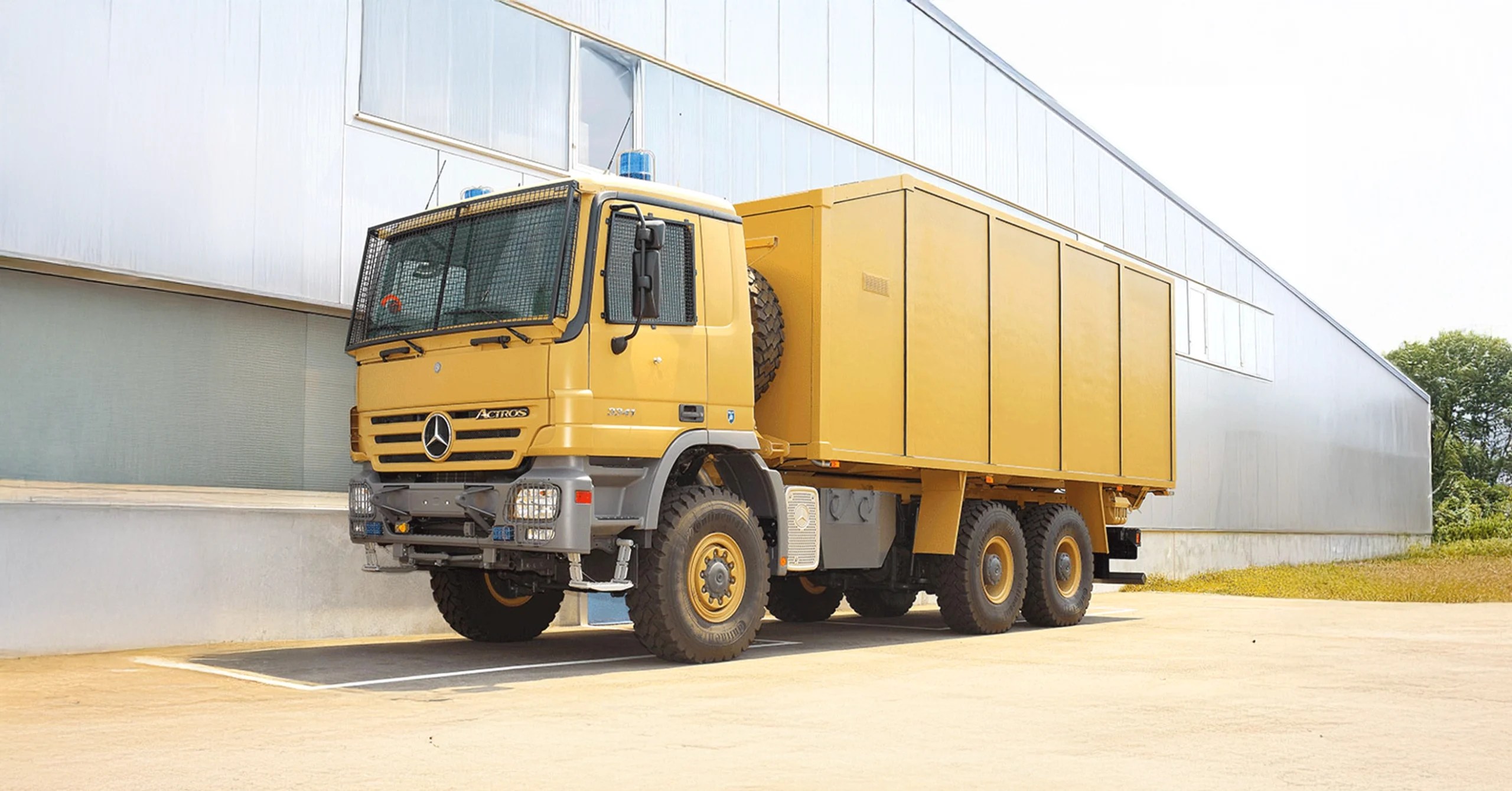
TEL650
Heavy logisticsThe TEL650 is an armor-plated vehicle designed for complex multi-robot emergency responses. It provides ample space for robots, equipment, and a control center. Safety features include bullet-proof tires, a protected engine and fuel tank. Options include an explosion-proof chamber and an airlock for hazardous material sampling.
- •Armor-plated vehicles for multi-robot emergency response
- •Ample space for robots and equipment plus control center
- •Bullet-proof tires, protected engine and fuel tank
- •Direct driver access from cab to working area
- •Optional explosion-proof chamber for explosive transport
- •Optional airlock for onboard robot sampling of hazardous substances
Detailed specs not disclosed.
Technology stackOur read
Inferred from product specs — click through to the technology wiki:
ResearchComputed
Product comparisonComputed
Each row leads with this company's product, side-by-side with similar ones · click a row to expand full specs, click again to collapse


Company announcement
News and Media
The company's official social & video channels · external links


News
From third-party news outlets (China & abroad) · external links