aidinrobotics
SnapshotCompany claim
Company description not yet disclosed.
- Founded
- Not disclosed
- HQ
- Not disclosed
- Models
- 5
- Categories
- 1
ContactCompany claim
- Address
- 5F, 12-20, Simin-daero 327beon-gil, Dongan-gu, Anyang-si, Gyeonggi-do, South Korea (14055)
Product families
Is this your company? Claim this profile to add verified data, respond to our analysis, and upgrade claims to Verified.
Claim this profile1. Executive Overview {#executive-overview}
AIDIN ROBOTICS (aidinrobotics.co.kr) is a Korean robotics component specialist with a commercially live portfolio of precision force and torque sensing hardware aimed at the collaborative and industrial robot market. The company's product line spans smart 6-axis force/torque (F/T) sensors, ultra-thin joint torque sensors, and an integrated smart gripper — a coherent set of building blocks for robot joint control, collision detection, and end-effector intelligence. Publicly listed prices ($1,300–$10,000 USD depending on product) indicate the company is actively selling, not merely prototyping, and the presence of Naver, Google, Bing, and HubSpot tracking infrastructure on their site suggests a functioning inbound-sales operation.
The company's documented public presence includes event participation — video content from what appears to be SFAW 2024 (Seoul Food & Agri-tech Week or a similarly abbreviated trade show, as referenced in site metadata) and a documentary-style ("다큐온") feature — signalling engagement with the Korean robotics industry ecosystem. The founding date and total headcount remain not yet publicly disclosed, though the site's Korean-language primary locale and .co.kr domain registration firmly place operations in South Korea.
Not yet disclosed: precise founding year, total employee count, and cumulative revenue. AIDIN ROBOTICS is invited to claim or correct any of these data points for this profile.
Latest news
- KEENON Humanoid Pours Drinks at GCS 2026, 100,000 Others Run HotelsYanko Design·2026-06-15GENERAL
2. The Company Story {#the-company-story}
AIDIN ROBOTICS operates under the legal entity name AIDIN ROBOTICS Inc. and markets its products under the brand "AIDIN ROBOTICS," with both a Korean-language primary domain (aidinrobotics.co.kr) and an English-facing domain (aidinrobotics.com) registered, indicating deliberate positioning for international reach alongside the domestic Korean market.
The company's product architecture — compact joint torque sensors designed for collaborative robots, integrated IMU functionality, and ESD-hardened designs (4 kV discharge test certification on the ATS Gen2) — reflects a focus on the precision sensing sub-segment of the cobot supply chain. This is a technically demanding niche: supplying components to robot OEMs and systems integrators requires consistent metrology performance and compatibility with the safety standards that govern collaborative robot deployments.
Milestone evidence in the public record includes participation in SFAW 2024, for which the company produced and published a sketch video (duration 1m 58s, uploaded November 2024), alongside a general company event sketch video (2m 8s) and a longer documentary-style cut (6m 43s). These materials suggest the company has moved beyond early-stage stealth and is actively building brand presence at industry events. The site's use of HubSpot CRM tracking (account ID 242527341) indicates a structured sales pipeline management approach consistent with B2B hardware sales.
Not yet disclosed: specific founding year, named investors or funding rounds, named OEM or integrator customers. AIDIN ROBOTICS is invited to claim or correct these details.
3. Product Portfolio {#product-portfolio}
Products & versions


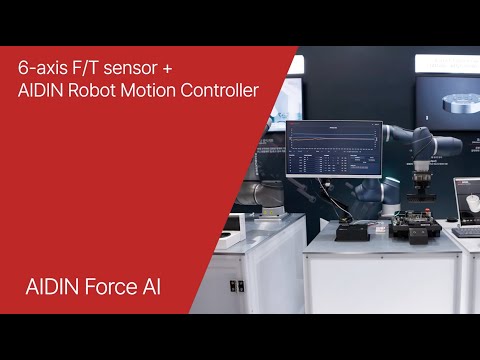
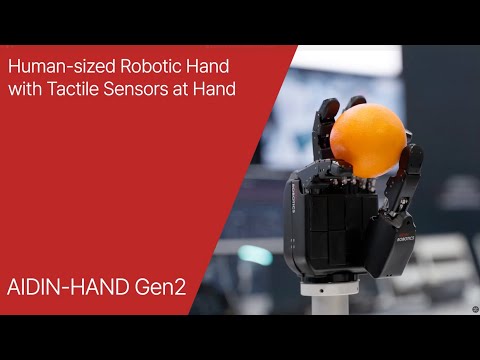
AIDIN ROBOTICS' current portfolio organises into two sensing families and one integrated end-effector product. The force/torque sensor family comprises the AFT200 Smart 6-axis Force Torque Sensor ($1,500 USD) and a Miniature 6-axis Force Torque Sensor offered at an exhibition promotion price of $3,500 USD — the latter likely targeting systems integrators evaluating the technology for assembly or inspection tasks. The joint torque sensor family is anchored by the ATS series, with the ATS Gen2 ($1,300 USD) representing the current generation flagship: an ultra-thin, all-in-one design that integrates an inertial measurement unit (IMU) and has passed 4 kV ESD discharge testing, making it suitable for the electrically noisy environments common in industrial automation cells. The elimination of a separate amplifier module ("all-in-one sensor — no additional amplifier") is a meaningful integration advantage, reducing BOM complexity for robot OEM customers.
Rounding out the lineup is the SUSGRIP-FT ($10,000 USD), a smart gripper rated at 50 N grip force, representing the company's step up the value chain from raw sensing components to a functional end-effector assembly with embedded force sensing. The price premium relative to the sensor-only products is consistent with the added mechanical and integration engineering required. Taken together, the portfolio addresses three distinct robot design pain points: joint-level torque sensing, end-effector force feedback, and multi-axis force/torque measurement at the robot's tool-centre point — a coherent and complementary set of capabilities for cobot OEMs and advanced automation integrators.
4. Technology Stack {#technology-stack}
The publicly documented product specifications provide a meaningful window into AIDIN ROBOTICS' core technical capabilities, even without access to full datasheets.
Force and torque sensing: The AFT200 and Miniature 6-axis F/T sensors measure forces and torques across all six Cartesian degrees of freedom (Fx, Fy, Fz, Mx, My, Mz). Six-axis F/T sensing at the tool-centre point is a well-established requirement for compliant assembly, surface-following, and contact-rich manipulation tasks. Our read: the two F/T products likely share underlying transducer architecture but differ in mechanical envelope, with the "miniature" variant targeting smaller robot arms (sub-10 kg payload class is common for such sensors).
Joint torque sensing: The ATS Gen2's ultra-thin form factor is technically significant — joint torque sensors must fit within the constrained cross-section of a robot joint, where axial thickness directly constrains joint design freedom. The integrated IMU adds inertial state estimation capability at the joint level, which can enhance dynamic torque compensation algorithms. The 4 kV discharge test passage is a concrete, verifiable electrostatic discharge (ESD) compliance claim relevant to CE and KC safety certification pathways. Our read: the "all-in-one" (no external amplifier) design implies on-board signal conditioning and analog-to-digital conversion, suggesting proprietary ASIC or mixed-signal PCB integration.
Smart gripper (SUSGRIP-FT): The 50 N grip force specification positions this as a light-duty precision gripper rather than a high-payload industrial gripper. The "FT" suffix implies integrated force/torque feedback, consistent with the company's core sensing competency. Our read: this is likely the AFT-class sensing technology embedded within a purpose-built gripper mechanical assembly, enabling grip-force regulation and object-contact detection without an external sensor.
Not yet disclosed: communication interfaces (EtherCAT, CANopen, RS-485, USB, etc.), accuracy/repeatability specifications (e.g., ±% full-scale), overload ratings, operating temperature ranges, or software SDKs. AIDIN ROBOTICS is invited to claim or correct these technical details.
5. Research, Papers, Authors, Labs {#research-papers}
Company-linked papers
AIDIN ROBOTICS presents as a product-commercialisation company rather than a research-publishing organisation. No academic papers, preprints, or named research lab affiliations are surfaced in the available data. This is entirely typical for hardware component vendors in the collaborative robotics supply chain, where intellectual property is more commonly protected through product design and manufacturing know-how than through open publication. If AIDIN ROBOTICS has affiliated researchers or has co-authored technical papers with university partners, that information is not yet publicly disclosed and the company is invited to claim it here.
6. Media Evidence {#media-evidence}
Media library
The available data surfaces three video assets published to the company's own website in November 2024: a general company event sketch (2m 8s), an SFAW 2024 event sketch (1m 58s), and a longer documentary-format cut labelled "다큐온" (6m 43s), suggesting a feature-length documentary appearance. Named third-party press coverage or analyst citations are not yet linked in the available data; AIDIN ROBOTICS is invited to claim or add verified media references.
7. Commercial Reality {#commercial-reality}
Customers & deployments
Revenue, customer count, and deployment figures are not disclosed in any publicly available data for AIDIN ROBOTICS. The presence of publicly listed product prices ($1,300–$10,000 USD), a HubSpot-tracked sales funnel, and a dedicated sales contact address (sales@aidinrobotics.co.kr) are consistent with active commercial operations, but no quantitative commercial metrics can be responsibly reported here. These figures are rendered as Not disclosed.
AIDIN ROBOTICS is invited to claim verified customer references, deployment counts, or revenue range data for inclusion in this profile. Any figures provided will be labelled as company-claim and sourced accordingly.
8. Markets and Use Cases {#markets-use-cases}
The product portfolio, while not tagged with explicit industry or use-case metadata in the available data, maps clearly onto several well-defined application segments based on the hardware specifications.
Collaborative robotics (cobots): The ATS Gen2 product description explicitly names "collaborative robot" as a target application. Joint torque sensing is a foundational safety-enabling technology for cobots, providing the joint-level force data needed for compliant control, power-and-force-limiting safety functions, and ISO/TS 15066-compliant human–robot collaboration. Robot OEMs building cobots — or retrofitting industrial arms with collaborative capability — are a natural customer segment.
Industrial automation and assembly: The ATS Gen2 description also names "industry application" and "automation" as use cases. Six-axis F/T sensors at the tool-centre point are widely used in precision assembly (connector insertion, screw driving, bearing press-fitting), quality inspection (surface scanning, dimensional gauging), and machine tending. The AFT200 and Miniature F/T sensor serve these tasks.
Research and advanced manipulation: The miniature 6-axis F/T sensor offered as an "exhibition promotion model" suggests awareness of the research robotics segment, where compact, affordable F/T sensors are in demand for dexterous manipulation research. The price point ($3,500 USD) is within reach of university lab procurement budgets.
Smart gripper applications: The SUSGRIP-FT's 50 N grip force and integrated force sensing make it applicable to delicate pick-and-place tasks requiring grip-force regulation — electronics assembly, food handling, and medical device manufacturing are typical domains for this class of gripper, though none are explicitly claimed in the available data.
9. Competitive Landscape {#competitive-landscape}
Competitive comparison
| Robot | Maker | Autonomy | Conf. |
|---|---|---|---|
| iRobot Roomba Combo 10 Max | iRobot | Autonomous | 0.90 |
| Mobile ALOHA (Stanford) | Stanford University | Teleoperated | 0.90 |
| 1X NEO | 1X Technologies | Remote-Assisted | 0.90 |
AIDIN ROBOTICS competes in the precision robotic sensing component market, a segment populated by both established global metrology instrument companies and specialist robotics-focused hardware startups. The market is characterised by strong performance differentiation (accuracy, overload tolerance, form factor), interface compatibility with major robot platforms, and increasingly by integrated software support. Component vendors in this space typically sell through direct channels to robot OEMs, systems integrators, and research institutions.
AIDIN ROBOTICS' differentiation, as inferable from its public product claims, centres on compact form factor (ultra-thin joint torque sensors), integration density (on-board IMU, no external amplifier), and accessible pricing relative to established sensor vendors. The SUSGRIP-FT represents a move toward higher-value integrated assemblies, a common strategic trajectory for sensing component companies seeking to increase average selling price and deepen customer relationships. The live competitor module above reflects computed peer positioning.
10. Country Advantage / Geopolitical {#geopolitical}
South Korea's manufacturing and robotics ecosystem provides a relevant structural context for AIDIN ROBOTICS. South Korea consistently ranks among the world's highest robot-density manufacturing economies (per IFR data), with major domestic conglomerates and automotive manufacturers representing a large addressable market for cobot-enabling components. The Korean government has also maintained active industrial robotics investment programmes. For a component supplier targeting cobot OEMs and automation integrators, a South Korean domestic base provides proximity to both manufacturing end-users and robot assembly operations in the region.
Not yet disclosed: whether AIDIN ROBOTICS sources manufacturing domestically, exports to specific geographies, or holds any Korean government R&D contracts. These details would materially affect the geopolitical relevance assessment and the company is invited to claim them.
11. Hype vs Real vs Ugly {#hype-real-ugly}
Claim tracker
What is documented and verifiable: AIDIN ROBOTICS offers a commercially priced product line (prices publicly listed), has a functioning web presence with sales contact infrastructure, and has documented trade show participation as of late 2024. These are real, observable facts.
Company claims requiring verification: The ATS Gen2's "4kV discharge test passed" is a specific, testable technical claim — it implies ESD compliance testing was conducted, but the testing body, standard, and certification status are not specified. The "all-in-one sensor (no additional amplifier)" claim is a meaningful product design claim whose verification would require hands-on evaluation. The SUSGRIP-FT's "50N" grip force is a stated specification; accuracy, repeatability, and operating conditions are not disclosed. All of these are labelled as company-claims pending independent verification.
Gaps (fixable, not fatal): The absence of published accuracy/repeatability specifications, communication interface details, and compatibility matrices with named robot platforms is a notable gap for B2B buyers conducting component qualification. Our read: this information likely exists internally and its public disclosure would materially strengthen buyer confidence. AIDIN ROBOTICS is invited to publish or claim these specifications.
Our read: The product concept — ultra-thin, IMU-integrated joint torque sensors at sub-$1,500 price points — is technically coherent and addresses a genuine market need. The portfolio is not hype-driven; it describes specific, bounded hardware with concrete form-factor and integration claims. The primary uncertainty is performance data, not product existence.
12. Future Scenarios {#future-scenarios}
Our read — Bull case: AIDIN ROBOTICS captures meaningful share of the Asian cobot component supply chain as collaborative robot adoption accelerates across Korean, Japanese, and Southeast Asian manufacturing. The SUSGRIP-FT positions the company to move up the value stack toward complete end-effector sub-systems; further integration of sensing and actuation could attract OEM supply agreements or strategic investment from a larger automation group. Expanded datasheet transparency and robot-platform compatibility certifications would accelerate this trajectory.
Our read — Base case: The company establishes a stable, profitable niche as a specialist supplier of precision torque and force sensing components, growing alongside the broader cobot market at a measured pace. Domestic Korean sales provide a reliable revenue base; selective international distribution partnerships expand reach without requiring large sales infrastructure investment. The product line evolves incrementally, with Gen3 sensor variants and additional gripper configurations extending the existing families.
Our read — Bear case: Intensifying price competition from lower-cost sensor manufacturers in the broader Asian market, combined with continued limited public technical documentation, slows the customer qualification process and constrains design-win momentum. Without publicly verifiable performance specifications, procurement engineers at risk-averse OEMs may default to established incumbent suppliers. The company's scale and financial position — both undisclosed — represent genuine unknowns that could limit the ability to sustain R&D investment through a prolonged sales cycle.
13. What to Watch {#what-to-watch}
- Technical datasheet publication: Release of accuracy, repeatability, overload, and interface specifications for all products — the single highest-impact action for accelerating B2B qualification.
- Robot platform compatibility announcements: Named compatibility with major cobot platforms (e.g., Universal Robots, Doosan, Rainbow Robotics, Techman) would signal OEM traction.
- ATS Gen3 or next-generation product announcements: The naming of the current product as "Gen2" implies a development roadmap; watch for successor announcements.
- Trade show presence in 2025: Participation in international robotics exhibitions (beyond domestic Korean events) would signal export market ambitions.
- Customer or integration partner references: Any named customer deployment or distributor agreement, domestic or international.
- Funding or partnership announcements: Given undisclosed financial status, any equity raise, government grant award, or strategic partnership disclosure would materially update the commercial reality assessment.
- Certification disclosures: CE, KC, or ISO 9283 compliance claims, which are prerequisites for many OEM supply relationships.
14. Sources & Methodology {#sources-methodology}
Primary data source: All factual claims in this report are grounded exclusively in structured data extracted from AIDIN ROBOTICS' own website (aidinrobotics.co.kr and aidinrobotics.com), including product listing pages, site metadata, embedded schema markup, and video asset metadata. All such claims are labelled company-claim — they represent what the company asserts about itself and have not been independently audited or verified by this report's authors.
Computed relations: Competitive peer groupings, market category classifications, and similar relational data are computed from product category tags and feature descriptions and are labelled accordingly.
Inferences: Where this report draws conclusions beyond the literal text of the source data (e.g., inferences about technical architecture or market positioning), these are explicitly labelled "Our read:" and should be understood as analyst interpretation, not established fact.
Rubric applied uniformly: This methodology — company-site extraction as primary source, explicit provenance labelling, refusal to assert unsourced negatives as fact, and invitation to claim/correct gaps — is applied identically to every company profiled in this series. No company receives a different evidential standard.
Gaps and corrections: AIDIN ROBOTICS, or any party with verified information about this company, is invited to submit corrections, additional data, or clarifications. Verified submissions will be incorporated with appropriate source labelling.

Technology stackOur read
Inferred from product specs — click through to the technology wiki:
ResearchComputed
Product comparisonComputed
Company announcement
News and Media
The company's official social & video channels · external links