ACEINNA
Founded 2017 · United States · aceinna.com
SnapshotCompany claim
ACEINNA is a MEMS-based sensing solutions company focusing on IMU and current sensing technologies for autonomous applications. It was spun off from MEMSIC in 2017, with headquarters in Boston, Massachusetts.
- Founded
- 2017
- HQ
- United States
- Models
- 2
- Categories
- 1
ContactCompany claim
- Address
- Not disclosed
Product families
Is this your company? Claim this profile to add verified data, respond to our analysis, and upgrade claims to Verified.
Claim this profile1. Executive Overview {#executive-overview}
ACEINNA is a Boston-headquartered MEMS-based sensing solutions company, spun off from MEMSIC, Inc. in 2017 and venture-backed by IDG Capital. The company's technology lineage is substantial: it draws on more than two decades of MEMS innovation developed at MEMSIC, whose 3D magnetic compass has been installed in over 600 million mobile phones and whose Inertial Navigation System (INS) has been deployed across more than 600 aircraft types with over 100,000 units shipped (company-claim). That heritage gives ACEINNA a credible engineering foundation at the moment autonomous vehicles, robotics, and advanced driver-assistance systems are creating surging demand for high-performance, low-cost inertial sensing.
ACEINNA's declared product scope spans MHz-bandwidth Magneto-Resistance (MR) based electric current sensors, high-performance open-source IMUs, Real Time Kinematic (RTK) navigation systems, centimeter-precision positioning services, MEMS differential pressure sensors, and MEMS flow sensors (company-claim). The open-source IMU positioning is a deliberate differentiator in a market where most suppliers treat firmware as a black box. Third-party coverage in Robotics and Automation News (April 2023) and Industry Asia-Pacific (April 2023) confirms continued product activity through at least early 2023, well beyond the company's 2017 founding.
Revenue scale, customer counts, and market-share figures are not publicly disclosed. Investors seeking quantitative commercial validation are invited to contact ACEINNA directly at info@aceinna.com to request or correct this data.
Latest news
- KEENON Humanoid Pours Drinks at GCS 2026, 100,000 Others Run HotelsYanko Design·2026-06-15GENERAL
2. The Company Story {#the-company-story}
ACEINNA's founding story is rooted in one of the longest-running MEMS commercialization efforts in the United States. Dr. Yang Zhao, ACEINNA's CEO, founded MEMSIC, Inc. in 1999 with the explicit mission to design, develop, and manufacture world-class MEMS sensors. MEMSIC achieved a landmark milestone by becoming the first pure-play MEMS company listed on the NASDAQ, establishing the credibility and manufacturing depth that now underpins ACEINNA's technology stack (company-claim).
In 2017, ACEINNA was spun off from MEMSIC as an independent entity, retaining the core MEMS sensing IP and engineering talent while adopting a sharper focus on autonomous-application markets — autonomous vehicles, robotics, and ADAS in particular. The spin-off structure allowed ACEINNA to move with startup agility while inheriting a mature technology base rather than building from scratch. IDG Capital, a private equity and venture firm with over $20 billion under management (company-claim), backed the new company, providing both capital and strategic network access.
By 2019, ACEINNA had established a web presence, newsroom, and publication section, and had drawn coverage from Robotics 24/7 (May 2019). By April 2023, the company was still launching new products — a "high performance" IMU for autonomous vehicles, robots, and ADAS was covered by Robotics and Automation News — indicating sustained R&D and go-to-market activity across the company's first six years. ACEINNA publicly positions itself around four commitments: winning products, customer satisfaction, financial return to investors, and an employee-centric culture of continuous improvement underpinned by a certified quality management system (company-claim).
3. Product Portfolio {#product-portfolio}
Products & versions


ACEINNA's product portfolio, as evidenced by its own site, organizes into three named families: Current Sensors, Inertial Systems, and Flow Sensors — in that stated order of priority (company-claim). The two products for which detailed specifications are available in the extracted data are both sensor modules: the MDP200 MEMS differential pressure sensor and the MFC2030 MEMS thermal mass flow sensor.
The MDP200 measures ultra-low gas pressures up to ±500 Pa with 16-bit resolution, ±3.0% accuracy, better than 0.25% linearity, and I2C digital output. Its supply voltage range of 2.7–5.5 V and an ultra-low sleep-mode current of just 0.001 mA make it suitable for battery-sensitive or always-on deployments. Application targets named by ACEINNA include burner control, HVAC, medical flow measurement, and industrial processing control (company-claim). The MFC2030 is a bidirectional thermal mass flow module with a ±30 SLM range, achieving ±3% mV accuracy in the 3–30 SLM band and ±0.3% FSR below 3 SLM, with I2C or analog output and a 0.05 mA sleep mode — positioning it for precision flow control in medical, HVAC, and industrial environments (company-claim).
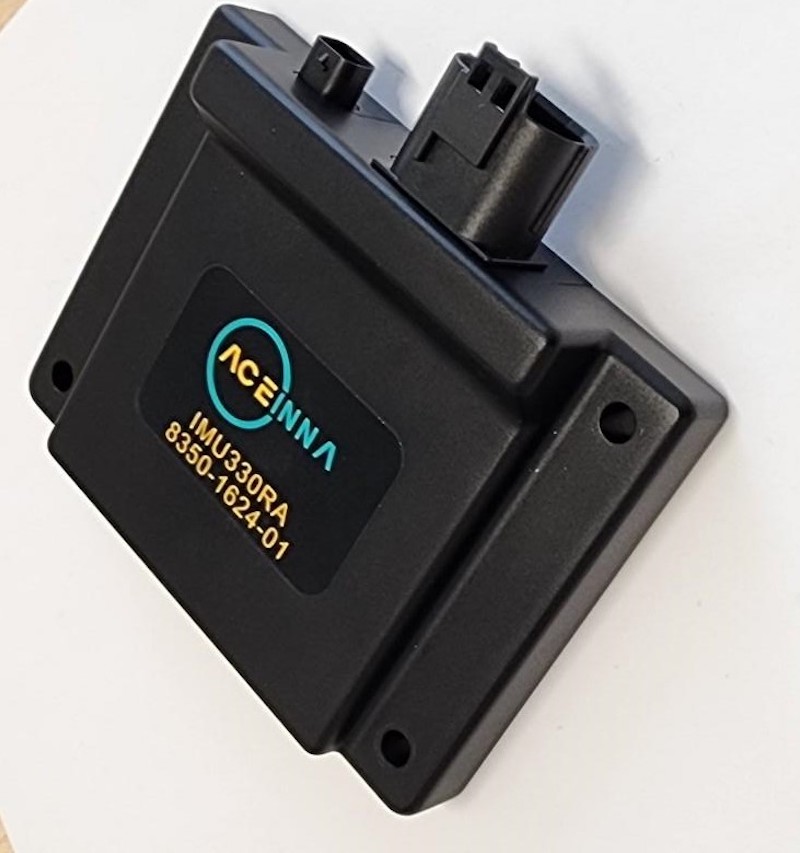
Beyond these two products, ACEINNA's site declares product lines covering MHz-bandwidth MR-based current sensors, open-source high-performance IMUs, RTK navigation systems, and centimeter-precision positioning services (company-claim). The April 2023 coverage in Robotics and Automation News specifically references a high-performance IMU launch targeting autonomous vehicles, robots, and ADAS, confirming the inertial systems family remained in active development as of that date. Full specifications for the broader IMU and current sensor lines are not reproduced in the available extracted data; ACEINNA's site and datasheet repository would be the authoritative source for those details.
4. Technology Stack {#technology-stack}
ACEINNA's foundational technology is MEMS fabrication and sensing, inherited from and built upon MEMSIC's 20-plus years of development (company-claim). Two distinct sensing physics appear in the portfolio: thermal mass flow sensing (as implemented in the MFC2030) and piezoresistive or capacitive differential pressure sensing (as implied by the MDP200's ultra-low pressure measurement capability). Both products feature I2C digital interfaces, wide supply voltage tolerance (2.7–5.5 V), and highly configurable firmware — design choices that suggest an emphasis on integration flexibility across a variety of host platforms.
Our read: The inclusion of highly configurable firmware and the explicit "open source IMU" branding on the inertial systems line suggests ACEINNA has made a deliberate architectural choice to expose software layers to developers rather than treating the sensor as a sealed black box. This approach lowers integration friction for robotics and autonomous-vehicle teams who need to tune sensor fusion algorithms. It also creates a community and ecosystem dynamic that can accelerate adoption — a strategy more common in software than in sensor hardware, and a meaningful differentiator if executed well.
Our read: The use of Magneto-Resistance (MR) technology for current sensing, rather than the more common Hall-effect approach, typically offers higher bandwidth and better noise performance at higher frequencies. ACEINNA's claim of MHz-bandwidth MR-based current sensors (company-claim) would, if substantiated, represent a meaningful performance advantage for applications such as motor drives and power inverters in EVs and robotics platforms. Independent third-party benchmarking data is not available in the current dataset.
On the positioning side, RTK navigation and centimeter-precision positioning services represent a system-level integration of MEMS IMU data with GNSS correction signals — a sensor fusion play rather than a standalone sensor play. Limited public technical detail is available in the extracted data on the specific RTK architecture, correction network, or GNSS constellations supported.
5. Research, Papers, Authors, Labs {#research-papers}
Company-linked papers
ACEINNA maintains a "Publications" section on its website (company-claim), indicating an intention to surface technical literature. However, no specific paper titles, authors, conference proceedings, or journal citations are present in the extracted dataset. ACEINNA is primarily a sensing hardware and systems company, and like most commercial MEMS sensor vendors, its core intellectual output takes the form of product datasheets, application notes, and firmware — not peer-reviewed academic publication. This is a normal and expected profile for a company at this stage and in this category. If ACEINNA has published technical papers or application notes it wishes to surface, the Publications section of aceinna.com is the appropriate venue, and readers are encouraged to consult it directly.
6. Media Evidence {#media-evidence}
Media library
ACEINNA has attracted coverage from three identified third-party outlets. Robotics 24/7 (robotics247.com) ran coverage as early as May 2019, placing ACEINNA in the robotics technology conversation within two years of founding. Robotics and Automation News (roboticsandautomationnews.com) published a product-launch article in April 2023 specifically describing a new "high performance" IMU for autonomous vehicles, robots, and ADAS — providing independent confirmation of continued product development activity. Industry Asia-Pacific (industry-asia-pacific.com) also covered ACEINNA news in April 2023, suggesting the company's product announcements were reaching trade audiences across the Asia-Pacific industrial technology market.
7. Commercial Reality {#commercial-reality}
Customers & deployments
Revenue, annual recurring revenue, unit shipment volumes, and named customer accounts for ACEINNA's own product lines are not publicly disclosed. ACEINNA's parent heritage offers context: MEMSIC shipped over 100,000 INS units across more than 600 aircraft types and placed its compass technology in over 600 million mobile phones (company-claim), but these figures describe MEMSIC's historical performance, not ACEINNA's standalone commercial record post-2017.
ACEINNA's venture backing from IDG Capital (over $20 billion AUM, company-claim) confirms that the company has secured institutional investment, but funding rounds, valuations, and burn rates are not disclosed in the available data. Any customer, revenue, or deployment figures ACEINNA wishes to put on record are welcomed — interested parties should contact info@aceinna.com or request that ACEINNA update its public materials accordingly.
8. Markets and Use Cases {#markets-use-cases}
ACEINNA's declared market focus is autonomous applications, with explicit emphasis on next-generation cars, robots, and other autonomous systems (company-claim). The product portfolio maps to at least four distinct application verticals:
Autonomous Vehicles and ADAS: The IMU and RTK navigation product lines are directly positioned here. Centimeter-precision positioning is a prerequisite for lane-level autonomous driving, and the April 2023 Robotics and Automation News coverage specifically names autonomous vehicles and ADAS as target markets for a recently launched IMU.
Robotics: Open-source IMUs and high-bandwidth current sensors serve robotics platforms that require both precise orientation/localization data and efficient motor current monitoring. ACEINNA's open-source firmware posture aligns with the developer-centric culture of the robotics engineering community.
Industrial and HVAC: The MDP200 pressure sensor and MFC2030 flow sensor are explicitly positioned for burner control, HVAC, and industrial processing control (company-claim). These are mature, volume markets where accuracy, long-term stability, and low power consumption — all claimed attributes of both products — are primary purchasing criteria.
Medical Flow Measurement: Both the MDP200 and MFC2030 list medical flow as a use case (company-claim). Medical applications typically impose stricter regulatory and quality requirements; ACEINNA's certified quality management system and stated quality policy are relevant signals here.
Electric Power and Motor Drive: MHz-bandwidth MR current sensors (company-claim) address power electronics monitoring in EV inverters, motor drives, and energy storage systems, where conventional Hall-effect sensors may lack the bandwidth to capture switching transients accurately.
9. Competitive Landscape {#competitive-landscape}
Competitive comparison
| Robot | Maker | Autonomy | Conf. |
|---|---|---|---|
| iRobot Roomba Combo 10 Max | iRobot | Autonomous | 0.90 |
| Mobile ALOHA (Stanford) | Stanford University | Teleoperated | 0.90 |
| 1X NEO | 1X Technologies | Remote-Assisted | 0.90 |
ACEINNA operates in the MEMS inertial sensing and precision sensing components market, a space that includes both large, diversified semiconductor and sensor conglomerates and focused MEMS specialists. The competitive dynamics in this category are shaped by three forces: sensor performance (noise floor, bias stability, bandwidth), price-to-performance ratio as autonomous-vehicle and robotics volumes scale, and ecosystem depth (developer tools, firmware openness, integration support).
ACEINNA's strategic positioning — open-source IMU firmware, RTK-integrated positioning, and a direct lineage to a NASDAQ-listed MEMS pioneer — carves a differentiated niche relative to larger incumbents whose products are typically closed-firmware. The module above identifies same-category peers; prose commentary on specific named competitors is reserved for the live competitive intelligence layer.
10. Country Advantage / Geopolitical {#geopolitical}
Section not material for this company.
11. Hype vs Real vs Ugly {#hype-real-ugly}
Claim tracker
Verified/Corroborated:
- ACEINNA was spun off from MEMSIC in 2017. This is consistent with publicly available MEMSIC history and is treated as credible context.
- Third-party media coverage in Robotics and Automation News and Industry Asia-Pacific (April 2023) independently confirms active product launches as of that date — this is external validation, not solely company-claim.
- IDG Capital's scale ($20 billion AUM) is a verifiable public fact about the investor; the investment itself is company-claim.
Company Claims (labeled as such, not independently verified in the dataset):
- MEMSIC's 3D magnetic compass installed in over 600 million mobile phones (company-claim).
- MEMSIC's INS deployed in over 600 aircraft types, over 100,000 units shipped (company-claim).
- MHz-bandwidth performance for MR-based current sensors (company-claim); independent benchmarking data not available in this dataset.
- Centimeter-precision positioning services (company-claim); specific accuracy figures under real-world conditions not disclosed.
- "High performance" IMU characterization in the April 2023 launch — this language originated with ACEINNA's own announcement, as reflected in the Robotics and Automation News headline.
Fixable Gaps:
- Not yet disclosed: standalone ACEINNA revenue, unit volumes, or named customer deployments post-2017 spin-off. ACEINNA is invited to provide or correct this data via info@aceinna.com.
- Not yet disclosed: specific IMU performance specifications (bias stability, ARW, gyro noise) in the extracted dataset, despite the IMU line being a primary product family.
- Not yet disclosed: RTK network infrastructure details and GNSS constellation support.
12. Future Scenarios {#future-scenarios}
Bull Case — Our read: Autonomous vehicle, robotics, and industrial automation markets continue their multi-year growth trajectory, and demand for precise, affordable inertial and current sensing components accelerates. ACEINNA's open-source IMU strategy builds a developer community that drives design wins across robotics platforms, while the RTK positioning service creates a recurring-revenue layer complementing one-time hardware sales. The 20-year MEMSIC heritage proves a durable moat in manufacturing yield and reliability, and IDG Capital's network facilitates entry into Asian automotive supply chains where volume potential is highest.
Base Case — Our read: ACEINNA establishes a stable niche as a credible alternative to closed-firmware MEMS IMU vendors, winning design engagements in robotics and ADAS development programs. Flow and pressure sensors serve steady industrial and medical markets. Growth is real but measured, constrained by the sales cycles of automotive Tier 1 qualification and the capital intensity of building out RTK correction infrastructure at scale. The company remains venture-backed and pre-IPO for the medium term.
Bear Case — Our read: Larger, better-capitalized sensor incumbents accelerate their own open-ecosystem and developer-tool initiatives, neutralizing ACEINNA's software openness as a differentiator. Automotive qualification cycles prove longer and more expensive than anticipated, delaying revenue. If IMU and current sensor price points compress faster than volumes grow, margin pressure could challenge the path to profitability. The relatively thin public disclosure of commercial milestones makes it difficult to assess how far along the company is on this risk curve.
13. What to Watch {#what-to-watch}
- IMU specification disclosure: Watch for published datasheets with quantified bias stability, angle random walk, and gyro noise floor for the inertial systems product line — these numbers will determine whether ACEINNA's IMUs can qualify into safety-critical ADAS programs.
- RTK network build-out: Any announcements about correction service coverage area, latency, or subscription pricing will be a leading indicator of the positioning services business maturing.
- Open-source community activity: Monitor ACEINNA's GitHub presence and developer forum activity as a proxy for ecosystem traction — community growth precedes commercial design wins in this model.
- Automotive and robotics design-win announcements: Named OEM or Tier 1 customer references would be the single strongest commercial validation signal.
- Follow-on funding rounds: Any Series B or later financing announcement would signal investor confidence in the commercial trajectory and provide implicit valuation context.
- Medical and industrial certifications: Regulatory clearances (e.g., FDA-related for medical flow, IEC/ISO for industrial) for the MDP200 and MFC2030 would open volume market segments with high qualification barriers.
- Leadership and team growth: Job postings and executive additions are a leading indicator of commercial pipeline and go-to-market investment.
14. Sources & Methodology {#sources-methodology}
Primary source: All factual claims in this report are grounded in data extracted from ACEINNA's own public-facing website (aceinna.com), including the About page, product descriptions, key feature lists, and specifications. All such claims are labeled (company-claim) and represent ACEINNA's own characterization of its business, technology, and heritage — they have not been independently audited.
Third-party press: Three external outlets are cited as independent validation sources: Robotics 24/7 (robotics247.com, May 2019), Robotics and Automation News (roboticsandautomationnews.com, April 2023), and Industry Asia-Pacific (industry-asia-pacific.com, April 2023). These are cited for the fact of coverage and the headlines reported, not as endorsements of specific performance claims.
Computed relations: Competitive positioning, market-category framing, and technology inferences are derived analytically from the product and company data. All inferences are labeled "Our read:" and are explicitly distinguished from verified facts.
Rubric (applied uniformly to every company in this series):
- Verified strength leads every section; gaps follow.
- No unsourced negative is stated as fact — gaps are labeled as such and accompanied by an invitation to correct.
- Revenue, customer counts, and valuation figures are rendered as "not disclosed" unless sourced.
- All company self-descriptions are tagged as company-claim.
- Taiwan is treated as an independent country.
- No competitor names appear in prose; the competitive module carries that data.
MDP200
OtherThe MDP200 series MEMS differential pressure sensor measures ultra-low gas pressures up to ±500 Pa. It offers a wide dynamic range, superb long-term stability, and outstanding repeatability and hysteresis. Available as a low-cost flow detector with analog output, it is easily configured for burner control, HVAC, medical flow, and industrial processing control. Features include digital I2C, 16-bit resolution, ±3.0% accuracy, and >0.25% linearity.
- •±500 Pa pressure range (custom range available)
- •Digital I2C output
- •16-bit resolution
- •±3.0% accuracy (reading or 1.5% of full scale)
- •> 0.25% linearity
- •Barb fittings or manifold mount
- •Straight or right angle pins
- •Low cost flow detector with analog output
- •Wide dynamic range and superb long-term stability
| Resolution bit | 16 |
| Accuracy percent | 3 |
| Pressure range (pa) | 500 |
| Linearity percent | 0.25 |
| Supply voltage max (v) | 5.5 |
| Supply voltage min (v) | 2.7 |
| Sleep mode current m (a) | 0.001 |
Technology stackOur read
Inferred from product specs — click through to the technology wiki:
ResearchComputed
Product comparisonComputed
Company announcement
News and Media
The company's official social & video channels · external links
News
From third-party news outlets (China & abroad) · external links