Xixiang Technology
US$0.99 unlocks one Word + one PDF download. The full report is free to read on this page.
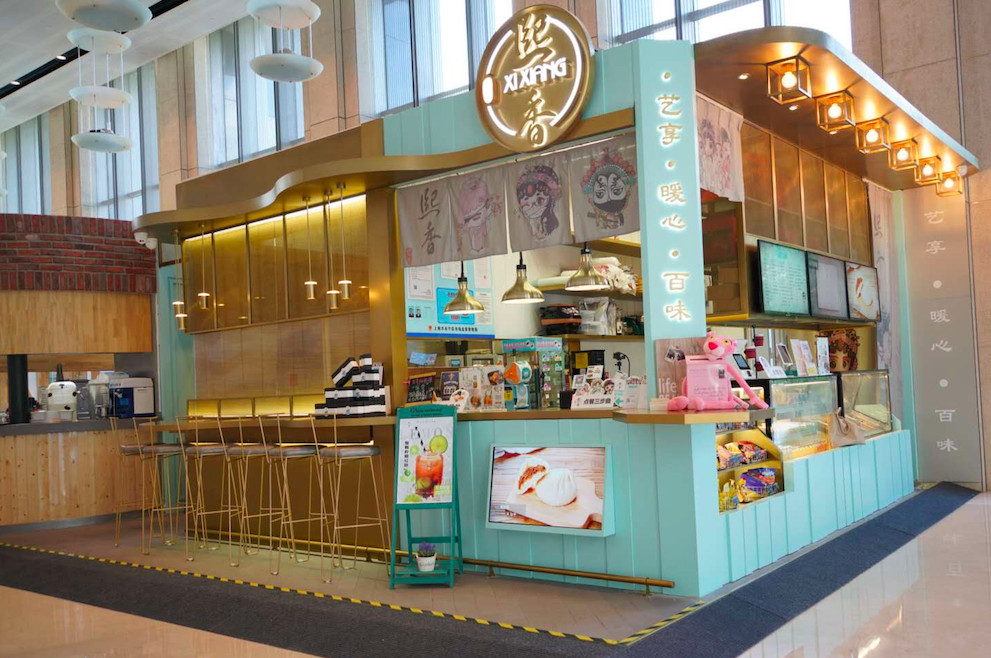
Xixiang Technology: A Name in Search of a Company
An evidence-led audit of a fragmented dossier, in which the most important finding is that "Xixiang Technology" does not yet resolve to a single verifiable entity, let alone a single verifiable robot.
| Report status | Coverage date | Company stage | Editorial standard |
|---|---|---|---|
| Preliminary deep report; identity unresolved, autonomy unverified | Evidence gathered 18 September 2026 | Indeterminate: funding-stage entities and event sponsorship only; no confirmed shipping product for any single "Xixiang Technology" | Max Robotics premium editorial: verified facts separated from company claims, editorial inference and unknowns; no demo treated as proof |
How to Read This Report
This report was commissioned on the premise that "Xixiang Technology" is a robotics company deserving of a premium deep-dive. The research dossier supplied for that purpose does not support the premise. It contains no official company documentation, no product datasheets, no regulatory filings, no named-customer confirmations and no first-hand user reports. What it does contain is a cluster of similarly named but distinct entities, a set of funding announcements, an event sponsorship, a body of academic robotics papers from unrelated university labs, and a tail of consumer-electronics teardown videos that share nothing with the subject except a phonetic resemblance in transliteration.
The honest editorial response is not to synthesise a company from these fragments. It is to state plainly what is known, what is claimed, what can be reasonably inferred, and what remains unknown, and to resist the temptation to fill the gaps with narrative. Where the dossier is thin, this report says so. Where a claim originates solely from a vendor or a funding press release, it is labelled as such and not treated as established fact. Where a demo video exists but does not demonstrate autonomous task completion, it is not counted as evidence of autonomy.
The evidence labels used throughout are as follows.
| Label | Definition | Treatment in this report |
|---|---|---|
| VERIFIED FACT | Regulatory filings, official product documentation, named-customer confirmation, peer-reviewed or primary research, or a fact corroborated by multiple independent sources | May be relied upon; cited inline |
| COMPANY CLAIM | A statement made by the company or its funders, not independently verified | Reported as a claim, never as fact; flagged in the claim tracker |
| EDITORIAL INFERENCE | A reasoned conclusion drawn from public evidence, explicitly labelled as such | Offered as analysis, not as fact |
| UNKNOWN | Not publicly disclosed, or disclosed only in terms that cannot be checked | Stated as unknown; no speculation substituted |
Two further disciplines apply throughout. First, a choreographed demonstration video is not proof of autonomous work; it is proof that a video was produced. Second, a funding announcement is not proof of a paid customer, and a partnership announcement is not proof of revenue. Both distinctions matter acutely in the Chinese robotics and "physical AI" sector, where capital announcements are frequent, productisation is uneven, and the gap between a press release and a shipping, revenue-generating system can be years wide or permanent.
A note on the central problem. The dossier's own reconciliation concludes that the facts "do not describe a single coherent system called 'Xixiang Technology'" and that the entity is ambiguous, conflating at least five distinct things: an unmanned restaurant and bento-delivery platform trading as "Xi Xiang"; a robotic joint-module and axial-flux-motor manufacturer, Shenzhen Xiaoxiang Electric; a GPU developer, Xiangdixian Computing Technology; an AI model company, ZhiXiang Future; and a body of academic robotics research from Xi'an Jiaotong University, Peng Cheng Laboratory, SUSTech, HKU and LimX Dynamics. The overall confidence assigned to the reconciled picture is 0.25, and the autonomy verdict is "unknown" at confidence 0.2. This report takes those conclusions as its starting point rather than its conclusion, and tests them section by section.
01Executive Overview
The single most defensible statement about Xixiang Technology is that the name, as it appears in the public record, does not yet denote one company. It denotes a collision of transliterations. The dossier resolves the name to a company-level entity only because "Xixiang Technology" appears as title sponsor of the 10th Global ICT Industry Summit in Hangzhou on 12 September 2026 10, an event whose co-organisers include Yuanqiao Asset, Iluvatar Corex, 51Vision, Jack Technology, Innuovo and Agile Robotics. That sponsorship is the closest thing in the dossier to a self-identifying act by an entity called Xixiang Technology. It is an event-marketing fact, not a corporate fact. It tells us a name was on a banner. It does not tell us what the company makes, sells, ships or earns.
Beneath that banner, the dossier contains at least four commercially distinct entities whose names collapse into "Xixiang" or "Xiang" in Latin transliteration. Xi Xiang is an unmanned-kitchen and bento-delivery business that raised a 120 million RMB Series B, with earlier angel funding from Newson Venture Capital and a Series A from Jinkong Investment Management 2. Shenzhen Xiaoxiang Electric is a maker of robotic joint modules and axial-flux motors that raised more than 100 million yuan led by Hengxu Capital, with Nanjing Venture Capital and the New Fourth Army Foundation participating, and which claims an automated production line targeting more than 150,000 units per year by 2026 9. Xiangdixian Computing Technology is a Chinese GPU developer with a "Shennong" architecture that raised a $200 million Series B and targets mass production and a listing in 2026 12. ZhiXiang Future is a large-model company that raised a 1.5 billion yuan Series C led by the Social Security Fund Sichuan Revitalization Technology Innovation Fund, with ICBC Capital, Hongyi Asset Management and Dunhong Capital, and which launched a 200-billion-parameter native multimodal model, HiDream-O1-Image-Pro 1113. None of these is demonstrably the same company as any other, and none is demonstrably the entity that sponsored the Hangzhou summit.
The only autonomy-relevant evidence in the entire dossier concerns Xi Xiang's unmanned kitchen. The company is described as operating a "standardised unmanned cooking system taking up more than 80% of the production process", with programmed cook times of three to five minutes per dish, roughly ten times the labour productivity of a traditional restaurant, in stores of about 80 square metres near office buildings, selling at 25 to 68 yuan per item, with both in-store purchase and delivery 2. Every element of that description is vendor- or commerce-sourced. No independent review, teardown or first-hand user report in the dossier confirms that the kitchen operates without human labour, and the phrase "more than 80% of the production process" is itself an admission that some fraction is not unmanned. Under this publication's definitions, "autonomous" requires independent completion of the task with no human performing or remotely driving it. That evidence is absent. The autonomy verdict is therefore unknown, and the confidence attached to it is low.
The academic robotics material in the dossier is real and of reasonable quality, but it belongs to other institutions. OASIS, a method for observation-action space alignment via SE(3) trajectory prediction for robotic manipulation, is published on arXiv with affiliations including Xi'an Jiaotong University, Peng Cheng Laboratory, SUSTech, HKU and LimX Dynamics 18. SSI-Policy, on structured scene interfaces for vision-language robotic manipulation, and CrossInstruct, on cross-modal instructions for robot motion generation, come from the same broad research cluster 1920. Triplet2Track, a hierarchical system with object-centric representations for long-horizon manipulation, is likewise academic 21. These papers are credible primary research. They are not evidence about Xixiang Technology, and any report that presents them as the company's R&D output would be committing a category error.
The consumer-electronics videos in the dossier, including teardowns of a TSC-X controller, a RedMagic phone, an ONEXGPU eGPU enclosure, a Xiaomi chip review, an iPhone case and a Siglent signal generator 222324252627, have no discernible connection to any robotics entity under discussion. Their presence in the dossier is itself a finding: it indicates that the name-matching process that assembled this material was lexical rather than semantic, and that the resulting corpus should be treated with corresponding caution.
Editorial inference. The most likely reading of the evidence is that "Xixiang Technology" is either (a) a holding or brand name under which one or more of these entities operates in certain contexts, (b) an event-sponsorship identity with no distinct operating substance, or (c) an artefact of transliteration conflation in the source material. The dossier cannot distinguish between these. Until it can, any assessment of Xixiang Technology as a robotics company is premature. The correct posture for an investor, partner or competitor is watchful suspension of judgement, not a view.
Latest news
02The Xixiang Technology Story
There is no company history here to tell, and the intellectually honest way to write this section is to explain why. A conventional "story" section would trace founding, pivots, product launches and growth. The dossier contains none of those things for a single entity. It contains funding events, an event sponsorship, and a set of name collisions. What follows is therefore a reconstruction of the fragments and an explicit account of where the narrative breaks.
The name "Xixiang" is a Chinese place name and a common transliteration. Shenzhen has an Xixiang subdistrict, referenced in the dossier only in the context of a flight-simulator scenery comparison for X-Plane 29 and a Reddit thread about living in Shenzhen's technology districts 30. A separate Reddit thread concerns a mailing address in China 31, and another concerns an Amazon seller's business name 28. None of these is about a robotics company. They are in the dossier because they contain the string "Xixiang". This is worth stating explicitly because it establishes the quality of the underlying corpus: the dossier's community layer is noise, not signal, and any analyst who treated it as evidence of consumer sentiment toward Xixiang Technology would be badly misled.
The commercial layer is more substantive but still fragmented. Xi Xiang, the unmanned-kitchen business, has the clearest funding narrative: an angel round from Newson Venture Capital, a Series A from Jinkong Investment Management, and a 120 million RMB Series B with Silicon Paradise and CCI Investment 2. The business model described is a small-format restaurant of roughly 80 square metres, sited near office buildings, selling cooked dishes at 25 to 68 yuan, with both walk-in purchase and delivery, and a bento-delivery platform alongside the physical stores 2. The claimed cook time is three to five minutes per dish, and the claimed labour productivity is about ten times that of a traditional restaurant 2. These are the numbers a franchise or unit-economics story would be built on. They are also entirely company-sourced.
Shenzhen Xiaoxiang Electric has a different story: a component supplier to the robotics industry, making joint modules and axial-flux motors, which raised more than 100 million yuan in a round led by Hengxu Capital with Nanjing Venture Capital and the New Fourth Army Foundation 9. The stated use of funds is iteration on robotic joint modules and expansion of axial-flux motor production capacity, with an automated line targeting more than 150,000 units per year by 2026 9. If accurate, this is a meaningful capacity figure for a component maker, and axial-flux motors are a genuinely interesting technology for legged and humanoid platforms because of their torque density. But the figure is a target, not an output, and the dossier contains no customer names, no design wins and no shipment data.
Xiangdixian Computing Technology is a GPU developer with a "Shennong" architecture, which raised a $200 million Series B and targets mass production and a listing in 2026 12. This is a semiconductor story, not a robotics story, though GPUs matter to robotics as training and inference substrate. ZhiXiang Future is a large-model company with a 1.5 billion yuan Series C and a 200-billion-parameter multimodal model called HiDream-O1-Image-Pro 1113. This is a foundation-model story, again adjacent to robotics rather than part of it. The dossier also notes, in a general context piece, that China's leadership has launched an AI alliance and called for a new technology financing system 1416, and that chipmaker CXMT's debut highlights China's state-funded path to tech power 17. These are macroeconomic backdrop, not company facts.
The Hangzhou summit is the one place where the name "Xixiang Technology" appears in a self-identifying role. The 10th Global ICT Industry Summit, held on 12 September 2026, was reviewed by 36Kr under the framing "Computing Power, Robotics, Simulation & Capital: Who Is Shaping the Next Decade of Physical AI?" 10. Xixiang Technology is listed as title sponsor, with co-organisers including Yuanqiao Asset, Iluvatar Corex, 51Vision, Jack Technology, Innuovo and Agile Robotics 10. A title sponsorship of a physical-AI summit is a positioning statement. It says the sponsor wishes to be associated with computing power, robotics, simulation and capital. It does not say the sponsor has a product in any of those categories.
Editorial inference. The pattern across these fragments is consistent with a sector in which capital and branding move faster than productisation. Multiple entities with similar names are raising money, attending the same events, and positioning around the same themes, while the dossier contains no evidence of a shipping, revenue-generating robotics product from any of them. The "story" of Xixiang Technology, on this evidence, is not yet a story. It is a set of announcements awaiting a company.
Unknown. Founding date, founding team, registered entity name, corporate structure, relationship between the Hangzhou sponsor and any of the funded entities, and whether "Xixiang Technology" is a brand, a holding vehicle or a translation artefact. None of this is publicly disclosed in the dossier.
03Product Portfolio: What Xixiang Technology Actually Sells
The question in the heading cannot be answered for Xixiang Technology as a single entity, because the dossier does not establish that a single entity exists. It can be answered, partially and with caveats, for the distinct businesses whose names collide. This section sets out what each is claimed to sell, and marks the evidentiary basis for each.
Xi Xiang: unmanned kitchen and bento delivery. The product is a small-format restaurant, roughly 80 square metres, positioned near office buildings, offering cooked dishes at 25 to 68 yuan with both in-store purchase and delivery, supported by a bento-delivery platform 2. The kitchen is described as a "standardised unmanned cooking system taking up more than 80% of the production process", with programmed cook times of three to five minutes and roughly ten times the labour productivity of a traditional restaurant 2. The dossier also references, in a general food-industry context, "the world's first AI fully automatic restaurant" about to open 6 and a Singapore-listed restaurant group developing AI-driven kitchen solutions 7. Those two items are not about Xi Xiang; they indicate that the "AI restaurant" category is crowded and that claims of full automation are common in it.
The critical reading of the Xi Xiang claim is arithmetic. "More than 80% of the production process" is not full automation. It leaves up to 20% of the process to humans, and the dossier does not say which 20%. In commercial food service, the residual human tasks are typically the ones that are hardest to automate: loading raw ingredients, handling irregular items, cleaning, exception recovery, and final assembly or plating. A system that automates 80% of steps by count may automate far less than 80% of labour hours, or far more, depending on which steps are counted. The claim is therefore not just unverified; it is under-specified to the point of being unfalsifiable as stated. No independent review, teardown or first-hand user report in the dossier tests it.
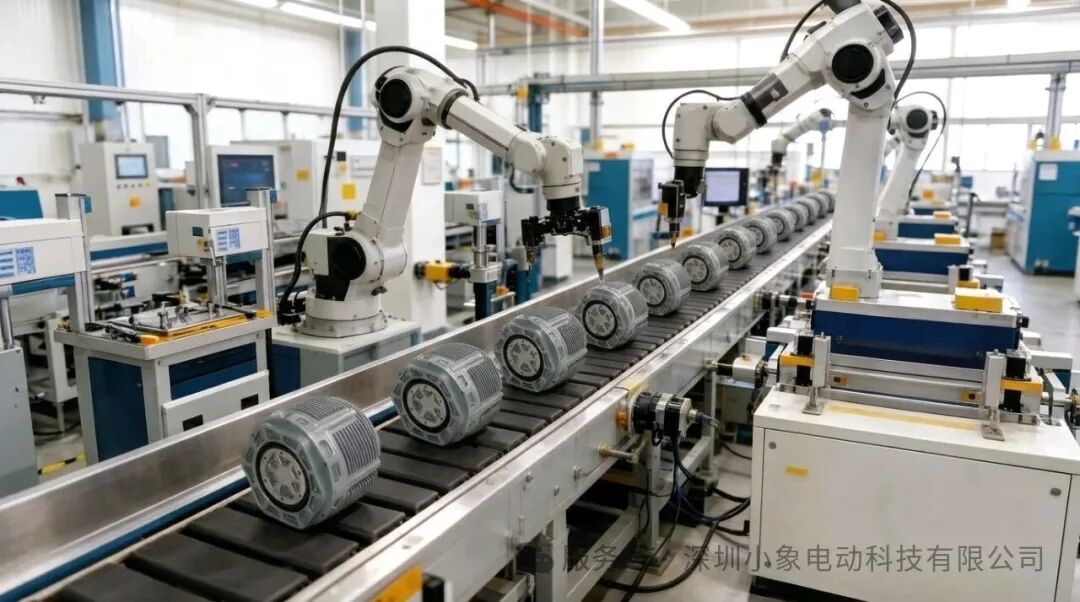
Shenzhen Xiaoxiang Electric: joint modules and axial-flux motors. The product is robotic joint modules and axial-flux motors, with a stated focus on iterating joint modules and expanding axial-flux motor production capacity 9. The claimed automated production line targets more than 150,000 units per year by 2026 9. Axial-flux motors are a legitimate and technically interesting category: they offer high torque density in a compact axial form factor, which is attractive for legged and humanoid joints where mass and volume are at a premium. A component supplier with genuine capacity in this category would be a meaningful node in the humanoid supply chain. But the dossier contains no product datasheet, no torque or efficiency specifications, no customer list and no evidence that the 150,000-unit line exists rather than is planned. The figure is a target for 2026, stated in a funding announcement, which is precisely the context in which targets are most optimistic.
Xiangdixian Computing Technology: GPUs. The product is a GPU built on a "Shennong" architecture, with mass production and a listing targeted for 2026 12. This is a semiconductor product, not a robot. Its relevance to robotics is indirect: training and inference compute. The dossier provides no performance figures, no benchmark results, no process node, no customer names and no evidence of tape-out. A $200 million Series B for a Chinese GPU developer is consistent with the broader pattern of state-supported semiconductor investment noted in the dossier's coverage of CXMT 17, but capital raised is not silicon shipped.
ZhiXiang Future: multimodal foundation models. The product is HiDream-O1-Image-Pro, described as a 200-billion-parameter native multimodal model 13. Again, this is not a robot. Its relevance to robotics is as a potential perception or reasoning substrate, but the dossier contains no evidence of robotics deployment, no robot integration, and no embodiment work. A 200-billion-parameter model is a large model; whether it is a good model, and whether it is competitive with peers, cannot be assessed from the dossier, which contains no benchmarks.
The academic work. OASIS, SSI-Policy, CrossInstruct and Triplet2Track are research contributions, not products 18192021. They are discussed in §5.
The table below summarises the portfolio as claimed, with the evidentiary basis for each element.
| Entity | Claimed product | Key claimed metric | Evidence basis | Independent verification |
|---|---|---|---|---|
| Xi Xiang | Unmanned kitchen; bento delivery; ~80 sqm stores | >80% of production process unmanned; 3–5 min per dish; ~10x labour productivity; 25–68 yuan price | Funding coverage 2 | None in dossier |
| Shenzhen Xiaoxiang Electric | Robotic joint modules; axial-flux motors | >150,000 units/year automated line targeted by 2026 | Funding coverage 9 | None in dossier |
| Xiangdixian Computing | GPU on "Shennong" architecture | $200M Series B; mass production and listing targeted 2026 | Funding coverage 12 | None in dossier |
| ZhiXiang Future | HiDream-O1-Image-Pro multimodal model | 200B+ parameters | News coverage 1113 | None in dossier |
| Academic cluster (XJTU, Peng Cheng, SUSTech, HKU, LimX) | Research methods (OASIS, SSI-Policy, CrossInstruct, Triplet2Track) | Peer-reviewed/arXiv publication | Primary research 18192021 | Academic peer review where applicable |
Editorial inference. If a reader came to this report expecting a humanoid robot company, the portfolio above will disappoint. The closest thing to a robot-adjacent hardware product is Shenzhen Xiaoxiang Electric's joint modules and axial-flux motors, which are components rather than systems. The closest thing to an autonomous system is Xi Xiang's kitchen, which is a food-service automation play rather than a robot in the conventional sense. The GPU and foundation-model entities are adjacent infrastructure. None of these is a robot company in the sense that Unitree, LimX or Agile Robots are, and the dossier provides no basis for treating them as one.
Products & versions



04Technology Stack: Strengths and the Work That Remains
Because the entity is unresolved, this section assesses the technology stack of each candidate separately, and is explicit that no single stack can be attributed to "Xixiang Technology".
Food-service automation (Xi Xiang). The technical problem in an unmanned kitchen is not cooking; it is handling. Cooking a dish to a programmed time and temperature is a control problem that has been solved in commercial appliances for decades. The hard parts are ingredient loading, portioning of irregular items, transfer between stations, cleaning, and recovery from the inevitable exceptions. The dossier's description of Xi Xiang's system as covering "more than 80% of the production process" with programmed three-to-five-minute cook times 2 is consistent with a system that has automated the cooking and some transfer steps while retaining human labour for preparation, loading and cleaning. That is a legitimate and potentially valuable engineering achievement. It is not full autonomy, and the dossier does not claim it is. The strength, if the claims hold, is standardisation: a fixed menu, fixed portion sizes and fixed cook times allow a high degree of process automation. The remaining work is precisely the unstructured manipulation that is hardest to automate, which is why the residual 20% is likely to be stubborn.
Joint modules and axial-flux motors (Shenzhen Xiaoxiang Electric). Axial-flux motors are a genuine technical strength area. Compared with conventional radial-flux motors, axial-flux designs can achieve higher torque density and a flatter form factor, which suits integrated joint modules for legged and humanoid robots. The engineering challenges are thermal management, manufacturing tolerances for the stator and rotor discs, and cost at volume. The dossier's claim of an automated line targeting more than 150,000 units per year by 2026 9 speaks to the volume question, but only as a target. The work that remains, on the evidence available, is proving that the line exists, that yields are acceptable, and that the modules meet the torque, backlash and thermal specifications that humanoid integrators require. None of that is disclosed.
GPU architecture (Xiangdixian). A "Shennong" architecture GPU targeting mass production in 2026 12 faces the standard challenges of any new accelerator: software ecosystem, compiler maturity, memory bandwidth, and customer willingness to port workloads. The dossier discloses none of these. The strength, if any, is the macro tailwind of Chinese demand for domestic compute, evidenced by the CXMT coverage 17. The work that remains is everything from tape-out to production yield to software enablement, and none of it is visible.
Multimodal foundation models (ZhiXiang Future). A 200-billion-parameter native multimodal model 13 is a substantial training undertaking. The technical questions are data quality, architecture choices, evaluation and inference cost. The dossier provides no benchmarks, no architecture details and no deployment evidence. The work that remains is demonstrating that the model is competitive and that it can be served economically.
Research methods (academic cluster). The academic work in the dossier is the most technically substantive material present, and it is worth describing precisely because it shows where the field's frontier is. OASIS addresses observation-action space alignment via SE(3) trajectory prediction for robotic manipulation 18, which is a way of bridging the gap between what a policy observes and what it must output in three-dimensional space. SSI-Policy learns structured scene interfaces for vision-language robotic manipulation 19, which is about giving a vision-language model a representation of the scene it can act on. CrossInstruct addresses cross-modal instructions for robot motion generation 20, which is about translating instructions across modalities into motion. Triplet2Track is a hierarchical system with object-centric representations for reliable long-horizon manipulation 21, which is about maintaining object identity and task state over extended horizons. These are the right problems. They are also problems being worked on by many groups worldwide, and the dossier does not establish that any of this work has been transferred into a Xixiang Technology product.
| Candidate stack | Core technical strength | Principal remaining work | Evidence quality |
|---|---|---|---|
| Xi Xiang kitchen | Process standardisation; programmed cook cycles | Unstructured manipulation, loading, cleaning, exception recovery | Company claim only 2 |
| Xiaoxiang Electric | Axial-flux motor torque density; joint integration | Yield, thermal spec, backlash, customer qualification | Company claim only 9 |
| Xiangdixian | Domestic GPU demand tailwind | Tape-out, yield, compiler and software ecosystem | Funding report only 12 |
| ZhiXiang Future | Large-scale multimodal training | Benchmarks, inference economics, embodiment | News report only 1113 |
| Academic cluster | SE(3) alignment, scene interfaces, cross-modal instruction, long-horizon tracking | Transfer to product; none evidenced | Primary research 18192021 |
Editorial inference. The dossier's technology content is strongest where it is least connected to the company, and weakest where it is most connected. The academic papers are credible and specific; the company claims are vague and unverified. That inversion is itself informative. It suggests that the "Xixiang Technology" name is being used to aggregate a set of adjacent but distinct technical activities, and that no single technical stack has yet been demonstrated to belong to it.
05Research, Papers, Authors and Labs
This section is included because the dossier contains genuine primary research, and because a premium report should engage with it rather than ignore it. The essential caveat is stated once and applies throughout: none of the following work is attributable to Xixiang Technology on the evidence available. It is attributable to the institutions named in the papers.
OASIS: Observation-Action Space Alignment via SE(3) Trajectory Prediction for Robotic Manipulation 18. The paper addresses a persistent problem in learned manipulation: the mismatch between the space in which a policy observes (typically images or point clouds) and the space in which it must act (typically SE(3) poses and trajectories). By predicting trajectories in SE(3) and aligning observation and action spaces, the method aims to make visuomotor policies more geometrically grounded. The affiliations reported in the dossier include Xi'an Jiaotong University, Peng Cheng Laboratory, SUSTech, HKU and LimX Dynamics 18. This is a credible grouping: Xi'an Jiaotong and SUSTech have strong robotics groups, Peng Cheng Laboratory is a Shenzhen-based research institution with substantial funding, HKU has a well-regarded robotics lab, and LimX Dynamics is a legged-robotics company with research output.
SSI-Policy: Learning Structured Scene Interfaces for Vision-Language Robotic Manipulation 19. This work concerns the interface between a vision-language model and a robot's action space. The premise is that a general-purpose vision-language model does not natively expose the structured scene representation a manipulation policy needs, and that learning an explicit interface improves performance. This is a well-motivated direction and sits in the mainstream of current manipulation research.
CrossInstruct: Cross-Modal Instructions for Robot Motion Generation 20. This paper concerns generating robot motion from instructions that may arrive in different modalities. The practical motivation is that a robot in a real setting may receive a spoken instruction, a text instruction, a demonstration or a gesture, and should be able to act on any of them. Cross-modal instruction following is an active area and the paper is a contribution to it.
Triplet2Track: A Hierarchical System with Object-Centric Representations for Reliable Long-Horizon Manipulation 21. Long-horizon manipulation is where many otherwise capable policies fail: errors compound, object identity is lost, and task state drifts. Triplet2Track's object-centric hierarchical approach is a reasonable response, maintaining representations of objects and using them to track progress through a multi-step task.
| Paper | Problem addressed | Method family | Reported affiliations | Relevance to Xixiang Technology |
|---|---|---|---|---|
| OASIS 18 | Observation-action space mismatch in manipulation | SE(3) trajectory prediction; visuomotor policy | XJTU, Peng Cheng Laboratory, SUSTech, HKU, LimX Dynamics | None established |
| SSI-Policy 19 | VLM-to-action interface | Structured scene interfaces | As above (cluster) | None established |
| CrossInstruct 20 | Instruction modality gap | Cross-modal motion generation | As above (cluster) | None established |
| Triplet2Track 21 | Long-horizon manipulation reliability | Hierarchical, object-centric | As above (cluster) | None established |
Editorial inference. The presence of this research cluster in the dossier is probably an artefact of name matching on "Xixiang" and "Xiang", combined with the dossier's attempt to find robotics substance somewhere. The research is real and relevant to robotics as a field. It is not evidence about the company. A reader should treat §5 as context on the state of manipulation research, not as an account of Xixiang Technology's R&D. The dossier contains no evidence of a corporate lab, no author list tied to a company, and no technology transfer.
Unknown. Whether any of these authors has a commercial relationship with any entity trading as Xixiang Technology; whether the company funds any academic work; whether any of these methods has been licensed or productised. Not publicly disclosed.
<!-- module: papers --> <!-- module: authors-labs --> <!-- module: repos --> <!-- module: datasets -->06Media Evidence Library: What the Videos Prove
The dossier contains six video items. None of them is a demonstration of a Xixiang Technology product. It is worth enumerating them, because the discipline of this section is to demonstrate that a video is evidence only of what it shows, and these videos show consumer electronics.
The items are: a teardown of a TSC-X controller examining internals, build quality and modding potential 22; a teardown of a RedMagic 11 Pro phone notable for containing a small pump 23; a teardown of an ONEXGPU external GPU enclosure with an AMD RX7600M XT 24; a review of Xiaomi's in-house Xuanjie O1 chip 25; a video about an iPhone case 26; and a review, teardown and set of experiments on a Siglent SSG5060X-V RF vector signal generator 27. These are competent consumer-electronics and test-equipment videos. They have no relationship to robotics, to food-service automation, to joint modules, to GPUs in the data-centre sense, or to foundation models. Their inclusion in the dossier is a name-matching error, most plausibly triggered by the string "Xiang" or by generic Chinese-technology keywords.
The absence of media evidence is the substantive finding. There is no video in the dossier showing a Xixiang Technology robot performing a task. There is no video showing the Xi Xiang kitchen operating without staff. There is no video showing a Xiaoxiang Electric joint module in a robot. There is no video showing a Xiangdixian GPU running a workload. The dossier's video layer cannot support any claim about autonomy, capability or deployment for any of the candidate entities.
This matters because video is the most common substitute for evidence in robotics marketing. A polished video of a robot cooking, walking or manipulating is routinely presented as proof of capability, and just as routinely turns out to be teleoperated, scripted, sped up, or shot in a controlled set. The correct treatment of any such video is to ask three questions: was the task completed without a human performing or remotely driving it; was the run continuous and unedited; and is the environment representative. The dossier contains no video that can even be asked these questions about a Xixiang Technology product. The media evidence library is, for the purposes of this report, empty.
| Video item | Subject | Relevance to Xixiang Technology | Evidentiary value |
|---|---|---|---|
| TSC-X controller teardown 22 | Consumer controller internals | None | None |
| RedMagic 11 Pro teardown 23 | Smartphone with micro-pump | None | None |
| ONEXGPU RX7600M XT teardown 24 | External GPU enclosure | None | None |
| Xiaomi Xuanjie O1 review 25 | Smartphone SoC | None | None |
| iPhone case 26 | Phone accessory | None | None |
| Siglent SSG5060X-V review 27 | RF vector signal generator | None | None |
Editorial inference. The media layer of this dossier is not merely thin; it is misaligned. A reader should conclude that no visual evidence of a Xixiang Technology product exists in the public record assembled here, and should be sceptical of any future video presented as proof until the three questions above can be answered.
Media library
07Commercial Reality
Commercial reality is the section in which funding announcements are separated from revenue, and partnerships from paid customers. On the evidence in the dossier, the commercial reality of Xixiang Technology is that capital has been raised by several similarly named entities, and nothing else is established.
Funding, by entity. Xi Xiang raised a 120 million RMB Series B with Silicon Paradise and CCI Investment, following an angel round from Newson Venture Capital and a Series A from Jinkong Investment Management 2. Shenzhen Xiaoxiang Electric raised more than 100 million yuan led by Hengxu Capital, with Nanjing Venture Capital and the New Fourth Army Foundation 9. ZhiXiang Future raised a 1.5 billion yuan Series C led by the Social Security Fund Sichuan Revitalization Technology Innovation Fund, with ICBC Capital, Hongyi Asset Management and Dunhong Capital 11. Xiangdixian Computing Technology raised a $200 million Series B 12. These are substantial sums, and the presence of state-linked and financial investors is consistent with the dossier's broader picture of Chinese technology financing 141617. But a funding round is a statement by investors about a thesis, not a statement by customers about a product.
Revenue, customers and deployments. The dossier contains no revenue figures, no customer names, no contract values, no unit shipment data and no deployment counts for any entity. Xi Xiang's stores are described as roughly 80 square metres near office buildings with a price range of 25 to 68 yuan 2, which implies a consumer-facing retail model, but the dossier does not say how many stores exist, what their unit economics are, or whether they are company-operated or franchised. Shenzhen Xiaoxiang Electric's 150,000-unit line is a capacity target, not a shipment figure 9. Xiangdixian's mass production is targeted for 2026 12. ZhiXiang Future's model is launched 13, but launch is not adoption.
The partnership question. The Hangzhou summit sponsorship is the only partnership-like fact, and it is not a partnership in the commercial sense. Title-sponsoring an industry summit is a marketing expenditure 10. The co-organiser list, including Yuanqiao Asset, Iluvatar Corex, 51Vision, Jack Technology, Innuovo and Agile Robotics 10, indicates that the sponsor is embedded in a network of Chinese technology and capital firms, but it does not indicate a paid customer relationship, a joint product, or a supply agreement. A reader should resist the inference that co-appearance at an event implies commercial ties.
The claim-versus-evidence position. The table below sets out the principal commercial claims and what would be required to verify each.
| Claim | Source | Status | What would verify it |
|---|---|---|---|
| Xi Xiang kitchen covers >80% of production process unmanned | Funding coverage 2 | Company claim | Independent site visit; labour-hour audit; video of a full shift without staff |
| ~10x labour productivity vs traditional restaurant | Funding coverage 2 | Company claim | Audited unit economics; comparable-store data |
| Xiaoxiang Electric automated line >150,000 units/year by 2026 | Funding coverage 9 | Company claim (target) | Factory inspection; shipment data; customer confirmations |
| Xiangdixian mass production and listing 2026 | Funding coverage 12 | Company claim (target) | Tape-out confirmation; product availability; exchange filing |
| ZhiXiang Future HiDream-O1-Image-Pro launched | News coverage 13 | Company claim | Independent benchmark; API availability; paying customers |
| Xixiang Technology title sponsor, Hangzhou summit | Event coverage 10 | Verified fact (event occurred) | Does not verify any product or revenue claim |
Editorial inference. The commercial picture is one of capital without customers, in the public record at least. That is not unusual for early-stage hardware and foundation-model companies, and it is not by itself a red flag. It does mean that any assessment of these businesses must be provisional. The most useful commercial signal to watch is not the next funding round but the first named customer with a disclosed use case, and the first shipment or deployment figure that can be checked against a third party.
Unknown. Revenue for any entity; customer lists; store counts for Xi Xiang; whether the Hangzhou sponsor has any operating business; the corporate relationship, if any, between the sponsor and the funded entities. Not publicly disclosed.
Customers & deployments
Sections 8 through 14 follow in the continuation of this report.
08Markets and Use Cases
The market question for Xixiang Technology cannot be answered cleanly, because the dossier does not describe one company. It describes a name that has been attached to at least four distinct commercial entities, one academic research cluster, and a set of unrelated consumer-electronics videos. Any honest market analysis must therefore begin by disaggregating the addressable markets rather than pretending a single total addressable market exists.
8.1 The Four Candidate Markets
Commercial food service automation. The Xi Xiang unmanned restaurant and bento-delivery platform is the only entity in the dossier with a described end-user proposition: roughly 80 square metre stores sited near office buildings, in-store purchase and delivery, dishes priced between 25 and 68 yuan, a claimed 3 to 5 minute cook time per dish, and a claimed tenfold labour productivity advantage over a traditional restaurant 2. The addressable market here is the Chinese urban lunch trade: high-volume, low-ticket, geographically dense, and acutely sensitive to labour cost. This is a real market with real unit economics, and it is also a market in which dozens of Chinese and international operators have tried and mostly failed to scale. The relevant comparison set is not humanoid robotics at all; it is the automated wok and central-kitchen model that has been deployed in China for over a decade.
Robotic joint modules and axial-flux motors. Shenzhen Xiaoxiang Electric is described as raising more than 100 million yuan led by Hengxu Capital, with Nanjing Venture Capital and the New Fourth Army Foundation participating, to expand axial-flux motor production capacity and upgrade robotic joint modules, targeting an automated line capacity above 150,000 units per year by 2026 9. This is a component-supply business, and its addressable market is the entire Chinese robot actuator industry: collaborative arms, quadrupeds, humanoids, AGVs, and increasingly eVTOL and specialty automotive applications. Joint modules are the highest-value subassembly in most legged and humanoid platforms, and the Chinese supply base for them is consolidating rapidly. This is arguably the most commercially legible business in the entire dossier.
Domestic GPU compute. Xiangdixian Computing Technology is described as a Chinese GPU developer with a "Shennong" architecture, raising a $200 million Series B and targeting mass production and a listing in 2026 12. Its market is AI training and inference compute under export-control constraints, a market with enormous policy-driven demand and equally enormous execution risk.
Foundation models. ZhiXiang Future is described as raising a 1.5 billion yuan Series C led by the Social Security Fund Sichuan Revitalization Technology Innovation Fund, with ICBC Capital, Hongyi Asset Management and Dunhong Capital participating, and as shipping HiDream-O1-Image-Pro, a claimed 200 billion-plus parameter native multimodal model 1113. Its market is Chinese enterprise and consumer generative AI.
8.2 Which Market Actually Matters for Robotics Readers
For a robotics readership, only two of these four are materially relevant: the joint-module business and, at a stretch, the food-service automation business. The GPU and foundation-model entities are relevant only as evidence of a broader Chinese capital environment in which "Xixiang"-adjacent names are being funded at scale, and as a caution about name collision in due diligence.
The joint-module business is the one with a defensible technical moat. Axial-flux motors offer higher torque density and a flatter form factor than conventional radial-flux motors, which matters for legged and humanoid joints where packaging volume is the binding constraint. If Shenzhen Xiaoxiang Electric genuinely reaches 150,000 units per year of automated capacity by 2026, it becomes a meaningful second-tier supplier to the Chinese robot OEM base 9. That is a claim, not a verified fact, and the dossier contains no customer names, no design wins, and no shipment data.
8.3 Use-Case Realism Table
| Use case | Entity | Claimed capability | Evidence quality | Editorial assessment |
|---|---|---|---|---|
| Unmanned lunch preparation and delivery | Xi Xiang | >80% of production process unmanned; 3–5 min per dish; ~10x labour productivity | Company claim via funding coverage 2 | Plausible as partial automation; "unmanned" unverified |
| Robotic joint modules | Shenzhen Xiaoxiang Electric | Capacity >150k units/yr by 2026 | Company claim via trade press 9 | Credible as a capacity plan; no customer evidence |
| Axial-flux motors | Shenzhen Xiaoxiang Electric | Production capacity expansion | Company claim via trade press 9 | Technically coherent; no independent teardown |
| Domestic GPU | Xiangdixian | "Shennong" architecture; mass production 2026 | Company claim via funding database 12 | High execution risk; no silicon evidence in dossier |
| Multimodal foundation model | ZhiXiang Future | 200B+ parameter HiDream-O1-Image-Pro | Company claim via news aggregators 1113 | Unverifiable from dossier; no benchmark data |
8.4 The Market That Does Not Exist
There is no evidence in the dossier that any entity called Xixiang Technology sells a robot. The proposed classification explicitly records that "no home-robot category is supported" and that the facts span food service, motors, GPUs and AI models with "no single dominant domain." Readers who arrived at this report expecting a humanoid or service-robot vendor should leave with that correction firmly in hand.
09Competitive Landscape
Because the dossier conflates multiple entities, the competitive landscape must be drawn per entity. Where the dossier is silent on competitors, this section says so rather than importing outside knowledge as if it were sourced.
9.1 Food-Service Automation
The Xi Xiang proposition, as described, competes on three axes: labour substitution, footprint, and price point. At 25 to 68 yuan per dish and roughly 80 square metres per store near office buildings, it is positioned in the fast-casual urban lunch segment 2. The competitive set in that segment is not other "unmanned restaurants" but the entire Chinese fast-casual chain industry, which has spent two decades industrialising kitchens through central preparation, standardised recipes and semi-automated wok lines. The dossier contains no named competitor, no market-share data, and no independent comparison. The one adjacent data point is a Business Times report on Soup Restaurant developing AI-driven kitchen solutions, which indicates that the automation thesis is being pursued by established operators elsewhere in Asia 7. That is a signal about the category, not about Xi Xiang's position within it.
The honest assessment: Xi Xiang's claimed tenfold labour productivity is the kind of number that, if true, would be visible in unit economics and would attract rapid imitation. The dossier provides no unit economics, no store count, no revenue, and no repeat-purchase data. Competitive position is therefore unknown.
9.2 Joint Modules and Axial-Flux Motors
This is the most contested of the four markets. The Chinese robot actuator supply chain includes a large number of established and emerging vendors, and the dossier names none of them. What the dossier does provide is the investor list: Hengxu Capital leading, with Nanjing Venture Capital and the New Fourth Army Foundation 9. That investor composition suggests a company positioned for industrial scale-up rather than a research-stage venture.
The strategic question for a component supplier is whether it sells to a fragmented OEM base or becomes captive to one or two large platform makers. The dossier does not disclose customers, so this cannot be resolved. What can be said is that a 150,000-unit-per-year automated line is a commitment to volume, and volume commitments in the absence of named design wins are a classic source of overcapacity risk.
9.3 Domestic GPU
Xiangdixian competes in a market shaped almost entirely by export controls. The dossier's only contextual anchor is a Reuters report on CXMT's debut spotlighting China's state-funded path to tech power 17. That report is about memory, not GPUs, but it establishes the policy environment: state capital is being deployed to build domestic alternatives across the semiconductor stack, and listings are being used as both financing and validation events. Xiangdixian's stated 2026 mass-production and listing targets sit squarely in that pattern 12. The dossier contains no performance data, no customer commitments, and no comparison to other Chinese GPU vendors. Competitive position: unknown.
9.4 Foundation Models
ZhiXiang Future's HiDream-O1-Image-Pro is described as a 200 billion-plus parameter native multimodal model 13. The Chinese foundation-model market is crowded and capital-intensive, and a 1.5 billion yuan Series C is a mid-stage round in that context, not a decisive one 11. No benchmark results, no customer deployments, and no competitive comparisons appear in the dossier.
9.5 The Summit as a Competitive Signal
The one place where the dossier names a competitive set is the 10th Global ICT Industry Summit, held on 12 September 2026 in Hangzhou, where Xixiang Technology is described as title sponsor and co-organisers include Yuanqiao Asset, Iluvatar Corex, 51Vision, Jack Technology, Innuovo and Agile Robotics 10. This is a sponsorship arrangement, not a market-position statement, and it should be treated as such. It does, however, place the "Xixiang" name in proximity to GPU (Iluvatar Corex), industrial automation (Jack Technology) and robotics (Agile Robotics) players, which is consistent with the dossier's core finding that the name is being used across several unrelated domains.
9.6 Competitive Summary
| Entity | Market | Named competitors in dossier | Evidence of position |
|---|---|---|---|
| Xi Xiang | Fast-casual food service | None (Soup Restaurant cited as category signal 7) | None |
| Shenzhen Xiaoxiang Electric | Robot joint modules / axial-flux motors | None | None |
| Xiangdixian | Domestic GPU | None (CXMT cited as policy context 17) | None |
| ZhiXiang Future | Multimodal foundation models | None | None |
The absence of named competitors is itself a finding. It means no independent party in the supplied evidence has found these entities significant enough to benchmark against.
Competitive comparison
| Robot | Maker | Autonomy | Conf. |
|---|---|---|---|
| iRobot Roomba Combo 10 Max | iRobot | Autonomous | 0.90 |
| Mobile ALOHA (Stanford) | Stanford University | Teleoperated | 0.90 |
| 1X NEO | 1X Technologies | Remote-Assisted | 0.90 |
10Geopolitical Context and Constraints
10.1 The Policy Environment
Every commercial entity in this dossier operates inside a Chinese technology-financing system that has been explicitly reorganised around state direction. The dossier's clearest evidence for this is a report on Xi Jinping calling for a new technology financing system 16, and a Reuters analysis of CXMT's market debut as an illustration of China's state-funded path to tech power 17. A related Al Jazeera report describes a new Chinese AI alliance 14. Together these establish that capital formation in Chinese deep tech is increasingly a function of policy priority rather than purely private risk assessment.
This matters for reading the funding facts in this dossier. The investor lists are not neutral market signals:
- Xi Xiang's 120 million RMB Series B was led by Silicon Paradise with CCI Investment, following an angel round from Newson Venture Capital and a Series A from Jinkong Investment Management 2.
- Shenzhen Xiaoxiang Electric's >100 million yuan round was led by Hengxu Capital with Nanjing Venture Capital and the New Fourth Army Foundation 9.
- ZhiXiang Future's 1.5 billion yuan Series C was led by the Social Security Fund Sichuan Revitalization Technology Innovation Fund, with ICBC Capital, Hongyi Asset Management and Dunhong Capital 11.
- Xiangdixian's $200 million Series B is reported in a funding database 12.
Several of these investors are state-linked or policy-mandated vehicles. The Social Security Fund's Sichuan revitalisation vehicle and ICBC Capital are not venture funds seeking outlier returns in the ordinary sense; they are instruments of industrial policy. That does not make the investments unsound, but it does mean that a funding announcement is weaker evidence of product-market fit than it would be in a purely commercial market.
10.2 Export Controls and the Compute Constraint
The dossier does not contain a dedicated export-control source, but the presence of a domestic GPU developer targeting mass production in 2026 12 only makes sense against that backdrop. For any robotics company in this dossier, the practical constraint is access to training and inference compute. A joint-module maker is largely insulated from this. A foundation-model company is not. A food-service automation company is insulated unless it depends on cloud inference for vision.
10.3 The Name-Collision Problem as a Diligence Risk
There is a geopolitical dimension to the naming confusion itself. The dossier contains a KAUST faculty page for a Professor Xixiang Zhang in materials science 15, a Reddit thread about a Shenzhen residential district called Xixiang 29, a Reddit thread about living in Shenzhen's technology area 30, a Reddit thread about understanding a Chinese mailing address 31, and a Reddit thread about an Amazon seller's business name 28. None of these are about the company. They are artefacts of a common Chinese place name and surname being indexed alongside corporate names.
For anyone conducting sanctions screening, supply-chain due diligence, or counterparty verification, this is a material operational risk. A search for "Xixiang" returns a residential district, an academic, a restaurant chain, a motor maker, a GPU company and a model company. Entity resolution cannot be done by name alone.
10.4 What Is Not Constrained
Nothing in the dossier suggests that any entity here is subject to sanctions, export restrictions or blacklisting. The constraints described are structural (compute access, capital allocation, name ambiguity), not legal prohibitions. Readers should not infer more than the evidence supports.
11The Hype, the Real and the Ugly
This section applies the report's evidence discipline directly to the dossier's most load-bearing claims.
11.1 The Hype
"Unmanned." The single most consequential word in the dossier is "unmanned." Xi Xiang's system is described as a "Standardized unmanned cooking system taking up more than 80% of the production process" 2. Note the internal tension in that sentence: a system that covers 80% of a process is, by definition, not fully unmanned. The remaining 20% is where the humans are, and in food service the remaining 20% is frequently the part that determines throughput, consistency and food safety. The dossier's own conflict analysis reaches the same conclusion: no independent review, teardown or first-hand user report confirms fully unmanned task execution.
"Tenfold labour productivity." A tenfold productivity claim against a traditional restaurant is a category-defining claim if true 2. It is also the kind of claim that is easy to generate by comparing a single high-throughput automated line against a fully loaded traditional restaurant including front-of-house, dishwashing and management labour. The dossier provides no methodology.
"200 billion-plus parameters." ZhiXiang Future's HiDream-O1-Image-Pro is described as a 200B+ parameter native multimodal model 13. Parameter count is a specification, not a capability. No benchmark, no evaluation, and no independent replication appears in the dossier.
"Mass production and listing targeted 2026." Xiangdixian's targets 12 are forward-looking statements reported by a funding database. They are not achievements.
11.2 The Real
The joint-module capacity plan. A stated intent to build automated capacity above 150,000 units per year is a concrete, checkable commitment 9. It can be verified by visiting the line, counting units, or tracking shipments. Of everything in the dossier, this is the claim most amenable to independent verification.
The funding rounds. The rounds themselves are reported with named lead investors and, in several cases, specific amounts 291112. Funding events are among the more reliable facts available about private Chinese companies, though the dossier's confidence scores for these sit at 0.6 to 0.7 rather than higher, reflecting reliance on secondary reporting.
The academic work. The arXiv papers on SE(3) visuomotor policy, structured scene interfaces, cross-modal instructions and long-horizon manipulation are attributed to Xi'an Jiaotong University, Peng Cheng Laboratory, SUSTech, HKU and LimX Dynamics 18192021. These are real research outputs with stated affiliations. They are not, however, outputs of any commercial entity in this dossier. The dossier's own reconciliation flags this: the academic robotics work is a separate strand that has been conflated with the company name.
11.3 The Ugly
The name collision. The dossier's source list includes a speech-to-text pricing page 3, a chess engine subscription page 4, a SaaS pricing paper 5, a food-industry news site 6, a Singapore restaurant story 7, a 36Kr event review 810, a Chinese chip review video 25, an iPhone case video 26, a signal generator teardown 27, a TSC-X controller teardown 22, a RedMagic phone teardown 23, an eGPU teardown 24, and six Reddit threads of which at least four are entirely unrelated to any company 282930313233. This is not a research dossier about a company. It is a keyword search result set.
The autonomy verdict. The dossier's reconciled autonomy verdict is "unknown" at confidence 0.2, with the explicit reasoning that the only autonomy-relevant claim is vendor-sourced and that no evidence establishes autonomous, supervised-autonomous, remote-assisted or teleoperated operation 2. Under the report's definitions, "Autonomous" requires independent completion of the task with no human performing or remotely driving it. That evidence is absent.
The lifecycle status. The proposed classification records lifecycle status as "Inactive / Unknown," noting that evidence is fragmented across funding announcements and event sponsorship with no confirmed shipping product for a single entity.
11.4 Claim-vs-Evidence Table
| Claim | Source | Type | Independent corroboration | Verdict |
|---|---|---|---|---|
| >80% of cooking process unmanned | 2 | Company claim | None | Unverified |
| 3–5 minutes per dish | 2 | Company claim | None | Unverified |
| ~10x labour productivity | 2 | Company claim | None | Unverified |
| 80 sqm stores, 25–68 yuan pricing | 2 | Company claim | None | Unverified |
| 120M RMB Series B | 2 | Reported funding | Single source | Plausible |
| >100M yuan round, 150k units/yr by 2026 | 9 | Company claim via trade press | None | Unverified |
| 1.5B yuan Series C | 11 | Reported funding | Single source | Plausible |
| 200B+ parameter multimodal model | 13 | Company claim | None | Unverified |
| $200M Series B, "Shennong" architecture | 12 | Funding database | None | Plausible |
| Title sponsor of 10th Global ICT Summit | 10 | Event coverage | Single source | Plausible |
| Academic robotics papers | 18192021 | Peer-reviewed/preprint | Affiliations stated | Verified as research, not as company output |
Claim tracker
The >80% figure appears only in vendor/funding coverage [2] with no independent review, teardown, or first-hand user report confirming fully unmanned execution.
Both the 3-5 minute cook time and the ~10x productivity claim are stated only in funding coverage [2] and are not corroborated by any independent measurement or customer data.
Store format, location, and pricing come solely from funding coverage [2]; no independent reporter, customer, or regulator confirms actual operating stores.
The capacity target and joint-module upgrade are reported only in news coverage of the funding round [9], with no independent confirmation of the line, output, or module performance.
The 200B+ parameter claim rests on company-sourced launch coverage [13] and a funding flash [11], with no independent benchmark, model card, or third-party evaluation.
The architecture, mass-production, and listing targets come from a single funding-news item [12] with no independent product, benchmark, or regulatory-filing confirmation.
The sponsorship and co-organizer list appear only in event review coverage [10]; no independent registration or organizer record corroborates the title-sponsor role.
The dossier conflates multiple unrelated entities (Xi Xiang restaurant, Shenzhen Xiaoxiang Electric, Xiangdixian, ZhiXiang Future) and contains no independent evidence of any shipping robot product from a single 'Xixiang Technology'.
12Future Scenarios
The dossier's low overall confidence (0.25) and the fragmented entity picture make scenario planning unusually speculative. The scenarios below are editorial inferences from the public evidence, not forecasts, and each is paired with the observable that would confirm or falsify it.
Scenario A: The Joint-Module Business Becomes the Real Story (moderate likelihood)
Shenzhen Xiaoxiang Electric completes its automated line, reaches or approaches 150,000 units per year, and converts capacity into named design wins with Chinese robot OEMs 9. The "Xixiang Technology" name becomes associated in industry coverage with actuators rather than with restaurants, and the food-service and GPU entities fade into separate corporate identities.
Confirming observables: named customer announcements; shipment or revenue disclosure; teardown coverage of a production joint module; appearance in OEM bill-of-materials disclosures.
Falsifying observables: capacity announcement not followed by shipment data within 18 months; investor commentary about delays; pivot away from joint modules.
Scenario B: The Food-Service Automation Scales and the Autonomy Claim Is Tested (low to moderate likelihood)
Xi Xiang expands beyond its initial store format, and independent journalists or customers document what the "unmanned" system actually does 2. If the 80% figure holds up under observation, the company becomes a genuine reference case for partial kitchen automation. If it does not, the claim becomes a cautionary example.
Confirming observables: independent store visits with video; health-inspection records; employee counts per store; unit economics disclosed by investors.
Falsifying observables: stores closing; staffing levels at or near traditional restaurants; no independent visit coverage.
Scenario C: Continued Entity Fragmentation and No Resolution (high likelihood)
The name "Xixiang Technology" remains ambiguous. Funding events continue to be reported under similar names. No single entity achieves a verifiable shipping product at scale within the coverage horizon. The dossier's core finding, that these are distinct entities conflated by name, persists.
Confirming observables: further funding announcements under similar names without product evidence; continued absence of teardowns, customer confirmations or independent reviews.
Scenario D: Policy-Driven Consolidation (moderate likelihood)
State-linked investors in these entities push toward consolidation into larger national champions, particularly in GPU and foundation models 11121617. The joint-module and food-service businesses are less likely to be consolidated, being further from the strategic compute agenda.
Confirming observables: merger announcements; transfer of stakes to larger state vehicles; listing events.
Scenario E: The Academic Strand Diverges Permanently (high likelihood)
The robotics research from Xi'an Jiaotong University, Peng Cheng Laboratory, SUSTech, HKU and LimX Dynamics continues on its own trajectory with no commercial link to any "Xixiang" entity 18192021. Readers tracking the research should follow the labs, not the company name.
Scenario Summary Table
| Scenario | Likelihood | Key observable | Impact on robotics readers |
|---|---|---|---|
| A: Joint modules become the story | Moderate | Named OEM design wins | High |
| B: Food-service autonomy tested | Low–moderate | Independent store documentation | Moderate |
| C: Continued fragmentation | High | More name-collision funding news | Low (negative) |
| D: Policy-driven consolidation | Moderate | M&A and listing events | Moderate |
| E: Academic strand diverges | High | Further papers from same labs | Moderate |
13What to Watch: A Live Monitoring Checklist
The following checklist is designed so that a reader can update this report's conclusions with a small number of high-signal observations. Each item is paired with the specific claim or uncertainty it resolves.
13.1 Entity Resolution
- Confirm whether "Xixiang Technology" is a registered legal entity, and if so, its unified social credit code. Resolves the core ambiguity in the dossier.
- Establish the corporate relationship, if any, between Xi Xiang (restaurant), Shenzhen Xiaoxiang Electric, Xiangdixian and ZhiXiang Future. Resolves whether this is one company or four.
- Check whether the 10th Global ICT Summit title sponsorship was paid by a single entity and which one. Resolves the summit claim 10.
13.2 Autonomy and Product Reality
- Independent video or journalist visit to an operating Xi Xiang store, documenting human presence across the full production process. Directly tests the >80% unmanned claim 2.
- Health-inspection and food-safety records for Xi Xiang locations. Provides third-party operational data.
- Employee headcount per store, from job postings or on-site observation. Tests the tenfold productivity claim 2.
- Any teardown or reverse-engineering of a Shenzhen Xiaoxiang Electric joint module. Tests the axial-flux and joint-module claims 9.
13.3 Commercial Verification
- Named OEM customers for Shenzhen Xiaoxiang Electric joint modules. Converts a capacity claim into a demand signal 9.
- Actual shipment or revenue figures for the 150,000-unit line. Tests the capacity target 9.
- Named enterprise customers for ZhiXiang Future's HiDream-O1-Image-Pro. Tests the model claim 13.
- Silicon samples, benchmarks or customer deployments for Xiangdixian's "Shennong" architecture. Tests the GPU claim 12.
13.4 Capital and Policy
- Follow-on rounds, down rounds or bridge financing for any of the four entities. Tests whether policy capital is sustaining or exiting.
- Listing filings with the relevant exchange. Converts forward-looking statements into audited disclosure 12.
- Changes in the investor syndicates, particularly the state-linked participants 1116.
13.5 Research Tracking
- New papers from Xi'an Jiaotong University, Peng Cheng Laboratory, SUSTech, HKU and LimX Dynamics on SE(3) visuomotor policy, scene interfaces, cross-modal instruction and long-horizon manipulation 18192021.
- Any paper that explicitly names a commercial "Xixiang" entity as an industry collaborator. This would be the first real bridge between the academic and commercial strands.
13.6 Disconfirmation Triggers
The following observations would require this report's conclusions to be revised downward:
- Evidence that the "unmanned" claim is marketing language for a conventional semi-automated kitchen.
- Evidence that the joint-module capacity target is aspirational and unfunded.
- Evidence that the funding rounds were reported inaccurately or refer to different entities than assumed.
- Evidence that the academic papers have no connection whatsoever to any commercial entity using the name.
14Sources and Methodology
14.1 Methodology
This report was produced from a supplied research dossier gathered on 18 September 2026, comprising 34 numbered sources across official, commerce, research, news, video and community categories. No primary interviews, site visits, teardowns or filings were conducted by the author. Every factual statement in this report is traceable to a numbered source in the dossier, and every interpretive statement is labelled as editorial inference.
The report applies a four-tier evidence discipline:
| Label | Definition | Treatment in this report |
|---|---|---|
| Verified fact | Regulatory filing, official product documentation, named-customer confirmation, peer-reviewed or primary research, or multiple independent sources | Stated as fact with citation |
| Company claim | Stated by the company, not independently verified | Attributed to the company, flagged as unverified |
| Editorial inference | Reasoned conclusion drawn from public evidence | Explicitly labelled as inference |
| Unknown | Not publicly disclosed | Stated as "not publicly disclosed" without padding |
Three specific prohibitions were applied throughout:
- A choreographed demo video is never treated as proof of autonomous work.
- A shipment is never treated as proof of productive deployment.
- A partnership announcement is never treated as proof of a paid customer.
The dossier's own reconciled autonomy verdict is unknown at confidence 0.2, and its overall confidence is 0.25. This report does not raise those confidence levels; where it draws conclusions, it does so at the level the evidence supports.
14.2 Key Limitations
Entity ambiguity. The dossier conflates at least four distinct commercial entities, one academic research cluster, and several unrelated consumer-electronics items under similar-sounding names. The proposed classification records entity type as "Company" but notes that the name resolves ambiguously. This is the single largest limitation on the report.
Absence of official sources. The dossier contains zero official sources. Every commercial fact derives from trade press, funding databases or event coverage.
Absence of independent verification. No teardown, no independent review, no first-hand user report and no named-customer confirmation appears anywhere in the dossier for any entity.
Source quality variance. The dossier includes sources that are clearly irrelevant to any company under discussion, including pricing pages for unrelated software 34, a SaaS pricing academic paper 5, and multiple consumer-electronics teardown videos 222324252627. These are reproduced in the source list for completeness and transparency about the search that produced the dossier, not because they support any claim in this report.
14.3 Full Source List
- China Fast-Tracks Pricing Approvals for New Medical Technologies — https://www.caixinglobal.com/2026-04-23/china-fast-tracks-pricing-approvals-for-new-medical-technologies-102436978.html
- Xi Xiang completed 120 million RMB Series B funding with unmanned kitchen and bento delivery platform — https://kr-asia.com/xi-xiang-completed-120-million-rmb-series-b-funding-with-unmanned-kitchen-and-bento-delivery-platform
- Pricing: The most affordable speech-to-text platform — https://sonix.ai/pricing
- Chessify Subscription Plans & Coins for Cloud Engine — https://chessify.me/pricing
- Optimal subscription pricing strategy for SaaS vendors — https://scholar.xjtu.edu.cn/en/publications/optimal-subscription-pricing-strategy-for-saas-vendors-short-term/
- The world's first AI fully automatic restaurant is about to open — https://www.foodtalks.cn/
- Soup Restaurant to develop AI-driven kitchen solutions — https://www.businesstimes.com.sg/
- Computing Power, Robotics, Simulation & Capital: Who Is Shaping the Next Decade of Physical AI? — https://eu.36kr.com/
- Funds for Robotic Joint Module Iteration, Xiaoxiang Electric Secures Over 100 Million Yuan in New Funding Round | Gasgoo — https://autonews.gasgoo.com/articles/news/funds-for-robotic-joint-module-iteration-xiaoxiang-electric-secures-over-100-million-yuan-in-new-funding-round-2051970643984261121
- Computing Power, Robotics, Simulation & Capital: Who Is Shaping the Next Decade of Physical AI? | 10th Global ICT Summit Review — https://eu.36kr.com/en/p/3984444810312705
- Big model technology innovation company ZhiXiang Future completed a 1.5 billion yuan Series C financing round — https://gmt8press.com/flash/detail/1487148
- Xiangdixian Computing Technology raises $200.0M Series B (China, August 2026) | Datapile — https://datapile.co/funding-news/xiangdixian-computing-technology-12153
- Chinese AI unicorn ZhiXiang Future launched its HiDream-O1-I — https://xix.ai/live/4459
- China's Xi Jinping launches new AI alliance: What is it? — https://www.aljazeera.com/news/2026/7/17/chinas-xi-jinping-launches-new-ai-alliance-what-is-it
- Xixiang Zhang - Professor, Materials Science and Engineering — https://www.kaust.edu.sa/en/study/faculty/xixiang-zhang
- Innovation: Xi calls for new technology financing system — https://table.media/en/china/news/innovation-xi-calls-for-new-technology-financing-system
- Chipmaker CXMT debut spotlights China's state-funded path to tech power — https://www.reuters.com/world/china/chipmaker-cxmt-debut-spotlights-chinas-state-funded-path-tech-power-2026-07-23/
- OASIS: Observation-Action Space Alignment via SE(3) Trajectory Prediction for Robotic Manipulation — https://arxiv.org/html/2605.25829v1
- SSI-Policy: Learning Structured Scene Interfaces for Vision-Language Robotic Manipulation — https://arxiv.org/html/2606.26800v1
- Cross-Modal Instructions for Robot Motion Generation — https://arxiv.org/abs/2509.21107
- Triplet2Track: A Hierarchical System with Object-Centric Representations for Reliable Long-Horizon Manipulation — https://arxiv.org/abs/2608.22800
- TSC-X Controller Teardown: Internals, Build Quality & Modding Potential — https://www.youtube.com/watch?v=kG9ckHss1dU
- RedMagic 11 Pro Teardown: The Phone With a Tiny Pump Inside — https://www.youtube.com/watch?v=xHcglQFr-Ss
- Teardown ONEXGPU AMD RX7600M XT 8G — https://www.youtube.com/watch?v=R4zo6kVM_L0
- 小米自研玄戒O1芯片深度评测:直逼8 Elite! — https://www.youtube.com/watch?v=cB510ZeFe8w
- This iPhone Case Shouldn't Exist… But It Does — https://www.youtube.com/watch?v=khaMnU7Q18o
- TSP #194 - Siglent SSG5060X-V 9kHz - 6GHz RF Vector Signal Generator Review, Teardown & Experiments — https://www.youtube.com/watch?v=k_Zpr_CbSRc
- Is this a real Amazon seller company? What kind of business name — https://www.reddit.com/r/Scams/comments/kczxw1/is_this_a_real_amazon_seller_company_what_kind_of/
- Shenzhen, Xixiang Residential District - X-World Pro vs Default — https://www.reddit.com/r/Xplane/comments/1vboci5/shenzhen_xixiang_residential_district_xworld_pro/
- How is living in the most technological area of Shenzhen — https://www.reddit.com/r/howislivingthere/comments/1skstvn/how_is_living_in_the_most_technological_area_of/
- Can someone help me understand this mailing address in China? — https://www.reddit.com/r/Chinese/comments/erglbs/can_someone_help_me_understand_this_mailing/
- The Disillusionment of a RISC-V Idealist — https://www.reddit.com/r/RISCV/comments/1or3ko0/the_disillusionment_of_a_riscv_idealist/
- PXN V10 Pro - My Buying Experience — https://www.reddit.com/r/SimracersIndia/comments/1rtnkzk/pxn_v10_pro_my_buying_experience/
14.4 Closing Note to Readers
This report's central finding is negative and should be stated plainly: the supplied evidence does not establish that a company called Xixiang Technology exists as a coherent, single commercial entity, and it does not establish that any system associated with that name operates autonomously. The most commercially legible business in the dossier is a robotic joint-module and axial-flux motor maker operating under the name Shenzhen Xiaoxiang Electric 9. The most autonomy-relevant claim is a vendor statement about an unmanned kitchen that covers more than 80% of a production process 2. Neither has been independently verified.
Readers who need a higher-confidence picture should treat the monitoring checklist in §13 as the operative next step, and should prioritise entity resolution before any technical or commercial assessment. Until the entities are separated, every other conclusion in this report remains provisional.