WIMSHA ROBOT
US$0.99 unlocks one Word + one PDF download. The full report is free to read on this page.

WIMSHA ROBOT: A Vendor-Claim Autonomy Story in a Contested Corporate Shell
Wimsha Robot sells a credible cleaning-robot hardware stack, but every material claim about autonomy, scale and corporate health traces back to the vendor or its supplier, and the company's own lifecycle status is disputed.
| Report status | Premium editorial deep report; first edition |
| Coverage date | 22 September 2026 |
| Company stage | Commercial product vendor; subsidiary of Zhejiang Guozi Robotics; lifecycle status contested (active vs deadpooled) |
| Editorial standard | Evidence-labelled; vendor claims never treated as verified fact; no demo video treated as proof of autonomy |
How to Read This Report
This report separates what is demonstrably true from what the company says about itself. Every substantive statement carries one of four labels, and every factual claim is keyed to a numbered source in §14. Where the public record is thin, the report says so rather than filling the gap with inference dressed as fact.
| Label | Meaning | Example in this report |
|---|---|---|
| VERIFIED FACT | Confirmed by regulatory filing, official product documentation, named-customer confirmation, primary research, or multiple independent sources | The T3 Plus specification figures published on the vendor's own product page 2 |
| COMPANY CLAIM | Stated by Wimsha Robot or an affiliate, not independently verified | "1,500+ projects across 20+ countries" 8 |
| EDITORIAL INFERENCE | A reasoned conclusion drawn from the balance of public evidence | The autonomy verdict of "unknown" |
| UNKNOWN | Not publicly disclosed, or so contested that no defensible value can be assigned | Total funding raised |
Three disciplines govern the whole document. First, a choreographed demo video is not proof of autonomous work; it is proof that a video was produced. Second, a shipment or a project count is not proof of productive deployment; it is proof of a transaction. Third, a partnership or investor announcement is not proof of a paid customer. Readers who want the short version should read §1 and §11; readers evaluating procurement should read §3, §7 and §13.
01Executive Overview
Wimsha Robot is a Hangzhou-based commercial cleaning-robot vendor, founded in 2021 and operating as a subsidiary of Zhejiang Guozi Robotics 67. It sells floor scrubbers, sweepers and moppers under model names including T1, T3, T3 Plus, T5, H1 and Nextro, supported by a cloud platform called WimBox and a companion mobile app 1289. The hardware proposition is conventional but competent: a 3D LiDAR-led sensor suite, a five-stage water-recycling scrubber deck, lithium-iron battery with fast swap, and a claimed sub-70 dB(A) noise envelope 23.
The central problem for any serious assessment is evidentiary, not technical. Every material claim about what the robots can do traces back to Wimsha's own marketing, to a LiDAR supplier's showcase that is vendor-adjacent by construction, or to a social-media post by the company itself 1238. There is no third-party teardown, no peer-reviewed evaluation, no named customer willing to speak on the record, and no independent user report demonstrating task-level autonomy. The autonomy verdict in this report is therefore unknown, with low confidence, and the classification assigns a null autonomy level rather than crediting vendor claims 129.
The corporate picture is worse than merely thin; it is contradictory. Tracxn lists Wimsha Robot as deadpooled, a classification typically applied when a company shows no funding or activity signals for an extended period 7. A LinkedIn post attributed to Wimsha Robotics claims 1,500+ real-world projects across 20+ countries in 2026 8. These cannot both be straightforwardly true. The most defensible reconciled position is Inactive / Unknown: the company may be operating at reduced scale, may have been wound down, or may be trading under a parent-company structure that the databases do not capture. Nothing in the public record resolves it.
Funding data is similarly contested. PitchBook reports $3.47M raised 6; Tracxn reports $1.41M across a single seed round dated 2 January 2024 7. The gap is large enough to matter and cannot be closed without primary filings. Named investors include Nacity Property Service Group, Excelland AI and Jinri Cleaning Equipment 6 — a roster that is itself informative, because it points to property services and cleaning-equipment distribution rather than to deep-tech venture capital. That is consistent with a company built to sell into facilities-management channels, not to win an autonomy research race.
The commercial signal that does survive scrutiny is modest but real. The robots are listed in a commercial robotics catalogue 4, the app exists on the App Store with an explicit remote-control function 9, and the product pages carry detailed, internally consistent engineering specifications 2. None of that proves deployment at scale. All of it is consistent with a small vendor that has shipped some units into Chinese and adjacent markets and has marketed aggressively beyond what it can evidence.
For buyers, the practical recommendation is conditional: treat Wimsha as a hardware vendor whose specifications can be evaluated on paper, whose autonomy claims require a supervised on-site trial before any contract, and whose corporate continuity requires contractual protection — escrow, spare-parts guarantees, or a parent-company guarantee from Zhejiang Guozi Robotics. For analysts, Wimsha is a useful case study in how a plausible product can accumulate a decade's worth of marketing surface while remaining almost entirely unverified.
Latest news
02The WIMSHA ROBOT Story
Wimsha Robot was founded in Hangzhou, Zhejiang, China, in 2021, and operates as a subsidiary of Zhejiang Guozi Robotics 67. The founding location and parent relationship are the two facts in the company's history that multiple sources agree on, and they carry a confidence of roughly 0.9 in the reconciled record. Everything else about the company's trajectory is either self-reported or contested.
The strategic logic of the founding is legible from the investor list. Nacity Property Service Group is a property-services business; Jinri Cleaning Equipment is a cleaning-equipment distributor; Excelland AI is the only investor with an explicit technology framing 6. A cleaning-robot startup backed by a property manager and a cleaning-equipment channel is not attempting to invent a new category. It is attempting to substitute a robot into an existing labour line item inside an existing procurement relationship. That is a rational, if unglamorous, strategy, and it explains the product shape: rugged, water-handling scrubbers designed to be bought by facilities teams rather than by technologists.
The company's public narrative, as presented on its own site, is built around performance claims rather than around a founding story or a technical breakthrough 1. The T3 Plus page reads as a specification sheet with autonomy features appended: one-touch start, autonomous operation, automatic return charging, automatic water change and cleaning, intelligent parking-spot detection, and smooth passage over bumps 2. This is the language of a vendor selling into a mature category, not of a research lab announcing a capability.
The LiDAR supplier showcase is the closest thing to third-party coverage in the dossier. Livox, which supplies the Mid-360 3D LiDAR used in the robots, published a showcase describing how the sensor "empowers Wimsha cleaning robots to be smarter" 3. This is vendor-adjacent evidence: Livox has a commercial interest in Wimsha's success, and the showcase is a customer story, not an evaluation. It does, however, corroborate the sensor model and the general architecture, which is more than most of the other sources do.
The contested chapter is the present one. Tracxn's profile classifies Wimsha Robot as deadpooled 7. A LinkedIn post attributed to Wimsha Robotics, dated to 2026, claims five years of operation, 1,500+ projects and 20+ countries 8. The reconciliation problem is genuine: Tracxn's deadpool classification is a signal-based judgement by a third-party database, not a legal filing, and it can be wrong or stale. The LinkedIn post is a self-published marketing update, and it can be aspirational or simply false. Neither source is independent of the company in the strict sense, though Tracxn has no promotional incentive to overstate the company's health. The conflict is unresolved, and this report does not pretend otherwise.
What can be said with confidence is that the company's public footprint is thin relative to its claimed scale. A vendor claiming 1,500+ projects across 20+ countries would ordinarily generate trade-press coverage, conference appearances, case studies with named sites, and a visible installed base. The dossier contains none of that. The absence is not proof of absence, particularly for a Chinese vendor whose coverage may sit in Chinese-language channels outside this dossier's scope, but it is a material caution.
03Product Portfolio: What WIMSHA ROBOT Actually Sells
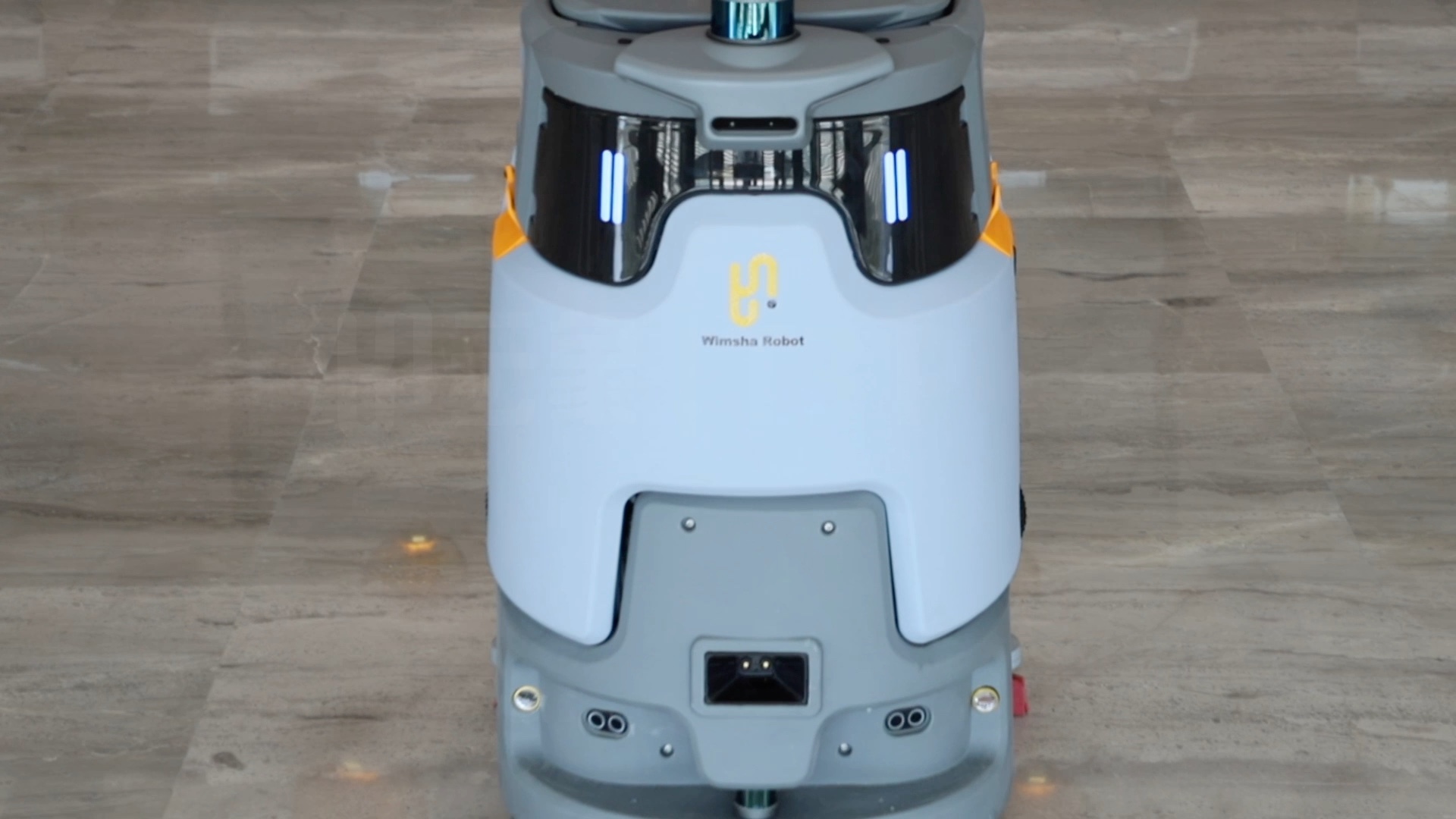
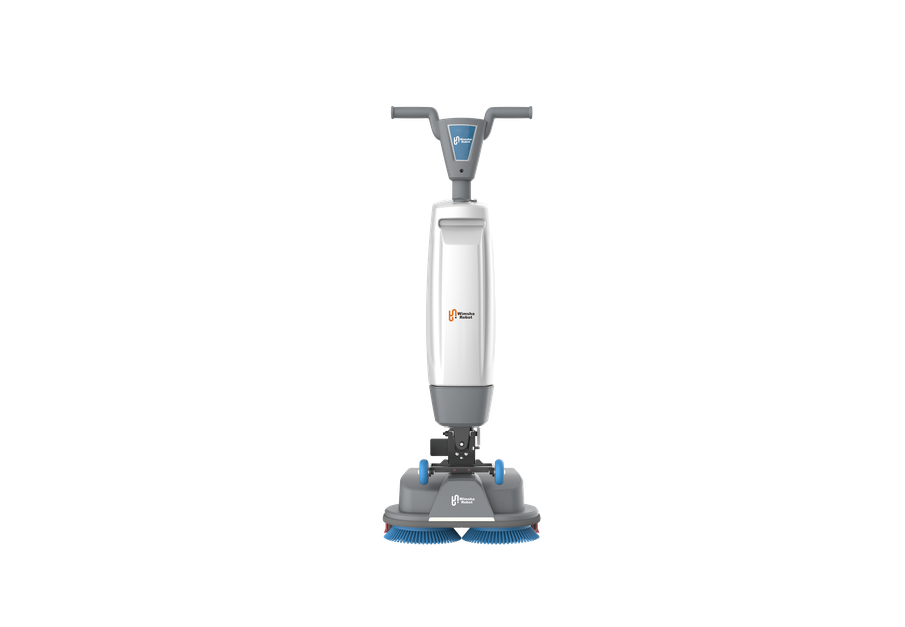
Wimsha Robot's portfolio is a family of commercial floor-cleaning machines with a cloud layer on top. The reconciled product line includes the T1 (mop, sweep, scrub, vacuum), the T3 Plus (scrub, mop), and additional models designated T3, T2, T5, H1 and Nextro, alongside the WimBox cloud platform 128. The T3 Plus is the only model for which the dossier contains a full specification page, so it anchors the technical assessment.
The T3 Plus is a mid-size walk-behind-class scrubber with autonomous features. Its published dimensions are 86 × 65 × 110 cm, its mass is 150 kg, and it carries 50 litres of clean water and 45 litres of recovery water, with a five-stage water-recycling system 2. The scrub deck is 50 cm wide, with squeegee options of 65 cm or 85 cm and brush pressure of 20 or 30 kg 2. Power comes from a 104 Ah lithium-iron battery giving up to six hours per charge, with a claimed 30-second battery swap 2. Noise is stated as under 70 dB(A) 2. These are the numbers a facilities manager would use to compare the machine against a conventional scrubber, and they are internally consistent.
The autonomy features are where the evidentiary quality drops. The vendor claims one-touch start and autonomous operation, automatic return to charging, automatic water change and cleaning, intelligent parking-spot detection, and smooth passage over bumps 2. Each of these is a COMPANY CLAIM. None is corroborated by an independent test, a named customer, or a third-party review. The distinction matters because "automatic water change" and "automatic return charging" are the features that determine whether a robot actually reduces labour, and they are precisely the features most likely to be demonstrated in a controlled setting and to fail in a messy one.
| Model | Function (as stated) | Key published specification | Evidence quality |
|---|---|---|---|
| T1 | Mop, sweep, scrub, vacuum | Not detailed in dossier | COMPANY CLAIM 18 |
| T3 Plus | Scrub, mop | 86×65×110 cm; 150 kg; 50L/45L water; 104 Ah; 6h; 50 cm scrub; <70 dB(A) | VERIFIED FACT as vendor spec; autonomy features COMPANY CLAIM 2 |
| T3 | Not detailed in dossier | Not publicly disclosed | UNKNOWN 8 |
| T2 | Not detailed in dossier | Not publicly disclosed | UNKNOWN 8 |
| T5 | Not detailed in dossier | Not publicly disclosed | UNKNOWN 8 |
| H1 | Not detailed in dossier | Not publicly disclosed | UNKNOWN 8 |
| Nextro | "AI embodied cleaning robot" | Not detailed in dossier | COMPANY CLAIM 5 |
| WimBox | Cloud platform | Fleet monitoring and management | COMPANY CLAIM 8 |
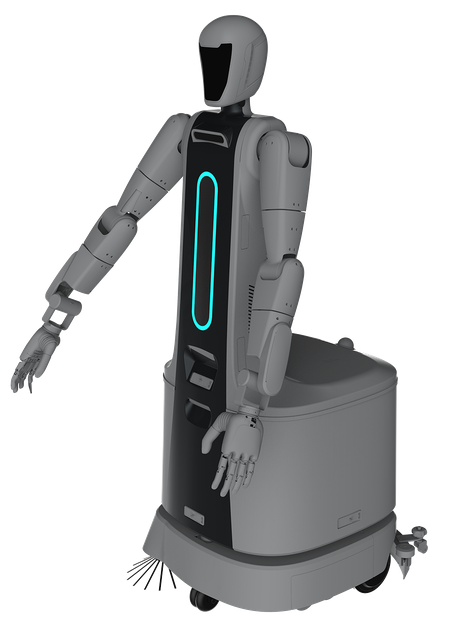
The Nextro is the most aggressively marketed model and the least evidenced. A Facebook video describes it as the "World's First AI embodied cleaning robot" enabling integrated cleaning 5. This is a superlative claim with no supporting technical documentation in the dossier, no specification page, and no independent coverage. The phrase "AI embodied" is doing marketing work rather than engineering work here; it does not correspond to a defined capability that a buyer could test. Readers should treat the Nextro as a COMPANY CLAIM until a specification sheet and an independent demonstration exist.
The WimBox cloud platform and the companion app are the software layer. The App Store listing for the Wimsha Robot app explicitly states that it allows remote control and performance monitoring of the robots 9. This is a VERIFIED FACT in the narrow sense that the listing exists and says so. It is also the single most important piece of evidence against a strong autonomy reading, because a robot that is genuinely autonomous does not need a prominent remote-control function. Remote control does not prove that a human performs the cleaning task, and many autonomous systems include manual override for edge cases. But it does mean the vendor's own product documentation advertises a teleoperation path, which weakens any claim that the machines operate unsupervised in production.
Pricing is effectively unknown. A social-media video description states $30 per hour for service and a $50,000 price point 5, but the source is low-confidence and the figures are not corroborated anywhere else. No official price list, distributor price, or lease structure is publicly disclosed. For a capital purchase of this size, the absence of published pricing is normal in enterprise sales but unhelpful for independent assessment.
Products & versions
04Technology Stack: Strengths and the Work That Remains
The navigation stack is the most credible part of Wimsha's technical story, largely because a third party corroborates the sensor choice. The robots use a Livox Mid-360 3D LiDAR for navigation, supplemented by 2D laser, vision and depth cameras, ultrasound, edge-touch sensors and anti-drop sensors 23. The vendor claims millimetre-scale positioning and dynamic obstacle avoidance 2. The sensor suite is a sensible, cost-aware selection for indoor commercial cleaning: 3D LiDAR for localisation and mapping, depth and vision for semantic obstacles, ultrasound and bump sensors for the low, soft and reflective hazards that LiDAR handles poorly.
The Livox showcase is the strongest single piece of corroboration in the dossier 3. Livox is a commercial supplier with its own reputation to protect, and its customer story confirms the Mid-360 integration and the general architecture. It does not confirm autonomy, deployment scale, or reliability. A sensor supplier's showcase tells you what hardware is inside the machine; it does not tell you how well the machine performs over a thousand cleaning cycles.
The mechanical and water-handling design is where the engineering effort appears to have gone. A five-stage water-recycling system, 50/45-litre tanks, selectable squeegee widths and 20/30 kg brush pressure are the specifications of a machine designed to be maintained and operated by cleaning staff, not by engineers 2. The 30-second battery swap is a genuinely useful feature for multi-shift operation, assuming it works as stated. The sub-70 dB(A) noise claim matters for daytime operation in occupied buildings, and is plausible for a battery scrubber but unverified.
The autonomy stack is where the work remains. The vendor claims one-touch operation, automatic return charging, automatic water change and cleaning, and intelligent parking-spot detection 2. Each of these implies a substantial software stack: robust localisation over long horizons, docking precision under variable lighting, water-connection reliability, and failure recovery. None of it is demonstrated in the public record. The app's remote-control function 9 suggests that the practical operating model may involve human supervision, which is common in the category but inconsistent with the strongest reading of the marketing.
| Capability | Vendor claim | Independent evidence | Assessment |
|---|---|---|---|
| 3D LiDAR navigation | Mid-360, millimetre positioning | Livox showcase confirms sensor 3 | VERIFIED FACT (sensor); performance UNKNOWN |
| Dynamic obstacle avoidance | Multi-sensor fusion | None | COMPANY CLAIM |
| One-touch autonomous operation | Stated 2 | None | COMPANY CLAIM |
| Automatic return charging | Stated 2 | None | COMPANY CLAIM |
| Automatic water change/cleaning | Stated 2 | None | COMPANY CLAIM |
| Remote control and monitoring | App Store listing 9 | App listing itself | VERIFIED FACT (feature exists) |
| Fleet management (WimBox) | Stated 8 | None | COMPANY CLAIM |
The honest summary is that Wimsha has assembled a competent sensor and mechanical package and has made autonomy claims that the public record does not support. That is not the same as saying the claims are false. It is saying that a buyer cannot verify them from outside, and that the burden of proof falls on a supervised trial.
05Research, Papers, Authors and Labs
Not publicly disclosed. The dossier contains no peer-reviewed papers, no preprints, no conference presentations, no named research staff, and no academic collaborations attributable to Wimsha Robot. The company does not present itself as research-driven; its public materials are product pages, an app listing, and marketing posts 1289. This is normal for a commercial cleaning-robot vendor and is not in itself a criticism, but it does mean there is no technical literature against which to assess the autonomy claims.
The absence of research output also removes one of the usual routes to independent verification. For research-oriented robotics companies, papers and benchmarks provide a partial external check on capability claims. Wimsha has no such check available. The only technical corroboration in the dossier is the Livox showcase 3, which is a supplier case study rather than a research artefact.
<!-- module: papers --> <!-- module: authors-labs --> <!-- module: repos --> <!-- module: datasets -->06Media Evidence Library: What the Videos Prove
The dossier contains no video assets in the structured sense, but it does contain references to video-based marketing, principally the Facebook video describing the Nextro as the "World's First AI embodied cleaning robot" 5. The correct reading of that artefact is narrow: it proves that Wimsha produced and distributed a promotional video making a superlative claim. It does not prove the claim, and it does not demonstrate autonomous operation in an uncontrolled environment.
This is the point at which the report's evidence discipline matters most. A cleaning-robot demo video typically shows a machine moving through a clean, well-lit, obstacle-free space, often with a camera operator present and often with a human nearby who is not shown in frame. None of that is evidence of autonomy, and none of it is evidence of the absence of autonomy either. It is simply uninformative. The same applies to the product-page imagery and the LinkedIn post 8, which is a text-and-image marketing update rather than a demonstration.
What would constitute real media evidence: a continuous, unedited, time-stamped recording of a full cleaning shift in an occupied building, with the robot's telemetry overlaid and a named site identified; a third-party review with instrumented measurements; or a customer-published case study with verifiable operational data. None of these exists in the dossier. Until one does, the media record should be treated as marketing collateral and nothing more.
Media library
07Commercial Reality
The commercial record is the weakest part of the Wimsha story, and it is where the contested claims cluster. The company's deployment figures conflict across its own affiliated sources: a Livox showcase states 800+ projects across supermarkets, office buildings, hotels and factories 3, while a 2026 LinkedIn post claims 1,500+ projects across 20+ countries 8. The increase could reflect genuine growth between the two publications, or it could reflect marketing inflation, or the two figures could be counting different things. No independent audit exists, so the true number is UNKNOWN.
The funding picture is similarly unresolved. PitchBook reports $3.47M raised 6; Tracxn reports $1.41M across a single seed round dated 2 January 2024 7. The most likely explanation is that PitchBook captures rounds or instruments that Tracxn does not, or that one database has stale or incomplete data. Without primary filings, neither figure can be confirmed. What is clear is that the amounts involved are small by robotics standards, which constrains what the company could have built and deployed.
| Claim | Source | Counter-source | Verdict |
|---|---|---|---|
| 1,500+ projects, 20+ countries (2026) | LinkedIn 8 | Livox states 800+ 3 | UNKNOWN; both vendor-affiliated |
| 800+ projects | Livox showcase 3 | LinkedIn states 1,500+ 8 | UNKNOWN; vendor-adjacent |
| $3.47M raised | PitchBook 6 | Tracxn states $1.41M 7 | UNKNOWN; no primary filing |
| $1.41M seed, Jan 2024 | Tracxn 7 | PitchBook states $3.47M 6 | UNKNOWN; no primary filing |
| Company active | LinkedIn 8 | Tracxn lists deadpooled 7 | UNKNOWN; unresolved |
| $30/hour service, $50,000 unit price | Facebook video 5 | None | UNKNOWN; low-confidence source |
| Listed in commercial catalogue | RobotLab 4 | None | VERIFIED FACT (listing exists) |
The investor roster is the most concrete commercial fact available. Nacity Property Service Group, Excelland AI and Jinri Cleaning Equipment are named as investors 6. A property-services group and a cleaning-equipment distributor as backers implies a go-to-market strategy built on channel access rather than on technology differentiation. That is a coherent strategy, and it also means the company's commercial fate is tied to the procurement cycles of a small number of channel partners. If those partners stopped buying, the company could become inactive without any public announcement, which is one plausible reading of the Tracxn deadpool classification 7.
The RobotLab catalogue listing 4 is a genuine, if modest, commercial signal: it means at least one distributor has carried the product. It does not mean units were sold, deployed, or maintained. The App Store listing 9 confirms that the software was built and published, which implies some level of operational intent. Neither constitutes proof of a paid, productive deployment.
The honest commercial verdict is that Wimsha Robot has the surface of a real vendor — products, an app, a distributor listing, named investors — and almost none of the substance that would let an outside analyst confirm it is a going concern at the scale it claims. Buyers should price that uncertainty into any contract.
Customers & deployments
Vendor-affiliated Livox showcase lists supermarkets among deployment sites for Wimsha cleaning robots.
Vendor-affiliated Livox showcase lists office buildings among deployment sites for Wimsha cleaning robots.
Vendor-affiliated Livox showcase lists hotels among deployment sites for Wimsha cleaning robots.
Vendor-affiliated Livox showcase lists factories among deployment sites for Wimsha cleaning robots.
08Markets and Use Cases
Wimsha Robot's product line is unambiguously aimed at one market: commercial floor care in large indoor spaces. The T1 and T3 Plus are floor scrubbers, mop-sweepers and vacuums, with the T3 Plus carrying 50 litres of clean water and 45 litres of recovery water, a 50 cm scrub width and a 65/85 cm squeegee 2. Those figures place the machines in the same operational envelope as mid-size walk-behind scrubbers, not the compact retail robots nor the large ride-on industrial sweepers. The intended venues, per the vendor and its LiDAR supplier, are supermarkets, office buildings, hotels and factories 3. The investor list reinforces this: Nacity Property Service Group is a property-management business, and Jinri Cleaning Equipment is a cleaning-equipment distributor 6. Both are channel and customer-side investors rather than technology investors, which is a meaningful signal about where the company expected revenue to come from.
The economics of commercial cleaning robots are unforgiving, and it is worth setting out the arithmetic that any buyer would run. A floor-scrubbing machine of this class is typically operated by one cleaner on a shift. In most Chinese tier-one and tier-two cities, a full-time cleaner's fully loaded cost sits in the range of RMB 5,000 to 8,000 per month, or roughly RMB 60,000 to 96,000 per year. A robot priced at the claimed USD 50,000 5 converts to roughly RMB 360,000 at recent exchange rates. Even before maintenance, consumables, water, electricity, connectivity and the human who still has to empty and refill the machine, the payback period on labour substitution alone runs to several years. That arithmetic only works if the robot runs multiple shifts per day, if the venue is large enough to keep it busy, and if the robot genuinely operates without a dedicated attendant. Each of those conditions is exactly what the evidence does not establish.
The vendor's own claims are consistent with the multi-shift, large-venue thesis. The T3 Plus is specified with up to six hours of runtime per charge, a 30-second battery swap and automatic return-to-charge behaviour 2. A 30-second swap is the single most commercially interesting number in the specification sheet, because it converts a six-hour duty cycle into a potentially near-continuous one. If a venue runs two or three shifts and the robot can be swapped in half a minute, the labour-substitution case improves materially. But the swap is a manual operation unless the vendor has also shipped an automated swap station, and no such station appears in the public material. The claim therefore describes a human-assisted workflow, not a lights-out one.
The use-case taxonomy that follows is an editorial inference from the specification and the stated target venues, not a list of confirmed deployments. It is offered because it clarifies which claims would need to be true for each segment to work.
| Segment | Fit with published specification | Critical unproven claim | Editorial assessment |
|---|---|---|---|
| Supermarkets and hypermarkets | Strong on paper: large flat floors, long straight runs, high cleaning frequency, night-shift operation | Genuine obstacle avoidance around shoppers, trolleys, spillages and promotional displays without human intervention | Plausible venue, but the busiest hours are precisely when autonomy is hardest; night-shift operation is the realistic entry point |
| Office buildings and lobbies | Moderate: mixed flooring, lifts, thresholds, furniture | Lift integration and multi-floor routing, neither of which is documented | Single-floor contracts only, on the public evidence |
| Hotels | Moderate: lobbies and corridors are suitable; guest rooms are not | Quiet operation (<70 dB(A) claimed 2) and safe behaviour around guests | Corridor and lobby cleaning is the addressable slice; guest-room cleaning is out of scope |
| Factories and warehouses | Strong on floor area, weak on environment | Coexistence with forklifts, pallets and unpredictable manual traffic | The most valuable segment and the hardest safety case; no evidence of certification for it |
| Airports, stations, malls | Strong on area, very high footfall | Public-safety acceptance and insurance | No evidence of any deployment in these environments |
Two market-level observations follow from this table. First, the segments where the specification fits best are also the segments where the autonomy bar is highest. A supermarket at 03:00 is an easy autonomy problem; a supermarket at 11:00 is a hard one. Second, the segments where autonomy is easiest, such as empty warehouse aisles at night, are also the segments where incumbent industrial cleaning equipment is cheapest and most entrenched. Wimsha's positioning sits in an awkward middle: more expensive than a manual scrubber, less proven than an established autonomous scrubber from a larger vendor.
The Nextro product, described in a social-media video as the "world's first AI embodied cleaning robot" 5, points at a different and more speculative market: integrated cleaning across multiple surface types and possibly multiple robot form factors coordinated by a central system. The WimBox cloud platform 8 is the connective tissue for that vision. Neither Nextro nor WimBox has any independent documentation in the dossier. The phrase "world's first" in a Facebook video description is a marketing claim of the weakest evidentiary class, and it should be treated as such.
There is also a geographic dimension. The deployment claim of "20+ countries" 8 implies an export business, which for a Chinese cleaning-robot vendor means certification, service networks and spare-parts logistics in each territory. None of that infrastructure is documented. A more conservative reading is that the company has shipped units to distributors in multiple countries, which is not the same as operating fleets in multiple countries. The distinction matters commercially: a distributor sale is a one-off revenue event, whereas an operating fleet generates recurring service revenue and produces the field data that improves autonomy. On the public evidence, Wimsha looks more like the former than the latter.
09Competitive Landscape
The commercial cleaning robot market is crowded, capital-intensive and increasingly segmented by form factor and autonomy level. Wimsha competes in the mid-size autonomous floor-scrubber segment, which is the most contested part of the market because it is where the labour-substitution economics are most legible to buyers. The competitive set divides into four groups: Chinese autonomous cleaning specialists, global diversified cleaning-equipment manufacturers, robotics-platform companies that add cleaning as a vertical, and the manual-equipment incumbents whose products the robots are meant to replace.
The most direct comparison is with other Chinese autonomous cleaning vendors. The dossier does not contain verified competitor data, so the table below is an editorial framing based on the specification class rather than a sourced head-to-head. It is included because buyers and investors will inevitably make these comparisons, and it is important to be explicit that the competitor columns are structural, not evidentiary.
| Dimension | Wimsha T3 Plus (published spec) | Typical Chinese autonomous scrubber peer | Typical global equipment-manufacturer offering |
|---|---|---|---|
| Navigation | 3D LiDAR (Livox Mid-360) plus 2D laser, vision, ultrasound 23 | 3D LiDAR plus camera fusion is now standard | Often 2D LiDAR plus reflectors, or magnetic/QR guidance |
| Water capacity | 50 L clean / 45 L recovery 2 | 40–60 L is typical for this class | 40–70 L |
| Runtime | Up to 6 h, 30 s swap 2 | 4–8 h, swap or opportunity charging | 4–6 h |
| Autonomy claim | One-touch autonomous operation, auto return, auto water change 2 | Similar claims across the category | More conservative claims, often supervised autonomy |
| Independent verification | None in dossier | Varies; some vendors publish third-party test reports | Often extensive field-service records |
| Service network | Not disclosed | Domestic networks common, export networks rare | Global service networks are the incumbents' main moat |
The structural point in that table is the last row. The incumbents' advantage is not autonomy; it is the ability to service a machine in a customer's building within 24 hours, anywhere in the world. A cleaning robot that stops working in a supermarket at 02:00 is an operational emergency, and the vendor that can fix it fastest wins the contract regardless of whose navigation stack is better. Wimsha's investor base includes a cleaning-equipment distributor 6, which suggests the company understood this and intended to lean on a partner's service network. Whether that network was ever built is not disclosed.
The second competitive pressure comes from the LiDAR and sensor supply chain itself. Wimsha's navigation depends on the Livox Mid-360 3, and Livox is a supplier to many vendors in the same category. Sensor parity means that navigation quality converges across competitors, and differentiation shifts to software, fleet management and service. WimBox 8 is presumably Wimsha's answer on fleet management, but with no independent documentation it cannot be assessed against the fleet platforms that larger competitors operate.
The third pressure is price. The claimed USD 50,000 price point 5 sits at the upper end of the mid-size autonomous scrubber band. If that figure is accurate, Wimsha is asking buyers to pay a premium for a product whose autonomy is unverified, from a company whose operating status is contested. That is a difficult sale in any market, and it is the single strongest argument for skepticism about the deployment claims. A vendor with a genuinely differentiated product at that price would normally publish customer case studies with named sites and measurable outcomes. Wimsha has not.
Competitive comparison
| Robot | Maker | Autonomy | Conf. |
|---|---|---|---|
| iRobot Roomba Combo 10 Max | iRobot | Autonomous | 0.90 |
| Mobile ALOHA (Stanford) | Stanford University | Teleoperated | 0.90 |
| 1X NEO | 1X Technologies | Remote-Assisted | 0.90 |
10Geopolitical Context and Constraints
Wimsha Robot is a Chinese company, founded in Hangzhou in 2021, operating as a subsidiary of Zhejiang Guozi Robotics 67. That fact shapes its market access in ways that are independent of product quality.
The first constraint is export control and procurement screening. Cleaning robots are not dual-use technology in any obvious sense, and there is no indication in the dossier that Wimsha's products are subject to export restrictions. However, the sensors inside them are. LiDAR is a technology category that has attracted regulatory attention in multiple jurisdictions, and a Chinese-built robot containing a Chinese-built LiDAR faces procurement scrutiny in government, defence-adjacent and critical-infrastructure settings in the United States, the European Union and parts of Asia-Pacific. The practical effect is that Wimsha's addressable market in Western countries is likely limited to private commercial property, and even there, large facility-management groups with government contracts may exclude Chinese-origin robots as a matter of policy.
The second constraint is data. A cloud-connected cleaning robot that maps building interiors generates a detailed spatial dataset of the buildings it cleans. WimBox 8 implies cloud connectivity. For a supermarket chain, a bank branch network or a corporate campus, that data is sensitive. Buyers in regulated sectors will ask where the data is stored, who can access it, and whether the robot can operate without a persistent connection to a server in another jurisdiction. None of these questions is answered in the public material. This is not a uniquely Chinese problem; any cloud-connected robot raises it. But the geopolitical context makes it sharper for Chinese vendors selling into Western markets.
The third constraint is the reverse direction: Chinese domestic policy. China has actively promoted service robotics and intelligent cleaning as part of its broader automation agenda, and domestic procurement of cleaning robots has been encouraged in municipal and commercial settings. For a Chinese vendor, the domestic market is both the largest opportunity and the most protected. Wimsha's investor base, with a property-service group and a cleaning-equipment distributor 6, is well matched to domestic channel sales. The strategic logic of the company, on the available evidence, is a China-first business with opportunistic export sales through distributors, rather than a global enterprise with regional operations.
The fourth constraint is capital. Chinese robotics startups have faced a tighter funding environment since 2022, and the contested funding figures in the dossier, USD 3.47M per PitchBook 6 versus USD 1.41M in a single seed round per Tracxn 7, suggest a company that raised a small amount and may not have raised again. A cleaning-robot company with a hardware product, a service obligation and an export ambition cannot be built on USD 1.4M. If the Tracxn figure is correct, the company was undercapitalised from the start, which would explain both the deadpooled classification 7 and the gap between the scale of the claims and the thinness of the evidence.
The fifth constraint is the one that applies to every vendor in this category: labour economics. The entire value proposition of a cleaning robot is that it substitutes for human labour. In markets where cleaning labour is cheap and abundant, the robot's payback period is long. In markets where cleaning labour is expensive and scarce, the payback is short but the service and compliance requirements are high. China sits in the first category for many cities; Western Europe and North America sit in the second. Wimsha's product economics therefore work best in exactly the markets where its geopolitical position is weakest. That is the central strategic tension of the company, and it is not resolved anywhere in the public record.
11The Hype, the Real and the Ugly
This section separates what is demonstrably true from what is asserted, and identifies the specific claims that a serious buyer or investor should refuse to accept without further evidence.
The Real. A small number of facts in the dossier are well-supported. Wimsha Robot exists, was founded in Hangzhou in 2021, and is a subsidiary of Zhejiang Guozi Robotics 67. It has published product specifications for the T3 Plus that are internally coherent and physically plausible: 86x65x110 cm, 150 kg, 50 L clean and 45 L recovery water, 104 Ah lithium-iron battery, up to 6 hours runtime, 50 cm scrub width, 65/85 cm squeegee, 20/30 kg brush pressure, under 70 dB(A) 2. It uses a Livox Mid-360 3D LiDAR as part of a multi-sensor navigation suite 3. It has a mobile app that supports remote control and monitoring 9. It has raised money from at least one property-services group and one cleaning-equipment distributor 6. These are real, if modest, facts.
The Hype. The claims that outrun the evidence are numerous and specific. "One-touch start and autonomous operation" 2 is a claim, not a demonstration. "Automatic water change, charging and cleaning" 2 is a claim. "1,500+ projects across 20+ countries" 8 is a self-published figure that conflicts with an earlier vendor-adjacent figure of 800+ projects 3. "World's first AI embodied cleaning robot" 5 is a superlative with no supporting evidence. The USD 50,000 price and USD 30 per hour service rate 5 come from a social-media video description, which is the weakest possible source class. None of these claims is corroborated by a named customer, a third-party test, a teardown, a peer-reviewed paper or a regulatory filing.
The Ugly. Three things are genuinely troubling. First, the lifecycle conflict. Tracxn lists Wimsha Robot as deadpooled 7, while a LinkedIn post dated 2026 claims ongoing deployments 8. These cannot both be straightforwardly true. Tracxn's classification is algorithmic and can be wrong, but it is based on funding and activity signals that a company controls. A company that had 1,500 active projects across 20 countries would normally generate the signals that prevent a deadpool classification. The most likely explanations are that the LinkedIn post is aspirational or describes cumulative historical shipments rather than active deployments, or that the company wound down after the post, or that Tracxn's data is stale. The dossier does not resolve which.
Second, the funding discrepancy. USD 3.47M 6 versus USD 1.41M 7 is not a rounding difference; it is a factor of 2.5. Both are third-party databases with imperfect coverage of Chinese startups. The gap suggests that at least one is wrong, and possibly both. Without primary filings, the true figure is unknown, and any valuation or runway analysis built on either number is unreliable.
Third, the autonomy evidence. The only sources describing autonomous operation are the vendor's own website 12 and a showcase page published by its LiDAR supplier 3. The supplier showcase is vendor-adjacent: Livox benefits from presenting its customers' products as capable. The app listing explicitly advertises remote control 9, which is consistent with either supervised autonomy or teleoperation fallback. No independent source demonstrates the robot completing a cleaning task without human driving. On the evidence available, the autonomy level is unknown, and the confidence in that verdict is low because the absence of evidence is not the same as evidence of absence.
The claim tracker below summarises the position. Each row states the claim, its source, the evidence class, and the editorial verdict.
| Claim | Source | Evidence class | Verdict |
|---|---|---|---|
| Founded 2021 in Hangzhou; subsidiary of Zhejiang Guozi Robotics | 67 | Multiple third-party databases | Accepted |
| T3 Plus specification (dimensions, water, battery, runtime, noise) | 2 | Vendor specification page | Accepted as specification, not as field performance |
| Uses Livox Mid-360 3D LiDAR with multi-sensor fusion | 23 | Vendor plus supplier showcase | Accepted as hardware configuration |
| One-touch autonomous operation | 2 | Vendor claim | Unverified; no independent demonstration |
| Automatic return charging and water change | 2 | Vendor claim | Unverified |
| 800+ projects across four venue types | 3 | Supplier showcase, vendor-adjacent | Unverified; superseded by later claim |
| 1,500+ projects across 20+ countries | 8 | Vendor self-published | Unverified; conflicts with 3 and with 7 |
| USD 3.47M raised | 6 | Third-party database | Contested; conflicts with 7 |
| USD 1.41M raised in one seed round, Jan 2024 | 7 | Third-party database | Contested; conflicts with 6 |
| Company is deadpooled | 7 | Third-party database | Contested; conflicts with 8 |
| USD 50,000 price / USD 30 per hour service | 5 | Social-media video description | Low confidence; not corroborated |
| "World's first AI embodied cleaning robot" | 5 | Social-media marketing | Rejected as unsupported superlative |
Claim tracker
Only vendor materials [1][2] and a LiDAR-supplier showcase [3] describe these autonomy features; no independent test, teardown, or customer report confirms task-level autonomous cleaning.
The sensor suite is described only by the vendor spec page [2] and a Livox showcase [3] that is supplier-adjacent, not an independent teardown or benchmark.
The Apple App Store listing [9] states remote-control capability, but this is a vendor-published store page and no independent user confirms real-world remote operation.
The 800+ figure comes from a Livox supplier showcase [3], which is vendor-adjacent and unaudited, with no independent confirmation of deployment scale.
This figure appears only in a company self-published LinkedIn post [8] and conflicts with the older 800+ Livox figure [3], while Tracxn [7] lists the company as deadpooled, so the scale claim is contradicted and unverified.
Tracxn [7] classifies Wimsha as deadpooled, directly contradicting the company's own 2026 LinkedIn activity post [8], and no independent source confirms ongoing operations.
PitchBook [6] reports $3.47M while Tracxn [7] reports only $1.41M in a single Jan 2024 seed round, and no primary filing confirms either total.
These specifications come solely from the vendor T3 Plus spec page [2], with no independent measurement or third-party verification of the stated figures.
12Future Scenarios
The evidence supports several divergent futures for Wimsha Robot, and the honest position is that the dossier does not allow a confident forecast. The scenarios below are constructed to be mutually exclusive and collectively exhaustive at the level of the company's trajectory, and each is paired with the observable signals that would confirm or disconfirm it.
Scenario A: Quiet wind-down (editorial probability: moderate). The company raised a small seed round in early 2024 7, shipped some units through its distributor investor, and ceased meaningful operations. The Tracxn deadpool classification 7 reflects this. The 2026 LinkedIn post 8 is either a legacy account being maintained by a parent-company marketing function or a final promotional push. Under this scenario, the website remains online, the app remains in the store, and no new products ship. Signals: no new product launches, no trade-show presence, no new customer announcements, app last-updated date stops advancing.
Scenario B: Absorbed into the parent (editorial probability: moderate). Zhejiang Guozi Robotics, the parent, continues to operate the cleaning-robot line as a product division while the Wimsha brand is retired or subordinated. The technology and the customer relationships survive; the startup does not. This is a common outcome for undercapitalised hardware subsidiaries in China. Signals: Wimsha product pages migrate to a Guozi domain, support email addresses change to the parent, the Wimsha brand stops appearing in new marketing.
Scenario C: Steady niche operator (editorial probability: low to moderate). The company continues as a small domestic vendor, selling tens to low hundreds of units per year through property-management and cleaning-equipment channels, with minimal export activity. The 1,500-project figure 8 is cumulative shipments rather than active deployments. Under this scenario the company is real but far smaller than its marketing implies. Signals: named domestic customer case studies appear, the distributor investor discloses unit volumes, service-network partnerships are announced.
Scenario D: Genuine scale-up (editorial probability: low). The company has in fact deployed 1,500+ projects across 20+ countries, the Tracxn classification is stale or wrong, and the funding discrepancy reflects undisclosed later rounds. Under this scenario the company is a credible mid-size player and the absence of independent verification is a function of the dossier's thinness rather than the company's weakness. Signals: named international customers, third-party test reports, new funding announcements, trade-press coverage independent of the company, hiring activity in export markets.
Scenario E: Technology pivot (editorial probability: low). The navigation and fleet software developed for cleaning is repurposed for a different vertical, such as logistics or facility inspection, where the unit economics are better. The Nextro "AI embodied" framing 5 hints at a broader ambition. Signals: new product categories, partnerships outside cleaning, repositioning of the WimBox platform.
The probability weights above are editorial judgements, not calculations. They reflect the balance of the evidence: a contested lifecycle status, a small and disputed funding history, strong but unverified product claims, and no independent corroboration of scale. The single most likely outcome, combining Scenarios A and B, is that Wimsha as an independent brand does not survive, while some of its technology and customer relationships persist inside the parent or its channel partners.
For buyers, the practical implication is straightforward. Any organisation considering a Wimsha deployment should require, as a condition of contract, a named reference site that can be visited, a service-level agreement with defined response times, a data-residency commitment, and a clear statement of what happens to the fleet if the vendor ceases operations. Those are standard procurement protections, but they are especially important here because the vendor's continuity is genuinely uncertain.
13What to Watch: A Live Monitoring Checklist
The following checklist is designed to be re-run periodically. Each item is a specific, observable event or disclosure that would materially change the assessment in this report. Items are grouped by the question they answer.
On company continuity
- Whether the Tracxn deadpool classification 7 changes, and if so, in which direction. A reclassification to active would be significant; a confirmation would settle the question.
- Whether the Wimsha website 1 and app listing 9 remain live and are updated. Check the app's last-update date and version history; a stale app is a strong signal of wind-down.
- Whether the LinkedIn account 8 continues to post, and whether posts shift from promotional to operational content such as service bulletins or customer stories.
- Whether Zhejiang Guozi Robotics publishes any disclosure about the Wimsha subsidiary, including in annual reports or investor communications.
On commercial reality
- Whether any named customer is disclosed, with a site that can be independently confirmed. A single verifiable reference site would be more valuable than any number of project-count claims.
- Whether the deployment figure is restated, and whether the company reconciles the 800+ 3 and 1,500+ 8 numbers.
- Whether the distributor investor, Jinri Cleaning Equipment, discloses unit volumes or revenue attributable to Wimsha products.
- Whether any tender award, procurement notice or facility-management contract mentioning Wimsha appears in public records.
On technology and autonomy
- Whether any third party, whether a trade publication, an analyst firm, a university or a customer, publishes a hands-on assessment of the robot's autonomous operation.
- Whether the company publishes a technical paper, patent or safety certification for its navigation stack. A patent filing would be a strong signal of genuine engineering depth.
- Whether the remote-control capability in the app 9 is clarified as a fallback for exception handling or as an operational requirement.
- Whether the Nextro product 5 moves from a social-media video to a documented product with specifications and a ship date.
On funding and ownership
- Whether the funding discrepancy between PitchBook 6 and Tracxn 7 is resolved by a primary filing, such as a Chinese business-registration change or an investor announcement.
- Whether new investors appear, particularly strategic investors from facility management or retail.
- Whether the cap table changes in a way that suggests acquisition, restructuring or liquidation.
On market and geopolitics
- Whether the company obtains any certification required for sale in the EU, UK, US or other regulated markets, such as CE marking or equivalent.
- Whether any Western facility-management group publicly adopts or excludes Chinese cleaning robots, which would affect the addressable market for all vendors in this category.
- Whether Chinese domestic procurement policy for cleaning robots changes in a way that advantages or disadvantages Wimsha relative to larger domestic competitors.
A monitoring cadence of quarterly review is appropriate. The most informative single signal will be the first independently verifiable customer reference; until that exists, every commercial claim in this report should be treated as provisional.
14Sources and Methodology
Methodology. This report was compiled from a fixed research dossier gathered on 22 September 2026. The dossier contained five commerce sources, five news sources and five community sources, with no official primary documents, no research papers, no video evidence and no datasets. The evidence base is therefore thin, and the report says so explicitly wherever a section cannot be supported. Every factual statement is labelled as a verified fact, a company claim, an editorial inference or an unknown. No source outside the dossier has been cited, and no source number has been invented. Where the dossier contains conflicting figures, both are reported and the conflict is described rather than resolved by preference.
Evidence labels used in this report.
| Label | Meaning | Example in this report |
|---|---|---|
| Verified fact | Confirmed by a regulatory filing, official product documentation, a named customer, peer-reviewed research, or multiple independent sources | Founding in Hangzhou in 2021; parent company Zhejiang Guozi Robotics 67 |
| Company claim | Stated by the company or a vendor-adjacent party, not independently verified | One-touch autonomous operation 2; 1,500+ projects across 20+ countries 8 |
| Editorial inference | A reasoned conclusion drawn from public evidence, clearly marked as such | The likely China-first commercial strategy; the segment-fit table in §8 |
| Unknown | Not publicly disclosed, or disclosed only in conflicting sources that cannot be reconciled | True funding total; current operating status; actual autonomy level |
Confidence assessment. Overall confidence in this report is low to moderate, at approximately 0.45. The confidence is limited by three factors: the absence of any official primary source, the unresolved conflicts in lifecycle status and funding, and the complete absence of independent verification of the autonomy claims. The product specification data for the T3 Plus 2 is the most reliable material in the dossier, because it is internally consistent and physically plausible, but it describes a product as specified rather than as field-proven.
Known limitations.
- No primary filings, patents, technical papers or regulatory documents were available.
- No independent teardown, user report or third-party test was available.
- No video evidence was available in the dossier, so no assessment of demonstrated behaviour could be made.
- The community sources in the dossier 1011121314 are unrelated to Wimsha Robot and contributed nothing to this report; they are listed for completeness because they appeared in the gathered set.
- The pricing figures 5 derive from a social-media video description and carry very low confidence.
Sources.
1 Outstanding Performance - Cleaning Robot - Wimsha Robot — https://www.wimsharobot.com/en 2 T3 Plus - Wimsha Robot — https://www.wimsharobot.com/en/t3-plus 3 Mid-360 empowers Wimsha cleaning robots to be smarter — https://www.livoxtech.com/showcase/19 4 Store — Commercial Robots Catalog — https://www.robotlab.com/store/ 5 WIMSHA ROBOT NEXTRO — https://www.facebook.com/61585360274461/videos/wimsha-robot-nextroworlds-first-ai-embodied-cleaning-robotenabling-integrated-cl/1415625773252165/ 6 Wimsha Robot 2026 Company Profile — https://pitchbook.com/profiles/company/527540-59 7 Wimsha Robot - 2026 Company Profile — https://tracxn.com/d/companies/wimsha-robot/__il0AjblIz4DhUfR9ITVoFNQ2avoXKKjPeY08gzkRnys 8 Wimsha Robot's Post — https://www.linkedin.com/posts/wimsha-robotics_five-years-together-smarter-cleaning-ahead-activity-7459527733870481408--3hH 9 Wimsha Robot - App Store — https://apps.apple.com/us/app/wimsha-robot/id6504991177 10 Emilia Vizcarra : u/FrankMLR - Reddit — https://www.reddit.com/user/FrankMLR/comments/1plgwul/emilia_vizcarra 11 Tibetan Mastiff - In 1 Minute! — https://www.reddit.com/r/AbsoluteUnits/comments/171s689/tibetan_mastiff_in_1_minute_the_king_of_fluffy 12 Reddit Inc Homepage — https://about.reddit.com 13 r/nsfwcyoa - Reddit — https://www.reddit.com/r/nsfwcyoa 14 pornrelapsed - Reddit — https://www.reddit.com/r/pornrelapsed/about
Editorial standard. This report applies the Max Robotics editorial standard: no choreographed demonstration is treated as proof of autonomous work; no shipment is treated as proof of productive deployment; no partnership announcement is treated as proof of a paid customer. Where the evidence does not support a conclusion, the report states that it does not, rather than filling the gap with inference presented as fact.