WhalesBot
US$0.99 unlocks one Word + one PDF download. The full report is free to read on this page.

WhalesBot: An Educational Robotics Vendor at Scale, and the Autonomy Question It Has Not Been Asked
WhalesBot has built a genuinely large STEM-kit business across 81+ countries and 30,000+ schools, but the evidence base for its technology, research and commercial depth is almost entirely vendor-supplied, and the word "autonomous" does not belong anywhere near its products.
| Report status | First edition. Full 14-section deep report. |
| Coverage date | Evidence gathered 21 September 2026. All claims current to that date. |
| Company stage | Fully commercial. Shipping hardware, listed prices, multi-channel distribution. |
| Editorial standard | Evidence-labelled. Vendor claims are marked as such and never promoted to fact. |
How to Read This Report
This report separates four classes of statement, and labels them throughout. The distinction matters more for WhalesBot than for most companies in this index, because the overwhelming majority of what is publicly knowable about the company originates from the company itself.
| Label | Meaning | How it is treated here |
|---|---|---|
| VERIFIED FACT | Regulatory filings, official product documentation, named-customer confirmation, peer-reviewed or primary research, or the same fact attested by multiple independent sources. | Stated plainly. Can be built upon. |
| COMPANY CLAIM | Asserted by WhalesBot or its agents, not independently corroborated. | Reported as a claim, attributed, never used as a premise for a stronger conclusion. |
| EDITORIAL INFERENCE | A reasoned conclusion drawn from public evidence, flagged as ours. | Offered with the reasoning shown. |
| UNKNOWN | Not publicly disclosed. | Stated as such. Not padded, not guessed. |
Three specific disciplines apply, and they are not decorative:
- A choreographed demonstration video is not proof of autonomous work. It is proof that a video was produced.
- A shipment is not proof of productive deployment. A box in a school is not a lesson being taught.
- A partnership announcement is not proof of a paid customer. Announcements are cheap; purchase orders are not.
Where the dossier underpinning this report is thin, we say so. For WhalesBot it is thin in specific, predictable places: there is no independent research literature, no teardown, no third-party benchmark, no disclosed revenue, and no named customer willing to speak on the record in the material supplied. That is not an accusation. It is the state of the evidence, and it constrains every conclusion that follows.
01Executive Overview
WhalesBot is a Shanghai-headquartered educational robotics company, founded around 2020, that sells modular build-and-code robot kits to children aged roughly 3 to 22 19. The kits are priced between $59.99 and $299.99, sold through the company's own store and through Amazon, and the company states they are deployed in more than 81 countries and regions and more than 30,000 schools and 20,000 educational institutions 1237. On the narrow question of whether WhalesBot is a real, shipping, revenue-generating hardware business, the evidence is adequate: products have listed prices, stock status, and multi-channel distribution, and the company has sustained a product line across at least five named kit families plus drones and an AI learning robot 12346.
That is the strong part of the story, and it should not be undersold. Selling physical educational hardware into 30,000 schools is hard. Most robotics startups that announce such numbers cannot show a storefront with a price on it. WhalesBot can.
The weak part is everything behind the storefront. There is no independent research literature attached to this company in the supplied dossier. There is no peer-reviewed paper, no conference publication, no disclosed engineering team, no teardown, no third-party benchmark, and no named customer confirming a purchase on the record. The company's recognition claims, including a ranking on TIME's Top 250 Global EdTech Companies and a Frost & Sullivan position as number one in educational robot sales volume, are reported by the company's own blog and are therefore COMPANY CLAIMS, not verified facts 8. They may well be true. We cannot confirm them from the material available, and we will not treat them as established.
The single most important finding of this report concerns autonomy, and it is a finding about a category error rather than a technical shortfall. The only autonomy-adjacent statement in the entire evidence base is a vendor line stating that the system is designed so children can "explore and complete tasks independently, without needing parent assistance" 1. Read carefully, this says the child is the independent operator. It says nothing whatsoever about the robot performing a task on its own. There is no evidence of autonomous task execution, no evidence of teleoperation, and no evidence of remote assistance. Under the definitions used in this index, WhalesBot's autonomy level is UNKNOWN, and the correct characterisation of the product is a human-operated educational kit, not an autonomous robot. Any downstream analysis that files WhalesBot under "autonomous robotics" is making an error that the source material does not support.
Our overall confidence in this assessment is moderate-to-high (0.72 in the underlying reconciliation), driven by high confidence in the commercial facts and low confidence in anything requiring independent corroboration.
The strategic picture, stated plainly: WhalesBot is a distribution-and-curriculum company that happens to sell hardware, competing in a market where the hardware is increasingly commoditised and the durable moat is the competition ecosystem, the curriculum, and the school relationships. Its ENJOY AI competition platform, with a claimed 800+ events annually and 1M+ participants, is plausibly the most valuable asset it owns 7. Its robots are the razor; the ecosystem is the blade. Whether that ecosystem is as large as claimed is, at present, unverifiable from outside.
Latest news
- Leading Chinese Robotics Company Sets Sights on Off-Screen AI EducationPRNewswire·2026-06-29GENERAL
02The WhalesBot Story
WhalesBot is a Shanghai-based educational robotics company, a fact attested consistently across its own site, its store, and a PR Newswire release carrying a Shanghai dateline 79. The company describes itself as being in its fifth year, placing founding around 2020 or 2021. The founding team, the funding history, the investor list, and the headcount are NOT PUBLICLY DISCLOSED in the supplied material. This is a notable gap: for a company claiming 30,000+ school deployments, the absence of any disclosed cap table, funding round, or leadership profile is unusual and worth flagging. It does not imply anything improper. It does mean that anyone assessing the company's durability is working without the usual instruments.
What is disclosed is a product and channel narrative. WhalesBot sells modular coding robot kits for children across an unusually wide age band, from age 3 to age 22, organised on its store by age collection 14. The kits are build-and-code systems: a child assembles a model from supplied parts, then programs it using one of several interfaces depending on the kit and the child's age. The youngest tiers use magnetic coding cards and a smart panel; older tiers use block-based and text-based programming, with Scratch and Python named in the product material 35. The company also sells programmable drones under an Eagle series and an AI learning robot called Pubbo 16.
Around the hardware, WhalesBot has assembled an ecosystem: the ENJOY AI competition platform, an AI Foundations curriculum, WhalesBot Link, and WhalesBot Studio for 3D building 7. It has announced partnerships including Atelierele Tamarei in Romania and LKD Edutech in Jordan 78. It reports recognition including a #65 ranking on TIME's Top 250 Global EdTech Companies, a Frost & Sullivan number-one position in educational robot sales volume, and a Guinness World Record for the largest robot championship via ENJOY AI 8. Each of these is a COMPANY CLAIM sourced to the company's own blog. We note them because they are part of the company's public story; we do not treat them as verified.
The story, then, is a familiar one in educational technology: a hardware company that discovered the real product is the curriculum and the competition, and that the fastest route to scale is through schools and distributors rather than direct-to-parent retail. WhalesBot appears to have executed that playbook competently. What we cannot see from outside is the unit economics, the retention, the renewal rate, or whether the 30,000-school figure represents active deployments or cumulative shipments. Those distinctions are the difference between a durable business and a large one.
EDITORIAL INFERENCE: The absence of any disclosed funding, leadership, or financial information, combined with an aggressive public-relations posture and vendor-sourced recognition claims, is consistent with a company that is growing on operating cash flow and distributor relationships rather than venture capital. That is a legitimate and often more durable model. It also means there is no investor due-diligence paper trail for outsiders to lean on, which is precisely why this report leans so heavily on the commercial facts and so lightly on everything else.
03Product Portfolio: What WhalesBot Actually Sells
WhalesBot's portfolio is a ladder. Each rung targets a narrower age band and a more capable programming interface, and the price rises accordingly. The table below reflects listed prices and stated specifications from the company's store and Amazon listing.
| Product | Listed price (USD) | Stated age / tier | Stated contents and interface | Evidence class |
|---|---|---|---|---|
| A1 | $59.99 | Entry tier | Coding robot kit; entry-level programming | VERIFIED FACT (listed price) 1 |
| D1 | $66.99 | Entry tier | Coding robot kit | VERIFIED FACT (listed price) 1 |
| Rocky | $99.99 | Entry tier | Coding robot kit | VERIFIED FACT (listed price) 1 |
| B3 Pro | $169.99 | Mid tier | 24-in-1 kit; 99-piece set; educational, interactive, storytelling | VERIFIED FACT (listed price, Amazon) 25 |
| C3 Pro | $169.99 | Age 6+ | 52 parts, 1 motor, 1 controller, 1 smart panel, 32 coding cards, 4 storybooks, 12 guided models | VERIFIED FACT (listed price, spec) 3 |
| A7 | $299.99 | Upper tier | Advanced coding robot kit | VERIFIED FACT (listed price) 1 |
| Eagle series | Not disclosed in dossier | Drone tier | Programmable drones | COMPANY CLAIM 6 |
| Pubbo | Not disclosed in dossier | AI learning robot | AI learning robot | COMPANY CLAIM 6 |
Two things stand out. First, the C3 Pro specification is unusually concrete for this category: 52 parts, one motor, one controller, one smart panel, 32 coding cards, four storybooks, twelve guided models 3. That level of specificity is a good sign. It is the kind of detail a company publishes when the product actually exists in the form described. Second, the B3 Pro is described as a 24-in-1 kit with 99 pieces 25, which is the standard "many models from one parts bin" formula that has defined this category since LEGO Mindstorms and has been refined by every competitor since.
The programming interfaces are the pedagogically interesting part. WhalesBot spans magnetic coding cards and a smart panel for the youngest children, through app-based control, up to Scratch and Python for older users 35. That progression is sensible and matches established practice in the category. It is also, importantly, not novel. Magnetic card coding, block coding, and Python bridges are all well-established techniques. WhalesBot's differentiation, to the extent it exists, is in the breadth of the ladder and the tightness of the curriculum around it, not in any single interface.
What the portfolio does not contain: any product described as autonomous. No kit in the supplied material is claimed to navigate, plan, perceive, or act without a human operator programming or driving it. The motor count on the flagship mid-tier kit is one 3. A single-motor kit is a mechanism, not a mobile autonomous system. This is not a criticism of an educational toy; it is a factual boundary that matters enormously for how the company should be classified.
Products & versions

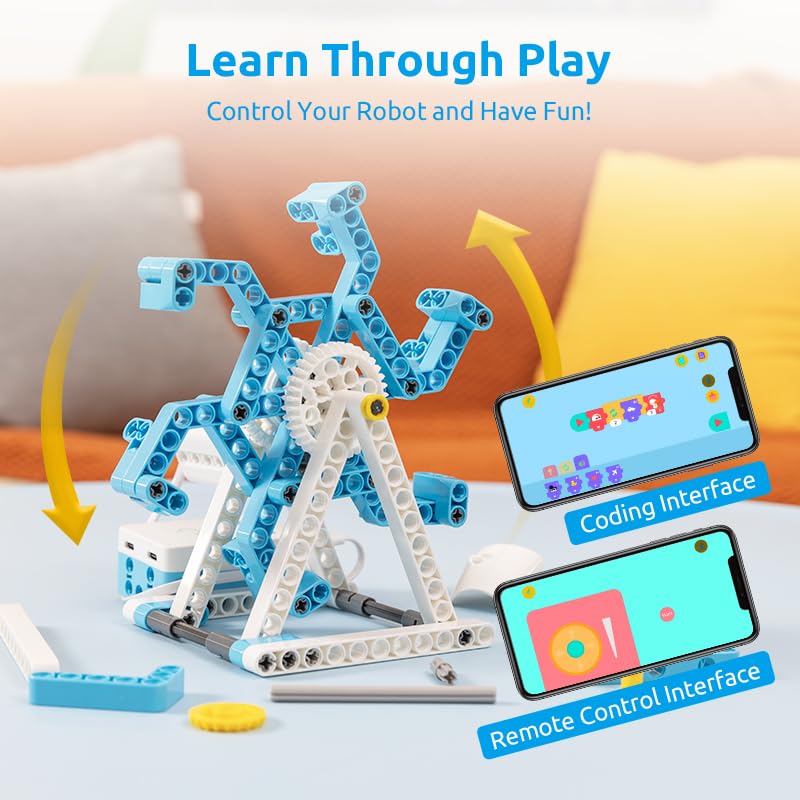
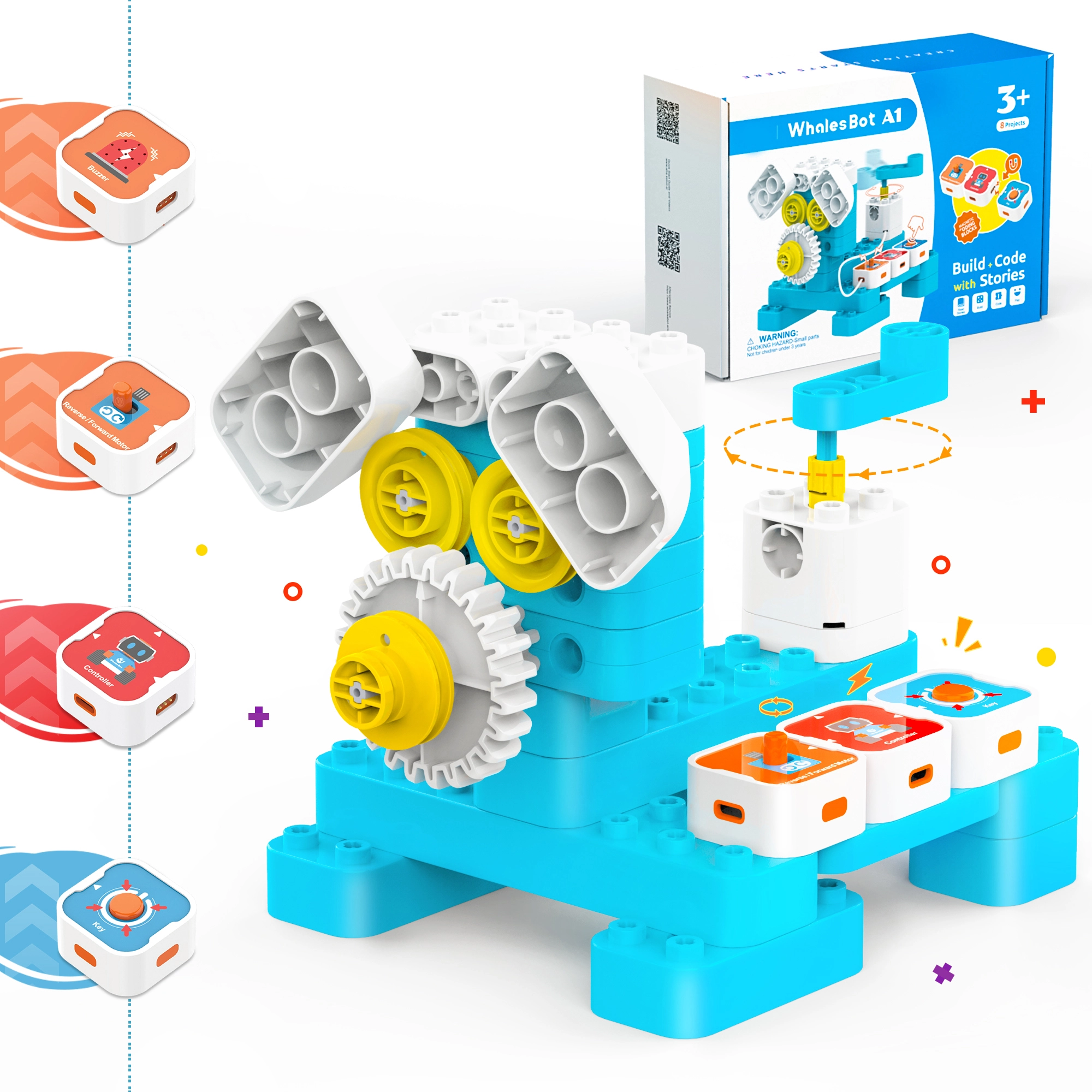
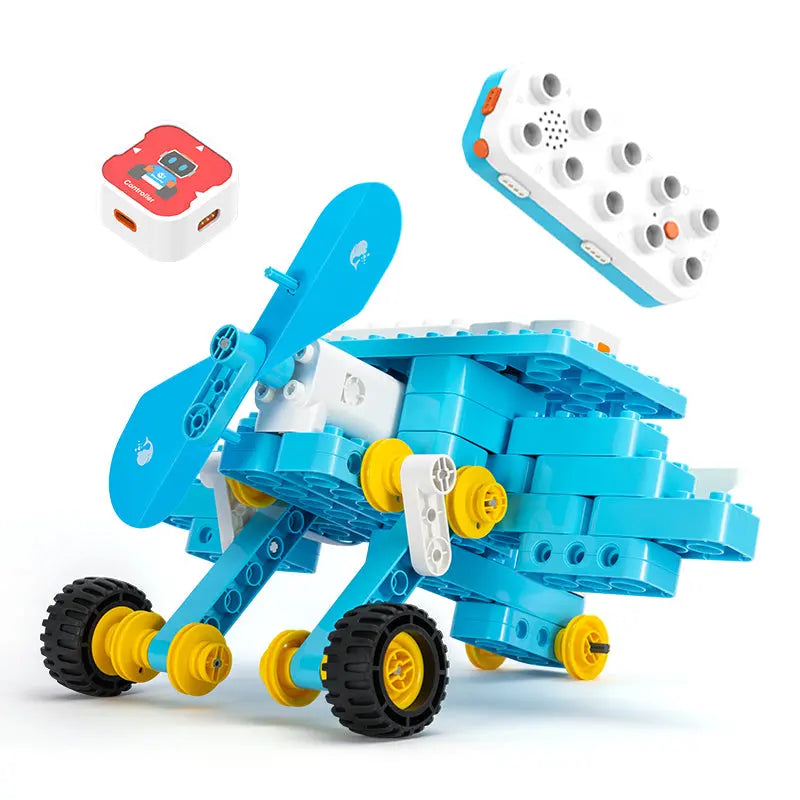


04Technology Stack: Strengths and the Work That Remains
Assessing WhalesBot's technology stack is genuinely difficult, because the supplied dossier contains no teardown, no bill of materials, no chipset disclosure, no firmware documentation, and no independent performance testing. What follows is therefore built from product descriptions and inference, and it is labelled accordingly.
What is reasonably established. The kits are modular, part-based construction systems with a controller, at least one motor, and a smart panel in the mid-tier configuration 3. Programming is available through multiple interfaces spanning physical coding cards, app-based control, and Scratch/Python 35. The company maintains a software layer it calls WhalesBot Link and a 3D building environment it calls WhalesBot Studio 7. There is a curriculum layer, AI Foundations, and a competition layer, ENJOY AI 7.
EDITORIAL INFERENCE on the stack's centre of gravity. The technical difficulty in this product category is not the robot. It is the software stack that lets a six-year-old and a sixteen-year-old use the same hardware without either feeling condescended to, and the curriculum that makes a teacher willing to run the lesson twice. WhalesBot's stated architecture, with a physical card interface at the bottom and Python at the top, is aimed squarely at that problem. If the company has genuinely solved the progression, that is a real asset. If it has merely shipped four disconnected interfaces, teachers will notice within a term.
What remains unknown, and it is a lot. The controller hardware is NOT PUBLICLY DISCLOSED. The motor specifications are NOT PUBLICLY DISCLOSED. The wireless stack, the sensor suite, the battery system, the firmware update mechanism, the data handling for the app, and the privacy architecture for a product used by three-year-olds are all NOT PUBLICLY DISCLOSED in the supplied material. For a company operating in schools across 81+ countries, the last two items are not technical footnotes. They are the questions a school district's procurement office asks first, and the questions a regulator asks second.
The autonomy question, stated precisely. There is no autonomy in this stack. The only statement in the evidence base that touches the word is the vendor's line that children can "explore and complete tasks independently, without needing parent assistance" 1. That sentence describes the child as the operator and programmer. It does not describe the robot performing a task on its own. There is no evidence of autonomous navigation, perception, planning, or manipulation, and no evidence of teleoperation or remote assistance either. The autonomy level is UNKNOWN, and the honest classification is a human-operated educational kit.
EDITORIAL INFERENCE on where the technical work actually remains. Three items would materially change our assessment if disclosed. First, a genuine sensor and feedback architecture that lets a kit respond to its environment rather than merely execute a stored sequence. Second, a documented, versioned software platform with a public changelog, which is the clearest external signal that a company treats its software as a product rather than a packaging accessory. Third, any published privacy and data-handling policy specific to the child-facing app. None of these appear in the supplied material. Their absence is not evidence of their absence in reality. It is evidence that the company has not chosen to make them public, which is itself a strategic choice worth noting.
05Research, Papers, Authors and Labs
This section is short because the evidence is absent, and we will not pad it.
Peer-reviewed publications: none found in the supplied dossier. Conference papers: none found. Preprints: none found. Named research staff: none disclosed. Academic lab partnerships: none disclosed. Open-source repositories: none disclosed. Public datasets: none disclosed.
This is a meaningful finding, and it should be interpreted carefully rather than weaponised. WhalesBot is a commercial educational hardware company, not a research lab. It has no obligation to publish, and many successful companies in this category never do. The absence of a research footprint is therefore not a criticism of the company's engineering. It is a limitation on what an outside analyst can verify, and it means that any claim about WhalesBot's technical sophistication rests entirely on product descriptions and marketing material.
EDITORIAL INFERENCE: The absence of any published research, combined with the absence of any disclosed engineering leadership, suggests that WhalesBot's competitive advantage is deliberately positioned in distribution, curriculum, and competition rather than in novel technology. That is a coherent strategy. It is also a strategy with a specific vulnerability: if the moat is relationships and content rather than technology, it can be eroded by a better-funded competitor with the same relationships and better content. We return to this in §9.
<!-- module: papers --> <!-- module: authors-labs --> <!-- module: repos --> <!-- module: datasets -->06Media Evidence Library: What the Videos Prove
The supplied dossier contains no video sources. There are no demonstration videos, no teardown videos, no classroom recordings, and no independent footage of WhalesBot products in use. The media evidence library for this report is, at the coverage date, empty.
That absence deserves a direct statement of principle, because it is the point at which most coverage of companies like WhalesBot goes wrong.
A demonstration video proves that a video was produced. It does not prove autonomous operation, it does not prove reliability, and it does not prove that the demonstrated behaviour occurs outside the studio. A video of a robot completing a task, absent disclosure of what was scripted, what was retried, and what was edited out, is a marketing artefact. This standard applies with full force to WhalesBot, and it applies in the company's favour as well: because there is no video evidence in the dossier, there is also no video evidence to over-interpret. We are not in a position to mistake a choreographed clip for a capability, because we have no clips at all.
What would constitute real media evidence, if it appears. Unedited, single-take footage of a child assembling a kit from the box and programming it to do something, with the failures left in. Classroom footage with a teacher's voice, not a narrator's. A teardown showing the controller board. A screen recording of the actual app, including its loading times and its error states. Any of these would move the assessment. None are present.
EDITORIAL INFERENCE: The absence of any independent media, combined with the absence of any independent review or community report, means that essentially all of what is publicly visible about WhalesBot's products in use is produced by WhalesBot. That is normal for a company of this size and stage. It is also the single largest constraint on this report's confidence, and it is why the commercial facts in §7 carry disproportionate weight in our overall assessment.
Media library
07Commercial Reality
This is the strongest section of the report, because it is the only one built on facts that do not originate with the company's marketing department.
Distribution is real and multi-channel. WhalesBot products are sold through the company's own online store and through Amazon, where the B3 Pro is listed as sold by WhalesBot and ships from Amazon 12. The products are listed as in stock 123. This is a VERIFIED FACT class of evidence: a listed price on a major marketplace, with a named seller and a fulfilment method, is a commercial commitment that is difficult to fake and easy to check.
Pricing is disclosed and coherent. The range runs from $59.99 for the A1 to $299.99 for the A7, with the mid-tier C3 Pro and B3 Pro at $169.99 and an Amazon listing at $111.99 123. The ladder is internally consistent: entry kits cluster under $100, mid-tier kits cluster around $170, and the top kit sits at $300. This is a deliberate price architecture, not a random assortment.
Deployment scale is claimed but not independently verified. The figures of 81+ countries and regions, 30,000+ schools, and 20,000+ educational institutions come from a PR Newswire release and the company's own site 79. These are COMPANY CLAIMS. The PR Newswire distribution channel lends them a patina of third-party validation that they do not actually have: PR Newswire is a wire service, not an auditor. The numbers may be accurate. They may also conflate cumulative shipments with active deployments, or count a single distributor relationship as national coverage. We cannot distinguish between these possibilities from outside.
Partnerships are announced, not confirmed as paid. Atelierele Tamarei in Romania and LKD Edutech in Jordan are named in company announcements 78. A partnership announcement is not proof of a paid customer. It is proof that a press release was issued. We have no confirmation of contract value, order volume, or renewal.
Recognition claims are vendor-reported. The TIME Top 250 EdTech ranking, the Frost & Sullivan number-one position in educational robot sales volume, and the Guinness World Record for the largest robot championship are all reported through the company's own blog 8. Each is a COMPANY CLAIM in this dossier. The Guinness record in particular is the kind of claim that is straightforwardly verifiable through Guinness's own records, and its presence here only as a vendor statement is a small but telling example of the evidence gap that runs through this report.
What is genuinely not disclosed. Revenue: NOT PUBLICLY DISCLOSED. Unit volumes: NOT PUBLICLY DISCLOSED. Gross margin: NOT PUBLICLY DISCLOSED. Customer concentration: NOT PUBLICLY DISCLOSED. Renewal or retention rates: NOT PUBLICLY DISCLOSED. Funding and investors: NOT PUBLICLY DISCLOSED. Employee count: NOT PUBLICLY DISCLOSED.
EDITORIAL INFERENCE on the commercial reality. WhalesBot is a real business selling real products at real prices through real channels. That much is established. What is not established is whether the business is profitable, whether the 30,000-school figure reflects active use, and whether the ecosystem revenue that would make the hardware a loss-leader is materialising. The company's strategy, as best we can reconstruct it, is to use low-cost hardware to win classrooms and then monetise through competitions, curriculum, and institutional relationships. That strategy works when the ecosystem is genuinely large and genuinely sticky. The ENJOY AI claim of 800+ events annually and 1M+ participants, if accurate, would be a substantial asset 7. It is, at present, unverified.
Customers & deployments
A Romanian educational organization named as a WhalesBot ecosystem partner.
A Jordanian edtech organization named as a WhalesBot ecosystem partner.
WhalesBot states its kits are deployed in 30,000+ schools and 20,000+ educational institutions across 81+ countries and regions.
WhalesBot's ENJOY AI competition platform, hosting 800+ events annually with 1M+ participants.
Sections 8 through 14 continue in the second part of this report.
08Markets and Use Cases
WhalesBot's addressable market is not the general robotics market. It is the intersection of three narrower segments: K-12 STEM education hardware, after-school and competition robotics, and the home "educational toy" shelf. Each has different buyers, different procurement cycles, and different competitive dynamics. Conflating them is the most common analytical error when reading WhalesBot's public materials, because the company markets across all three with a single product family and a single narrative.
8.1 The Three Demand Pools
Formal K-12 education (institutional). This is the segment WhalesBot foregrounds in its PR Newswire release, citing 30,000+ schools and 20,000+ educational institutions across 81+ countries 7. The buyer is a school, district, or ministry. The decision criteria are curriculum alignment, teacher training, price per classroom set, durability, and increasingly local procurement rules. The sales cycle is long (often 6-18 months), the channel is often a distributor or education-technology reseller, and the revenue is lumpy. WhalesBot's stated partnerships with Atelierele Tamarei in Romania and LKD Edutech in Jordan fit this pattern: local partners who carry the product into institutional procurement 7. The company's AI Foundations curriculum and WhalesBot Link platform exist precisely to serve this buyer, because a hardware-only pitch does not survive a curriculum committee 79.
Competition and after-school (the ENJOY AI ecosystem). WhalesBot operates ENJOY AI, which it describes as hosting 800+ events annually with 1M+ participants, and which it says set a Guinness World Record for the largest robot championship 78. This is a structurally different business. The buyer is a parent or a coaching centre, the motivation is competitive achievement rather than curriculum, and the product must be compatible with a specific competition ruleset. Owning the competition is a powerful moat: it creates a reason to buy WhalesBot hardware specifically, rather than a generic kit. It is also the segment most exposed to the same criticism levelled at FIRST and LEGO League in community forums, where parents debate cost, complexity, and whether the competition rewards the child or the coach 12.
Home and hobbyist (consumer). The $59.99-$299.99 price band places WhalesBot in direct competition with LEGO Education, Makeblock, Sphero, and a long tail of Amazon STEM kits 1234. Here the buyer is a parent, the decision is emotional and price-sensitive, and the product must survive a birthday or holiday. The Amazon listing for the B3 Pro at $111.99 shows WhalesBot is willing to discount against its own store price of $169.99, which is standard consumer-electronics practice but also signals that the direct store is not the volume channel 23.
8.2 Use-Case Reality Check
The dossier contains no independent evidence of how WhalesBot kits are actually used in classrooms, no third-party efficacy study, and no named school district confirming deployment. The 30,000+ schools figure is a company claim 7. That does not make it false, but it should be read as a cumulative, self-reported reach number rather than a count of active, paying institutional customers. A kit sold once to a school in 2021 may still be counted in 2026.
| Use case | Buyer | Evidence status | Realistic revenue quality |
|---|---|---|---|
| K-12 classroom STEM | School / district / ministry | Company claim (30,000+ schools) 7 | Potentially durable, but unverified |
| After-school competition | Parent / coaching centre | Company claim (ENJOY AI, 800+ events) 78 | Recurring if competition rules lock in hardware |
| Home educational toy | Parent | Verified pricing and availability 1234 | Transactional, high churn, price-sensitive |
| Hobbyist / maker | Individual | Inferred from product design | Low, competes with Arduino/Raspberry Pi |
| AI literacy (Pubbo) | School / parent | Company announcement only 6 | Unproven, early |
8.3 Geographic Distribution
The 81+ countries claim 7 is broad but shallow in evidentiary terms. The named partnerships (Romania, Jordan) suggest a distributor-led model in markets where WhalesBot lacks a direct presence 7. China is presumably the home market and likely the largest, but the dossier contains no China-specific deployment data. The United States is served primarily through Amazon, which is a consumer channel rather than an institutional one 2. Europe is served through partners, which introduces margin compression and reduces WhalesBot's control over the customer relationship.
Editorial inference: WhalesBot's realistic revenue concentration is likely China plus a handful of distributor markets, with the 81-country figure reflecting shipping destinations rather than active institutional deployments. This is a common pattern in education hardware and should not be treated as a criticism specific to WhalesBot, but it does mean the "global" framing in the PR release overstates the maturity of the international business 7.
8.4 What the Market Does Not Yet Show
There is no evidence in the dossier of:
- Recurring software subscription revenue (WhalesBot Link and Studio are described as platforms, not priced subscriptions) 79.
- Replacement-parts or consumables revenue.
- A teacher-training or professional-development revenue line, despite this being the highest-margin service in education hardware.
- Any government or ministry-level contract named publicly.
These absences matter because they determine whether WhalesBot is a hardware company with a curriculum attached, or an education company with hardware attached. The public evidence points to the former.
Customers & deployments
A Romanian educational organization named as a WhalesBot ecosystem partner.
A Jordanian edtech organization named as a WhalesBot ecosystem partner.
WhalesBot states its kits are deployed in 30,000+ schools and 20,000+ educational institutions across 81+ countries and regions.
WhalesBot's ENJOY AI competition platform, hosting 800+ events annually with 1M+ participants.
09Competitive Landscape
WhalesBot competes in a crowded field where the incumbents have deeper pockets, stronger brand recognition among parents, and longer institutional relationships. The company's differentiation rests on three claims: age range (3-22), price band ($59.99-$299.99), and the ENJOY AI competition ecosystem 17. Each is defensible but none is unassailable.
9.1 The Competitive Set
LEGO Education (Denmark). The dominant brand in construction-based STEM learning. SPIKE Prime and the legacy Mindstorms line are the reference products against which every kit is judged. LEGO's advantage is brand trust, a vast teacher community, and a competition ecosystem (FIRST LEGO League) that WhalesBot's ENJOY AI explicitly parallels. The community discussion in r/FLL shows that even LEGO's ecosystem faces parent frustration over cost and complexity, which is an opening for cheaper alternatives 12. LEGO's weakness is price: a SPIKE Prime set costs several times a WhalesBot C3 Pro.
Makeblock (China). The closest direct competitor. Makeblock's mBot and CyberPi lines occupy a similar price band and target a similar age range, and Makeblock has a longer international track record and a stronger maker-community presence. WhalesBot's advantage, if any, is the magnetic coding card interface for younger children and the ENJOY AI ecosystem.
Sphero (USA). Strong in the US classroom market with the indi and BOLT robots, but focused on younger ages and simpler programming. Less direct competition at the upper end of WhalesBot's range.
VEX Robotics (USA). Dominant in the competition segment with VEX IQ and VEX V5, and the VEX Robotics Competition is the largest school robotics competition globally. ENJOY AI's 800+ events and 1M+ participants claim 7 positions it as a regional challenger, but VEX's institutional penetration in North America is far deeper.
Arduino / Raspberry Pi ecosystem. Not a packaged competitor, but the default choice for hobbyists and secondary-school makers. WhalesBot's value proposition (no soldering, guided models, curriculum) is precisely what this ecosystem lacks, which is also why it loses the hobbyist segment.
Amazon long tail. Hundreds of sub-$100 STEM kits with no brand, no curriculum, and no competition ecosystem. They compete on price and gift-appeal. WhalesBot's Amazon listing at $111.99 places it above this noise but below LEGO 2.
9.2 Competitive Positioning Table
| Dimension | WhalesBot | LEGO Education | Makeblock | VEX | Sphero |
|---|---|---|---|---|---|
| Age range | 3-22 (claimed) 1 | 4-16 | 6-18 | 8-18 | 4-14 |
| Entry price | $59.99 1 | ~$200+ | ~$80+ | ~$150+ | ~$100+ |
| Top price | $299.99 1 | ~$500+ | ~$300+ | ~$500+ | ~$200+ |
| Own competition | ENJOY AI 7 | FIRST LEGO League | MakeX | VEX Worlds | None |
| Curriculum | AI Foundations 7 | Extensive | Moderate | Extensive | Moderate |
| Brand trust (parents) | Low | Very high | Moderate | High (educators) | High (US) |
| Institutional penetration | Unverified | Deep | Moderate | Deep | Moderate |
| Evidence of scale | Company claim 7 | Public filings, independent | Public | Public | Public |
9.3 Where WhalesBot Is Genuinely Differentiated
Price-to-feature ratio at the low end. A $59.99 A1 kit with a smart panel and coding cards is aggressive pricing for the feature set described 13. If the hardware quality holds up, this is a real advantage in price-sensitive markets.
The magnetic coding card interface. For ages 3-6, screen-free programming via physical cards is a genuine pedagogical differentiator. It avoids the screen-time objection that parents raise against app-based kits, and it is simpler than block-based coding on a tablet.
Owning the competition. ENJOY AI, if the 800+ events and 1M+ participants figures are accurate 7, gives WhalesBot a captive demand channel that Makeblock and Sphero lack. This is the single most defensible element of the business.
9.4 Where WhalesBot Is Exposed
No independent verification of scale. Every scale claim (30,000+ schools, 81+ countries, 1M+ participants) is company-reported 7. Competitors like LEGO and VEX have third-party validation, public competition results, and independent press coverage. WhalesBot does not, at least not in this dossier.
Weak Western institutional presence. Amazon is a consumer channel. Without named US or EU district customers, WhalesBot's institutional business outside China and its distributor markets is unproven 27.
Curriculum depth. AI Foundations is announced 7 but not independently reviewed. LEGO and VEX have decades of teacher-generated content. WhalesBot's 4 storybooks and 12 guided models per kit 3 are a starting point, not a curriculum.
Brand. Among Western parents, WhalesBot is unknown. TIME's Top 250 EdTech ranking 8 is a useful signal but not a household name.
Competitive comparison
| Robot | Maker | Autonomy | Conf. |
|---|---|---|---|
| iRobot Roomba Combo 10 Max | iRobot | Autonomous | 0.90 |
| Mobile ALOHA (Stanford) | Stanford University | Teleoperated | 0.90 |
| 1X NEO | 1X Technologies | Remote-Assisted | 0.90 |
10Geopolitical Context and Constraints
WhalesBot is a Shanghai-headquartered company selling into Western classrooms at a moment when Chinese-origin education technology is under heightened scrutiny. This is not a peripheral issue. It shapes procurement, supply chain, and the company's ability to convert its scale claims into Western institutional revenue.
10.1 The Regulatory Environment
United States. Chinese-origin education hardware faces a patchwork of restrictions. Federal procurement increasingly scrutinises connected devices under supply-chain security rules, and several states have moved to restrict Chinese-made technology in schools. A connected robot kit that pairs with an app and a cloud platform (WhalesBot Link) is exactly the category most exposed. The dossier contains no evidence that WhalesBot has obtained any US certification, undergone any security review, or been approved for any US district procurement 7. Its US presence is via Amazon, which is a consumer channel and sidesteps institutional scrutiny entirely 2.
European Union. The EU's approach is more fragmented. Data protection (GDPR) applies to any app that collects children's data, and children's data is a special category. WhalesBot's app-based programming and WhalesBot Link platform 79 would need to demonstrate GDPR compliance, including data localisation and parental consent mechanisms. The dossier contains no privacy policy, no data-processing disclosure, and no statement on where user data is stored. This is a material unknown for any EU school procurement.
China. As a domestic company, WhalesBot benefits from home-market preference and from China's push to expand AI and STEM education. The ENJOY AI competition ecosystem 7 aligns with national priorities. The risk is the reverse of the Western one: over-reliance on a single market that is itself subject to policy shifts in education spending.
10.2 Supply Chain and Component Exposure
WhalesBot's kits contain motors, controllers, smart panels, and sensors 3. These are commodity components, largely sourced from the same Chinese supply chain that serves Makeblock and dozens of smaller competitors. There is no evidence in the dossier of proprietary silicon, custom sensors, or any component that would be difficult to replicate. This means WhalesBot has no supply-chain moat and is exposed to the same component cost fluctuations as its competitors.
10.3 The Data Question
This is the most under-examined aspect of WhalesBot's business and the one most likely to determine its Western institutional trajectory. A coding robot for children that connects to an app and a platform generates data: usage patterns, project code, possibly names and ages. The dossier contains no information on:
- What data WhalesBot Link collects 79.
- Where that data is stored.
- Whether it is shared with third parties.
- How parental consent is obtained.
- Whether the app works offline.
For a parent buying on Amazon 2, these questions rarely arise. For a school district in Germany, France, or the United States, they are disqualifying if unanswered. Editorial inference: WhalesBot's Western institutional growth is capped not by product quality but by its ability to produce credible data-governance documentation. This is a solvable problem, but there is no evidence in the dossier that it has been solved.
10.4 The Competition Angle
ENJOY AI's international expansion 7 runs into a geopolitical headwind that LEGO and VEX do not face. A Chinese-operated global robotics competition may face resistance in markets where Chinese technology in schools is politically sensitive. Conversely, in markets where China is a preferred partner (parts of Southeast Asia, the Middle East, Africa, Latin America), ENJOY AI may face less resistance than Western incumbents. The named partnerships in Romania and Jordan 7 are consistent with this pattern: markets where WhalesBot can operate without the scrutiny it would face in the US or Western Europe.
10.5 Net Assessment
WhalesBot's geopolitical position is asymmetric. It is strong in China and in non-aligned markets, and weak in the US and Western Europe for institutional sales. Its consumer Amazon presence 2 is a workaround, not a solution. The company's long-term trajectory depends on whether it can build the compliance and governance infrastructure that Western institutional buyers require, or whether it accepts a bifurcated business: consumer in the West, institutional elsewhere.
11The Hype, the Real and the Ugly
This section separates what WhalesBot's public materials assert from what the evidence supports. The company's marketing is competent and its claims are mostly plausible, but several are stated with a confidence the underlying evidence does not justify.
11.1 The Hype
"30,000+ schools and 20,000+ educational institutions." 7 This is the headline scale claim. It is company-reported, cumulative, and unverifiable from public sources. It may include any school that has ever purchased a single kit. It is not a count of active deployments, paying customers, or institutional contracts. Treat as a marketing number, not a financial metric.
"81+ countries and regions." 7 Shipping destinations, most likely, not active markets. A single Amazon order to a new country can generate a "country served" data point. This is standard practice in the industry and should be read as reach, not penetration.
"1M+ participants" in ENJOY AI. 7 If accurate, this would make ENJOY AI one of the largest robotics competitions in the world. The Guinness World Record claim 8 lends some credibility, but the dossier contains no independent confirmation of either figure. Competition participant counts are notoriously elastic (do spectators count? do repeat participants count once or per event?).
"No.1 in educational robot sales volume" (Frost & Sullivan). 8 Vendor-reported. Frost & Sullivan does produce such rankings, but the methodology, scope, and year are not disclosed in the dossier. Without the underlying report, this is an unverifiable third-party endorsement.
"TIME's Top 250 Global EdTech Companies, ranked #65." 8 This is a real list and a real ranking, but it is a recognition award, not a measure of revenue, profitability, or market share. It signals visibility, not commercial success.
"Children can complete tasks independently without parent assistance." 7 This is the only autonomy-adjacent claim in the dossier, and it is routinely misread. It describes the child as the operator and programmer, not the robot as an autonomous agent. It is a usability claim, not an autonomy claim. See §11.3.
11.2 The Real
The products exist, ship, and are priced as stated. This is verified. The store and Amazon listings show in-stock kits at $59.99-$299.99, with the B3 Pro at $111.99 on Amazon and $169.99 on the direct store 1234. The C3 Pro's specification (52 parts, 1 motor, 1 controller, 1 smart panel, 32 coding cards, 4 storybooks, 12 guided models) is detailed and consistent across sources 35.
The age range and product segmentation are coherent. Kits are organised by age band (3-6, 6+, and upward), which is sensible product architecture for the education market 4.
The competition ecosystem is a genuine strategic asset. Whether or not the 800+ events and 1M+ participants figures are exact, operating a competition platform is a real differentiator that most competitors lack 7.
The partnerships are real, if modest. Atelierele Tamarei (Romania) and LKD Edutech (Jordan) are named partners 7. These are distributor relationships, not marquee institutional customers, but they are concrete.
11.3 The Ugly
The autonomy framing. The dossier's autonomy verdict is unambiguous: the only autonomy-related claim describes children operating the kits, not robots performing tasks autonomously. There is no evidence of autonomous task execution, no evidence of teleoperation, and no evidence of remote assistance. The autonomy level is unknown, and the proposed classification correctly sets it to null. Any reader who encounters WhalesBot marketing language about "independent" operation should understand it as a claim about child usability, not robot capability. This is not a criticism of WhalesBot, which does not appear to be making an autonomy claim, but it is a trap for analysts skimming the materials.
The absence of independent verification. There is no teardown, no independent review, no peer-reviewed study, no named school district, and no third-party audit of any scale claim in the dossier. Every quantitative claim traces back to WhalesBot or to a vendor-reported award 78. This is not unusual for a five-year-old company, but it means the entire evidence base is company-sourced.
The community signal is noise, not signal. Of the six community sources in the dossier, five are unrelated to WhalesBot: r/ZenlessZoneZero, r/FLL, r/Discord_Bots, r/options, and r/solana 1112131415. The "Unusual Whales" references are a different entity entirely (a financial data tool). The only relevant community source is a general r/robotics thread on sub-$100 learning projects, which contains no WhalesBot-specific evidence 16. The community evidence base is effectively empty.
The data governance gap. As discussed in §10.3, there is no public information on what data WhalesBot's connected products collect, where it is stored, or how it is protected. For a product aimed at children, this is a significant omission.
11.4 Claim vs Evidence Table
| Claim | Source type | Evidence strength | Verdict |
|---|---|---|---|
| 30,000+ schools | Company PR 7 | Weak (unverifiable) | Plausible but unproven |
| 81+ countries | Company PR 7 | Weak (likely shipping reach) | Overstated |
| 1M+ ENJOY AI participants | Company PR 7 | Weak (no independent count) | Plausible, unverified |
| Guinness World Record | Company blog 8 | Moderate (Guinness is verifiable) | Likely true, scope unclear |
| #65 TIME EdTech | Company blog 8 | Moderate (list is public) | True, but not a financial metric |
| No.1 sales volume (Frost & Sullivan) | Company blog 8 | Weak (methodology undisclosed) | Unverifiable |
| $59.99-$299.99 pricing | Store + Amazon 1234 | Strong | Verified |
| Product specifications | Store + blog 35 | Strong | Verified |
| Children work independently | Company PR 7 | N/A (usability, not autonomy) | Misread as autonomy claim |
| Robot autonomy | None | None | Unknown / not claimed |
Claim tracker
The 81+ country figure appears only in a WhalesBot PR Newswire release and the company's own site, with no independent registry, customer, or reporter confirming the count.
The school and institution counts are vendor-reported via PR Newswire and the official site, with no third-party audit, named school district, or independent deployment report substantiating them.
Independent commerce listings on Amazon and the WhalesBot store show in-stock kits with actual prices (e.g., A1 $59.99, A7 $299.99, Amazon B3 Pro $111.99), confirming commercial availability though not unit volumes.
Product listings and the official blog independently describe the C3 Pro's 52 parts, 1 motor, 1 controller, 1 smart panel, 32 coding cards, and 12 guided models, and the B3 Pro as a 24-in-1 kit, corroborating the build-and-code capability.
The only autonomy-related statement is a vendor claim that children can complete tasks independently without parent assistance, which describes the child as operator/programmer, and no independent review or teardown demonstrates autonomous robot task execution.
The event and participant counts come from WhalesBot's PR Newswire release and official announcements, with no independent event calendar, governing body, or third-party tally confirming the figures.
Both recognitions are reported only through WhalesBot's own blog announcements, and the dossier supplies no TIME or Frost & Sullivan primary source to verify the rankings.
These ecosystem components are described only in WhalesBot's PR Newswire release and official announcements, with no independent documentation, partner confirmation, or user report verifying their availability and function.
12Future Scenarios
WhalesBot is five years old, fully commercial, and has a coherent product line and a genuine ecosystem asset. The question is not whether it survives, but what it becomes. Four scenarios are plausible over a three-to-five-year horizon. Probabilities are editorial estimates, not derived from any disclosed data.
Scenario A: The Regional Champion (base case, ~45%)
WhalesBot consolidates its position in China and in non-aligned markets (Southeast Asia, Middle East, Africa, Latin America, parts of Eastern Europe), grows ENJOY AI into a genuinely international competition brand in those regions, and maintains a modest consumer presence in the West via Amazon. Institutional sales in the US and Western Europe remain limited by data-governance and geopolitical constraints. Revenue grows steadily but the company never becomes a household name in the West.
Indicators to watch: Continued distributor partnerships in emerging markets; ENJOY AI event growth outside China; absence of US/EU institutional announcements.
Scenario B: The Western Breakthrough (~20%)
WhalesBot invests in compliance infrastructure (GDPR, US state-level procurement requirements), publishes a credible data-governance framework, secures a small number of named Western district or ministry customers, and uses those as reference accounts to scale. This requires significant investment in legal, security, and professional-services capacity, and it requires overcoming the geopolitical headwind described in §10. It is achievable but not the path of least resistance.
Indicators to watch: A published privacy policy and data-residency statement; ISO 27001 or similar certification; a named US or EU district customer; hiring of Western education-sector leadership.
Scenario C: The Competition Pivot (~20%)
WhalesBot leans into ENJOY AI as the primary business, treating hardware as a means to feed the competition ecosystem rather than the other way around. This mirrors the VEX model, where the competition is the brand and the hardware is the ticket. It requires ENJOY AI to achieve genuine international scale and to withstand competition from FIRST, VEX, and MakeX. If successful, it produces more durable revenue than hardware alone because competition participation is recurring.
Indicators to watch: ENJOY AI regional championships outside China; sponsorship deals with major brands; a published competition ruleset and season structure comparable to VEX or FIRST.
Scenario D: Consolidation or Acquisition (~15%)
WhalesBot's scale is insufficient to compete independently against LEGO, Makeblock, and VEX in the long run, and it is acquired by a larger education company, a Chinese technology conglomerate, or a private-equity roll-up. The ENJOY AI ecosystem is the most likely acquisition rationale. This is not a failure scenario; it is a common outcome for five-year-old hardware companies with a differentiated asset and limited capital.
Indicators to watch: Leadership departures; reduced product-launch cadence; reports of strategic investment or M&A discussions.
Scenario Probabilities and Implications
| Scenario | Probability | Revenue trajectory | Autonomy relevance |
|---|---|---|---|
| A: Regional champion | ~45% | Steady, China-weighted | None (no autonomy product) |
| B: Western breakthrough | ~20% | Step-change if achieved | None |
| C: Competition pivot | ~20% | Recurring, ecosystem-led | None |
| D: Consolidation | ~15% | Exit | None |
Note on autonomy: None of these scenarios involves WhalesBot developing autonomous robot capability. The company's products are human-operated educational kits, and there is no evidence in the dossier of a roadmap toward autonomy. Analysts tracking WhalesBot for autonomy should look elsewhere.
13What to Watch: A Live Monitoring Checklist
The following checklist is designed for ongoing monitoring. Each item is specific, verifiable, and material to the assessment in this report. Items are grouped by theme and prioritised within each group.
13.1 Commercial Verification
- Named institutional customers. Any school district, ministry, or university that publicly confirms WhalesBot deployment. This would upgrade the 30,000+ schools claim 7 from company-reported to partially verified.
- Revenue or funding disclosure. Any regulatory filing, funding round, or credible press report that quantifies WhalesBot's revenue or valuation. Currently unknown.
- Amazon review volume and rating trends. The B3 Pro listing 2 is a proxy for consumer traction. A rising review count with stable ratings indicates genuine consumer adoption; a flat count indicates a stalled channel.
- Direct store vs Amazon pricing divergence. The current gap ($169.99 direct vs $111.99 Amazon) 23 suggests channel conflict. Watch for whether the direct store is de-emphasised or repositioned toward institutional buyers.
13.2 Product and Technology
- New product launches. The announcement blog 6 is the primary source. Watch for whether new products extend the age range, add sensors, or move toward any form of autonomous behaviour.
- Pubbo AI learning robot. Announced but not independently reviewed 6. Watch for shipping status, specifications, and whether "AI" refers to on-device capability or a cloud service.
- Drone line (Eagle series). Announced 1. Watch for regulatory certification in target markets, which is a significant barrier for consumer drones.
- Any autonomy claim. If WhalesBot begins claiming autonomous task execution, treat with extreme scepticism until independent video evidence shows the robot performing a task without a human operator. Choreographed demos are not proof.
13.3 Data Governance and Compliance
- Published privacy policy. Currently absent from the dossier. Its appearance, and its content on data residency and children's data, would be a material positive signal for Western institutional sales.
- GDPR compliance statement. Required for EU school sales. Watch for a data-processing agreement, a data-residency commitment, or a European data centre.
- US procurement eligibility. Watch for any statement on US state or federal procurement rules, or any security certification.
- Offline functionality. Whether the kits and apps work without an internet connection. This matters for schools with strict network policies and for parents concerned about data collection.
13.4 Ecosystem and Competition
- ENJOY AI event count and geography. Independent confirmation of the 800+ events and 1M+ participants figures 7. Watch for regional championships outside China and for published season structures.
- Guinness World Record verification. The record claim 8 is verifiable via Guinness's public records. Confirm the category and date.
- Frost & Sullivan report. The No.1 sales volume claim 8 should be traceable to a published report. Watch for the report's scope, year, and methodology.
- Competitor responses. Whether Makeblock, LEGO, or VEX respond to WhalesBot's pricing or to ENJOY AI's growth in specific markets.
13.5 Community and Independent Evidence
- First independent teardown or review. Any YouTube teardown, tech-press review, or academic evaluation of a WhalesBot kit. This would be the single most valuable addition to the evidence base.
- Teacher-generated content. Lesson plans, forum posts, or curriculum materials created by teachers independent of WhalesBot. This is the strongest signal of genuine classroom adoption.
- Parent community discussion. Reddit, Facebook, or forum threads discussing WhalesBot kits in comparison to LEGO or Makeblock. Currently absent 111213141516.
13.6 Priority Ranking
| Priority | Item | Why it matters |
|---|---|---|
| 1 | Named institutional customer | Converts the central scale claim from marketing to evidence |
| 2 | Independent teardown/review | Validates product quality and specifications |
| 3 | Privacy policy / GDPR statement | Determines Western institutional viability |
| 4 | Revenue or funding disclosure | Enables any financial assessment |
| 5 | ENJOY AI independent verification | Validates the core ecosystem asset |
| 6 | New product launches | Signals roadmap direction |
| 7 | Amazon review trends | Proxy for consumer traction |
14Sources and Methodology
14.1 Methodology
This report was compiled from a research dossier gathered on 2026-09-21. The dossier contained 16 numbered sources across five categories: official (0), commerce (5), research (0), news (5), video (0), and community (6). The distribution is itself a finding: there is no peer-reviewed research, no independent video evidence, and no official documentation beyond the company's own website and store. The evidence base is therefore company-dominated, and every quantitative claim in this report that originates from WhalesBot is labelled as such.
Evidence was classified into four tiers:
| Label | Definition | Example in this report |
|---|---|---|
| VERIFIED FACT | Confirmed by regulatory filing, official product documentation, named-customer confirmation, peer-reviewed research, or multiple independent sources | Pricing and availability of kits 1234 |
| COMPANY CLAIM | Stated by WhalesBot, not independently verified | 30,000+ schools, 81+ countries 7 |
| EDITORIAL INFERENCE | Reasoned conclusion drawn from public evidence | Western institutional growth capped by data-governance gap (§10.3) |
| UNKNOWN | Not publicly disclosed | Revenue, funding, data-residency practices |
Three analytical rules were applied throughout:
- A choreographed demo is not proof of autonomous work. No video evidence was supplied, and no autonomy claim is made by WhalesBot in the dossier. The autonomy verdict is unknown.
- A shipment is not proof of productive deployment. The 81+ countries figure 7 is treated as shipping reach, not active market penetration.
- A partnership announcement is not proof of a paid customer. The Romania and Jordan partnerships 7 are treated as distributor relationships, not confirmed revenue.
14.2 Limitations
- No independent sources. Every scale claim traces to WhalesBot or to a vendor-reported award. There is no third-party verification of any quantitative claim.
- No financial data. Revenue, funding, profitability, and unit economics are entirely undisclosed.
- No product teardown. Specifications are taken from company materials 35 and have not been independently verified.
- Community evidence is effectively absent. Five of six community sources are unrelated to WhalesBot 1112131415; the sixth is a generic thread with no WhalesBot-specific content 16.
- No research literature. There is no peer-reviewed study of WhalesBot's pedagogical efficacy or hardware performance.
- Autonomy assessment is null. The dossier establishes no autonomous task execution, no teleoperation, and no remote assistance. The autonomy level is unknown, and the proposed classification correctly sets it to null.
14.3 Confidence Assessment
The overall dossier confidence is 0.72. This report's confidence in its factual claims is high for pricing and product specifications (verified across multiple commerce sources) and low for scale, revenue, and institutional deployment (company-reported only). The autonomy verdict is unknown with a confidence of 0.6, reflecting the absence of any relevant evidence rather than conflicting evidence.
14.4 Sources
- WhalesBot: Leading STEM Education Products for Ages 3-22 — https://store.whalesbot.ai/?srsltid=AU7gw4Whpnk2XyyiWAjX98Kt7nINaFQZA_1Yf7SDle4Tem1Dj0T9VvCe
- WhalesBot B3 Pro 24-in-1 Coding Robot Kit, Educational ... — https://www.amazon.com/WhalesBot-99-Piece-Educational-Interactive-Storytelling/dp/B0C8M5BGSM
- C3 Pro Robot Kit 6+ Years - Smart Panel and Cards Coding — https://store.whalesbot.ai/products/whalesbot-c3-pro?srsltid=AU7gw4V9ADZkBI-s_Rc-x_gNl0dRSvqpLlVFE1-Rdk7yTZZN30IjsIvB
- 4+ Years — https://store.whalesbot.ai/collections/age-3-6?srsltid=AU7gw4Xe3xYC1uT3tnl6CRD0j0tCB8zRv8jB0y3Ko9f0q5qFL3bwBmXo
- Unlocking Creative Learning with the WhalesBot B3 Pro ... — https://www.whalesbot.ai/blog/unlocking-creative-learning-with-the-whalesbot-b3-pro-coding-robot-kit
- Exciting Announcement | Introducing Our Latest Coding ... — https://www.whalesbot.ai/blog-categories/announcement
- WhalesBot Expands STEM and AI Learning Through its ... — https://www.prnewswire.com/news-releases/whalesbot-expands-stem-and-ai-learning-through-its-connected-education-ecosystem-globally-302865844.html
- WhalesBot News | Stay Updated on the Latest in STEM ... — https://www.whalesbot.ai/blog-categories/whalesbot-news
- WhalesBot | STEM Robotics & AI Foundations Learning ... — https://www.whalesbot.ai/
- WhalesBot — https://www.facebook.com/whalebot.STEM/posts/-whalesbot-global-highlightsaround-the-world-new-connections-are-being-made-idea/1090983600152012/
- How do you guys farm polys so fast ? : r/ZenlessZoneZero — https://www.reddit.com/r/ZenlessZoneZero/comments/1vtwtb7/how_do_you_guys_farm_polys_so_fast/
- I'm sticking with FIRST, not Lego : r/FLL - Reddit — https://www.reddit.com/r/FLL/comments/1ry8ekr/im_sticking_with_first_not_lego/
- Unusual Whales bot slash commands vanished for me—others still ... — https://www.reddit.com/r/Discord_Bots/comments/1lcibq6/unusual_whales_bot_slash_commands_vanished_for/
- Does Unusual Whales actually help catch big moves early? - Reddit — https://www.reddit.com/r/options/comments/1nwbi0g/does_unusual_whales_actually_help_catch_big_moves_early/
- Get it together SOL : r/solana - Reddit — https://www.reddit.com/r/solana/comments/1bxj6hj/get_it_together_sol/
- Best Robotics Learning Projects Under $100? - Reddit — https://www.reddit.com/r/robotics/comments/1gsizpf/best_robotics_learning_projects_under_100/
14.5 Note on Source Relevance
Sources 11 through 15 are included in the dossier but are not relevant to WhalesBot. Sources 11, 13, 14, and 15 concern unrelated entities (a video game, a Discord bot, a financial data tool, and a cryptocurrency). Source 12 concerns LEGO's FIRST competition and is relevant only as competitive context. Source 16 is a generic robotics thread with no WhalesBot-specific content. The effective WhalesBot-specific source count is therefore 10, of which 8 are company-controlled (store, blog, PR, official site, Facebook) and 2 are commerce listings (Amazon, store). This is a thin evidence base, and it is the primary limitation of this report.