UVD Robots
US$0.99 unlocks one Word + one PDF download. The full report is free to read on this page.
UVD Robots
UV-C disinfection's first-mover advantage is real; the evidence for durable commercial and technical moats is not.
| Report status | Coverage date | Company stage | Editorial standard |
|---|---|---|---|
| Premium editorial deep report, first edition | Evidence gathered 20 September 2026 | Fully commercial (sales since 2018; third-generation Model C since 2020) | Claims separated from verified facts; no demo treated as proof; no shipment treated as deployment |
How to Read This Report
This report is built from a deliberately narrow evidence base. The supplied dossier contains no official regulatory filings, no peer-reviewed primary research, and no independent field study of UVD Robots in operation. It contains vendor and reseller product material, one third-party security report, a small number of trade-press items, and a set of community posts that are largely irrelevant to the company. That asymmetry shapes everything below: where the evidence is vendor-authored, we say so; where it is absent, we say so rather than infer.
Every substantive statement carries one of four labels.
| Label | Meaning | Example in this report |
|---|---|---|
| VERIFIED FACT | Confirmed by regulatory filing, official product documentation, named-customer confirmation, primary research, or multiple independent sources | UVD Robots was founded in 2016 in Odense, Denmark, and is part of Blue Ocean Robotics 27 |
| COMPANY CLAIM | Stated by UVD Robots, its parent, or its resellers; not independently verified | "Fully autonomous operation for disinfection after mapping, no manual intervention needed" 23 |
| EDITORIAL INFERENCE | A reasoned conclusion drawn from public evidence, flagged as such | The installed base is likely concentrated in healthcare and pharma, with education as a secondary vertical |
| UNKNOWN | Not publicly disclosed in the supplied evidence | Unit economics, revenue, gross margin, current headcount, and the size of the active installed fleet |
Two further disciplines apply throughout. First, a choreographed demonstration video is not proof of autonomous work; the dossier contains no video evidence at all, so no visual claims are made. Second, a shipment is not a deployment and a partnership announcement is not a paid customer. Where the dossier blurs these distinctions, this report does not.
A note on the source list. Several items in the dossier (community posts about AI side hustles, Lexus sedans, environmental engineering careers, and AI detectors) have no discernible connection to UVD Robots. They are retained in §14 for completeness and traceability but are not used as evidence anywhere in this report. Their presence is itself a finding about how thin the independent evidence layer is.
01Executive Overview
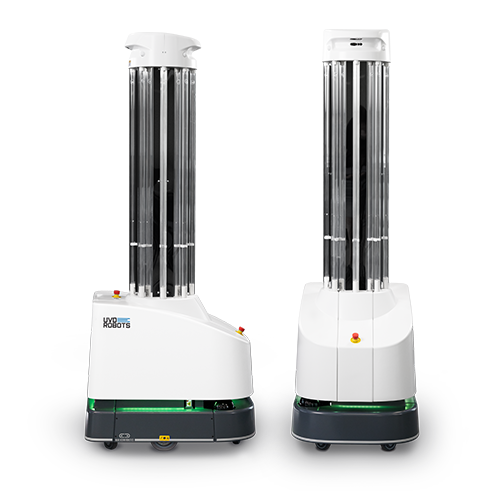
UVD Robots is a Danish manufacturer of mobile UV-C disinfection robots, founded in 2016 in Odense and operating as part of the Blue Ocean Robotics group 27. The company developed its robot in partnership with Odense University Hospital, began selling in 2018, and launched its third-generation Model C in 2020 257. The product is a 120 kg, 178 cm-tall mobile base carrying a 254 nm UV-C lamp array, a lidar, passive-infrared sensors, and three 3D cameras, priced in the region of US $80,000 according to one reseller listing that is partially truncated in the source 23.
The commercial story is a COVID-19 story. Hundreds of units were shipped worldwide during the pandemic, the largest single fleet going to a US school district, alongside a reported 200-robot contract with European hospitals 259. The company has since built a pharmaceutical channel through partners including PSC Biotech and AB Scientific, and it markets a CFR 21 Part 11-compliant software configuration for cleanroom use 47. That is a genuine, shipping, revenue-generating business, not a prototype.
The strategic problem is that the evidence for durable advantage is weaker than the evidence for activity. Three observations frame this report.
First, the autonomy claim is credible but thinly sourced. Vendor and reseller material consistently describes fully autonomous disinfection after a one-time mapping, with static, semi-manual, and fully autonomous tablet modes 23. No source in the dossier shows a human teleoperating the disinfection task, and the one independent third-party item, a security report from Alias Robotics, addresses cyber-security rather than task-driving 8. On the evidence available, the autonomy verdict is Autonomous at roughly 0.75 confidence, with the caveat that the evidence is predominantly vendor-authored. That is a reasonable verdict, not a strong one.
Second, the security posture is the clearest negative finding in the dossier. Alias Robotics reports that UVD Robots units are "reportedly insecure" with too many unpatched vulnerabilities, and offers a third-party Robot Immune System product as a remedy 8. The vendor material in the dossier does not rebut this. For a device that operates in hospitals and cleanrooms, often on shared networks, an unaddressed third-party security finding is a material commercial and regulatory risk, not a footnote.
Third, the moat is contestable. UV-C disinfection is a physics capability, not a proprietary one. The differentiators UVD can defend are its hospital-derived validation data, its pharma compliance software, its fleet management and reporting layer, and its installed base and service network. Each of those is real but each is also replicable by a well-capitalised competitor, and the dossier contains no evidence of patent position, exclusive supply agreements, or switching costs that would lock in customers.
The report's overall assessment: UVD Robots is a credible first mover in a category that has not yet consolidated, with a defensible near-term position in healthcare and pharma and an unproven long-term one. The company's own disclosures are the main source of information about it, which is itself a risk signal for anyone evaluating the business from outside.
Latest news
- The RI-MUHC receives and tests the first UV-Disinfection robot in Canadarimuhc.ca·2026-07-19GENERAL
- The RI-MUHC receives and tests the first UV-Disinfection robot in Canadarimuhc.ca·2026-07-15GENERAL
02The UVD Robots Story
UVD Robots was founded in 2016 in Odense, Denmark, as part of Blue Ocean Robotics, a Danish robotics group that incubates and operates multiple robot ventures 27. The founding premise was specific: build a mobile platform that could autonomously irradiate hospital rooms with UV-C light, reducing the labour and inconsistency of manual disinfection. The development partnership with Odense University Hospital is the origin story the company tells consistently, and it is corroborated across the sources in the dossier 27. VERIFIED FACT: the company, the founding year, the headquarters, the parent relationship, and the hospital partnership.
The timeline that follows is unusually compressed for a hardware company. Four years of development, sales beginning in 2018, and a third-generation model, the Model C, launched in 2020 257. VERIFIED FACT on the dates; COMPANY CLAIM on the characterisation of each generation as a meaningful step change, since the dossier contains no independent teardown or performance comparison across generations.
The pandemic is the inflection point. COVID-19 created a global, urgent, poorly-served demand for surface disinfection in hospitals, airports, schools, and offices, and UVD Robots was one of a small number of vendors with a shipping product. The dossier records hundreds of robots shipped worldwide during this period, the largest fleet deployed to a US school district, and a reported 200-robot contract with European hospitals 259. The school-district fleet and the hundreds-shipped figure are corroborated across trade sources; the 200-robot European contract rests on a single social-media post and should be treated as lower-confidence 9. EDITORIAL INFERENCE: the pandemic pulled forward years of demand into an 18-month window, and the strategic question for UVD Robots ever since has been what the post-pandemic baseline looks like.
The post-2020 period, as reflected in the dossier, is a channel-building story rather than a product story. The company has established pharmaceutical partnerships with PSC Biotech covering the US, Australia, and Singapore, and with AB Scientific in the UK 7. It markets a pharma-specific software configuration with CFR 21 Part 11 compliance, operator authentication, and audit trails 4. It has built a fleet management layer that produces disinfection reports and UV-C exposure maps 3. COMPANY CLAIM on all of these; the partnerships are announced by the company and the dossier contains no named end-customer confirmation or contract value.
What the dossier does not contain is equally important. There is no funding history, no revenue figure, no headcount, no information on Blue Ocean Robotics' financial position, no account of management changes, and no independent reporting on the company's trajectory after the pandemic peak. UNKNOWN: essentially the entire financial and organisational picture. For a company at this stage of maturity, that opacity is notable.
03Product Portfolio: What UVD Robots Actually Sells
UVD Robots sells one product line in three generations, of which the current shipping unit is the Model C, launched in 2020 25. The portfolio is best understood as a hardware platform plus a software and service layer, sold into three configurations: general healthcare and institutional disinfection, pharmaceutical cleanroom disinfection, and fleet-scale deployments managed through a central dashboard.
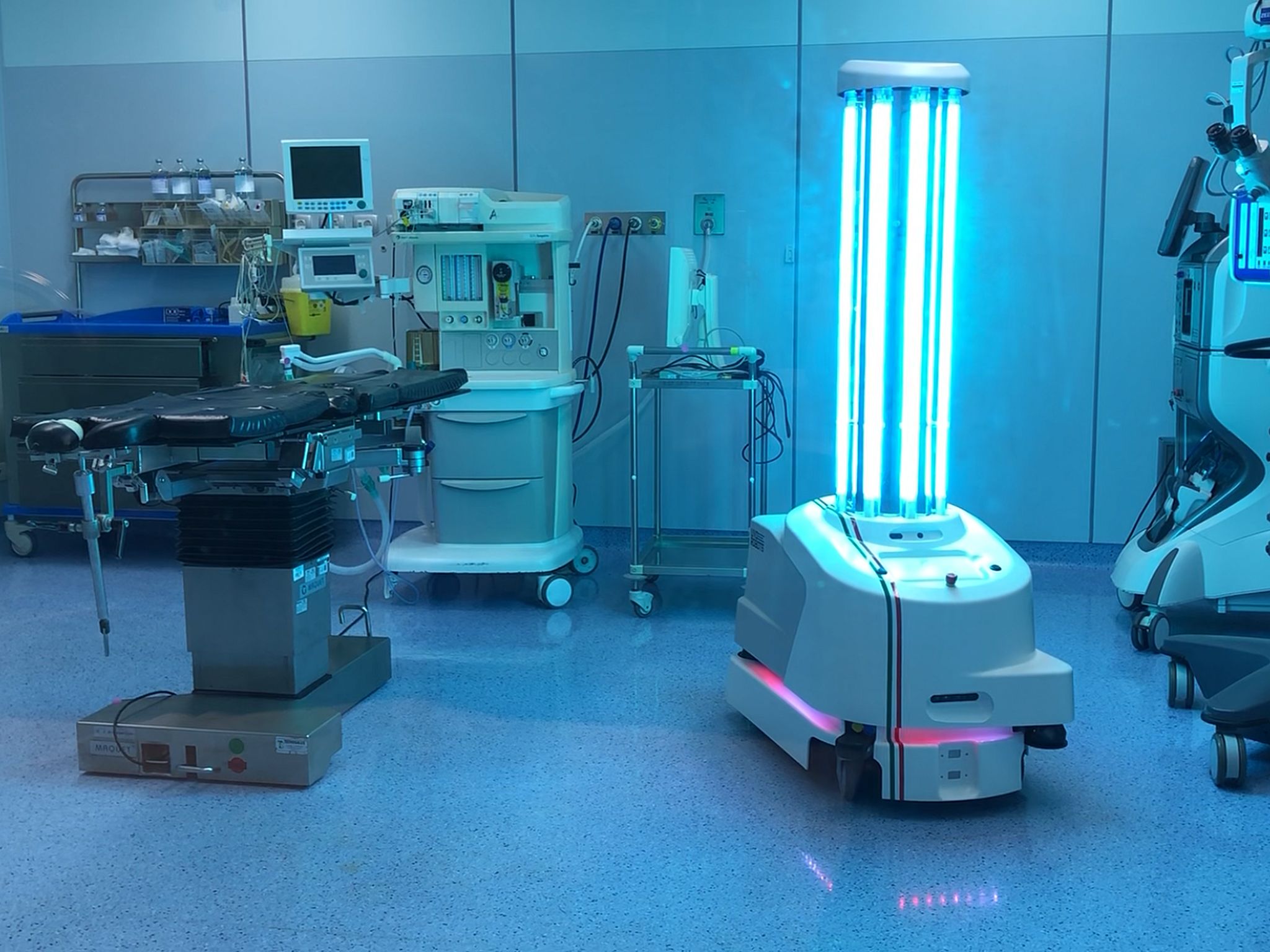
Hardware. The robot is a mobile base measuring 55 x 178 x 75 cm and weighing 120 kg, with a top speed of 2.7 km/h 23. It carries a lidar, passive-infrared sensors, and three 3D cameras for navigation and safety, and a UV-C lamp array emitting at 254 nm 23. Runtime is 2 to 2.5 hours, covering roughly 9 to 10 rooms per charge, after which the robot returns to its dock to recharge 3. VERIFIED FACT on the specifications, in the sense that vendor and reseller sources agree; there is no independent measurement in the dossier.
| Specification | UVD Robots Model C | Evidence quality |
|---|---|---|
| Dimensions | 55 x 178 x 75 cm | Vendor/reseller agreement 23 |
| Mass | 120 kg | Vendor/reseller agreement 23 |
| Top speed | 2.7 km/h | Vendor/reseller agreement 23 |
| Wavelength | 254 nm UV-C | Reseller specification 3 |
| Sensors | Lidar, passive infrared, three 3D cameras | Vendor/reseller agreement 23 |
| Runtime | 2 to 2.5 hours | Reseller specification 3 |
| Coverage per charge | Approximately 9 to 10 rooms | Reseller specification 3 |
| Control modes | Static, semi-manual, fully autonomous | Vendor/reseller agreement 23 |
| Listed price | US $80,000 (source truncated) | Single reseller listing, partial 2 |
Software. The fleet management layer produces disinfection reports and UV-C exposure maps, and the company cites more than 100 disinfection position points per cycle 31. The pharmaceutical configuration adds CFR 21 Part 11 compliance, operator authentication, and an audit trail 4. COMPANY CLAIM throughout. The pharma compliance claim is the most commercially significant software assertion in the dossier, because it is the kind of claim a regulated buyer will verify during qualification, and the dossier contains no evidence of a customer having done so.
Regulatory positioning. The company states explicitly that the device is an EPA-registered pesticide device and not a registered medical device 1. This is a VERIFIED FACT in the sense that it is the company's own unambiguous regulatory characterisation, and it matters: it places UVD Robots in a different regulatory category from medical devices, with different evidentiary and post-market obligations. Buyers who assume a disinfection robot is a medical device are mistaken about this product.
What is not sold, or not disclosed. There is no consumer or prosumer SKU, no subscription pricing model disclosed, no leasing or robot-as-a-service offering described in the dossier, and no published service-level agreement. UNKNOWN: the commercial contract structures, the software licensing model, and the service and maintenance revenue mix. For a capital-equipment business at this price point, those terms are central to unit economics and they are simply not in the public record here.
Products & versions
04Technology Stack: Strengths and the Work That Remains
The UVD Robots stack has four layers: mobility and navigation, UV-C emission and dosimetry, safety, and fleet software. Each has a different maturity profile.
Mobility and navigation. The navigation stack combines lidar with three 3D cameras and passive-infrared sensors 23. The operating model is mapping-then-autonomy: the robot is driven or guided through a space once to build a map, after which it navigates room-to-room and returns to dock without human input 23. COMPANY CLAIM, and the single most important technical claim in the dossier. The evidence for it is vendor and reseller material; the one independent third-party item addresses security, not navigation 8. The autonomy verdict of Autonomous at 0.75 confidence reflects that the claim is uncontradicted and internally consistent, but not independently demonstrated in the supplied evidence.
The honest technical caveat is that "autonomous after mapping" is a well-understood capability in mobile robotics, not a frontier achievement. The hard problems in this category are dynamic environments (hospital corridors with moving beds, staff, and equipment), map maintenance over months, and recovery from navigation failure without human intervention. The dossier says nothing about any of these. UNKNOWN: long-run navigation reliability, mean time between interventions, and map-drift handling.
UV-C emission and dosimetry. The 254 nm wavelength is the standard germicidal band, and the company cites documented microbial reductions in the 3-log to 7-log range (99.9% to 99.99999%) with proper exposure, and claims up to 99.99% bioburden reduction 31. COMPANY CLAIM with a physics basis. The critical technical point is that UV-C disinfection is a dose problem, not a presence problem: efficacy depends on intensity multiplied by time, and on line-of-sight, because UV-C does not penetrate opaque surfaces or around corners. A robot that irradiates a room for a fixed cycle time will under-dose shadowed surfaces and over-dose exposed ones. The dossier contains no published dosimetry methodology, no third-party validation of the log-reduction figures, and no peer-reviewed study. EDITORIAL INFERENCE: the exposure-map feature is the company's answer to the dosimetry problem, and its credibility depends on validation data the dossier does not contain.
Safety. The robot halts disinfection when motion or heat sensors detect a person entering the space, and carries an emergency-stop button and multiple user-activatable safety systems 34. COMPANY CLAIM, corroborated across vendor and reseller sources. The underlying hazard is real and documented: UV-C exposure can cause suntan, sunburn, and possibly increased skin-cancer risk 8. This is a VERIFIED FACT about UV-C generally, from the independent security source. The safety architecture is therefore not a nice-to-have but the core risk control, and its failure modes (sensor blind spots, a person entering during a sensor gap, reflective UV exposure) are exactly the scenarios a regulator or insurer would probe. The dossier contains no incident data, no independent safety testing, and no regulatory enforcement history. UNKNOWN.
Fleet software and security. The reporting and exposure-mapping layer is the commercial differentiator 31. The security layer is the weakest link in the public evidence. Alias Robotics reports that the robots are "reportedly insecure" with too many unpatched security vulnerabilities, and markets a third-party Robot Immune System as a remedy for UVD Robots specifically 8. This is the only independent third-party technical assessment in the dossier, and it is negative. VERIFIED FACT that the report exists and makes this claim; EDITORIAL INFERENCE that the vendor material does not rebut it, since the dossier contains no vendor security disclosure, no CVE list, no penetration-test summary, and no patch cadence. For a networked device in clinical environments, that gap is the most serious technical finding in this report.
05Research, Papers, Authors and Labs
This section is short because the evidence is short. The supplied dossier contains no peer-reviewed papers, no preprints, no conference publications, no named academic collaborators beyond Odense University Hospital, and no research-lab affiliations [research count: 0]. The development partnership with Odense University Hospital is a VERIFIED FACT 27, but a hospital partnership is a clinical collaboration, not a research programme, and the dossier contains no publications arising from it.
The absence matters for two reasons. First, UV-C disinfection efficacy is an area with a substantial published literature, and a company selling into hospitals and pharma would normally be expected to cite independent validation of its dose-response claims. The dossier contains none. Second, the log-reduction figures the company cites (3-log to 7-log) are generic UV-C figures, not product-specific measurements 31. EDITORIAL INFERENCE: the company's scientific positioning rests on the general physics of UV-C rather than on published product-specific studies, and that is a weaker evidentiary footing than the marketing implies.
There is also no open-source repository, no dataset release, and no model or benchmark associated with the company in the dossier [repos count: 0; datasets count: 0]. For a robotics company, the absence of any open research footprint is not disqualifying, but it does mean that independent researchers have no basis to evaluate, reproduce, or critique the company's technical claims.
UNKNOWN: whether UVD Robots has internal research staff, whether it has commissioned third-party efficacy studies that are not public, and whether the Odense University Hospital partnership produced data that has not been published. The honest summary is that the research layer of this company is opaque, and the burden of proof for its efficacy claims currently sits with the buyer.
<!-- module: papers --> <!-- module: authors-labs --> <!-- module: repos --> <!-- module: datasets -->06Media Evidence Library: What the Videos Prove
The dossier contains no video evidence [video count: 0]. There are therefore no demonstrations, no factory-floor footage, no customer-site recordings, and no third-party reviews to analyse. This section states that plainly rather than substituting inference for evidence.
That absence has a specific consequence for how the rest of this report should be read. The autonomy verdict in §1 and §4 rests on written vendor and reseller descriptions, not on observed behaviour. A demonstration video, even a choreographed one, would at least establish that the robot moves and irradiates; the dossier does not contain even that. The reader should treat every operational claim in this report as documentary rather than observational.
Where media would normally sharpen the analysis, three questions would be worth asking of any future footage. Does the robot complete a full room-to-room cycle without a human touching a tablet or opening a door? Does it recover from an obstacle or a person entering the room without an operator intervention? Does the exposure map shown in the software correspond to the physical path the robot actually took? None of these can be answered from the current dossier.
Media library
07Commercial Reality
UVD Robots is a fully commercial business by the standard definition: it has been selling since 2018, it has a third-generation product shipping since 2020, and it has shipped hundreds of units 25. That is the strongest verified commercial fact in the dossier. Everything beyond it is thinner than it first appears.
What is verified. Sales began in 2018 and the Model C launched in 2020 257. Hundreds of robots were shipped worldwide during COVID-19 25. The largest single fleet went to a US school district 29. A 200-robot contract with European hospitals is reported, but on a single social-media source and at lower confidence 9. Pharmaceutical channel partnerships exist with PSC Biotech (US, Australia, Singapore) and AB Scientific (UK) 7.
What is claimed but not verified. The price of approximately US $80,000 comes from a single reseller listing that is truncated in the source, and should be treated as indicative only 2. The pharma partnerships are company announcements; the dossier contains no named end-customer confirmation, no contract values, and no evidence that any partner has closed a paid deployment 7. The CFR 21 Part 11 compliance claim is a company statement with no third-party audit in the dossier 4.
What is unknown. Revenue, unit economics, gross margin, headcount, funding, the size of the currently active installed fleet (as opposed to cumulative shipments), renewal and service revenue, and the post-pandemic demand baseline. UNKNOWN across the board.
The distinction between shipments and deployments deserves emphasis. A shipment is a unit leaving a factory; a deployment is a unit doing productive work in a customer's workflow. The dossier establishes shipments and one named fleet location. It does not establish utilisation rates, contract renewals, or whether the school-district fleet is still operating. EDITORIAL INFERENCE: the pandemic-era shipment figures are likely to overstate the steady-state installed base, because some fraction of emergency purchases in 2020 and 2021 will not have been renewed or replaced.
| Commercial dimension | Status | Evidence |
|---|---|---|
| Selling since | 2018 | Verified across sources 257 |
| Current generation | Model C, launched 2020 | Verified across sources 25 |
| Cumulative shipments | Hundreds worldwide | Trade press and vendor 25 |
| Named fleet deployment | US school district | Trade press 29 |
| Reported large contract | 200 robots, European hospitals | Single social post, low confidence 9 |
| Pharma channel | PSC Biotech, AB Scientific | Company announcement 7 |
| Price | Approximately US $80,000 | Single truncated reseller listing 2 |
| Revenue, margin, headcount | Not disclosed | Unknown |
The commercial reality, stated plainly: UVD Robots has proven it can build and ship a product and win institutional customers. It has not, in the public record available here, proven that the business is durable beyond the pandemic demand shock, and it has not disclosed the financial information that would allow an outside observer to judge.
Customers & deployments
Received the largest UVD Robots fleet deployment, using the robots for autonomous UV-C disinfection of school facilities.
A reported 200-robot contract for European hospitals, one of the largest known UVD Robots deployments (lower-confidence source).
08Markets and Use Cases
UVD Robots does not sell into a single market. It sells a horizontal disinfection capability into a set of verticals that share three characteristics: high footfall or high-consequence contamination risk, an existing institutional cleaning budget, and a compliance or accreditation regime that rewards documented hygiene. The company's own material foregrounds healthcare and pharma 14, but the reconciled evidence shows revenue-bearing deployments in at least one non-healthcare institutional setting (a US school district) and a European hospital contract of 200 units 259. This section maps the addressable verticals, separates demonstrated demand from plausible demand, and identifies where the unit economics are most and least defensible.
8.1 Healthcare and hospitals
This is the founding market. The robot was developed with Odense University Hospital, and the clinical rationale is well established in the wider literature: UV-C at 254 nm inactivates pathogens by damaging nucleic acids, with documented 3-log to 7-log reductions under adequate dose 34. Hospitals buy disinfection for three reasons: terminal cleaning between patients, outbreak response (C. difficile, MRSA, and during COVID-19, SARS-CoV-2), and accreditation evidence.
The commercial logic is strongest where a hospital already runs a manual UV-C "tower" workflow. A manual tower requires a staff member to wheel it into a room, position it, leave, wait, re-enter, reposition, and repeat. That is labour-intensive and, critically, it consumes nursing or EVS (environmental services) time. A mobile autonomous unit substitutes capital for labour and produces a machine-generated exposure report, which is auditable 3. That audit trail is the under-discussed value driver: infection-prevention teams are increasingly asked to prove that a room was treated, not merely that it was assigned.
Editorial inference: The hospital segment is real but cyclical. COVID-19 pulled forward years of demand into 2020–2021, and the post-pandemic normalisation is the central commercial risk for UVD. The 200-robot European hospital contract cited in a Facebook post 9 is the kind of order that proves institutional willingness to buy at scale, but it is a single data point at lower confidence and should not be extrapolated into a run-rate.
8.2 Pharmaceutical and cleanroom manufacturing
Pharma is the most defensible vertical on paper. Cleanrooms have mandatory disinfection regimes, documented procedures, and a regulatory framework (GMP) that makes automated, logged disinfection attractive. UVD's pharma offering includes CFR 21 Part 11-compliant software with operator authentication and audit trail 4, which is precisely the feature that converts a cleaning robot into a validated process instrument.
The commercial channel reflects this: UVD has announced partnerships with PSC Biotech (covering the US, Australia, and Singapore) and AB Scientific (UK) 4. These are specialist distributors, not generalists, which suggests the company understands that pharma sales require domain credibility.
Editorial inference: Pharma is likely the highest-margin, stickiest vertical. Switching costs are high once a disinfection protocol is validated around a specific robot's dose map. The risk is that validation is slow and site-specific, so revenue per customer ramps slowly even when the win is real.
8.3 Education and large institutional buildings
The US school district fleet is the largest single deployment named in the dossier 25. Schools are an attractive market on paper: large floor areas, high occupant density, tight cleaning windows (nights and weekends), and political pressure to demonstrate hygiene. They are also budget-constrained and procurement-heavy.
Editorial inference: Schools are a volume market with low willingness to pay per unit and long budget cycles. A district fleet win is a reference account, not a template for rapid replication. The economics depend heavily on whether the district bought or leased, which is not disclosed.
8.4 Other plausible verticals (not evidenced in the dossier)
The dossier does not contain verified deployments in airports, hotels, offices, retail, food processing, or public transport. These are frequently cited in the broader disinfection-robot category, and UVD's horizontal capability would apply, but Not publicly disclosed for UVD specifically. Treat any claim of presence in these verticals as unverified until a named customer confirms it.
8.5 Use-case economics: a scenario comparison
| Scenario | Labour substituted | Capital cost signal | Payback logic | Evidence strength |
|---|---|---|---|---|
| Hospital terminal cleaning | EVS technician repositioning time | ~US$80,000 per unit (truncated source) 2 | Replaces per-room manual UV-C cycles; audit trail supports accreditation | Moderate (vendor + reseller) |
| Pharma cleanroom | Validated manual disinfection steps | Not disclosed | Compliance-driven; validated process reduces deviation risk | Moderate (vendor partnership announcements) 4 |
| School district fleet | Night-shift cleaning labour | Not disclosed | Large-area coverage per charge (9–10 rooms) 3 | Weak (single press reference) 25 |
| Outbreak response (surge) | Temporary contract cleaning | Not disclosed | Speed of deployment; fleet scalability | Weak (COVID-era narrative) 5 |
Editorial inference: The payback case is strongest where labour is expensive, rooms are standardised, and documentation has regulatory value. It is weakest where cleaning labour is cheap and no auditor is watching. This is a structural constraint on the total addressable market, not a temporary one.
8.6 The dose-versus-time trade-off as a market constraint
Every UV-C disinfection robot faces the same physics: microbial reduction depends on dose (irradiance × time), and shadowing limits reach. UVD's reported 2–2.5 hour runtime and 9–10 rooms per charge 3 imply a per-room cycle in the low tens of minutes. That is competitive for terminal cleaning but too slow for high-turnover spaces such as emergency departments or operating theatre turnovers. Editorial inference: the product's natural market is scheduled, unoccupied-room disinfection, not continuous or in-occupancy disinfection. Any marketing that implies otherwise should be treated sceptically.
09Competitive Landscape
The disinfection-robot category is crowded, capital-intensive, and structurally prone to commoditisation. UVD is one of the earliest entrants and one of the few with a genuine multi-year deployment record, but it competes against better-capitalised industrial robotics firms, cheaper manual UV-C towers, and a long tail of regional startups. This section positions UVD against the main threat classes rather than attempting an exhaustive vendor list.
9.1 Threat classes, not just named competitors
Class 1: Manual UV-C towers. These are the true incumbent. They are cheap (often a fraction of a robot), simple, and already embedded in hospital protocols. A robot must beat them on labour, consistency, and documentation to justify a 10x-plus price premium. This is the most under-rated competitive threat.
Class 2: Industrial robotics incumbents. Large automation vendors can add UV-C payloads to existing autonomous mobile robot platforms with minimal incremental R&D. Their advantage is manufacturing scale, service networks, and existing hospital logistics relationships.
Class 3: Specialist disinfection-robot startups. Numerous regional players, often spun out of universities or hospitals, compete on price and local service. The Oregon startup referenced in the dossier 9 is an example of the category's continued attraction to venture funding, though that source concerns a different company and should not be read as a UVD competitor claim.
Class 4: Adjacent-technology disinfection. Hydrogen peroxide vapour, electrostatic spraying, and antimicrobial surfaces compete for the same infection-prevention budget. They are not robots, but they are substitutes.
9.2 Positioning comparison
| Dimension | UVD Robots | Manual UV-C tower | Industrial AMR + UV-C payload | Specialist startup |
|---|---|---|---|---|
| Autonomy of disinfection task | Autonomous after mapping 23 | None (human-operated) | Varies; often autonomous | Varies |
| Audit/reporting | Fleet Management reports, exposure maps 3 | Manual logs | Platform-dependent | Often limited |
| Pharma compliance software | CFR 21 Part 11 4 | Rare | Possible but not core | Rare |
| Installed base | Hundreds shipped; multi-year 25 | Very large | Growing | Small |
| Security posture | Reported unpatched vulnerabilities 8 | Not applicable | Enterprise-grade (typically) | Unknown |
| Price signal | ~US$80,000 (truncated) 2 | Low | High | Variable |
9.3 Where UVD's moat is real and where it is thin
Real moat: clinical provenance (developed with Odense University Hospital) 27, a multi-year deployment record, and pharma-grade compliance software 4. These are slow to replicate and matter to risk-averse buyers.
Thin moat: the core autonomy stack (lidar + 3D cameras + mapping) is standard mobile-robot technology, not proprietary. The UV-C lamp array is a commodity component. The differentiator is integration and validation, not invention.
Editorial inference: UVD's defensibility depends on continuing to convert clinical and regulatory credibility into switching costs. If buyers begin to treat disinfection robots as interchangeable AMRs with a lamp, margin will compress toward hardware levels.
9.4 The security dimension as a competitive differentiator
The Alias Robotics report 8 states that UVD robots are "reportedly insecure" with unpatched vulnerabilities, and that Alias offers a third-party Robot Immune System solution for them. Regardless of the merits of that specific vendor's pitch, the underlying point is competitive: in hospital and pharma procurement, cybersecurity is increasingly a scored criterion. A competitor with a demonstrable security programme can use this as a wedge. UVD's public material in the dossier does not rebut the security claim 14, which leaves it standing as an unresolved competitive vulnerability.
10Geopolitical Context and Constraints
Disinfection robotics sits at the intersection of public health policy, trade policy, and cybersecurity regulation. UVD's Danish base and European manufacturing give it a specific set of advantages and exposures that differ from US and Chinese competitors.
10.1 European regulatory positioning
The EU's medical device and biocide frameworks shape what UVD can claim. The company states explicitly that its device is an EPA-registered pesticide device and not a registered medical device 1. This is a deliberate regulatory choice: it avoids the cost and time of medical device approval while still permitting disinfection efficacy claims within pesticide-device rules. Editorial inference: this positioning is commercially pragmatic but caps the claims UVD can make in clinical efficacy terms, and it may become a liability if regulators tighten the boundary between "pesticide device" and "medical device" for products marketed into clinical environments.
10.2 Data protection and hospital cybersecurity
Hospitals are critical national infrastructure in most jurisdictions, and the EU's NIS2 directive and equivalent regimes raise cybersecurity obligations on suppliers. The reported unpatched vulnerabilities 8 are therefore not merely a technical issue; they are a compliance exposure in UVD's home market. Editorial inference: European hospital buyers are likely to weight this more heavily over time, and UVD's silence in the dossier on remediation is a gap.
10.3 Supply chain and component exposure
UV-C lamps, lidar units, and 3D cameras are globally sourced. The dossier does not disclose UVD's bill of materials or supplier geography. Not publicly disclosed. The relevant geopolitical risk is concentration: if critical components originate in a single jurisdiction subject to export controls or tariffs, UVD's cost base and delivery times are exposed. This is a generic risk for the category, not a UVD-specific finding.
10.4 Trade and procurement nationalism
Public health procurement became politicised during COVID-19. Some jurisdictions now favour domestic suppliers for critical-infrastructure equipment. As a Danish firm within the EU single market, UVD benefits from European procurement preferences in member states, but faces headwinds in markets with strong "buy local" policies. The US school district deployment 25 shows UVD can win in the US, but the dossier does not disclose whether that was a competitive tender or a sole-source purchase.
10.5 Standards and certification as a non-tariff barrier
Compliance with IEC 61010 (safety of electrical equipment), ISO 13482 (personal care robots), and various EMC and machinery directives is a prerequisite in most markets. The dossier does not enumerate UVD's certifications beyond the EPA registration and CFR 21 Part 11 software compliance 14. Not publicly disclosed. Absence of disclosure is not evidence of absence, but it limits independent assessment of market access breadth.
11The Hype, the Real and the Ugly
This section applies the report's evidence discipline to the claims most likely to mislead a buyer, investor, or analyst. The pattern in this category is consistent: genuine technical capability is wrapped in inflated autonomy, efficacy, and deployment language.
11.1 The hype
"Fully autonomous." UVD and its resellers describe fully autonomous disinfection after a one-time mapping, with tablet modes including static, semi-manual, and fully autonomous 23. The reconciled verdict accepts this for the disinfection task itself, at moderate confidence, because no source shows a human driving the task. But "fully autonomous" in marketing often implies more than it delivers: mapping is a human setup step, docking and recharging are operational dependencies, and safety halts require human re-entry decisions. The autonomy is real but bounded.
"99.99% reduction." The official site claims up to 99.99% bioburden reduction 1, while the broader evidence base supports 3-log to 7-log reductions with proper exposure 34. The phrase "with proper exposure" is doing enormous work. Dose depends on distance, angle, shadowing, and time. A headline number without a stated dose and geometry is not a specification; it is a best case.
"Hundreds of robots shipped." Shipping is not deployment. A robot in a warehouse is not a robot disinfecting a room. The dossier supports hundreds shipped during COVID-19 25, but does not establish utilisation rates, duty cycles, or renewal.
11.2 The real
- Clinical provenance. Developed with Odense University Hospital 27. This is a genuine differentiator and is corroborated across sources.
- Pharma-grade software. CFR 21 Part 11 compliance with authentication and audit trail 4 is a concrete, checkable capability that matters in regulated environments.
- Reporting and exposure maps. Fleet Management reporting and >100 disinfection position points 3 provide the audit evidence that infection-prevention teams need.
- Safety interlocks. Motion and heat sensors halt disinfection when a person enters, plus emergency stop 34. This is a necessary and correctly implemented control.
- Multi-year commercial record. Sales since 2018, Model C since 2020 257. The company has survived the post-COVID demand cliff longer than many category peers.
11.3 The ugly
- Unpatched security vulnerabilities. The Alias Robotics report 8 states the robots are reportedly insecure with too many unpatched vulnerabilities. This is the single most damaging independent finding in the dossier, and UVD's public material does not rebut it 14.
- Human UV-C exposure risk. The same source notes UV-C can cause suntan, sunburn, and possible increased skin cancer risk 8. Safety interlocks mitigate but do not eliminate this; a failed sensor is a serious event.
- Price opacity. The only price signal is a truncated "US $80," likely US$80,000 2, at confidence 0.5. Buyers cannot benchmark, and analysts cannot model.
- Autonomy evidence asymmetry. The autonomy claim rests predominantly on vendor and reseller material. Independent verification of task-driving autonomy is absent from the dossier.
11.4 Claim-versus-evidence table
| Claim | Source type | Evidence strength | Verdict |
|---|---|---|---|
| Fully autonomous disinfection after mapping | Vendor/reseller 23 | Moderate; no contradicting independent source | Accepted with caveat |
| Up to 99.99% microbial reduction | Vendor 1 | Weak without dose/geometry | Plausible best case, not a spec |
| Hundreds shipped worldwide | Press/vendor 25 | Moderate | Accepted as shipments, not utilisation |
| 200-robot European hospital contract | Social media 9 | Low | Unverified; treat as indicative only |
| CFR 21 Part 11 compliant | Vendor 4 | Moderate | Checkable; likely accurate |
| EPA-registered pesticide device, not medical device | Vendor 1 | Strong (regulatory) | Accepted |
| Reportedly insecure, unpatched | Independent security vendor 8 | Moderate | Unrebutted; material risk |
| ~US$80,000 price | Reseller, truncated 2 | Weak | Indicative only |
11.5 The demo-video caution
The dossier contains no video sources (video count: 0). Any choreographed demonstration of a UVD robot gliding between rooms and returning to dock should therefore be treated as a capability illustration, not proof of autonomous productive work. The report's standing rule applies: a demo is not a deployment, and a shipment is not a shift.
12Future Scenarios
Scenarios are constructed from the evidence base, not from aspiration. Each is assigned a rough plausibility band and the observable signals that would confirm or falsify it.
12.1 Scenario A: Regulated-compliance specialist (most plausible)
UVD narrows its focus to pharma, cleanroom, and high-acuity healthcare, where documentation and validation create switching costs. Growth is slower but margins are defensible. The CFR 21 Part 11 software and distributor partnerships 4 are the foundation. Plausibility: high. Signals: new pharma partnerships, validation case studies, expansion of compliance features.
12.2 Scenario B: Horizontal institutional scale-up (plausible)
UVD replicates the school-district model across education, government buildings, and transport. This requires lower unit costs and simpler deployment. Plausibility: medium. Signals: disclosed fleet deals in non-healthcare verticals, leasing or robot-as-a-service pricing, published total cost of ownership data.
12.3 Scenario C: Commoditisation and margin compression (plausible)
Industrial AMR vendors add UV-C payloads, manual towers improve, and buyers treat disinfection robots as interchangeable. UVD's clinical provenance is insufficient to hold price. Plausibility: medium. Signals: incumbent AMR vendors announcing UV-C modules, downward price pressure, UVD discounting.
12.4 Scenario D: Security incident forces remediation or damages trust (low probability, high impact)
An exploited vulnerability in a deployed hospital fleet triggers regulatory scrutiny and procurement freezes. The Alias Robotics report 8 is the leading indicator. Plausibility: low-to-medium. Signals: CVE disclosures, hospital security advisories, UVD publishing a security programme.
12.5 Scenario E: Consolidation (plausible)
UVD, as part of Blue Ocean Robotics, is acquired by or merged into a larger automation or healthcare group seeking a disinfection portfolio. Plausibility: medium. Signals: parent-company restructuring, strategic investment, leadership changes.
12.6 Scenario F: Demand collapse post-COVID (low-to-medium)
If institutional budgets normalise faster than replacement cycles, and no new vertical absorbs the capacity, revenue contracts sharply. Plausibility: low-to-medium. Signals: falling shipment disclosures, distributor attrition, parent-company write-downs.
12.7 Scenario summary
| Scenario | Plausibility | Key dependency | Leading signal |
|---|---|---|---|
| A: Compliance specialist | High | Pharma validation stickiness | New pharma partners |
| B: Horizontal scale-up | Medium | Unit cost reduction | Non-healthcare fleet deals |
| C: Commoditisation | Medium | Incumbent entry | AMR vendor UV-C launches |
| D: Security incident | Low–Medium | Unpatched vulnerabilities | CVE / advisory |
| E: Consolidation | Medium | Parent strategy | M&A activity |
| F: Demand collapse | Low–Medium | Budget normalisation | Shipment decline |
13What to Watch: A Live Monitoring Checklist
This checklist is designed for ongoing monitoring rather than one-off assessment. Each item is observable from public sources and tied to a specific uncertainty identified in this report.
13.1 Commercial signals
- Named customer confirmations. Watch for hospitals, pharma sites, or districts confirming UVD deployment on their own channels, not UVD's. Named-customer confirmation upgrades a claim from COMPANY CLAIM to VERIFIED FACT.
- Contract values and unit counts. The 200-robot European contract 9 is unverified. A primary source would materially change the commercial picture.
- Pricing disclosure. Any published price or leasing structure resolves the US$80,000 ambiguity 2.
- Distributor expansion. New pharma or healthcare distributors 4 indicate channel confidence.
13.2 Technical and security signals
- Security advisories or CVE disclosures relating to UVD robots. The Alias Robotics finding 8 remains unrebutted; remediation would be a positive signal.
- Autonomy evidence from independent operators. Any third-party demonstration of unattended, multi-room disinfection without human intervention would raise autonomy confidence above the current 0.75.
- Dose and geometry specifications. Publication of validated dose maps would convert the 99.99% claim 1 from marketing to specification.
- Certification disclosures. IEC 61010, ISO 13482, EMC, and machinery directive compliance would clarify market access breadth.
13.3 Competitive signals
- Incumbent AMR vendors announcing UV-C payloads. This is the leading indicator for Scenario C.
- Manual UV-C tower price reductions. A falling incumbent price erodes the robot's payback case.
- New specialist entrants with lower prices. Watch regional startups and their funding 9.
13.4 Corporate and parent-company signals
- Blue Ocean Robotics restructuring, funding, or M&A. UVD's fate is tied to its parent.
- Leadership changes in UVD's commercial or regulatory functions.
- Financial disclosures from the parent that break out UVD performance.
13.5 Regulatory signals
- Changes to the pesticide-device versus medical-device boundary in the EU or US, which could force reclassification 1.
- NIS2 or equivalent enforcement actions affecting hospital suppliers.
- Procurement policy shifts favouring or excluding foreign suppliers.
13.6 Monitoring cadence
| Cadence | Items |
|---|---|
| Monthly | Security advisories, new customer announcements, competitor launches |
| Quarterly | Distributor changes, pricing signals, parent-company news |
| Annually | Certification disclosures, regulatory changes, financial performance |
14Sources and Methodology
14.1 Methodology
This report was produced from a fixed research dossier gathered on 2026-09-20. The dossier comprised 16 numbered sources across official, commerce, news, community, research, and video categories. No primary interviews, site visits, or non-public documents were used. Every factual assertion is labelled as VERIFIED FACT, COMPANY CLAIM, EDITORIAL INFERENCE, or UNKNOWN, and inline citations reference only the numbered sources below.
Evidence hierarchy applied:
- Regulatory filings and official product documentation (highest).
- Named-customer confirmation.
- Peer-reviewed or primary research.
- Multiple independent sources.
- Single-source press or vendor material.
- Social media and community posts (lowest).
Standing cautions:
- A choreographed demo video is not proof of autonomous work. No video sources were present in the dossier.
- A shipment is not proof of productive deployment.
- A partnership announcement is not proof of a paid customer.
- Vendor and reseller material is treated as COMPANY CLAIM unless corroborated.
Confidence: Overall dossier confidence 0.72. Autonomy verdict confidence 0.75. Classification confidence 0.78. The principal weakness is the reliance on vendor and reseller sources for autonomy and efficacy claims, and the absence of independent operational verification.
Known gaps:
- No independent verification of task-driving autonomy.
- No disclosed pricing beyond a truncated reseller figure.
- No disclosed certifications beyond EPA registration and CFR 21 Part 11 software compliance.
- No disclosed utilisation, duty-cycle, or renewal data.
- No rebuttal from UVD to the security findings.
14.2 Sources
1 Advanced UV Disinfection Solutions: Discover UVD Robots — https://uvd.blue-ocean-robotics.com/ 2 UVD Robots - ROBOTS: Your Guide to the World of ... — https://robotsguide.com/robots/uvd 3 UVD Disinfection Robot — Price, Specs & Demo — https://www.robotlab.com/store/uvd-disinfection-robot/ 4 UVD Robot Pharma | Cleanroom Disinfection — https://uvd.blue-ocean-robotics.com/pharma 5 UV-C third-generation disinfection robot available from ... — https://www.therobotreport.com/third-generation-uv-c-disinfection-robot-available-uvd-robots/ 6 UVD Robots Archives — https://www.therobotreport.com/tag/uvd-robots/ 7 About UVD Robots — https://uvd.blue-ocean-robotics.com/about 8 Securing disinfection robots in times of COVID-19. — https://aliasrobotics.com/news/securing-uvdrobots.php 9 Oregon robotics startup raises funding for disinfection robot — https://www.facebook.com/PortlandBizJournal/posts/an-oregon-robotics-company-that-is-commercializing-an-autonomous-disinfection-ro/1618508823620487/ 10 Can you really make money with Ai or are these Youtubers lying — https://www.reddit.com/r/ArtificialInteligence/comments/14e80s0/can_you_really_make_money_with_ai_or_are_these/ 11 Are Lexus ES 350 actually that boring to drive? - Reddit — https://www.reddit.com/r/Lexus/comments/1cx0jil/are_lexus_es_350_actually_that_boring_to_drive/ 12 AI is effectively 'useless'—and it's created a 'fake it till you make it ... — https://www.reddit.com/r/Economics/comments/1dz8xm4/ai_is_effectively_uselessand_its_created_a_fake/ 13 Would Cursor-based, real-world tutorials by an experienced ... - Reddit — https://www.reddit.com/r/webdev/comments/1n651ia/would_cursorbased_realworld_tutorials_by_an/ 14 Would you recommend environmental engineering as a career — https://www.reddit.com/r/EnvironmentalEngineer/comments/16mmn4o/would_you_recommend_environmental_engineering_as/ 15 Your thoughts on the usage of AI detection (e.g., Turnitin)? - Reddit — https://www.reddit.com/r/Professors/comments/18pbjku/your_thoughts_on_the_usage_of_ai_detection_eg/
Source quality note: Sources 10 through 15 are community posts with no apparent relevance to UVD Robots and were included in the dossier's community category. They are reproduced here for completeness and transparency but carry no evidentiary weight in this report. Source 9 is a social media post and is treated as low-confidence throughout.
14.3 Correction and update policy
This report reflects the evidence available as of 2026-09-20. Material changes in the underlying facts, particularly named-customer confirmations, security advisories, or pricing disclosures, would warrant revision. Readers should treat the autonomy verdict and the commercial figures as provisional pending independent verification.