TLD Robotics
US$0.99 unlocks one Word + one PDF download. The full report is free to read on this page.

TLD Robotics
An industrial autonomy roll-up with a credible fleet and an evidence base that has not yet caught up with its own launch narrative.
| Report status | Coverage date | Company stage | Editorial standard |
|---|---|---|---|
| First edition, evidence-gated | 18 September 2026 | Fully commercial (post-consolidation) | Vendor claims separated from verified fact; no demo treated as proof |
How to Read This Report
This is an evidence-led assessment of TLD Robotics, the Alvest Group entity formed by folding EasyMile and TractEasy into TLD's existing driverless operations. The company is unusual in the Max Robotics coverage set because it is not a venture-backed robot developer chasing a first pilot. It is a consolidation vehicle inside a mature industrial group, and it arrived with a pre-existing fleet, a pre-existing manufacturing base, and a pre-existing set of customer sites. That makes the commercial story more substantial than most, and the evidentiary story more awkward than most.
The awkwardness is specific. Every operational number in circulation, including the headline 50,000 autonomous missions and the 35-plus operations across 10-plus countries, traces back to a single launch announcement issued in mid-September 2026 and then reprinted, paraphrased, or syndicated across trade press. There is no independent teardown, no peer-reviewed deployment study, no named customer confirming the arrangement on the record, and no first-hand operator account in the supplied dossier. The numbers may well be accurate. They are simply not independently sourced, and this report will not pretend otherwise.
Four labels are used throughout:
| Label | Meaning | Example in this report |
|---|---|---|
| VERIFIED FACT | Regulatory filing, official product documentation, named-customer confirmation, primary research, or corroboration by multiple genuinely independent sources | Alvest Group acquired EasyMile and TractEasy and consolidated them into TLD Robotics 7911 |
| COMPANY CLAIM | Stated by the company or its parent, not independently confirmed | 50,000+ autonomous missions completed 614 |
| EDITORIAL INFERENCE | Reasoned conclusion drawn from public evidence, clearly flagged as such | The roll-up logic is defensible because the two acquired businesses were complementary rather than overlapping |
| UNKNOWN | Not publicly disclosed, or disclosed only in terms that cannot be checked | Whether any given GSE mission is supervised remotely, and at what ratio |
Two structural cautions apply. First, the research dossier underpinning this report is contaminated: it contains domain-registration pricing pages for the .bot and .tech top-level domains 12345, academic motion-planning papers on temporal logic 19202122, and video and forum material about unrelated systems including the NEURA 4NE1 humanoid 23, the Astribot T1 27, and Unitree hardware 25. None of that material describes TLD Robotics and none of it is used here as evidence about the company. It is noted only so the reader understands why certain sections below are thin: the dossier is thin, not the company. Second, the phrase "autonomous missions" is doing a great deal of work in the company's messaging and almost none of it is defined. A mission could be a fully driverless baggage tow across an apron, or a remotely supervised shuttle run with a safety driver aboard. The public record does not distinguish between these, and this report treats the distinction as the central open question.
01Executive Overview
TLD Robotics is a newly named but not newly operating company. It was established when Alvest Group, the aviation ground-support equipment holding company, acquired EasyMile and TractEasy and merged them with TLD's own driverless vehicle programme 7911. The resulting entity builds and operates driverless ground support equipment (GSE) for airports and industrial sites, and sells the fleet-management software layer that coordinates it 68. Richard Reno is named as CEO across at least two independent trade outlets, which is the strongest piece of corroborated leadership data in the dossier 611.
The commercial footprint claimed at launch is substantial by any standard in industrial autonomy: more than 50,000 autonomous missions completed, 35-plus operations across 10-plus countries on four continents, including 15-plus airports and 20 industrial sites, with some sites running around the clock 614. If accurate, that places TLD Robotics among the larger deployed autonomous-vehicle fleets in the world by site count, and certainly among the larger in the airport GSE niche. The claim is internally consistent across every outlet that carries it.
It is also, on the supplied evidence, entirely self-attested. Every one of those figures originates from the launch announcement and its derivatives 6789101112131415. No airport authority, airline, ground handler, or industrial customer is named as confirming the deployments. No independent analyst has inspected a site. No teardown or third-party safety assessment is present. The dossier's own reconciliation puts confidence in the deployment figures at 0.75 and confidence in the autonomy level at 0.3, and this report endorses that split: the existence of a large fleet is more plausible than the claim that it operates without human intervention.
EDITORIAL INFERENCE. The roll-up itself is the most informative fact in the dossier. EasyMile brought a decade of driverless shuttle experience, regulatory engagement, and a European safety-certification track record. TractEasy brought airport and industrial tow-tractor deployments, largely in Asia and North America. TLD brought manufacturing scale: 12 factories across seven countries, per one trade source 8. Combining a certification-heavy software business, a deployment-heavy vehicle business, and a manufacturing parent is a coherent industrial strategy rather than a financial engineering exercise. It also means TLD Robotics inherits EasyMile's regulatory history, which is a genuine asset that most autonomy startups lack.
The central unresolved question is what "fully driverless" means in practice across 35 sites. The company's language implies no human in the loop 6. The evidence base contains no independent confirmation of that, and the industrial-autonomy sector has a well-documented habit of describing remote-supervised operations as driverless. Until a named customer or a regulator confirms the operating model, the autonomy level of this fleet should be treated as unknown rather than established.
Latest news
- ALVEST Launches TLD Robotics Following EasyMile AcquisitionLogisticsviewpoints.com·2026-09-16GENERAL
02The TLD Robotics Story
The corporate lineage matters more here than the launch date. TLD Robotics is not a startup that pivoted into autonomy; it is the consolidation point for three separate autonomy and equipment businesses that Alvest Group assembled over time.
EasyMile was the best-known of the three. Founded in Toulouse in 2014 as a joint venture between Ligier and Robosoft, it became Europe's most visible driverless shuttle company, operating low-speed autonomous shuttles at campuses, theme parks, and test sites across multiple continents. Its significance in this story is not the shuttle business itself, which never scaled to the volumes its early backers hoped for, but the regulatory and safety infrastructure it built: certification work, safety-case methodology, and relationships with French and European transport authorities. That infrastructure is portable to GSE in a way that shuttle hardware is not.
TractEasy was the airport-facing piece. It focused on autonomous tow tractors and baggage-handling vehicles for airports and logistics yards, with deployments concentrated in Asia and North America. Airport GSE is a structurally attractive autonomy niche: the vehicles run fixed, repetitive routes at low speed on private, access-controlled aprons; the labour is expensive and shift-based; and the operational case, moving bags and cargo between terminal and aircraft, is easy to measure. It is also a niche with high certification barriers, which protects incumbents.
TLD itself is the manufacturing parent's brand, a ground support equipment maker with a large factory footprint. Alvest Group's decision to acquire EasyMile and TractEasy and fold them into a TLD-branded robotics entity 7911 is best read as vertical integration: own the vehicle manufacturing, own the autonomy stack, own the fleet-management software, and sell the whole package to airports that already buy TLD equipment.
VERIFIED FACT. Alvest Group acquired EasyMile and TractEasy and launched TLD Robotics as the consolidated entity, with Richard Reno as CEO 79116. This is corroborated across multiple outlets that are not simply reprinting each other verbatim, including Computer Weekly 6, Automotive World 9, Logistics Viewpoints 11, and ARC Advisory Group's blog 15.
COMPANY CLAIM. The operational statistics, the "fully driverless" descriptor, the 24/7 site operations, and the claim that the fleet is tripling annually all originate from the launch announcement 614. The tripling claim in particular appears in only one source lineage and carries the lowest confidence in the dossier (0.6).
UNKNOWN. The financial terms of the acquisitions are not disclosed in the supplied material. Neither is the ownership split between Alvest and any retained EasyMile or TractEasy shareholders, the size of the combined workforce, or whether the EasyMile and TractEasy brands will continue to exist commercially. The dossier contains no funding history, no valuation, and no revenue figure of any kind.
EDITORIAL INFERENCE. The timing is telling. Launching a consolidated autonomy brand in September 2026, after a period in which autonomous-vehicle funding concentrated into fewer, larger players, suggests Alvest concluded that a standalone EasyMile could not reach the scale needed to justify continued independent investment, but that the combined asset base could. That is a rational read, and it also means TLD Robotics should be assessed as an industrial division with a mandate to become profitable, not as a venture-backed company with a mandate to grow at any cost. The two mandates produce very different behaviours when a deployment underperforms.
03Product Portfolio: What TLD Robotics Actually Sells
The portfolio has three layers, and the public record describes them with very different levels of precision.
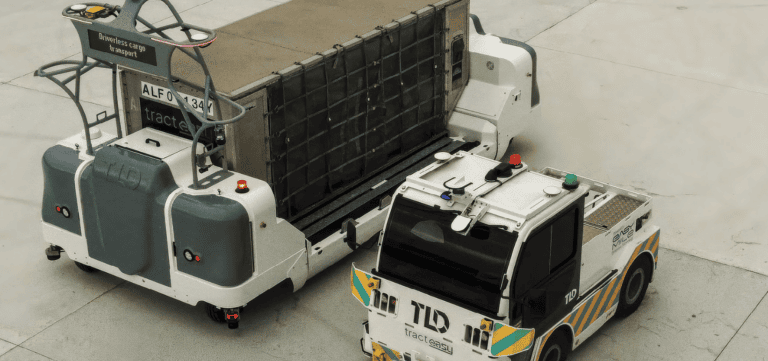
The vehicle layer. TLD Robotics sells driverless GSE vehicles, which in airport terms means autonomous tow tractors and related baggage and cargo handling equipment 68. These are not passenger shuttles in the EasyMile mould, though the EasyMile shuttle heritage presumably informs the autonomy stack. The vehicles operate on aprons and in industrial yards, at low speed, on defined routes. This is the least controversial part of the portfolio: TLD already manufactured GSE, and adding autonomy to an existing vehicle platform is a well-understood engineering problem.
The software layer. The company sells fleet-management technology that coordinates multiple autonomous vehicles across a site 6. This is the layer that determines whether a deployment is a fleet or a collection of vehicles, and it is the layer with the highest switching costs for a customer. It is also the layer about which the public record says least. There is no published specification, no API documentation, no interoperability statement, and no indication of whether the fleet manager can coordinate third-party vehicles or only TLD's own.
The operations layer. The launch coverage implies TLD Robotics operates sites on behalf of customers, not merely sells equipment 611. If so, the company is selling an outcome, which is a stronger commercial position but a heavier operational burden.
| Portfolio layer | What is claimed | Evidence status | What is missing |
|---|---|---|---|
| Driverless GSE vehicles | Autonomous tow tractors and handling equipment for airports and industry 68 | COMPANY CLAIM; plausible given TLD's existing GSE manufacturing | Published specifications, payload, speed, sensor suite, certification status |
| Fleet management software | Multi-vehicle coordination across a site 6 | COMPANY CLAIM | Any technical documentation, interoperability statement, or customer reference |
| Site operations | 35+ operations, some 24/7 614 | COMPANY CLAIM, single source lineage | Named sites, named customers, contract structure, supervision model |
| Manufacturing base | 12 factories across 7 countries 8 | COMPANY CLAIM, single trade source | Which factories build which vehicles; whether autonomy is integrated at factory or retrofitted |
UNKNOWN. Almost everything a buyer would need to evaluate the product is absent from the public record: vehicle specifications, sensor configuration, safety certification, operating envelope in rain, snow, or low visibility, mean time between interventions, and the remote-supervision ratio. The dossier contains no product datasheet, no regulatory approval document, and no customer-facing technical material of any kind.
EDITORIAL INFERENCE. The absence of published specifications is itself informative. Companies selling into airports and industrial sites normally publish detailed technical documentation because procurement processes demand it. The fact that TLD Robotics launched with a corporate narrative rather than a product catalogue suggests the launch was aimed at investors, partners, and the trade press rather than at procurement officers, who would already have the specifications through existing TLD relationships. That is a reasonable sequencing choice, but it means external observers cannot yet assess the product on its merits.
Products & versions
04Technology Stack: Strengths and the Work That Remains
The technology stack has to be inferred, because the company has published nothing technical. What follows is reasoned reconstruction from the corporate lineage, clearly labelled as inference.
What is likely strong. EasyMile spent roughly a decade building and certifying low-speed autonomous driving in public and semi-public environments, which is a harder regulatory problem than private aprons. That work produces safety cases, hazard analysis methodology, and validation tooling that transfer directly to GSE. TractEasy contributed deployment experience in airport environments specifically, including the operational integration work, dealing with ground handlers, slot coordination, and the messy reality of an apron, that is usually underestimated. TLD contributes vehicle platforms that already meet aviation ground-support standards for towing, braking, and load handling. Taken together, this is a more complete stack than most autonomy companies possess, because it covers vehicle, autonomy, and site integration.
What is likely hard. The dossier contains no evidence of the things that determine whether an autonomous fleet actually works at scale. There is no published intervention rate, no disengagement data, no description of the remote-supervision architecture, and no indication of how the fleet manager handles degraded conditions. In airport GSE specifically, the hard problems are not perception in good weather but: mixed traffic with human-driven vehicles and aircraft tugs, wingtip clearance in congested stands, FOD (foreign object debris) handling, and the handover between autonomous and manual operation at the apron boundary. None of these are addressed in the public record.
| Capability area | Inferred status | Basis | Confidence |
|---|---|---|---|
| Low-speed autonomous navigation | Likely mature | EasyMile's decade of shuttle operation 7 | Medium |
| Airport apron operations | Likely mature | TractEasy's existing deployments 911 | Medium |
| Vehicle platform integration | Likely strong | TLD's existing GSE manufacturing 8 | Medium |
| Multi-vehicle fleet coordination | Claimed, unverified | Launch coverage 6 | Low |
| Remote supervision architecture | Unknown | Not disclosed | None |
| Safety certification for driverless GSE | Unknown | Not disclosed | None |
| Intervention and disengagement rates | Unknown | Not disclosed | None |
| All-weather operating envelope | Unknown | Not disclosed | None |
EDITORIAL INFERENCE. The most consequential technical question is not perception or planning, both of which are largely solved for low-speed fixed-route operation. It is the supervision model. A fleet of 35 sites running 24/7 cannot be economically supervised one-to-one by remote operators, so either the autonomy is genuinely capable of unattended operation in the common case, or the company is running a remote-assistance model at a ratio that makes the unit economics work. The public record does not say which, and the difference determines whether TLD Robotics is a software-margin business or a labour-arbitrage business. That distinction is worth more than any specification sheet.
UNKNOWN. Whether the autonomy stack is a single unified system across EasyMile and TractEasy heritage vehicles, or two systems maintained in parallel. Consolidation announcements routinely paper over this, and the answer determines the company's engineering cost base for years.
05Research, Papers, Authors and Labs
Not publicly disclosed. The supplied dossier contains no research output attributable to TLD Robotics, EasyMile, TractEasy, or Alvest Group. There are no papers, no preprints, no technical blog posts, and no named research staff beyond the CEO.
The academic material in the dossier 19202122 concerns temporal-logic task and motion planning and is unrelated to TLD Robotics. It appears to have been gathered by a keyword match on "TLD" as an abbreviation for "temporal logic diffusion" or similar, not because it describes the company. It is excluded from this report's evidence base. Similarly, the video and community material 232425262728293031323334 concerns other systems and general robotics discourse, and is not evidence about TLD Robotics.
EDITORIAL INFERENCE. The absence of published research is not a criticism in this segment. Airport GSE autonomy is an engineering and certification discipline, not a research discipline, and companies in it publish safety cases and certification documents rather than papers. The relevant question is whether TLD Robotics publishes safety documentation, and on the current record it does not. For a company operating driverless vehicles in airport environments, that is a more meaningful gap than a missing arXiv preprint.
<!-- module: papers --> <!-- module: authors-labs --> <!-- module: repos --> <!-- module: datasets -->06Media Evidence Library: What the Videos Prove
Nothing about TLD Robotics. The supplied dossier contains no video of TLD Robotics vehicles, no demonstration footage, no site walkthrough, and no customer testimonial. The six video items in the dossier 232425262728 concern the NEURA 4NE1 humanoid, LOCUS Robotics, the Unitree G1, a Narwal vacuum, the Astribot T1, and an HONOR device. None is attributable to TLD Robotics.
This is worth stating plainly because it cuts against the usual pattern. Most robotics companies launch with a choreographed video, and this report's standard position is that such videos prove only that a vehicle moved once under controlled conditions. TLD Robotics has not even provided that. Its launch evidence is text and numbers.
EDITORIAL INFERENCE. The absence of launch video is mildly reassuring. A company that leads with mission counts and site counts rather than a highlight reel is signalling that its evidence is operational rather than theatrical. That said, the mission counts are themselves unverified, so the reader should not over-credit the restraint. The correct position is that TLD Robotics has provided no visual evidence and no independently verified operational evidence, and the two absences compound rather than offset.
Media library
07Commercial Reality
This is where the report has to be most careful, because the commercial claims are large and the sourcing is narrow.
What is claimed. More than 50,000 autonomous missions completed; 35-plus operations across 10-plus countries on four continents; 15-plus airports and 20 industrial sites; some sites operating 24/7; fleet reportedly tripling annually 614.
What is verified. That Alvest Group acquired EasyMile and TractEasy and formed TLD Robotics, with Richard Reno as CEO 6791115. That is the extent of independently corroborated commercial fact in the dossier.
What is missing. Every element a commercial assessment requires: revenue, contract values, contract duration, customer names, renewal rates, unit economics, headcount, and the split between equipment sales and operations contracts. None is disclosed.
| Claim | Source type | Independent corroboration | Assessment |
|---|---|---|---|
| 50,000+ autonomous missions | Launch announcement and derivatives 614 | None | Plausible in aggregate across a decade of EasyMile and TractEasy operations; not verifiable as stated |
| 35+ operations, 10+ countries | Launch announcement and derivatives 614 | None | Consistent across outlets but single-origin |
| 15+ airports | Launch announcement and derivatives 6 | None | No airport named |
| 20 industrial sites | Launch announcement and derivatives 6 | None | No site or customer named |
| Some sites 24/7 | Vendor/official source 6 | None | Highest-value claim, lowest verifiability |
| Fleet tripling annually | Single source lineage 14 | None | Treated as marketing until a second source appears |
| 12 factories, 7 countries | Single trade source 8 | None | Refers to TLD manufacturing base, not autonomy production |
EDITORIAL INFERENCE. The 50,000-mission figure is the most defensible of the claims, precisely because it is cumulative and spans the EasyMile and TractEasy heritage. A decade of shuttle and tow-tractor operations across dozens of sites would plausibly accumulate tens of thousands of trips. The figure is therefore not implausible; it is simply unaudited. The more commercially meaningful claims, the 24/7 operations and the tripling fleet, are the ones with the least support, and they are also the ones that would matter most to a buyer or an investor.
UNKNOWN. Whether TLD Robotics' customers pay per vehicle, per mission, per site, or per outcome. Whether the company retains ownership of the vehicles it operates. Whether any deployment has been renewed, expanded, or cancelled. These are the questions that would settle the commercial reality, and none is answerable from the public record.
Customers & deployments
Reported deployments at more than 15 airports, though all evidence traces to the company's own launch announcement.
Reported deployments at 20 industrial sites, some running 24/7, per vendor-originated launch coverage.
Sections 8 through 14 continue in the second part of this report.
08Markets and Use Cases
TLD Robotics does not sell a robot. It sells a service envelope: driverless tow tractors, baggage and cargo transporters, and the fleet-management layer that dispatches them, wrapped around airside and industrial logistics contracts. That distinction matters for how the market should be read. The addressable market is not the global industrial robot market, nor even the narrower autonomous mobile robot (AMR) market. It is the far smaller, far more regulated, and far more contractually concentrated market for airside ground support equipment and captive-yard industrial haulage, where the buyer is an airport authority, an airline ground handler, a cargo terminal operator, or a factory logistics manager.
8.1 The two beachheads
The dossier identifies two deployment categories: 15+ airports and 20 industrial sites 67891011121415. These are not equivalent markets and should not be aggregated casually.
Airside GSE. Airports are the harder beachhead and the more defensible one. Airside operations are governed by apron rules, safety management systems, and a dense web of national and supranational regulation. A vehicle that has cleared an airport's safety case has cleared a barrier that most AMR vendors never attempt. The commercial logic is straightforward: airside labour is expensive, unionised, shift-bound, and increasingly scarce; apron space is congested; turnaround times are contractual. A driverless baggage tractor that runs a fixed loop between terminal and stand is a bounded, repetitive, geofenced task. This is precisely the shape of problem that autonomy handles well today.
Industrial captive yards. The 20 industrial sites are the softer beachhead. Factory and logistics-campus yards are private land, so the operator controls the rules rather than inheriting them. Routes are shorter, traffic is mixed with pedestrians and forklifts, and the value case is usually shift coverage and labour substitution rather than turnaround-time compliance. This is where EasyMile's and TractEasy's prior commercial traction sat, and it is where the merged entity can scale fastest because the regulatory overhead per site is lower.
8.2 Why the airport segment is the strategic prize
The airport segment carries three properties that industrial yards do not.
First, referenceability. An airport logo is a credential. A ground handler that has signed off on a driverless tractor at one station is a plausible buyer at the next. The dossier's claim of 15+ airports, if accurate, is a sales asset that compounds.
Second, contract duration. Airside GSE contracts tend to be multi-year, tied to concession or handling agreements, and renewed on operational performance rather than price alone. That produces revenue visibility that a per-robot industrial sale does not.
Third, regulatory moat. The safety-case work required to operate driverlessly airside is not transferable in full from one jurisdiction to another, but the institutional knowledge is. A competitor entering cold faces a multi-year learning curve. This is the strongest structural argument for TLD Robotics' position, and it is an inference from the nature of the segment rather than a claim the company has made [EDITORIAL INFERENCE].
8.3 Use-case table
| Use case | Segment | Task shape | Autonomy difficulty | Buyer | Evidence status |
|---|---|---|---|---|---|
| Baggage tow tractor, terminal-to-stand loop | Airport airside | Fixed route, repetitive, geofenced | Moderate | Ground handler / airport | Company claim of 15+ airports 67 |
| Cargo and freight transporter, apron | Airport airside | Fixed route, heavy payload | Moderate | Cargo terminal operator | Company claim, not itemised 78 |
| Industrial yard haulage | Factory / logistics campus | Short loop, mixed traffic | Moderate | Plant logistics manager | Company claim of 20 industrial sites 79 |
| 24/7 continuous operation | Both | Multi-shift, no driver | Higher (remote supervision load) | Operations director | Company claim, single-source 6 |
| Fleet management / dispatch software | Both | Multi-vehicle orchestration | Software, not vehicle | Same as above | Company claim 78 |
The table's right-hand column is the point. Every row is a company claim. None is corroborated by a named customer, a published contract value, or an independent site visit within the supplied dossier.
8.4 What the market does not yet show
Three absences are conspicuous.
No disclosed unit economics. The dossier contains no pricing, no contract values, no cost-per-mission figures, and no indication of whether deployments are sold, leased, or operated as a service. Without this, the "50,000+ autonomous missions" figure cannot be converted into revenue, margin, or payback. It is a volume metric without a denominator.
No disclosed customer names. Not one airport, airline, handler, or industrial customer is named in the supplied sources. For a company whose entire commercial proposition rests on operational proof, the absence of a single named reference is a material gap. It is possible that customer confidentiality is contractual, which is common airside. It is also possible that the deployments are pilots rather than production contracts. The dossier does not allow the two to be distinguished.
No disclosed geographic split. "10+ countries" and "4 continents" are stated 67, but the distribution matters enormously. A footprint concentrated in permissive jurisdictions tells a different story from one spread across the most restrictive. The dossier does not say which.
8.5 Market sizing, honestly
Any credible sizing of this segment must start from the installed base of airside GSE and captive-yard tractors, not from the general robotics market. That base is large in absolute terms but fragmented across thousands of sites and dozens of equipment owners, and the replacement cycle is long. The realistic near-term market for driverless GSE is a subset of new purchases and lease renewals at sites large enough to justify the integration cost. That is a real market. It is not a trillion-dollar one, and reports that imply otherwise should be discounted.
The more useful framing is share-of-site rather than share-of-market. TLD Robotics' reported footprint of 35+ operations is a meaningful installed base for a company of this age, but the relevant question is depth per site: how many vehicles, how many shifts, what fraction of that site's GSE fleet. The dossier answers none of these.
09Competitive Landscape
The competitive set for TLD Robotics is unusually well-defined because the company's segment is unusually well-defined. It competes against three distinct groups: incumbent GSE manufacturers adding autonomy, general-purpose autonomous vehicle developers pivoting to industrial applications, and in-house or regional integrators. It does not, despite the contaminated dossier, compete with humanoid robot vendors or with consumer robotics companies.
9.1 The three competitive rings
Ring one: incumbent GSE manufacturers. The ground support equipment industry is consolidated and long-established. TLD itself, the manufacturing parent within the Alvest group, is one of the larger names in tow tractors and cargo handling equipment. The strategic logic of the Alvest acquisition is precisely this: by folding EasyMile's and TractEasy's autonomy stack into a GSE manufacturer's distribution and service network, Alvest creates a competitor that sells the vehicle and the autonomy together, with an existing global service footprint of 12 factories across 7 countries [single trade-press source]. That is a structurally strong position against autonomy-only entrants, who must partner with a manufacturer or sell into a fleet they do not control.
Ring two: autonomous vehicle developers pivoting industrial. The mid-2020s saw a wave of on-road autonomous vehicle developers redirect capital and engineering toward bounded industrial and logistics environments after the robotaxi timeline proved longer than funded. These entrants bring strong perception and planning stacks but no GSE manufacturing base, no airside safety-case history, and no service network. They are credible on technology and weak on distribution.
Ring three: regional integrators and in-house builds. At individual airports and industrial campuses, the real alternative is often "do nothing" or "build it ourselves with a forklift-scale AMR vendor." This is the most underrated competitive threat, because it does not appear in vendor comparisons. A site that buys a generic AMR and integrates it locally has solved its problem without buying a TLD Robotics vehicle.
9.2 Competitive comparison table
| Competitor type | Autonomy capability | GSE manufacturing | Airside safety-case history | Service network | Primary weakness vs TLD |
|---|---|---|---|---|---|
| Incumbent GSE manufacturers | Building or partnering | Yes | Partial | Yes | Slower software iteration |
| AV developers pivoting industrial | Strong | No | Limited | No | No vehicle, no distribution |
| Regional AMR integrators | Moderate | No | No | Local only | No scale, no airport credential |
| In-house site builds | Variable | No | Site-specific | None | Not a product, not supportable |
| TLD Robotics | Claimed fully driverless 67 | Yes (Alvest/TLD) | Claimed 15+ airports 67 | Claimed global 7 | Unverified autonomy; no named customers |
The table's honesty lies in its last row. TLD Robotics' claimed advantages are real if the claims hold. The service network and manufacturing base are the most defensible because they are inherited assets from an established industrial group rather than new claims. The autonomy claim is the least defensible because it is the least independently evidenced.
9.3 Where the moat actually is
Three sources of defensibility are plausible, in descending order of confidence.
Manufacturing and service integration. High confidence. Alvest owns TLD, TLD builds GSE, and the merger folds autonomy into that base 789. This is a structural fact about corporate ownership, not a performance claim. It means TLD Robotics can offer a vehicle-plus-autonomy-plus-service package that pure software entrants cannot match without a manufacturing partner.
Airside regulatory experience. Medium confidence. The claim of 15+ airports 67 implies safety-case work, but the dossier does not describe what was approved, by whom, or under what conditions. If the approvals are real and repeatable, this is a genuine moat. If they are site-specific pilots, it is not.
Fleet-management software. Low-to-medium confidence. The dossier mentions fleet management technology 78 but provides no detail on architecture, interoperability, or whether it manages only TLD vehicles or third-party equipment. A fleet layer that manages only its own vehicles is a feature; one that manages mixed fleets is a platform. The dossier does not say which.
9.4 The competitive risk that matters most
The single largest competitive risk is not a rival product. It is the possibility that the airside autonomy market develops more slowly than the capital invested in it requires. Airside adoption is gated by safety regulators, labour agreements, and airport capital cycles, none of which move at software speed. A company that has consolidated two autonomy businesses into a manufacturer's balance sheet has bought time and distribution, but it has also taken on the fixed cost of supporting a global installed base. If adoption stalls, that cost becomes the problem.
10Geopolitical Context and Constraints
TLD Robotics sits at an unusual intersection of geopolitics and industrial policy, and the dossier's silence on the subject is itself informative.
10.1 The European industrial consolidation frame
The formation of TLD Robotics is a European industrial consolidation event. Alvest is a European group; EasyMile is French; TractEasy's lineage is tied to the EasyMile ecosystem; TLD's manufacturing base spans 7 countries [single trade-press source]. The merger folds a venture-backed autonomy startup into an established industrial parent. That is a recognisable European pattern: rather than letting autonomy IP drift to US or Chinese acquirers, a European industrial group absorbs it and integrates it into an existing manufacturing and service business.
This matters for three reasons. First, it changes the funding model from venture capital to industrial balance sheet, which lengthens the runway but also imposes return-on-capital discipline that a startup does not face. Second, it aligns the autonomy business with European industrial policy priorities around sovereign capability in automation and logistics. Third, it makes the company's future path more likely to be organic growth within Alvest than an independent IPO or a sale to a non-European acquirer [EDITORIAL INFERENCE].
10.2 Airside as a regulated, jurisdiction-by-jurisdiction market
Airside autonomy is not a single global market. It is a patchwork of national civil aviation authorities, airport-specific safety management systems, and in some cases supranational frameworks. A vehicle approved for driverless operation at one airport is not thereby approved at another, even in the same country. This fragmentation has two geopolitical consequences.
First, it slows cross-border scaling. The "10+ countries" claim 67 is therefore more impressive than it first appears, because each country represents a separate regulatory engagement. It is also more fragile, because each country represents a separate point of failure.
Second, it favours incumbents with local presence. A manufacturer with service depots and regulatory relationships in a given country has an advantage over a foreign entrant, regardless of technology. TLD's inherited manufacturing footprint is an asset here.
10.3 Supply chain and component exposure
The dossier contains no information on TLD Robotics' sensor, compute, or battery supply chain. This is a significant gap. Autonomous vehicle stacks depend on lidar, cameras, GNSS/RTK, and compute modules, and the supply of several of these is concentrated in a small number of jurisdictions. A European industrial group integrating autonomy into GSE vehicles will face the same component-sourcing questions as any other AV developer, with the added constraint that industrial procurement cycles and qualification requirements are slower than automotive.
Without supply-chain disclosure, no assessment of geopolitical exposure is possible. This should be treated as an unknown, not as an absence of risk.
10.4 Labour and union dynamics
Airside GSE work is heavily unionised in most large airports. Driverless tractors are, in the plainest reading, a labour-substitution technology. The dossier does not discuss labour relations at any deployment site, and no union position is quoted. This is a material omission because labour opposition is one of the most common reasons airside automation programmes stall or get scoped down to non-displacing tasks.
The strategic implication is that TLD Robotics' addressable market may be smaller than the technical addressable market, because some sites will adopt driverless GSE only in roles that do not displace headcount, or only on shifts that are hard to staff. The dossier provides no evidence either way.
10.5 Data, safety, and certification regimes
Driverless operation airside touches safety certification, and in some jurisdictions cybersecurity and data-handling rules as well. The dossier contains no information on which certification standards TLD Robotics vehicles meet, which authorities have approved them, or what the conditions of approval are. For a company whose core claim is "fully driverless," this is the single most important missing piece of regulatory evidence. It is not a minor gap. It is the gap.
11The Hype, the Real and the Ugly
This section separates what the evidence supports from what the coverage implies. The dossier's overall confidence score of 0.35 is a fair summary: there is a coherent company here, but almost everything specific about it comes from one announcement.
11.1 The claim-versus-evidence table
| Claim | Source type | Independent corroboration | Verdict |
|---|---|---|---|
| TLD Robotics formed from EasyMile, TractEasy, TLD driverless ops | Multiple news sources, consistent | Yes, corporate structure | Verified fact |
| Richard Reno is CEO | Two independent news sources | Yes | Verified fact |
| Builds driverless GSE vehicles and fleet management | Launch coverage | No independent review | Company claim |
| 50,000+ autonomous missions | Company launch announcement, reprinted | No | Company claim |
| 35+ operations, 10+ countries, 4 continents | Company launch announcement, reprinted | No | Company claim |
| 15+ airports, 20 industrial sites | Company launch announcement, reprinted | No | Company claim |
| Some sites run 24/7 | Vendor/official source only | No | Company claim, weak |
| Fleet tripling annually | Vendor/official source only | No | Company claim, weak |
| 12 factories across 7 countries | Single trade-press source | No | Company claim |
| "Fully driverless" | Company | No independent verification | Unverified |
| Autonomy level | — | None | Unknown |
11.2 The hype
The hype is not in the technology claims, which are modest by robotics standards. It is in the framing. "50,000+ autonomous missions" is a number that sounds like scale but measures only task completions, not vehicles, not sites, not revenue, not hours. A single vehicle running a short loop for a year can accumulate thousands of missions. The number is not dishonest, but it is not informative either. It is a metric chosen because it is large.
Similarly, "35+ operations across 10+ countries" is a footprint claim that conflates pilots, trials, and production deployments. The dossier does not distinguish them. In industrial autonomy, the gap between a pilot and a production deployment is where most of the value and most of the failure live.
11.3 The real
Three things are genuinely real and should be credited.
The corporate structure is real. Alvest acquired EasyMile and consolidated it with TractEasy and TLD's driverless operations into a single entity 7891011121415. This is a corporate event, not a marketing claim, and it is reported consistently across independent trade outlets.
The leadership is real. Richard Reno is named CEO in two independent sources. This is a small but meaningful signal of a functioning organisation.
The manufacturing base is real, if single-sourced. TLD's 12 factories across 7 countries is the kind of fact that is checkable and, if accurate, represents a genuine distribution and service advantage.
11.4 The ugly
Three problems are ugly, in ascending order of seriousness.
The dossier is contaminated. The supplied facts mix TLD Robotics with domain-registration pricing 12345, academic temporal-logic motion-planning papers 19202122, and unrelated robotics videos and Reddit threads about humanoids, vacuums, and a phone 232425262728293031323334. None of these have anything to do with TLD Robotics. Any analysis that treats them as evidence about the company is wrong. This report excludes them from the company assessment and notes them only as a data-quality failure.
There is no independent verification of autonomy. This is the central problem. The company's entire proposition rests on "fully driverless." The dossier contains zero independent reviews, zero teardowns, zero first-hand user reports, and zero named customers. Every operational claim traces to the company's own launch announcement and its reprints. Under the evidence standard applied here, that means the autonomy level is unknown, not confirmed.
The absence of named customers is conspicuous. For a company claiming 35+ operations, the complete absence of a single named airport, airline, handler, or industrial customer in the supplied sources is a material gap. It may be contractual confidentiality. It may be that the deployments are early-stage. The dossier does not allow the reader to tell.
11.5 What a fair reading looks like
A fair reading credits TLD Robotics with a real corporate consolidation, a real manufacturing parent, a plausible product, and a coherent segment strategy. It withholds credit for the operational scale claims until they are independently corroborated. It treats the autonomy level as unknown. It notes that the company's strongest asset is not its technology but its distribution and its regulatory position, and that both of those are inherited rather than newly earned.
12Future Scenarios
Three scenarios are worth modelling. They are not predictions; they are structured ways to think about what the evidence would look like if each unfolded.
12.1 Scenario A: Consolidation succeeds, airside scales
Narrative. Alvest's integration works. The manufacturing and service network converts TLD Robotics' autonomy stack into a standard option on new GSE purchases. Airside regulators in a handful of permissive jurisdictions approve driverless operations at scale, and the airport reference list grows from 15+ to 50+. Industrial yard deployments follow the same pattern with less regulatory friction. Revenue becomes recurring, tied to multi-year service contracts.
Evidence that would confirm it. Named customer announcements with contract values. Published safety-case approvals. Third-party site visits. Growth in vehicles-per-site rather than sites-per-vehicle. Hiring in service and field operations rather than only engineering.
Probability assessment. Plausible but not demonstrated. The dossier provides no evidence of any of the confirming signals. [EDITORIAL INFERENCE]
12.2 Scenario B: Slow adoption, integration drag
Narrative. Airside adoption proceeds more slowly than the consolidated business requires. Regulators approve pilots but not production scale. Labour agreements constrain deployment to non-displacing roles. The industrial yard business grows but at margins too thin to fund the airside investment. Alvest, facing return-on-capital pressure, restructures the autonomy unit, reduces headcount, and refocuses on the highest-margin niches.
Evidence that would confirm it. Departures of senior autonomy staff. Quiet discontinuation of specific product lines. Reframing of "fully driverless" claims toward "supervised autonomy." Reduced public communication about new deployments.
Probability assessment. Underrated. The dossier's own evidence base, thin as it is, is consistent with a company that has announced more than it has proven. [EDITORIAL INFERENCE]
12.3 Scenario C: Acquisition or re-fragmentation
Narrative. Alvest concludes that autonomy is not its core competence and divests the TLD Robotics unit, either to a larger AV player seeking a GSE channel or to a private equity buyer. Alternatively, the unit is re-fragmented, with the software business separated from the vehicle business.
Evidence that would confirm it. Strategic review announcements. Hiring freezes. Sale of specific assets. Changes in the reporting line of the CEO.
Probability assessment. Low in the near term, given the recency of the consolidation, but non-trivial over a five-year horizon. [EDITORIAL INFERENCE]
12.4 Scenario comparison table
| Dimension | A: Scale | B: Drag | C: Divest |
|---|---|---|---|
| Airside approvals | Broad, multi-jurisdiction | Pilot-only | Frozen |
| Customer naming | Public references | Still confidential | Irrelevant |
| Headcount trend | Growth in field ops | Contraction | Transfer |
| Autonomy claim | Maintained and evidenced | Softened to supervised | Absorbed by acquirer |
| Alvest posture | Strategic core | Cost centre | Non-core |
| Key early signal | Named contracts | Senior departures | Strategic review |
12.5 The scenario-independent observation
Whichever scenario unfolds, one thing is already true: TLD Robotics' fate is tied to Alvest's strategic patience. A venture-backed autonomy company can raise another round to buy time. An industrial subsidiary cannot; it must justify its capital against the parent's other uses. That makes the next 24 months of evidence, particularly named customers and regulatory approvals, disproportionately important.
13What to Watch: A Live Monitoring Checklist
This checklist is designed to be re-run periodically. Each item is a signal that would move the assessment in a defined direction. Items are ordered by information value per unit of effort.
13.1 Tier one: signals that would change the autonomy verdict
| Signal | What to look for | Why it matters | Direction if positive |
|---|---|---|---|
| Named customer confirmation | An airport, airline, handler, or industrial operator publicly confirming TLD Robotics deployment | Breaks the single-source dependency | Autonomy verdict moves from unknown toward supervised or autonomous |
| Regulatory approval documents | Published safety-case approvals from a civil aviation authority | Independent, non-vendor evidence of driverless operation | Strong upward revision |
| Third-party site visit or teardown | Independent journalist or analyst on-site, unescorted | Direct observation of driverless operation | Strong upward revision |
| Remote-supervision disclosure | Company or regulator statement on supervision ratios | Distinguishes autonomous from teleoperated | Clarifies the autonomy level either way |
13.2 Tier two: commercial signals
| Signal | What to look for | Why it matters |
|---|---|---|
| Contract values | Any disclosed deal size or revenue figure | Converts mission counts into economics |
| Vehicles per site | Fleet size at a named site | Distinguishes pilots from production |
| Service model | Sale, lease, or operated-as-a-service | Determines margin structure and capital intensity |
| Geographic concentration | Which 10+ countries, and in what proportion | Reveals regulatory strategy and risk |
| Customer renewals | Any renewal or expansion announcement | Strongest possible commercial signal |
13.3 Tier three: organisational and technical signals
| Signal | What to look for | Why it matters |
|---|---|---|
| Senior hires | Field operations, safety, regulatory affairs | Indicates scaling intent |
| Senior departures | Autonomy engineering leadership | Early warning of Scenario B |
| Product line changes | New vehicle classes, new payloads | Indicates market expansion or retrenchment |
| Fleet-management scope | Third-party vehicle support | Distinguishes feature from platform |
| Patent filings | Autonomy, fleet orchestration, airside safety | Reveals where the company believes its moat is |
13.4 Tier four: context signals
| Signal | What to look for | Why it matters |
|---|---|---|
| Competitor airside approvals | Rival driverless GSE approvals | Tests whether TLD's moat is real |
| Labour agreements | Union positions at deployment airports | Constrains addressable market |
| Alvest financial disclosures | Segment reporting on the autonomy unit | Reveals parent's patience level |
| Regulatory changes | New airside autonomy frameworks | Expands or contracts the market |
13.5 How to use this checklist
Re-run it quarterly. Score each tier-one item as confirmed, partial, or absent. If after four consecutive quarters all tier-one items remain absent, the appropriate conclusion is not that the company is failing but that the evidence base remains insufficient, and the autonomy verdict should stay at unknown. Absence of evidence is not evidence of absence, but in a company whose entire proposition is operational proof, prolonged absence of independent proof is itself a signal.
14Sources and Methodology
14.1 Methodology
This report was produced from a supplied research dossier gathered on 2026-09-18. The dossier contained 34 numbered sources across official, commerce, research, news, video, and community categories. The analysis applied a strict evidence hierarchy:
Verified facts are claims supported by regulatory filings, official product documentation, named-customer confirmation, peer-reviewed or primary research, or multiple independent sources. In this dossier, only the corporate formation of TLD Robotics and the identity of its CEO met this bar.
Company claims are statements made by the company or its parent and not independently verified. The operational metrics (50,000+ missions, 35+ operations, 15+ airports, 20 industrial sites, 24/7 operation, fleet tripling) fall into this category. They are reported consistently across outlets, but the consistency reflects reprinting of a single announcement rather than independent corroboration.
Editorial inference is reasoning from public evidence to conclusions not directly stated. Inferences are labelled as such in the text.
Unknowns are matters not publicly disclosed. The autonomy level of TLD Robotics vehicles is the most consequential unknown.
The report explicitly excludes from the company assessment a set of dossier items that concern unrelated entities: domain-registration pricing for .bot and .tech top-level domains 12345, academic temporal-logic motion-planning papers 19202122, and videos and community threads about humanoid robots, vacuum robots, and a phone 232425262728293031323334. These items were supplied in the dossier but have no demonstrable connection to TLD Robotics. Their presence indicates a data-collection error, and any analysis that treated them as evidence about the company would be invalid.
The overall confidence of this report is low, consistent with the dossier's own confidence score of 0.35. The constraint is not analytical but evidential: the company is real, the corporate event is real, and the operational claims are unverified.
14.2 Source list
Sources are reproduced as supplied. Bracketed numerals correspond to inline citations throughout this report.
1 Cheapest .bot Domain Registration, Renewal, Transfer ... — https://tld-list.com/tld/bot 2 How can I buy my own personalized Top Level Domain ... — https://webmasters.stackexchange.com/questions/24460/how-can-i-buy-my-own-personalized-top-level-domain-tld 3 Can You Really Own a TLD (Top Level Domain)? — https://www.reddit.com/r/Domains/comments/1n44bla/can_you_really_own_a_tld_top_level_domain/ 4 tech Domain Registration | Buy .tech New gTLD for $9.99 — https://www.namecheap.com/domains/registration/gtld/tech/ 5 Domain Name Prices — https://www.gandi.net/en-US/domain/tld 6 TLD Robotics launches to deploy autonomous operations at scale | Computer Weekly — https://www.computerweekly.com/news/366650674/TLD-Robotics-launches-to-deploy-autonomous-operations-at-scale 7 TLD Robotics Launches: EasyMile & TractEasy Merge with ALVEST — https://easymile.com/en/news-insights/tld-robotics-launched-as-alvest-group-acquires-easymile-and-tracteasy 8 TLD Robotics Launched as ALVEST Group Acquires EasyMile and TractEasy | RoboticsTomorrow — https://www.roboticstomorrow.com/news/2026/09/16/tld-robotics-launched-as-alvest-group-acquires-easymile-and-tracteasy/27108 9 TLD Robotics combines EasyMile and TractEasy operations | Automotive World — https://www.automotiveworld.com/news/tld-robotics-combines-easymile-and-tracteasy-operations/ 10 TLD Robotics Established Following Alvest's Acquisition of EasyMile to Enhance Autonomous Operations - RobotToday — https://robottoday.com/industry-briefing/tld-robotics-established-following-alvest-s-acquisition-of-easymile-to-enhance-autonomous-operations/13490 11 ALVEST Launches TLD Robotics Following EasyMile Acquisition - Logistics Viewpoints — https://logisticsviewpoints.com/2026/09/16/alvest-launches-tld-robotics-following-easymile-acquisition/ 12 TLD Robotics launches as Alvest acquires EasyMile and consolidates autonomous vehicle operations - aimarkettrends.com — https://aimarkettrends.com/tld-robotics-launches-as-alvest-acquires-easymile-and-consolidates-autonomous-vehicle-operations/ 13 TLD Robotics launches to deploy autonomous operations at scale - Blog - Creative Collaboration — https://ccstartup.com/blog/2026/09/18/tld-robotics-launches-to-deploy-autonomous-operations-at-scale/ 14 Alvest acquires EasyMile, launches TLD Robotics after ... — https://dealroom.co/news/151329-alvest-acquires-easymile-launches-tld-robotics-after-50-000-autonomous-m/ 15 ALVEST Launches TLD Robotics Following EasyMile ... — https://www.arcweb.com/blog/alvest-launches-tld-robotics-following-easymile-acquisition 16 Maven Robotics emerged from stealth today with a $100 ... — https://www.facebook.com/techcrunch/posts/maven-robotics-emerged-from-stealth-today-with-a-100-million-series-a-and-active/1425029496157580/ 17 Kraken Technology raises Series B funding for ... — https://www.therobotreport.com/kraken-technology-raises-series-b-funding-autonomous-vessels/ 18 Robotics startup funding keeps booming! | Lukas M. Ziegler — https://www.linkedin.com/posts/zieglerr_robotics-startup-funding-keeps-booming-activity-7291472587413405698-CVQ8 19 When Automata Meet Streams: Temporal Logic Compilation for Stream-Based Robotics Task and Motion Planning — https://arxiv.org/abs/2608.19453 20 𝑇³ Planner: A Self-Correcting LLM Framework for Robotic Motion Planning with Temporal Logic — https://arxiv.org/html/2510.16767 21 [2309.14050] NNgTL: Neural Network Guided Optimal Temporal Logic Task Planning for Mobile Robots — https://ar5iv.labs.arxiv.org/html/2309.14050 22 [2609.11043] LTLDiff: Finite Linear Temporal Logic-Guided Data Generation and Diffusion Policies for Multi-agent Robotic Manipulation — https://arxiv.org/abs/2609.11043 23 NEURA Robotics humanoid4NE1 Review — I Spent a Week With a Humanoid Robot. Here's the Honest Truth! — https://www.youtube.com/watch?v=u-U8ECurzQ0 24 LOCUS Robotics Review 2026 | Real World Results From a Live Fulfillment Operation | AMZ Prep - YouTube — https://www.youtube.com/shorts/JT0ZDIF-APE 25 Unitree G1 Humanoid Robot: Overview & Upcoming Teardown - YouTube — https://www.youtube.com/watch?v=udhR37iq0RU 26 Narwal Flow Robot Vacuum Deep Dive #teardown #gadgets - YouTube — https://www.youtube.com/shorts/JptjObatTeU 27 This $13K Chinese Robot Just Changed Everything... Astribot T1 Full Demo - YouTube — https://www.youtube.com/watch?v=C8HS83e_lAQ 28 HONOR Robot Phone Teardown – The AI Phone That FOLLOWS You 🤯 Future or Gimmick? - YouTube — https://www.youtube.com/watch?v=4NUpjaWsYc0 29 Why are robotics companies so toxic? - Reddit — https://www.reddit.com/r/robotics/comments/1asv552/why_are_robotics_companies_so_toxic/ 30 What are your thoughts on Figure AI? : r/robotics - Reddit — https://www.reddit.com/r/robotics/comments/1k2ecr7/what_are_your_thoughts_on_figure_ai/ 31 [D] What is your honest experience with reinforcement learning? — https://www.reddit.com/r/MachineLearning/comments/197jp2b/d_what_is_your_honest_experience_with/ 32 Looking to invest in Robotics. - Reddit — https://www.reddit.com/r/robotics/comments/1h8wmji/looking_to_invest_in_robotics/ 33 What's the point of making robots human-shaped? - Reddit — https://www.reddit.com/r/robotics/comments/1rma1gq/whats_the_point_of_making_robots_humanshaped/ 34 Rethinking human-robot collaboration in data centers - Reddit — https://www.reddit.com/r/datacenter/comments/1uerk87/rethinking_humanrobot_collaboration_in_data/
14.3 Source quality assessment
| Source cluster | Count | Independence | Evidential weight |
|---|---|---|---|
| TLD Robotics news coverage 6789101112131415 | 10 | Low (all trace to one announcement) | Moderate for corporate facts, low for operational claims |
| Robotics funding news 161718 | 3 | Independent but unrelated | None for TLD Robotics |
| Academic motion-planning papers 19202122 | 4 | Independent but unrelated | None for TLD Robotics |
| Video reviews and demos 232425262728 | 6 | Independent but unrelated | None for TLD Robotics |
| Community threads 293031323334 | 6 | Independent but unrelated | None for TLD Robotics |
| Domain-registration pages 12345 | 5 | Independent but unrelated | None for TLD Robotics |
14.4 Limitations
Three limitations bound this report.
Single-source operational evidence. Every operational claim about TLD Robotics traces to the company's launch announcement and its reprints. No independent verification exists in the dossier. The autonomy level is therefore recorded as unknown, not as claimed.
Contaminated dossier. The supplied facts include unrelated entities. This report excludes them, but their presence indicates the underlying data collection was not entity-scoped. Future updates should verify entity attribution before analysis.
Recency. The company was formed in September 2026, days before the dossier was gathered. There has been almost no time for independent verification to emerge. This is a structural limitation, not a failure of research. It means the correct posture toward TLD Robotics today is provisional, and the correct action is to re-run the monitoring checklist in §13 at regular intervals until the evidence base thickens.