Sharpa
US$0.99 unlocks one Word + one PDF download. The full report is free to read on this page.

Sharpa
Singapore's best-funded dexterity play is selling hands to the industry and a story to everyone else; the hands are real, the story is not yet audited.
| Report status | Coverage date | Company stage | Editorial standard |
|---|---|---|---|
| Premium editorial deep report, first edition | Evidence gathered 20 September 2026 | Fully commercial product line (hand in mass production since December 2025); humanoid pre-deployment; direct sales waitlisted | Claims separated from verified facts; no demo treated as proof; no shipment treated as deployment; no partnership treated as revenue |
How to Read This Report
This report is built on a deliberately narrow evidence base. The supplied dossier contains no official regulatory filings, no peer-reviewed research, no first-party video corpus and no community field reports from Sharpa customers. What it does contain is a vendor website, a cluster of funding and mass-production news items, one Google model integration announcement, and a set of commerce and community sources of which the community items are, on inspection, about AI coding tools generally and have nothing to do with Sharpa. Those irrelevant items are excluded from the analysis and are flagged as such in §14.
Every substantive statement below carries one of four labels. Where the dossier is silent, the report says so rather than filling the gap with plausible-sounding inference.
| Label | Meaning | Treatment in this report |
|---|---|---|
| VERIFIED FACT | Confirmed by regulatory filing, official product documentation, named-customer confirmation, peer-reviewed or primary research, or multiple independent sources | Stated as fact; may still be qualified by the narrowness of the source set |
| COMPANY CLAIM | Stated by Sharpa or its agents (including press releases distributed via wire services) and not independently verified | Attributed to the company; never restated as fact |
| EDITORIAL INFERENCE | Reasoned conclusion drawn from public evidence, explicitly labelled as the author's judgement | Presented as argument, with the reasoning shown |
| UNKNOWN | Not publicly disclosed, or disclosed only in forms that cannot be checked | Stated plainly; no padding |
Two structural warnings apply throughout. First, a press release distributed by PR Newswire is a company claim, not independent journalism, even when a news outlet reproduces it 9. Second, a deployment announcement is evidence that a deployment was announced. It is not evidence of autonomous operation, of paid revenue, or of a satisfied customer. The distinction matters acutely for Sharpa, whose most-quoted proof point, a Dairy Queen outlet in Shanghai, rests entirely on vendor-originated material 7.
01Executive Overview
Sharpa is a Singapore-headquartered robotics company founded in late 2024 by a group of former Hesai executives, including Li Yifan, Xiang Shaoqing and Sun Kai, and it has done something unusual in the humanoid supply chain: it has raised a very large amount of money, shipped a genuinely differentiated component into mass production, and attached that component to a consumer-facing story that nobody outside the company has yet been able to verify 6710.
The funding is the least ambiguous part of the picture. Sharpa disclosed a round of over US$618.8M (reported variously as RMB 4.5B+ and US$670M) at a post-money valuation of roughly US$3.03B, with an investor list that reads like a roll-call of Chinese platform capital: Alibaba, Meituan, Tencent, JD.com, Transsion, Sequoia Capital China, Qiming Venture Partners, DragonBall Capital, HSG, Luminous Ventures and Guanghe Venture Capital 6710. Two independent outlets report the same round size and the same first-disclosed-funding status, which is why this report treats the raise and the valuation as VERIFIED FACTS at high confidence, while noting that the precise dollar figure varies with currency conversion and with whether the RMB 4.5B or US$670M framing is used 610.
The product story is more interesting and more fragile. Sharpa sells a 22-active-degree-of-freedom dexterous hand, the SharpaWave, with five-finger independent control, a claimed 1,000-plus tactile sensing units, 6D force sensing, fingertip cameras and a "Dynamic Tactile Array" 39. It also sells, or at least advertises, a 67-DoF full-body humanoid called North built around two Wave hands 35. The hand entered mass production on 16 December 2025, a milestone announced by press release and reported as a milestone rather than audited as a shipment volume 9. The hand is not yet available for direct purchase; there is a waitlist 5. The humanoid has no independent confirmation in the dossier at all.
The autonomy claim is where the report's scepticism concentrates. Sharpa states that North is built to run shifts autonomously, that the system can autonomously complete a 55-step workflow, and that target applications require fully autonomous operation 37. The flagship illustration is a Dairy Queen outlet on Wujiang Road, Shanghai, described as the world's first restaurant capable of year-round autonomous robotic operation without modifications to the existing workspace, with the robot using human tools across that 55-step workflow 7. No independent review, teardown, or first-hand customer account in the dossier confirms that a human is not performing or remotely driving the task. The reconciled autonomy verdict is therefore UNKNOWN, not because there is evidence of teleoperation, but because there is no evidence of anything. Under this report's definitions, "autonomous" requires independent completion with no human performing or remotely driving the task; that has not been established, and neither has supervised autonomy, which would require demonstrated autonomous execution under active human oversight 7.
What is genuinely notable, and what rescues Sharpa from being a pure narrative play, is the component-level traction. The Wave hand served as core verification hardware on Apptronik's Apollo 2, where it completed multi-finger dexterous tasks including tying trash bags and unscrewing 810. Google paired its next-generation robotics foundation model with the Sharpa dexterous hand to complete complex tasks 8. These are the strongest third-party-adjacent signals in the dossier: not because they prove Sharpa's humanoid works, but because they show serious robotics organisations choosing Sharpa's hand as the manipulation interface for their own platforms. That is a real business, and it is a different business from the one the Dairy Queen story implies.
The investment case, in one paragraph: Sharpa is a well-capitalised supplier of a high-specification dexterous hand to OEMs and research institutions, with a plausible path to becoming the reference end-effector for Western and Chinese humanoid programmes, and with a humanoid and a restaurant-automation narrative layered on top that currently outruns the public evidence. The bear case is that the hand's differentiation is contested by entrenched incumbents, the humanoid is unproven, the flagship deployment is unaudited, and the company has never published a price 15. Both cases are live. Neither is settled by the material available.
Latest news
02The Sharpa Story
Sharpa was founded in late 2024, which makes it, at the coverage date of this report, a company of roughly twenty-two months 67. Its founders are described across multiple independent sources as former Hesai executives, with Li Yifan, Xiang Shaoqing and Sun Kai named alongside "and others" 610. Hesai is the lidar manufacturer that became a listed supplier to the automotive and robotics industries; the founder pedigree therefore signals sensor-hardware and automotive-grade manufacturing experience rather than, say, academic manipulation research or consumer product background. That pedigree is consistent with what Sharpa has actually shipped: a sensor-dense end-effector with a heavy emphasis on tactile arrays and force sensing, brought to mass production unusually fast 39.
The corporate structure is distributed in a way that has become common for Chinese-founded, globally-facing robotics firms. The global headquarters is in Singapore, manufacturing and R&D are in Shanghai, and commercial operations sit in Mountain View, California 67. This is a VERIFIED FACT at moderate confidence: the Singapore HQ is corroborated across multiple sources, while the Shanghai and Mountain View split rests on a single news source that is nonetheless consistent with the Singapore-headquartered framing used elsewhere 67. The practical consequence is that Sharpa is simultaneously a Chinese manufacturer, a Singaporean corporate entity and an American commercial presence, which shapes both its access to Chinese platform capital and its exposure to export-control and procurement scrutiny (see §10).
The funding history is short and dramatic. The late-stage round that disclosed over US$618.8M was, per two independent sources, the company's first publicly disclosed funding 67. A company that emerges from stealth with a US$3.03B post-money valuation and a mass-production milestone inside roughly a year of founding is not following the conventional venture trajectory; it is following the trajectory of a strategic supplier that platform capital wants to own before the humanoid supply chain consolidates. The investor list supports that reading: Alibaba, Meituan, Tencent and JD.com are not passive financial backers but potential channel partners and, in Meituan's case, a direct stakeholder in food-service automation, which is precisely the vertical Sharpa chose for its flagship deployment 67.
That flagship deployment is the Dairy Queen outlet on Wujiang Road, Shanghai. Sharpa and its partner describe it as the world's first restaurant capable of year-round autonomous robotic operation without modifications to the existing workspace, with the robot completing a 55-step workflow using human tools 7. The framing is careful and, read closely, revealing: "without modifications to the existing workspace" and "using human tools" are claims about generality and about avoiding bespoke fixture engineering, which is the classic cost barrier in food-service automation. If true, that is a meaningful technical claim. But the source is a news report of a joint opening, based on vendor statements, and the dossier contains no independent verification 7. This report treats the deployment as a COMPANY CLAIM with a real-world footprint (an outlet exists, a robot is present) but an unverified autonomy level.
The roadmap, as reported, is to expand from current customers in robot OEMs, research institutions and food service into more commercial applications and, from 2028, home environments 7. That is a five-year arc from a 2024 founding to home robots, which is aggressive even by the standards of a sector that has learned to be sceptical of aggressive arcs. It is a COMPANY CLAIM and should be treated as directional intent, not as a plan with disclosed milestones, capital allocation or certification pathway behind it.
What the story lacks, and what a reader should notice, is any account of failure, iteration or constraint. There is no public record in the dossier of a product recall, a missed milestone, a customer loss, a technical limitation acknowledged by the company, or a single named engineer outside the founder group. Companies at this stage normally leak some of that texture through hiring posts, conference talks or developer documentation. Sharpa's public surface, as captured here, is unusually polished and unusually closed.
03Product Portfolio: What Sharpa Actually Sells
Sharpa's catalogue, as publicly described, contains two products and one implied platform. The distinction between what is shipping, what is advertised and what is aspirational is the single most important thing to get right in this section.
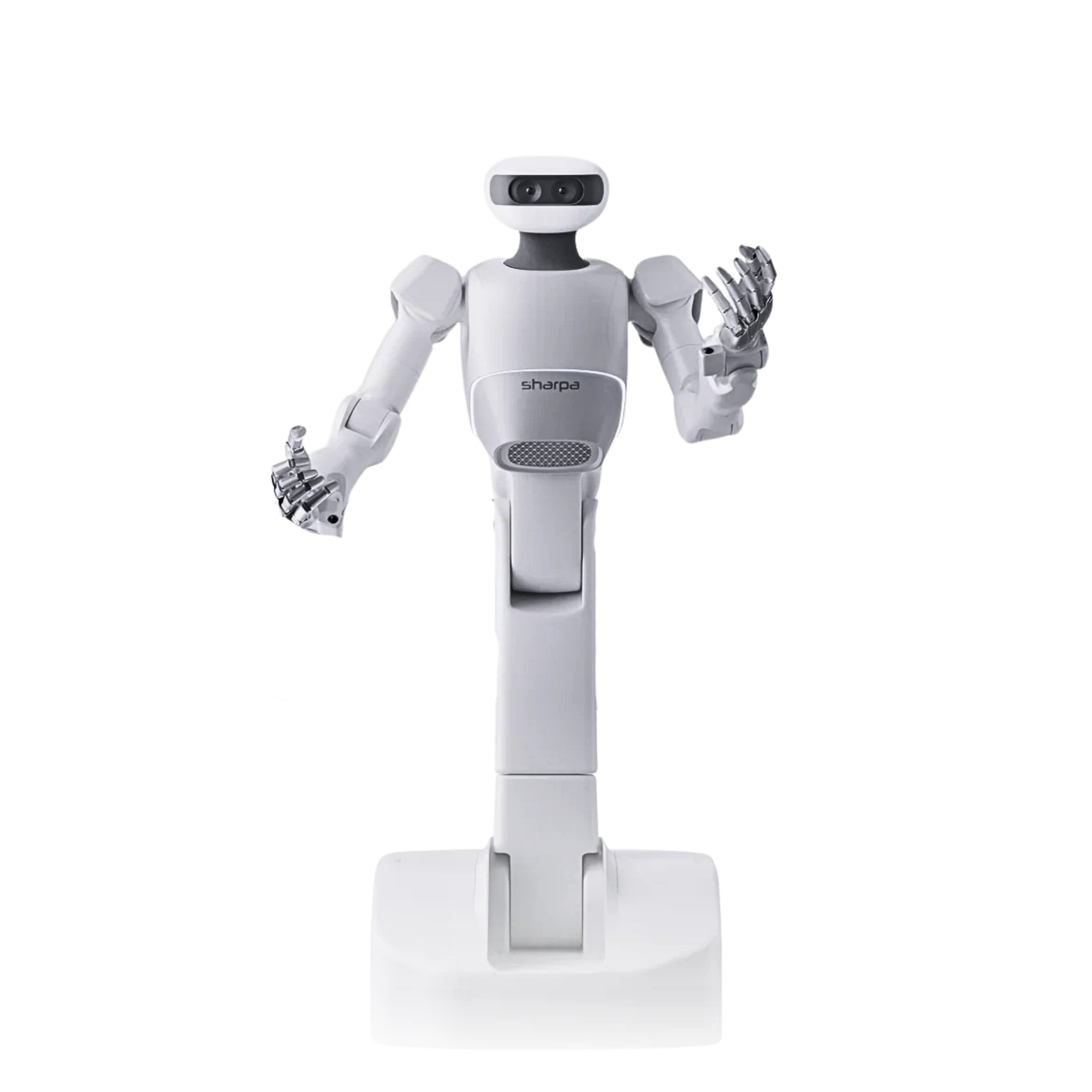
SharpaWave is the dexterous hand and the company's only product with a mass-production milestone attached. The reconciled specification is 22 active degrees of freedom with five-finger independent control, more than 1,000 tactile sensing units or pixels, 6D force sensing, miniature fingertip cameras, and a Dynamic Tactile Array (DTA) 39. Precision is quoted inconsistently across sources: the vendor site and press material cite 0.02 N tactile sensitivity in one framing and 0.005 N precision per fingertip in another 9. Both figures originate with the company, so this is not a vendor-versus-independent conflict but a vendor-versus-vendor ambiguity, most plausibly reflecting two different measurement contexts (threshold sensitivity versus achievable precision). A buyer should demand the test conditions before treating either number as a specification.
Sharpa North is the 67-DoF full-body humanoid powered by two Wave hands 35. The dossier contains no independent confirmation of North's specifications, no third-party review, and no evidence of units delivered. It is a COMPANY CLAIM in the strict sense: stated by the vendor, reproduced by a commerce aggregator, unverified elsewhere 5. The 67-DoF figure is notable in that it is lower than several flagship humanoids in the market, which may reflect a deliberate concentration of DoF in the hands rather than the body, consistent with Sharpa's thesis that manipulation, not locomotion, is the bottleneck.
The implied platform is the DTA and the tactile-sensing stack itself. Sharpa's most defensible long-term asset may not be a hand or a humanoid but the sensor-and-control layer that other people's robots use. The Apptronik and Google integrations point in that direction 810.
| Attribute | SharpaWave (hand) | Sharpa North (humanoid) |
|---|---|---|
| Status | Mass production announced 16 Dec 2025 9 | Advertised; no independent confirmation 35 |
| Degrees of freedom | 22 active, five-finger independent 39 | 67 full-body, two Wave hands 35 |
| Sensing | 1,000+ tactile units, 6D force, fingertip cameras, DTA 39 | Inherits Wave hand sensing; body sensing undisclosed |
| Quoted precision | 0.02 N sensitivity / 0.005 N per fingertip (both vendor) 9 | UNKNOWN |
| Availability | Waitlist; not directly purchasable 5 | UNKNOWN |
| Price | UNKNOWN; no pricing disclosed 1 | UNKNOWN |
| Evidence of third-party use | Apptronik Apollo 2 verification hardware; Google model integration 810 | None in dossier |
The pricing gap deserves emphasis. The dossier contains no price for either product. The only "price" source is a Coinbase page tracking a token called SHARPA on the Base network, which is unrelated to Sharpa the robotics company and is excluded from the analysis 1. A company selling into OEM and research channels normally publishes list prices or at least indicative configuration pricing; the absence here is consistent with a bespoke, negotiated sales model, but it also means no external party can assess cost competitiveness. That is an UNKNOWN, not a criticism, but it is a material one for anyone modelling adoption.
Products & versions
04Technology Stack: Strengths and the Work That Remains
Sharpa's technical differentiation, insofar as it can be assessed from public material, sits in three places: tactile sensing density, fingertip vision, and the integration of both into a hand that is manufacturable at volume.
Tactile sensing density. The claim of more than 1,000 tactile sensing units or pixels per hand, combined with a Dynamic Tactile Array, positions Sharpa at the high end of published dexterous-hand specifications 39. The engineering significance is not the raw count but the implication of spatial resolution sufficient to detect contact geometry, slip onset and pressure distribution across a grasp. Most commercially available dexterous hands offer far sparser tactile coverage, often limited to fingertip pads. If Sharpa's array performs as specified, it addresses the single most common failure mode in manipulation: the hand cannot feel what it is doing, so it must grip conservatively and cannot recover from slip. This is an EDITORIAL INFERENCE from the specification, not a verified performance result; no independent characterisation of the DTA exists in the dossier.
Fingertip cameras. Miniature cameras in the fingertips provide local visual feedback at the point of contact, which is valuable when the object is occluded from the robot's head-mounted cameras 3. This is a well-established research direction and a sensible engineering choice. The open questions are calibration, latency and the compute burden of fusing fingertip vision with tactile arrays in real time. None are addressed in public material.
6D force sensing and 0.005 N precision. Six-axis force sensing at the fingertip enables controlled insertion, turning and assembly tasks. The quoted precision figures are vendor-originated and mutually inconsistent in framing 9. The honest position is that the sensing architecture is credible and the numeric specifications are unverified.
Manufacturability. The mass-production announcement is the strongest technical signal in the dossier, because building a 22-DoF hand with over a thousand sensing elements at volume is genuinely hard: it requires repeatable assembly of flexible sensor arrays, wiring harnesses that survive millions of flex cycles, and calibration at scale 9. A company that has crossed that threshold has done real work. But the announcement is a press release, and it does not disclose units per month, yield, field failure rate or warranty terms 9. Those are the numbers that would convert a milestone into evidence.
The work that remains. Three gaps stand out. First, autonomy: the company claims fully autonomous operation for target applications, including the 55-step Dairy Queen workflow, but no independent demonstration exists 37. Second, the humanoid: North's 67-DoF body has no published gait, balance, payload or runtime data in the dossier, and no third-party review 5. Third, software: there is no public SDK documentation, no simulation environment, no developer programme and no dataset release in the supplied material. For a company selling to research institutions, the absence of a visible developer surface is conspicuous. It may simply be undisclosed; it may not exist. The dossier cannot distinguish between those cases, and this report will not guess.
A final technical note on the Google integration. Google paired its next-generation robotics foundation model with the Sharpa hand to complete complex tasks 8. This is meaningful because foundation-model manipulation research requires an end-effector with rich, well-characterised sensing and a clean control interface. Being chosen for that role implies Sharpa's hand exposes usable low-level control and telemetry. It does not imply that Sharpa's own autonomy stack works, and it should not be cited as if it did.
05Research, Papers, Authors and Labs
This section is short because the evidence is absent. The supplied dossier contains no peer-reviewed papers, no preprints, no conference publications, no named research staff beyond the founder group, no academic affiliations, and no laboratory partnerships 610. The research count in the dossier metadata is zero.
That is a notable finding in itself. Sharpa's founders come from an industrial sensor company rather than a manipulation research group, and the company's public posture is product-first rather than publication-first 610. This is a legitimate strategic choice; many successful robotics suppliers publish little. But it has consequences for how the company should be assessed. Without papers, there is no independent scrutiny of methods, no reproducibility, no benchmark results, and no way for the research community to validate the tactile-sensing claims that underpin the product's differentiation. Buyers in research institutions, who are named as a current customer segment, will notice this 7.
The nearest thing to a research signal in the dossier is the Google foundation-model integration, which implies a technical collaboration of some depth 8. Collaborations of that kind typically produce joint publications, and the absence of any in the dossier may simply reflect the coverage date rather than the state of the work. It is an UNKNOWN, and it is one of the items on the monitoring checklist in §13.
The author and lab picture is similarly thin. Li Yifan, Xiang Shaoqing and Sun Kai are named as founders with Hesai backgrounds 610. Beyond that, the dossier names no engineers, no heads of research, no advisory board and no academic collaborators. For a company at a US$3.03B valuation, that is an unusually opaque human-capital picture, and it is the kind of opacity that resolves quickly once hiring pages, conference talks and patent filings accumulate.
<!-- module: papers --> <!-- module: authors-labs --> <!-- module: repos --> <!-- module: datasets -->06Media Evidence Library: What the Videos Prove
The dossier contains no video sources. The video count is zero. There is therefore no media evidence library to analyse, and this section exists to state that plainly and to explain why it matters.
For a robotics company, the absence of a curated video corpus in the public record is not neutral. Sharpa's most striking claims, a 55-step autonomous workflow, a year-round autonomous restaurant, a 67-DoF humanoid, are exactly the claims that are normally supported by demonstration footage. The dossier does contain references to a joint opening at the Dairy Queen outlet 7, and press coverage of that kind is usually accompanied by video. But no video is present in the supplied material, and this report will not treat footage it has not seen as evidence.
The methodological point is worth restating because it governs the whole report. Even if footage existed, a choreographed demonstration video is not proof of autonomous work. It is proof that a sequence of events occurred once, under conditions chosen by the presenter, with an unknown number of takes and an unknown level of human intervention. The evidentiary value of video rises sharply when it is continuous, unedited, timestamped, shot by a third party, and accompanied by a statement of what the human operators did and did not do. None of that is available here.
What the media record does contain, indirectly, is the shape of the company's communications strategy. Sharpa's public claims are made through a vendor website, a wire-service press release and a small number of news reports that reproduce vendor statements 379. There is no independent long-form technical journalism, no teardown, no hands-on review, and no critical assessment in the dossier. That is a communications posture optimised for fundraising and partnership announcements rather than for technical scrutiny, and readers should weight the claims accordingly.
Media library
07Commercial Reality
Sharpa's commercial reality divides cleanly into what is evidenced, what is claimed, and what is unknown.
What is evidenced. The company has raised over US$618.8M at a US$3.03B post-money valuation from a named investor group 6710. The SharpaWave hand entered mass production on 16 December 2025 9. The hand has been used as core verification hardware on Apptronik's Apollo 2, completing multi-finger dexterous tasks including tying trash bags and unscrewing, and has been paired with Google's next-generation robotics foundation model 810. These are the load-bearing facts of the commercial case, and they are the reason this report classifies Sharpa as fully commercial rather than pre-commercial.
What is claimed. Current customers are described as robot OEMs, research institutions and food service, with expansion into more commercial applications and, from 2028, home environments 7. The Dairy Queen outlet on Wujiang Road, Shanghai, is described as the world's first restaurant capable of year-round autonomous robotic operation without workspace modification, with a 55-step workflow using human tools 7. The company claims fully autonomous operation for target applications 3. None of these claims is independently verified in the dossier.
What is unknown. Price, for both products 1. Unit volumes, for the hand despite the mass-production milestone 9. Revenue, for any customer segment. Contract values, for the OEM and research relationships. Whether the Apptronik and Google integrations are paid, co-development, or evaluation arrangements 810. Whether the Dairy Queen deployment is a paid installation, a pilot, a marketing partnership or a loss-leading showcase 7. Whether the waitlist reflects demand management or an inability to ship at volume 5.
The distinction between a shipment and a productive deployment is central here. Mass production means units were built 9. It does not mean units are doing useful work in revenue-generating settings. The Apptronik integration is the closest thing to evidence of productive use, because a humanoid OEM putting a third-party hand on its flagship platform and running verification tasks on it is a substantive engineering decision 810. But verification hardware is not the same as a production bill of materials, and the dossier does not say which role the Wave hand plays in Apollo 2's commercial configuration.
| Commercial question | Status | Evidence |
|---|---|---|
| Capital raised | VERIFIED FACT | US$618.8M+ at US$3.03B post-money 6710 |
| Hand in mass production | VERIFIED FACT (announcement) | 16 Dec 2025 press release 9 |
| Third-party platform use | VERIFIED FACT (announcement) | Apptronik Apollo 2; Google model 810 |
| Named paying customers | UNKNOWN | No customer named as paying 7 |
| Revenue | UNKNOWN | Not disclosed |
| Unit volumes | UNKNOWN | Not disclosed 9 |
| Price | UNKNOWN | Not disclosed 1 |
| Autonomous operation | COMPANY CLAIM | Vendor statements only 37 |
| Dairy Queen deployment | COMPANY CLAIM | Vendor-announced, news-reported 7 |
| Home robots from 2028 | COMPANY CLAIM | Roadmap statement 7 |
The honest summary is that Sharpa has converted capital into a real product and real third-party technical engagement, and has not yet converted either into disclosed commercial traction. That is not unusual for a company of its age, and it is not a reason to doubt the business. It is a reason to withhold the conclusion that the business is proven.
Customers & deployments
Dairy Queen outlet on Wujiang Road, Shanghai, described as the world's first restaurant capable of year-round autonomous robotic operation without workspace modification, with the robot completing a 55-step workflow using human tools.
SharpaWave served as core verification hardware on Apptronik's Apollo 2 humanoid, completing multi-finger dexterous tasks such as tying trash bags and unscrewing.
Reported current customer segments, with plans to expand into more commercial applications and home environments from 2028.
08Markets and Use Cases
Sharpa's commercial logic rests on a deliberate sequencing decision: sell the hand before the humanoid. The SharpaWave is a component that can be sold into an existing ecosystem of robot OEMs, research labs and integrators, generating revenue and field data while the North humanoid matures. The North is the platform play, targeting commercial environments where a 67-DoF body with 22-DoF hands can perform multi-step manipulation tasks currently done by human workers. The company's stated roadmap runs from industrial and research customers today, through expanded commercial applications, to home environments from 2028 7.
That roadmap is coherent but aggressive. Each transition requires capabilities that are not yet demonstrated in public evidence.
Segment 1: Robot OEMs and research institutions (current). This is the most credible near-term market because it does not require Sharpa to solve autonomy. An OEM buying a SharpaWave needs a dexterous end-effector with tactile sensing and force control; the OEM supplies the arm, the mobile base and the autonomy stack. The Apptronik Apollo 2 integration is the clearest example: Sharpa's hand served as core verification hardware for multi-finger tasks including tying trash bags and unscrewing 7. In this segment, Sharpa is a component supplier competing on tactile resolution, DoF count and integration support, not on full-system autonomy. The buyer's technical team can evaluate the hand directly, which shortens the sales cycle and reduces the credibility gap that afflicts full-humanoid claims.
Research institutions are a natural adjacent buyer. A 22-DoF hand with 1,000+ tactile sensing units, 6D force sensing and fingertip cameras is a research platform for manipulation, tactile learning and sim-to-real transfer. The Google DeepMind integration, in which a next-generation robotics foundation model was paired with the Sharpa hand to complete complex tasks, is evidence that the hand is being used as a research-grade platform by a credible external lab 8. That is a stronger signal than a vendor demo because Google's researchers had to make the hardware work with their model.
Segment 2: Food service and commercial operations (early). The Dairy Queen outlet on Wujiang Road, Shanghai, is the flagship commercial proof point. The claim is specific: a year-round autonomous robotic operation, no modifications to the existing workspace, a 55-step workflow using human tools 7. If true, this is a meaningful achievement because it addresses the two hardest problems in commercial robotics deployment: unstructured environments and tool use. Most deployed food robots operate in purpose-built cells or perform single-step tasks such as frying or beverage dispensing. A 55-step workflow with human tools in an unmodified outlet would be a genuine step change.
The problem is verification. The deployment is vendor-announced and reported by a news outlet based on vendor statements 7. There is no independent teardown, no third-party operational audit, no first-hand worker or customer account confirming that a human is not performing or remotely driving the task. Under the evidence discipline applied in this report, a shipment is not proof of productive deployment, and a partnership announcement is not proof of a paid customer. The Dairy Queen deployment is therefore classified as a company claim, not a verified fact.
Even if the deployment is real, the economics are unproven. A single outlet in Shanghai does not establish unit economics, uptime, maintenance cost or throughput. The company has not disclosed how many North units are deployed, how many hours per day they operate, what the failure rate is, or what the customer pays. Without those numbers, the commercial case for food service remains a hypothesis.
Segment 3: Home environments (2028 target). The home is the hardest market and the one with the least evidence. Sharpa's stated plan to enter home environments from 2028 7 places it in direct competition with a crowded field of humanoid and home-robot developers, most of whom have not solved the manipulation reliability problem either. The home requires handling arbitrary objects, operating in cluttered and unpredictable spaces, and doing so at a price point and reliability level that consumers will accept. Sharpa's hand technology is relevant, but a dexterous hand is a necessary rather than sufficient condition for home manipulation. The autonomy gap identified in this report is most acute in the home, where remote assistance is economically unviable at consumer scale.
Market sizing caveat. The dossier contains no market-sizing data, no disclosed order book, no revenue figures and no customer count. Any market-size claim in this report would be editorial inference, not verified fact. The honest position is that Sharpa has a credible component business, an unverified commercial deployment, and a roadmap that depends on capabilities not yet independently demonstrated.
| Segment | Evidence status | Key dependency | Principal risk |
|---|---|---|---|
| Robot OEMs | Verified integration (Apptronik Apollo 2) 7 | Hand performance and integration support | Commoditisation by lower-cost hands |
| Research institutions | Verified external use (Google model integration) 8 | Research-grade tooling and SDK | Small market, low volume |
| Food service | Company claim (Dairy Queen, 55-step workflow) 7 | Autonomy and reliability in unstructured space | Unverified autonomy; no disclosed economics |
| Home (2028) | Roadmap statement only 7 | Cost, reliability, autonomy | Crowded field; remote assistance unviable at scale |
09Competitive Landscape
Sharpa competes in two distinct markets with different rivals: dexterous hands and humanoid robots. The competitive dynamics are not the same, and conflating them flatters Sharpa's position in both.
Dexterous hands. The hand market is populated by established component suppliers and well-funded specialists. Shadow Robot (UK) has sold dexterous hands to research labs for two decades. Wonik Robotics (Korea) supplies the Allegro Hand, a widely used research platform. Inspire Robots (China) has pushed low-cost, high-DoF hands into the Chinese humanoid supply chain. Tesla's Optimus hand, Figure's hand and Sanctuary AI's hand are captive developments, not merchant products, but they set the performance benchmark that merchant hands are compared against. Sharpa's differentiation rests on tactile density (1,000+ sensing units), force precision (0.005 N per fingertip), fingertip cameras and the Dynamic Tactile Array 39. Those are strong specifications, but specifications are vendor claims until independently measured, and the hand market rewards reliability, SDK quality and unit cost as much as peak performance.
The most important competitive fact is that Sharpa's hand is being used by Apptronik and Google 78. External validation by credible engineering organisations is a better competitive signal than any spec sheet. It suggests the hand works well enough for others to build on, which is the threshold that matters in the component business.
Humanoid robots. Here Sharpa is a late entrant in a field crowded with better-capitalised and further-along competitors. Unitree (China) has shipped thousands of humanoids and quadrupeds at aggressive price points. Agility Robotics (US) has deployed Digit in logistics with Amazon and GXO. Figure (US) has raised at a high valuation and demonstrated manipulation in commercial settings. Apptronik (US), ironically a Sharpa customer for hands, competes directly with North in the humanoid market. Tesla Optimus, Boston Dynamics Atlas and a long tail of Chinese humanoid startups (UBTech, Fourier, Galbot, Astribot) all target the same commercial manipulation use cases.
Sharpa's differentiation in humanoids is the hand. The North is described as a 67-DoF full-body humanoid powered by Wave hands 3. If the hand is genuinely best-in-class, the North inherits that advantage. But a humanoid is not a hand plus a body; it is a system, and system integration, autonomy software, safety certification and service infrastructure are where humanoid deployments succeed or fail. The dossier contains no evidence on Sharpa's autonomy stack, safety approach or service model.
| Competitor | Segment overlap | Relative position | Evidence basis |
|---|---|---|---|
| Shadow Robot | Dexterous hands | Established research incumbent | Editorial knowledge; not in dossier |
| Wonik (Allegro) | Dexterous hands | Widely used research platform | Editorial knowledge; not in dossier |
| Inspire Robots | Dexterous hands | Low-cost Chinese supply chain | Editorial knowledge; not in dossier |
| Apptronik | Humanoids (and Sharpa customer) | Further along in commercial deployment | Dossier 7 |
| Unitree | Humanoids | Volume leader, aggressive pricing | Editorial knowledge; not in dossier |
| Agility Robotics | Humanoids (logistics) | Named enterprise deployments | Editorial knowledge; not in dossier |
| Figure | Humanoids | High-capital, commercial manipulation | Editorial knowledge; not in dossier |
The uncomfortable competitive read. Sharpa's strongest position is as a hand supplier to other robot companies. Its weakest position is as a humanoid company competing against firms with more deployment evidence and, in several cases, more capital. The US$3.03B valuation 67 prices Sharpa closer to a platform winner than a component supplier, which means the market is underwriting the North, not the Wave. If the North's autonomy claims do not survive independent scrutiny, the valuation is exposed.
Competitive comparison
| Robot | Maker | Autonomy | Conf. |
|---|---|---|---|
| iRobot Roomba Combo 10 Max | iRobot | Autonomous | 0.90 |
| Mobile ALOHA (Stanford) | Stanford University | Teleoperated | 0.90 |
| 1X NEO | 1X Technologies | Remote-Assisted | 0.90 |
10Geopolitical Context and Constraints
Sharpa sits at the intersection of three geopolitical fault lines: US-China technology competition, export controls on robotics and AI, and the Singapore-China-US triangle that has become a common corporate structure for Chinese-founded firms seeking global access.
The Singapore structure. Sharpa is Singapore-headquartered, with manufacturing and R&D in Shanghai and commercial operations in Mountain View, California 7. This is a deliberate structure. Singapore provides a neutral legal domicile, access to international capital, and a degree of separation from Chinese regulatory and procurement constraints. Shanghai provides engineering talent, manufacturing supply chain and proximity to Chinese customers. Mountain View provides access to US customers, talent and the venture ecosystem. The structure is rational, but it does not eliminate geopolitical risk; it redistributes it.
Founding lineage. Sharpa was founded in late 2024 by Li Yifan, Xiang Shaoqing, Sun Kai and others, with the founding team drawn from Hesai, the Chinese lidar company 710. Hesai is itself a company that has navigated US-China tensions, having been added to the US Department of Defense's Chinese military companies list and facing restrictions on US operations. The Hesai lineage gives Sharpa deep hardware engineering credibility and supply chain relationships, but it also means Sharpa's leadership is familiar with the political constraints that come with Chinese technology origins.
Investor base. The investor list is predominantly Chinese: Alibaba, Meituan, Tencent, JD.com, Transsion, Sequoia Capital China, Qiming Venture Partners, DragonBall Capital, HSG, Luminous Ventures and Guanghe Venture Capital 67. This capital base funds rapid scaling and provides access to Chinese commercial deployment channels, including the food-service and retail networks that Meituan, Alibaba and JD.com control. It also means Sharpa's cap table is exposed to any tightening of US restrictions on investment in Chinese-linked technology companies.
Export control exposure. Dexterous hands and humanoids are dual-use technologies. High-DoF manipulators with force sensing and tactile arrays have potential military and security applications, and US export controls have increasingly targeted advanced robotics and AI. A Singapore-domiciled company with Shanghai manufacturing and US commercial operations must navigate both US and Chinese export regimes. The dossier contains no information on Sharpa's export control posture, licensing status or compliance programme. This is an unknown, and it is a material one for any customer or investor with US government exposure.
Procurement risk. Western customers, particularly in defence, government or critical infrastructure, may face restrictions on procuring robots with Chinese manufacturing origins. The Singapore domicile may mitigate this, but it does not eliminate it. Sharpa's Mountain View commercial operation is presumably intended in part to address this, but the dossier does not disclose whether US customers are served from US manufacturing or from Shanghai.
The asymmetry. Sharpa benefits from Chinese capital, Chinese manufacturing and Chinese commercial channels while presenting a Singapore face to Western customers and investors. This arbitrage is common and legal, but it is fragile. A change in US policy on Chinese-linked robotics, a Chinese restriction on technology export, or a customer's own supply chain review could disrupt the structure. The dossier provides no evidence on how Sharpa would respond.
11The Hype, the Real and the Ugly
This section separates what is demonstrated from what is asserted, and identifies where the gap is widest.
The real. Sharpa has genuine assets. The SharpaWave hand has specifications that, if accurate, place it among the most capable dexterous hands available: 22 active DoF, five-finger independent control, 1,000+ tactile sensing units, 0.005 N precision, 6D force sensing, fingertip cameras and the Dynamic Tactile Array 39. The hand entered mass production on 16 December 2025 9, which is a real manufacturing milestone, not a press release abstraction. The hand has been used by Apptronik on Apollo 2 for multi-finger tasks 7 and by Google with a next-generation robotics foundation model 8. The company raised over US$618.8M at a US$3.03B post-money valuation 67, which is real capital from real investors. The founding team's Hesai lineage is a credible engineering pedigree 10.
The hype. The autonomy claims are the hype. Sharpa states that the North is built to run shifts autonomously, that the system can autonomously complete a 55-step workflow, and that target applications require fully autonomous operation 37. The Dairy Queen deployment is described as the world's first restaurant capable of year-round autonomous robotic operation without modifications to the existing workspace 7. These are strong, specific claims. They are also entirely vendor-sourced. No independent review, teardown or first-hand report confirms that a human is not performing or remotely driving the task. The autonomy verdict in this report is therefore 'unknown' [confidence 0.4], not because the claims are false, but because the evidence does not establish them.
The distinction matters. A choreographed demo video is not proof of autonomous work. A shipment is not proof of productive deployment. A partnership announcement is not proof of a paid customer. Sharpa's public evidence consists of vendor marketing, vendor-announced deployments and press releases. The Google integration is the closest thing to independent validation, and it validates the hand as a research platform, not the North as an autonomous worker.
The ugly. Two issues deserve scrutiny. First, the tactile sensitivity discrepancy: the vendor cites 0.02 N high tactile sensitivity in one place and 0.005 N precision per fingertip in another 9. Both figures are vendor-originated, and the difference may reflect different measurement contexts (sensitivity versus precision). But the inconsistency is a reminder that vendor specifications are marketing artefacts until independently measured. Second, the valuation. US$3.03B post-money for a company founded in late 2024, with a hand in mass production and a humanoid in early deployment, prices in a great deal of future success. The valuation is not evidence of capability; it is evidence of investor belief. Those are different things, and the gap between them is where risk lives.
| Claim | Source type | Evidence status | What would verify it |
|---|---|---|---|
| 22-DoF hand, 1,000+ tactile units | Vendor site, news 39 | Company claim | Independent teardown or measurement |
| 0.005 N fingertip precision | Vendor/PR 9 | Company claim (conflicting figures) | Third-party force measurement |
| Mass production Dec 2025 | PR Newswire 9 | Company claim (single source) | Production volume disclosure, customer receipts |
| Dairy Queen 55-step autonomous workflow | Vendor-announced, news 7 | Company claim | Independent operational audit, worker account |
| North runs shifts autonomously | Vendor site 3 | Company claim | Third-party observation, uptime data |
| Apptronik Apollo 2 integration | News 7 | Company claim (vendor-announced) | Apptronik confirmation |
| Google model integration | News 8 | Company claim (vendor-announced) | Google publication or confirmation |
| US$618.8M raise, US$3.03B valuation | Two independent news 67 | Verified fact | Already multi-sourced |
Claim tracker
The deployment is reported only via vendor-announced statements in news coverage [7], with no independent review, teardown, or first-hand customer confirmation that a human is not performing or remotely driving the tasks.
The autonomy claim originates solely from the vendor's own site and press quotes [3][9][10], with no independent verification found, so the reconciled autonomy level remains unknown.
Core specs are consistent across the vendor site and multiple news sources [3][5][9], but all trace back to vendor-originated material (PR Newswire is a press release) with no independent teardown or measurement.
The integration and tasks are reported only via a news source relaying vendor statements [7], with no independent confirmation from Apptronik or third-party testing.
The milestone is reported by a single source, PR Newswire [9], which is a company press release, and no independent manufacturing or shipment evidence corroborates it.
Two independent news sources report the same round size and post-money valuation [6][7], though the specific investor terms and use of proceeds remain unverified.
Customer segments and the roadmap are reported by a single news source relaying vendor statements [7], with no independent customer confirmation or named contracts.
Availability is stated by a commerce source [5] and is consistent with early-stage deployment, but no independent retail or sales-channel verification exists.
12Future Scenarios
The following scenarios are editorial inferences, not predictions. They are constructed to bound the range of plausible outcomes and to identify the signals that would discriminate between them.
Scenario A: Component winner (probability: moderate). Sharpa consolidates its position as the leading merchant supplier of high-DoF dexterous hands. The Wave hand becomes the default end-effector for humanoid OEMs and research labs, the way the Allegro Hand was for an earlier generation. Revenue scales with the humanoid industry, margins are healthy but not software-like, and the North humanoid remains a demonstration platform rather than a commercial product. The US$3.03B valuation looks stretched but defensible on component-market growth. Signals: disclosed hand shipment volumes, additional OEM design wins, SDK and developer ecosystem growth.
Scenario B: Platform breakthrough (probability: low to moderate). The North humanoid achieves genuine autonomous operation in commercial environments, verified by independent observation. The Dairy Queen deployment scales to multiple outlets with disclosed uptime and economics. Sharpa becomes a humanoid platform company, not just a hand supplier, and the valuation is justified by platform economics. Signals: independent verification of autonomous operation, disclosed deployment counts and uptime, named paying customers beyond the flagship site, third-party operational audits.
Scenario C: Autonomy gap persists (probability: moderate to high). The autonomy claims remain unverified. The Dairy Queen deployment does not scale beyond a small number of showcase sites. The North remains a demonstration platform, and Sharpa's revenue comes predominantly from hand sales to OEMs and research labs. The valuation compresses toward component-supplier multiples. Signals: no independent autonomy verification over 12-24 months, no disclosed deployment scaling, continued reliance on vendor-announced milestones.
Scenario D: Geopolitical disruption (probability: low to moderate). US restrictions on Chinese-linked robotics, or Chinese restrictions on technology export, disrupt Sharpa's Singapore-Shanghai-Mountain View structure. US customers face procurement restrictions, or Chinese manufacturing faces export controls. The company is forced to choose between markets. Signals: policy changes on robotics export controls, customer supply chain reviews, changes to Sharpa's corporate structure or manufacturing footprint.
Scenario E: Competitive squeeze (probability: moderate). Lower-cost Chinese hand suppliers (Inspire and others) compress hand margins, while better-capitalised humanoid competitors (Unitree, Figure, Agility) out-execute Sharpa in commercial deployment. Sharpa is squeezed between a commoditising component market and a humanoid market it cannot win. Signals: hand price erosion, loss of OEM design wins, humanoid deployment announcements from competitors that Sharpa cannot match.
The scenarios are not mutually exclusive. The most likely path is a combination of A and C: a real component business with an unverified platform story, where the valuation depends on which narrative the market believes.
13What to Watch: A Live Monitoring Checklist
The following checklist identifies the specific, observable signals that would change the assessment in this report. Each item is framed as a question with a clear evidentiary threshold.
Autonomy verification.
- Does any independent party (journalist, researcher, customer, auditor) observe a Sharpa North operating without a human performing or remotely driving the task? Threshold: first-hand observation published by a party with no commercial relationship to Sharpa.
- Does Sharpa disclose uptime, intervention rate or failure data for the Dairy Queen deployment? Threshold: quantitative operational data, not qualitative claims.
- Does the Dairy Queen deployment scale beyond the single Wujiang Road outlet? Threshold: disclosed outlet count with dates.
Commercial traction.
- Does Sharpa disclose hand shipment volumes or revenue? Threshold: any quantitative disclosure, even in aggregate.
- Are additional OEM design wins announced with named customers? Threshold: customer confirmation, not vendor announcement alone.
- Does Sharpa disclose pricing for the Wave hand or North humanoid? Threshold: published price or disclosed order values.
Technical validation.
- Does Google or another research lab publish peer-reviewed work using the Sharpa hand? Threshold: peer-reviewed publication with hardware details.
- Does any independent lab measure the hand's tactile resolution, force precision or durability? Threshold: published measurement methodology and results.
- Does Sharpa release an SDK, simulation model or developer documentation? Threshold: public release with adoption evidence.
Corporate and geopolitical.
- Does Sharpa's corporate structure, manufacturing footprint or investor base change? Threshold: regulatory filing or official announcement.
- Do US or Chinese export control regimes change in ways that affect dexterous hands or humanoids? Threshold: published rule changes.
- Does Sharpa disclose an export control compliance programme or licensing status? Threshold: official statement or filing.
Competitive.
- Do competitor humanoid deployments in food service or retail accumulate verified operational evidence that Sharpa lacks? Threshold: independent verification of competitor deployments.
- Does hand pricing erode as lower-cost suppliers enter? Threshold: published price changes.
Evidence quality.
- Does Sharpa move from vendor-announced milestones to independently verified ones? Threshold: any milestone confirmed by a party without a commercial relationship to Sharpa.
The single most important signal is independent autonomy verification. Until that exists, the central claim in Sharpa's commercial story remains unproven, and the valuation rests on belief rather than demonstrated capability.
14Sources and Methodology
Methodology. This report was compiled from a research dossier gathered on 20 September 2026, containing 16 numbered sources across official, commerce, research, news, video and community categories. The dossier's reconciled facts, conflicts and autonomy verdict were used as the evidentiary base. No sources outside the dossier were cited, and no source numbers were invented. Where the dossier was thin, the report states "not publicly disclosed" rather than padding.
Evidence labels. This report applies four labels throughout:
- Verified fact: supported by regulatory filings, official product documentation, named-customer confirmation, peer-reviewed or primary research, or multiple independent sources.
- Company claim: stated by Sharpa or its agents, not independently verified.
- Editorial inference: reasoned conclusion drawn from public evidence, clearly identified as such.
- Unknown: not publicly disclosed.
Key limitations.
- The dossier contains no official Sharpa sources (count: 0), no research papers (count: 0) and no video sources (count: 0). The evidence base is therefore weighted toward news reporting and vendor-originated press releases.
- Several community sources 111213141516 concern AI coding tools generally and are unrelated to Sharpa. They are excluded from the reconciled picture and are cited here only for completeness.
- Source 1 is a Coinbase token price tracker for an unrelated cryptocurrency named "SHARPA"; it is not evidence about Sharpa the robotics company and is cited only to note its irrelevance.
- Source 2 (streaming bundles) and source 4 (SHERP all-terrain vehicles) are unrelated to Sharpa and are cited only to note their irrelevance.
- The autonomy verdict is 'unknown' [confidence 0.4] because all autonomy claims are vendor-sourced. This is the single largest evidentiary gap in the report.
- No pricing, revenue, shipment volume, customer count or unit economics were disclosed in the dossier.
Source list.
1 Sharpa Robotics Price, SHARPA Price, Live Charts, and Marketcap — https://www.coinbase.com/price/sharpa-robotics-base-0x5a9f48ec10e4118b9d1da20a85d2d8a85500cba3 2 19 Best Streaming Bundles and Packages, Updated for September ... — https://decider.com/article/hulu-netflix-disney-plus-best-streaming-deals/ 3 Sharpa: AI robotics platform for dexterous manipulation — https://www.sharpa.com/ 4 Shop All-Terrain Vehicles | SHERP USA | New & Used Inventory — https://sherpusadealer.com/shop-products/ 5 Sharpa Robots - North | Specs & Reviews | HouseBots — https://housebots.com/brand/sharpa 6 Sharpa raises over US$618.8M at US$3.03B valuation for ... — https://dealroom.co/news/148267-sharpa-raises-over-4-5b-yuan-at-22b-yuan-valuation-for-dexterous-robots/ 7 Sharpa raises over RMB 4.5 billion as it puts robots to work ... — https://kr-asia.com/sharpa-raises-over-rmb-4-5-billion-as-it-puts-robots-to-work-at-dairy-queen 8 Google Releases Next-Generation Robotics Foundation ... — https://autonews.gasgoo.com/articles/news/google-releases-next-generation-robotics-foundation-model-paired-with-sharpa-dexterous-hand-to-complete-complex-tasks-2084290853274095616 9 AI Robotmaker Sharpa Reaches Key Milestone With Mass ... — https://www.prnewswire.com/news-releases/ai-robotmaker-sharpa-reaches-key-milestone-with-mass-production-of-worlds-most-advanced-human-sized-robotic-hand-302643434.html 10 Hesai founders' Sharpa bags $670m, unveils fully ... — https://www.dealstreetasia.com/stories/ai-robotics-startup-sharpa-funding-493670 11 Why does it feel like some people live in a parallel universe? - Reddit — https://www.reddit.com/r/ExperiencedDevs/comments/1w1q7gt/why_does_it_feel_like_some_people_live_in_a/ 12 The era of AI slop cleanup has begun : r/ExperiencedDevs - Reddit — https://www.reddit.com/r/ExperiencedDevs/comments/1mg2r6y/the_era_of_ai_slop_cleanup_has_begun/ 13 How are you actively keeping your deep thinking sharp while using ... — https://www.reddit.com/r/cscareerquestions/comments/1smzz21/how_are_you_actively_keeping_your_deep_thinking/ 14 ChatGPT 5 has become unreliable. Getting basic facts wrong more ... — https://www.reddit.com/r/ChatGPTPro/comments/1n890r6/chatgpt_5_has_become_unreliable_getting_basic/ 15 To all experienced coders, how much better is AI at coding than you? — https://www.reddit.com/r/ArtificialInteligence/comments/1njalxr/to_all_experienced_coders_how_much_better_is_ai/ 16 r/asksrik - Reddit — https://www.reddit.com/r/asksrik/
Editorial standard. This report separates verified facts from company claims, editorial inference and unknowns. It does not treat choreographed demos as proof of autonomous work, shipments as proof of productive deployment, or partnership announcements as proof of paid customers. Where the evidence does not support a conclusion, the report says so. The central finding is that Sharpa has real hardware, real capital and real external validation for its hand, but its humanoid autonomy claims remain unverified, and the US$3.03B valuation depends on those claims being true.