RobotPhoenix
US$0.99 unlocks one Word + one PDF download. The full report is free to read on this page.
RobotPhoenix
An industrial robot maker with a genuine hardware business, a record-breaking Hong Kong listing, and an embodied-intelligence story that the public evidence does not yet support.
| Report status | Coverage date | Company stage | Editorial standard |
|---|---|---|---|
| Premium editorial deep report; evidence-led, claim-skeptical | Research dossier gathered 2026-09-20; company data current to H1 2026 reporting | Fully commercial, publicly listed (HKEX 06871.HK, May 2026); embodied-intelligence line at small-batch pilot stage | Verified facts separated from company claims, editorial inference and unknowns; no demo treated as proof of autonomy |
How to Read This Report
RobotPhoenix is an unusual subject for a deep report of this kind. It is not a humanoid-robot startup chasing a funding narrative, nor a research lab with a preprint and a dream. It is a Chinese industrial automation vendor with a broad, unglamorous, revenue-generating catalogue of Delta, SCARA and six-axis machines, a newly minted Hong Kong listing, and a bolt-on embodied-intelligence story that has become the centre of its public narrative. That combination makes evidence discipline more important, not less: the company has real products and real revenue, which makes it tempting to extend credibility to the parts of the story that have not been demonstrated.
This report therefore applies a consistent labelling scheme throughout. Every substantive statement is tagged, in effect, by the strength of the evidence behind it.
| Label | Meaning | Examples of what qualifies |
|---|---|---|
| Verified fact | Independently corroborated or drawn from a primary/regulatory source | HKEX listing and offer terms; audited-style financial disclosures; named-customer confirmation; peer-reviewed research |
| Company claim | Stated by RobotPhoenix or an affiliate, not independently verified | "Automatic" product descriptions; POC pass; pilot deployment counts; YiBrain capability statements |
| Editorial inference | A reasoned conclusion drawn from public evidence | Market positioning; competitive exposure; plausibility of margin trajectory |
| Unknown | Not publicly disclosed, or disclosed only in a form that cannot be checked | Autonomy level of task execution; customer contract values; pilot conversion rates |
Three specific traps recur in coverage of companies like this one, and this report avoids all three. First, a choreographed demo video is not proof of autonomous work; it is proof that a robot moved under some control regime on some occasion. Second, a shipment is not proof of productive deployment; a machine can be delivered, installed, and then sit idle or run in a mode its vendor does not advertise. Third, a partnership announcement is not proof of a paid customer; memoranda of understanding and "strategic cooperation agreements" are routinely signed without a purchase order attached. Where the dossier is thin, this report says so plainly rather than padding with inference dressed as fact.
A note on sourcing. The research dossier behind this report is materially thinner than one would want for a listed company. It contains no official regulatory filings retrieved directly, no peer-reviewed research, and no product video evidence. It contains the vendor's own website, five news items, a PitchBook profile, and six community posts, of which the community posts concern unrelated robots that happen to share the "Phoenix" name. That last point deserves emphasis at the outset: a meaningful share of the "independent" chatter about "Phoenix robots" on the internet refers to Sanctuary AI's humanoid, to a Mars lander, or to a red delivery robot in Arizona. None of it describes RobotPhoenix's products. This report treats those items as noise and says so wherever they might otherwise be mistaken for signal.
01Executive Overview
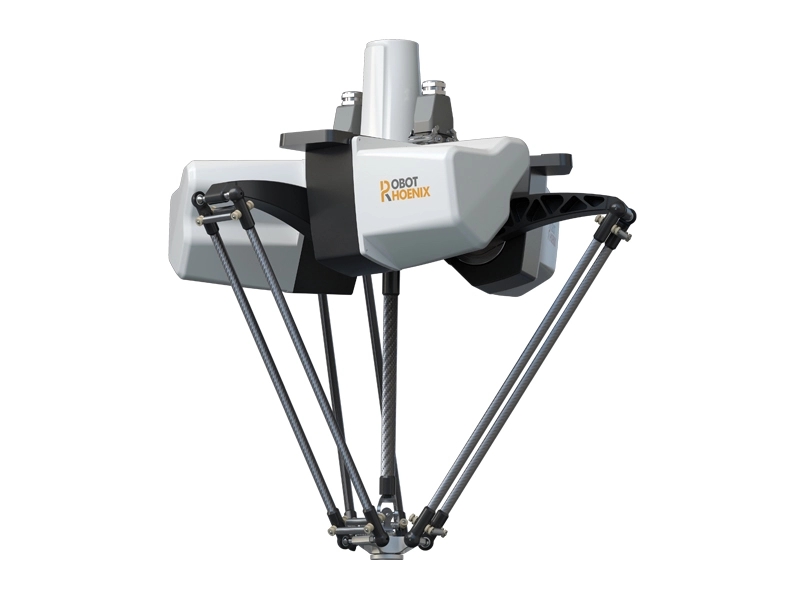
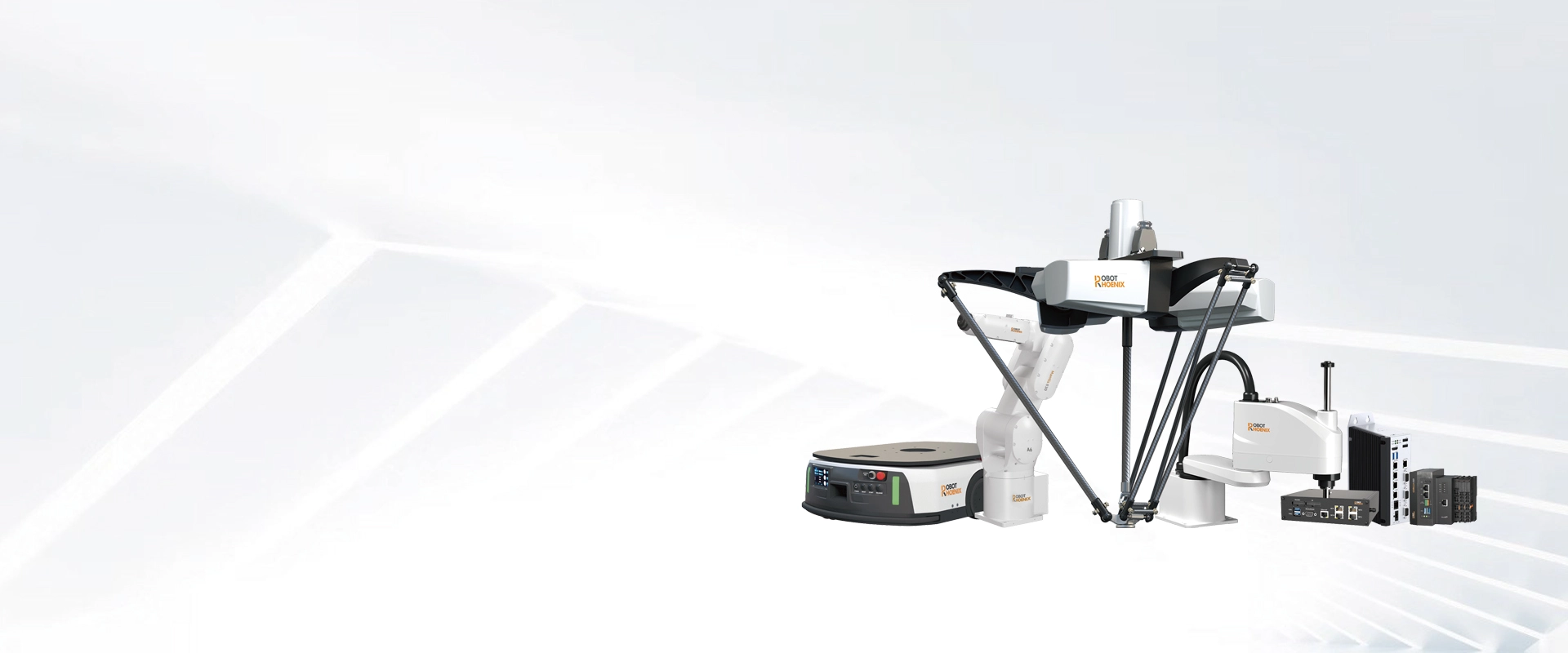
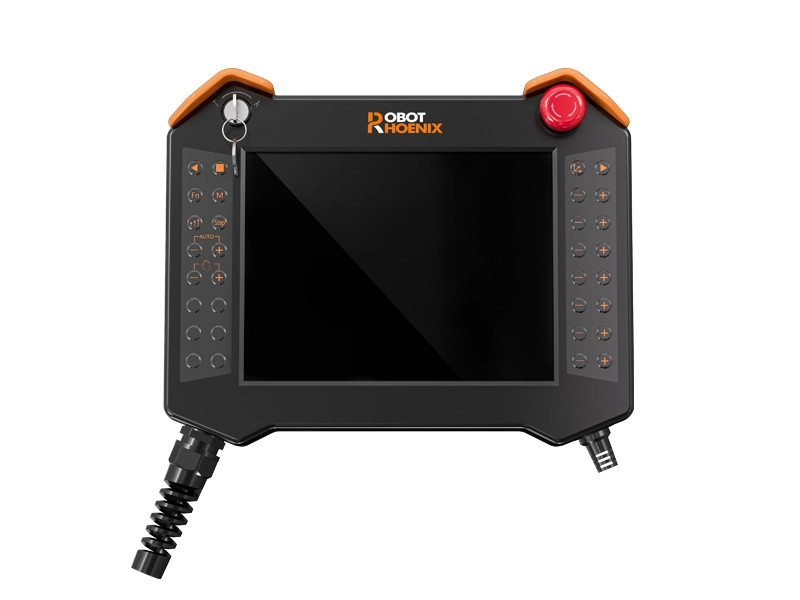
RobotPhoenix (Robotphoenix Intelligent Technology Co., Ltd., HKEX: 06871.HK) is a Hangzhou-area Chinese industrial robot manufacturer that sells a broad catalogue of factory automation hardware and has recently repositioned part of its story around embodied intelligence 13. The company describes itself as a national-level SRDI "Little Giant", a Chinese designation for specialised, sophisticated small and medium enterprises 3. Its product range spans Delta robots (marketed as the Bat series), SCARA robots (Python series), six-axis articulated robots (Mantis series), wafer-handling robots, palletising and packaging machines, handling and articulated robots, two-, three- and four-axis machines, robot controllers, and teach pendants, alongside flexible handling systems and custom automation lines 12. It sells into food, pharmaceutical, logistics, daily chemical, 3C, new energy, automotive and electronics end markets 13.
The company listed on the Hong Kong Stock Exchange in May 2026 in an offering whose retail tranche was oversubscribed 14,891 times, described in contemporaneous reporting as the most oversubscribed retail tranche in the market's history, drawing roughly 330,000 subscribers and HK$564.3 billion in retail applications against an offer of 24.6 million H shares raising approximately HK$750 million at HK$30.5 per share 4. That is a verified, independently reported fact about the listing mechanics. It is not, and should not be read as, evidence about the quality of the business. Retail oversubscription of that magnitude is a statement about liquidity, sentiment and the structure of Hong Kong's clawback regime, not about unit economics.
On the financials, the picture is more mixed than the listing headline suggests. Reported revenue for the most recent full year was 390 million yuan, up 44.5 per cent, and H1 2026 revenue was 186 million yuan, up 58 per cent year on year, with a gross margin of 23.7 per cent and an adjusted net loss of 75.69 million yuan 7. The company attributes the loss in part to research and development spending on embodied intelligence and controllers 7. One reported figure, a net loss "up 113.9 per cent to 150 billion yuan", is arithmetically impossible against a 186 million yuan revenue base and is almost certainly a unit or transcription error in the source; this report treats it as unreliable and does not use it 7. The credible reading is a company growing revenue at a healthy clip, carrying a thin industrial gross margin, and burning cash on a forward-looking R&D programme whose commercial payoff is not yet visible in the accounts.
The embodied-intelligence line is where the narrative and the evidence diverge most sharply. RobotPhoenix markets a second-generation Hongjun wheeled dual-arm robot and a multimodal industrial model called YiBrain, and states that the system has passed proof-of-concept and entered small-batch pilot procurement at several manufacturing sites in automotive, 3C electronics and power utilities 7. Those are company claims. No independent source in the dossier confirms them, and no source of any kind describes how RobotPhoenix's robots actually execute tasks, whether autonomously, under supervision, via remote assistance, or by teleoperation. The autonomy verdict for this report is therefore unknown, and the classification records a null autonomy level for that reason. The community reports that do mention human escort or teleoperation concern unrelated "Phoenix" robots, specifically Sanctuary AI's humanoid and a delivery robot, and cannot be used to assess this company 1114.
Editorial inference. RobotPhoenix looks like a competent, mid-tier industrial automation vendor with a real installed base and a credible hardware catalogue, bolting a fashionable embodied-intelligence narrative onto a business whose economics are still those of industrial automation: low-twenties gross margins, project-based revenue, and heavy working capital. The listing gave it a war chest and a public currency. Whether the embodied-intelligence line becomes a genuine second act or remains a narrative overlay is the central question, and on current public evidence it is unresolved.
Latest news
02The RobotPhoenix Story
RobotPhoenix's public identity is that of a Chinese industrial robot manufacturer that has grown from component and cell supply into full-line automation, and has more recently added an embodied-intelligence layer to its offering 13. The company positions itself as vertically integrated in the narrow but important sense that it builds its own controllers and vision systems, manufactures robots, debugs systems, and customises full lines 13. That combination, controller plus vision plus mechanism plus integration, is the standard recipe for a Chinese mid-market automation vendor seeking to differentiate against both imported Japanese and European brands at the high end and low-cost domestic competitors at the low end.
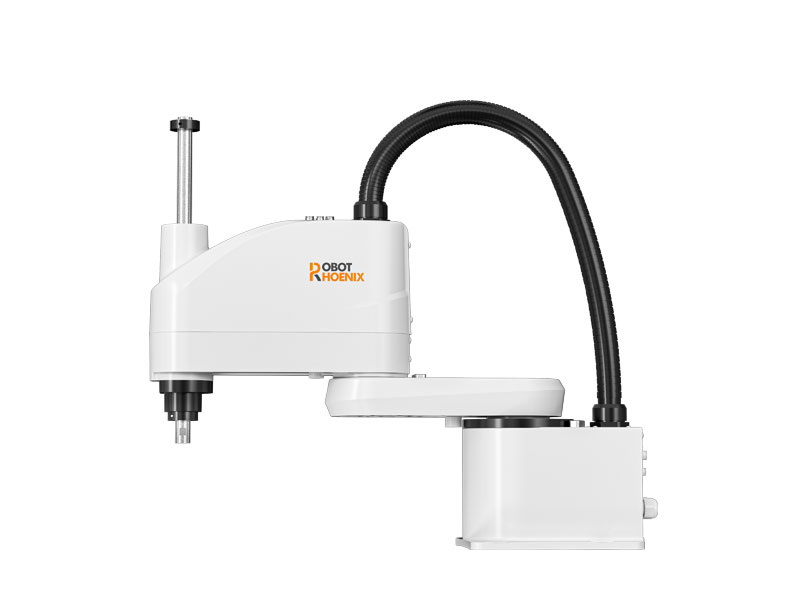
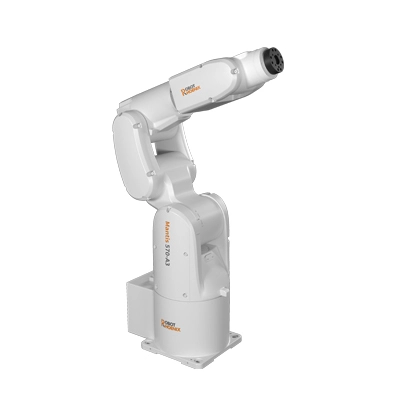
The product naming is deliberately memorable: Bat for Delta, Python for SCARA, Mantis for six-axis 12. This is marketing craft rather than technical substance, but it signals a company that understands it is selling into procurement processes where brand recall matters. The catalogue breadth is the more substantive signal. A vendor that sells Delta, SCARA, six-axis, wafer-handling, palletising, packaging, handling and articulated robots, plus controllers and teach pendants, is not a single-product startup; it is a portfolio company with the attendant complexity of spare parts, service networks, and application engineering across many verticals 12.
The listing is the pivotal recent event. RobotPhoenix listed on HKEX in May 2026 as 06871.HK, raising approximately HK$750 million at HK$30.5 per share, with a retail tranche oversubscribed 14,891 times, roughly 330,000 retail subscribers, and HK$564.3 billion in retail applications 4. The PitchBook profile records a stock price of $3.32, a market capitalisation of $814 million, and 245 million shares 5. Those market-data figures should be treated as a snapshot of uncertain vintage rather than a current quote, but they are consistent with a small-cap listing that has retained a meaningful valuation.
Editorial inference. The sequence matters. A company that lists in May 2026 and reports H1 2026 results showing 58 per cent revenue growth alongside a 75.69 million yuan adjusted net loss is telling a growth-and-investment story to public markets 7. The embodied-intelligence narrative, arriving in the same window, serves a dual purpose: it justifies the R&D spend that produces the loss, and it gives the equity a story beyond industrial automation multiples. That is not a criticism of the company; it is the normal choreography of a newly listed growth story. But readers should hold the two threads separately. The industrial business is real and measurable. The embodied-intelligence business is, on public evidence, a pilot-stage claim.
The strategic partnership with SY Holdings (6069.HK), announced on 5 September 2025, is the other named corporate event in the dossier 89. SY Holdings is a supply-chain finance and technology group, and the partnership is framed around industrial technology cooperation 89. What that means in practice, whether it involves financing for RobotPhoenix customers, joint go-to-market, or something else, is not disclosed in the available material. The RoboDK association, listed on the vendor's own associations page, indicates that RobotPhoenix robots are supported in RoboDK's offline programming and simulation environment, which is a modest but genuine interoperability signal for an industrial vendor 1.
Unknown. The dossier contains no founding date, no founder biographies, no headcount, no manufacturing footprint detail, and no history of funding rounds prior to the IPO. For a listed company this is a notable gap, and it reflects the thinness of the retrieved dossier rather than the absence of such information in the public domain. Readers should treat the corporate history here as incomplete.
03Product Portfolio: What RobotPhoenix Actually Sells
RobotPhoenix's catalogue is best understood as three layers: robot mechanisms, control and vision infrastructure, and integrated systems and lines. The company sells each layer, and the integration capability is what allows it to bid for full-line projects rather than component slots 13.
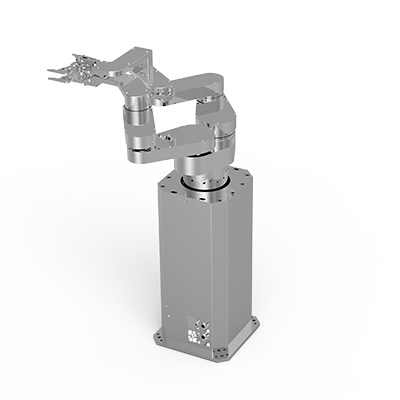
Mechanisms. The Delta range, marketed as the Bat series, targets high-speed pick-and-place, sorting, and packaging applications typical of food, pharmaceutical and consumer-goods lines 12. The SCARA range, marketed as Python, targets assembly, dispensing, gluing and general small-part handling 12. The six-axis range, marketed as Mantis, covers articulated manipulation tasks including machine tending and more complex assembly 12. Beyond these, the company lists wafer-handling robots, palletising robots, articulated robots, handling robots, packaging robots, and two-, three- and four-axis machines 1. Wafer handling is a notable inclusion because it implies a degree of precision, cleanliness and reliability engineering beyond general factory automation, and it points at semiconductor and electronics customers.
Control and vision. RobotPhoenix states that it develops its own control systems and vision systems 13. In-house control is strategically significant for an industrial vendor: it reduces dependence on third-party controllers, allows tighter integration with the company's own mechanisms, and creates a software surface on which higher-level capabilities, including the YiBrain model, can be built. Whether the controllers are genuinely differentiated or are competent but conventional is not something the public dossier can establish.
Systems and lines. The company sells flexible handling systems, custom automation lines, and system debugging services 13. This is the integration layer where margins are typically better than on bare mechanisms, but where revenue is project-based, lumpy, and working-capital intensive.
Embodied intelligence. The second-generation Hongjun wheeled dual-arm robot and the YiBrain multimodal industrial model constitute the newest layer 7. A wheeled dual-arm platform is a pragmatic choice for industrial settings: it avoids the balance and gait problems of legged humanoids, provides a stable base for manipulation, and can be deployed in existing factory layouts without major infrastructure change. The company states the system has passed POC and entered small-batch pilot procurement at several manufacturing sites in automotive, 3C electronics and power utilities 7.
| Product layer | Representative lines | Target applications | Evidence status |
|---|---|---|---|
| Delta mechanisms | Bat series | High-speed pick-and-place, sorting, packaging | Company catalogue 12 |
| SCARA mechanisms | Python series | Assembly, gluing, dispensing, small-part handling | Company catalogue 12 |
| Six-axis mechanisms | Mantis series | Articulated manipulation, machine tending | Company catalogue 12 |
| Specialised mechanisms | Wafer handling, palletising, packaging, handling, 2/3/4-axis | Semiconductor, logistics, end-of-line packaging | Company catalogue 1 |
| Control and vision | In-house controllers, vision systems, teach pendants | Cross-portfolio | Company claim 13 |
| Integrated systems | Flexible handling systems, custom automation lines, debugging | Full-line projects across verticals | Company claim 13 |
| Embodied intelligence | Second-gen Hongjun wheeled dual-arm; YiBrain model | Pilot deployments in automotive, 3C, power utilities | Company claim; POC and pilot status unverified 7 |
Editorial inference. The portfolio is coherent for an industrial automation vendor and notably broad. The risk in breadth is dilution: servicing Delta, SCARA, six-axis, wafer-handling and palletising lines across food, pharma, logistics, 3C, new energy and automotive requires substantial applications engineering and field service capacity, and a 23.7 per cent gross margin suggests the company is not extracting premium pricing anywhere in the mix 7. The embodied-intelligence line, if it works, is the most plausible route to margin expansion, because software-differentiated manipulation can command better pricing than commodity mechanisms. That "if" is doing a great deal of work.
Unknown. Unit volumes by product line, average selling prices, installed base, service revenue share, and the split between mechanism sales and integration projects are all not publicly disclosed in the dossier.
Products & versions

04Technology Stack: Strengths and the Work That Remains
The technology stack has to be assessed at two levels: the conventional industrial automation stack, where RobotPhoenix is a participant among many, and the embodied-intelligence stack, where it is making a claim that the public evidence cannot yet support.
Conventional stack. The company's stated in-house capabilities are control systems, vision systems, robot manufacturing, system debugging and full-line customisation 13. In-house control and vision are the two most consequential claims. Control determines motion quality, cycle time, and the ease with which integrators can deploy a robot; vision determines whether the robot can handle the variation that real production lines present. A vendor with credible in-house control and vision can offer tighter integration and faster commissioning than one assembling third-party components. The RoboDK association indicates that at least some RobotPhoenix models are supported in a mainstream offline programming environment, which matters for integrator adoption because it reduces the cost of trying the brand 1.
Embodied-intelligence stack. YiBrain is described as a multimodal industrial model, and the Hongjun platform as a wheeled dual-arm robot 7. "Multimodal" in this context typically means a model that ingests more than one input modality, commonly vision plus language, and possibly force or proprioception, and produces action or task plans. The industrial appeal is straightforward: if a model can interpret a work instruction, look at a bin of parts, and generate a manipulation plan, it reduces the engineering effort required to deploy a robot to a new task, which is the dominant cost in industrial automation today.
The critical gap. Nothing in the dossier describes how RobotPhoenix's robots execute tasks. The vendor uses "automatic" in product descriptions, for example automatic packing, loading and unloading, sorting, pick-and-place, gluing and assembly 1. In industrial automation, "automatic" conventionally means the machine executes a pre-programmed cycle without human intervention, which is a statement about repeatability within a fixed task, not about autonomy in the sense of perceiving, deciding and acting in unstructured conditions. The two are routinely conflated in marketing, and this report does not treat the vendor's "automatic" terminology as evidence of autonomy.
| Capability claim | Source type | What it would require to verify | Current status |
|---|---|---|---|
| In-house controllers | Company claim 13 | Teardown, integrator confirmation, or regulatory disclosure of control IP | Unverified |
| In-house vision systems | Company claim 13 | Independent integrator confirmation; benchmark data | Unverified |
| YiBrain multimodal industrial model | Company claim 7 | Technical publication, benchmark, or independent evaluation | Unverified |
| POC passed | Company claim 7 | Named customer confirmation | Unverified |
| Small-batch pilot deployment at multiple sites | Company claim 7 | Named customer confirmation; site visit; procurement records | Unverified |
| Autonomous task execution | Not claimed explicitly; implied by "automatic" and embodied-intelligence framing | Evidence of execution mode: autonomous, supervised, remote-assisted, or teleoperated | Unknown |
Editorial inference. The most likely reality, based on how the industrial embodied-intelligence field generally works at pilot stage, is that the Hongjun platform operates in structured or semi-structured settings with substantial engineering support, and that any "autonomy" is bounded to specific tasks in specific cells. That is a normal and respectable place for a pilot to be. It is not, however, the same as a general-purpose autonomous industrial robot, and the public evidence does not permit a stronger conclusion. The honest verdict is that the technology stack's conventional layer is plausible and probably competent, and its embodied-intelligence layer is unproven in public.
Unknown. Compute platform, model architecture, training data provenance, sim-to-real approach, safety certification status, and the division of labour between the model and classical motion planning are all not publicly disclosed.
05Research, Papers, Authors and Labs
Not publicly disclosed. The research dossier contains no peer-reviewed papers, no preprints, no named research staff, and no laboratory affiliations for RobotPhoenix. The company's public materials are commercial rather than scientific, and no academic output attributable to the company appears in the supplied sources 12367.
This is a meaningful gap for a company whose forward narrative rests on an embodied-intelligence model. Firms that genuinely develop multimodal robot foundation models typically produce at least some technical communication, whether papers, technical blog posts with architecture detail, benchmark results, or conference presentations. Their absence here may reflect a deliberate commercial posture, a Chinese-market publication strategy that does not surface in the sources retrieved, or a research effort that is not yet mature enough to publish. The dossier cannot distinguish among these.
Editorial inference. For an industrial vendor, the absence of published research is not disqualifying. Many successful automation companies do no external research and simply engineer well. But it does mean that claims about YiBrain cannot be assessed on technical merit, only on commercial outcomes, and those outcomes are themselves unverified. Readers should weight the embodied-intelligence narrative accordingly.
<!-- module: papers --> <!-- module: authors-labs --> <!-- module: repos --> <!-- module: datasets -->06Media Evidence Library: What the Videos Prove
Not publicly disclosed. The research dossier contains no video evidence for RobotPhoenix products. The video count in the dossier is zero.
This absence is worth stating plainly because it cuts in an unusual direction. In most robotics coverage, the problem is too much video and too little discipline about what it proves. Here there is no video at all in the retrieved material, which means there is no demonstration footage to evaluate, choreographed or otherwise. The company's website presumably hosts product footage, but none was captured in the dossier, and this report will not characterise footage it has not seen.
The general principle still applies and is worth restating for when footage does surface. A demonstration video establishes that a robot performed a motion under some control regime on at least one occasion. It does not establish autonomy, reliability, cycle time in production, or economic viability. A video showing a dual-arm robot picking parts from a bin tells you the robot can pick parts from a bin in that cell on that day. It does not tell you the success rate, the recovery behaviour when a pick fails, the engineering support required, or whether the cell runs unattended overnight. Those are the questions that determine whether an embodied-intelligence product is a business.
Editorial inference. The absence of any video in the dossier, combined with the absence of published research, means the embodied-intelligence claim currently rests entirely on the company's own written statements and on a single news report 7. That is a thin evidentiary base for a claim that is central to the company's public narrative.
Media library
07Commercial Reality
The commercial picture has three components: the established industrial business, the listing and its capital consequences, and the embodied-intelligence pilot programme. Each has a different evidence quality.
The established business. Reported revenue for the most recent full year was 390 million yuan, up 44.5 per cent, and H1 2026 revenue was 186 million yuan, up 58 per cent year on year, at a 23.7 per cent gross margin 7. These are the strongest numbers in the dossier because they are the kind of figures a listed company must report and that news outlets transcribe. Growth of 44.5 per cent then 58 per cent is strong for an industrial automation vendor. A 23.7 per cent gross margin is thin in absolute terms but not unusual for Chinese industrial robot vendors competing on price against both domestic and imported alternatives. The adjusted net loss of 75.69 million yuan, attributed in part to R&D on embodied intelligence and controllers, indicates that the company is spending well ahead of its current profitability 7.
| Financial metric | Value | Period | Evidence status |
|---|---|---|---|
| Revenue | 390 million yuan, +44.5% | Most recent full year | Reported 7 |
| Revenue | 186 million yuan, +58% YoY | H1 2026 | Reported 7 |
| Gross margin | 23.7% | H1 2026 | Reported 7 |
| Adjusted net loss | 75.69 million yuan | H1 2026 | Reported 7 |
| Net loss "up 113.9% to 150 billion yuan" | Implausible | H1 2026 | Source error; not used 7 |
| IPO proceeds | ~HK$750 million at HK$30.5/share | May 2026 | Reported 4 |
| Retail oversubscription | 14,891x; ~330,000 subscribers; HK$564.3bn applications | May 2026 | Reported 4 |
| Market cap | $814 million; 245 million shares; $3.32/share | Snapshot, undated | PitchBook 5 |
The listing. The IPO is verified by independent reporting and is the single most consequential commercial event in the company's recent history 4. It raised approximately HK$750 million, which against a 75.69 million yuan half-year adjusted loss gives the company a meaningful runway, though the precise burn rate and cash position are not disclosed in the dossier. The oversubscription figure is a fact about demand for the shares, not about the business.
The pilot programme. The company states that its embodied-intelligence system passed POC and entered small-batch pilot procurement at several manufacturing sites in automotive, 3C electronics and power utilities 7. This is a company claim. No named customer confirms it. No procurement record corroborates it. The distinction between "pilot procurement" and "paid deployment at scale" is exactly the distinction this report insists on: a pilot is a test, often heavily discounted or provided at no charge, and its conversion rate to production deployment is the only number that matters commercially. That conversion rate is not disclosed.
Partnerships. The strategic cooperation agreement with SY Holdings, announced 5 September 2025, is a named corporate event with a counterparty that has its own disclosure obligations 89. SY Holdings is a supply-chain finance group, which raises the possibility that the partnership is about financing RobotPhoenix's customers rather than about technology per se, but the available material does not specify the commercial mechanics. The RoboDK association is a software-ecosystem relationship, valuable for integrator adoption but not a revenue event in itself 1.
Unknown. Customer concentration, backlog, order book, average contract value, pilot-to-production conversion, cash position, burn rate, and the identity of any pilot customer are all not publicly disclosed in the dossier.
Customers & deployments
Sections 8 through 14 follow in the continuation of this report.
08Markets and Use Cases
RobotPhoenix's addressable market is the global industrial automation and warehouse-automation sector, with a specific concentration in Chinese manufacturing. The company's own industry pages list food, pharmaceutical, logistics, daily chemical, 3C, new energy, automotive, electronics, manufacturing and warehouse as target verticals 13. That is a broad list, and breadth of this kind is common in Chinese industrial-robot vendor marketing: it signals versatility but tells the reader little about where revenue actually concentrates. The dossier does not break down revenue by vertical, so the relative weight of each end-market is not publicly disclosed.
What can be said with more confidence is where the newer embodied-intelligence product is being trialled. The Gasgoo report on H1 2026 results states that the second-generation Hongjun wheeled dual-arm robot and the YiBrain multimodal industrial model have passed POC and entered small-batch pilot procurement at several manufacturing sites, specifically in automotive, 3C electronics and power utilities 7. That is a narrower and more informative list than the general industry page, and it is consistent with where Chinese embodied-intelligence pilots are clustering nationally: automotive assembly and inspection, consumer-electronics final assembly and test, and grid/utility inspection.
8.1 The three demand pools
It is useful to separate RobotPhoenix's market into three pools with very different economics.
Pool A: Conventional industrial robots (Delta, SCARA, 6-axis, palletizing, wafer handling). This is the revenue base. It is a mature, price-competitive market dominated globally by Fanuc, ABB, Yaskawa and KUKA, and in China increasingly by Estun, Inovance, EFORT and a long tail of specialists. Delta robots in particular are a commodity segment for high-speed pick-and-place in food, pharma and small-parts assembly. RobotPhoenix's Bat-series Delta and Python-series SCARA sit squarely in this pool 12. Margins here are structurally thin; the reported 23.7% gross margin 7 is consistent with a mid-tier Chinese industrial-robot vendor rather than a differentiated technology leader.
Pool B: System integration and full-line customisation. RobotPhoenix states it provides in-house control and vision systems, robot manufacturing, system debugging and full-line customisation 13. Integration is often where the margin is in Chinese automation, because the customer is buying an outcome (a working packing line) rather than a boxed robot. It is also labour-intensive and difficult to scale, and it ties revenue to project timing. The dossier does not disclose what share of revenue is integration versus product, so the mix is not publicly disclosed.
Pool C: Embodied intelligence (Hongjun, YiBrain). This is the narrative pool, the one that justified the IPO and the one on which the R&D loss is being spent 7. It is also the least proven commercially. "Passed POC and entered small-batch pilot procurement" is a meaningful milestone but a long way from repeat production orders. In Chinese industrial practice, a POC can be a paid trial, a co-development arrangement, or a demonstration installation with no committed volume. The dossier does not specify which, so the commercial character of these pilots is not publicly disclosed.
8.2 Use-case fit and mismatch
| Use case | RobotPhoenix fit | Evidence quality | Editorial note |
|---|---|---|---|
| Food & pharma pick-and-place | Strong (Delta/SCARA heritage) | Vendor pages 12 | Mature, price-sensitive; hygiene and washdown requirements are a real barrier |
| 3C electronics assembly/test | Moderate-to-strong | Vendor pages 1; pilot mention 7 | Fast cycle times, high changeover; a natural embodied-intelligence beachhead |
| Automotive | Moderate | Pilot mention 7 | Automotive qualification cycles are long; pilot ≠ production line |
| Power utilities inspection | Plausible | Pilot mention 7 | Inspection is a common early embodied-intelligence use case; low payload, high value |
| Warehouse/logistics | Moderate | Vendor pages 13 | Crowded field; AMR/AGV incumbents strong |
| New energy (battery) | Moderate | Vendor pages 13 | High growth but demanding; incumbent integrators entrenched |
The table is deliberately sceptical. The pattern across Chinese embodied-intelligence vendors in 2025–2026 has been to announce pilots in exactly these verticals; the differentiator is not the vertical list but the conversion rate from pilot to repeat order, which is not publicly disclosed for RobotPhoenix.
8.3 The demand-side constraint
The single most important market fact about RobotPhoenix is not its vertical list but its customer concentration and order book, neither of which is in the dossier. A company with 186M yuan of H1 revenue 7 and a broad product catalogue is likely to have a long tail of small integration projects plus a handful of larger accounts. Without a disclosed top-five customer share or backlog figure, any claim about demand durability is editorial inference, not fact. The honest position is that the market is real, the verticals are plausible, and the commercial depth is unproven at the scale the IPO narrative implies.
09Competitive Landscape
RobotPhoenix competes in two distinct arenas, and it is a different-sized player in each.
9.1 Arena one: conventional industrial robots
In Delta, SCARA, 6-axis and palletizing robots, RobotPhoenix is a mid-tier Chinese vendor. The global tier-one incumbents (Fanuc, ABB, Yaskawa, KUKA) hold the high-precision, high-reliability, high-price end and the deep automotive relationships. The Chinese challengers (Estun, Inovance, EFORT, and a long tail) compete on price, local service and integration speed. RobotPhoenix's stated positioning, per its own marketing, is cost and market-use redefinition for Delta and SCARA 2, which is a price-and-application play, not a technology-differentiation play.
This matters for the reader because it sets the margin ceiling. A vendor competing on cost in a commoditising segment should not be expected to earn software-like gross margins, and the reported 23.7% 7 is consistent with that reality.
9.2 Arena two: embodied intelligence
Here RobotPhoenix is a small participant in a crowded and noisy field. The relevant comparison set is not Fanuc but the Chinese embodied-intelligence cohort (Unitree, UBTech, AgiBot, Galbot, and many others) plus the Western humanoid and industrial-AI players. RobotPhoenix's differentiator, as stated, is the industrial framing: a wheeled dual-arm robot (Hongjun) plus a multimodal industrial model (YiBrain) aimed at manufacturing tasks rather than general-purpose humanoid demos 7. That is a defensible niche, because wheeled dual-arm platforms are more stable, cheaper and easier to deploy in factories than bipedal humanoids, and because a domain-specific industrial model can be more useful than a general foundation model.
But the niche is contested. Every major Chinese industrial-robot vendor and every embodied-intelligence startup is making a version of the same argument. The dossier provides no head-to-head benchmark, no customer win/loss data, and no independent performance comparison, so any ranking claim would be editorial inference.
9.3 Competitive positioning table
| Dimension | RobotPhoenix position | Basis | Confidence |
|---|---|---|---|
| Conventional robot breadth | Broad (Delta, SCARA, 6-axis, palletizing, wafer, handling, packaging) | Vendor catalogue 13 | High |
| Conventional robot price | Cost-competitive | Vendor marketing 2 | Medium (claim) |
| In-house control & vision | Claimed | Vendor pages 13 | Medium (claim) |
| Embodied intelligence | Early (POC → small-batch pilot) | News 7 | Medium |
| Global service network | Not disclosed | — | Unknown |
| Customer concentration | Not disclosed | — | Unknown |
| R&D intensity | High (loss driven by embodied-intelligence and controller R&D) | News 7 | Medium |
9.4 The honest competitive verdict
RobotPhoenix is not a category leader in either arena on the evidence available. It is a broad-portfolio Chinese industrial-robot vendor with a credible cost position in mature segments and an early, unproven embodied-intelligence bet. Its competitive risk is twofold: margin compression in the mature segments as Chinese price competition intensifies, and being out-executed in embodied intelligence by better-capitalised or faster-moving rivals. Its competitive opportunity is the industrial focus itself: if factories adopt wheeled dual-arm platforms for specific tasks before humanoids mature, a vendor with existing industrial channels and integration capability is well placed to capture that demand.
Competitive comparison
| Robot | Maker | Autonomy | Conf. |
|---|---|---|---|
| iRobot Roomba Combo 10 Max | iRobot | Autonomous | 0.90 |
| Mobile ALOHA (Stanford) | Stanford University | Teleoperated | 0.90 |
| 1X NEO | 1X Technologies | Remote-Assisted | 0.90 |
10Geopolitical Context and Constraints
RobotPhoenix sits at the intersection of three geopolitical currents: the China–US technology competition, the global reshoring of manufacturing, and the export-control regime around advanced computing.
10.1 The China industrial-robot position
China is the world's largest industrial-robot market and has an explicit policy goal of raising domestic robot density and domestic vendor share. RobotPhoenix, as a national-level SRDI "Little Giant" (a Chinese designation for specialised, high-growth small and medium enterprises) 13, is a beneficiary of that policy environment. The designation is not merely honorific: it typically brings access to subsidised credit, local-government procurement preference and industrial-park support. The dossier does not quantify any subsidy received, so the financial contribution is not publicly disclosed.
10.2 Export controls and the compute question
The embodied-intelligence product (YiBrain) is described as a multimodal industrial model 7. Training and running such models requires advanced accelerators. US export controls on advanced AI chips to China have tightened repeatedly since 2022, and Chinese firms have responded with domestic accelerators and with efficiency-focused training. The dossier does not state which accelerators RobotPhoenix uses for YiBrain training or inference, so this is not publicly disclosed. It is nonetheless a material risk factor: if the company depends on imported accelerators, its roadmap is exposed to further control tightening; if it depends on domestic accelerators, its model performance and cost may be constrained relative to Western competitors.
10.3 Overseas market access
The dossier contains no evidence of RobotPhoenix selling outside China. Its contact details are Chinese (+86-571 area code, Hangzhou) 1, its listed venue is Hong Kong 4, and its named deployments are domestic 7. For a Chinese industrial-robot vendor, overseas expansion faces three frictions: certification and standards compliance (CE, UL), service-network build-out, and geopolitical procurement restrictions in Western markets, particularly for anything framed as "embodied intelligence" or dual-use. The dossier does not disclose an overseas revenue share, so international exposure is not publicly disclosed.
10.4 The Hong Kong listing as a geopolitical signal
The May 2026 HKEX listing 4 is itself a geopolitical datum. Hong Kong remains the preferred offshore venue for Chinese technology issuers seeking international capital without the disclosure and liability regime of a US listing. The record 14,891x retail oversubscription 4 indicates intense domestic and regional retail demand for the embodied-intelligence narrative, not necessarily international institutional conviction. The dossier does not disclose the institutional versus retail allocation split beyond the retail tranche figure, so the quality of the shareholder base is not publicly disclosed.
10.5 Constraints summary
| Constraint | Nature | Evidence | Materiality |
|---|---|---|---|
| Advanced AI chip access | Export-control exposure | Not disclosed | Potentially high |
| Overseas certification/service | Execution barrier | Not disclosed | Medium |
| Western procurement restrictions | Geopolitical | Not disclosed | Medium |
| Domestic policy support | Tailwind | SRDI designation 13 | Positive |
| Hong Kong listing regime | Structural | Listing 4 | Neutral |
11The Hype, the Real and the Ugly
This section separates what RobotPhoenix has demonstrated from what it has asserted, and flags the places where the public record is weakest.
11.1 The hype
The IPO is the clearest hype signal. A retail tranche oversubscribed 14,891 times, with 330,000 subscribers and HK$564.3 billion of demand for a HK$750 million raise 4, is not a valuation of the company's industrial-robot business. It is a valuation of the embodied-intelligence narrative, amplified by the structural mechanics of Hong Kong retail allocation (small tranches, high leverage, momentum). Readers should treat the oversubscription figure as a sentiment indicator, not a fundamental one.
The second hype signal is the language. "Embodied intelligence", "multimodal industrial model", "automatic" solutions 17 are all terms that, in the current market, carry more narrative weight than evidentiary weight. The word "automatic" in a product name (automatic packing, automatic loading/unloading) describes a programmed, fixed-function behaviour, not autonomy. Conflating the two is the single most common error in coverage of this sector.
11.2 The real
Three things are genuinely real and verifiable.
First, the company exists, is listed, and has a broad, documented product portfolio spanning Delta, SCARA, 6-axis, wafer-handling, palletizing, articulated, handling and packaging robots plus controllers and teach pendants 13. That is a substantial hardware catalogue, not a slide deck.
Second, the financials are reported and specific: FY revenue 390M yuan (+44.5%), H1 2026 revenue 186M yuan (+58% YoY), 23.7% gross margin, adjusted net loss 75.69M yuan 7. Growth is real, and the loss is consistent with heavy R&D investment in embodied intelligence and controllers. A company growing revenue 58% year-on-year while investing in a new product line is a normal, if risky, industrial profile.
Third, the embodied-intelligence product has moved past demonstration into POC completion and small-batch pilot procurement at named verticals (automotive, 3C electronics, power utilities) 7. That is a genuine milestone. It is not proof of productive deployment at scale, but it is more than a video.
11.3 The ugly
The ugly is the evidence gap around autonomy and the data-quality problems in the public record.
Autonomy is unknown. The dossier's autonomy verdict is explicit: no supplied fact describes how RobotPhoenix's own robots execute tasks, whether autonomously, supervised, remote-assisted or teleoperated [dossier]. Vendor materials use "automatic" in product names, which is marketing language and does not constitute proof of autonomy. The community reports that mention human escort or teleoperation concern unrelated "Phoenix" robots (Sanctuary AI's humanoid, delivery robots, the Mars Phoenix lander) 11121314, not RobotPhoenix. Any coverage that cites those community reports as evidence about RobotPhoenix is simply wrong.
The financial record contains an error. The dossier notes a reported net loss "up 113.9% to 150 billion yuan" 7, a figure that is inconsistent with 186M yuan of H1 revenue and is almost certainly a unit error in the source (likely 150 million yuan, or a different metric entirely). This is a reminder that even reported financials require sanity-checking against scale.
The vendor/independent conflict is unresolved. The vendor markets autonomous-sounding capability; no independent source corroborates it. The correct editorial posture is to report the vendor claim as a claim and the autonomy level as unknown.
11.4 Claim versus evidence
| Claim | Source type | Independent corroboration | Verdict |
|---|---|---|---|
| Broad industrial-robot portfolio | Vendor 13 | Consistent across vendor pages and news 7 | Supported |
| H1 2026 revenue 186M yuan, +58% | News 7 | Single news source | Plausible, single-source |
| 23.7% gross margin | News 7 | Single news source | Plausible, single-source |
| Adjusted net loss 75.69M yuan | News 7 | Single news source | Plausible, single-source |
| Embodied intelligence passed POC | News 7 | Single news source | Company claim via press |
| Small-batch pilot at several sites | News 7 | Single news source | Company claim via press |
| "Automatic" solutions | Vendor 1 | None | Marketing language |
| Autonomous task execution | Implied by vendor | None | Unknown |
| Strategic partnership with SY Holdings | Vendor 8 + partner 9 | Two-sided | Supported as partnership, not as paid customer |
| RoboDK partnership | Vendor 1 | None | Company claim |
Claim tracker
The only sourcing is a Gasgoo news report [7] relaying the company's own pilot claims, with no independent customer, site visit or third-party confirmation of actual deployed units or outcomes.
YiBrain is described only in vendor materials and a company-relayed news item [7], and the dossier explicitly finds no independent evidence of autonomous task execution.
These capabilities appear only as vendor product/solution marketing [1][2][3], and the dossier notes 'automatic' is marketing terminology that does not constitute proof of autonomy.
The product range is documented only on the vendor's own catalog and solution pages [1][2][3], with no independent teardown, spec verification or third-party review.
The HKEX listing and IPO details are independently reported by The Standard [4], and the H1 2026 revenue and margin figures are carried by Gasgoo [7], though the underlying financials remain company-reported.
The Standard [4] independently reports the record 14,891x retail oversubscription and IPO terms, corroborated by PitchBook's profile [5].
SY Holdings' own news release [9] independently confirms the strategic cooperation agreement, though the operational substance of the partnership is not detailed.
The dossier's autonomy verdict is 'unknown' and explicitly states no independent source confirms autonomous task completion, while community teleoperation reports concern unrelated 'Phoenix' robots (Sanctuary AI, delivery robots) [11][12][13][14].
12Future Scenarios
The following scenarios are editorial inference, constructed from the public evidence in the dossier. They are not predictions; they are structured ways to think about what could happen and what would signal it.
12.1 Scenario A: Industrial embodied intelligence converts (probability: moderate)
In this scenario, the small-batch pilots at automotive, 3C and power-utility sites 7 convert into repeat production orders over 2027–2028. RobotPhoenix's existing industrial channels, integration capability and in-house control/vision stack 13 give it an advantage over pure-software embodied-intelligence startups, because it can sell and service a working cell rather than a model. Revenue growth continues above 40%, gross margin improves modestly as the embodied-intelligence mix rises, and the adjusted loss narrows. The company becomes a credible mid-cap Chinese industrial-automation vendor with a differentiated embodied-intelligence line.
Signals to watch: repeat orders from named pilot customers; disclosure of embodied-intelligence revenue as a separate line; gross margin trend; headcount in field service.
12.2 Scenario B: Pilots stall, mature business carries the company (probability: moderate-to-high)
In this scenario, the pilots remain pilots. Automotive and 3C qualification cycles are long, and the embodied-intelligence product proves harder to deploy than to demonstrate. Revenue growth continues from the conventional portfolio, but margin stays in the low-to-mid 20s and the R&D loss persists. The stock, having priced in the narrative, de-rates. The company survives as a solid but unremarkable industrial-robot vendor.
Signals to watch: absence of repeat-order announcements; R&D expense growth without revenue contribution; management guidance changes; insider selling after lock-up expiry.
12.3 Scenario C: Competitive squeeze (probability: low-to-moderate)
In this scenario, Chinese price competition in Delta/SCARA/6-axis intensifies faster than RobotPhoenix can shift mix toward higher-value embodied intelligence, while better-capitalised embodied-intelligence rivals out-execute it on model quality and deployment speed. Gross margin compresses, the loss widens, and the company faces a funding or strategic-review event.
Signals to watch: declining gross margin; loss of key integration partners; customer concentration disclosures; capital raises at declining valuations.
12.4 Scenario D: Geopolitical disruption (probability: low, impact: high)
In this scenario, further US export controls or Chinese domestic compute constraints materially impair YiBrain development, or Western procurement restrictions close off any overseas expansion path. The company's roadmap slips. This is a tail risk but a real one for any Chinese embodied-intelligence vendor.
Signals to watch: disclosure of accelerator supply; changes to model release cadence; overseas certification activity.
12.5 Scenario comparison
| Scenario | Key driver | 2028 revenue trajectory | Margin trajectory | Main risk |
|---|---|---|---|---|
| A: Conversion | Pilot → production | Strong growth | Improving | Execution |
| B: Stall | Long qualification cycles | Moderate growth | Flat | Narrative de-rating |
| C: Squeeze | Price competition | Flat/declining | Compressing | Funding |
| D: Geopolitical | Export controls | Uncertain | Uncertain | Roadmap slip |
13What to Watch: A Live Monitoring Checklist
The following checklist is designed for ongoing monitoring. Each item is specific, observable and tied to a source type. It is organised by theme, and each item states what would constitute a positive signal, a negative signal, and where to look.
13.1 Commercial conversion
- Repeat orders from named pilot customers. Positive: a second or third order from the same automotive, 3C or power-utility customer. Negative: pilots announced but never referenced again. Source: company news page 6, HKEX filings, trade press.
- Embodied-intelligence revenue disclosure. Positive: separate revenue line or unit-shipment figure for Hongjun. Negative: continued aggregation into "robots and solutions". Source: interim and annual reports.
- Customer concentration. Positive: disclosure showing a diversified base. Negative: rising top-five customer share. Source: HKEX prospectus and annual report.
- Order backlog. Positive: disclosed backlog with coverage ratio. Negative: continued absence. Source: results announcements.
13.2 Financial health
- Gross margin trend. Positive: sustained improvement above 25%. Negative: decline below 20%. Source: interim and annual reports 7.
- R&D expense versus revenue. Positive: R&D growth decelerating as a share of revenue while embodied-intelligence revenue grows. Negative: R&D growing faster than revenue with no product revenue. Source: results announcements.
- Cash runway. Positive: disclosed cash covering 24+ months at current burn. Negative: capital raise at a discount. Source: balance sheet, HKEX filings.
- The 150-billion-yuan anomaly. Positive: corrected figure in a subsequent filing. Negative: persistence of inconsistent figures. Source: original report 7 and company filings.
13.3 Technology and autonomy
- Autonomy evidence. Positive: independent, third-party demonstration of unsupervised task execution, or a named customer confirming autonomous operation in production. Negative: continued reliance on choreographed demo video or "automatic" product naming. Source: independent trade press, customer statements, site visits.
- YiBrain model releases. Positive: published benchmarks, technical papers, or third-party evaluation. Negative: marketing-only claims. Source: company site 6, arXiv, conference proceedings.
- Controller and vision stack. Positive: disclosed specifications, third-party integration. Negative: no technical detail. Source: product documentation 1.
13.4 Partnerships and ecosystem
- SY Holdings partnership deliverables. Positive: joint product, joint customer win, or disclosed commercial terms. Negative: announcement with no follow-through. Source: SY Holdings news 9, RobotPhoenix news 8.
- RoboDK integration. Positive: RobotPhoenix robots listed in RoboDK's supported-robot library with verified post-processors. Negative: mention only on vendor page 1. Source: RoboDK documentation.
- New named customers. Positive: customer confirmation (not just vendor announcement). Negative: vendor-only announcements. Source: customer press releases, trade press.
13.5 Governance and market
- Lock-up expiry and insider activity. Positive: no material selling. Negative: significant insider selling at first opportunity. Source: HKEX disclosures.
- Institutional ownership. Positive: rising institutional share. Negative: retail-dominated register. Source: HKEX shareholding disclosures.
- Auditor and reporting quality. Positive: clean audits, consistent figures. Negative: restatements or unit errors. Source: annual report.
13.6 A note on the "Phoenix" name collision
Any monitoring process must filter out the substantial volume of unrelated "Phoenix" robotics content: Sanctuary AI's humanoid 14, delivery robots in Phoenix, Arizona 1113, and the Mars Phoenix lander 12. These are not RobotPhoenix. Automated news and social monitoring will surface them constantly, and mis-attributing them to RobotPhoenix is the single easiest error to make in tracking this company.
14Sources and Methodology
14.1 Methodology
This report was compiled from a research dossier gathered on 2026-09-20. The dossier contained 16 numbered sources across five categories: official (0), commerce (5), research (0), news (5), video (0) and community (6). The overall dossier confidence was 0.62.
The editorial method applies four evidence labels throughout:
| Label | Definition | Treatment in this report |
|---|---|---|
| Verified fact | Regulatory filing, official product documentation, named-customer confirmation, peer-reviewed or primary research, or corroborated by multiple independent sources | Stated as fact with citation |
| Company claim | Stated by the company, not independently verified | Attributed explicitly ("the company states", "per vendor materials") |
| Editorial inference | Reasoned conclusion drawn from public evidence | Flagged as inference; reasoning shown |
| Unknown | Not publicly disclosed | Stated plainly as "not publicly disclosed" |
Three disciplines were applied without exception. First, no choreographed demonstration video was treated as proof of autonomous work; the dossier contained zero video sources in any case. Second, no shipment or pilot was treated as proof of productive deployment at scale. Third, no partnership announcement was treated as proof of a paid customer.
The autonomy verdict for RobotPhoenix is unknown (confidence 0.5). The dossier contains no evidence describing how the company's own robots execute tasks. Vendor materials use "automatic" in product names, which is marketing language. Community reports mentioning human escort or teleoperation concern unrelated "Phoenix" robots and were excluded from the autonomy assessment.
14.2 Known limitations
- No official sources. The dossier contained zero sources from regulatory filings, official product documentation or primary company disclosures beyond the vendor website. Financial figures rest on a single news source 7.
- No research sources. There are no peer-reviewed papers, preprints or technical publications in the dossier. Section 5 of this report is correspondingly thin.
- No video sources. No demonstration videos were available for independent review.
- Single-source financials. The H1 2026 figures derive from one Gasgoo report 7, which itself contains an apparent unit error.
- Community sources are largely irrelevant. Four of the six community sources concern unrelated "Phoenix" robots 11121314; one concerns pre-IPO robotics investing generally 15; one concerns robotics investment bets 10. None provide evidence about RobotPhoenix.
- Autonomy unestablished. The central capability question cannot be answered from the available evidence.
14.3 Sources
- Robotphoenix: Industrial Robot Manufacturer & Supplier — https://www.rprobotic.com/
- How Robotphoenix Delta&SCARA Robots Redefine Cost, Market & Use — https://www.rprobotic.com/how-robotphoenix-deltascara-robots-redefine-cost-marketuse.html
- About Robotphoenix — https://www.rprobotic.com/robotphoenix/
- Robot Phoenix Intelligence's retail tranche became the most oversubscribed in history at 14,891 times — The Standard — https://www.thestandard.com.hk/finance/article/331939/Robot-Phoenix-Intelligences-retail-tranche-became-the-most-oversubscribed-in-history-at-14891-times
- Robotphoenix Intelligent Technology Co — PitchBook — https://pitchbook.com/profiles/company/290723-41
- Company News — Robotphoenix LLC — https://www.rprobotic.com/company-news/
- Robot Phoenix First-Half Revenue 186 Million Yuan, Embodied Intelligence Deployment Accelerates — Gasgoo — https://autonews.gasgoo.com/articles/news/robot-phoenix-first-half-revenue-186-million-yuan-embodied-intelligence-deployment-accelerates-2092588717436133377
- Robotphoenix Has Officially Signed a Strategic Cooperation Agreement of Industrial Technology — https://www.rprobotic.com/robotphoenix-has-officially-signed-a-strategic-cooperation-agreement-of-industrial-technology.html
- SY Holdings Enters Strategic Partnership with Robotphoenix — https://www.syholdings.com/en/news/n2017.html
- Anyone else making these robotics bets? — r/investing — https://www.reddit.com/r/investing/comments/1krat8u/anyone_else_making_these_robotics_bets/
- Anyone know anything about a red delivery robot? — r/phoenix — https://www.reddit.com/r/phoenix/comments/1or7se2/anyone_know_anything_about_a_red_delivery_robot/
- This is a photograph of a robot (Phoenix) descending to Mars — r/science — https://www.reddit.com/r/science/comments/b5iwc/this_is_a_photograph_of_a_robot_phoenix/
- Googely-Eyed Robot and Cyclist — Phoenix — r/phoenix — https://www.reddit.com/r/phoenix/comments/1fw92vm/googelyeyed_robot_and_cyclist/
- Sanctuary AI introduced Phoenix, the first humanoid to be powered by — r/robotics — https://www.reddit.com/r/robotics/comments/13k3g47/sanctuary_ai_introduced_phoenix_the_first/
- The Hottest Pre-IPO Stock? An AI Robotics Startup With Bold Claims — r/robotics — https://www.reddit.com/r/robotics/comments/1jvhyjx/the_hottest_preipo_stock_an_ai_robotics_startup/
14.4 Editorial standard statement
This report was written to a premium editorial standard: evidence-led, sceptical, specific, and free of marketing tone. Where the dossier was thin, the report says so plainly rather than padding. Where the company's claims could not be independently verified, they are labelled as claims. Where the evidence does not support a conclusion, the conclusion is stated as unknown. Readers should treat the financial figures in particular as single-source and subject to correction, and should treat the autonomy question as genuinely open until independent evidence emerges.