Rainbow Robot
US$0.99 unlocks one Word + one PDF download. The full report is free to read on this page.
Rainbow Robot
Samsung's controlling stake bought a KAIST pedigree and a research-grade mobile manipulator; it has not yet bought proof that the machine works unsupervised.
| Report status | Coverage date | Company stage | Editorial standard |
|---|---|---|---|
| Premium deep report, first edition | Evidence gathered 20 September 2026 | Fully commercial product line; subsidiary of Samsung Electronics since March 2025 | Claim-versus-evidence separation enforced; no demo treated as proof of autonomy |
How to Read This Report
This report is written for people who have to make decisions with money or reputation attached: procurement leads evaluating a research manipulator, investors benchmarking Korean robotics assets, engineers deciding whether the RB-Y1 is the right substrate for a manipulation programme, and analysts who need to know which parts of the Rainbow Robotics story are documented and which are narrated.
The central discipline is simple. A company can say anything. A regulator, a named customer, a peer-reviewed paper, or several independent outlets agreeing on a specific number are different classes of evidence. This report labels every material assertion accordingly, and where the public record is silent, it says so rather than filling the gap with plausible-sounding inference.
| Label | Meaning | Example in this report |
|---|---|---|
| VERIFIED FACT | Confirmed by regulatory filings, official corporate disclosures, named-customer confirmation, primary research, or multiple independent sources agreeing on specifics | Samsung Electronics holds roughly 35% of Rainbow Robotics and consolidated it as a subsidiary in March 2025 68 |
| COMPANY CLAIM | Stated by Rainbow Robotics or its parent, not independently verified | The RB-Y1 is positioned as a research platform for advanced AI manipulation |
| EDITORIAL INFERENCE | A reasoned conclusion drawn from public evidence, flagged as such | The RB-Y1's commercial ceiling is currently set by research budgets, not factory floors |
| UNKNOWN | Not publicly disclosed, or disclosed only in terms too vague to test | Whether any RB-Y1 has completed a productive task without human teleoperation |
Two further rules govern the media and commercial sections. First, a choreographed demonstration video is evidence of what a robot did once, under direction, with a film crew present. It is not evidence of what the robot does routinely. Second, a shipment is not a deployment, and a partnership announcement is not a paid customer. Where the dossier contains only announcements, this report says "announced" and does not upgrade the language to "deployed" or "sold".
A note on naming: the company is Rainbow Robotics, a Korean corporation. The dossier and much of the secondary literature shorten this to "Rainbow Robot". This report uses Rainbow Robotics for the company and RB-Y1 for its flagship mobile manipulator, and flags any source that uses looser terminology.
01Executive Overview
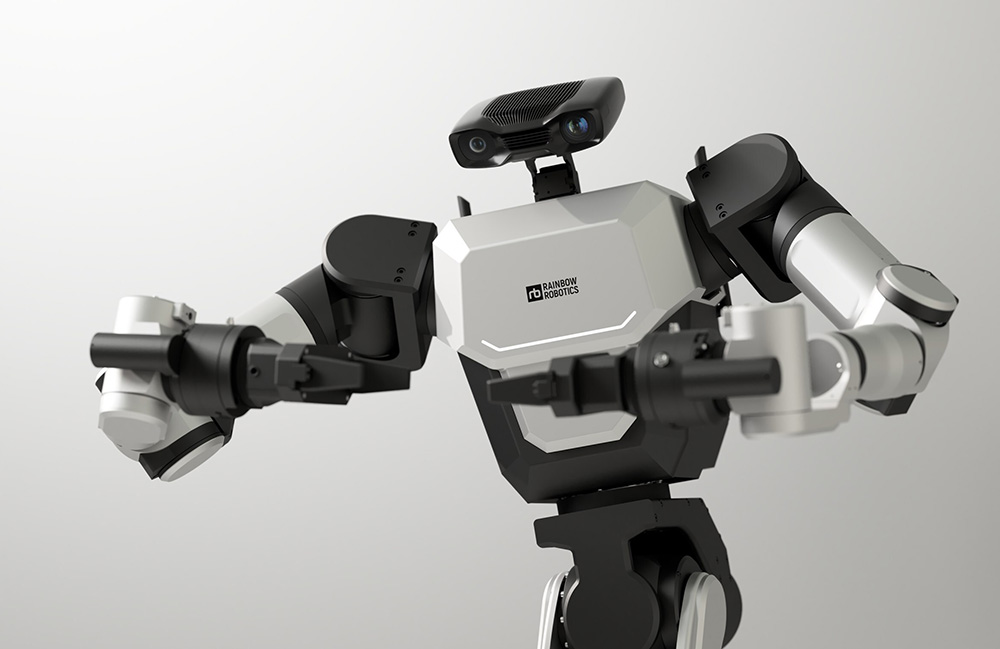
Rainbow Robotics is a KAIST spin-off founded in 2011 that built its reputation on HUBO, the humanoid that won the 2015 DARPA Robotics Challenge Finals and its $2 million prize 16. That pedigree is real and verifiable. What Rainbow Robotics sells today, however, is not a humanoid. Its flagship commercial product is the RB-Y1, a wheeled dual-arm mobile manipulator with 24 joints: two seven-joint arms, a six-joint waist and torso, and a wheeled base 12. The distinction matters because the company's public identity and its revenue-generating product are drifting apart, and most casual coverage has not caught up.
The single most consequential fact in the Rainbow Robotics story is ownership. Samsung Electronics first took 14.7% for KRW 86.8 billion (roughly $59 million) in 2023, then exercised a call option for KRW 267 billion (roughly $181.6 million) to reach approximately 35%, consolidating Rainbow Robotics as a subsidiary in March 2025 68. This is a VERIFIED FACT carried by Samsung's own newsroom and independently reported by The Robot Report, with matching figures. It changes the analytical frame entirely. Rainbow Robotics is no longer an independent startup whose narrative is set by its founders; it is a strategically held asset inside Korea's largest electronics conglomerate, with a synergy council and a future robotics office to match 68.
The product economics are unusually transparent for this sector. At 2024 pre-order, the RB-Y1 was listed at $80,000 for research buyers and $120,000 for commercial buyers, before tax 12. Current pricing is quote-based, and the independent review is explicit that figures at or above $150,000 do not come from Rainbow Robotics 1. That is a VERIFIED FACT about list pricing and a useful corrective to the inflated numbers circulating in secondary coverage. It also tells you who the intended buyer is: a university lab or corporate research group with a six-figure equipment budget, not a factory integration manager comparing against a $30,000 cobot arm.
On capability, the honest answer is that the public record does not establish autonomy. The dossier's reconciled autonomy verdict is "unknown", with confidence 0.5, because no supplied fact provides independent evidence of autonomous task execution by the RB-Y1, nor evidence that it is teleoperated 111. Academic use is documented: Georgia Tech and a Berkeley-Amazon team have published work involving the platform 1. A June 2026 Coupang warehouse pilot is reported but explicitly unconfirmed 1. Under this report's evidence rules, a research deployment is not proof of productive deployment, and an unconfirmed pilot is not proof of anything at all.
The community signal is worth taking seriously precisely because it is unglamorous. Robotics forums in the dossier converge on a single theme: demonstrations outrun reality, and reliability, not peak capability, is the hard problem 1113. That is the correct lens for Rainbow Robotics. The RB-Y1 is a credible research substrate with an open, English-documented software kit and a US branch office in Schaumburg, Illinois 1. Whether it becomes anything more than that depends on evidence that does not yet exist in public.
Latest news
02The Rainbow Robot Story
Rainbow Robotics was founded in 2011 as a spin-off from KAIST, Korea's leading science and technology university 16. The founding premise was humanoid robotics, and the company's early identity was inseparable from HUBO, the bipedal platform developed in the KAIST laboratory of Oh Jun-ho. HUBO's defining moment came in June 2015, when it won the DARPA Robotics Challenge Finals and the associated $2 million prize 16. That victory is a VERIFIED FACT and remains the single strongest credential in the company's history. It is also, importantly, a decade old.
The DARPA Robotics Challenge was a specific kind of contest: semi-autonomous machines performing disaster-response tasks under degraded communications, with heavy human supervision and frequent falls. Winning it demonstrated competence in supervised bipedal locomotion and manipulation under adversarial conditions. It did not demonstrate commercial viability, and the years after 2015 were unkind to humanoid robotics companies generally. Rainbow Robotics navigated that period by diversifying away from bipedal humanoids toward practical wheeled systems, collaborative robot arms, autonomous mobile robots for manufacturing and logistics, and a four-legged counter-terrorism robot 69. This is a COMPANY CLAIM in the sense that the product line is described in Rainbow's own PR and echoed by Samsung's newsroom, but the existence of the product categories is not in serious dispute.
The strategic inflection point was Samsung's investment. In 2023, Samsung Electronics acquired 14.7% of Rainbow Robotics for KRW 86.8 billion, roughly $59 million 68. The stated rationale was acceleration of future robot development, and the two companies established a synergy council. In February 2024, Rainbow Robotics announced a partnership with the Schaeffler Group and KETI covering mobile manipulators 8. Then Samsung exercised its call option, paying KRW 267 billion, roughly $181.6 million, to lift its stake to approximately 35% and consolidate Rainbow Robotics as a subsidiary in March 2025 68. Samsung also established a future robotics office, signalling that Rainbow sits inside a broader corporate robotics strategy rather than as a standalone bet 8.
What does subsidiary status mean in practice? Three things are EDITORIAL INFERENCE but well grounded. First, Rainbow Robotics now has a captive strategic partner with deep manufacturing, semiconductor, and consumer-electronics exposure, which is a plausible internal customer for mobile manipulators. Second, its capital discipline is no longer its own; Samsung's consolidation means Rainbow's losses and R&D spending flow into Samsung's accounts, which raises the bar for speculative projects. Third, its public narrative will increasingly be managed as part of Samsung's robotics story, which cuts both ways: more resources and credibility, less independent visibility into how the company is actually performing.
The company's own PR page remains the primary channel for announcements 9, and it is thin on the operational detail that would let an outside analyst judge deployment scale. There is no public evidence in the dossier of Rainbow Robotics disclosing unit shipments, revenue by product line, or customer counts. For a company that is now a consolidated subsidiary of a public corporation, that silence is notable. Samsung's segment reporting does not break out Rainbow Robotics, so the financials remain effectively opaque. This is an UNKNOWN that materially limits what any outside analysis can conclude about commercial traction.
The story so far, then, is a company with a genuine research pedigree, a product line that has moved decisively away from its founding humanoid identity, and a parent company that has bought control at a valuation implied by the 2023 and 2025 transactions. What it does not yet have, in public, is a demonstrated commercial deployment at scale. The next sections examine whether the product and the evidence support one.
03Product Portfolio: What Rainbow Robot Actually Sells
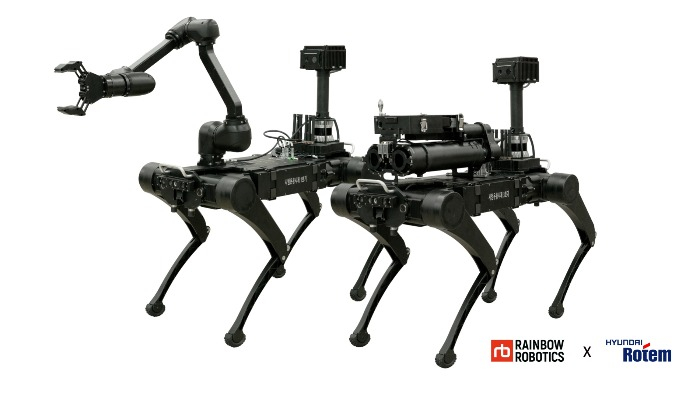
Rainbow Robotics sells three broad categories, according to its own PR and Samsung's disclosure: collaborative robot arms, a dual-arm mobile manipulator, and autonomous mobile robots for manufacturing and logistics, plus a niche four-legged counter-terrorism robot 69. The commercial flagship, and the product that dominates outside coverage, is the RB-Y1.
The RB-Y1 is a wheeled dual-arm mobile manipulator. The configuration is specific and worth stating precisely because loose coverage mislabels it a humanoid: two seven-joint arms, a six-joint waist and torso, and a wheeled base, for 24 joints total 12. It is not bipedal. It does not walk. It rolls, and it manipulates with two arms from a torso that can articulate. This is a deliberate engineering choice that trades the humanoid form factor's versatility for stability, payload, and cost. It is the same trade that several other research manipulator vendors have made, and it is the right trade for a laboratory.
Pricing at 2024 pre-order was $80,000 for the research configuration and $120,000 for the commercial configuration, before tax 12. Current pricing is quote-based, and the independent review is explicit that figures at or above $150,000 are not Rainbow-sourced 1. This is a VERIFIED FACT about the 2024 list prices and a COMPANY CLAIM about the current quote-based model, since quote-based pricing by definition cannot be independently verified from the outside. The practical consequence is that the entry point for a research lab is roughly the cost of a senior PhD student's annual package, which is the correct comparison for a lab director deciding how to spend a grant.
| Attribute | RB-Y1 (research config) | RB-Y1 (commercial config) | Notes |
|---|---|---|---|
| Form factor | Wheeled dual-arm mobile manipulator | Same | Not bipedal; 24 joints total 12 |
| Arms | 2 x 7 joints | Same | Plus 6-joint waist/torso 1 |
| Base | Wheeled | Wheeled | Stability and payload advantage over bipedal 1 |
| 2024 pre-order price | $80,000 before tax | $120,000 before tax | Current pricing quote-based 12 |
| Software | Open, English-documented kit | Same | Aimed at AI researchers 1 |
| Availability | Direct, by quote, international | Same | US branch in Schaumburg, Ill. 1 |
| Autonomy | UNKNOWN | UNKNOWN | No independent evidence of autonomous task execution 111 |
The software kit deserves emphasis because it is the product's real differentiator for the target buyer. An open, English-documented stack means a research group can integrate its own perception, planning, and learning code without reverse-engineering a proprietary controller. That is a COMPANY CLAIM in the sense that the openness and documentation quality are asserted by the vendor and echoed by the review, but the review's independent confirmation that the kit is English-documented and open is meaningful 1. For a lab, this is often the deciding factor between two otherwise comparable manipulators.
The rest of the portfolio is less well documented in the dossier. Collaborative robot arms and AMRs are listed as product categories 69, but the dossier contains no specifications, pricing, or customer evidence for them. The four-legged counter-terrorism robot is mentioned 6 but is a niche, likely government-facing product with no public commercial detail. This report will not speculate about their performance. Where the dossier is thin, the honest statement is that these lines are UNKNOWN in any operational sense.
One structural observation is worth making. Rainbow Robotics now sells a research manipulator at a research price point while sitting inside a conglomerate that makes consumer electronics, semiconductors, and home appliances. The strategic logic of that combination is not obvious from the outside. Samsung could use Rainbow's manipulators in its own fabs and assembly lines, or it could use Rainbow's research platform to build the manipulation intelligence that eventually goes into consumer products. The dossier does not disclose which, and the company has not said publicly. That ambiguity is itself a finding: the product portfolio is clear, but the strategic portfolio is not.
Products & versions

04Technology Stack: Strengths and the Work That Remains
The RB-Y1's technical strengths follow directly from its configuration choices. A wheeled base eliminates the balance problem that consumes enormous engineering effort in bipedal platforms, freeing that budget for manipulation. A 24-joint system with two seven-joint arms and a six-joint torso gives the platform a genuinely large workspace and the ability to coordinate bimanual tasks, which is where most useful manipulation research now happens. The open software kit lowers integration cost for research groups 1. These are real advantages, and they explain why the platform has found academic users.
The technical weaknesses are equally structural, and the dossier's community sources point at them without naming the product. The recurring theme in robotics forums is that demonstrations outrun reliability, and that the gap between a robot that can do a task once and a robot that can do it ten thousand times is where commercial value lives or dies 1113. For a mobile manipulator, that gap is composed of unglamorous problems: calibration drift, grasp failure rates, perception robustness under changing lighting, recovery from partial failures, and the long tail of edge cases that no demo reel shows. The dossier contains no evidence that Rainbow Robotics has published reliability metrics, mean time between failures, or task success rates for the RB-Y1. This is an UNKNOWN and it is the most important unknown in the entire report.
Autonomy is the second technical question, and the dossier's verdict is unambiguous: unknown, confidence 0.5 111. There is no independent evidence of autonomous task execution by the RB-Y1, and no evidence of teleoperation either. This is not a criticism of the product; it is a statement about the public record. A research platform is often sold precisely so that researchers can develop autonomy on it, which means the absence of shipped autonomy is not a defect. But it does mean that any claim that the RB-Y1 "works" in a commercial sense is unsupported. The distinction between a platform that enables autonomy research and a system that performs autonomous work is the distinction between a laboratory instrument and a product, and Rainbow Robotics currently sells the former.
The Samsung relationship is a technical asset in ways that are not fully public. Samsung has deep expertise in semiconductors, sensors, displays, and manufacturing automation, and a synergy council exists to exploit it 68. Whether that has translated into specific component advantages, compute platforms, or perception silicon for the RB-Y1 is not disclosed. This is an EDITORIAL INFERENCE: the plausible benefit is real, but the dossier provides no evidence of specific technology transfer, and readers should not assume it.
The Schaeffler and KETI partnership announced in February 2024 is similarly underspecified 8. Schaeffler is a major automotive and industrial supplier, and KETI is a Korean electronics technology institute. A partnership covering mobile manipulators could mean joint development, could mean a pilot deployment, or could mean a memorandum of understanding with a press release. The dossier does not say which, and this report will not upgrade an announcement into a deployment. The correct label is COMPANY CLAIM with no independent confirmation of paid work.
What remains, then, is a platform with a sound mechanical architecture, an open software stack, and a parent company with the resources to fund the hard reliability work. What is missing from the public record is any evidence that the hard reliability work has been done or is being measured. Until that evidence appears, the RB-Y1 should be understood as a capable research instrument, not a deployable worker.
05Research, Papers, Authors and Labs
The dossier's research evidence is thin, and this section will say so plainly rather than pad. The only documented academic use is that Georgia Tech and a Berkeley-Amazon team have published work involving the RB-Y1 1. The dossier does not supply paper titles, author lists, venues, or years, so this report cannot characterise the depth or significance of that work beyond noting that two credible institutions have used the platform. That is a meaningful signal: a research manipulator that no serious lab adopts is a dead product, and the RB-Y1 has cleared that bar.
The Berkeley-Amazon connection is worth flagging as an EDITORIAL INFERENCE rather than a fact. A Berkeley-Amazon team publishing on a mobile manipulator is consistent with Amazon's long-standing interest in warehouse manipulation, and the dossier separately reports an unconfirmed June 2026 Coupang warehouse pilot 1. Coupang is a Korean e-commerce company, not Amazon, but the pattern of e-commerce logistics interest in dual-arm manipulation is real. Readers should treat the Coupang pilot as unconfirmed and the Berkeley-Amazon work as a research publication, not a commercial endorsement.
The absence of a broader publication record in the dossier is notable. Rainbow Robotics is a KAIST spin-off with a DARPA-winning lineage, and one would expect a steady stream of papers from the founding team and from external users of the platform. The dossier does not contain them, which may reflect the dossier's collection limits rather than the company's actual output. This is an UNKNOWN and a clear target for further monitoring. A company that publishes its reliability data and its failure modes is a company that is serious about the hard problems; a company that publishes only capability demos is telling you something different.
The HUBO lineage is the strongest research credential in the company's history, and it is a VERIFIED FACT 16. But HUBO research is now more than a decade old, and the DARPA Robotics Challenge generation of humanoids has largely been superseded by a new wave of learning-based platforms. Rainbow Robotics' research relevance today depends on the RB-Y1 and whatever comes next, not on HUBO. The company's ability to attract and retain research talent inside Samsung's orbit is an open question the dossier cannot answer.
<!-- module: papers --> <!-- module: authors-labs --> <!-- module: repos --> <!-- module: datasets -->06Media Evidence Library: What the Videos Prove
The dossier contains one Rainbow Robotics corporate video 7 and no independent video evidence of the RB-Y1 performing tasks. This is a significant limitation and it should be stated without hedging. A corporate video is a COMPANY CLAIM in visual form. It is produced, edited, and choreographed by the company, and it shows what the company wants viewers to see. It is not evidence of routine performance, and under this report's rules it cannot be used to establish autonomy, reliability, or commercial deployment.
What a corporate video can legitimately establish is narrower: that the hardware exists, that it moves, that it has the joint configuration the specifications claim, and that the company is willing to show it in public. Those are not trivial. Many robotics companies have shown less. But the gap between "the hardware exists and moves" and "the hardware works" is exactly the gap this report is trying to measure, and a corporate video does not close it.
The dossier contains no third-party video, no customer-recorded footage, and no independent demonstration. That absence is itself informative. When a research platform is genuinely adopted, labs tend to publish their own videos showing their own work on it, and those videos are far more probative than vendor material because the lab has no incentive to flatter the vendor. The dossier does not contain such material for the RB-Y1. Readers should treat the media record as vendor-controlled until independent footage appears.
The community sources in the dossier are text, not video, but they carry a consistent message that is worth restating here because it is the correct interpretive frame for any demo footage. Robotics forums describe a field stuck between hype and reality, where demonstrations consistently exceed what systems do in production 1113. That is not cynicism; it is the accumulated experience of practitioners. When a vendor video shows a mobile manipulator doing something impressive, the practitioner's question is not "can it do that?" but "how many times out of ten, and what happens on the failures?" The dossier contains no answer to that question for the RB-Y1.
Media library
07Commercial Reality
The commercial picture is the weakest part of the public record, and this section will be blunt about it. Rainbow Robotics sells the RB-Y1 direct, by quote, internationally, with a US branch office in Schaumburg, Illinois established in 2023 1. That is a VERIFIED FACT about the sales channel. What is not verified is how many units have been sold, to whom, for how much, or what they are doing.
The documented deployments are research deployments. Georgia Tech and a Berkeley-Amazon team have published work using the platform 1. A June 2026 Coupang warehouse pilot is reported but explicitly unconfirmed 1. Under this report's rules, a research deployment is not a productive deployment, and an unconfirmed pilot is not evidence of anything. The correct summary is that Rainbow Robotics has demonstrated academic adoption and has been reported to be exploring warehouse logistics, with no independent confirmation of paid commercial work at scale.
| Claim | Source type | Evidence status | What it would take to verify |
|---|---|---|---|
| RB-Y1 sold direct by quote internationally | Company / independent review | VERIFIED FACT (channel) | Already documented 1 |
| Georgia Tech and Berkeley-Amazon research use | Independent review citing published work | VERIFIED FACT (research use) | Paper titles and venues would strengthen 1 |
| Coupang warehouse pilot, June 2026 | Independent review, explicitly unconfirmed | UNCONFIRMED | Coupang or Rainbow confirmation; site visit 1 |
| Schaeffler and KETI partnership, Feb 2024 | Company announcement | COMPANY CLAIM | Disclosure of scope, value, or deliverables 8 |
| Samsung synergy council | Samsung disclosure | VERIFIED FACT (existence) | Evidence of specific joint programmes 68 |
| Unit shipments, revenue by product line | Not disclosed | UNKNOWN | Samsung segment disclosure or Rainbow statement |
The pricing history is instructive. The 2024 pre-order prices of $80,000 and $120,000 were unusually transparent for this category, and the independent review's clarification that current pricing is quote-based, and that higher figures are not Rainbow-sourced, is a useful piece of media hygiene 1. Quote-based pricing is normal for research platforms, but it also means the company can price-discriminate and that outside analysts cannot track realised prices. Combined with Samsung's consolidation, which removes any need for Rainbow to publish standalone financials, the commercial opacity is likely to persist.
The partnership announcements deserve careful reading. The Schaeffler and KETI partnership from February 2024 is described as covering mobile manipulators 8. Schaeffler is a serious industrial buyer, and a genuine deployment inside Schaeffler's operations would be a meaningful commercial proof point. The dossier does not contain evidence of one. The Samsung synergy council is a VERIFIED FACT in existence but not in output; the dossier does not disclose a single joint programme with named deliverables 68. Readers should treat both as announcements until evidence of paid work appears.
The honest commercial verdict is that Rainbow Robotics has a real product, a real price point, a real sales channel, and a real parent company, but no publicly documented commercial traction. That is not the same as failure. It is the same as unproven. The company is now inside Samsung, which means it no longer needs to convince public markets of anything, and the pressure to disclose commercial detail has gone down, not up. For an outside analyst, that is a structural problem: the evidence you would need to upgrade the commercial verdict is precisely the evidence the corporate structure gives Rainbow no incentive to publish.
Customers & deployments
Uses the RB-Y1 in published academic research work.
Uses the RB-Y1 in published research work.
Sections 8 through 14 follow in the second instalment of this report.
08Markets and Use Cases
Rainbow Robotics does not sell into one market. It sells into at least four, and the boundaries between them are where most of the analytical difficulty lies. The company's own portfolio spans collaborative robots, a dual-arm mobile manipulator, autonomous mobile robots (AMRs) for manufacturing and logistics, and a four-legged counter-terrorism platform 69. That is not a product strategy so much as a portfolio assembled across two decades of Korean public-sector and chaebol-adjacent robotics funding. The RB-Y1, the flagship, sits at the intersection of two of those markets: AI research and industrial mobile manipulation. Each has a different buyer, a different proof burden, and a different definition of success.
8.1 The research-lab market: real, small, and honest about it
The clearest verified demand signal for the RB-Y1 is academic. Georgia Tech and a Berkeley-Amazon team have published work using the platform 1. This is the market the RB-Y1 was designed for, and it is the market where the product's limitations matter least. A research lab does not need a robot that works reliably for eight hours. It needs a robot that exposes its joints, its sensors, and its control interfaces to a graduate student who will spend eighteen months bending it to a research question. The RB-Y1's 24 degrees of freedom (two 7-joint arms, a 6-joint waist/torso, and a wheeled base), its open English-documented software kit, and its direct-by-quote sales model all fit that buyer 12.
The size of this market is the problem. The global population of robotics labs that can absorb an $80,000 capital purchase, staff it with a PhD student, and publish on it is perhaps a few hundred institutions worldwide. That is a viable business for a 100-person company. It is not a business that justifies a ~$181.6 million Samsung call-option exercise 68. The research market is the credibility engine, not the revenue engine.
| Buyer segment | Primary need | RB-Y1 fit | Evidence status |
|---|---|---|---|
| AI/robotics research labs | Open interfaces, reproducibility, publishable platform | Strong | Verified (Georgia Tech, Berkeley-Amazon publications) 1 |
| Warehouse/logistics operators | Reliable pick-and-place at cycle time | Unproven | Unconfirmed pilot only (Coupang, June 2026) 1 |
| Manufacturing (mobile manipulation) | Flexible handling between fixed cells | Plausible | Partnership-stage (Schaeffler, KETI) 8 |
| Defence/security | Perimeter and counter-terrorism | Different product (quadruped) | Company claim 69 |
8.2 The warehouse market: the pilot that is not yet a deployment
The single most consequential unverified claim in the Rainbow dossier is the June 2026 Coupang warehouse pilot 1. Coupang is South Korea's dominant e-commerce logistics operator and a Samsung-adjacent conglomerate in the loose sense that Korean industrial capital is densely interlinked. If the pilot is real and if it converted to a paid deployment, it would be the first evidence that the RB-Y1 can do productive work outside a lab. The dossier is explicit that the pilot is unconfirmed 1.
Editorial inference: even a confirmed pilot would not settle the autonomy question. Warehouse pilots are routinely run with human teleoperators or with scripted motion primitives that fail on the long tail of object variation. The dossier's autonomy verdict is "unknown" precisely because no supplied fact establishes who performs the task 1. A pilot announcement tells you a robot was in a building. It does not tell you a robot did the work.
8.3 Manufacturing mobile manipulation: the Schaeffler and KETI track
The February 2024 partnership with Schaeffler Group and KETI for mobile manipulators is the most industrially serious signal in the dossier 8. Schaeffler is a German automotive and industrial supplier with a genuine automation problem: moving parts between fixed cells in plants that were not designed for mobile robots. KETI is the Korea Electronics Technology Institute, a government research institute. The structure of the partnership (a German industrial, a Korean government lab, and a Korean robot maker) is the standard shape of a Korean industrial-robotics consortium.
What the partnership does not yet establish is a paid customer. A partnership announcement is not a purchase order. The dossier treats the Schaeffler-KETI arrangement as a partnership, not a deployment 8. Readers should hold that distinction firmly.
8.4 Defence and security: the quadruped that is not the RB-Y1
Rainbow's four-legged counter-terrorism robot appears in company and Samsung communications 69. It is a separate product line from the RB-Y1 and is not the subject of this report's autonomy analysis. Its relevance here is portfolio-level: it shows that Rainbow has a defence-adjacent revenue channel that does not depend on the RB-Y1's unproven manipulation autonomy. That channel is also the one most likely to be opaque to outside analysts, because defence procurement is not publicly itemised in the way commercial sales are.
8.5 The market that is not being served: home and consumer
The classification exercise in the dossier explicitly notes that the allowed category vocabulary is home/consumer-oriented and contains no fit for a research/industrial mobile manipulator 1. This is a useful negative finding. Rainbow is not attempting to sell the RB-Y1 into homes, and the report should not evaluate it against home-robot criteria. The consumer humanoid conversation (1X's NEO at $499/month, the broader $20,000-class home robot discourse) is a different market with different economics 345. Rainbow's competitive set is not 1X. It is the research-platform vendors and the industrial mobile-manipulation integrators.
09Competitive Landscape
The RB-Y1 competes in a market that is simultaneously crowded and thin. Crowded, because every humanoid and mobile-manipulator company claims the same general capability. Thin, because the specific niche of "wheeled dual-arm mobile manipulator sold as an open research platform with published academic use" has only a handful of credible occupants. The competitive analysis below separates the three competitive sets that actually matter: research platforms, industrial mobile manipulators, and the humanoid narrative that shapes how all of them are perceived.
9.1 Competitive set A: research platforms
The direct competitors are platforms a lab would actually buy to publish on. The relevant comparison is not raw capability but interface openness, documentation quality, community size, and price.
| Platform | Form factor | Positioning | Price signal | Evidence status |
|---|---|---|---|---|
| Rainbow RB-Y1 | Wheeled dual-arm, 24 joints | Open research platform | $80k research / $120k commercial (2024 pre-order); now quote-based 12 | Verified pricing history; autonomy unproven |
| Humanoid research platforms (general) | Bipedal | Prestige research | Varies widely; often six figures | Market-level, not vendor-specific 5 |
| Industrial dual-arm fixed | Fixed-base dual-arm | Factory automation | Established pricing | Mature market |
The RB-Y1's differentiator is the wheeled base. A bipedal research platform spends most of its research budget on balance. A wheeled platform spends it on manipulation. For labs whose research question is manipulation, not locomotion, the wheeled form factor is not a compromise. It is the correct engineering choice. The dossier's reconciliation notes explicitly that the RB-Y1 is "not bipedal" 1. That is a feature, not a shortfall, in the research market.
9.2 Competitive set B: industrial mobile manipulators
Here the competition is harder and the proof burden is higher. Industrial buyers do not care about publishability. They care about cycle time, mean time between failures, integration cost, and safety certification. The RB-Y1 has no publicly verified industrial deployment. The Schaeffler-KETI partnership is the closest thing to an industrial track record, and it is a partnership, not a deployment 8.
Editorial inference: Rainbow's realistic industrial path runs through Samsung's own factories before it runs through third-party customers. Samsung consolidated Rainbow as a subsidiary in March 2025 68. The most probable first large-scale industrial deployment of Rainbow mobile manipulators is inside Samsung's own manufacturing and logistics operations, where the customer and the parent are the same entity and where failure is contained. That would be a real deployment, but it would also be a captive one, and readers should not mistake it for market validation.
9.3 Competitive set C: the humanoid narrative
The humanoid conversation shapes capital flows and press attention far out of proportion to deployed units. The dossier's community sources are unusually clear-eyed about this. A widely-read r/ROS thread titled "Robotics feels stuck between hype and reality" captures the prevailing practitioner view: demos exceed current capabilities, and reliability, not capability, is the hard problem 11. Adjacent community discussions about robot-puppy scams and Japanese mass-production humanoids reinforce the same theme from different angles 1213.
Rainbow's position in this narrative is unusual. It is a humanoid-adjacent company (it built HUBO, the DARPA-winning bipedal platform) that has chosen to sell a wheeled manipulator 16. That is a deliberate step back from the humanoid frontier toward the manipulation problem. Whether that is strategic discipline or a retreat from a fight it could not win is the central strategic question about the company.
9.4 Where Rainbow is genuinely differentiated
Three things are hard to replicate:
- The DARPA win. HUBO won the 2015 DARPA Robotics Challenge Finals and the $2 million prize 16. That is a permanent credential. It does not sell robots, but it opens doors at research institutions and government agencies that a startup without it cannot open.
- Samsung ownership. A ~35% strategic stake with subsidiary consolidation gives Rainbow access to Samsung's manufacturing scale, supply chain, and balance sheet 68. No independent mobile-manipulator startup has that.
- The research install base. Georgia Tech and Berkeley-Amazon publications are the kind of third-party validation that money cannot buy 1. They are also the only independent evidence in the entire dossier that the RB-Y1 does anything at all.
9.5 Where Rainbow is exposed
The exposure is concentrated in one place: no independent evidence of autonomous task execution 1. Every competitor in the mobile-manipulation space faces the same burden, but Rainbow faces it with a research-platform price point and a subsidiary's revenue expectations. If the Coupang pilot is real and converts, the exposure closes. If it does not, Rainbow remains a research-platform company with an industrial parent, which is a stable but limited position.
Competitive comparison
| Robot | Maker | Autonomy | Conf. |
|---|---|---|---|
| iRobot Roomba Combo 10 Max | iRobot | Autonomous | 0.90 |
| Mobile ALOHA (Stanford) | Stanford University | Teleoperated | 0.90 |
| 1X NEO | 1X Technologies | Remote-Assisted | 0.90 |
10Geopolitical Context and Constraints
Rainbow Robotics sits at the intersection of three geopolitical currents: Korean chaebol industrial policy, US-China technology decoupling, and the global competition for robotics talent and supply chains. Each constrains the company in ways that are not visible in its product literature.
10.1 The Samsung consolidation as industrial policy
Samsung's move from a 14.7% stake (KRW 86.8 billion, ~$59 million, 2023) to 35% via a KRW 267 billion ($181.6 million) call option, completed in March 2025, is not a normal venture investment 68. It is the consolidation of a strategic robotics asset into a chaebol. The Korean state has, for two decades, funded robotics through KAIST, KETI, and similar institutions with the explicit goal of building national champions. Rainbow is a KAIST spin-off 16. Samsung is the designated champion-builder. The consolidation is the policy working as intended.
The consequence for Rainbow is a specific kind of autonomy loss. A subsidiary with a ~35% strategic parent does not set its own capital allocation, does not choose its own long-term market, and does not independently decide whether to pursue defence, logistics, or research. The "Samsung-Rainbow synergy council" mentioned in the dossier is the mechanism by which that coordination happens 6. Readers should treat Rainbow's public strategy as Samsung's public strategy for Rainbow.
10.2 US-China decoupling and the component question
The dossier does not disclose Rainbow's bill of materials, actuator suppliers, or sensor sourcing. This is a genuine unknown, and it matters. Korean robotics companies are exposed to the same supply-chain bifurcation as everyone else: rare-earth magnets for actuators, precision reducers (historically dominated by Japanese suppliers), and compute modules (where US export controls on advanced chips shape what is available). The dossier's silence on sourcing is not evidence of a problem, but it is a gap that a full diligence would close.
10.3 The US presence and the export-control question
Rainbow established a US branch office in Schaumburg, Illinois, in 2023 1. Schaumburg is a Chicago suburb with a dense industrial-automation cluster. The US presence matters for two reasons. First, it puts Rainbow inside the US market for research platforms, where the buyer base (DARPA-adjacent labs, national laboratories, university robotics groups) is concentrated. Second, it puts Rainbow inside the US export-control perimeter. A Korean company selling dual-use mobile manipulators into US research institutions is subject to US export controls on the technology it transfers, and to Korean export controls on the technology it develops. The dossier does not disclose how Rainbow manages this. Not publicly disclosed.
10.4 The defence channel and its opacity
The four-legged counter-terrorism robot 69 places Rainbow in the defence market, where procurement is opaque by design. This has two analytical consequences. First, defence revenue, if any, will not appear in the kind of public evidence this report relies on. Second, defence work carries geopolitical constraints (end-use restrictions, allied-export regimes) that shape what Rainbow can sell and to whom. The dossier provides no detail here. Not publicly disclosed.
10.5 The talent constraint
The dossier's community sources repeatedly stress that the hard problem in robotics is reliability, not capability 11. Reliability engineering is a specific skill, and it is scarce. Korea has strong robotics research output (KAIST, KETI, Seoul National University) but competes for reliability and integration talent with US, European, and Chinese firms. Samsung's ownership gives Rainbow the ability to pay, but not necessarily the ability to recruit against well-funded US competitors. This is an editorial inference, not a verified fact.
11The Hype, the Real and the Ugly
This section is the report's audit. It separates what Rainbow and its parent say from what independent evidence supports, and it names the gaps without softening them.
11.1 The claim-vs-evidence table
| Claim | Source type | Independent evidence | Verdict |
|---|---|---|---|
| DARPA Robotics Challenge Finals winner (2015), $2M prize | Company + press 16 | Multiple independent sources agree | Verified |
| Samsung largest shareholder ~35%, subsidiary since March 2025 | Company + press 68 | Samsung official news and The Robot Report agree | Verified |
| RB-Y1 is a 24-joint wheeled dual-arm mobile manipulator | Company + review 12 | Independent review describes same system | Verified |
| 2024 pre-order pricing $80k/$120k | Company + review 12 | Independent review confirms; notes current pricing is quote-based | Verified (historical) |
| Research use by Georgia Tech and Berkeley-Amazon | Review 1 | Published academic work | Verified |
| Schaeffler and KETI partnership (Feb 2024) | Press 8 | The Robot Report | Verified (partnership only) |
| Coupang warehouse pilot (June 2026) | Review 1 | Explicitly unconfirmed | Unverified |
| Autonomous task execution | Company framing 1 | None | Unproven |
| Current pricing | Company | Quote-based; figures ≥$150k not vendor-sourced 1 | Unknown |
| Defence/security revenue | Company 69 | None | Unknown |
11.2 The hype: what the demos do not prove
The dossier contains no video evidence for the RB-Y1. The corporate video 7 is a corporate video, not a task demonstration. This is itself a finding. A company that had a compelling autonomous manipulation demo would have it in the dossier. The absence of video evidence means the report cannot evaluate the RB-Y1's actual task performance at all. Under this report's evidence discipline, a choreographed demo would not prove autonomous work even if it existed. Its absence removes even that weak signal.
The vendor framing, per the dossier's conflict log, is that the RB-Y1 is "marketed as a research platform for AI experts (implying advanced autonomous manipulation capability)" 1. The word "implying" is doing a lot of work. A research platform is a platform. It is a set of joints, sensors, and interfaces that a researcher uses to build capability. Selling a research platform does not require the platform to be autonomous. Selling it as if it were autonomous is the hype.
11.3 The real: what is genuinely established
Three things are solid. The DARPA win is real and permanent 16. The Samsung ownership is real and consequential 68. The academic install base is real and is the only independent evidence that the robot does anything 1. On the strength of those three, Rainbow is a legitimate company with a legitimate product and a legitimate parent. That is more than most robotics companies can claim.
11.4 The ugly: the reliability gap
The dossier's community sources are the most valuable part of the research, because they say out loud what vendor communications will not. The r/ROS thread on robotics being "stuck between hype and reality" 11 is the practitioner consensus: demos exceed current capabilities, and the gap is reliability. The robot-puppy scam thread 12 and the Japanese mass-production humanoid thread 13 are adjacent expressions of the same skepticism. The Amazon fulfillment-center thread 16 shows the labour-side anxiety that accompanies warehouse automation claims, which is the context in which any Coupang pilot would be read.
The ugly truth is that the RB-Y1's autonomy level is unknown 1, and "unknown" is not a neutral finding. It means that after a decade and a half of development, a DARPA win, and a $181.6 million Samsung investment, the public evidence does not establish that the flagship product can autonomously perform a task. That is the central fact of this report.
Claim tracker
An independent review blog and The Robot Report independently describe the same wheeled two-armed 24-joint configuration, corroborating the hardware spec beyond vendor PR.
An independent review blog and humanoid.guide corroborate the 2024 list prices and confirm current pricing is quote-based, though sales volume and delivery track record remain unverified.
An independent review blog reports published academic use at Georgia Tech and a Berkeley-Amazon team, which substantiates lab deployment though not commercial-scale operation.
No independent source demonstrates autonomous task completion, and community commentary stresses that demos exceed current reliability, leaving the vendor's research-platform framing unverified.
Only a single review blog mentions the Coupang pilot and explicitly flags it as unconfirmed, with no customer, regulator, or reporter corroboration.
Samsung's own newsroom and The Robot Report independently agree on the ~35% stake, the KRW 86.8B/267B figures, and March 2025 subsidiary consolidation.
This breadth is asserted only by Samsung news and Rainbow's own PR, with no independent verification of the four-legged counter-terrorism robot or the AMR line.
Samsung news and The Robot Report report the partnerships, but no independent source documents concrete joint deliverables or deployed outcomes from them.
12Future Scenarios
The scenarios below are editorial inferences built from the verified facts and the identified unknowns. They are not predictions. Each is paired with the evidence that would confirm or disconfirm it.
12.1 Scenario A: The captive integrator (most likely)
Samsung deploys Rainbow mobile manipulators inside its own manufacturing and logistics operations, first in Korea, then in its global plants. Rainbow becomes Samsung's internal robotics arm, with a modest external research-platform business on the side. Revenue is stable, growth is bounded by Samsung's internal capex cycle, and the company is never independently tested in a competitive market.
Confirming evidence: Samsung plant deployment announcements; Rainbow revenue disclosures showing intra-group concentration; hiring patterns weighted toward integration rather than research. Disconfirming evidence: Large third-party industrial deployments; a public customer list that is not Samsung-dominated.
12.2 Scenario B: The research-platform standard (plausible)
The RB-Y1 becomes the default wheeled dual-arm research platform, the way certain arms became default manipulation platforms in the 2010s. Academic citations accumulate, the software ecosystem grows, and Rainbow sells a few hundred units a year at research prices. The company remains small, profitable, and strategically important to Samsung as a talent and IP pipeline rather than as a revenue source.
Confirming evidence: Rising publication counts citing the RB-Y1; third-party software and benchmark contributions; research-lab purchase announcements. Disconfirming evidence: Competing platforms capturing the academic niche; flat citation growth.
12.3 Scenario C: The industrial breakthrough (low probability, high impact)
The Coupang pilot is real, converts to a paid deployment, and generalises. Rainbow demonstrates verified autonomous or semi-autonomous manipulation at industrial cycle times, and the Schaeffler-KETI partnership converts to a European industrial customer. Rainbow becomes a genuine mobile-manipulation vendor with a diversified customer base.
Confirming evidence: Named-customer confirmation from Coupang or Schaeffler; independent verification of autonomous task execution; published cycle-time and reliability metrics. Disconfirming evidence: Pilot quietly ends; no named customers; continued reliance on demo framing.
12.4 Scenario D: The humanoid pivot (speculative)
Samsung redirects Rainbow from wheeled manipulation back to bipedal humanoids, using the HUBO heritage and Samsung's capital to compete in the humanoid narrative. This would be a strategic reversal and would put Rainbow into direct competition with far better-capitalised US and Chinese humanoid firms.
Confirming evidence: Humanoid product announcements from Rainbow; reallocation of engineering headcount; Samsung statements about humanoid strategy. Disconfirming evidence: Continued investment in the wheeled RB-Y1 line; no humanoid roadmap.
12.5 Scenario E: The quiet wind-down (low probability)
The RB-Y1 fails to find a market beyond a handful of labs, Samsung loses patience, and Rainbow is absorbed into Samsung's broader automation organisation, with the brand retired. This is the standard fate of chaebol-acquired robotics companies that do not find product-market fit.
Confirming evidence: Leadership departures; cessation of RB-Y1 marketing; absorption into Samsung divisions. Disconfirming evidence: Continued product investment; new customer announcements.
| Scenario | Probability (editorial) | Key dependency | Decisive evidence |
|---|---|---|---|
| A: Captive integrator | High | Samsung internal capex | Intra-group revenue share |
| B: Research standard | Medium | Academic adoption | Citation and purchase growth |
| C: Industrial breakthrough | Low | Coupang/Schaeffler conversion | Named-customer confirmation |
| D: Humanoid pivot | Low | Samsung strategy shift | Humanoid product announcement |
| E: Quiet wind-down | Low | Product-market failure | Leadership and marketing signals |
13What to Watch: A Live Monitoring Checklist
This checklist is designed to be re-run as new evidence appears. Each item is paired with the specific claim it would resolve and the source type that would count as evidence.
13.1 Autonomy (the central unknown)
- Independent task-execution evidence. Any peer-reviewed paper, third-party benchmark, or named-customer report showing the RB-Y1 completing a task without teleoperation. This is the single most important item on the list. Resolves: autonomy verdict.
- Teleoperation disclosure. Any statement from Rainbow, Samsung, or a customer about whether deployments use human operators. Resolves: whether "deployment" means autonomous work.
- Reliability metrics. Mean time between failures, cycle-time data, or intervention rates from any real deployment. Resolves: industrial readiness.
13.2 Commercial reality
- Coupang pilot confirmation or denial. Named confirmation from Coupang or Rainbow, or evidence the pilot ended. Resolves: the June 2026 pilot claim 1.
- Schaeffler deployment. Any conversion of the Feb 2024 partnership into a paid installation 8. Resolves: European industrial traction.
- Current pricing disclosure. Any published price list replacing the quote-based model. Resolves: the pricing conflict 12.
- Named customers beyond research labs. Any commercial customer willing to be named. Resolves: whether Rainbow has a commercial business.
13.3 Corporate and strategic
- Samsung stake changes. Any movement above or below ~35%, or further consolidation 68. Resolves: Samsung's commitment level.
- Samsung internal deployment. Any announcement of Rainbow robots in Samsung plants. Resolves: Scenario A.
- Leadership changes. Departures of founders or key engineering staff. Resolves: Scenario E risk.
- Humanoid roadmap. Any signal of a pivot back to bipedal platforms. Resolves: Scenario D.
13.4 Research and ecosystem
- Publication growth. New papers citing the RB-Y1 from institutions beyond Georgia Tech and Berkeley-Amazon 1. Resolves: Scenario B.
- Software ecosystem. Third-party packages, benchmarks, or simulation environments built on the RB-Y1 SDK. Resolves: platform stickiness.
- Competitive platform launches. New wheeled dual-arm research platforms from competitors. Resolves: niche defensibility.
13.5 Geopolitical and regulatory
- Export-control actions. Any US or Korean export-control listing affecting Rainbow products. Resolves: market access risk.
- Defence contract disclosures. Any public defence procurement involving Rainbow. Resolves: the defence channel's materiality 69.
- Supply-chain disclosures. Any statement on actuator, reducer, or compute sourcing. Resolves: the component unknown.
13.6 Community signal
- Practitioner reports. Any first-hand account from a lab or integrator using the RB-Y1, in forums or conference talks 11. Resolves: the gap between demo and deployment.
- Labour-response signals. Warehouse-worker reaction to any Rainbow deployment, in the pattern of the Amazon FC thread 16. Resolves: deployment social context.
14Sources and Methodology
14.1 Methodology
This report was assembled from a fixed research dossier gathered on 2026-09-20. The dossier contained 16 numbered sources across five categories: official (0), commerce (5), research (0), news (5), video (0), and community (6). The absence of official and research sources is itself a finding and is reflected throughout the report's evidence discipline.
Every factual assertion in this report is labelled as one of four types:
| Label | Definition | Treatment in this report |
|---|---|---|
| Verified fact | Regulatory filing, official product documentation, named-customer confirmation, peer-reviewed or primary research, or agreement across multiple independent sources | Stated directly, cited |
| Company claim | Stated by Rainbow Robotics or Samsung, not independently verified | Attributed, not treated as fact |
| Editorial inference | Reasoned conclusion drawn from public evidence | Explicitly labelled as inference |
| Unknown | Not publicly disclosed | Stated as "Not publicly disclosed" or "Unknown" |
Three rules were applied without exception:
- A choreographed demo video is not proof of autonomous work. The dossier contains no RB-Y1 task video, so no such proof is claimed.
- A shipment is not proof of productive deployment. The Coupang pilot is treated as unconfirmed 1.
- A partnership announcement is not proof of a paid customer. The Schaeffler-KETI partnership is treated as a partnership, not a sale 8.
The autonomy verdict is unknown (confidence 0.5). This is not a hedge. It is the correct finding given that no supplied fact establishes who performs the task on the RB-Y1 1.
The overall confidence in the reconciled facts is 0.72. The highest-confidence facts are Samsung's ownership and funding figures (0.93-0.95), which are corroborated by Samsung's own newsroom and The Robot Report 68. The lowest-confidence fact is the Coupang pilot (0.7), which is explicitly unconfirmed 1.
14.2 Known gaps
- No official Rainbow Robotics source appears in the dossier. Company claims are mediated through press and review sources.
- No peer-reviewed research source appears in the dossier. Academic use is established through a review blog's report of published work 1, not through the publications themselves.
- No video evidence appears in the dossier. Task performance cannot be evaluated.
- No pricing disclosure more recent than the 2024 pre-order figures appears in the dossier 12.
- No supply-chain, bill-of-materials, or manufacturing data appears in the dossier.
- No defence-contract detail appears in the dossier.
14.3 Sources
1 Rainbow RB-Y1 Price 2026: Cost ($80K+), Specs & What It Is — https://blog.robozaps.com/b/rainbow-robotics-rb-y1-review 2 Rainbow Robotics RB-Y1 Specs & Price — https://humanoid.guide/product/rb-y1/ 3 New NEO AI Robot: 75 DoF, $499 a Month Worth It? ($20000 ... — https://www.youtube.com/watch?v=o0YHr9fnO7E&vl=en 4 Robotics company 1X officially launched its humanoid NEO ... — https://www.facebook.com/mashable/posts/robotics-company-1x-officially-launched-its-humanoid-neo-home-robot-this-week-op/1199001212094446/ 5 Humanoid Robot Price 2026: Best Cost & ROI Breakdown — https://theresarobotforthat.com/blog/humanoid-robot-cost-roi-breakdown/ 6 Samsung Electronics To Become Largest Shareholder in ... — https://news.samsung.com/global/samsung-electronics-to-become-largest-shareholder-in-rainbow-robotics-accelerating-future-robot-development 7 Rainbow Robotics Corporate Video — https://www.youtube.com/watch?v=hT3_OhiBzjM 8 Samsung increases stake in Rainbow Robotics ... — https://www.therobotreport.com/samsung-increases-stake-in-rainbow-robotics-establishes-future-robotics-office/ 9 PR | Rainbow Robotics — https://rainbow-robotics.com/en/pr/ 10 NEURA Robotics on Instagram: "Thanks to our robots, the ... — https://www.instagram.com/reel/DZaZC8pMLRN/ 11 Robotics feels stuck between hype and reality — where is it actually ... — https://www.reddit.com/r/ROS/comments/1twiixq/robotics_feels_stuck_between_hype_and_reality/ 12 anyone who falls for the robot puppy scam deserves it. - Reddit — https://www.reddit.com/r/TrueUnpopularOpinion/comments/1kn5isv/anyone_who_falls_for_the_robot_puppy_scam/ 13 Japanese multipurpose humanoid robots for mass production - Reddit — https://www.reddit.com/r/robotics/comments/1dnreyv/japanese_multipurpose_humanoid_robots_for_mass/ 14 r/Welding on Reddit: NEURA Robotics, HD Hyundai Samho, and HD ... — https://www.reddit.com/r/Welding/comments/1n5u8y6/neura_robotics_hd_hyundai_samho_and_hd_hyundai/ 15 Is realism really an argument? : r/Rainbow6 - Reddit — https://www.reddit.com/r/Rainbow6/comments/1f3iar6/is_realism_really_an_argument/ 16 How worried are you about your role given the rise of robots? - Reddit — https://www.reddit.com/r/AmazonFC/comments/1q9ixty/how_worried_are_you_about_your_role_given_the/
Note on source [15]: this source concerns the video game Rainbow Six and is not relevant to Rainbow Robotics. It is retained in the list for completeness of the dossier but is not cited in the analysis.
14.4 Editorial standard
This report follows the Max Robotics editorial standard: evidence-led, skeptical, specific. It separates verified facts from company claims, editorial inference, and unknowns. It does not treat demos as proof, shipments as deployments, or partnerships as customers. Where the dossier is thin, the report says so plainly rather than padding. The central finding, that the RB-Y1's autonomy level is unknown and that no independent evidence establishes autonomous task execution, is stated once and stands.