PuduTech
US$0.99 unlocks one Word + one PDF download. The full report is free to read on this page.
PuduTech: The 130,000-Unit Question
PuduTech has shipped more service robots than almost any company on earth, yet the public record still cannot tell us whether they work as advertised.
| Report status | Coverage date | Company stage | Editorial standard |
|---|---|---|---|
| Premium editorial deep report, first edition | Evidence gathered 18 September 2026 | Fully commercial, late-stage private | Evidence-labelled; vendor claims separated from verified fact |
How to Read This Report
This report is built on a deliberately narrow evidence base. The research dossier behind it contains no regulatory filings, no audited financial statements, no peer-reviewed papers authored by PuduTech staff, and no independent field trials. What it does contain is a large volume of company-issued material (press releases, product pages, a developer portal, YouTube demonstrations), a small number of third-party commerce listings, one independent hardware teardown, and a handful of community posts from people who have physically encountered a Pudu robot in a restaurant or a shop.
That asymmetry shapes everything below. PuduTech is a company that communicates fluently and frequently. The independent record is thin, and where it exists it is mostly about presence rather than performance: a robot was seen, a robot was photographed, a robot was used to play Doom. Almost nothing in the public domain tests whether the robot did its job correctly, for how long, with what intervention rate, or at what cost per task.
Every substantive statement in this report carries one of four labels.
| Label | Meaning | Example in this report |
|---|---|---|
| VERIFIED FACT | Confirmed by regulatory filing, official product documentation, named-customer confirmation, peer-reviewed or primary research, or multiple independent sources agreeing | PuduTech was founded in 2016 and is headquartered in Shenzhen 168 |
| COMPANY CLAIM | Stated by PuduTech or its controlled channels, not independently verified | "Over 130,000 robots shipped across 85+ countries" 67 |
| EDITORIAL INFERENCE | A reasoned conclusion drawn from public evidence, explicitly ours and not the company's | The 130,000 shipped and 60,000 deployed figures are probably measuring different things |
| UNKNOWN | Not publicly disclosed, and we say so rather than estimate | Actual field reliability, intervention rates, unit economics |
Two rules govern the whole document. First, a choreographed demonstration video is not proof of autonomous work; it is proof that a robot can perform a scripted behaviour under favourable conditions with a camera crew present. Second, a shipment is not a deployment, and a deployment is not a productive deployment. A robot sitting in a restaurant lobby greeting guests is a shipment. A robot scrubbing 4,000 square metres of airport floor every night for three years without a maintenance contract dispute is a productive deployment. PuduTech's public record establishes the first category abundantly and the second category barely at all.
Where the dossier is thin, this report says "Not publicly disclosed" and moves on. It does not fill gaps with plausible-sounding numbers. Readers who want the marketing version can find it on the company's own site 1; the purpose here is to establish what an informed buyer, investor, or competitor can actually rely on.
01Executive Overview
PuduTech is, by shipment volume, one of the most successful commercial service robotics companies in the world, and by public evidence standards, one of the least examined. The company was founded in Shenzhen in 2016 and has grown into a multi-line manufacturer spanning delivery robots, floor-cleaning robots, industrial autonomous mobile robots (AMRs), pallet-handling robots, commercial robotic mowers, and a pair of semi-humanoid service robots 168. It raised close to USD 150 million in its most recent round at a valuation exceeding USD 1.5 billion, bringing cumulative funding past USD 300 million 6817. It claims more than 130,000 units shipped across 85-plus countries 67, and its developer portal separately cites 60,000-plus commercial deployments 3. Frost & Sullivan, cited in company material, placed it first in global commercial service robotics market share at 23 per cent in 2023 6.
Those are substantial numbers, and they are almost entirely company-reported. COMPANY CLAIM. No independent audit, regulatory filing, or third-party market study in the dossier corroborates the shipment count, the deployment count, the market-share figure, or the valuation. The funding round is reported by PR Newswire and echoed by SiliconANGLE, which raises confidence in the headline figure without verifying the underlying terms 68. EDITORIAL INFERENCE: the 130,000 shipped and 60,000 deployed figures are almost certainly measuring different things, most likely cumulative units sold versus units currently active or registered on the platform. The gap between them is not disclosed, and it matters: a 54 per cent ratio of active-to-shipped units would be unremarkable in hardware, but it would also mean that nearly half of all Pudu robots ever built are not currently doing anything.
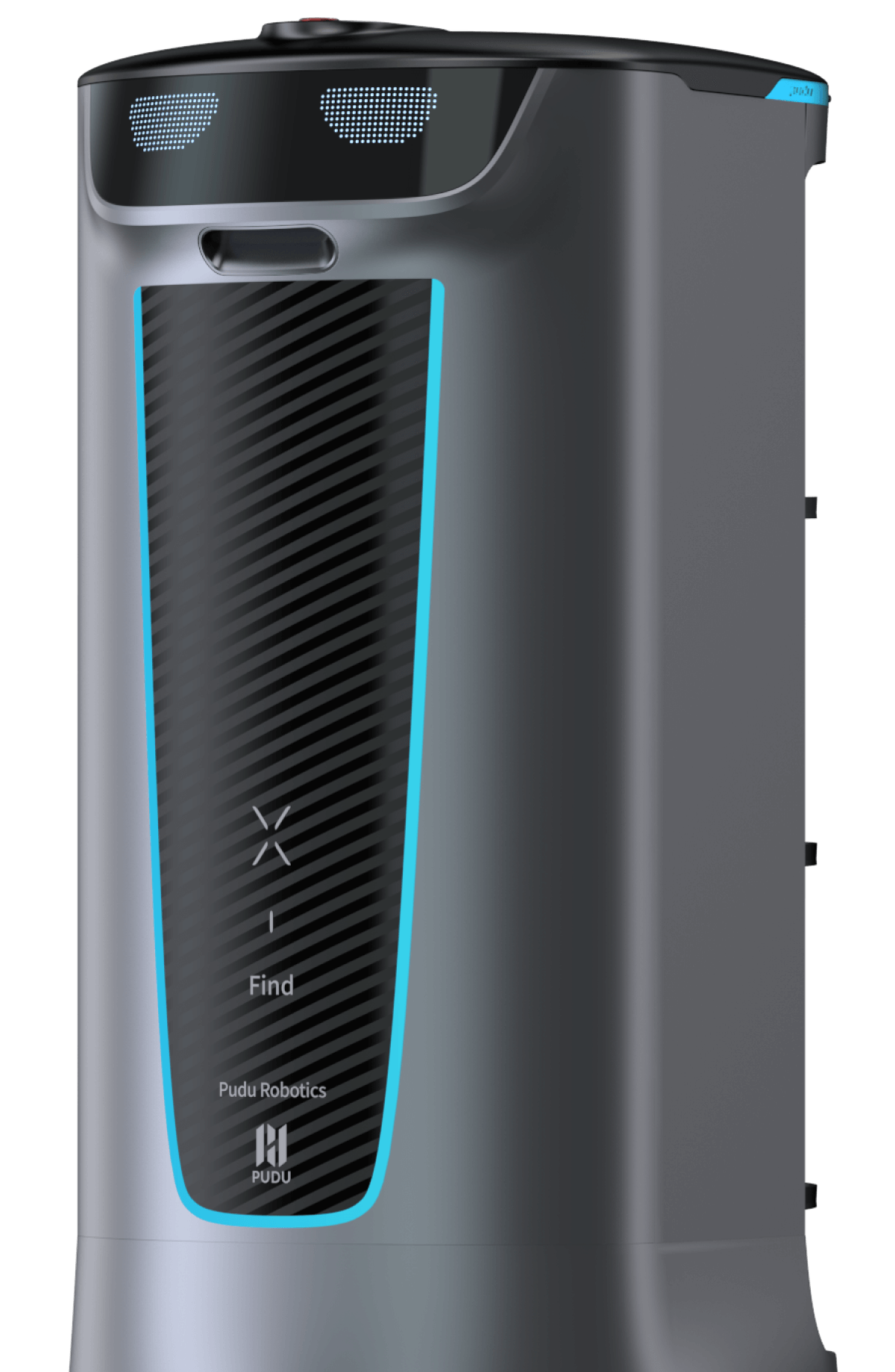
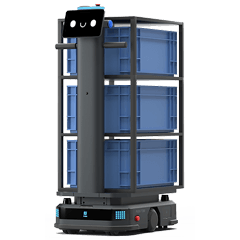
The product portfolio is genuinely broad. Delivery robots (BellaBot, KettyBot, FlashBot, HolaBot) start around USD 14,000; cleaning robots (CC1, MT1, S1 Pro) and industrial AMRs (T300, T150, MP2000) sit in the mid-range; the D9 semi-humanoid is listed at up to USD 60,000, with the D7 quote-only 245. The MP2000 pallet robot handles 2,000 kg, and the T300 AMR handles 300 kg for assembly-line and warehouse material transport 1124. The GT series extends the company into commercial turf management 10. This is not a single-product company riding one form factor; it is a platform company attempting to occupy several adjacent markets simultaneously.
The autonomy story is where the evidence gets interesting and where the report's central tension sits. PuduTech markets its robots as fully autonomous, with VSLAM-plus navigation that requires no reflectors or QR codes, AI stain detection that selects cleaning methods and verifies results with a rear camera, and automatic docking for brush and squeegee refresh 1323. An independent teardown of a Pudu unit confirms the physical basis for these claims: a single-board Android computer, an ESP32 microcontroller, a ceiling-facing camera, two 3D cameras, brushless motors, and a 7S battery pack 27. That is real sensing and real compute, consistent with autonomous operation and inconsistent with teleoperation. EDITORIAL INFERENCE: the hardware is credible; the software behaviour is asserted. No independent source in the dossier tests whether the robot navigates correctly in a crowded, cluttered, adversarial real environment, or how often it requires human rescue. The autonomy verdict this report supports is Autonomous, at moderate confidence (0.6), with the explicit caveat that most of the evidence is vendor-produced.
The commercial picture is similarly bifurcated. Pudu robots are visibly present in restaurants, and community posts confirm real-world encounters in dining and retail settings 293033. But presence is not performance. No source in the dossier provides a named customer confirming a paid deployment at scale, a contract value, a renewal, a service-level outcome, or a failure rate. The European expansion announced after IFA 2026 is a strategy statement, not a customer list 79. The Tul Corp. factory video is a vendor-produced case study, not an independently verified deployment 24.
The competitive and geopolitical context compounds the uncertainty. PuduTech competes against a crowded field of Chinese service robotics manufacturers and against Western AMR incumbents in the industrial segment, while operating under the same geopolitical constraints that affect every Chinese robotics company selling into North America and Europe: potential procurement restrictions, data-sovereignty scrutiny, tariff exposure, and customer caution about supply-chain dependency. None of these constraints appear in the company's public communications, which is itself informative.
The bottom line. PuduTech is a real company with real hardware, real funding, and a real global footprint. It is also a company whose most important claims, about autonomy, reliability, and deployment scale, rest almost entirely on its own word. The evidence supports "this robot exists and can navigate a room." It does not yet support "this robot reliably does useful work at scale." Closing that gap is the central task of the next phase of the company's life, and the central question for anyone evaluating it.
Latest news
02The PuduTech Story
PuduTech was founded in Shenzhen in 2016, at the moment when China's consumer robotics supply chain, honed by years of drone and vacuum-robot manufacturing, began to be redirected toward commercial service applications 168. The founding premise was straightforward: the same commodity components that made a robot vacuum affordable, brushless motors, lithium battery packs, depth cameras, low-cost inertial sensors, could be assembled into a wheeled platform capable of carrying trays, scrubbing floors, or moving pallets, and sold to businesses rather than consumers. VERIFIED FACT on the founding year and location; EDITORIAL INFERENCE on the strategic logic, which is consistent with the company's product trajectory but not stated in any single source.
The early years were spent in the restaurant delivery niche. By 2019 the company had raised more than USD 15 million and was being covered as a participant in a heating-up server-robot market 18. That framing is important: PuduTech did not invent the restaurant delivery robot, and it did not arrive first. It arrived into a category that already had multiple Chinese competitors, and its early differentiation was execution and price rather than novel technology. The Series C round of USD 78 million, reported by The Robot Report and Robotics 247, marked the transition from niche player to scaled manufacturer 1415.
The company's growth strategy from that point followed a recognisable pattern: expand horizontally into adjacent form factors rather than vertically deepen a single one. Delivery robots led to cleaning robots, cleaning robots led to industrial AMRs, industrial AMRs led to pallet handlers, and the whole portfolio was eventually capped by a semi-humanoid line (D7, D9) that serves as much as a brand statement as a product 245. The GT series of commercial mowers, launched in 2026, extends the logic into turf management 10. Each new line reuses the navigation stack, the cloud platform, and the manufacturing base, which is the economic argument for the strategy. EDITORIAL INFERENCE: the risk of the strategy is that it produces a portfolio of adequate products in many categories rather than a dominant product in one, and that service, support, and spare-parts complexity scale faster than revenue.
The funding history tells a story of accelerating ambition. From the early USD 15 million to the USD 78 million Series C to the nearly USD 150 million round at a valuation above USD 1.5 billion, the company has raised on a trajectory that assumes continued category expansion 6141718. The most recent round was explicitly framed around "embodied AI technology" deployment, which is the phrase the industry currently uses to signal that a robotics company intends to be valued like an AI company 8. EDITORIAL INFERENCE: the pivot in fundraising language from "service robots" to "embodied AI" is a capital-markets move as much as a technology move, and it should be read with appropriate scepticism until the company publishes evidence of learned policies operating in production.
International expansion has been deliberate. The company made its IFA debut in 2026 and immediately followed with a European growth announcement emphasising localisation 79. Europe is a demanding market for service robotics: it has stronger data-protection regulation, more assertive works councils in hospitality and facilities management, and a customer base that expects multi-year service contracts rather than one-off hardware purchases. Whether PuduTech's model, which appears to be hardware-led with a cloud platform attached, adapts to those expectations is UNKNOWN from public sources.
What the story does not include, in any public document in the dossier, is a candid account of failures. There is no disclosure of product lines discontinued, markets exited, customers lost, or reliability problems encountered. Every company narrative is selective, but PuduTech's is unusually frictionless: continuous expansion, continuous funding, continuous new products. EDITORIAL INFERENCE: a company shipping 130,000 units across 85 countries has certainly encountered failures, returns, and dissatisfied customers. Their absence from the public record is a gap in disclosure, not evidence of their non-existence.
03Product Portfolio: What PuduTech Actually Sells
PuduTech sells into six product families, and the pricing spans roughly USD 14,000 to USD 60,000, with at least one model (the D7) available only by quotation 245. The table below consolidates what the commerce listings and company material establish. Prices are as listed by third-party resellers and should be treated as indicative rather than authoritative; PuduTech does not publish a global price list, and regional pricing, configuration, and service contracts will move the real number substantially.
| Family | Models | Stated role | Indicative price | Evidence quality |
|---|---|---|---|---|
| Delivery | BellaBot, KettyBot, FlashBot, HolaBot | Food and item delivery in restaurants, hotels, retail | KettyBot Pro from ~USD 13,995 | Commerce listings 245; community sightings 2933 |
| Cleaning | CC1, CC1 Pro, MT1, S1 Pro | Floor scrubbing, sweeping, AI stain detection | Mid-range, not consistently disclosed | Vendor video 232628; commerce listings 2 |
| Industrial AMR | T300, T150 | Material transport, assembly line and warehouse logistics | Not consistently disclosed | Vendor video 2425; press release 11 |
| Pallet handling | MP2000 | Autonomous pallet handling, 2,000 kg payload | Not disclosed | Press release 11 |
| Semi-humanoid | D7, D9 | Service interaction, brand flagship | D9 up to ~USD 60,000; D7 quote-only | Commerce listings 245 |
| Mowers | GT3, GT5, GT7 | Commercial turf and grounds management | Not disclosed | Press release 10 |
VERIFIED FACT: these product names and categories appear consistently across commerce, news, and video sources, and the payload figures for the T300 (300 kg) and MP2000 (2,000 kg) are stated in company material 1124. COMPANY CLAIM: the functional descriptions, particularly around autonomy and AI capability. UNKNOWN: unit economics, gross margin by line, service contract attach rates, and the proportion of revenue each family contributes.
Three observations about the portfolio are worth making explicitly.
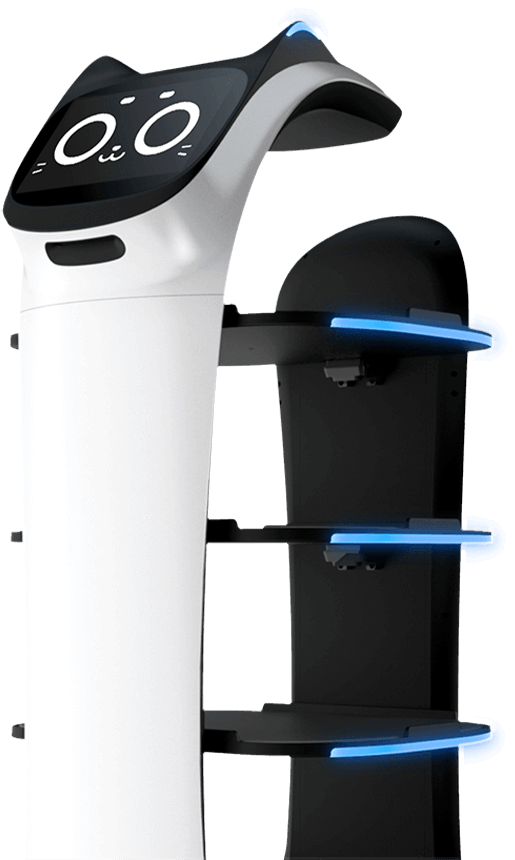
First, the delivery robots are the company's historical identity and its most visible product, but they are also the most commoditised. A restaurant delivery robot is, functionally, a wheeled tray with a navigation stack. The BellaBot's differentiator is its animated cat-like face, which is a user-experience feature rather than a technical moat. EDITORIAL INFERENCE: delivery robots are likely a low-margin, high-volume business for PuduTech, valuable for brand and manufacturing scale but vulnerable to price competition from other Shenzhen manufacturers.
Second, the industrial line is where the strategic value sits. The T300 and MP2000 compete in the AMR market, where customers buy on reliability, integration with warehouse management systems, and total cost of ownership rather than novelty 1124. This is a harder market to enter and a stickier one to hold. The claim that the MP2000 requires no reflectors or QR codes for deployment is a genuine operational advantage if true, because reflector-based navigation requires physical infrastructure installation that slows deployment and raises cost 11. COMPANY CLAIM, unverified.
Third, the semi-humanoid D7 and D9 are best understood as portfolio marketing. A USD 60,000 semi-humanoid service robot has a narrow set of economically rational use cases, and the dossier contains no evidence of a paid deployment of either model 245. EDITORIAL INFERENCE: the D-series exists to signal technological ambition to investors and trade-show audiences, and to provide a halo for the delivery and cleaning lines. That is a legitimate strategy, but it should not be confused with a revenue-generating product line.
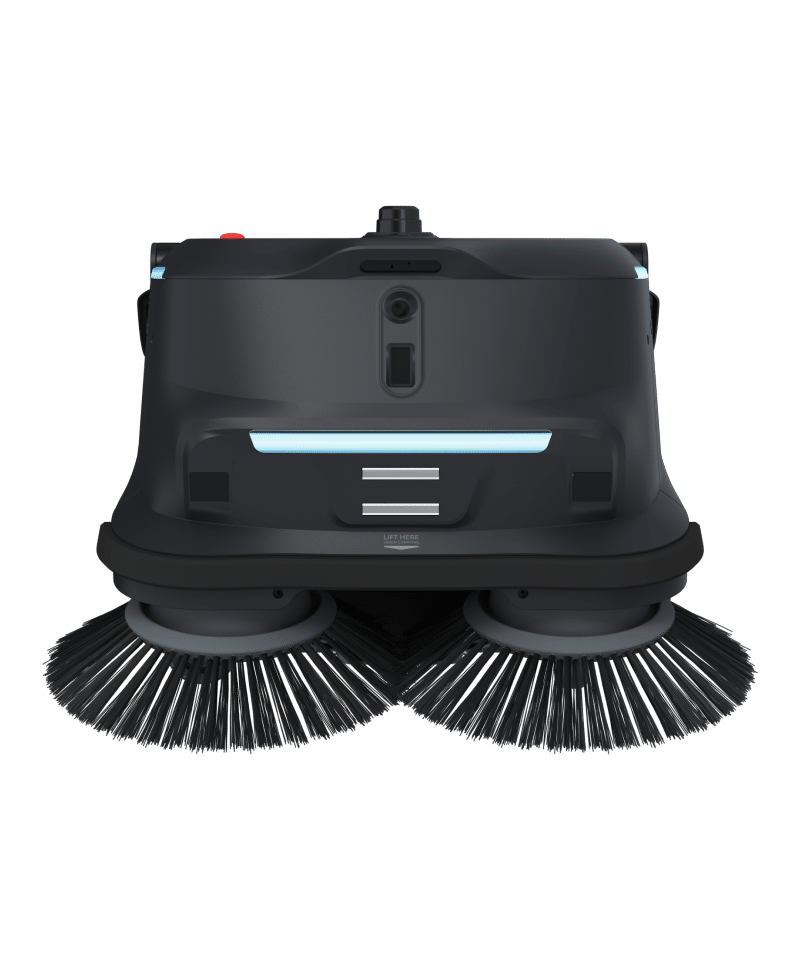
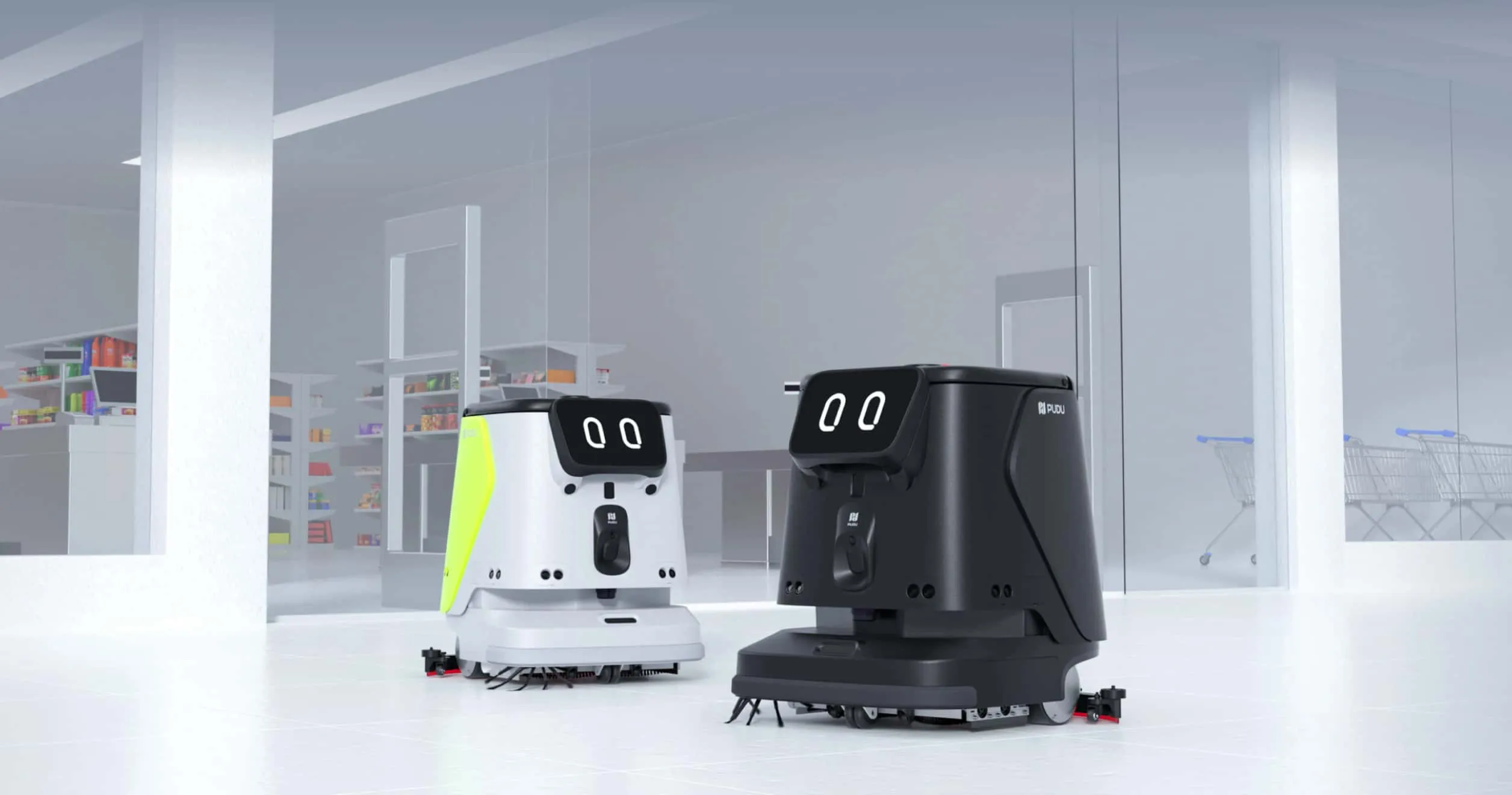
The cleaning line deserves separate attention because it is where the company makes its most specific autonomy claims. The CC1 Pro is marketed with AI stain detection via a front camera, automatic selection of cleaning method, rear-camera verification, re-cleaning of missed spots, and self-return to a docking station for squeegee and brush refresh 2328. If those behaviours work reliably in production, the CC1 Pro is a genuinely autonomous cleaning system rather than a remote-controlled scrubber. If they work only in demonstration conditions, it is an expensive floor machine with a camera. The dossier contains vendor video of the behaviours and no independent verification 23. COMPANY CLAIM.
Products & versions



04Technology Stack: Strengths and the Work That Remains
The single most valuable independent document in the entire dossier is a teardown video of a Pudu delivery robot, in which the unit is disassembled and its internals inspected 27. That video establishes, as VERIFIED FACT, the following hardware configuration: a single-board PC running Android, an ESP32 microcontroller, a ceiling-facing camera, two 3D cameras, brushless motors, a 7S lithium battery pack, a removable top cover, and downward-firing loudspeakers at the base.
This is a revealing bill of materials. The Android single-board computer is a commodity choice, which tells us the company is optimising for cost and developer familiarity rather than bespoke silicon. The ESP32 handles real-time microcontroller duties, a sensible division of labour. The ceiling camera is the most interesting component: it implies a localisation strategy that uses overhead visual features, which is consistent with the company's claim of QR-code-free navigation and with the "dual SLAM" language in its marketing 13. The two 3D cameras provide forward and possibly rear depth sensing. The 7S battery is a standard configuration. Nothing in the teardown suggests exotic or expensive components, which supports the inference that PuduTech's advantage, if it has one, is in integration and software rather than hardware.
EDITORIAL INFERENCE: the reliance on a ceiling camera for localisation is a meaningful architectural choice with a meaningful limitation. Ceiling-based localisation works well in buildings with consistent ceiling features and adequate lighting, and degrades in spaces with uniform ceilings, high ceilings, or changing overhead clutter. It also means the robot's navigation quality is partly a function of the building, not just the robot. This is not a flaw unique to PuduTech, but it is the kind of architectural dependency that determines where the product works and where it does not, and it is not discussed in any company material in the dossier.
On the software side, the company operates the PUDU Open Platform, which provides an SDK, a cloud API, a claimed 99.9 per cent API service-level agreement, a claimed five-minute integration time, and the ability to scale from one unit to thousands 3. COMPANY CLAIM across the board. The existence of a developer platform is itself a VERIFIED FACT and a meaningful signal: it indicates the company intends its robots to be integrated into third-party systems rather than operated as standalone appliances, which is the correct strategic posture for commercial robotics. But a developer portal is not evidence that developers are using it, and the dossier contains no third-party application built on the platform, no integration case study from an independent source, and no developer community activity data.
The navigation stack is described by the company as VSLAM-plus, or dual SLAM, combining visual simultaneous localisation and mapping with the ceiling-camera approach 13. COMPANY CLAIM. The teardown confirms the sensors that would support such a stack 27. What is not established anywhere in the dossier is how the stack performs under adversarial conditions: crowded restaurant floors with moving chairs and unpredictable pedestrians, reflective or wet floors in cleaning applications, or dynamic warehouse environments with forklifts. These are the conditions that determine whether a robot is useful or merely present, and they are precisely the conditions that demonstration videos avoid.
The AI stain detection capability in the cleaning line is the company's most specific and testable software claim 2328. The described behaviour chain, detect stain with front camera, select cleaning method, clean, verify with rear camera, re-clean if necessary, return to dock for brush refresh, is a closed-loop control system, and closed-loop systems are meaningfully harder to build than open-loop ones. If it works, it is a real technical achievement. COMPANY CLAIM, demonstrated only in vendor video, with no independent test in the dossier.
The most significant technology gap in the public record is the absence of any published research. The dossier's research sources are four arXiv papers on quadruped parkour, legged loco-manipulation, tactile manipulation, and multimodal diffusion policy 19202122. None of them are authored by PuduTech personnel, none concern wheeled service robots, and none are cited by the company. EDITORIAL INFERENCE: PuduTech does not appear to publish peer-reviewed robotics research, which distinguishes it from companies like Unitree or Boston Dynamics that maintain visible research programmes. This is not necessarily a weakness, since commercial integration and manufacturing scale are different competencies from research publication, but it means the company's technical claims cannot be assessed through the scientific literature and must be taken on trust or tested directly.
What remains, then, is a stack that is credible in its hardware, plausible in its architecture, and unverified in its behaviour. The work that remains is not primarily technical invention; it is the unglamorous work of proving reliability at scale, publishing failure rates, and submitting to independent evaluation. Until that happens, every autonomy claim in this report carries the same caveat.
05Research, Papers, Authors and Labs
This section is short because the evidence is short, and it is better to say so plainly than to pad it.
The dossier contains four research sources, all arXiv papers, and none of them are connected to PuduTech 19202122. They cover quadruped parkour learning with sparsely gated mixture-of-experts models, cooperative whole-body legged loco-manipulation, contact-rich manipulation with predicted touch, and multimodal diffusion policy for quadruped parkour navigation. These are relevant to the broader field of embodied AI and legged locomotion, and they are the kind of work that informs the industry's direction, but they are not PuduTech's work and they do not describe PuduTech's robots.
VERIFIED FACT: no peer-reviewed paper, conference publication, or technical report authored by PuduTech staff appears in the dossier. UNKNOWN: whether the company conducts internal research that it does not publish, which is likely but unverifiable.
This absence is worth interpreting carefully rather than simply noting. A commercial service robotics company is not obliged to publish research, and many successful hardware companies do not. The relevant question is not whether PuduTech publishes, but whether the absence of publication correlates with an absence of fundamental technical depth. EDITORIAL INFERENCE: the company's competitive position appears to rest on integration, manufacturing cost, and go-to-market execution rather than on novel algorithms. That is a legitimate and often more profitable position, but it has a specific vulnerability: integration advantages are easier to copy than research advantages, and a competitor with comparable manufacturing scale and a better navigation stack could displace PuduTech in any given vertical.
The dossier also contains no information about the company's research organisation, its engineering headcount, its academic partnerships, or its patent portfolio. UNKNOWN across all four. For a company valued above USD 1.5 billion and claiming market leadership, this is a notable disclosure gap. Patent filings would be public and would provide a window into the company's technical priorities; their absence from the dossier may reflect a gap in research rather than an absence of filings, but either way the reader should treat the company's technical moat as unestablished.
<!-- module: papers --> <!-- module: authors-labs --> <!-- module: repos --> <!-- module: datasets -->06Media Evidence Library: What the Videos Prove
The dossier contains six video sources, five of them vendor-produced and one an independent teardown 232425262728. This section examines what each category of video actually establishes, applying the report's core discipline: a demonstration video proves that a behaviour can occur under demonstration conditions, and nothing more.
The vendor videos fall into three groups.
Cleaning demonstrations. The CC1 Pro self-cleaning docking station video and the CC1 Pro scrubber-dryer video show the robot performing stain detection, method selection, and dock-based brush refresh 2328. The MT1 sweeper video shows AI-powered sweeping 26. These videos establish that the behaviours exist in some form. They do not establish frequency of success, behaviour under adverse floor conditions, or whether the "AI stain detection" is a learned model or a heuristic threshold on image brightness. COMPANY CLAIM.
Industrial deployment videos. The Tul Corp. factory video and the e-commerce warehouse video show T300 AMRs moving material in what appear to be real operational settings 2425. The Tul Corp. video is framed as a customer case study, which is stronger evidence than a pure demonstration, but it is still vendor-produced and the customer's own account is not independently reported. COMPANY CLAIM, with the caveat that a named customer appearing in a vendor video is weak evidence of a real deployment and no evidence at all of a satisfied one.
The teardown. The "Doom on a Food Delivery Robot" video is the only independent media in the dossier 27. Its value is not the Doom demonstration, which is a novelty, but the disassembly, which provides the hardware inventory discussed in §4. This is the single most reliable piece of evidence in the entire report, precisely because it was produced by someone with no incentive to flatter the company.
What none of the videos prove: that the robots operate autonomously for extended periods without human intervention; that they handle crowded, dynamic, or adversarial environments; that they recover gracefully from navigation failures; that their battery life matches specification in real use; or that they generate positive return on investment for their owners. No video in the dossier shows a full work shift, a failure, a human rescue, or a maintenance event. EDITORIAL INFERENCE: the absence of failure footage across a six-video sample is itself a signal about the selection process, not about the robots' reliability.
The community sources are a different kind of evidence and deserve their own treatment. Reddit posts confirm that Pudu robots are physically present in restaurants and retail settings, and that people have interacted with them 293033. One post asks how the robot feels to use and how much it cost, which indicates genuine user curiosity rather than a planted testimonial 29. Another shows a restaurant birthday encounter 33. A Target drive-up robot post and a Voices of the Void post are of uncertain relevance to Pudu specifically 3132. VERIFIED FACT: Pudu robots are in the field and encountered by the public. UNKNOWN: whether those encounters represent successful deployments or merely installed units.
Media library
07Commercial Reality
This is the section where the gap between PuduTech's public narrative and the verifiable record is widest, and it is the section that matters most to anyone considering a purchase, an investment, or a competitive response.
Start with what is claimed. PuduTech states that it has shipped over 130,000 robots across more than 85 countries 67. Its developer portal states 60,000-plus commercial deployments 3. Frost & Sullivan, cited in company material, ranked it first in global commercial service robotics with 23 per cent market share in 2023 6. The company raised nearly USD 150 million at a valuation above USD 1.5 billion 6817. These are the numbers that circulate in industry coverage, and they are all COMPANY CLAIMS or company-cited third-party claims.
Now the reconciliation problem. The 130,000 shipped figure and the 60,000 deployed figure come from two different Pudu-controlled sources and differ by a factor of more than two 36. EDITORIAL INFERENCE: the most likely explanation is that "shipped" counts cumulative units sold to distributors and resellers, while "deployed" counts units activated or registered on the Pudu cloud platform. If that reading is correct, the gap represents inventory in channel, units deployed but not connected, and units no longer in service. A 46 per cent gap between shipped and deployed is not necessarily alarming in hardware distribution, where channel inventory and end-of-life attrition are normal, but it is large enough that the company should explain it. It does not.
The market-share claim requires separate scrutiny. A 23 per cent global share in commercial service robotics, attributed to a 2023 Frost & Sullivan report, would make PuduTech the dominant player in a category that includes dozens of Chinese manufacturers and several well-funded Western competitors 6. EDITORIAL INFERENCE: market-share figures in emerging hardware categories are highly sensitive to how the category is defined. If "commercial service robotics" is defined narrowly enough, a leading position is plausible; if defined broadly, 23 per cent would be extraordinary. The dossier does not contain the underlying report, so the definition cannot be checked. The claim should be treated as directional rather than precise.
What is entirely absent from the dossier is any of the evidence that would establish commercial reality rather than commercial presence. There is no named customer confirming a paid deployment with a contract value. There is no disclosure of average selling price realised, gross margin, or service revenue. There is no renewal rate, no churn figure, no installed-base utilisation rate. There is no independent report of a Pudu robot operating in production for a sustained period. There is no information about the reseller and distributor network that the "shipped" figure implies, or about how much of the installed base is owned by end users versus sitting in channel inventory. UNKNOWN across all of these.
The European expansion announced after IFA 2026 is a case in point 79. The press release describes a "scaled and localized growth strategy," which is corporate language for hiring local staff and adapting products to regional requirements. It does not name a single European customer, a single signed contract, or a single deployment site. EDITORIAL INFERENCE: the European announcement is a market-entry signal, not a revenue event, and should be read as the beginning of a sales effort rather than evidence of its success.
The one piece of commercial evidence that carries independent weight is the community sightings. Pudu robots are in restaurants, and people have seen them 293033. That establishes that units have reached end users and are operating in public. It does not establish that those units are profitable for their owners, that they are reliable, or that they are doing work that would otherwise require a human. A restaurant delivery robot that carries plates from kitchen to table and requires a staff member to load and unload it is a customer-experience feature, not a labour-cost reduction. EDITORIAL INFERENCE: the delivery robot category, PuduTech's original business, may be structurally limited in economic value even where it is commercially successful in unit terms, because the labour it displaces is a small fraction of the labour involved in the task.
The honest summary of PuduTech's commercial reality is this: the company has achieved distribution at a scale few competitors can match, and it has not publicly demonstrated that this distribution translates into durable, profitable, productive deployments. The first is a genuine achievement. The second is the open question, and it is the one that will determine whether the 130,000-unit figure represents a business or a warehouse.
Customers & deployments
Deployed PUDU T300 AMRs to automate material transport in factory intralogistics operations.
Sections 8 through 14 follow in the second part of this report.
08Markets and Use Cases
PuduTech's commercial logic rests on a simple observation: the tasks it automates are repetitive, low-skill, high-turnover, and geographically universal. Food running, floor scrubbing, pallet moving, and turf mowing exist in every market, and the labour that performs them is expensive in the developed world and increasingly scarce everywhere. That universality is the company's greatest strategic asset. It is also the reason the competitive field is crowded and the reason PuduTech's own positioning has drifted steadily from "restaurant robot company" toward "general commercial service robotics platform."
Understanding where the robots actually work requires separating four distinct markets that PuduTech serves with different products, different sales motions, and very different levels of evidence.
8.1 Food Service and Hospitality
This is PuduTech's origin market and still its most visible one. The BellaBot, KettyBot, HolaBot, and FlashBot lines are designed for restaurants, hotels, cafes, and banquet halls, performing tray delivery, dish return, and wayfinding. Community evidence confirms real deployments: Reddit threads show BellaBots running in restaurants in multiple countries, and the "MadeMeSmile" thread 33 captures the now-familiar scene of a birthday dinner interrupted by a cat-faced delivery robot. These are genuine deployments, not demos. What they do not show is whether the robot replaced a staff member, supplemented one, or became a novelty that management kept for marketing.
The economics are the crux. A KettyBot Pro at roughly $13,995 24 is a capital expense that must be justified against a server's wage. In markets with high minimum wages and acute hospitality labour shortages (Western Europe, North America, parts of East Asia), the payback math can work within a year or two. In markets with abundant low-cost labour, the case is weaker and the robot becomes a differentiator rather than a cost-saving. PuduTech's own European push following IFA 2026 79 is a direct bet on the high-wage end of that spectrum.
The honest assessment: food service is a real market with real deployments, but it is also the market most vulnerable to the "novelty decay" problem. A robot that delights customers in month one can become an obstacle in month six if it does not demonstrably reduce labour cost. PuduTech does not publish retention or utilisation data, so the durability of these deployments is unknown.
8.2 Commercial Cleaning
Cleaning is where PuduTech's product story is most technically interesting and least independently verified. The CC1, MT1, and S1 Pro lines target shopping malls, airports, hospitals, factories, and office buildings. The claimed capability set is genuinely ambitious: AI stain detection via front camera, automatic selection of cleaning method, rear-camera verification, re-cleaning of missed spots, and self-return to dock for squeegee and brush refresh 2328.
If those behaviours work as demonstrated, cleaning is a stronger commercial case than food service. Cleaning is night-shift work, it is physically punishing, it has chronic labour shortages in every developed economy, and the task is more structured than navigating a crowded restaurant. A robot that can scrub a mall floor autonomously for a full shift and dock itself is a genuine labour substitute, not a novelty.
But this is precisely where evidence discipline matters most. The cleaning capability claims trace almost entirely to vendor video 2328. The dossier records no independent verification of the AI stain detection, the re-cleaning loop, or the docking refresh. The teardown 27 confirms the sensing hardware exists, which lends plausibility, but hardware presence is not behavioural proof. A front camera and a rear camera can be present and the stain-detection algorithm can still be unreliable in real-world lighting, on real-world floor types, with real-world mess. Until an independent operator publishes a shift-level trial, the cleaning autonomy claim sits at COMPANY CLAIM, not VERIFIED FACT.
8.3 Industrial Logistics and Material Handling
The T300 (300 kg payload) and MP2000 (2,000 kg pallet handling) represent PuduTech's push into the industrial domain, and this is the segment where the company's strategic future most likely lies. The T300 is positioned for assembly-line and warehouse material transport 2425; the MP2000 is an "AI-native pallet handling robot" for logistics 11. The claimed advantage is deployment without reflectors or QR codes, using VSLAM+ and ceiling-camera localisation 311.
Industrial AMR is a mature, competitive, and technically demanding market. The incumbents (MiR, OMRON, Fetch, Seegrid, and a long tail of Chinese and European vendors) have years of deployment data, integration ecosystems, and enterprise sales relationships. PuduTech's differentiator is cost and ease of deployment: the "no reflectors, no QR codes" claim, if true, materially reduces installation time and cost, which is one of the largest hidden expenses in AMR projects.
The T300 deployment with Tul Corp. 24 is described in vendor video. The dossier contains no named-customer confirmation from Tul Corp. itself, no independent site report, and no throughput or uptime data. The MP2000 launch 11 is a press release. Industrial buyers are sophisticated and will demand proof; PuduTech's ability to convert press releases into reference customers is the single most important commercial question for the industrial line.
8.4 Grounds and Turf Management
The GT3/GT5/GT7 robotic mower line 10 is PuduTech's newest and most surprising expansion. Commercial robotic mowing for golf courses, sports fields, and municipal grounds is a real and growing market, but it is also a market with established specialists (Husqvarna, Belrobotics, and others) and a very different buyer (groundskeepers, municipalities, golf course superintendents) from PuduTech's existing customer base. The launch is a press release 10; no deployment evidence appears in the dossier. This is best read as a portfolio-expansion bet rather than a proven revenue line.
8.5 Market Summary Table
| Market | Products | Evidence level | Commercial maturity | Key risk |
|---|---|---|---|---|
| Food service / hospitality | BellaBot, KettyBot, HolaBot, FlashBot | Community-confirmed deployments 2933 | Mature, visible | Novelty decay; labour-cost sensitivity |
| Commercial cleaning | CC1, MT1, S1 Pro | Vendor video only 2328 | Scaling | Unverified autonomy; shift-level reliability |
| Industrial logistics | T300, MP2000 | Vendor video + press release 112425 | Early | Enterprise sales; incumbent competition |
| Grounds / turf | GT3/GT5/GT7 | Press release only 10 | Launch | Different buyer; established specialists |
8.6 The Geographic Dimension
PuduTech's 85+ country footprint 67 is a genuine achievement, but it is not evenly distributed. China is the home market and almost certainly the largest by volume, though the company does not break out regional revenue. Europe is the current strategic focus, evidenced by the IFA 2026 debut and the "scaled and localized growth strategy" framing 79. North America is served through distributors and online channels 25. The developing world is largely a future opportunity, constrained by the same labour-cost economics that make the robots attractive in high-wage markets.
The European push is the most consequential near-term move. Europe combines high labour costs, strong labour protections that make automation attractive to employers, and a regulatory environment (GDPR, the EU AI Act, machinery directives) that is more demanding than China's. PuduTech's ability to navigate European compliance while localising service and support will determine whether the 85-country figure translates into durable European revenue or remains a distribution footprint.
09Competitive Landscape
PuduTech competes in several distinct arenas, and its position differs sharply in each. The company's own claim to market leadership rests on a single data point: a Frost & Sullivan 2023 report cited in company communications stating 23% global commercial service robotics market share and a number-one ranking 6. That figure is COMPANY CLAIM, sourced to a report the dossier does not reproduce, and it should be treated with caution. Market-share claims in fragmented emerging categories are notoriously sensitive to how the category is defined.
9.1 The Delivery Robot Arena
In food-service delivery robots, PuduTech's direct competitors include Keenon, Pudu's closest Chinese rival; Bear Robotics (SoftBank-backed, strong in Korea, Japan, and the US); and a long tail of regional players. PuduTech's advantages are breadth of product line, aggressive pricing, and a developer platform 3 that lowers integration cost. Its disadvantage is that the food-service delivery robot is a relatively commoditised product: the core capability (navigate a restaurant, carry trays, avoid people) is now achievable by many vendors, and differentiation increasingly comes down to price, reliability, and service network.
The strategic risk is that food-service delivery becomes a low-margin hardware business where scale matters more than technology. PuduTech's 130,000-unit shipment figure 6, if accurate, gives it scale, but scale in a commoditising category is a defensive position, not a moat.
9.2 The Cleaning Robot Arena
Commercial cleaning robots pit PuduTech against a different set of specialists: Gaussian Robotics (a direct Chinese competitor with a strong cleaning focus), ICE Cobotics, Tennant, and Kärcher's robotic line, among others. Cleaning is a market where the incumbents have deep customer relationships with facility-management companies and decades of domain knowledge about floor types, chemicals, and cleaning protocols. PuduTech's AI stain detection 23 is a genuine potential differentiator, but it is unverified, and the incumbents are not standing still.
9.3 The Industrial AMR Arena
This is the most competitive and least forgiving arena. PuduTech's T300 and MP2000 1124 enter a market dominated by established AMR vendors with enterprise sales forces, integration partnerships, and reference customers. The "no reflectors, no QR codes" deployment claim 311 is the right differentiator for a market where installation cost is a major barrier, but it must be proven at scale. Industrial buyers run pilots, demand SLAs, and measure uptime in fractions of a percent. PuduTech's 99.9% API SLA claim 3 is a start, but API availability is not the same as robot availability.
9.4 The Semi-Humanoid Question
The D7 and D9 semi-humanoid robots 24 position PuduTech in the most hyped and least commercially proven category in robotics. The D9's roughly $60,000 price tag 4 and the D7's quote-only status suggest these are flagship/showcase products rather than volume sellers. The semi-humanoid form factor offers no clear functional advantage over a purpose-built delivery or cleaning robot for the tasks PuduTech currently automates; its value is largely in marketing, brand positioning, and the "embodied AI" narrative that the company's funding round explicitly invoked 8. This is a strategic bet on narrative and future capability, not a near-term revenue driver.
9.5 Competitive Positioning Table
| Arena | PuduTech position | Strongest competitors | PuduTech's edge | PuduTech's vulnerability |
|---|---|---|---|---|
| Food-service delivery | Scale leader (claimed) | Keenon, Bear Robotics | Price, product breadth, developer platform | Commoditisation; low margins |
| Commercial cleaning | Challenger | Gaussian, ICE, Tennant, Kärcher | AI stain detection (unverified) | Incumbent customer relationships |
| Industrial AMR | Challenger | MiR, OMRON, Seegrid, Fetch | No-reflector deployment | Enterprise sales; proof gap |
| Semi-humanoid | Early mover | Unitree, Figure, others | Integrated service portfolio | No proven use case |
| Grounds / turf | New entrant | Husqvarna, Belrobotics | Portfolio integration | Different buyer; no track record |
9.6 The Structural Question
The competitive landscape raises a structural question that PuduTech's own strategy has not fully answered: is it a focused leader in one category, or a diversified platform across many? The product portfolio spans delivery, cleaning, industrial, mowing, and humanoid, which is either a coherent "commercial service robotics platform" play or a scattergun expansion that dilutes focus. The developer platform 3 and the "embodied AI" funding narrative 8 suggest the company wants to be the platform, but platforms require ecosystem lock-in, and PuduTech's SDK is a tool, not yet an ecosystem. The next two years will reveal whether diversification produces compounding advantage or spreading-thin vulnerability.
Competitive comparison
| Robot | Maker | Autonomy | Conf. |
|---|---|---|---|
| iRobot Roomba Combo 10 Max | iRobot | Autonomous | 0.90 |
| Mobile ALOHA (Stanford) | Stanford University | Teleoperated | 0.90 |
| 1X NEO | 1X Technologies | Remote-Assisted | 0.90 |
10Geopolitical Context and Constraints
PuduTech operates at the intersection of three geopolitical forces that will shape its trajectory: the China-US technology decoupling, the European regulatory tightening around AI and data, and the broader global reassessment of Chinese hardware in critical infrastructure.
10.1 The China-US Dimension
PuduTech is a Shenzhen company. Its robots contain Chinese compute, Chinese sensors, and Chinese software. In the United States, this creates a growing set of constraints. The US has already restricted Chinese-made robots in certain federal and critical-infrastructure contexts, and the political appetite for broader restrictions on Chinese hardware in public spaces, hospitals, and government buildings is increasing. A restaurant robot in a private venue faces fewer barriers than a cleaning robot in a federal building or a hospital, but the direction of travel is clear.
The practical consequence is that PuduTech's addressable market in the US may be structurally limited to private commercial customers willing to accept Chinese hardware. That is a large market, but it excludes the public-sector and regulated segments where cleaning and logistics robots have some of their strongest use cases. PuduTech does not publicly discuss this constraint, and the dossier contains no evidence of US regulatory action specifically targeting the company, but the risk is real and rising.
10.2 The European Regulatory Environment
Europe is PuduTech's stated strategic focus 79, and Europe is also the world's most demanding regulatory environment for AI and robotics. The EU AI Act imposes obligations on AI systems deployed in public spaces, the GDPR governs the personal data that robots' cameras inevitably capture, and the Machinery Regulation sets safety requirements for autonomous mobile machinery. Compliance is achievable but costly, and it favours vendors willing to invest in European legal and technical infrastructure.
PuduTech's "localized growth strategy" 7 is almost certainly a response to this. Localisation in the European context means not just language and service but data residency, conformity assessment, and a European legal entity capable of bearing liability. Whether PuduTech is doing this substantively or performatively is not disclosed. The IFA 2026 debut 9 is a marketing milestone; the compliance substance behind it is UNKNOWN.
10.3 Data and Surveillance Concerns
Every PuduTech robot carries cameras. The ceiling camera, the two 3D cameras confirmed in the teardown 27, and the front and rear cameras on the cleaning robots 23 collectively capture continuous video of the environments they work in. In a restaurant, that means customers. In a mall, that means shoppers. In a hospital, that means patients. The data-handling implications are significant and largely unaddressed in public materials.
PuduTech's developer platform 3 offers cloud APIs, which implies data flows to PuduTech infrastructure or customer cloud environments. Where that data resides, how long it is retained, who can access it, and how it is protected are not publicly disclosed. In Europe, this is a GDPR question with real legal exposure. In the US, it is a privacy and potentially a national-security question. The company's silence on data governance is a material gap in its public posture.
10.4 Supply Chain and Component Exposure
PuduTech's robots depend on a global supply chain: sensors, motors, batteries, and semiconductors. The teardown 27 identifies an Android-based single-board PC, ESP32 microcontrollers, brushless motors, and a 7S battery. Some of these components are subject to export controls or supply constraints, particularly advanced semiconductors. The dossier does not disclose PuduTech's specific component sourcing or its exposure to export-control regimes, but as a Chinese company selling globally, it faces both the risk of component access restrictions and the risk of its products being restricted in destination markets.
10.5 The Strategic Implication
The geopolitical environment favours PuduTech in China and much of the developing world, is manageable but costly in Europe, and is increasingly constrained in the US and allied markets for public-sector and regulated applications. The company's diversification into industrial and cleaning robots, which are more likely to be deployed in regulated environments than restaurant delivery robots, actually increases its geopolitical exposure rather than reducing it. This is an underappreciated tension in PuduTech's strategy: the segments with the best economics are also the segments with the highest regulatory and geopolitical barriers.
11The Hype, the Real and the Ugly
This section separates what PuduTech's marketing asserts from what the evidence supports, and identifies where the gap is widest.
11.1 The Hype
"Fully autonomous." PuduTech's materials describe robots performing tasks fully autonomously, including closed-loop cleaning and navigation without human intervention. The evidence supports autonomous navigation and task execution in vendor demonstrations 23242526, and the teardown 27 confirms the sensing hardware is real. But "fully autonomous" in a controlled demo is not the same as "fully autonomous" across the messy, unpredictable environments where the robots actually work. The autonomy verdict in the dossier is Autonomous at 0.6 confidence, which is a reasonable reading: probably autonomous for the core task, but not independently proven at scale.
"130,000 robots shipped." This figure 6 is a shipment count, not a deployment count, and it comes from PuduTech. Shipments include units sitting in distributor inventory, units in trials, and units that may never be activated. The developer portal's separate "60,000+ commercial deployments" figure 3 is a different and more meaningful metric, but it is also company-sourced and its relationship to the 130,000 figure is unexplained. Neither number is independently verified.
"23% global market share, ranked first." This is a 2023 Frost & Sullivan figure cited by the company 6. Market-share claims in fragmented categories depend entirely on category definition, and the dossier does not reproduce the underlying report. Treat as COMPANY CLAIM.
"Embodied AI." The funding round was framed around deploying "embodied AI technology" 8. This is a narrative term, not a technical specification. PuduTech's robots use SLAM, computer vision, and path planning, which are established robotics techniques. Whether there is anything genuinely "embodied AI" about them, in the sense of learning-based generalisation across tasks, is not demonstrated in any source in the dossier.
11.2 The Real
The hardware is real. The independent teardown 27 confirms a genuine robotics platform: ceiling camera, two 3D cameras, Android compute, ESP32, brushless motors, a 7S battery, and a serviceable design with a removable top cover. This is not vapourware.
The deployments are real. Community evidence 2933 confirms PuduTech robots working in real restaurants. These are not staged demos.
The funding is real. Nearly USD 150M raised, over USD 1.5B valuation, over USD 300M cumulative 6817. These figures come from a press release but are corroborated by independent tech press 813.
The product breadth is real. Delivery, cleaning, industrial, mowing, and humanoid lines, with explicit pricing across multiple models 245. This is a shipping company with a genuine portfolio.
11.3 The Ugly
The verification gap. Almost every autonomy and capability claim traces to vendor material. The dossier's own reconciliation flags this repeatedly. For a company at PuduTech's scale and valuation, the absence of independent operational data (uptime, throughput, failure rates, retention) is a significant transparency deficit.
The data governance silence. Cameras everywhere, cloud APIs, no published data-handling policy. In a world of GDPR and rising privacy expectations, this is a liability.
The metric ambiguity. "130,000 shipped" and "60,000 deployed" are different numbers measuring different things, and the company uses whichever suits the context. This is not necessarily deceptive, but it is not transparent either.
The semi-humanoid distraction. The D7/D9 line 24 consumes engineering and marketing resources for a form factor with no demonstrated commercial advantage over purpose-built robots. It serves the funding narrative more than the customer.
11.4 Claim-vs-Evidence Table
| Claim | Source | Evidence level | Independent verification |
|---|---|---|---|
| Fully autonomous operation | Vendor 123 | COMPANY CLAIM | None; teardown confirms hardware only 27 |
| 130,000+ robots shipped | Vendor 6 | COMPANY CLAIM | None |
| 60,000+ deployments | Vendor 3 | COMPANY CLAIM | None |
| 23% market share, #1 | Vendor citing Frost & Sullivan 6 | COMPANY CLAIM | Report not reproduced |
| AI stain detection + re-clean | Vendor video 23 | COMPANY CLAIM | None |
| No reflectors/QR needed | Vendor 311 | COMPANY CLAIM | None |
| 99.9% API SLA | Vendor 3 | COMPANY CLAIM | None |
| Real onboard sensing | Teardown 27 | VERIFIED FACT | Independent teardown |
| Real restaurant deployments | Community 2933 | VERIFIED FACT | Multiple independent reports |
| ~$150M raise, $1.5B valuation | Press release 6 + tech press 813 | VERIFIED FACT | Independent corroboration |
Claim tracker
Vendor videos [23][26][28] show self-navigation, AI stain detection and auto-docking, and an independent teardown confirms real onboard sensing (ceiling camera, two 3D cameras) consistent with autonomy, but no independent source actually tests or verifies autonomous operation, so the claim remains vendor-asserted.
Both the 130,000-unit/85-country figure and the 60,000+ deployment figure originate from Pudu-controlled sources (press releases and the developer portal), and no independent source corroborates either number or reconciles the discrepancy between them.
These specific behaviors are demonstrated only in Pudu's own video [23] and product material, with no independent test, customer report, or third-party source verifying the closed-loop cleaning capability.
Payload figures and deployment descriptions come from Pudu's own videos [24][25] and press releases [11], with no independent measurement, customer confirmation, or third-party verification of the stated payloads.
An independent teardown confirms the presence of a ceiling camera and two 3D cameras on a Pudu unit, lending partial credibility, but the specific VSLAM+/dual-SLAM architecture and the no-reflector/no-QR deployment claim remain vendor-sourced and untested independently.
The 23% share and first-place ranking are cited only in a Pudu news release referencing a Frost & Sullivan report, and no independent source reproduces or verifies the market-share figure.
The figures are stated in a PR Newswire press release [6] and echoed by SiliconANGLE [8] and xix.ai [13], but all trace back to the company's own announcement with no independent confirmation of the round size or valuation.
Multiple independent community reports on Reddit [29][32][33] describe encountering Pudu delivery robots in restaurants and stores, independently confirming real-world deployment, though these accounts do not test autonomy or performance.
12Future Scenarios
The following scenarios are EDITORIAL INFERENCE, constructed from the public evidence in the dossier. They are not predictions; they are structured ways of thinking about how PuduTech's trajectory could unfold.
12.1 Scenario A: The Platform Play Succeeds (optimistic)
PuduTech converts its product breadth and developer platform 3 into a genuine ecosystem. The industrial line (T300, MP2000) wins reference customers who validate the no-reflector deployment claim, cleaning robots prove reliable in independent trials, and the developer platform attracts integrators who build vertical solutions on Pudu OS. Revenue diversifies beyond food service, margins improve as software and services grow, and the 85-country footprint becomes a durable distribution advantage. The semi-humanoid line becomes a credible R&D showcase that feeds technology back into the commercial products.
Probability assessment: Plausible but not the base case. Requires execution on enterprise sales, independent validation of cleaning autonomy, and successful navigation of European regulation. The company has the capital 6 and the product breadth, but the evidence of enterprise traction is thin.
12.2 Scenario B: The Commodity Squeeze (base case)
Food-service delivery commoditises, margins compress, and PuduTech's scale advantage is offset by price competition from Keenon and others. Cleaning and industrial lines grow but face entrenched incumbents and a persistent proof gap. The company remains a significant player with a broad portfolio but struggles to translate shipment volume into durable profitability. The semi-humanoid line remains a marketing exercise. Growth continues but valuation expectations 6 prove optimistic.
Probability assessment: The most likely path given current evidence. The company is real, shipping, and funded, but the moat is shallow and the verification gap limits its ability to command premium pricing in enterprise segments.
12.3 Scenario C: The Geopolitical Wall (downside)
US and allied restrictions on Chinese robotics tighten, closing public-sector and regulated markets. European compliance costs rise faster than expected. Data-governance concerns trigger regulatory action or customer rejection in privacy-sensitive segments. PuduTech retreats to China and friendly markets, ceding the high-value Western enterprise segments to non-Chinese competitors. The 85-country footprint shrinks in effective terms even if the nominal count holds.
Probability assessment: Low-to-moderate in the near term, rising over a five-year horizon. Depends heavily on US-China relations and European regulatory trajectory, neither of which PuduTech controls.
12.4 Scenario D: The Acquisition (strategic exit)
A larger industrial or technology company acquires PuduTech for its product portfolio, manufacturing scale, and Shenzhen supply-chain position. The acquirer gains immediate entry into commercial service robotics; PuduTech gains distribution and enterprise credibility it could not build alone. Given the $1.5B valuation 6, any acquisition would be a significant transaction.
Probability assessment: Speculative. No evidence in the dossier points to acquisition discussions. Included because it is a structurally plausible outcome for a well-funded, broad-portfolio company in a consolidating market.
12.5 Scenario Comparison Table
| Scenario | Key driver | Evidence for | Evidence against |
|---|---|---|---|
| A: Platform success | Ecosystem + industrial traction | Product breadth, funding, developer platform 36 | No enterprise reference customers in dossier |
| B: Commodity squeeze | Price competition | Commoditised delivery category | Scale, brand, portfolio breadth |
| C: Geopolitical wall | US/EU restrictions | Rising Chinese-hardware scrutiny | No specific action in dossier |
| D: Acquisition | Consolidation | Valuation, portfolio, supply chain | No signals in dossier |
13What to Watch: A Live Monitoring Checklist
The following indicators would materially change the assessment in this report. Each is framed as a falsifiable signal with a direction of interpretation.
13.1 Autonomy and Capability Verification
- Independent cleaning trial data. If a facility-management company, trade publication, or academic group publishes shift-level data on CC1/MT1/S1 Pro reliability, stain-detection accuracy, and re-clean rates, this would move cleaning autonomy from COMPANY CLAIM toward VERIFIED FACT. Absence of such data over the next 12-24 months would reinforce skepticism.
- Third-party industrial deployment confirmation. A named industrial customer (beyond Tul Corp. 24) confirming T300 or MP2000 deployment with throughput and uptime figures would validate the industrial line. Watch for case studies that include operational metrics rather than testimonials.
- Teardown or reverse-engineering of the cleaning and industrial lines. The existing teardown 27 covers a delivery unit. Equivalent analysis of a CC1 or T300 would reveal whether the sensing and compute match the marketing.
13.2 Commercial and Financial Signals
- Deployment vs shipment disclosure. If PuduTech begins reporting active deployments, utilisation rates, or retention, that would be a significant transparency improvement. Continued reliance on shipment counts would sustain the metric-ambiguity concern.
- Regional revenue breakdown. Any disclosure of revenue by region would clarify whether the 85-country footprint is commercially meaningful or distribution-deep but revenue-shallow.
- Pricing pressure. Watch for discounting, leasing models, or robot-as-a-service offerings, which would signal commoditisation pressure in the delivery segment.
- New funding or IPO signals. A further round, a down-round, or IPO preparation would reveal investor confidence and the company's capital needs. The $1.5B valuation 6 is a benchmark to test against future raises.
13.3 Regulatory and Geopolitical Signals
- US restrictions on Chinese service robots. Any federal, state, or municipal action restricting Chinese-made robots in public buildings, hospitals, or government facilities would directly affect PuduTech's addressable market.
- EU AI Act enforcement actions. Early enforcement cases involving service robots would clarify the compliance burden and could disadvantage non-European vendors.
- Data-governance disclosures. Any published data-handling policy, data-residency commitment, or privacy certification would address the current silence. Continued silence should be treated as a risk factor.
- European entity and compliance infrastructure. Evidence of a substantive European legal entity, conformity assessments, and local data processing would validate the "localized growth strategy" 7 as more than marketing.
13.4 Product and Technology Signals
- Semi-humanoid commercial traction. Any named customer deploying D7 or D9 for a productive task (not a demo) would change the assessment of the humanoid line from marketing to business.
- GT series deployment evidence. Named customers for the robotic mowers 10 would validate the grounds/turf expansion.
- Developer platform adoption metrics. Published numbers of active developers, integrations, or third-party applications built on PUDU OS 3 would indicate whether the platform strategy is gaining traction.
- Autonomy upgrades. Any move toward learning-based generalisation (as opposed to SLAM and rule-based behaviour) would substantiate the "embodied AI" framing 8.
13.5 Monitoring Priority Table
| Signal | Priority | Interpretation if positive | Interpretation if absent |
|---|---|---|---|
| Independent cleaning trial | High | Validates core capability | Sustains verification gap |
| Named industrial customer with metrics | High | Validates enterprise traction | Industrial line unproven |
| US regulatory action | High | Narrows addressable market | Risk remains latent |
| Data-governance disclosure | Medium | Reduces privacy risk | Sustains liability concern |
| Deployment/retention data | Medium | Improves transparency | Sustains metric ambiguity |
| Humanoid commercial deployment | Low | Validates form factor | Confirms marketing exercise |
14Sources and Methodology
14.1 Methodology
This report was compiled from a research dossier gathered on 2026-09-18. The dossier aggregated official company materials, commerce listings, research papers, news coverage, video evidence, and community discussion. The analysis applies a strict evidence hierarchy:
- VERIFIED FACT requires regulatory filings, official product documentation, named-customer confirmation, peer-reviewed or primary research, or corroboration across multiple independent sources.
- COMPANY CLAIM denotes assertions made by PuduTech or its affiliates that have not been independently verified.
- EDITORIAL INFERENCE denotes reasoned conclusions drawn from the available public evidence.
- UNKNOWN denotes information not publicly disclosed.
Choreographed demonstration videos are not treated as proof of autonomous work. Shipment figures are not treated as proof of productive deployment. Partnership and customer announcements are not treated as proof of paid, operational deployments unless corroborated.
The overall confidence score for the reconciled assessment is 0.62, reflecting moderate confidence constrained by the predominance of vendor-sourced autonomy and capability claims and the absence of independent operational data.
14.2 Evidence Label Reference
| Label | Meaning | Example in this report |
|---|---|---|
| VERIFIED FACT | Independently corroborated or primary-source confirmed | Teardown confirming onboard sensing 27 |
| COMPANY CLAIM | Stated by PuduTech, not independently verified | 130,000+ robots shipped 6 |
| EDITORIAL INFERENCE | Reasoned conclusion from public evidence | Commoditisation risk in delivery segment |
| UNKNOWN | Not publicly disclosed | Data-handling and retention policies |
14.3 Source List
1 Pudu Robotics | AI-driven Service Robotics for Industrial ... — https://www.pudurobotics.com/
2 Pudu Robotics for Sale | Buy Online — https://robotixmarket.com/collections/pudu-robotics
3 PUDU OPEN PLATFORM — https://open.pudutech.com/en
4 Pudu Robotics Price Guide for Service & Delivery Robots — https://todorobotics.com/feeds/category/pudu-robotics-price
5 PUDU Robotics — https://www.robotshop.com/collections/pudu
6 Pudu Robotics Raises Nearly USD 150 Million, Exceeds USD 1.5 Billion Valuation — https://www.prnewswire.com/news-releases/pudu-robotics-raises-nearly-usd-150-million-exceeds-usd-1-5-billion-valuation-302751139.html
7 Pudu Robotics Deepens European Presence Following IFA 2026, Advancing a Scaled and Localized Growth Strategy — https://www.prnewswire.com/news-releases/pudu-robotics-deepens-european-presence-following-ifa-2026-advancing-a-scaled-and-localized-growth-strategy-302877494.html
8 Pudu Robotics raises nearly $150M at $1.5B valuation to deploy embodied AI technology — SiliconANGLE — https://siliconangle.com/2026/04/24/pudu-robotics-raises-nearly-150m-1-5b-valuation-deploy-embodied-ai-technology/
9 Pudu Robotics Makes Its IFA Debut, Bringing Its Full Robotics Portfolio to Europe — https://www.prnewswire.co.uk/news-releases/pudu-robotics-makes-its-ifa-debut-bringing-its-full-robotics-portfolio-to-europe-302870497.html
10 Pudu Robotics Launches PUDU GT Series, a Three-Model Lineup of Commercial Robotic Mowers for Professional Grounds and Turf Management — https://www.prnewswire.com/news-releases/pudu-robotics-launches-pudu-gt-series-a-three-model-lineup-of-commercial-robotic-mowers-for-professional-grounds-and-turf-management-302866160.html
11 Pudu Robotics Launches PUDU MP2000, an AI-Native Pallet Handling Robot, to Simplify Autonomous Pallet Handling for Industrial Logistics — https://www.prnewswire.com/apac/news-releases/pudu-robotics-launches-pudu-mp2000-an-ai-native-pallet-handling-robot-to-simplify-autonomous-pallet-handling-for-industrial-logistics-302854186.html
12 Seeds | Pudu Robotics Closes Nearly 1 Billion Yuan Funding ... — https://autonews.gasgoo.com/
13 Pudu Robotics Secures $150 Million Funding for Industrial Expansion - xix.ai — https://xix.ai/ainews/pudu-robotics-secures-150-million-funding-for-industrial-expansion.html
14 Pudutech closes $78M in series C funding for autonomous ... — https://www.therobotreport.com/pudutech-closes-78m-in-series-c-funding-for-autonomous-mobile-robots/
15 PuduTech Raises $78M in Series C Funding for Service ... — https://www.robotics247.com/article/pudutech_raises_78m_in_series_c_funding_for_service_robots/Warehouse
16 April Milestones: Pudu Robotics Expands Funding, ... — https://www.linkedin.com/pulse/april-milestones-pudu-robotics-expands-funding-footprint-xowqc
17 Pudu Robotics Raises $150M, Valuation Exceeds $1.5B — https://www.pudurobotics.com/en/news/pudu-robotics-raises-150-million-exceeds-1-5-billion-valuation
18 Pudu Tech Raised More than $15M as the Server Robot ... — https://thespoon.tech/pudu-tech-raised-more-than-15m-as-the-server-robot-space-heats-up/
19 [2604.19344] Quadruped Parkour Learning: Sparsely Gated Mixture of Experts with Visual Input — https://arxiv.org/abs/2604.19344
20 RoboDuet: Learning a Cooperative Policy for Whole-body Legged Loco-Manipulation — https://arxiv.org/html/2403.17367
21 [2609.15198] PredTac: Learning Contact-Rich Manipulation with Predicted Touch — https://arxiv.org/abs/2609.15198
22 MulDP: Multimodal Diffusion Policy for Autonomous Quadruped Parkour Navigation across Complex Terrains — https://arxiv.org/pdf/2609.03984.pdf
23 PUDU CC1 Pro + Self-Cleaning Docking Station = True Autonomous Cleaning — https://www.youtube.com/watch?v=Ri0Tv564W5c
24 Advancing Factory Intralogistics: Empowering Tul Corp.'s Operations with PUDU T300 — https://www.youtube.com/watch?v=yLQU79-F4no
25 How AMR Robots Improve E-commerce Warehouse Logistics | PUDU T300 — https://www.youtube.com/watch?v=wmellx7EK9w
26 PUDU MT1 - AI Powered Robotic Sweeper | Pudu Robotics — https://www.youtube.com/watch?v=RczLmqYRAXc
27 Doom on a Food Delivery Robot - Pudu Robotics — https://www.youtube.com/watch?v=cBzTto2OIDQ
28 🚀 Meet the PUDU CC1 Pro Robotic Scrubber dryer — https://www.youtube.com/watch?v=UqczM99ZRpg
29 Have you used the pudu robot? How does it feel? How much did ... — https://www.reddit.com/r/RobotVacuums/comments/1m39ouv/have_you_used_the_pudu_robot_how_does_it_feel_how/
30 What makes for great service? : r/tipping — https://www.reddit.com/r/tipping/comments/1u6o52r/what_makes_for_great_service/
31 Finally found one too, with girlfriend in the background — https://www.reddit.com/r/Voicesofthevoid/comments/1hrre3f/finally_found_one_too_with_girlfriend_in_the/
32 Target drive up robot — https://www.reddit.com/r/Target/comments/1m0u13i/target_drive_up_robot/
33 I went to a restaurant for my birthday last night and they got this little ... — https://www.red