PSYONIC
US$0.99 unlocks one Word + one PDF download. The full report is free to read on this page.
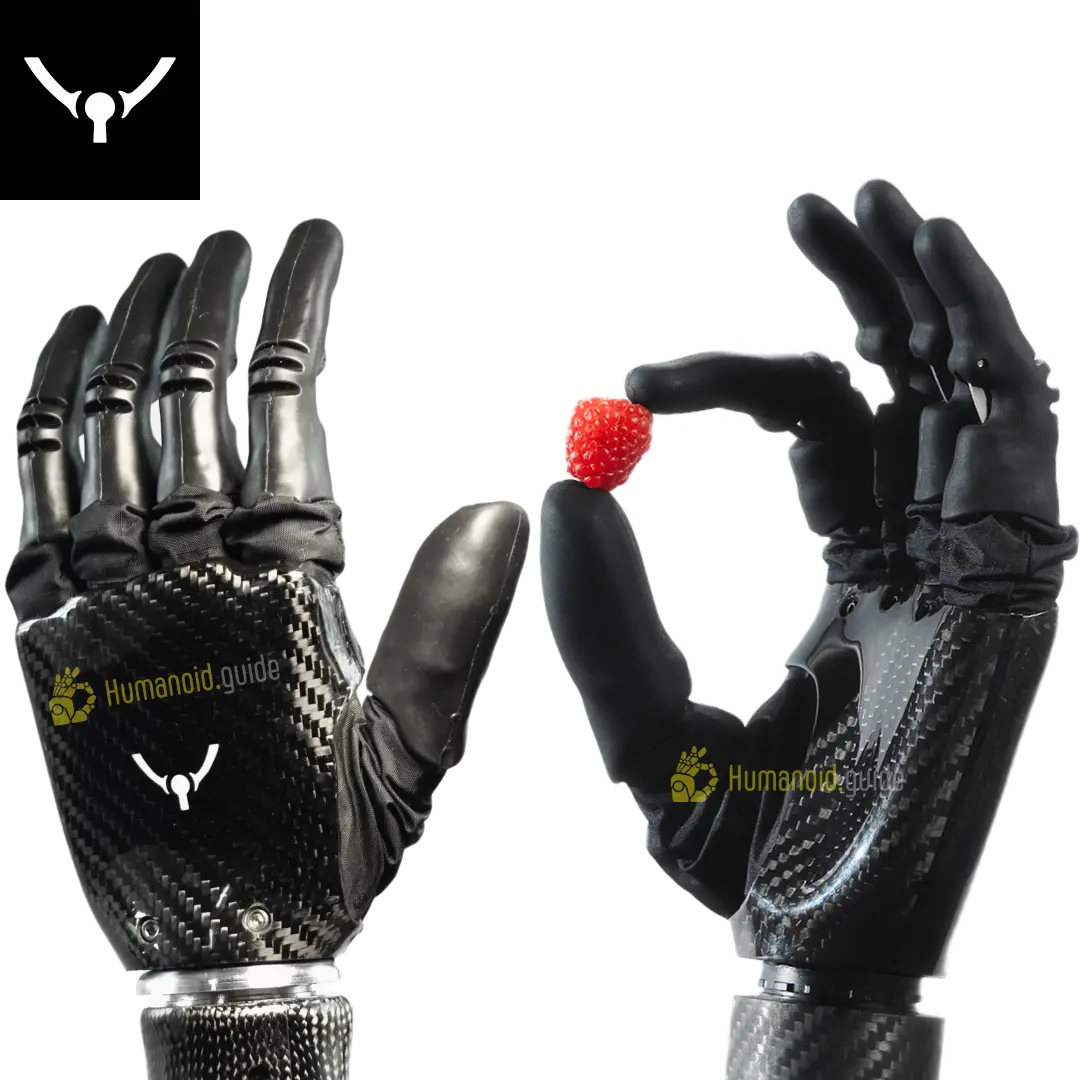
PSYONIC: The Bionic Hand That Became a Robot Component
An FDA-cleared prosthetic with ~300 human users and a growing second life as a dexterous end-effector for NVIDIA, ABB and academic labs, but no evidence of autonomous task performance anywhere in the public record.
| Report status | Coverage date | Company stage | Editorial standard |
|---|---|---|---|
| Premium editorial deep report, evidence-led | Evidence gathered 20 September 2026 | Fully commercial: FDA-cleared, insurance-covered, ~300 amputee users, dual human/robot sales | Verified facts separated from company claims, editorial inference and unknowns; no demo treated as proof |
How to Read This Report
This report distinguishes four classes of statement, and labels them throughout. The distinction matters more than usual for PSYONIC, because the company sits at an unusual intersection: a medical device with regulatory clearance and real human wearers, and a robotics component whose public profile rests heavily on partner announcements, conference demonstrations and choreographed video. Those two businesses have very different evidentiary standards, and conflating them is the single most common error in coverage of this company.
| Label | Meaning | Example in this report |
|---|---|---|
| VERIFIED FACT | Regulatory filings, official product documentation, named-customer confirmation, peer-reviewed or primary research, or multiple independent sources agreeing | FDA clearance and Medicare/VA coverage 8; ~300 amputee users reported by independent press 7 |
| COMPANY CLAIM | Stated by PSYONIC, not independently verified | Grip configuration counts, generation numbering, performance framing on the company site 1 |
| EDITORIAL INFERENCE | Reasoned conclusion drawn from public evidence, explicitly flagged as such | That the robotics business is currently a data-and-integration play rather than a volume revenue line |
| UNKNOWN | Not publicly disclosed | Unit economics, robotics revenue split, paid-versus-evaluation status of named partners |
Three specific disciplines apply. First, a choreographed demonstration video is not proof of autonomous work; it is proof that a hand moved under some control regime, which the video usually does not disclose. Second, a shipment or a deployment is not proof of productive deployment; a hand mounted on a robot dog at a trade show and a hand running eight hours a day on a production line are different evidentiary objects. Third, a partnership announcement is not proof of a paid customer. NVIDIA listing the Ability Hand as a native asset in Isaac Lab is a genuine technical integration and a genuine distribution benefit, but it is not a purchase order.
Where the dossier is thin, this report says so plainly rather than padding. Several sections below are shorter than a reader might expect from a company with this much press coverage, because the underlying public evidence is genuinely thin on those points.
01Executive Overview
PSYONIC is a San Diego company, incorporated in Illinois, founded in 2015 by Dr. Aadeel Akhtar, who remains CEO 78. It makes one core product: the Ability Hand, a multi-articulating, touch-sensing bionic hand built from carbon fibre and silicone, sold in two distinct markets. In the first, it is a prosthetic for people with upper-limb loss, cleared by the FDA, covered by Medicare, the VA and most private insurers, and worn by roughly 300 amputees 78. In the second, it is a robotic end-effector, mounted on industrial arms, mobile robot dogs and humanoid platforms, and used as a research platform in academic robotics 691012.
The central editorial finding of this report is a deflationary one, and it should be stated at the top rather than buried. The Ability Hand is not an autonomous system, and no supplied evidence shows it performing a task autonomously. As a prosthetic it is controlled by the user through electromyographic (EMG) muscle signals: the human performs the task, and the hand executes. As a robotics component it is an end-effector driven by an external policy or by teleoperation, for example the HATO low-cost hands-and-arms teleoperation system 18. The reconciled autonomy verdict is therefore unknown rather than any defined level, because the system's primary identity is a component rather than a standalone task-performing robot. If one insists on classifying the prosthetic use case alone, it is teleoperated, with the human's residual muscles as the control channel. This is not a criticism of the product. It is a correction of a category error that appears repeatedly in secondary coverage, where a dexterous hand with tactile sensing is described in language borrowed from autonomous manipulation.
What PSYONIC has actually built is more interesting than the autonomy framing suggests, and more defensible. It has a hand that is simultaneously a regulated medical device with real wearers and a commercially available robot component with a native integration into NVIDIA's Isaac Lab simulation stack 612. That dual identity gives it something almost no competitor has: a supply of real-world tactile and kinematic data from human-controlled use, and a credible story about transferring that data into robot learning. The NVIDIA collaboration, announced at GTC 2026, is framed by both parties around exactly this "real-to-real transfer" idea, bridging the robotics data gap by using human-driven hand data to inform robot policies 612. Whether that story converts into revenue is an open question. Whether it is technically coherent is not: it is.
Commercially, the picture is mixed and the public evidence is uneven. The prosthetic business has the markers of a real, if small, medical device company: FDA clearance, insurance reimbursement, a Shark Tank deal that closed at a reported $1M for 6% equity from Kevin O'Leary, Daymond John and Lori Greiner, a 2024 StartEngine community round, and a reported $2M+ funding event tied to a new headquarters 241516. The robotics business has the markers of an early-stage platform play: named integrations with NVIDIA and ABB Robotics, academic citations, and conference presence, but no disclosed paid deployment at scale 691011. The price picture is genuinely confusing and the sources conflict, which this report preserves rather than averages: figures range from $10,000–$20,000 for a hand, to $25,000 for a hand-plus-leg bundle, to $100,000–$150,000 for a typical full equipment-and-services package 34. These almost certainly describe different scopes, and the discrepancy is itself informative about how opaque medical device pricing is.
The strategic risk is concentration. PSYONIC sells one product into two markets, one of which is reimbursement-dependent and slow, and the other of which is dominated by much larger robotics incumbents who could build or buy competing end-effectors. The strategic opportunity is the same fact viewed from the other side: a single product that is already cleared, already worn, already integrated into the dominant simulation stack, and already generating the tactile data that the humanoid industry currently cannot buy at scale.
Latest news
02The PSYONIC Story
PSYONIC was founded in 2015 by Dr. Aadeel Akhtar, who serves as CEO 78. The founding narrative, repeated across interviews and the company's own materials, is that Akhtar's interest in prosthetics began with an encounter in a developing country and developed into a research programme at the University of Illinois, where the underlying technology was incubated before being commercialised 2223. The company is a Delaware-style venture-backed entity in structure but is registered as an Illinois corporation, with operations and headquarters in San Diego 816. The 2026 SEC filing confirms the corporate identity and the San Diego operating base 8.
The company's public profile was transformed by an appearance on Shark Tank Season 15, where Akhtar pitched the Ability Hand 4525. The pitch sought $1,000,000 for a 2% stake, and the reported outcome was a deal of $1M for 6% equity involving Kevin O'Leary, Daymond John and Lori Greiner 4. This is one of the report's documented conflicts: the 2% figure is the ask stated in the pitch, and the 6% figure is the reported closed deal. Both are plausible at different stages, and the conflict is best read as a stage difference rather than a contradiction. Neither figure is independently audited, and readers should treat the equity percentage as a company-and-press claim rather than a verified cap-table fact.
Following the television exposure, PSYONIC ran a community fundraising round on StartEngine in 2024 2, and the company has publicly announced a fundraising round closing 14. A reported $2M+ funding event accompanied a move to a new headquarters, according to a Swan Impact Network post 16. The company has also issued $200,000 in SAFEs across three tranches, per the reconciled facts. The funding history is therefore a patchwork of a television deal, a regulated crowdfunding round, a small venture event and SAFE instruments, rather than a clean institutional venture round. That pattern is typical of hardware companies with a medical device at the centre and a longer regulatory runway than a pure software company would tolerate.
The most consequential strategic development in the company's history is not the Shark Tank appearance but the pivot, or rather the extension, into robotics. PSYONIC began positioning the Ability Hand as a robotic end-effector, and by 2026 had announced a collaboration with NVIDIA at GTC 2026 and coverage in Forbes, the San Diego Business Journal, NBC San Diego, MassRobotics and Humanoids Daily describing work with NVIDIA and ABB Robotics 679101112. The company's own framing, and the framing adopted by much of the coverage, is that the prosthetic business and the robotics business are two expressions of the same underlying dexterity and tactile-sensing technology.
Editorial inference. The robotics extension is best understood not as a pivot away from prosthetics but as a capital-efficiency move. The prosthetic business is capital-intensive, reimbursement-constrained and slow to scale. The robotics business reuses the same hardware, the same manufacturing line and the same sensor stack, and sells into a market with far more capital sloshing around it in 2025–2026. It also gives PSYONIC a second narrative for investors at a moment when humanoid robotics is the most fundable category in the sector. Whether the company internally treats robotics as the primary business or as a hedge is not publicly disclosed.
The company's manufacturing approach is worth noting because it bears on scalability. PSYONIC has publicly described using Formlabs Form 4 printers in an agile manufacturing workflow to build the Ability Hand 17. This is a company claim about its own process, but it is a specific and checkable one, and it is consistent with the small-batch, high-mix profile of a company making hundreds rather than tens of thousands of units.
03Product Portfolio: What PSYONIC Actually Sells
PSYONIC sells one product family, the Ability Hand, into two markets. The company describes it as a touch-sensing, multi-articulating bionic hand with 32 grip configurations, built from carbon fibre and silicone, now in roughly its ninth-and-a-half generation 1. The generation numbering and grip count are company claims; they appear in company materials and are repeated in press coverage but are not independently verified in the dossier. What is independently corroborated is the core capability set: fingertip sensors that provide vibration and pressure feedback to the user, EMG-based muscle control, and integration with direct nerve interfaces in some configurations 71013.
The two markets are genuinely different products in commercial terms even though they share a bill of materials.
As a prosthetic, the Ability Hand is a regulated medical device. It is FDA-registered and FDA-cleared, covered by Medicare, the VA and most private insurance, and available now 8. It is worn by approximately 300 amputees, a figure reported by independent press rather than by the company alone 7. The control interface is the user's own residual muscles via EMG, with sensory feedback delivered through vibration or pressure at the fingertip. This is the use case where the human unambiguously performs the task and the hand executes.
As a robotic end-effector, the same hand is sold or supplied for mounting on industrial robot arms, mobile robot dogs and humanoid platforms 691012. Here the control interface is external: a learned policy, a teleoperation rig, or a research codebase. The NVIDIA collaboration makes the Ability Hand a native asset in Isaac Lab, NVIDIA's robot learning simulation framework, which means researchers and developers can instantiate the hand in simulation with its kinematics and, per the collaboration framing, transfer policies trained in simulation to the physical hand 612. ABB Robotics compatibility extends the same hand to ABB's industrial arm ecosystem 911.
The pricing picture is the clearest example in this report of why scope matters more than point estimates. Three figures circulate:
| Source | Figure | Likely scope | Evidence class |
|---|---|---|---|
| Shark Tank blog 4 | $10,000–$20,000 | Device-only, possibly earlier pricing | Independent secondary |
| Ability Fund / company 3 | $25,000 | Hand plus prosthetic leg bundle | Company claim |
| Company / press 3 | $100,000–$150,000 | Full equipment and services package | Company claim |
These are not necessarily contradictory. A prosthetic limb is not bought like a consumer device; the device cost is one line in a package that includes fitting, socket fabrication, rehabilitation and service. The $10k–$20k figure may be an earlier or device-only estimate, the $25k figure is explicitly a hand-plus-leg bundle, and the $100k–$150k figure is a full package. Editorial inference: the spread is a symptom of an opaque, reimbursement-mediated pricing structure rather than of unreliable reporting, and any external analysis that quotes a single number for "the price of an Ability Hand" is almost certainly wrong about scope.
The Ability Fund, launched with Limbs for Life, is the company's access programme and is the mechanism by which some of the ~300 users have been fitted 3. It is a company initiative and should be read as such, but it is a concrete programme with a named partner rather than a marketing slogan.
Products & versions
04Technology Stack: Strengths and the Work That Remains
The Ability Hand's technical differentiation rests on three things: multi-articulation, fingertip tactile sensing, and speed of actuation. All three are described consistently across company materials, independent press and academic use 171018.
Multi-articulation. The hand has independently actuated fingers, which is what separates it from the simpler grippers that dominate industrial robotics. The company claims 32 grip configurations 1; the specific number is a company claim, but the underlying capability, a hand that can form multiple distinct grasps rather than open and close, is corroborated by its use in research requiring multi-fingered manipulation 1920.
Tactile sensing. Fingertip sensors provide pressure and vibration feedback. In the prosthetic use case this feedback is relayed to the user, which is the feature that most distinguishes the Ability Hand from cosmetic or body-powered prostheses. In the robotics use case, the same sensors are a data source. This is the technically most interesting part of the story, because tactile data is precisely what the robot learning community lacks at scale, and a hand that is worn daily by hundreds of humans is, in principle, a tactile data collection instrument that no lab can replicate.
Speed. The company markets the hand as fast, and speed matters for both prosthetic function, where latency degrades the sense of embodiment, and for robotic manipulation, where slow end-effectors bottleneck policy execution. The speed claim is a company claim; the dossier contains no independent benchmark.
What the technology stack does not include, on the public evidence, is any onboard autonomy. There is no disclosed onboard perception, no disclosed onboard policy, no disclosed onboard task planner. The hand is a controlled actuator array with sensors. This is the correct architecture for a prosthetic, where the user is the controller, and it is a perfectly reasonable architecture for a research end-effector, where the policy lives on an external compute node. But it means that any claim that the Ability Hand "does" something autonomous is unsupported.
The work that remains is therefore not about making the hand more capable in isolation but about the interfaces around it. Three areas stand out.
First, the sim-to-real pipeline. The NVIDIA collaboration is explicitly framed around real-to-real transfer and bridging the data gap 612. Making the Ability Hand a native Isaac Lab asset is the easy half. The hard half is demonstrating that policies trained against the simulated hand transfer reliably to the physical hand across tasks, and the public evidence for that is currently a collaboration announcement and a research direction rather than a published benchmark.
Second, the control interface for robotics customers. A research lab can write its own control stack. An industrial customer cannot. Whether PSYONIC ships a usable control SDK, a reference teleoperation rig, or a certified integration with ABB's controllers is not publicly disclosed, and it is the single biggest determinant of whether the robotics business scales beyond research.
Third, durability and service. A prosthetic hand is serviced through a clinical channel. An industrial end-effector is serviced through a factory maintenance contract. These are different operational regimes, and the dossier contains no public evidence on the Ability Hand's duty cycle, mean time between failures, or service model in an industrial setting. This is an unknown and it is a material one.
05Research, Papers, Authors and Labs
PSYONIC's research footprint is real and is one of the stronger parts of its public record, but it is important to characterise it correctly. The Ability Hand appears in academic robotics work as a platform, not as a contribution. That is, papers use the hand; they are not papers about the hand's autonomy.
The dossier identifies four research artefacts. The first is a paper on zero-shot transfer of learned grasping policies to the Ability Hand, reporting a 90% success rate 18. This is the strongest single research data point in the dossier, and it is worth being precise about what it shows: a policy learned elsewhere transfers to the Ability Hand and achieves 90% success on the evaluated task distribution. It does not show the hand acting autonomously in an open-world sense, and the 90% figure is task- and distribution-specific. The second is work on learning visuotactile skills with two multifingered hands 19, which places the Ability Hand in the bimanual manipulation literature. The third is DexMachina, on functional retargeting for bimanual dexterous manipulation 20. The fourth is work on multi-fingered robot manipulation using smart lenses 21. The HATO teleoperation system is also referenced in the reconciled facts as a low-cost hands-and-arms teleoperation system using the Ability Hand 18.
The pattern across these papers is consistent and worth stating plainly: the Ability Hand is used as a dexterous, tactile-capable end-effector in manipulation research, and the intelligence in every case lives outside the hand, in a learned policy, a retargeting algorithm or a teleoperation system. This is exactly what one would expect from a well-instrumented end-effector, and it is the correct reading of the autonomy question.
Editorial inference. The academic footprint is strategically valuable to PSYONIC for a reason that is easy to miss. In robotics, the platform that researchers use becomes the platform that their students use, and the platform their students use becomes the platform they specify when they move into industry. Being the hand in the bimanual manipulation literature is a durable distribution advantage, and it is cheaper to maintain than a sales force. It is also fragile in one specific way: if a competing hand becomes cheaper or better instrumented, the literature can migrate within a couple of conference cycles.
The authors and labs involved are not enumerated in the supplied dossier beyond the paper titles and identifiers, and this report will not invent them. Not publicly disclosed in the supplied evidence: the specific principal investigators, laboratory affiliations and institutional relationships beyond what the paper identifiers imply. Readers who need the author-level detail should consult the papers directly at the identifiers in §14.
<!-- module: papers --> <!-- module: authors-labs --> <!-- module: repos --> <!-- module: datasets -->06Media Evidence Library: What the Videos Prove
The dossier contains six video sources, and they divide cleanly into three evidentiary categories. None of them proves autonomous task performance, and it is worth walking through why, because the videos are the most likely source of the category error identified in §1.
Category one: the pitch and the profile. The Shark Tank pitch 525 and the interview and profile videos 222324 are promotional and biographical. They establish that the company exists, that the founder can articulate the technology, and that the hand can be demonstrated on command. They do not establish deployment, autonomy or commercial scale. A pitch video is a performance under controlled conditions, and the Shark Tank format in particular rewards demonstrations that are rehearsed.
Category two: the technical demonstration. The "PSYONIC Brings Prosthetic Design into the 21st Century" short 24 and the episode interview 22 show the hand in operation. What they prove is that the hand articulates, that it responds to control input, and that it can be mounted and demonstrated. What they do not disclose is the control regime: whether the hand in a given shot is driven by EMG from a wearer, by a teleoperator, by a scripted sequence, or by a policy. This is the crux. A viewer watching a hand pick up an object cannot tell from the video whether a human is performing the task through the hand or whether a policy is. In the prosthetic case, the human is performing the task by definition.
Category three: noise. Three of the six video sources in the dossier are not about PSYONIC at all. The "Psionic Sentry: Infinite" first-impressions video 26, the Aolion J20 / NYXI Hyperion 2 controller review 27, and the Baldur's Gate 3 discussion 28 are unrelated to the company and appear to have been captured by keyword collision on "psionic." The same is true of several of the community sources: the Reddit threads on psionics in Draw Steel 32 and D&D 33, the Baldur's Gate thread 28, the robotic race worldbuilding thread 30, and the two guitar amplifier threads about Psionic Audio 2931 are about tabletop roleplaying games, worldbuilding and a guitar amplifier manufacturer respectively. They are not evidence about PSYONIC in any form.
This is worth stating explicitly rather than silently dropping, because it is a data-quality finding in its own right. Editorial inference: any automated monitoring system tracking PSYONIC by keyword will accumulate a substantial volume of false positives from the tabletop gaming and audio equipment communities, and a human analyst filtering those out is doing necessary work rather than being pedantic. The dossier's community signal is, on inspection, almost entirely noise.
The honest summary of the media library is therefore: it establishes that the product exists and functions under demonstration conditions, and it establishes nothing about autonomy, deployment scale or commercial traction.
Media library
07Commercial Reality
PSYONIC's commercial reality is two businesses with very different maturity, and the public evidence supports strong conclusions about one and weak conclusions about the other.
The prosthetic business is real. The markers are specific and checkable. FDA clearance and registration are documented in the SEC filing 8. Medicare, VA and most private insurance coverage is confirmed across independent sources 78. Approximately 300 amputee users is an independently reported figure 7. A named access programme with Limbs for Life exists 3. A television deal closed at a reported $1M for 6% equity 4. A 2024 community round ran on StartEngine 2. A reported $2M+ funding event accompanied a headquarters move 16. None of these individually proves a large business, and 300 users is a small number in absolute terms, but together they describe a functioning medical device company with a reimbursement pathway, which is a genuinely difficult thing to achieve and a genuine moat against hobbyist competitors.
The robotics business is early. The evidence consists of a collaboration announcement with NVIDIA 6, compatibility with ABB industrial arms 911, coverage in Forbes, SDBJ, NBC San Diego, MassRobotics and Humanoids Daily 79101112, and academic use 18192021. What is missing is any disclosed paid deployment at scale, any named industrial customer running the hand in production, any unit volume for the robotics line, and any revenue split between the two businesses. Unknown: all of the above. The NVIDIA collaboration in particular should be read carefully. A native asset in Isaac Lab is a technical integration and a distribution channel; it is not a purchase order, and NVIDIA's practice of integrating promising hardware into its simulation stack is a platform strategy, not a procurement strategy.
The funding picture deserves a sceptical paragraph. The company's capital history is a Shark Tank deal, a regulated crowdfunding round, a small reported venture event and $200,000 in SAFEs. That is not the profile of a company that has raised a large institutional round, and it is not the profile of a company that is cash-flow positive at scale. It is the profile of a capital-efficient hardware company that has kept its burn low and used non-dilutive and community capital where it could. That is a defensible strategy, and it is also a constraint: it limits how fast the robotics business can be built out, and it means PSYONIC is competing for robotics mindshare against companies with orders of magnitude more capital.
Editorial inference. The most likely commercial reality, on the available evidence, is that the prosthetic business is the revenue base and the robotics business is currently a combination of research-platform sales, partnership-driven visibility and strategic optionality. That is not a criticism. It is a description of a company that has found a way to be in the humanoid conversation without having raised humanoid-scale capital, by virtue of having a hand that already works and already has users.
Customers & deployments
Collaboration announced at NVIDIA GTC 2026; the Ability Hand is a native asset in Isaac Lab and is used for real-to-real transfer of dexterity data.
The Ability Hand is compatible with ABB industrial arms, enabling robotic dexterity for manufacturing applications.
Sections 8 through 14 follow in the continuation of this report.
08Markets and Use Cases
PSYONIC operates in two markets that share a single bill of materials. That is the central commercial fact of the company, and it explains almost everything else about how it prices, partners, and positions itself. The first market is upper-limb prosthetics: a small, heavily regulated, insurance-financed clinical market with a fixed population of addressable users and a reimbursement pathway that took the company roughly a decade to unlock. The second is robotic manipulation: a large, fast-moving, capital-rich market in which the Ability Hand is not a prosthetic at all but a dexterous end-effector competing against hardware from established gripper vendors and a wave of new dexterous-hand startups. The two markets have almost nothing in common except the product.
This section assesses each market on its own terms, then examines the crossover logic that PSYONIC and its partners have been promoting since 2026.
8.1 The Prosthetics Market: Small, Regulated, Reimbursement-Gated
The addressable population for a multi-articulating bionic hand is a subset of upper-limb amputees. Roughly 300 amputees wear the Ability Hand according to independent reporting 7. That figure is the single most useful commercial data point in the entire dossier, because it anchors the prosthetic business in reality rather than in total-addressable-market arithmetic. Three hundred users is a real installed base for a small medical device company. It is also a rounding error against the population of upper-limb amputees in the United States alone, which is typically cited in the tens of thousands, and against the global figure, which is larger still but concentrated in markets with far weaker reimbursement.
The gating factor is not demand. It is payment. A powered prosthetic hand is expensive, and in the United States the pathway to a patient runs through a prosthetist, a clinical evaluation, a fitting and training process, and then a payer. PSYONIC's SEC filing confirms FDA registration and clearance, and independent reporting confirms coverage by Medicare, the Department of Veterans Affairs, and most private insurers 87. That coverage is the company's most durable moat in the clinical market. A competitor with a technically superior hand but no reimbursement codes and no payer relationships cannot reach patients at scale, regardless of engineering quality.
The Ability Fund, launched with Limbs for Life, addresses the residual gap: patients who are uninsured, underinsured, or caught in the deductible and prior-authorisation machinery that sits between coverage-in-principle and a device-on-the-arm 3. Charitable subsidy programmes of this kind are common in prosthetics and are best read as a distribution workaround rather than a growth engine. They convert a small number of patients per year and generate goodwill and press, but they do not change the underlying economics.
The structural constraint on this market is that it is a replacement market with a long cycle. A patient who receives an Ability Hand today is unlikely to receive another for several years. Revenue therefore depends on new patient acquisition, which depends on prosthetist relationships, payer coverage, and clinical evidence. This is a slow, relationship-intensive, evidence-gated business. It is not a business that scales on a viral video.
Editorial inference: The prosthetic business is best understood as PSYONIC's credibility engine rather than its growth engine. It produces the FDA clearance, the clinical relationships, the human stories, and the moral authority that make the robotics business legible to partners. It is unlikely, on the evidence available, to produce venture-scale returns on its own.
8.2 The Robotics Market: A Component Sale into a Crowded Field
In robotics, the Ability Hand is sold as an end-effector: a five-fingered, multi-articulating hand with fingertip tactile sensing, mounted on an industrial arm, a mobile robot dog, or a humanoid platform 91011. The value proposition is not autonomy. It is hardware: a hand that is small, light, robust, and instrumented, available today, with a native integration into NVIDIA's Isaac Lab simulation stack 612.
The demand drivers in this market are different from prosthetics in almost every respect:
| Dimension | Prosthetics market | Robotics market |
|---|---|---|
| Buyer | Patient, prosthetist, payer | Robotics OEM, research lab, integrator |
| Decision cycle | Months to years, clinical | Weeks to quarters, procurement |
| Volume per buyer | One unit | Tens to thousands, if designed in |
| Regulatory burden | FDA clearance required | None for the hand itself |
| Price sensitivity | Low at point of use, high at payer | High, benchmarked against grippers |
| Competitive set | Other bionic hand vendors | Grippers, other dexterous hands, custom builds |
| Evidence of value | Clinical outcomes, user reports | Benchmarks, integration support, data |
The robotics market is where the growth narrative lives, and it is where the competitive pressure is most intense. A two-finger parallel gripper costs a fraction of a multi-articulating hand and is sufficient for a large share of industrial pick-and-place tasks. The case for a five-fingered hand in industry rests on tasks that genuinely require multi-finger dexterity, or on research and development programmes where the hand is a platform for learning rather than a production tool.
Verified fact: The Ability Hand is deployed on industrial robot arms, mobile robot dogs, and humanoid robots 91011. Company claim: The hand is compatible with ABB industrial arms and is a native asset in NVIDIA Isaac Lab 69. Editorial inference: These are integration and ecosystem relationships. The dossier contains no evidence of a named industrial customer running the Ability Hand in a paid production deployment at volume. That distinction matters and is developed in §7 and §11.
8.3 Research and Development as a Market
A third, less-discussed market is academic and corporate research. The dossier contains direct evidence of the Ability Hand being used in peer-reviewed and preprint robotics research: zero-shot transfer of learned grasping policies with a reported 90 per cent success rate, the HATO low-cost teleoperation system, and vision-language-model-based skill selection 18192021. This is a genuine market with real buyers, typically funded by grants or corporate research budgets, and it has properties that suit PSYONIC well.
Research buyers are less price-sensitive than industrial buyers, more tolerant of integration effort, and more likely to publish work that cites the hardware. Every paper that uses the Ability Hand is a citation, a validation, and a recruiting tool for the next research lab. In a hardware category where credibility is scarce, a body of academic literature is a durable asset.
The risk in this market is that it is small and cyclical. Grant funding fluctuates, and research labs are notorious for building their own hardware when commercial options are expensive or inflexible. The Ability Hand's position in this market is therefore best read as a strategic asset rather than a revenue centre.
8.4 The Crossover Thesis and Its Limits
The crossover thesis, as articulated in PSYONIC's NVIDIA collaboration and the surrounding coverage, runs roughly as follows: the prosthetic hand has been worn continuously by humans in unstructured environments for years, generating a body of real-world tactile and kinematic data; that data, combined with simulation, can accelerate robot learning; and the same hardware serves both markets, amortising development cost 612.
This is a coherent thesis and it is more substantive than most crossover narratives in robotics. The data argument has a real basis: a hand that has been deployed on human bodies in messy, variable, real-world conditions has encountered a distribution of contact events that a lab-mounted hand has not. Whether that data is actually usable for robot learning depends on instrumentation, logging, consent, and labelling, none of which is disclosed in the dossier.
Unknowns: The dossier does not disclose how much prosthetic usage data PSYONIC has collected, whether it is instrumented and logged, what consent framework governs its use, or whether any of it has been used to train a robot policy. The NVIDIA collaboration is described in terms of simulation assets and real-to-real transfer 612, which is a different and more modest claim than "prosthetic data trains robots."
Editorial inference: The crossover thesis is best treated as a promising strategic narrative with a partially evidenced technical basis. It is not yet a demonstrated commercial flywheel.
8.5 Use-Case Assessment
The following table assesses each evidenced use case on the dimensions that matter commercially.
| Use case | Evidence strength | Buyer identified | Recurring revenue | Autonomy involved | Assessment |
|---|---|---|---|---|---|
| Upper-limb prosthesis for amputees | Strong (FDA, insurance, ~300 users) | Yes (patient/payer) | Low (replacement cycle) | None (human-controlled) | Real business, slow growth |
| Research platform for grasping/teleoperation | Strong (multiple papers) | Yes (labs) | Low to moderate | None (external policy/teleop) | Strategic asset, small revenue |
| End-effector on industrial arms | Moderate (ABB compatibility) | Not named | Unknown | None (external policy) | Unproven at production scale |
| End-effector on robot dogs | Moderate (deployment reported) | Not named | Unknown | None (external policy) | Demonstration-stage |
| End-effector on humanoids | Moderate (deployment reported) | Not named | Unknown | None (external policy) | Speculative, high option value |
| Data source for robot learning | Weak to moderate (narrative) | NVIDIA (partner) | Unknown | Not applicable | Thesis, not yet a product |
The pattern is consistent: the prosthetic and research markets are evidenced and real; the industrial and humanoid markets are evidenced as deployments but not as paid production customers; and the data market is a narrative with a partner but no disclosed commercial terms.
8.6 What Would Change This Assessment
Three developments would materially upgrade the robotics market assessment. First, a named industrial customer running the Ability Hand in production, with volume disclosed. Second, a disclosed commercial structure with NVIDIA or ABB that goes beyond integration and into revenue. Third, published evidence that prosthetic-collected data measurably improves robot policy performance, which would validate the crossover thesis on technical rather than rhetorical grounds.
Absent those, the honest reading is that PSYONIC has a real clinical business, a real research presence, and a promising but unproven industrial and humanoid opportunity.
09Competitive Landscape
PSYONIC competes in two categories that are usually analysed separately. In prosthetics, it competes against established bionic hand vendors with longer clinical histories and, in some cases, larger installed bases. In robotics, it competes against gripper manufacturers, dexterous-hand startups, and the option of building hardware in-house. The company's unusual position is that it is one of very few players with a credible claim in both.
This section maps the competitive field, identifies where PSYONIC's advantages are durable and where they are fragile, and assesses the most likely sources of competitive pressure over the next several years.
9.1 The Prosthetics Competitive Set
The upper-limb prosthetics market is dominated by a small number of established players, most notably Ottobock, which has the deepest clinical and distribution footprint in the category, and a set of specialised bionic hand vendors including Össur (which acquired Touch Bionics) and Steeper, alongside a long tail of regional suppliers. These competitors share several characteristics: decades of clinical relationships, established reimbursement pathways across multiple countries, and large service networks.
PSYONIC's differentiation in this market rests on three claims:
- Speed. The Ability Hand is marketed as fast, with the company claiming a close time that is competitive with or better than alternatives 17.
- Touch feedback. Fingertip sensors provide vibration and pressure feedback to the user, a capability that is not universal in the category 17.
- Durability and weight. The carbon-fibre and silicone construction is presented as robust and light, which matters for a device worn daily 17.
Company claims: Speed, sensory feedback, and durability are asserted by PSYONIC and repeated in press coverage 1717. Verified facts: FDA clearance and Medicare/VA/private insurance coverage are confirmed by the SEC filing and independent reporting 87. Editorial inference: The competitive advantage in prosthetics is real but narrow. Established competitors can and do match individual features over time. What they cannot easily replicate is PSYONIC's cost structure if the robotics business genuinely amortises development, or its narrative position as the newer, more technically ambitious entrant.
The most important competitive fact in this market is not product performance. It is reimbursement. A competitor with a marginally inferior hand but broader payer coverage will win more patients. PSYONIC's coverage is confirmed but its breadth relative to Ottobock is not disclosed.
9.2 The Robotics Competitive Set
The robotics end-effector market is more crowded and more fluid. It can be divided into four tiers.
| Tier | Description | Representative pressure on PSYONIC |
|---|---|---|
| Simple grippers | Two-finger parallel, vacuum, soft grippers | Price. Sufficient for most pick-and-place. |
| Established dexterous hands | Multi-finger hands from industrial and research vendors | Integration maturity, support, existing OEM relationships |
| New dexterous-hand startups | Venture-funded humanoid-adjacent hand makers | Funding, speed, humanoid OEM design wins |
| In-house builds | Custom hands built by humanoid and research teams | Control, cost at volume, no vendor dependency |
PSYONIC's position in this field rests on a specific and defensible claim: the Ability Hand is a shipping, field-proven, human-rated hand with tactile sensing and a native simulation asset, available today 6912. That combination is genuinely uncommon. Most dexterous hands in the robotics market are either research prototypes, not yet shipping at scale, or industrial grippers without multi-finger articulation.
The vulnerability is price and volume. A humanoid manufacturer planning to build thousands of units will look hard at the cost of a hand that was designed for a clinical market with clinical margins. If the Ability Hand's bill of materials and assembly process cannot be driven down at volume, humanoid OEMs will design their own hands or source from a vendor built for volume from day one.
Unknowns: The dossier does not disclose the Ability Hand's unit cost, manufacturing capacity, or volume pricing. The Formlabs case study on agile manufacturing suggests a small-batch, high-mix production model rather than high-volume automation 17. That is appropriate for prosthetics and research, and potentially limiting for humanoid-scale demand.
9.3 The Data and Simulation Competitive Set
If the crossover thesis is correct, PSYONIC's long-term competitive position depends on data and simulation assets rather than hardware. Here the competitive field is different again. NVIDIA is a partner, not a competitor, but NVIDIA's Isaac Lab ecosystem is also a platform on which competing hands can be integrated. Being a native asset is an advantage; it is not exclusivity.
The more significant competitive question is whether prosthetic-derived data is a durable moat. If the data is valuable, other prosthetic vendors with large installed bases could pursue the same strategy. If it is not valuable, the moat is illusory.
Editorial inference: The data thesis is the least defensible part of PSYONIC's competitive position on current evidence, because the dossier contains no demonstration that the data has been used to produce a measurable robot-learning advantage. It is a plausible strategy, not an established moat.
9.4 Competitive Summary
| Competitive arena | PSYONIC position | Durability |
|---|---|---|
| Prosthetics: clinical relationships | Challenger with confirmed coverage | Moderate |
| Prosthetics: product features | Competitive on speed, touch, weight | Low to moderate |
| Prosthetics: cost structure | Potentially advantaged via robotics amortisation | Moderate, unproven |
| Robotics: shipping multi-finger hand | Strong, few direct equivalents | Moderate to high near term |
| Robotics: price at volume | Unknown, likely challenged | Low |
| Robotics: simulation integration | Native Isaac Lab asset | Moderate, non-exclusive |
| Robotics: data advantage | Asserted, not demonstrated | Low on current evidence |
The overall picture is of a company with a genuine and unusual dual-market position, a real but narrow product advantage, and a set of competitive vulnerabilities that are mostly about scale, price, and the unproven data thesis rather than about engineering quality.
Competitive comparison
| Robot | Maker | Autonomy | Conf. |
|---|---|---|---|
| iRobot Roomba Combo 10 Max | iRobot | Autonomous | 0.90 |
| Mobile ALOHA (Stanford) | Stanford University | Teleoperated | 0.90 |
| 1X NEO | 1X Technologies | Remote-Assisted | 0.90 |
10Geopolitical Context and Constraints
PSYONIC is a United States company, incorporated in Illinois and headquartered in San Diego, selling a regulated medical device and a robotics component into a market where supply chains, export controls, and industrial policy increasingly shape outcomes 87. This section examines the geopolitical dimensions that bear on the company, distinguishing between those that are evidenced in the dossier and those that are structural features of the sectors in which it operates.
10.1 Domestic Manufacturing and Industrial Policy
The dossier contains evidence that PSYONIC manufactures in the United States, with a case study describing agile manufacturing using Formlabs equipment 17. This is a meaningful fact in the current policy environment. United States industrial policy over the past several years has directed substantial funding toward domestic advanced manufacturing, robotics, and medical device production, and has attached conditions and preferences to procurement in some categories.
Verified fact: PSYONIC uses agile manufacturing with Formlabs equipment 17. Editorial inference: A domestically manufactured, FDA-cleared medical device with a robotics application sits in a favourable position for United States government procurement, including defence and veterans' health channels. The Department of Veterans Affairs is confirmed as a payer 7, which is both a commercial fact and a signal of government acceptance.
Unknowns: The dossier does not disclose the proportion of components sourced domestically, the location of suppliers, or whether PSYONIC has received any government grant, contract, or procurement award beyond VA reimbursement.
10.2 Export Controls and Dual-Use Considerations
A multi-articulating robotic hand with tactile sensing is a dual-use article. It is a medical device when worn by an amputee and a robotics component when mounted on an industrial arm or humanoid. United States export control regimes, including the Export Administration Regulations and the International Traffic in Arms Regulations, treat some robotics and advanced manipulation technologies as controlled, and the medical device exemptions are not always straightforward when the same hardware is sold into a robotics channel.
Unknowns: The dossier contains no information on PSYONIC's export control posture, its licensing status for international sales, or whether it has faced any restriction on selling the Ability Hand into particular jurisdictions. This is a genuine gap and one that matters for any assessment of the robotics business, because the largest potential markets for dexterous hands include jurisdictions subject to United States export restrictions.
Editorial inference: A company selling the same hardware as both a medical device and a robotics component should expect increasing scrutiny as the robotics application grows, particularly if humanoid platforms attract national-security attention. This is a structural risk, not a disclosed one.
10.3 Supply Chain Exposure
The dossier does not disclose PSYONIC's supply chain. The relevant exposures for a product of this type include rare-earth magnets for motors, precision sensors for tactile feedback, carbon fibre, medical-grade silicone, and semiconductor components. Several of these categories have been subject to export restrictions, tariff changes, and supply disruptions in recent years.
Editorial inference: A small manufacturer with a high-mix, low-volume production model is more exposed to component shortages and price shocks than a large one, because it lacks the purchasing leverage to secure allocation. The Formlabs case study suggests a flexible manufacturing approach that may partially mitigate this, but the underlying component dependencies are not disclosed 17.
10.4 The China Question
China is simultaneously the largest potential market for dexterous robotic hands and the most significant source of competitive pressure. Chinese manufacturers have demonstrated the ability to produce multi-finger hands and humanoid platforms at costs that Western manufacturers struggle to match, supported by domestic supply chains and state industrial policy.
Editorial inference: PSYONIC's competitive position against Chinese hand manufacturers rests on factors that are not primarily about price: FDA clearance, clinical validation, United States manufacturing, and integration with Western robotics ecosystems such as NVIDIA Isaac Lab. These are real advantages in Western markets. They are unlikely to be decisive in Chinese markets, and they may be eroded if Chinese manufacturers obtain equivalent certifications and integration support.
The dossier contains no evidence of PSYONIC's China strategy, revenue exposure to China, or competitive response to Chinese entrants. This is a material unknown for a company whose robotics ambitions depend on global end-effector demand.
10.5 Geopolitical Assessment
| Factor | Evidence | Assessment |
|---|---|---|
| Domestic manufacturing | Verified (Formlabs case study) | Favourable for US procurement |
| Government as payer | Verified (VA coverage) | Favourable, validates device |
| Export control exposure | Not disclosed | Structural risk, unquantified |
| Supply chain concentration | Not disclosed | Structural risk, unquantified |
| China competition | Not disclosed | Material unknown |
| Industrial policy tailwinds | Inferred from sector | Likely favourable, unquantified |
The honest summary is that PSYONIC benefits from being a United States manufacturer of an FDA-cleared device in a policy environment that favours both, and faces unquantified risks from export controls, supply chains, and Chinese competition that the public record does not address.
11The Hype, the Real and the Ugly
This section separates what PSYONIC and its ecosystem say from what the evidence supports. It is organised as a claim-by-claim audit, followed by an assessment of the gap between narrative and reality.
11.1 The Claim Audit
| Claim | Source type | Evidence | Verdict |
|---|---|---|---|
| FDA-cleared bionic hand | Company + SEC filing + independent | SEC filing confirms registration/clearance; independent reporting confirms coverage | Verified |
| Covered by Medicare, VA, most private insurers | Company + independent | Independent reporting confirms 7 | Verified |
| ~300 amputee users | Independent | Reported by San Diego Business Journal 7 | Verified, single-source |
| Touch feedback via fingertip sensors | Company + independent + video | Multiple sources agree 17 | Verified |
| 32 grip configurations | Company | Company specification 1 | Company claim |
| Fastest bionic hand | Company | Marketing claim, no independent benchmark in dossier | Company claim, unverified |
| Native asset in NVIDIA Isaac Lab | Company + independent | Press release plus Forbes, MassRobotics, Humanoids Daily 691112 | Verified as integration |
| Compatible with ABB industrial arms | Company + independent | Forbes, NBC, MassRobotics 91011 | Verified as compatibility |
| Real-to-real transfer bridging data gap | Company + trade press | Humanoids Daily, Forbes 129 | Company claim, partially evidenced |
| Zero-shot grasping at 90% success | Peer-reviewed/preprint | arXiv paper 18 | Verified in research context |
| Used by humanoid, manufacturing, BMI companies | Company | No named customers in dossier | Company claim, unnamed |
| $1M Shark Tank deal for 6% equity | Company + media | Shark Tank blog reports 6%; pitch video shows 2% ask 45 | Conflicting, stage-dependent |
| Price $10k–$20k | Media | Shark Tank blog 4 | Conflicting with other figures |
| Price $25k hand+leg | Company (Ability Fund) | PSYONIC/Limbs for Life 3 | Company claim |
| Typical $100k–$150k equipment and services | Company | Ability Fund materials 3 | Company claim |
| Autonomous capability | Not claimed explicitly | No evidence of autonomous task completion | Not established |
11.2 The Hype
The hype around PSYONIC takes three forms, and they are worth distinguishing because they have different sources and different consequences.
The first is the Shark Tank effect. A national television appearance with a $1 million deal is a powerful narrative event, and it produced a wave of coverage that framed PSYONIC as a breakthrough company 4515. The coverage was largely accurate on the product and the mission, and largely vague on the business. The equity figure conflict (2 per cent ask versus 6 per cent reported deal) is a minor illustration of how pitch-stage numbers get flattened in retelling 45.
The second is the robotics narrative. The framing of the Ability Hand as a component for humanoids, robot dogs, and industrial arms is technically accurate and commercially unproven. The dossier contains no named industrial customer, no disclosed volume, and no revenue figure for the robotics business 91011. The narrative is ahead of the evidence, which is normal in robotics and worth stating plainly.
The third is the data narrative. The claim that prosthetic use generates data that bridges the robotics "data gap" is the most ambitious claim in the dossier and the least evidenced 12. It may prove correct. On the current record, it is a thesis.
11.3 The Real
The real achievements are substantial and should not be lost in the scepticism.
- FDA clearance and payer coverage. This is the hardest thing to achieve in the prosthetics market and PSYONIC has done it 87.
- Three hundred human users. A device worn daily by 300 people is a validated product, not a prototype 7.
- A genuine research footprint. Multiple independent research groups have used the Ability Hand and published results 18192021.
- Ecosystem integration. Native Isaac Lab support and ABB compatibility are real engineering and business achievements 69.
- Dual-market hardware. Very few companies have a product that credibly serves both a clinical and a robotics market.
11.4 The Ugly
Three issues deserve direct statement.
Autonomy is not established, and the framing can mislead. The Ability Hand is human-controlled as a prosthetic and externally driven as a robot component 1822. No evidence in the dossier shows it completing a task autonomously. Marketing that emphasises capability without clarifying the control architecture invites misreading, particularly among investors and journalists who do not distinguish between a dexterous hand and an autonomous system.
Pricing is opaque and inconsistent. Reported figures range from $10,000–$20,000 to $25,000 for a hand-plus-leg bundle to $100,000–$150,000 for equipment and services 34. These likely refer to different scopes, but the absence of a clear public price structure makes it difficult to assess the business and creates room for misunderstanding.
The robotics customer base is unnamed. Every robotics deployment in the dossier is described generically or through partners, not through named paying customers 91011. This is the single largest gap between the narrative and the evidence.
11.5 Hype-to-Evidence Ratio
| Domain | Hype level | Evidence level | Gap |
|---|---|---|---|
| Prosthetics | Moderate | Strong | Small |
| Research use | Low | Strong | Small |
| Robotics deployment | High | Moderate | Large |
| Data crossover thesis | High | Weak | Very large |
| Autonomy | Low to moderate | None | Material |
The pattern is clear: PSYONIC's clinical and research claims are well supported, and its robotics and data claims are ahead of the public evidence. That is not unusual for a company in this position, but it is the distinction that matters most for anyone assessing the company.
Claim tracker
Independent news, video, and peer-reviewed research sources corroborate touch feedback and muscle control, though direct nerve integration remains demonstrated only in limited research settings.
An SEC filing and independent news confirm FDA status and insurance coverage, though the specific FDA clearance pathway and code are not detailed in the dossier.
Independent news reports the ~300 user figure and official/news sources show multi-robot deployment, but the robot deployments appear to be research/partner integrations rather than confirmed at-scale commercial fleet deployments.
An official press release plus independent news outlets (SDBJ, Forbes, NBC, MassRobotics, Humanoids Daily) corroborate the collaborations, though the depth and commercial scale of the ABB integration remain unverified.
Peer-reviewed/preprint research papers directly describe use of the Ability Hand, though the 90% success rate is from a specific research setup and may not generalize.
All independent and research sources describe human control (EMG) for prosthetic use or external/teleoperated control (e.g., HATO) in robotics, with no evidence of autonomous task completion by the hand itself.
Multiple sources report funding but the equity percentage varies (2% ask vs. 6% reported deal) and none of the figures are independently audited, leaving the exact terms unverified.
Sources give conflicting figures ($10k–$20k device-only vs. $25k hand+leg bundle vs. $100k–$150k full services) that likely reflect different scopes and timing, so no single price is independently confirmed.
12Future Scenarios
This section sets out four scenarios for PSYONIC over a three-to-five-year horizon. They are constructed from the evidenced facts and the identified unknowns, and they are intended to be mutually distinguishable rather than exhaustive. Probabilities are editorial judgements, not measurements.
12.1 Scenario A: The Clinical Compounder
Narrative. PSYONIC continues to grow the prosthetic business steadily, expanding payer coverage and prosthetist relationships, reaching a user base in the low thousands. The robotics business remains a research and development channel with modest revenue and occasional high-profile integrations. The company is a successful, durable, mid-sized medical device manufacturer with a robotics sideline.
Preconditions. Reimbursement expands; clinical evidence accumulates; the robotics market does not deliver volume; the company manages cash carefully.
Indicators to watch. Growth in disclosed user numbers; new payer coverage announcements; clinical publications; absence of large robotics contracts.
Editorial probability: 35 per cent. This is the most straightforward extrapolation of the evidenced business and requires no new assumptions.
12.2 Scenario B: The Robotics Breakout
Narrative. A humanoid or industrial OEM designs the Ability Hand into a platform at volume. Robotics revenue overtakes prosthetics revenue within the horizon. PSYONIC becomes a dexterous hand supplier with a clinical heritage, and the data thesis begins to show measurable results.
Preconditions. A named design win at volume; manufacturing scale-up; competitive pricing against Chinese and in-house alternatives; the data thesis producing results.
Indicators to watch. Named OEM customer with disclosed volume; manufacturing expansion announcements; unit cost reductions; published robot-learning results using PSYONIC hardware or data.
Editorial probability: 20 per cent. The opportunity is real but the competitive and pricing obstacles are substantial, and the dossier contains no evidence of a volume design win.
12.3 Scenario C: The Acquisition
Narrative. PSYONIC is acquired by a larger prosthetics company, a robotics platform company, or a medical device conglomerate. The acquisition is motivated by the FDA-cleared product, the payer relationships, the human user base, or the robotics integration assets.
Preconditions. The company reaches a scale where acquisition is attractive; a strategic buyer identifies the assets as complementary; founders and investors are willing to sell.
Indicators to watch. Hiring of senior finance leadership; unusual partnership structures; reports of strategic interest; changes in the SEC filing posture.
Editorial probability: 25 per cent. PSYONIC's asset combination is genuinely unusual and would be attractive to several categories of buyer. The timing is speculative.
12.4 Scenario D: The Stall
Narrative. The prosthetic business grows slowly because reimbursement expansion is harder than expected; the robotics business fails to convert integrations into volume; the data thesis does not produce results; funding becomes difficult and the company retrenches or winds down.
Preconditions. Payer expansion stalls; no volume robotics customer emerges; capital markets tighten for hardware; key personnel depart.
Indicators to watch. Flat user numbers; absence of new funding; departure of senior staff; reduced publication and conference activity.
Editorial probability: 20 per cent. The company has real assets and a real product, which makes outright failure less likely than in many hardware startups, but the combination of a slow clinical market and an unproven robotics market is a genuine risk.
12.5 Scenario Comparison
| Scenario | Prosthetics outcome | Robotics outcome | Key dependency | Probability |
|---|---|---|---|---|
| A: Clinical compounder | Steady growth | Modest R&D channel | Reimbursement expansion | 35% |
| B: Robotics breakout | Stable | Volume revenue | Named OEM design win | 20% |
| C: Acquisition | Stable | Strategic asset | Buyer interest | 25% |
| D: Stall | Flat | No conversion | Funding and market conditions | 20% |
12.6 Cross-Cutting Uncertainties
Three uncertainties affect all scenarios and are not resolvable from the dossier.
Autonomy and control architecture. If the robotics market moves toward fully autonomous manipulation, the value of a human-controlled or externally driven hand depends on how well it integrates with learned policies. The dossier shows research in this direction 18192021 but no production deployment.
Data rights and consent. If prosthetic-derived data becomes a core asset, the consent and regulatory framework governing its use will shape what PSYONIC can do with it. This is entirely undisclosed.
Competitive entry. A well-funded humanoid manufacturer building hands in-house, or a Chinese manufacturer achieving Western certifications, would materially change the robotics outlook.
13What to Watch: A Live Monitoring Checklist
This section provides a structured monitoring framework. Each item is stated as an observable event, with the source where it would likely appear and the interpretation that should follow.
13.1 Clinical and Prosthetics Indicators
| Indicator | Where to look | Why it matters | Interpretation |
|---|---|---|---|
| Updated amputee user count | Company statements, trade press | Growth of the core business | Above 500 suggests real traction; flat suggests stall |
| New payer coverage announcements | Company news, payer bulletins | Widens addressable market | New national payer is significant |
| Clinical outcome publications | Peer-reviewed journals | Evidence base for reimbursement | Independent outcomes strengthen the case |
| Ability Fund activity | PSYONIC/Limbs for Life news | Access programme scale | Volume of patients funded |
| FDA clearances for new indications | FDA databases | Product expansion | New clearances signal R&D pipeline |
13.2 Robotics Commercial Indicators
| Indicator | Where to look | Why it matters | Interpretation |
|---|---|---|---|
| Named industrial customer | Press releases, trade press | Converts narrative to revenue | The single most important missing data point |
| Disclosed unit volumes | Company statements, filings | Validates production scale | Any volume figure above demonstration scale is material |
| Humanoid OEM design win | OEM announcements | Largest potential market | A design win at a major humanoid maker is transformative |
| ABB relationship deepening | ABB and PSYONIC news | Converts compatibility to sales | A co-sold product would be significant |
| Pricing disclosure | Company materials, distributors | Assesses competitiveness | Transparent volume pricing signals market confidence |
13.3 Technology and Research Indicators
| Indicator | Where to look | Why it matters | Interpretation |
|---|---|---|---|
| New peer-reviewed papers using the hand | arXiv, IEEE, RSS, CoRL | Validates research position | Sustained publication is a leading indicator |
| Robot-learning results using PSYONIC data | arXiv, conference proceedings | Tests the crossover thesis | A measurable improvement would validate the strategy |
| Isaac Lab asset updates | NVIDIA developer resources | Ecosystem commitment | Continued investment signals partnership health |
| Autonomy demonstrations | Conference talks, videos | Clarifies control architecture | Look for whether a human is in the loop |
| New sensor or actuation capabilities | Product documentation | Competitive differentiation | Incremental improvements matter in a crowded field |
13.4 Financial and Corporate Indicators
| Indicator | Where to look | Why it matters | Interpretation |
|---|---|---|---|
| New funding rounds | SEC filings, StartEngine, press | Runway and valuation | Round size and structure indicate confidence |
| SEC filing changes | SEC EDGAR | Corporate structure and scale | New filings may reveal revenue or headcount |
| Headquarters or facility expansion | Local business press, LinkedIn | Capacity growth | Expansion implies demand |
| Senior hires | LinkedIn, press | Strategic direction | A CFO hire often precedes a transaction |
| Acquisition or partnership rumours | Trade press, filings | Exit or scale path | Treat rumours as unverified until confirmed |
13.5 Geopolitical and Regulatory Indicators
| Indicator | Where to look | Why it matters | Interpretation |
|---|---|---|---|
| Export control changes affecting robotics | BIS, Federal Register | Market access | New controls could restrict sales |
| Medical device regulatory changes | FDA, CMS | Reimbursement environment | Coverage decisions affect the core business |
| Supply chain disruptions | Industry press | Production continuity | Small manufacturers are most exposed |
| Chinese competitor certifications | Regulatory databases, trade press | Competitive pressure | Western certifications would erode an advantage |
13.6 How to Use This Checklist
The checklist is designed to be read as a set of falsifiable propositions. The most important items are the named industrial customer, the disclosed unit volume, and the robot-learning results using PSYONIC data. If none of these appear within the next eighteen to twenty-four months, the robotics narrative should be treated as aspirational rather than commercial. If any of them appear, the assessment in §8 and §9 should be revised upward accordingly.
14Sources and Methodology
14.1 Methodology
This report was produced from a supplied research dossier compiled on 20 September 2026, containing official, commerce, research, news, video, and community sources. The dossier's reconciled facts, conflicts, autonomy verdict, and proposed classification were treated as inputs to be tested rather than conclusions to be reproduced.
The analytical method applied four disciplines:
Evidence labelling. Every material statement is labelled as a verified fact, a company claim, an editorial inference, or an unknown. Verified facts require regulatory filings, official product documentation, named-customer confirmation, peer-reviewed or primary research, or multiple independent sources. Company claims are attributed to the company and not treated as established. Editorial inferences are reasoned conclusions drawn from public evidence and are marked as such. Unknowns are stated plainly rather than filled with speculation.
Source triangulation. Claims supported by a single source are identified as such. Claims supported by multiple independent sources are treated as stronger. Vendor and independent sources are compared, and conflicts are preserved rather than averaged.
Demonstration scepticism. Choreographed demonstrations are not treated as proof of autonomous work. Shipments are not treated as proof of productive deployment. Partnership announcements are not treated as proof of paid customers. The autonomy verdict of "unknown" reflects this discipline.
Gap disclosure. Where the dossier is thin, the report says so. The most significant gaps are the absence of named robotics customers, the absence of disclosed unit volumes and pricing at volume, the absence of information on data rights and consent, and the absence of export control and supply chain disclosure.
14.2 Confidence Assessment
The dossier reports an overall confidence of 0.82. This report broadly concurs for the clinical and research dimensions, where evidence is strong and triangulated, and is more cautious on the robotics and data dimensions, where the evidence is thinner than the narrative.
| Domain | Dossier confidence | This report's assessment |
|---|---|---|
| Company identity and history | 0.95 | High confidence, well corroborated |
| Product specification | 0.93 | High confidence on core features |
| Regulatory and coverage status | 0.93 | High confidence, SEC and independent sources |
| Deployment (prosthetic users) |