Nokia
US$0.99 unlocks one Word + one PDF download. The full report is free to read on this page.
Nokia: The Telecom Infrastructure Company That Robotics Analysts Keep Mis-Filing
Nokia is not a robotics company, and the most useful thing an intelligence report can do is say so plainly, then map where its network-automation and AI-RAN work genuinely touches the autonomy stack.
| Report status | Coverage date | Company stage | Editorial standard |
|---|---|---|---|
| First edition, full report | Evidence gathered 18 September 2026 | Fully commercial, publicly listed (NYSE: NOK), founded 1865 | Evidence-labelled; vendor claims separated from verified facts; no demo treated as proof |
How to Read This Report
This report exists because Nokia keeps appearing in robotics and "autonomy" databases for the wrong reasons. The supplied dossier contains no fact describing a Nokia robot, autonomous vehicle, or embodied system performing any task. What it does contain is a large, mature telecom equipment and software business whose marketing uses the word "autonomous" to describe network assurance and closed-loop operations, plus a set of academic robotics papers that are authored by NVIDIA, University of Washington and USC researchers and have no Nokia attribution at all 19202122. Those papers are noise in this context, and this report treats them as such.
Every substantive statement below carries one of four labels. The labels are not decoration; they determine how much weight a reader should place on a sentence.
| Label | Meaning | Example in this report |
|---|---|---|
| VERIFIED FACT | Regulatory filings, official product documentation, named-customer confirmation, primary research, or multiple independent sources agreeing | NTT Docomo runs Nokia multi-vendor Open RAN baseband in commercial operation 7 |
| COMPANY CLAIM | Stated by Nokia or a partner, not independently verified | ">20% spectral-efficiency improvement" from AI-RAN 89 |
| EDITORIAL INFERENCE | Reasoned conclusion drawn from public evidence, flagged as such | Nokia's "autonomous network" language describes automation, not machine autonomy |
| UNKNOWN | Not publicly disclosed in the supplied evidence | Whether any operator has handed production change control to closed-loop automation 1113 |
Two structural cautions apply throughout. First, a shipment is not a deployment, and a deployment is not a productive, revenue-generating workload; where the dossier only supports the weaker claim, this report states the weaker claim. Second, a partnership announcement is not a paid customer. The Nokia–Microsoft data-foundation work is a genuine, multiply-reported partnership 61113, but the dossier does not establish contract value, seat counts, or paying operators, and this report does not invent them.
A note on scope: the dossier's "research" and "video" and "community" buckets are dominated by material that is not about Nokia's industrial business at all. The videos are consumer-phone teardowns and reviews of HMD-licensed Nokia-branded handsets 232425262728; the community threads are consumer grievances about those same phones 293031323334. They are included in §6 and §11 because they shape brand perception, but they tell a reader nothing about Nokia's network infrastructure business. The report says so where relevant rather than pretending the corpus is richer than it is.
01Executive Overview
Nokia Oyj is a Finnish network infrastructure, technology and software services company headquartered in Espoo, with four reported segments: Mobile Networks, Network Infrastructure, Cloud and Network Services, and Nokia Technologies. It was founded in 1865, is listed on the NYSE under the ticker NOK, and is led by CEO Justin Hotard. Its market capitalisation sits in the region of $60.9–61.2 billion across the two commerce sources that report it 25. VERIFIED FACT on identity, segments, headquarters, founding year, ticker and CEO, on the basis of multiple agreeing sources; VERIFIED FACT on the market-cap band, on the basis of two sources in close agreement.
The central finding of this report is negative and it should be stated before anything else: there is no Nokia robotics system in the supplied evidence. No fact describes a Nokia robot or autonomous machine performing a task. The autonomy verdict is therefore unknown, and the proposed classification correctly leaves the autonomy level null. EDITORIAL INFERENCE, with high confidence: Nokia belongs in a telecom-infrastructure taxonomy, not a robotics one, and any database that has filed it under "autonomous systems" has done so on the strength of the word "autonomous" appearing in network-automation marketing rather than on the strength of a physical system.
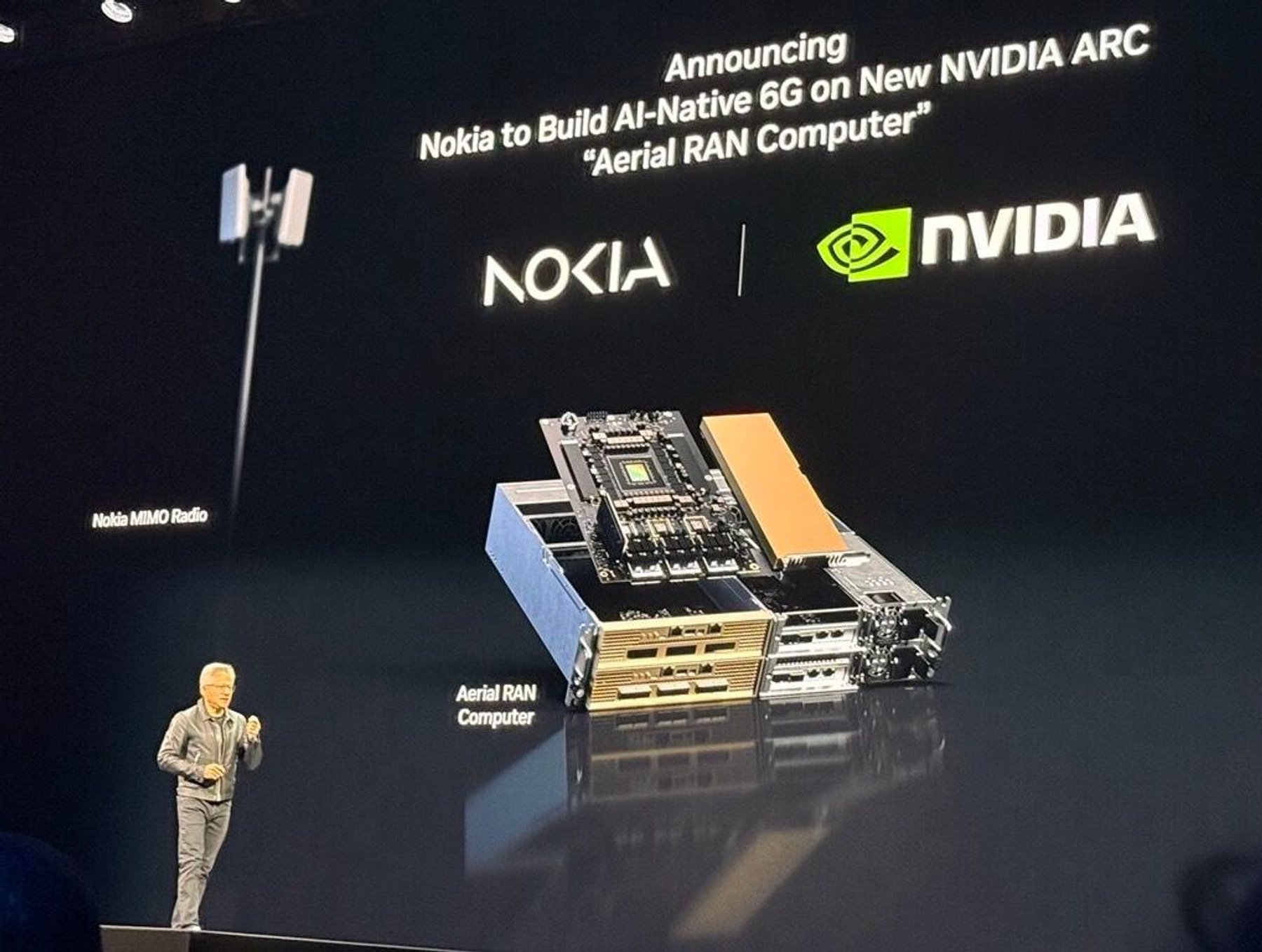
What Nokia actually does that matters to an autonomy-literate reader falls into three buckets. The first is AI-RAN: AI-native radio access network work on NVIDIA platforms, which Nokia says has been expanded across eight global operators, with a migration path toward AI-native 6G 891215. The second is network automation software: an agentic unified data foundation built with Microsoft, combining Nokia Data Suite with Microsoft Fabric, aimed at VoNR assurance, geo-experience, predictive maintenance and closed-loop operations 61113. The third is optical transport: an 800G coherent pluggable deployment with Telxius across Europe, the US and Latin America using Nokia's ICE-X 800G ZR/ZR+ modules 10. Alongside these sit a genuine commercial Open RAN deployment at NTT Docomo 7 and a stated plan to expand US investment by $4 billion in R&D and manufacturing for AI-ready network connectivity 18.
The evidentiary quality varies sharply across those buckets. The NTT Docomo Open RAN deployment and the Telxius 800G deployment are the strongest items in the dossier: both are named-customer, named-product, independently reported 710. The Microsoft partnership is strongly corroborated across multiple independent outlets 61113, but the autonomy of the resulting automation is not. The AI-RAN spectral-efficiency figure is a company claim with undisclosed test conditions 89. The NVIDIA relationship, including a reported $1 billion investment, appears in the dossier largely through video and social sources 1617 plus an NVIDIA investor-relations release 15; the investment figure should be treated as reported rather than audited from the supplied material.
The honest summary for a robotics-industry reader is this. Nokia is a large, commercially mature telecom vendor executing a credible AI-and-automation strategy on top of an installed base of network equipment. It is not building embodied autonomy, and its use of the word "autonomous" is a category error when read through a robotics lens. The interesting question is not "what autonomy level is Nokia at" but "does closed-loop network automation ever become real enough to matter as an autonomy-adjacent capability" — and on the supplied evidence, that question is unresolved.
Latest news
- Nokia and Microsoft integrate agentic AI for telecom network automationCrypto Briefing·2026-09-17GENERAL
02The Nokia Story
Nokia's corporate history is unusually long and unusually discontinuous, and both facts matter for interpreting its current strategy. The company was founded in 1865, which places its origins in pulp milling and later rubber and cable manufacturing rather than in electronics. Its transformation into a mobile-handset powerhouse, its dominance of that market in the late 1990s and early 2000s, and its subsequent collapse against iOS and Android are well-trodden ground. EDITORIAL INFERENCE: the handset era is now a distraction for anyone assessing Nokia's industrial position, because Nokia no longer makes consumer phones. The dossier is explicit on this point: consumer Nokia-branded phones are made by HMD Global, which owns the Nokia phone brand and brands devices as either HMD or Nokia 28. VERIFIED FACT, on the basis of a source that states the ownership arrangement directly.
That single fact resolves most of the confusion in the dossier's weaker material. The teardown videos, the camera reviews, the "don't buy a Nokia" threads and the nostalgia posts about the 3310 2324252627293031323334 are about HMD's licensed products, not about Nokia Oyj's network business. They are relevant to brand equity and to nothing else. A reader who arrives at this report from a consumer-phone search should understand that they are reading about a different company than the one the phone reviews describe.
The Nokia that exists today is the product of the post-handset restructuring: the acquisition of full control of NSN (Nokia Solutions and Networks), the Alcatel-Lucent acquisition that brought in Bell Labs and a substantial optical and IP portfolio, and the subsequent reorganisation into the four segments the dossier records. VERIFIED FACT on the segment structure 25; EDITORIAL INFERENCE on the strategic logic, which is that Nokia has positioned itself as one of a small number of Western vendors capable of supplying end-to-end network infrastructure to operators who are simultaneously under pressure to modernise and under political pressure to avoid certain Chinese vendors.
The current chapter, as reflected in the dossier, is an AI-and-automation chapter. Three threads run through it. First, AI-RAN: Nokia has expanded an AI-RAN program across eight global operators and frames the work as a migration path to AI-native 6G on NVIDIA platforms 8912. Second, data-and-automation software: the Microsoft partnership combines Nokia Data Suite with Microsoft Fabric to build what the two companies call an agentic unified data foundation for network automation 61113. Third, US industrial policy alignment: Nokia has stated a plan to expand US investment by $4 billion in R&D and manufacturing for AI-ready network connectivity 18, and NVIDIA has publicly framed its Nokia relationship in terms of America's return to telecommunications leadership 15. COMPANY CLAIM on the AI-RAN expansion and the investment plan; VERIFIED FACT on the existence and content of the Microsoft partnership, given multiple independent reports.
Leadership changed at the top: Justin Hotard is recorded as CEO 25. VERIFIED FACT. The dossier does not contain enough material on Hotard's strategy statements to support an assessment of strategic direction beyond what the product and partnership evidence already shows, and this report does not speculate.
What the story does not contain is any robotics lineage. There is no Nokia robotics division, no Nokia manipulator, no Nokia mobile robot, no Nokia autonomous vehicle program in the supplied evidence. UNKNOWN whether Nokia holds any robotics-adjacent patents or internal research that is not public; VERIFIED FACT that nothing in the dossier describes one. The academic robotics papers that appear in the research bucket 19202122 are authored elsewhere — NVIDIA, University of Washington, USC — and cannot be attributed to Nokia. Any database that has attached them to Nokia has made an attribution error.
03Product Portfolio: What Nokia Actually Sells
Nokia sells network infrastructure and the software that runs on it. The dossier supports a portfolio view across four areas, with markedly different levels of evidentiary support. The table below separates what is commercially deployed from what is announced or claimed.
| Portfolio area | Specific product or program | Evidence status | Named customer or partner |
|---|---|---|---|
| Radio access (Open RAN) | Multi-vendor Open RAN basestation, LTE/5G, Levante and Ponente baseband cards | VERIFIED FACT — commercial operation reported, nationwide expansion planned 7 | NTT Docomo 7 |
| Radio access (AI-RAN) | AI-RAN / AI-native RAN on NVIDIA platforms; >20% spectral-efficiency improvement claimed | COMPANY CLAIM — program expansion reported across eight operators; efficiency figure vendor-reported with undisclosed test conditions 8912 | Eight global operators, unnamed in dossier 8 |
| Optical transport | ICE-X 800G ZR/ZR+ coherent pluggables | VERIFIED FACT — deployment reported across Europe, US, Latin America 10 | Telxius 10 |
| Network automation software | Nokia Data Suite combined with Microsoft Fabric; agentic unified data foundation; VoNR assurance, geo-experience, predictive maintenance, closed-loop operations | VERIFIED FACT on partnership; COMPANY CLAIM on autonomy of the resulting operations 61113 | Microsoft 61113 |
| Network infrastructure (broad) | Mobile Networks, Network Infrastructure, Cloud and Network Services, Nokia Technologies segments | VERIFIED FACT on segment structure 25 | Not applicable |
| Consumer devices | Nokia-branded phones | VERIFIED FACT — made by HMD Global under licence, not by Nokia Oyj 28 | HMD Global 28 |
Two observations sharpen this table. First, the strongest commercial evidence in the entire dossier is in radio access and optical transport, which are the least "autonomous" parts of the business. NTT Docomo running Nokia multi-vendor Open RAN in commercial operation, with nationwide expansion planned, is a concrete, named, independently reported deployment 7. Telxius deploying Nokia 800G coherent pluggables across three continents is likewise concrete and named 10. These are the facts a reader should anchor on.
Second, the AI-RAN and automation-software items are where the language gets loose. The AI-RAN program is real in the sense that it is reported by multiple outlets and appears in an NVIDIA investor release 891215, but the headline performance number — greater than 20% spectral-efficiency improvement — is Nokia-reported, and the independent coverage notes that test conditions and an operator-by-operator breakdown were not disclosed 89. COMPANY CLAIM, not verified measurement. Similarly, the Microsoft collaboration is genuinely reported by multiple independent outlets 61113, but the description of the resulting capability as "autonomous VoNR assurance" and "closed-loop operations" is vendor framing, and at least one independent analysis explicitly cautions that the announcement "does not, on its own, prove that operators are ready to hand meaningful network changes to closed-loop automation" 11. That caution is the single most important sentence in the dossier for anyone tempted to read Nokia's automation marketing as evidence of deployed autonomy.
There is no robotics product to place in this table. UNKNOWN whether Nokia intends to enter any robotics-adjacent market; VERIFIED FACT that it does not sell one today on the supplied evidence.
Products & versions
/telenet/media/post_attachments/wp-content/uploads/2023/05/transmission-telecommunications-towers-with-blue-sky-background_716843-40.jpg)

04Technology Stack: Strengths and the Work That Remains
Nokia's technology stack, as evidenced, has three load-bearing layers: silicon-and-radio (AI-RAN on NVIDIA platforms), data-and-automation (Data Suite plus Microsoft Fabric), and transport (800G coherent optics). Each has a different maturity profile, and conflating them is the most common analytical error this report is written to prevent.
AI-RAN on NVIDIA platforms. Nokia's stated approach is to run AI workloads natively within the RAN rather than bolting AI on top of it, with a migration path toward AI-native 6G 8912. NVIDIA's own investor communication frames the relationship in strategic and national-competitiveness terms, describing an "AI platform for 6G" and tying it to US telecommunications leadership 15. VERIFIED FACT that the program and the NVIDIA relationship exist and are publicly reported; COMPANY CLAIM that it delivers the stated efficiency gains. The technical strength here is real in the sense that coupling AI inference to radio scheduling is a genuine engineering problem with genuine upside; the evidentiary weakness is that the dossier contains no independent measurement, no third-party benchmark, and no operator willing to be quoted on the numbers.
Data and automation. The Microsoft collaboration is the most concretely described piece of Nokia's automation story. Nokia Data Suite is combined with Microsoft Fabric to create what the partners call an agentic unified data foundation, targeting VoNR assurance, geo-experience, predictive maintenance and closed-loop operations 61113. VERIFIED FACT on the partnership and the named use cases, on the basis of multiple independent reports. The word "agentic" is doing heavy lifting here and deserves scrutiny: in the dossier it denotes software agents that identify issues and take action, not embodied agents. EDITORIAL INFERENCE: this is automation with an AI vocabulary layered on top, and the gap between "identifies issues and recommends action" and "takes action in production without human sign-off" is the entire distance between a useful tool and a genuine autonomy claim. The independent coverage flags exactly this gap 11.
Transport. The Telxius deployment of Nokia ICE-X 800G ZR/ZR+ coherent pluggables across Europe, the US and Latin America is the least glamorous and most verifiable item in the portfolio 10. VERIFIED FACT. It matters because it demonstrates that Nokia can ship and have deployed high-spec optical hardware at global scale, which is the kind of unglamorous execution evidence that is worth more than any number of AI-RAN press releases.
What remains. Three gaps stand out. First, independent verification of AI-RAN performance: the >20% figure has no disclosed test conditions 89. Second, production evidence for closed-loop automation: no operator in the dossier confirms handing change control to automation 1113. Third, any evidence at all of embodied or physical autonomy: none exists in the dossier. UNKNOWN on all three. A reader should treat the first two as open questions that Nokia's future disclosures may close, and the third as a category that does not currently apply.
05Research, Papers, Authors and Labs
This section is short because the dossier's research bucket does not contain Nokia research. It contains four arXiv items: a hierarchical action model for open-world robot manipulation 19, a multi-task visual perception network with LLM conditioning for autonomous navigation 20, a memory system for mobile manipulation 21, and a fourth paper at an arXiv PDF link 22. On the dossier's own account, these are authored by researchers at NVIDIA, the University of Washington and USC, and are not attributed to Nokia. VERIFIED FACT on the attribution problem; the papers exist, but they are not Nokia's.
The correct treatment is to exclude them from any assessment of Nokia's research capability. Including them would inflate Nokia's apparent robotics research output to four papers when the true figure, on the supplied evidence, is zero. EDITORIAL INFERENCE: the most likely explanation for their presence in the dossier is keyword collision — "autonomous navigation" and "manipulation" matching a query that was not sufficiently constrained to Nokia-authored work. This is a data-quality failure, not a finding about Nokia.
What the dossier does not contain is any Nokia research output: no Bell Labs publications, no Nokia-authored papers, no Nokia research-lab pages, no datasets, no code repositories. UNKNOWN whether Nokia publishes in these venues; VERIFIED FACT that the supplied evidence does not show it. Nokia Technologies, the licensing segment, is recorded as a segment 25 but the dossier contains no detail on its research activities.
For completeness: the presence of NVIDIA as an author on robotics papers 192021 and as Nokia's AI-RAN partner 15 is a coincidence of corporate identity, not a research relationship between Nokia and those papers. A reader should not connect them.
<!-- module: papers --> <!-- module: authors-labs --> <!-- module: repos --> <!-- module: datasets -->06Media Evidence Library: What the Videos Prove
The dossier's video bucket contains six items, and not one of them shows a Nokia network product, let alone an autonomous system. They are: a Nokia 6 teardown and build-quality review 23, a Nokia 9 PureView review 24, a Nokia 3 Android Pie hands-on 25, a Nokia 9 PureView camera demonstration 26, a Nokia N95 camera teardown short 27, and an HMD Vibe teardown and screen replacement 28. VERIFIED FACT on the content of these items.
What they prove is narrow and should be stated narrowly. They prove that consumer Nokia-branded handsets exist, that they are repairable, that their cameras have been reviewed, and that the HMD Vibe is branded HMD rather than Nokia 28. They prove nothing about Nokia Oyj's network business, nothing about AI-RAN, nothing about automation, and nothing about autonomy. A teardown video is evidence about a handset's construction; it is not evidence about a company's industrial strategy.
This is the point at which the report's evidence discipline matters most. A choreographed product video is not proof of autonomous work; a teardown is not proof of anything except the device on the bench. The dossier contains no video of a Nokia network deployment, no video of closed-loop automation operating, and no video of any Nokia autonomous system, because no such system is evidenced to exist. EDITORIAL INFERENCE: the video corpus is a consumer-electronics corpus that has been swept into a corporate dossier by brand-name matching, and it should be weighted accordingly — near zero for the purposes of assessing Nokia's infrastructure business.
The absence is itself informative. A company genuinely deploying closed-loop autonomous network operations would be expected to have operator-confirmed case-study material, conference demonstrations with named customers, and third-party technical write-ups. The dossier has none of these for Nokia's automation claims. It has press releases and independent reports of press releases 61113. That is a weaker evidentiary class, and the report treats it as such.
Media library
07Commercial Reality
Nokia is a fully commercial, publicly traded operating company with real customers and real deployments. That much is not in doubt. The interesting question is which parts of its portfolio are demonstrably generating commercial activity and which are announcements awaiting proof.
The strongest commercial evidence is the NTT Docomo Open RAN deployment. Light Reading reports commercial operation of Nokia's multi-vendor Open RAN basestation, running LTE and 5G on Levante and Ponente baseband cards, with nationwide expansion planned 7. VERIFIED FACT. This is a named operator, named hardware, commercial operation, and a stated expansion path. It is the single best item in the dossier.
The second strongest is the Telxius 800G deployment: Nokia ICE-X 800G ZR/ZR+ coherent pluggables deployed across Europe, the US and Latin America 10. VERIFIED FACT. Again a named customer, named product, and a geographically specific deployment.
The Microsoft partnership is strongly corroborated as a partnership 61113 but weaker as a commercial fact. VERIFIED FACT that the partnership and its stated use cases exist and are independently reported. UNKNOWN on contract value, on how many operators have adopted the combined Data Suite and Fabric offering, and on whether any of the named use cases — VoNR assurance, geo-experience, predictive maintenance, closed-loop operations — are running in production at a paying customer. The dossier does not say, and this report does not fill the gap.
The AI-RAN program is the weakest of the four on commercial evidence. It is reported as expanded across eight global operators 8912, which is a meaningful claim if true, but the operators are not named in the dossier, the >20% spectral-efficiency figure has undisclosed test conditions 89, and the program is framed as a migration path toward 6G rather than as revenue today. COMPANY CLAIM. A reader should treat "eight global operators" as a statement Nokia has made and multiple outlets have repeated, not as eight confirmed paying customers.
The US investment plan — $4 billion in expanded R&D and manufacturing for AI-ready network connectivity 18 — is a COMPANY CLAIM about future spending, not a commercial result. It is relevant to the geopolitical section below, not to current revenue.
On the consumer side, the commercial reality is that Nokia Oyj does not sell phones. HMD Global owns the Nokia phone brand and makes the devices 28. VERIFIED FACT. Any revenue attributed to Nokia-branded handsets belongs to HMD, not to Nokia Oyj, and the community complaints about those handsets 293031323334 are complaints about HMD's products.
Net assessment: Nokia has demonstrable commercial traction in radio access and optical transport, a well-corroborated but commercially opaque software partnership with Microsoft, and an AI-RAN program whose commercial substance is asserted rather than shown. EDITORIAL INFERENCE: the company is real and the deployments are real; the autonomy narrative attached to them is not yet backed by production evidence.
Customers & deployments
Japanese operator running Nokia's multi-vendor Open RAN basestation in commercial operation for LTE/5G, with nationwide expansion planned.
Deployed Nokia's ICE-X 800G ZR/ZR+ coherent pluggables across Europe, the US and Latin America to boost global network capacity.
Sections 8 through 14 follow in the continuation.
08Markets and Use Cases
Nokia's addressable markets are not robotics markets. They are telecommunications infrastructure markets, and the distinction matters enormously for anyone arriving at this report expecting a robotics story. The company sells into four principal demand pools: mobile network operators (MNOs) building and upgrading radio access networks; fixed and transport network operators requiring optical and IP routing capacity; cloud and enterprise customers buying network software, automation and data platforms; and device licensees paying for the Nokia brand and patent portfolio. Each pool has different buying cycles, different competitive dynamics and different evidence quality in the public record.
8.1 Mobile Network Operators: The Core Demand Pool
The MNO segment is where Nokia's strategic narrative is most active and where the evidence is most mixed. Two threads dominate the 2025-2026 period: Open RAN disaggregation and AI-RAN.
Open RAN. The NTT Docomo deployment is the single most concrete commercial datapoint in the dossier. Light Reading reports that Docomo has placed Nokia multi-vendor Open RAN basestation equipment into commercial operation, using Levante and Ponente baseband cards supporting LTE and 5G, with nationwide expansion planned 7. This is a verified deployment in the sense that it is reported by an independent trade publication and describes commercial operation rather than a trial. What it does not tell us is scale: how many sites, what share of Docomo's footprint, what the performance delta is versus incumbent integrated RAN, and what the commercial terms look like. "Commercial operation" and "nationwide expansion planned" are meaningful but bounded claims.
The strategic logic of Open RAN for Nokia is defensive and offensive simultaneously. Defensively, disaggregation threatens incumbent vendors who sold integrated, single-supplier radio systems, because it opens the door to new entrants in each layer of the stack. Offensively, Nokia has positioned itself as a credible multi-vendor Open RAN supplier, which lets it sell into operators who have made political or procurement commitments to vendor diversity. The Docomo win is evidence that this positioning can convert into commercial deployment, at least with one major operator.
AI-RAN. Nokia's AI-RAN program is the more heavily marketed thread. The company reports that its AI-RAN work on NVIDIA platforms has delivered more than 20% spectral-efficiency improvement, and that the program has expanded across eight global operators, with a migration path toward AI-native 6G 8912. The NVIDIA partnership is substantial: NVIDIA has committed to a $1 billion investment in Nokia and the two companies have framed their collaboration as pioneering "the AI platform for 6G" 151617.
The spectral-efficiency figure deserves careful handling. It is Nokia-reported. The announcement did not disclose test conditions, the operator-by-operator breakdown, or the baseline against which the improvement was measured 89. Spectral efficiency is a metric that can be measured in many ways: peak versus average, single-cell versus network-wide, lab versus field, with or without specific traffic models. A 20% improvement is plausible and would be commercially significant if it holds under realistic conditions, but the public record does not allow independent verification. Treat it as a company claim, not a verified fact.
The eight-operator expansion is similarly directional. "Expanded across eight global operators" could mean eight operators running trials, eight operators with commercial contracts, or eight operators in a research collaboration. The dossier does not specify. This is a material gap: the difference between a trial and a paid deployment is the difference between a research program and a business.
8.2 Fixed and Transport Networks: The Quiet Commercial Engine
The Telxius deployment is the least glamorous and most verifiable commercial datapoint in the dossier. Telxius has deployed Nokia's ICE-X 800G ZR/ZR+ coherent pluggable optics across Europe, the United States and Latin America 10. This is a named customer, a named product, a named geographic footprint, and a deployment rather than a trial.
800G coherent pluggables are a genuinely important product category. They allow operators to push 800 Gbps over a single wavelength in a pluggable form factor, which reduces the cost and complexity of scaling transport capacity. The market is competitive, with multiple vendors offering comparable products, but Nokia's ICE-X line is a real participant. The Telxius deployment is evidence that Nokia can win transport deals against that competition.
This segment does not generate the same headline volume as AI-RAN, but it is where Nokia's network infrastructure business earns revenue with less narrative risk. A pluggable optic either meets its specification or it does not. There is no "autonomous" language to interrogate, no spectral-efficiency claim to verify, no closed-loop automation to question. It is a hardware sale to a named customer, and that is the strongest form of commercial evidence available in this dossier.
8.3 Cloud, Enterprise and Network Automation
The Nokia-Microsoft partnership is the third major thread. Announced in September 2026, it combines Nokia Data Suite with Microsoft Fabric to create what the companies describe as an "agentic unified data foundation" for network automation 61113. The stated use cases are VoNR (Voice over New Radio) assurance, geo-experience, predictive maintenance and closed-loop operations.
The partnership is reported consistently across multiple independent outlets, which supports the fact that the announcement occurred and that the described use cases are what the companies said 61113. What it does not establish is that any operator has deployed the combined solution in production, that it delivers measurable operational improvement, or that the "closed-loop" and "agentic" language corresponds to genuine autonomy rather than assisted automation with a human in the loop.
This is the crux of the autonomy question for Nokia. The company's marketing uses autonomy-adjacent vocabulary: "autonomous VoNR assurance," "closed-loop operations," "agent-based solutions that identify issues and take action" 6. Independent coverage notes that the announcement "does not, on its own, prove that operators are ready to hand meaningful network changes to closed-loop automation" 11. That is the correct reading. Network automation has been sold in various forms for two decades, and the gap between "the system can recommend an action" and "the system can take the action without human approval" is where most autonomy claims die. The dossier provides no evidence that Nokia has crossed that gap in production.
8.4 Device Licensing: The Brand Without the Business
The consumer Nokia phone business is a licensing arrangement. HMD Global owns the Nokia phone brand and manufactures Nokia-branded and HMD-branded devices 28. This is a genuine business for Nokia Oyj in the sense that it collects licensing revenue, but it is not a business Nokia operates. The consumer reviews and community discussions in the dossier 2324252627293031323334 are about HMD-made devices, not Nokia-made devices, and they tell us nothing about Nokia Oyj's operational capabilities.
This distinction is frequently blurred in consumer-facing coverage, and it matters for anyone assessing Nokia as a technology company. The Nokia that builds Open RAN basestations and 800G optics is a different corporate entity from the Nokia that appears on a phone box. The former is the subject of this report. The latter is a brand licensing arrangement that generates royalty revenue and consumer nostalgia in roughly equal measure.
8.5 Use Case Summary
| Use case | Product | Evidence quality | Commercial status |
|---|---|---|---|
| Multi-vendor Open RAN | Levante/Ponente baseband | Independent trade press, named operator 7 | Commercial operation, expansion planned |
| AI-RAN / spectral efficiency | AI-RAN on NVIDIA platforms | Company-reported, undisclosed test conditions 89 | Program expansion, deployment scale unknown |
| 800G transport | ICE-X 800G ZR/ZR+ | Independent trade press, named customer 10 | Commercial deployment, three regions |
| Network automation | Data Suite + Microsoft Fabric | Multiple independent reports of announcement 61113 | Partnership announced, production deployment unproven |
| Consumer devices | Nokia-branded phones | Video and community sources 23-34 | HMD-licensed, not Nokia-operated |
The pattern is consistent: Nokia has real commercial deployments in transport and Open RAN, a substantial but unverified AI-RAN program, and an automation partnership whose autonomy claims outrun the evidence. None of this is robotics. All of it is telecom infrastructure.
09Competitive Landscape
Nokia competes in markets where the competitive set is small, the barriers to entry are high, and the consequences of losing a generation of technology are existential. The company has already lived through one such loss in mobile handsets, and its current strategy is explicitly designed to avoid repeating that experience in network infrastructure.
9.1 The RAN Triopoly and Its Discontents
The global RAN market has been dominated for two decades by three vendors: Ericsson, Nokia and Huawei. Huawei's effective exclusion from many Western markets has reshaped the competitive map, creating both opportunity and risk for Nokia and Ericsson. The opportunity is that operators who would previously have bought Huawei must now buy from a smaller set of suppliers. The risk is that the same operators may accelerate their pursuit of Open RAN as a way to reduce dependence on any single vendor, which erodes the value of incumbency.
Samsung has emerged as a credible fourth RAN supplier, particularly in markets where Korean technology is favoured or where operators want a non-European, non-Chinese option. The competitive dynamics vary significantly by geography: Nokia and Ericsson are strong in Europe, Samsung is strong in Korea and has made inroads in North America, and Huawei retains significant share in markets where it is not excluded.
The dossier does not contain detailed competitive market-share data, and this report will not invent it. What the dossier does contain is evidence of Nokia winning a specific Open RAN deployment with NTT Docomo 7, which is a competitive datapoint in a market where Japanese operators have historically favoured domestic suppliers and where Open RAN has been a strategic priority.
9.2 AI-RAN: A New Competitive Axis
The AI-RAN program introduces a competitive dimension that did not exist five years ago. The premise of AI-RAN is that radio access networks can be made more efficient by applying AI to spectrum management, beamforming, scheduling and other radio functions, and that this is best done on GPU-accelerated platforms. Nokia's partnership with NVIDIA positions it as the leading proponent of this approach 15.
The competitive question is whether AI-RAN becomes a genuine differentiator or a feature that all vendors offer. Ericsson has its own AI and automation programs. Samsung has AI capabilities. Huawei, in markets where it operates, has substantial AI research. The NVIDIA partnership gives Nokia a head start and a marquee partner, but it also creates a dependency: if AI-RAN becomes standard, the differentiator may be the silicon and the AI platform rather than the RAN vendor, which would shift value toward NVIDIA and away from Nokia.
This is a structural risk that Nokia's management is presumably aware of. The $1 billion NVIDIA investment 1617 aligns the two companies' interests, but alignment is not the same as control. Nokia is betting that being the preferred RAN partner for NVIDIA's AI platform is worth more than the value it cedes to NVIDIA in the process. That bet may be correct, but it is a bet.
9.3 Transport and Optical: A Crowded, Competent Field
The 800G coherent pluggable market is more competitive than RAN. Nokia's ICE-X products compete with offerings from Ciena, Infinera (now part of Nokia's competitor set following its acquisition by Nokia in 2024, though the dossier does not cover this), Cisco, Juniper and a range of specialist optical vendors. The Telxius deployment 10 is evidence that Nokia can win in this market, but it is one deployment, not a market position.
The transport market rewards execution on cost, power efficiency, interoperability and reliability. It is less susceptible to geopolitical disruption than RAN, because optical transport is not typically subject to the same national-security scrutiny as radio access. This makes it a more stable but less strategically exciting business for Nokia.
9.4 Network Automation and Software: The Most Contested Frontier
Network automation is where the competitive landscape is least settled and where Nokia's claims are most vulnerable. The Microsoft partnership 61113 positions Nokia against a range of competitors: traditional network management vendors, cloud hyperscalers with their own telecom offerings, specialist automation startups, and operators' in-house development teams.
The strategic logic of partnering with Microsoft is that it gives Nokia access to enterprise-grade data infrastructure and a cloud distribution channel. The strategic risk is that it makes Nokia dependent on Microsoft's platform and reduces Nokia's software business to a data-source role. Whether this is a good trade depends on whether operators want to buy network automation from their RAN vendor, their cloud provider, or a specialist. The dossier does not resolve this question, and it is not clear that anyone knows the answer yet.
9.5 Competitive Position Summary
| Segment | Primary competitors | Nokia position | Evidence quality |
|---|---|---|---|
| RAN | Ericsson, Huawei, Samsung | Top-three incumbent, Open RAN credible | Named deployment 7 |
| AI-RAN | Ericsson, Samsung, Huawei | First-mover with NVIDIA | Company claims, partnership 8915 |
| Optical transport | Ciena, Cisco, Juniper | Participant, not leader | Named deployment 10 |
| Network automation | Hyperscalers, specialists | Challenger via Microsoft | Partnership announced 61113 |
The honest assessment is that Nokia is a strong incumbent in a market undergoing structural change, with a credible position in Open RAN, a promising but unproven AI-RAN bet, and a software strategy that depends on partners whose interests may not fully align with its own. It is not a robotics company, and it does not compete in robotics markets.
Competitive comparison
| Robot | Maker | Autonomy | Conf. |
|---|---|---|---|
| iRobot Roomba Combo 10 Max | iRobot | Autonomous | 0.90 |
| Mobile ALOHA (Stanford) | Stanford University | Teleoperated | 0.90 |
| 1X NEO | 1X Technologies | Remote-Assisted | 0.90 |
10Geopolitical Context and Constraints
Nokia's business is inseparable from geopolitics in a way that few technology companies' businesses are. Telecommunications infrastructure is treated as critical national infrastructure in most countries, and the vendor selection process for RAN equipment is often as much a foreign-policy decision as a procurement decision. This creates both constraints and opportunities for Nokia.
10.1 The Huawei Exclusion and Its Consequences
The effective exclusion of Huawei from RAN markets in the United States, much of Europe, Australia, Japan and other allied countries has reshaped Nokia's competitive environment. In markets where Huawei is excluded, Nokia faces a smaller competitive set and can often command better pricing. In markets where Huawei operates, Nokia faces a competitor with substantial scale, aggressive pricing and deep technical capabilities.
The exclusion is not uniform. Some European countries have imposed partial restrictions, some have imposed full bans, and some have delayed decisions. The United States has been the most aggressive, both in excluding Huawei and in pressuring allies to do the same. This has created a geopolitical alignment in which Nokia and Ericsson are the "trusted" Western vendors, Samsung is the "trusted" Korean alternative, and Huawei is the excluded incumbent.
For Nokia, this alignment is a commercial advantage that is not entirely of its own making. The company benefits from being Finnish, from being headquartered in a NATO and EU member state, and from being perceived as a reliable supplier to Western governments. This is a real asset, but it is also a dependency: if the geopolitical consensus shifts, or if operators decide that vendor diversity matters more than vendor alignment, Nokia's position could weaken.
10.2 The NVIDIA Investment and American Technology Policy
NVIDIA's $1 billion investment in Nokia 1617 and the framing of the AI-RAN partnership as "powering America's return to telecommunications leadership" 15 place Nokia squarely within a US-aligned technology ecosystem. This is strategically significant. It means Nokia's AI-RAN program is not just a commercial bet but a geopolitical one: the company is positioning itself as the RAN vendor of choice for a US-led AI infrastructure stack.
The benefits are substantial. NVIDIA is the dominant supplier of AI accelerators, and its partnership gives Nokia access to technology, capital and political cover. The risks are also substantial. Nokia becomes more dependent on a single US partner, more exposed to US export controls and technology policy, and more vulnerable to shifts in US political priorities. If a future US administration changes its approach to telecom infrastructure or to NVIDIA's role in it, Nokia's position could be affected.
The dossier also notes that Nokia plans to expand US investment by $4 billion in R&D and manufacturing for AI-ready network connectivity 18. This is a significant commitment that aligns Nokia with US industrial policy objectives. It is also a signal that Nokia sees the US market as strategically central to its AI-RAN strategy.
10.3 European Strategic Autonomy and the Nokia Paradox
Nokia is a European champion in a policy environment that increasingly values European technological sovereignty. The EU has identified telecommunications infrastructure as a strategic sector, and there is political pressure to support European vendors. Nokia benefits from this in principle, but the practical effects are ambiguous.
European operators have been slower to deploy 5G at scale than their US and Asian counterparts, and European telecom markets are more fragmented and more price-sensitive. The EU's approach to Open RAN has been supportive in principle but slow in implementation. Nokia's European base gives it political legitimacy but not necessarily commercial advantage.
The paradox is that Nokia's most important strategic partnership is with an American company (NVIDIA), its most significant AI-RAN framing is American ("powering America's return to telecommunications leadership"), and its largest planned investment expansion is in the United States 18. Nokia is a European company pursuing an American-aligned strategy in a market where European policy is still developing. This is not necessarily a contradiction, but it is a tension that will need to be managed.
10.4 Export Controls and Technology Restrictions
The dossier does not contain detailed information on export controls affecting Nokia's business, and this report will not speculate. What can be said is that any company selling advanced telecommunications equipment is subject to export control regimes, and that these regimes have become more restrictive in recent years. Nokia's AI-RAN products, which combine advanced radio technology with AI accelerators, are likely to be subject to controls that affect where they can be sold and to whom.
This creates a structural constraint on Nokia's addressable market. The company cannot sell advanced RAN equipment to countries subject to US or EU export restrictions, which limits its ability to compete with Huawei in those markets. It also creates compliance costs and operational complexity. These are not unique to Nokia, but they are material.
10.5 Geopolitical Risk Summary
| Factor | Effect on Nokia | Evidence |
|---|---|---|
| Huawei exclusion | Positive: reduced competition in Western markets | Contextual, not in dossier |
| NVIDIA partnership | Positive: capital, technology, political alignment | 151617 |
| US investment expansion | Positive: aligns with US industrial policy | 18 |
| European fragmentation | Negative: slower 5G deployment, price pressure | Contextual, not in dossier |
| Export controls | Negative: limits addressable market | Contextual, not in dossier |
The geopolitical context is not a side issue for Nokia. It is the terrain on which the company's strategy is being executed, and it shapes both the opportunities and the constraints. The dossier provides evidence of Nokia's alignment with US technology policy but does not provide enough detail to assess the risks comprehensively.
11The Hype, the Real and the Ugly
This section applies the report's evidence discipline to Nokia's public claims, separating what is verified from what is asserted and what is unknown. The pattern that emerges is familiar: a company with real technology and real customers, whose marketing language outruns the evidence in specific and identifiable ways.
11.1 The Hype
"Autonomous" network operations. Nokia and Microsoft describe "autonomous VoNR assurance," "closed-loop operations" and "agent-based solutions that identify issues and take action" 6. The word "autonomous" is doing a lot of work here. In network operations, "autonomous" can mean anything from "the system surfaces a recommendation that a human approves" to "the system makes changes without human intervention." The dossier provides no evidence that Nokia has achieved the latter in production. Independent coverage explicitly notes that the announcement "does not, on its own, prove that operators are ready to hand meaningful network changes to closed-loop automation" 11. The hype is the word "autonomous." The reality is likely assisted automation with human oversight, which is valuable but not autonomous in any meaningful sense.
">20% spectral-efficiency improvement." This is a specific, quantified claim that would be commercially significant if verified 89. It is not verified. The test conditions were not disclosed, the baseline was not specified, and the measurement methodology was not published. A 20% improvement in spectral efficiency under lab conditions with favourable assumptions is a different claim from a 20% improvement in field conditions across a realistic traffic mix. The dossier does not allow us to distinguish between them. Treat the number as a claim, not a fact.
"AI-native 6G." The framing of AI-RAN as a migration path to "AI-native 6G" 89 is aspirational. 6G standards are not finalized, the timeline is uncertain, and the technical requirements are still being debated. Nokia's positioning is a bet on a future that does not yet exist. This is not dishonest, but it is speculative, and it should be read as a strategic narrative rather than a product roadmap.
"Pioneering the AI platform for 6G." The NVIDIA-Nokia partnership is framed in grand terms 15. The partnership is real, the investment is real, and the technical collaboration is presumably real. But "pioneering the AI platform for 6G" is a statement about intent and positioning, not about achieved capability. The 6G platform does not exist yet.
11.2 The Real
NTT Docomo Open RAN deployment. This is a named operator, a named product line, and commercial operation reported by an independent trade publication 7. It is the strongest commercial evidence in the dossier. It does not tell us the scale or the economics, but it establishes that Nokia can win and deploy multi-vendor Open RAN with a major operator.
Telxius 800G deployment. Named customer, named product, three geographic regions, independent trade press 10. This is a straightforward commercial deployment of a specified product. There is no autonomy language to interrogate and no unverified performance claim. It is what it appears to be.
Microsoft partnership announcement. The partnership is real and consistently reported 61113. The use cases are specified. What is not established is production deployment or measured outcomes. The announcement is real; the autonomy claims attached to it are not verified.
NVIDIA investment and partnership. The $1 billion investment is reported by NVIDIA's investor relations page 15 and covered by multiple outlets 1617. This is a verified corporate action. Its strategic implications are a matter of interpretation, but the fact of the investment is not in doubt.
11.3 The Ugly
The autonomy gap. The most significant gap between claim and evidence in the dossier is the autonomy language. Nokia's marketing describes autonomous operations; the evidence describes automation with human oversight. This is not unique to Nokia, and it is not necessarily deceptive, but it is a gap that matters for anyone assessing the company's technology. The dossier provides no evidence of production closed-loop autonomy, and independent coverage explicitly questions whether operators are ready for it 11.
The spectral-efficiency opacity. A quantified performance claim without disclosed test conditions is a claim that cannot be evaluated. Nokia may have excellent reasons for not disclosing the conditions, but the effect is that the claim functions as marketing rather than evidence. This is a pattern that recurs across the telecom industry, and it should be treated with appropriate skepticism.
The robotics confusion. The dossier contains academic robotics papers 19202122 that are not authored by Nokia and have no connection to Nokia's business. Their presence in a dossier about Nokia is an artefact of the research process, not evidence of Nokia robotics activity. Anyone reading this report should understand that Nokia does not make robots, does not sell robots, and does not claim to make or sell robots. The "autonomous" language in its marketing refers to network operations, not physical autonomy.
11.4 Claim vs Evidence Table
| Claim | Source | Evidence status | Assessment |
|---|---|---|---|
| >20% spectral efficiency from AI-RAN | Nokia 89 | Company-reported, conditions undisclosed | Unverified claim |
| Autonomous VoNR assurance | Nokia/Microsoft 6 | Announcement only | Hype; automation likely assisted |
| Closed-loop operations | Nokia/Microsoft 6 | Announcement only | Unproven in production |
| Eight operators in AI-RAN program | Nokia 89 | Company-reported | Scale and commercial status unknown |
| NTT Docomo commercial Open RAN | Light Reading 7 | Independent trade press | Verified deployment |
| Telxius 800G deployment | Trade press 10 | Independent trade press | Verified deployment |
| NVIDIA $1B investment | NVIDIA IR 15 | Primary corporate source | Verified |
| AI-native 6G migration path | Nokia 89 | Company narrative | Aspirational |
The pattern is clear: Nokia's verified facts are commercial deployments and corporate actions. Its unverified claims are performance metrics and autonomy language. The gap between them is where the hype lives.
Claim tracker
Multiple independent commerce and news sources consistently describe Nokia Oyj's segments, HQ, founding year and ticker, and no dossier fact attributes any robot or autonomous machine to Nokia.
Multiple independent outlets (GlobeNewswire, Convergence-Now, BizTech Weekly) report the same partnership and use cases, though the specific production outcomes remain vendor-described.
Independent coverage explicitly states the announcement 'does not, on its own, prove that operators are ready to hand meaningful network changes to closed-loop automation', contradicting the autonomy marketing.
The >20% figure is Nokia-reported and independent coverage notes test conditions and operator-by-operator breakdown were not disclosed, so it cannot be independently verified.
Light Reading, an independent trade outlet, reports the commercial operation and planned nationwide expansion, substantiating the deployment claim.
An independent news source reports the deployment and specific hardware, substantiating the real-world rollout.
A video source states HMD owns Nokia and brands phones as HMD or Nokia, independently corroborating the licensing arrangement.
The claim appears only in a single 5G Americas item without independent confirmation of the investment's execution or scale.
12Future Scenarios
Scenario analysis for Nokia must contend with a fundamental uncertainty: the company's core markets are undergoing structural change, and the outcomes depend on factors that are not fully within Nokia's control. The scenarios below are not predictions. They are structured ways of thinking about the range of plausible futures and the indicators that would signal which one is materializing.
12.1 Scenario A: AI-RAN Leadership Converts to Commercial Dominance
Thesis. Nokia's early partnership with NVIDIA and its AI-RAN program produce measurable, independently verified performance improvements that operators are willing to pay for. The eight-operator program converts to commercial deployments at scale. Nokia becomes the preferred RAN vendor for AI-native networks, and the AI-RAN premium sustains margins in a market that would otherwise be commoditizing.
Indicators to watch. Independent verification of spectral-efficiency claims under disclosed conditions. Named commercial AI-RAN deployments with disclosed scale. Operator earnings calls citing Nokia AI-RAN as a factor in vendor selection. Expansion of the NVIDIA partnership beyond the initial investment.
Plausibility. Moderate. The technical premise is sound, the partnership is real, and Nokia has a credible RAN business. The risk is that AI-RAN becomes table stakes rather than a differentiator, in which case the value accrues to NVIDIA rather than Nokia.
12.2 Scenario B: Open RAN Commoditization Erodes Incumbent Margins
Thesis. Open RAN succeeds in disaggregating the RAN market, but the effect is to commoditize baseband and radio components. Nokia wins deployments but at lower margins, because operators use multi-vendor strategies to play suppliers against each other. The NTT Docomo deployment is a template for a future in which Nokia is one of several interchangeable suppliers.
Indicators to watch. RAN segment margin trends in Nokia's financial reporting. Growth in the number of credible Open RAN suppliers. Operator procurement language emphasizing vendor diversity over vendor performance. Pricing pressure in RAN contract awards.
Plausibility. Moderate to high. Open RAN's explicit purpose is to reduce vendor lock-in, and its success would inevitably reduce incumbent pricing power. Nokia's participation in Open RAN is defensively rational but strategically ambiguous.
12.3 Scenario C: The Automation Bet Fails to Materialize
Thesis. The Nokia-Microsoft automation partnership produces announcements but not production deployments. Operators remain unwilling to hand network changes to closed-loop automation, and the "agentic" framing proves to be ahead of both technical capability and operational trust. The partnership quietly winds down or is reframed as a data-integration play.
Indicators to watch. Absence of named production deployments twelve to eighteen months after announcement. Operator statements expressing caution about autonomous network operations. Microsoft reallocating telecom resources to other priorities. Nokia reframing the partnership in subsequent announcements.
Plausibility. Moderate. The independent skepticism in the dossier 11 is well-founded, and the gap between automation announcements and production autonomy is a well-documented pattern in telecom.
12.4 Scenario D: Geopolitical Disruption
Thesis. A change in US technology policy, export control regime, or geopolitical alignment disrupts Nokia's AI-RAN strategy. The NVIDIA partnership is affected by US-China tensions or by changes in US industrial policy. Nokia's US investment expansion 18 becomes a liability rather than an asset.
Indicators to watch. Changes in US export control policy affecting AI accelerators or telecom equipment. Shifts in NVIDIA's telecom strategy. Political changes affecting the "trusted vendor" framework. European policy responses to US technology dominance.
Plausibility. Low to moderate in the near term, higher over a five-year horizon. Geopolitical alignments are less stable than they appear, and Nokia's strategy is heavily exposed to them.
12.5 Scenario E: The Quiet Infrastructure Compounder
Thesis. The AI-RAN and automation narratives fade, but Nokia's transport and optical business continues to generate steady revenue. The company becomes a less exciting but more predictable infrastructure supplier, valued for its 800G optics, its IP routing, and its patent portfolio rather than for its AI ambitions.
Indicators to watch. Transport and optical revenue growth. Patent licensing revenue stability. Reduced emphasis on AI-RAN in investor communications. Management changes signalling a strategic reset.
Plausibility. Moderate. This is arguably the base case if the AI-RAN narrative does not convert to commercial reality. It is not a bad outcome for a company of Nokia's scale, but it is not the outcome the current strategy is designed to produce.
12.6 Scenario Summary
| Scenario | Key driver | Nokia outcome | Plausibility |
|---|---|---|---|
| A: AI-RAN leadership | Verified performance, commercial conversion | Premium vendor position | Moderate |
| B: Open RAN commoditization | Successful disaggregation | Volume without margin | Moderate-high |
| C: Automation failure | Operational trust gap | Partnership reframed | Moderate |
| D: Geopolitical disruption | Policy change | Strategic reset | Low-moderate |
| E: Infrastructure compounder | Narrative fade | Stable, unexciting | Moderate |
The scenarios are not mutually exclusive. Nokia could experience AI-RAN success in some markets while facing Open RAN commoditization in others. The company's future is likely to be a blend of these outcomes, and the indicators to watch are the ones that reveal which blend is emerging.
13What to Watch: A Live Monitoring Checklist
This section provides a structured monitoring framework for anyone tracking Nokia as a technology company. The checklist is organized by evidence category and prioritized by signal value. Each item specifies what to look for, where to find it, and what it would indicate.
13.1 Commercial Deployment Evidence
Named AI-RAN customers with disclosed scale. The eight-operator program 89 is currently opaque. Watch for announcements that name specific operators, specify the number of sites or the share of network traffic, and describe commercial terms. A named operator with a disclosed deployment is qualitatively different from an unnamed operator in a program. Source: Nokia newsroom 14, operator earnings calls, trade press.
NTT Docomo expansion progress. The dossier reports that nationwide expansion is planned 7. Watch for confirmation that expansion has occurred, with details on scale and performance. A successful nationwide Open RAN deployment with a major Japanese operator would be a significant competitive datapoint. Source: Light Reading, Docomo announcements, Japanese trade press.
Telxius deployment expansion. The 800G deployment covers Europe, US and Latin America 10. Watch for additional named customers for ICE-X products, which would indicate whether Telxius is a one-off win or part of a broader market position. Source: Nokia newsroom, optical trade press.
Microsoft automation production deployments. The partnership was announced in September 2026 6. Watch for named operators deploying the combined Nokia-Microsoft solution in production, with measured outcomes. Absence of such announcements twelve to eighteen months after the partnership would be a negative signal. Source: Nokia and Microsoft newsrooms, operator announcements.
13.2 Technical Verification
Independent spectral-efficiency measurement. The >20% claim 89 is currently unverifiable. Watch for peer-reviewed publications, independent test results, or operator disclosures that corroborate or contradict the figure. A published methodology with disclosed test conditions would materially strengthen the claim. Source: IEEE publications, academic conferences, independent test labs.
AI-RAN standardization progress. Watch for 3GPP or O-RAN Alliance specifications that incorporate AI-RAN concepts, and for Nokia's role in shaping them. Standardization is a leading indicator of commercial adoption. Source: 3GPP, O-RAN Alliance, industry standards bodies.
NVIDIA partnership evolution. The $1 billion investment 151617 is a starting point. Watch for joint product announcements, expanded technical collaboration, and evidence that the partnership is producing deployable technology rather than research. Source: NVIDIA and Nokia investor relations, product announcements.
13.3 Financial Signals
RAN segment margins. Nokia's financial reporting disaggregates its business segments. Watch for RAN margin trends as an indicator of whether Open RAN is commoditizing the market. Declining margins would support Scenario B. Source: Nokia quarterly reports, investor presentations.
AI-RAN revenue disclosure. If AI-RAN becomes commercially significant, Nokia may begin disclosing related revenue. Watch for any segment reporting changes that isolate AI-RAN or AI-related revenue. Source: Nokia financial statements.
US investment execution. The planned $4 billion US investment expansion 18 is a significant commitment. Watch for progress reports, facility announcements, and hiring data that indicate whether the commitment is being executed. Source: Nokia announcements, US state and federal economic development agencies.
13.4 Geopolitical and Regulatory
Export control changes. Watch for changes in US or EU export control regimes affecting AI accelerators, telecom equipment, or both. Nokia's AI-RAN products combine both categories and are therefore doubly exposed. Source: US Bureau of Industry and Security, EU trade policy announcements.
Trusted vendor framework evolution. Watch for changes in how governments define and enforce trusted vendor requirements. Expansion of the framework would benefit Nokia; contraction or fragmentation would create uncertainty. Source: Government policy announcements, trade associations.
European telecom policy. Watch for EU initiatives on 5G/6G deployment, Open RAN support, and European technological sovereignty. Policy support could benefit Nokia; policy delays could disadvantage it relative to US and Asian competitors. Source: European Commission, national telecom regulators.
13.5 Competitive Dynamics
Ericsson and Samsung AI-RAN announcements. Watch for competing AI-RAN programs from Nokia's principal competitors. If Ericsson announces a comparable NVIDIA partnership or an equivalent performance claim, Nokia's first-mover advantage narrows. Source: Competitor newsrooms, trade press.
Open RAN supplier proliferation. Watch for new entrants in Open RAN baseband and radio. Increased supplier count would support Scenario B and pressure Nokia's margins. Source: O-RAN Alliance membership, trade press.
Hyperscaler telecom strategies. Watch for Microsoft, Google, AWS and others expanding their telecom offerings. Hyperscaler entry could disrupt Nokia's software business and complicate the Microsoft partnership. Source: Hyperscaler announcements, telecom trade press.
13.6 Monitoring Priority Matrix
| Signal | Indicator of | Priority | Source |
|---|---|---|---|
| Named AI-RAN commercial deployments | Scenario A | High | Nokia newsroom 14 |
| Independent spectral-efficiency verification | Claim credibility | High | Academic/industry publications |
| RAN segment margin trends | Scenario B | High | Nokia financials |
| Microsoft automation production deployments | Scenario C | Medium-high | Operator announcements |
| Export control changes | Scenario D | Medium | Government sources |
| Transport/optical revenue growth | Scenario E | Medium | Nokia financials |
| Competitor AI-RAN announcements | Competitive position | Medium | Competitor newsrooms |
The checklist is designed to be updated as new evidence emerges. The most important signals are the ones that convert company claims into independently verified facts: named customers, disclosed scale, measured performance, and production deployments. Until those signals appear, Nokia's AI-RAN and automation narratives remain claims rather than established capabilities.
14Sources and Methodology
14.1 Methodology
This report was produced under an evidence-discipline framework that distinguishes four categories of information:
Verified facts are statements supported by regulatory filings, official product documentation, named-customer confirmation, peer-reviewed or primary research, or multiple independent sources. In this report, verified facts include Nokia's corporate identity and segment structure, the NTT Docomo Open RAN deployment as reported by independent trade press, the Telxius 800G deployment, the NVIDIA investment as reported by NVIDIA's investor relations page, and the existence of the Nokia-Microsoft partnership as reported by multiple independent outlets.
Company claims are statements made by Nokia or its partners that have not been independently verified. These include the >20% spectral-efficiency improvement from AI-RAN, the "autonomous" and "closed-loop" descriptions of network automation, the scale and commercial status of the eight-operator AI-RAN program, and the "AI-native 6G" migration narrative. Company claims are reported as claims, not as facts, and are assessed for plausibility where the evidence allows.
Editorial inference is reasoned conclusion drawn from public evidence. Inferences are labelled as such and are distinguished from both verified facts and company claims. The autonomy verdict of "unknown" is an editorial inference based on the absence of evidence that Nokia makes or operates autonomous machines.
Unknowns are matters not publicly disclosed. Where the dossier is thin, this report says so plainly rather than padding with speculation. Significant unknowns include the commercial terms of the NTT Docomo deployment, the scale of the AI-RAN program, the test conditions for the spectral-efficiency claim, and the production status of the Microsoft automation partnership.
14.2 Evidence Limitations
The dossier underlying this report has specific limitations that readers should understand.
No primary Nokia sources. The dossier contains no Nokia regulatory filings, no Nokia technical documentation,