NEURA Robotics
NEURA Robotics
Europe's most-funded humanoid bet: separating the engineering from the aspiration
| Field | Detail |
|---|---|
| Report status | Part 1 of 2 — Sections 1–7 (Sections 8–14 to follow) |
| Coverage date | 20 June 2026 |
| Company stage | Pre-revenue scale / Series C (milestone-contingent) |
| Editorial standard | Evidence-disciplined; claims graded by source type |
How to Read This Report
This report applies a four-tier evidence grading system throughout. Every material claim is tagged inline or contextualised according to the following scheme:
| Label | Meaning |
|---|---|
| VERIFIED | Confirmed by regulatory filing, official product documentation, named customer, peer-reviewed research, or corroborated by two or more independent sources |
| COMPANY CLAIM | Stated by NEURA Robotics or its representatives; not independently verified |
| EDITORIAL INFERENCE | Reasoned conclusion drawn from the weight of available public evidence |
| UNKNOWN | Not publicly disclosed; dossier is silent |
Where the research dossier is thin, this report says so plainly. A choreographed demonstration video is not treated as proof of autonomous operation. A pre-order announcement is not treated as a confirmed shipment. A partnership announcement is not treated as a paying customer relationship. Readers should apply the same discipline.
Bracketed numerals [n] refer to the numbered source list in §14.
01Executive Overview
NEURA Robotics is a German cognitive robotics company headquartered in Metzingen, Baden-Württemberg, founded in 2019 by David Reger 1. In June 2026 it announced a Series C financing round of up to $1.4 billion, led by Tether Holdings and joined by a consortium that includes NVIDIA, Amazon, Bosch, Qualcomm, the European Investment Bank, and Schaeffler, among others 56. The headline figure is milestone-contingent — meaning the full $1.4 billion is not guaranteed and disbursement is tied to performance thresholds that have not been publicly specified 6. An anonymous source cited by CNBC placed the post-money valuation at approximately $7 billion, though this figure has not been independently verified 6.
The company's product portfolio spans five product lines: the 4NE1 full-size humanoid robot, the MAiRA cognitive robotic arm, the LARA collaborative arm series, the MAV autonomous mobile vehicle, and the MiPA wheeled consumer robot 1. All are described by the company as being powered by a proprietary AI platform called AURA, which the company characterises as incorporating a perception-language-action model, on-device reinforcement learning, and multimodal processing 15. The 4NE1 industrial humanoid is priced at approximately €98,000 per unit and is accepting pre-orders with a €100 refundable deposit, with first industrial deliveries targeted for late 2026 27.
The central tension in any analysis of NEURA Robotics is the distance between its funding trajectory and its deployment evidence. The company has raised at least $281 million prior to the Series C 23 and now commands one of the largest single financing rounds in the humanoid robotics sector globally. Yet no independent source has confirmed a scaled commercial deployment of any NEURA product. Community analysts explicitly note that production-ready claims remain unverified by public deployment evidence 2526. The MAiRA arm carries the vendor claim of being "the world's first commercially available cognitive robot" 2, a superlative that no independent party has validated and that rests on a contested definition of the word "cognitive."
EDITORIAL INFERENCE: NEURA Robotics is at an inflection point that is common in deep-tech hardware companies — it has secured the capital to attempt scale, but the engineering and commercial execution required to justify a $7 billion valuation remains largely ahead of it rather than behind it. The Series C gives it runway; it does not constitute proof of product-market fit.
Latest news
- Tether expands robotics push with lead role in NEURA's $1B-plus funding roundCointelegraph·2026-06-10GENERAL
- NEURA Robotics Announces Record Series C of Up to $1.4 BillionNEURA Robotics·2026-06-10FUNDING
- Locus Robotics Acquires Nexera Robotics to Advance Mobile ManipulationBusiness Wire·2026-05-19FUNDING
02The NEURA Robotics Story
Founding and Early Trajectory
NEURA Robotics was founded in 2019 by David Reger in Metzingen, a mid-sized town in Baden-Württemberg most commonly associated with the Hugo Boss fashion group 123. The choice of location is not incidental: the Stuttgart-Tübingen industrial corridor has a dense concentration of precision engineering suppliers, automotive Tier 1 manufacturers, and applied research institutions, all of which are relevant to a company building high-precision robotic systems. Reger's background prior to founding NEURA is not extensively documented in the available dossier — UNKNOWN — though he appears consistently as the public face and chief executive across all official communications 517.
The company's early years coincided with a period of rapid maturation in large language models, transformer-based vision systems, and high-torque actuator miniaturisation — the three enabling technologies that underpin the current generation of cognitive humanoids. NEURA's founding thesis, as articulated in its public materials, was that the limiting factor in industrial robotics was not mechanical capability but cognitive capability: the ability of a robot to perceive, reason, and adapt in unstructured environments 15. This framing positioned the company against traditional industrial robot vendors such as KUKA, Fanuc, and ABB, whose systems excel in structured, programmed environments but require significant re-engineering for new tasks.
Funding History
Prior to the June 2026 Series C, NEURA had raised at least $281 million across earlier rounds 23. The precise composition of those earlier rounds — Series A size, Series B size, lead investors, and terms — is not fully documented in the available dossier. UNKNOWN. What is confirmed is that strategic investors including Bosch, Schaeffler, and Kawasaki were involved prior to the Series C 523, which is significant: these are not financial investors placing bets on a narrative; they are industrial companies with direct operational interest in the technology working.
The Series C announcement on 10 June 2026 was covered by CNBC, The Robot Report, Tech.eu, Manufacturing Dive, Robotics 24/7, SiliconANGLE, and Interesting Engineering, among others 6789101112. The consistency of the headline figure across these outlets reflects the official press release 5 rather than independent financial verification. CNBC's reporting added the important qualification that the full $1.4 billion is contingent on performance milestones 6 — a detail that several other outlets either buried or omitted. The practical implication is that NEURA has not necessarily received $1.4 billion; it has received a commitment structure under which that sum could be disbursed if specified targets are met.
The Tether Dimension
The lead investor, Tether Holdings, is the issuer of the USDT stablecoin and one of the most profitable entities in the cryptocurrency sector by reported earnings. Its entry into humanoid robotics is notable for two reasons. First, it brings a category of capital that is not traditional venture or strategic industrial money, which may affect governance dynamics and exit expectations. Second, the dossier records a specific integration claim: that NEURA robots will incorporate a Tether Wallet Development Kit enabling robot digital wallets for autonomous payments 10. This claim has no independent verification and represents a genuinely novel — and commercially unproven — concept in industrial robotics. EDITORIAL INFERENCE: The Tether relationship introduces both financial firepower and reputational complexity. The autonomous payment concept is interesting as a long-term vision but is not a near-term commercial differentiator and should not be weighted as such in any deployment analysis.
Headcount and Organisational Scale
The company employs approximately 478 people as of the coverage date, per a community analyst source 23. This is a meaningful headcount for a pre-revenue-scale hardware startup — it implies significant engineering depth — but it is modest relative to the ambition of simultaneously developing a full humanoid platform, multiple arm product lines, an autonomous mobile vehicle range, a consumer robot, and a proprietary AI platform. For context, Boston Dynamics, which produces a single humanoid (Atlas) and a single quadruped (Spot) at limited volumes, employs roughly 600 people and has been operating for over three decades. EDITORIAL INFERENCE: NEURA's headcount suggests it is spreading engineering resource across a wide portfolio, which carries execution risk.
Design and Industrial Partnerships
The 4NE1 humanoid was designed by Studio F.A. Porsche, the industrial design consultancy affiliated with the Porsche automotive group 27. This is a credible signal of industrial design seriousness — Studio F.A. Porsche has a track record in precision consumer and industrial product design — but it speaks to aesthetics and ergonomics rather than to underlying mechanical or software engineering quality. Strategic partnerships with NVIDIA (compute platform), Bosch (industrial systems), Schaeffler (precision bearings and actuator components), Kawasaki (robotics manufacturing), Delta Electronics (power systems), Qualcomm (edge AI chips), and Omron (industrial automation) are confirmed across official and community sources 52325. The depth of these relationships — whether they are co-development agreements, supply arrangements, or investor relationships that carry a partnership label — is not uniformly disclosed. UNKNOWN for most.
03Product Portfolio: What NEURA Robotics Actually Sells
NEURA Robotics presents five distinct product lines. The maturity, commercial availability, and independent deployment evidence differ substantially across them. The table below summarises the key parameters before the prose analysis.
| Product | Type | Key Specs | Price | Availability | Independent Deployment Evidence |
|---|---|---|---|---|---|
| 4NE1 | Full-size humanoid | 1.8 m, ~80 kg, 100 kg lift, 3.1 mph, 360° vision, emotion detection, artificial skin | €98,000 (industrial); €19,999 (Mini) | Pre-orders open; industrial late 2026; Mini April 2026 | None confirmed |
| MAiRA | Cognitive robotic arm | 7 DoF; S: 15–18 kg/1100 mm; M: 12–14 kg/1400 mm; L: 9–11 kg/1600 mm; IP65; 6-DoF F/T sensor | Not publicly disclosed | COMPANY CLAIM: commercially available | None confirmed |
| LARA | Collaborative arm | 9 variants; 3–30 kg payload; 590–1800 mm reach; ±0.02 mm precision; IP54/IP66; PLd Cat. 3 / SIL2 | Not publicly disclosed | COMPANY CLAIM: commercially available | None confirmed |
| MAV | Autonomous mobile vehicle | MAV 500: 500 kg; MAV 1500: 1500 kg; MAV+: 500–1000 kg; 1.5 m/s; ±5–7 mm accuracy; PLd Cat. 3 | Not publicly disclosed | COMPANY CLAIM: commercially available | None confirmed |
| MiPA | Wheeled consumer robot | Camera array; infrared, ultrasonic, lidar sensors | Not publicly disclosed | COMPANY CLAIM: available | None confirmed |
4NE1 Humanoid
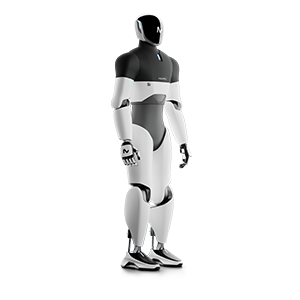
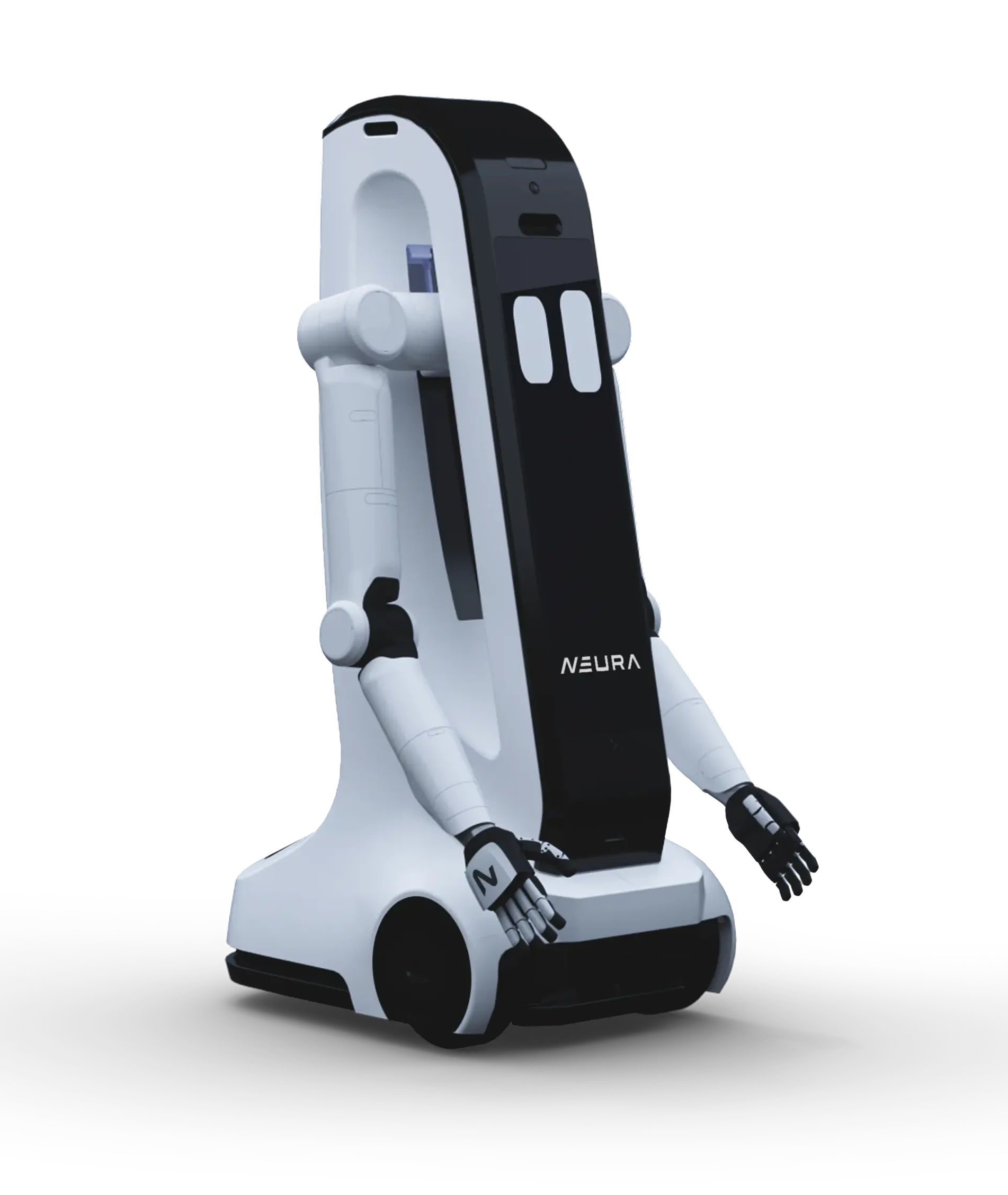
The 4NE1 is NEURA's flagship product and the primary focus of its Series C narrative. At 1.8 metres tall and approximately 80 kilograms, it sits within the physical envelope of a large adult human 27. The claimed 100 kilogram lift capacity is, if accurate, the highest among general-purpose humanoids currently on the market — a figure cited by at least one community reviewer 27. The robot incorporates what NEURA terms "artificial skin" — a sensor layer designed to detect pre-impact contact and trigger adaptive safe motion responses 2427. This is a meaningful safety differentiator if it performs as described, because it addresses one of the core barriers to cage-free human-robot collaboration: the inability of conventional robots to sense impending contact before it becomes a collision.
The compute architecture is built around NVIDIA's Isaac GR00T platform and a Thor T5000 processor, with water cooling to manage thermal load 27. The use of water cooling in a mobile humanoid is an unusual engineering choice that implies high sustained compute load — consistent with the on-device AI claims — but also adds mechanical complexity and potential failure modes that air-cooled systems avoid. The robot was designed by Studio F.A. Porsche 27, and the visual result is a machine that reads as deliberately industrial rather than anthropomorphically uncanny — a sensible choice for factory-floor acceptance.
Pricing is approximately €98,000 for the industrial variant and €19,999 for a smaller "Mini" variant 27. Pre-orders are open with a €100 refundable deposit, with industrial deliveries targeted for late 2026 and Mini deliveries for April 2026 27. EDITORIAL INFERENCE: The refundable deposit structure is standard for pre-production hardware and does not constitute a firm order book. The late 2026 industrial delivery target is ambitious given that, as of the coverage date, no independent source has confirmed a production-ready unit in customer hands.
The company claims an order book exceeding $1 billion 9. This figure is unverified by any independent source and is reported solely on the basis of a company statement to Manufacturing Dive 9. It is not possible to determine from available evidence whether this represents binding purchase orders, letters of intent, or pipeline estimates.
MAiRA Cognitive Arm
MAiRA is presented as NEURA's most commercially mature product and carries the vendor claim of being "the world's first commercially available cognitive robot" 2. It is a 7-degrees-of-freedom arm available in three reach/payload configurations: Small (15–18 kg payload, 1100 mm reach), Medium (12–14 kg payload, 1400 mm reach), and Large (9–11 kg payload, 1600 mm reach) 2. It incorporates an IP65 ingress protection rating, a 6-DoF force-torque sensor, and dual encoders 2. These are credible industrial specifications — the dual encoder architecture in particular is a meaningful quality signal, as it provides redundant position feedback that improves both precision and safety.
The "world's first commercially available cognitive robot" claim is a COMPANY CLAIM that no independent source has verified 25. The definition of "cognitive" in this context is not standardised in the robotics literature, and the claim functions primarily as a marketing differentiator. What can be said with confidence is that MAiRA incorporates on-device AI processing and is designed for adaptive task execution — capabilities that go beyond traditional teach-and-repeat industrial arms. Whether this constitutes "cognition" in any meaningful technical sense is a matter of ongoing academic debate.
Pricing for MAiRA is not publicly disclosed [UNKNOWN]. This is a notable gap for a product claimed to be commercially available: the absence of list pricing either indicates that sales are conducted through direct negotiation (common for industrial capital equipment) or that the product is not yet in volume commercial supply.
LARA Collaborative Arm
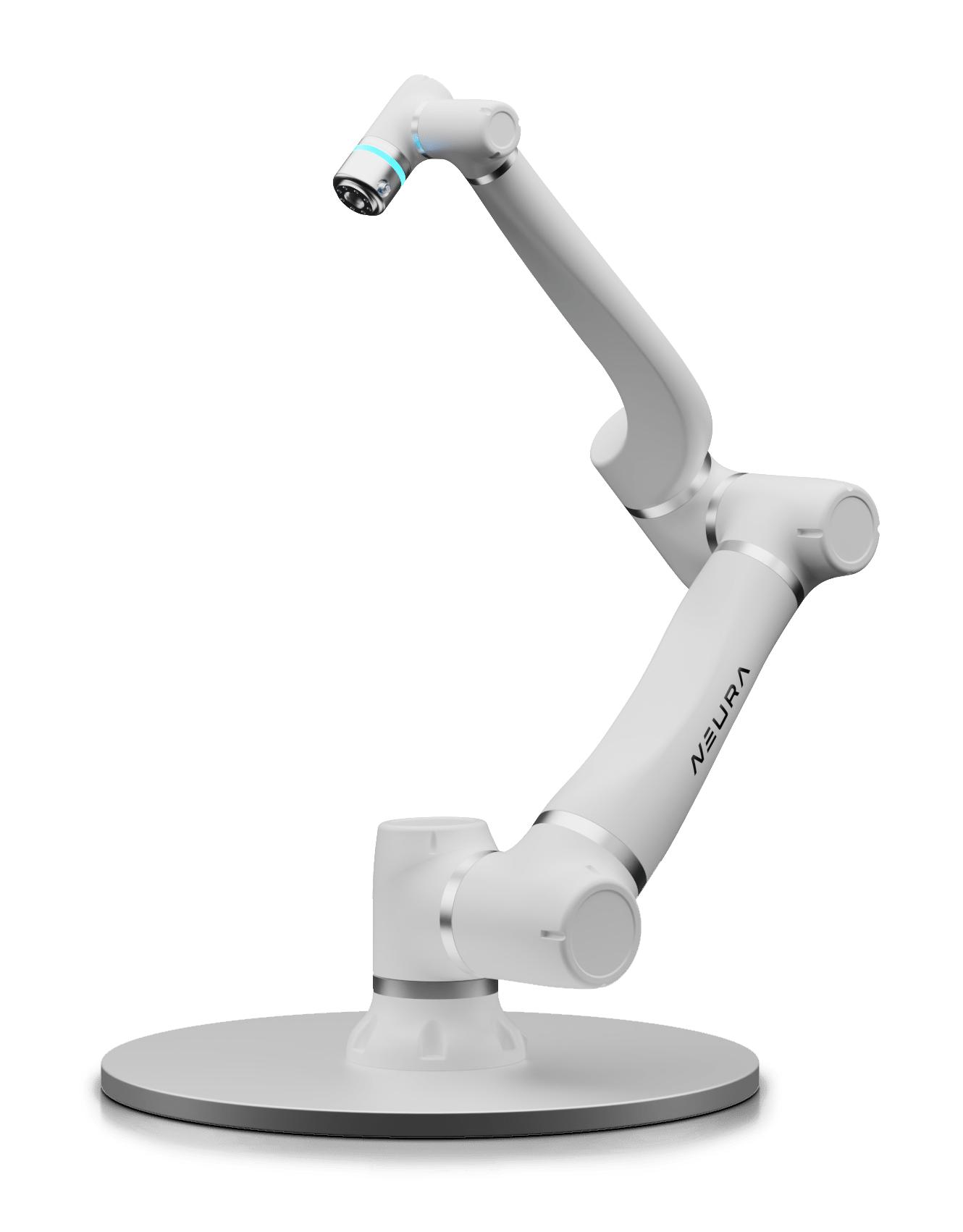
LARA is a more conventional collaborative robot arm series, available in nine variants spanning 3 to 30 kilograms payload and 590 to 1800 millimetres reach 3. Its ±0.02 mm precision specification is competitive with leading cobot vendors. The safety certifications — PLd Category 3 under ISO 13849-1 and SIL2 — are VERIFIED via the official product page 3 and represent genuine third-party validation of the safety architecture. These certifications are not trivial to obtain and signal that LARA has undergone formal functional safety assessment.
IP54 and IP66 ratings across the range indicate suitability for environments with dust and water ingress — relevant for food processing, pharmaceutical, and outdoor industrial applications 3. LARA appears to be the product line most likely to be in actual commercial deployment given its conventional architecture and certified safety profile, but independent confirmation of customer deployments remains absent from the dossier.
MAV Autonomous Mobile Vehicle
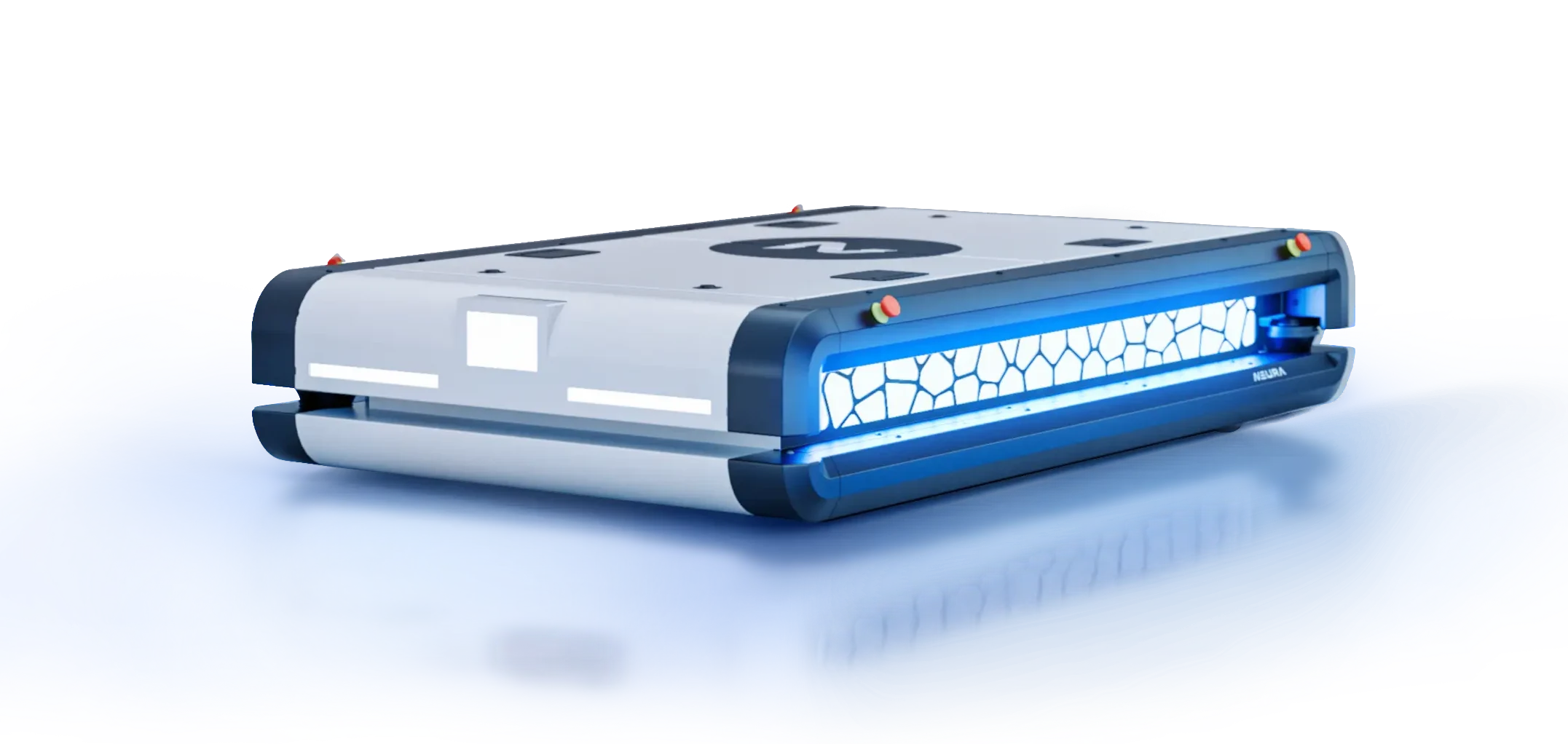
The MAV series covers three variants: MAV 500 (500 kg payload), MAV 1500 (1500 kg payload), and MAV+ (500–1000 kg payload), all operating at 1.5 m/s with ±5–7 mm positioning accuracy 4. The use of 360-degree laser scanners and route-free navigation — meaning the vehicle does not require pre-programmed fixed paths — is consistent with current-generation autonomous mobile robot (AMR) technology from vendors such as MiR, Fetch, and Geek+ 4. The PLd Category 3 safety certification under ISO 13849-1 is VERIFIED via the official product page 4 and is the same standard applied to the LARA arm.
The MAV is arguably the most technically conventional product in the NEURA portfolio — route-free laser-scanner AMRs are an established product category with multiple mature vendors — and therefore the most plausible candidate for near-term commercial deployment. The differentiation NEURA claims is integration with the AURA AI platform for fleet-level coordination and learning, but this claim is unverified at scale.
MiPA Consumer Robot
MiPA is a wheeled consumer robot incorporating a camera array with infrared, ultrasonic, and lidar sensors 112. Pricing is not publicly disclosed [UNKNOWN]. The consumer robotics market is exceptionally difficult — iRobot's trajectory with Roomba illustrates the margin pressure even for category-defining products — and MiPA appears to be a secondary priority relative to the industrial portfolio. The dossier contains limited detail on MiPA's capabilities, target use cases, or commercial status.
AURA AI Platform
Across all products, NEURA claims a unifying AI platform called AURA, described as incorporating a perception-language-action model, reinforcement learning, multimodal AI, and on-device neural processing without cloud dependency 15. The company also describes a "NeuraVerse" shared intelligence ecosystem enabling continuous learning and collaboration across deployed robots 510, and "NEURA Gyms" — real-world robot training facilities planned for rollout 5. These are COMPANY CLAIMS. The perception-language-action model architecture is consistent with current academic and industry research directions (see §4 and §5), but the specific capabilities of AURA, its performance benchmarks, and its comparison to competing platforms such as NVIDIA Isaac GR00T's native software stack or 1X's EVE platform have not been independently assessed.
Products & versions
04Technology Stack: Strengths and the Work That Remains
Compute Architecture
The 4NE1's compute backbone — NVIDIA Isaac GR00T on a Thor T5000 processor with water cooling 27 — reflects a deliberate alignment with NVIDIA's physical AI ecosystem. Isaac GR00T is NVIDIA's foundation model framework for humanoid robots, providing pre-trained sensorimotor policies that can be fine-tuned for specific tasks. The Thor T5000 is a high-performance system-on-chip designed for robotics and autonomous vehicle applications. This is a credible and well-resourced compute stack, and the NVIDIA investor relationship 5 likely provides preferential access to hardware and software development resources.
The water-cooling choice deserves scrutiny. Mobile humanoids operating in industrial environments will encounter vibration, orientation changes, and potential impacts. Water-cooling loops introduce leak risk, pump failure modes, and weight penalties that air-cooled or phase-change thermal management systems avoid. EDITORIAL INFERENCE: The water-cooling architecture suggests that NEURA has prioritised sustained compute performance over mechanical simplicity in the current generation — a reasonable engineering trade-off for a development platform, but one that may require revision for volume production.
The MAiRA and LARA arms, and the MAV vehicles, are described as incorporating on-device neural processing 234. The specific chip architectures for these products are not disclosed in the dossier. UNKNOWN. The Qualcomm investor relationship 5 suggests possible use of Qualcomm's Robotics RB-series or AI 100 inference accelerators, but this is EDITORIAL INFERENCE without documentary support.
Artificial Skin and Safety Architecture
The artificial skin system described for the 4NE1 2427 — a sensor layer enabling pre-impact contact detection, contact classification, and adaptive safe motion envelope adjustment — is the most technically distinctive claimed feature in the portfolio. Pre-impact sensing (as opposed to post-contact force limiting) addresses a genuine gap in current collaborative robot safety: most cobots detect contact only after it has occurred, relying on force-torque thresholds to limit injury. A system that detects the approach of a human limb before contact and adjusts trajectory accordingly would represent a meaningful advance.
The 77 patents cited in the dossier include a granted patent on OmniSensor multi-axis force determination 2325, which is consistent with this safety architecture. A granted patent is VERIFIED as a legal fact; it does not verify that the described technology performs as claimed in operational conditions.
EDITORIAL INFERENCE: The artificial skin concept is scientifically grounded — capacitive and resistive sensor arrays for robot surface coverage have been an active research area for over a decade — but the engineering challenge of covering a full humanoid body with a reliable, durable, and computationally tractable sensor skin at production cost is substantial. No independent test data on the system's performance, coverage area, detection latency, or false-positive rate is available.
AURA: The AI Platform Claims
NEURA's AURA platform is described as a perception-language-action (PLA) model — a class of architecture that takes multimodal sensory inputs (vision, proprioception, language instructions) and outputs motor actions 15. This is consistent with the direction of leading academic and industry research, including work from Google DeepMind (RT-2), Stanford (Mobile ALOHA), and Carnegie Mellon (ACT). The claim of on-device inference without cloud dependency 1 is technically plausible given the Thor T5000 compute capacity, but the trade-off between model size, inference latency, and task performance at the edge has not been independently benchmarked.
The NeuraVerse shared intelligence concept — where deployed robots contribute to a shared learning pool 510 — mirrors federated learning architectures that have been explored in academic settings. The practical implementation challenges are significant: data quality from heterogeneous deployments, privacy and IP concerns from industrial customers, and the latency of policy updates across a fleet all require careful engineering. These challenges are not insurmountable, but they are non-trivial, and NEURA has not published technical documentation that would allow independent assessment of how they are addressed.
Reinforcement Learning and Inverse Kinematics
The dossier includes four academic papers in its research section 13141516, though their direct connection to NEURA's internal research programme is not established. The papers cover multi-robot arm coordination via reinforcement learning 13, machine learning-based inverse kinematics for redundant manipulators 14, and mobile robotics education 16. These are relevant research areas for NEURA's product lines, but the papers do not appear to be authored by NEURA employees or to describe NEURA-specific systems. See §5 for detailed analysis.
Force-Torque Sensing and Precision
The MAiRA arm's 6-DoF force-torque sensor 2 and the LARA arm's ±0.02 mm precision specification 3 are competitive with leading cobot vendors. ATI Industrial Automation's force-torque sensors, which are widely used in the industry, provide comparable multi-axis measurement. The dual encoder architecture on MAiRA 2 is a meaningful quality signal: dual encoders allow the system to detect discrepancies between commanded and actual joint positions, improving both precision and fault detection.
The Work That Remains
The following gaps represent the most significant engineering challenges between NEURA's current state and its stated ambitions:
Full-body dexterous manipulation at scale. The 4NE1's hands and finger dexterity specifications are not detailed in the dossier. UNKNOWN. Dexterous manipulation — grasping irregular objects, assembling small components, handling flexible materials — remains one of the hardest open problems in robotics and is not solved by any vendor at production scale.
Generalisation across unstructured environments. The AURA PLA model's ability to generalise from training environments to novel industrial settings has not been independently tested. The gap between laboratory demonstration and factory-floor robustness is where most robotics programmes encounter their most expensive surprises.
Battery life and energy density. Runtime per charge for the 4NE1 is not disclosed in the dossier. UNKNOWN. For an 80 kg robot with high-performance compute and water cooling, energy consumption will be substantial, and battery life is a critical operational parameter for industrial deployment.
Production cost and yield. At €98,000 per unit, the 4NE1 is priced at a level that implies either significant margin or significant cost — or both. The bill of materials for a humanoid with artificial skin, water cooling, and high-performance compute is not trivial, and achieving consistent manufacturing yield at scale is an engineering challenge that is separate from the robotics engineering challenge.
05Research, Papers, Authors and Labs
The research dossier contains four academic papers associated with NEURA Robotics' coverage 13141516. It is important to establish at the outset what these papers do and do not represent.
Paper-by-Paper Analysis
[13] An Efficient Multi-Robot Arm Coordination Strategy for Pick-and-Place Tasks using Reinforcement Learning (arXiv:2409.13511, 2024). This paper addresses the coordination of multiple robotic arms on shared pick-and-place tasks using reinforcement learning — directly relevant to NEURA's MAiRA and LARA product lines and to the NeuraVerse shared learning concept. However, the paper's authorship and institutional affiliation are not confirmed as NEURA-internal in the dossier. UNKNOWN whether this represents NEURA research or external academic work included for thematic relevance. The reinforcement learning approach described is consistent with NEURA's stated AURA methodology but cannot be attributed to NEURA without author confirmation.
[14] Machine Learning-based Framework for Optimally Solving the Analytical Inverse Kinematics for Redundant Manipulators (arXiv:2211.04275, 2022). Inverse kinematics for redundant manipulators — arms with more degrees of freedom than strictly required for a given task, such as MAiRA's 7-DoF configuration — is a classical robotics problem with practical implications for motion planning efficiency. A machine learning approach to IK solution is relevant to NEURA's arm products. Again, authorship affiliation with NEURA is not confirmed. UNKNOWN.
[15] arXiv:2210.17138 (2022). The title and full content of this paper are not described in the dossier beyond the URL. UNKNOWN. It cannot be meaningfully analysed without access to the full text and author information.
[16] RHINO-VR Experience: Teaching Mobile Robotics Concepts in an Interactive Museum Exhibit (arXiv:2403.15151, 2024). This paper describes a virtual reality educational exhibit for mobile robotics concepts. Its connection to NEURA's commercial or research programme is unclear. EDITORIAL INFERENCE: This paper was likely included in the dossier due to keyword overlap with mobile robotics rather than direct relevance to NEURA's technology development.
Assessment of Research Depth
The honest assessment is that the available dossier does not establish a strong independent research publication record for NEURA Robotics. This is not unusual for a company at NEURA's stage — many hardware robotics companies publish minimally in peer-reviewed venues, preferring to protect IP through patents and trade secrets rather than academic disclosure. NEURA's 77 patents 2325, including the granted OmniSensor patent, represent a more direct indicator of its research output than the academic papers in the dossier.
The absence of published benchmarks, ablation studies, or technical white papers on AURA's performance is a gap that matters for enterprise customers conducting due diligence. Industrial buyers of €98,000 robots need more than demonstration videos and press releases to justify procurement decisions; they need reproducible performance data. NEURA has not, as of the coverage date, published such data in any publicly accessible form.
Relevant External Research Context
The research areas most relevant to NEURA's technology claims — perception-language-action models, whole-body contact sensing, reinforcement learning for manipulation, and federated robot learning — are active fields with significant publication activity from academic groups at ETH Zurich, TU Munich, the German Research Center for Artificial Intelligence (DFKI), and industry labs at Google DeepMind, Microsoft Research, and Meta AI. NEURA's location in Baden-Württemberg places it within reasonable proximity to the Stuttgart and Tübingen university research ecosystems, and its Bosch and Schaeffler partnerships may provide access to applied research infrastructure. Whether NEURA is actively collaborating with these institutions is not documented in the dossier. UNKNOWN.
<!-- module: papers --> <!-- module: authors-labs --> <!-- module: repos --> <!-- module: datasets -->06Media Evidence Library: What the Videos Prove
The dossier contains six video sources 171819202122. Applying the evidence discipline stated in the preface — a choreographed demonstration video is not proof of autonomous operation — the following analysis assesses what each video actually establishes.
Video-by-Video Assessment
| Source | Format | What It Shows | What It Proves | What It Does Not Prove |
|---|---|---|---|---|
| 17 "I Spent a Week With a Humanoid Robot. Honest Truth!" | Long-form review (~community reviewer) | 4NE1 in controlled environment; reviewer interaction; spec walkthrough | Physical existence of a 4NE1 unit; basic mobility and interaction; reviewer's subjective assessment | Autonomous industrial operation; scalable production; customer deployment |
| 18 "Meet NEURA 4NE-1: Changing Our Homes in 2025" | Promotional/review | 4NE1 physical demonstration; feature highlights | Physical form factor; design quality | Autonomous home operation; 2025 availability (title appears aspirational) |
| 19 "AI that gets hands-on" (deutschland.de) | Government/editorial feature | NEURA technology overview; likely includes arm and humanoid footage | Institutional recognition by German government media | Technical performance; deployment at scale |
| 20 "Is This $1.4B Robotics Bet About to Change Everything?" | Commentary/analysis video | Series C funding discussion; product footage | Funding announcement context | Technology validation; commercial traction |
| 21 "NEURA Robotics Just Raised the Largest Funding Round in Robotics History!" | YouTube Short | Funding reaction content | Funding announcement awareness | Any technical or commercial claim |
| 22 "NEURA Robotics Just Raised $1.4 BILLION!" | YouTube Short | Funding reaction content | Funding announcement awareness | Any technical or commercial claim |
What the Video Record Establishes
The most substantive video evidence comes from source 17 — a long-form community reviewer who claims to have spent a week with a 4NE1 unit. This is the closest available proxy to independent hardware assessment in the dossier. The reviewer's account provides specific pricing details (€98,000 industrial, €19,999 Mini) 27 and describes the compute architecture (NVIDIA Isaac GR00T, Thor T5000, water cooling) 27 with a level of specificity that suggests genuine access to the hardware or detailed technical briefing materials. The reviewer notes the robot as "impressive but with notable limitations most hype videos ignore" 25 — a characterisation that is consistent with the general pattern of first-generation humanoid hardware: capable in controlled conditions, with significant gaps in robustness and generalisation.
The deutschland.de video 19 is notable as an indicator of institutional recognition — Germany's official international media platform covering NEURA signals that the company has achieved a level of domestic credibility that goes beyond startup press releases. This is a soft signal of legitimacy, not a technical validation.
What the Video Record Does Not Establish
None of the six videos in the dossier shows:
- Autonomous operation in an uncontrolled industrial environment without human supervision or choreography
- A named industrial customer operating NEURA equipment in production
- Sustained multi-hour or multi-shift operation under real workload conditions
- Failure modes, error recovery, or edge-case handling
- Comparative performance against competing systems under controlled conditions
EDITORIAL INFERENCE: The video evidence is consistent with a company that has working hardware prototypes and pre-production units capable of impressive demonstrations in controlled settings. It is not consistent with — and does not support — claims of production-ready autonomous industrial operation at scale. This gap between demonstration capability and deployment readiness is normal for a company at NEURA's stage; the concern is that the company's public communications do not always make this distinction clearly.
Media library
07Commercial Reality
Revenue and Order Book
NEURA Robotics' revenue is not publicly disclosed. UNKNOWN. The company is privately held and has not filed public financial statements accessible in the dossier. The only commercial traction figure in the public record is the company's own claim of an order book exceeding $1 billion, reported by Manufacturing Dive on the basis of a company statement 9. This figure has not been independently verified, and its composition — binding purchase orders versus letters of intent versus pipeline estimates — is not disclosed.
EDITORIAL INFERENCE: A $1 billion order book claim from a company with no publicly confirmed customer deployments and a primary product (4NE1) not yet in production delivery warrants significant scepticism. It is not impossible — large industrial companies routinely place forward orders for capital equipment ahead of production readiness — but without named customers, order terms, or independent confirmation, this figure cannot be treated as a reliable indicator of commercial traction.
Named Customers
No named customer has publicly confirmed a deployment of any NEURA product in the available dossier. This is the single most important commercial gap in the NEURA story. Community analysts explicitly note the absence of validated scaled commercial deployments 2526. The distinction between a strategic investor (Bosch, Schaeffler, Kawasaki) and a paying customer is critical and is not established in the available evidence.
EDITORIAL INFERENCE: Bosch, Schaeffler, and Kawasaki's investor status creates a plausible pathway to early customer relationships — these companies have manufacturing operations that could serve as pilot deployment sites — but investor relationships do not automatically translate to commercial procurement. The terms of these relationships are not publicly disclosed.
Pricing Architecture
The pricing structure that is available in the dossier reveals a deliberate market segmentation strategy:
| Product | Price | Target Segment |
|---|---|---|
| 4NE1 Industrial | ~€98,000 | Large industrial manufacturers |
| 4NE1 Mini | ~€19,999 | SME / research / prosumer |
| MAiRA | Not disclosed | Industrial (direct sales) |
08Markets and Use Cases
NEURA Robotics has articulated a market strategy that spans three distinct deployment horizons: near-term industrial automation, medium-term logistics and warehousing, and longer-term consumer and eldercare applications. The credibility of each horizon varies considerably, and it is worth examining them separately rather than treating the company's total addressable market framing as a single coherent claim.
Industrial Manufacturing — The Credible Near Term
The most defensible commercial territory for NEURA's current product portfolio is industrial manufacturing, specifically the kind of semi-structured, mixed-task environments where fixed automation is economically impractical. The LARA collaborative arm family, with nine variants spanning 3 to 30 kg payload and 590 to 1800 mm reach, certified to PLd Category 3 and SIL2 safety standards 3, addresses a well-understood market segment already served by Universal Robots, FANUC, and Kuka. The MAiRA cognitive arm, with its 7-DoF architecture, integrated 6-DoF force-torque sensing, and IP65 rating 2, is positioned at the higher end of collaborative robotics where dexterity and adaptability matter more than raw throughput.
The strategic partnerships with Bosch, Schaeffler, and Kawasaki 5 are relevant here: these are industrial companies with genuine manufacturing floor requirements, not merely financial investors. Whether those partnerships translate into volume purchase orders remains undisclosed, but the industrial credibility of the investor base is a meaningful signal that the product roadmap is at least being evaluated against real factory requirements.
The 4NE1 humanoid, priced at approximately €98,000 per unit 27, targets industrial assembly, quality inspection, and material handling tasks that currently require human workers. At that price point, the economics are plausible for high-value manufacturing lines where labour costs are substantial and task variability is high — automotive final assembly, electronics manufacturing, and pharmaceutical packaging are the canonical examples. However, the economics only close if the robot operates reliably and autonomously for a significant fraction of a working shift. That threshold has not been independently validated.
Logistics and Warehousing — A Contested Middle Ground
The MAV autonomous mobile vehicle range — with payload capacities of 500 kg and 1500 kg, route-free laser-scanner navigation, and PLd/Category 3 certification 4 — competes in a market that is already well-served by established players including MiR, Omron, and Fetch Robotics. The MAV's certified safety architecture and stated accuracy of ±5 to 7 mm are consistent with industrial AMR specifications, and this is the segment of NEURA's portfolio where autonomous task execution is most technically plausible given the relative maturity of AMR navigation technology.
The partnership with Omron 25 is notable in this context: Omron is itself a significant AMR manufacturer, which raises the question of whether the relationship is genuinely complementary or potentially competitive. The dossier does not clarify the commercial terms of that partnership.
For humanoid-based logistics — the vision of a 4NE1 unit picking, sorting, and palletising in a warehouse — the timeline is considerably less certain. The 100 kg lift capacity claim 27 is striking if accurate, but lift capacity in a controlled demonstration and reliable manipulation in an unstructured warehouse environment are categorically different capabilities. No independent evidence of warehouse deployment has been documented.
Consumer and Eldercare — The Long Horizon
The MiPA wheeled consumer robot and the longer-term vision of the 4NE1 Mini (priced at approximately €19,999 27) represent NEURA's consumer ambitions. The eldercare and domestic assistance narrative — a robot that can assist ageing populations in Germany and across Europe — is compelling from a demographic standpoint. Germany's old-age dependency ratio is rising steadily, and the political appetite for technological solutions to care workforce shortages is genuine.
However, the gap between a €19,999 consumer robot and reliable, safe, autonomous domestic assistance is enormous. The regulatory environment for robots operating in uncontrolled domestic environments is substantially more demanding than for industrial settings. The MiPA's sensor array (camera, infrared, ultrasonic, lidar 12) is appropriate for navigation, but domestic manipulation — the tasks that would actually reduce care burden — requires a level of dexterous autonomy that no company has demonstrated at scale in unstructured home environments.
EDITORIAL INFERENCE: The consumer horizon is best understood as a strategic positioning exercise and a long-term option on a market that may materialise in the 2030s, rather than a near-term revenue driver. It is not a basis for current valuation.
Sector Prioritisation Table
| Market Segment | Current Product Fit | Autonomy Readiness | Independent Evidence | Timeline Credibility |
|---|---|---|---|---|
| Industrial manufacturing (arms) | High (LARA, MAiRA) | Partial (certified safety, unverified at scale) | Absent | Near-term plausible |
| Industrial manufacturing (humanoid) | Medium (4NE1) | Low (pre-production) | Absent | Late 2026 at earliest |
| Intralogistics / AMR | High (MAV) | Moderate (certified navigation) | Absent | Near-term plausible |
| Warehousing (humanoid) | Low-medium | Very low | Absent | 2027+ speculative |
| Consumer / eldercare | Low (MiPA, 4NE1 Mini) | Very low | Absent | 2028+ speculative |
The table reflects a consistent pattern: product-market fit is most credible where the technology is most mature and the regulatory pathway is clearest. The further one moves toward humanoid and consumer applications, the thinner the evidentiary base becomes.
The German Industrial Ecosystem Advantage
One genuine structural advantage NEURA possesses is its location within the German industrial ecosystem. Metzingen sits in Baden-Württemberg, one of the world's densest concentrations of precision manufacturing, automotive supply chain, and Mittelstand engineering companies. The proximity to Bosch, Schaeffler, and the broader Stuttgart automotive cluster means that pilot deployment opportunities — if the technology is ready — are geographically and commercially accessible in a way that would not be true for a company based in, say, a secondary European market. This is an editorial inference, but it is grounded in the observable geography of NEURA's investor and partner base.
09Competitive Landscape
NEURA Robotics competes across three distinct product categories simultaneously — collaborative arms, autonomous mobile robots, and humanoid robots — which means its competitive set is unusually broad. This multi-front strategy is either a sign of genuine platform ambition or a sign of strategic overextension; the evidence does not yet resolve that question definitively.
Humanoid Robot Competitors
The humanoid segment is the most heavily contested and most heavily funded area of robotics in 2025-2026. The principal competitors are:
| Company | Country | Lead Product | Price (approx.) | Deployment Status | Key Backer |
|---|---|---|---|---|---|
| Figure AI | USA | Figure 02 | Undisclosed | BMW pilot (reported) | OpenAI, Microsoft, Nvidia |
| Agility Robotics | USA | Digit | ~$250,000 | Amazon warehouse pilots | Amazon |
| Boston Dynamics | USA | Atlas (electric) | Undisclosed | Hyundai internal | Hyundai |
| 1X Technologies | Norway | NEO | Undisclosed | Pre-production | OpenAI |
| Apptronik | USA | Apollo | Undisclosed | GXO pilot | NASA, Google |
| Unitree Robotics | China | H1 / G1 | $16,000–$90,000 | Research/developer sales | — |
| Fourier Intelligence | China | GR-1 | ~$58,000 | Limited commercial | — |
| NEURA Robotics | Germany | 4NE1 | ~€98,000 | Pre-orders, late 2026 target | Nvidia, Amazon, Bosch |
Several observations follow from this comparison. First, NEURA's €98,000 price point for the 4NE1 industrial unit sits in the middle of the disclosed price range — more expensive than Unitree's G1 but less than Agility's Digit. Second, NEURA's claimed 100 kg lift capacity 27 is, if accurate, a genuine differentiator; most competitors in this class are rated for 5 to 25 kg payloads. Third, NEURA is the only European company in this list with a credible funding base and a disclosed product roadmap, which gives it a structural advantage in accessing European industrial customers who may prefer a local supplier for regulatory, data sovereignty, and supply chain reasons.
The competitive moat rating of NARROW assigned by the independent analyst 25 reflects the reality that NEURA's technology advantages — sensor skin, AURA AI platform, high payload — are not yet validated at scale and could be replicated or surpassed by better-resourced American or Chinese competitors before NEURA achieves volume production.
Collaborative Arm Competitors
In the collaborative arm segment, NEURA faces a mature and well-capitalised competitive set:
| Company | Lead Product | Payload Range | Key Differentiator |
|---|---|---|---|
| Universal Robots (Teradyne) | UR3e–UR20 | 3–20 kg | Market share, ecosystem, ease of integration |
| FANUC | CRX series | 5–25 kg | Reliability, industrial integration |
| Kuka (Midea) | LBR iisy | 3–15 kg | German engineering, automotive heritage |
| ABB | GoFa / SWIFTI | 5–10 kg | Safety certification, global service |
| NEURA Robotics | MAiRA / LARA | 3–30 kg | Cognitive AI, force-torque sensing, IP65 |
The MAiRA's claim to be the "world's first commercially available cognitive robot" 2 is an unverified marketing superlative, as noted in the dossier conflicts. Universal Robots and FANUC both offer arms with integrated vision and force sensing that could reasonably be described as having cognitive elements. The meaningful differentiator, if it can be validated, is the depth of on-device AI inference and the AURA platform's claimed ability to adapt task execution without reprogramming. That claim has not been independently verified.
AMR Competitors
The MAV competes in a crowded AMR market:
| Company | Product | Max Payload | Navigation | Certification |
|---|---|---|---|---|
| Mobile Industrial Robots (MiR) | MiR1350 | 1350 kg | Laser SLAM | CE, UL |
| Omron | HD-1500 | 1500 kg | Laser SLAM | CE, UL |
| Fetch Robotics (Zebra) | CartConnect | 450 kg | Laser SLAM | CE |
| NEURA Robotics | MAV 1500 | 1500 kg | 360° laser, route-free | PLd Cat. 3 |
The MAV 1500's PLd Category 3 certification 4 is a genuine technical credential, and the route-free navigation claim is consistent with modern laser SLAM approaches. However, MiR and Omron have years of validated field deployments, established service networks, and integration ecosystems that NEURA cannot yet match. The Omron partnership 25 may be an attempt to access that ecosystem rather than compete with it directly — but the commercial terms remain undisclosed.
The China Factor
Chinese humanoid robotics companies — Unitree, Fourier, UBTECH, and a growing cohort of well-funded startups — represent a structural competitive threat that is worth treating separately. Chinese manufacturers benefit from lower labour costs, integrated supply chains for motors and sensors, and aggressive government support. Unitree's G1, priced at approximately $16,000, demonstrates that the cost floor for capable humanoid platforms is falling rapidly. If Chinese manufacturers achieve comparable cognitive capability at a fraction of NEURA's price point, the European premium positioning becomes difficult to sustain. Geopolitical factors (discussed in §10) may provide some protection, but they are not a substitute for cost competitiveness.
Competitive comparison
| Robot | Maker | Autonomy | Conf. |
|---|---|---|---|
| iRobot Roomba Combo 10 Max | iRobot | Autonomous | 0.90 |
| Mobile ALOHA (Stanford) | Stanford University | Teleoperated | 0.90 |
| 1X NEO | 1X Technologies | Remote-Assisted | 0.90 |
10Geopolitical Context and Constraints
NEURA Robotics operates at the intersection of several significant geopolitical currents, each of which shapes both its opportunities and its constraints.
European Industrial Policy and Sovereign Technology
The European Union's strategic anxiety about technological dependence on the United States and China is a genuine tailwind for a European humanoid robotics company. The European Investment Bank's participation in the Series C 5 is not merely a financial signal; it reflects a policy preference for building European capability in physical AI rather than importing it. Germany's federal government has been explicit about the strategic importance of robotics and AI to the country's industrial base, and Baden-Württemberg's state government has historically been supportive of advanced manufacturing technology investment.
The EU AI Act, which entered into force in August 2024, creates a regulatory framework that will affect how autonomous robots are classified, tested, and deployed. Robots operating in close proximity to humans in industrial settings are likely to fall under high-risk AI system requirements, which mandate conformity assessments, technical documentation, and human oversight mechanisms. NEURA's existing safety certifications (PLd Category 3, SIL2) are relevant but not sufficient; the AI Act imposes additional obligations on the AI systems themselves, not just the mechanical safety architecture. This is a compliance burden that falls equally on all competitors operating in the European market, but NEURA, as a European company, may be better positioned to navigate it than American or Chinese competitors.
The Tether Holdings Dimension
The lead investor in the Series C is Tether Holdings, the company behind the USDT stablecoin 56. This is an unusual choice of lead investor for an industrial robotics company, and it introduces a dimension of reputational and regulatory risk that deserves explicit attention.
Tether has faced sustained scrutiny over the adequacy of its dollar reserves, the transparency of its auditing, and its exposure to regulatory action in multiple jurisdictions. The reported integration of a Tether Wallet Development Kit enabling robot digital wallets for autonomous payments 11 adds a layer of complexity: it is either a genuinely novel capability for machine-to-machine commerce, or a mechanism for deepening the financial entanglement between NEURA's robots and Tether's stablecoin ecosystem. No independent analysis of the commercial rationale for this integration has been published.
From a geopolitical risk perspective, if Tether were to face significant regulatory action in the United States or European Union — both of which have active stablecoin regulatory processes — the implications for NEURA's funding stability and the robot payment infrastructure would be non-trivial. This is not a prediction, but it is a material risk that any serious investor or customer due diligence process should address.
The NVIDIA and Amazon Dimension
The participation of NVIDIA and Amazon as strategic investors 56 creates a different kind of geopolitical consideration. Both companies are American, subject to US export controls, and operating in a technology sector that is increasingly subject to national security review. The NVIDIA Isaac GR00T platform and Thor T5000 processor that reportedly power the 4NE1 27 are American technology. If US-China technology tensions escalate further, or if export control regimes are tightened to cover advanced robotics compute, NEURA's supply chain could be affected — not because NEURA is a Chinese company, but because its compute dependency on American silicon creates a potential chokepoint.
Conversely, the NVIDIA and Amazon relationships provide access to cloud infrastructure, AI training resources, and distribution networks that would be difficult to replicate independently. The net geopolitical effect is probably positive for NEURA in the near term, but the dependency is worth monitoring.
German Export Controls and Dual-Use Considerations
Advanced humanoid robots with high payload capacity, sophisticated sensing, and autonomous navigation capability are plausibly subject to dual-use export control considerations under EU regulations. A robot capable of lifting 100 kg, navigating autonomously, and executing complex manipulation tasks could have non-civilian applications. NEURA has not publicly addressed this dimension, and the dossier contains no information about export control compliance frameworks. This is an UNKNOWN that becomes increasingly relevant as the company scales internationally.
The China Market Question
NEURA has not publicly disclosed any strategy for the Chinese market, which is simultaneously the world's largest manufacturing economy and the home of its most aggressive humanoid robotics competitors. Entering China would expose NEURA's IP to significant risk; not entering China cedes the world's largest potential deployment market to domestic competitors. This is a strategic dilemma that NEURA will need to resolve explicitly as it scales, and the answer is not obvious.
11The Hype, the Real and the Ugly
The gap between NEURA Robotics' public narrative and the independently verifiable evidence is wide enough to warrant systematic examination. This section does not argue that NEURA is fraudulent or that its technology is without merit. It argues that the company's communications consistently present aspirational claims as established facts, and that investors, customers, and analysts should apply significant discounting to the vendor narrative.
The Hype: Claims That Outrun the Evidence
"Europe's first production-ready humanoid robot" 1 — This claim appears on NEURA's website and has been repeated in press coverage. It is not supported by independent evidence. Pre-orders with a €100 refundable deposit and a target shipping date of late 2026 do not constitute production readiness. Production readiness, in any rigorous engineering or manufacturing sense, requires demonstrated manufacturing yield, validated reliability over extended operational periods, and a service and support infrastructure capable of maintaining deployed units. None of these have been independently verified 26.
"World's first commercially available cognitive robot" 2 — This claim for MAiRA is an unverified marketing superlative. The definition of "cognitive robot" is not standardised, and multiple competitors offer arms with integrated AI, vision, and force sensing that could plausibly claim the same descriptor. No independent body has validated this claim.
"Over $1 billion orderbook" 9 — Reported by Manufacturing Dive citing a company statement. An orderbook figure from a company with no disclosed revenue, no named customers, and no independently verified deployments should be treated with considerable caution. The distinction between a signed purchase order, a letter of intent, a memorandum of understanding, and a pre-order deposit is commercially significant, and NEURA has not clarified the composition of this figure.
"Multi-million robots by 2030" 5 — This deployment target from the official press release is a projection with no disclosed manufacturing capacity, supply chain, or financial model to support it. For context, the entire global humanoid robot installed base in 2025 is measured in the hundreds, not millions. Reaching millions by 2030 would require a rate of scale-up that has no precedent in the history of complex electromechanical systems.
"Fully autonomous reaction" and "no cloud dependency" 25 — These claims for the AURA platform are technically specific and therefore testable in principle, but no independent test has been published. On-device inference without cloud dependency is a meaningful architectural choice, but it does not by itself constitute full autonomy in unstructured environments.
The Real: What the Evidence Actually Supports
The following claims are supported by credible independent evidence or are technically plausible given the disclosed specifications:
The LARA and MAiRA arm specifications — payload, reach, safety certification — are drawn from official product pages 23 and are consistent with the stated certifications. PLd Category 3 and SIL2 are real, auditable standards, and claiming them falsely would expose the company to significant legal liability.
The MAV's route-free laser navigation and PLd/Category 3 certification 4 are consistent with the technical state of the art in AMR navigation and represent a credible product offering in a well-understood market.
The Series C funding of up to $1.4 billion, led by Tether with participation from NVIDIA, Amazon, Bosch, and others, is confirmed by multiple independent news sources 678910. The milestone-contingency qualification (per CNBC 6) is important but does not negate the significance of the round.
The 4NE1's design by Studio F.A. Porsche 27 and its use of NVIDIA Isaac GR00T and Thor T5000 compute 27 are plausible given the disclosed partnerships and are consistent with the product's positioning.
The 77 patents including a granted patent on OmniSensor multi-axis force determination 25 represent genuine IP activity, though patent counts are a weak proxy for competitive moat.
The Ugly: Structural Concerns
Revenue opacity — NEURA has raised at least $281 million prior to the Series C 25 and is now raising up to $1.4 billion more. It has not disclosed revenue figures, customer names, or deployment volumes. For a company at this funding level and this valuation, the absence of disclosed revenue is unusual and warrants scrutiny. It is possible that revenue is genuinely early-stage and the company is pre-revenue or near-revenue; it is also possible that the revenue picture is more developed but strategically withheld. Either way, the opacity is a legitimate concern for anyone evaluating the company's commercial progress.
The Tether relationship — As discussed in §10, the choice of Tether Holdings as lead investor introduces reputational and regulatory risk that is not typical for an industrial robotics company. The robot digital wallet integration 11 deepens this entanglement. The commercial rationale has not been independently explained.
Demo-versus-deployment gap — The video evidence reviewed in §6 (discussed in the earlier sections of this report) shows capable demonstrations in controlled environments. The community reviewer who spent a week with the 4NE1 noted "impressive but with notable limitations most hype videos ignore" 17. This is the canonical pattern in robotics: demonstrations are optimised for visual impact, not for the edge cases, failure modes, and maintenance requirements that determine real-world utility. No independent party has published a systematic evaluation of NEURA's products under realistic operating conditions.
Milestone-contingent funding — The full $1.4 billion Series C is contingent on performance milestones 6. The specific milestones have not been disclosed. If the milestones are tied to deployment volumes or revenue targets, and if those targets are not met, the effective funding available to NEURA could be substantially less than the headline figure. This is a material uncertainty for anyone modelling the company's financial runway.
Claim-vs-Evidence Summary Table
| Claim | Source | Evidence Status | Editorial Assessment |
|---|---|---|---|
| Europe's first production-ready humanoid | NEURA 1 | COMPANY CLAIM | Unverified; pre-orders ≠ production-ready |
| World's first commercially available cognitive robot | NEURA 2 | COMPANY CLAIM | Unverified superlative; definition contested |
| Over $1 billion orderbook | NEURA via Manufacturing Dive 9 | COMPANY CLAIM | Composition undisclosed; treat with caution |
| Multi-million robots by 2030 | NEURA 5 | COMPANY CLAIM | No manufacturing capacity evidence |
| Full autonomy, no cloud dependency | NEURA 25 | COMPANY CLAIM | Architecturally plausible; unvalidated at scale |
| Up to $1.4B Series C | Multiple independent 678 | VERIFIED FACT | Milestone-contingency is a material qualification |
| LARA/MAiRA safety certifications | NEURA 23 | VERIFIED (auditable standard) | Credible; legally binding claim |
| MAV PLd Category 3 certification | NEURA 4 | VERIFIED (auditable standard) | Credible; legally binding claim |
| ~$7B valuation | CNBC anonymous source 6 | UNVERIFIED | Single anonymous source; treat as indicative |
| 100 kg lift capacity (4NE1) | Community reviewer 27 | COMPANY CLAIM (via reviewer) | Unverified in independent test |
| No scaled commercial deployments | Community analyst 26 | EDITORIAL INFERENCE | Best-supported independent assessment |
Claim tracker
The Series C headline is confirmed by the official press release and corroborated by multiple independent news outlets, though CNBC notes the full amount is milestone-contingent [5][6][9].
The $1 billion order book figure is cited by Manufacturing Dive but sourced solely from a company statement, with no independent verification of actual signed contracts or revenue [9].
This capability is reported by a news source in the context of the Tether investment, but it is a novel claim with no independent technical verification or real-world deployment evidence [8][11].
12Future Scenarios
The following scenarios are constructed from the available evidence and are intended to bracket the plausible range of outcomes over a three-to-five year horizon. They are editorial inferences, not predictions.
Scenario A: Successful Industrial Pivot (Probability: Moderate)
In this scenario, NEURA successfully delivers the first industrial 4NE1 units in late 2026, accumulates a small but growing base of named industrial customers in the German and broader European manufacturing sector, and demonstrates reliable autonomous operation in semi-structured factory environments. The LARA and MAiRA arms achieve meaningful commercial traction in the collaborative robotics market, and the MAV establishes a foothold in European intralogistics.
The conditions for this scenario include: milestone-contingent funding tranches being released on schedule, the AURA AI platform delivering on its claimed adaptability in real factory conditions, and the Bosch/Schaeffler/Kawasaki partnerships converting from strategic relationships into volume purchase commitments.
In this scenario, NEURA becomes a credible European alternative to American and Chinese humanoid robotics companies, with a defensible position in the premium industrial segment. Revenue grows to a scale that justifies a significant fraction of the current valuation, and a path to profitability becomes visible.
Scenario B: Arms-and-AMR Sustains, Humanoid Slips (Probability: Moderate-High)
In this scenario, the LARA, MAiRA, and MAV product lines achieve genuine commercial traction — they are the most technically mature products and address well-understood market needs — but the 4NE1 humanoid faces repeated delays, reliability issues, or customer hesitation. The humanoid shipping date slips from late 2026 into 2027 or beyond, and early deployments are limited to pilot programmes rather than volume orders.
This is arguably the most likely near-term outcome given the pattern of humanoid robotics development across the industry. It is not a failure scenario — a company that builds a credible European collaborative arm and AMR business on the back of $1.4 billion in funding would be a substantial industrial enterprise. But it would represent a significant gap between the current narrative (humanoid-first, cognitive robotics platform) and commercial reality.
Scenario C: Funding Shortfall and Strategic Reset (Probability: Low-Moderate)
In this scenario, the milestone-contingent tranches of the Series C are not fully released because deployment or revenue targets are not met. NEURA's burn rate — supporting approximately 478 employees 25, multiple product lines, and the planned NEURA Gyms training infrastructure 5 — creates financial pressure. The company is forced to narrow its product focus, defer the consumer MiPA and 4NE1 Mini, and potentially seek additional bridge funding or a strategic acquisition.
The conditions for this scenario include: the Tether Holdings relationship becoming a reputational liability, the humanoid market developing more slowly than projected, and Chinese competitors undercutting NEURA's pricing before it achieves volume manufacturing efficiency.
This scenario does not necessarily mean the company fails; it means the current strategic ambition is scaled back to match financial reality. A focused European collaborative robotics company built on the LARA/MAiRA/MAV foundation would be a viable business, even if it falls short of the "cognitive robotics platform" vision.
Scenario D: Acquisition by a Strategic Partner (Probability: Low-Moderate, Rising)
The combination of NVIDIA and Amazon as investors, a credible IP portfolio (77 patents), a European regulatory footprint, and a team with demonstrated humanoid robotics capability makes NEURA a plausible acquisition target. NVIDIA's interest in physical AI is explicit; Amazon's interest in warehouse automation is well-documented. A strategic acquisition at a premium to the current valuation would represent a successful outcome for early investors even if the company never achieves standalone profitability.
This scenario becomes more likely if Scenario B or C materialises — a company with strong technology but commercial execution challenges is a more attractive acquisition target than a fully independent competitor.
Scenario E: Breakout Scale (Probability: Low)
In this scenario, NEURA achieves the multi-million robot deployment target by 2030, the AURA platform establishes itself as the dominant European physical AI stack, and the company becomes a global humanoid robotics leader. This scenario requires a rate of technology maturation, manufacturing scale-up, and market adoption that has no precedent in the history of complex robotics systems. It is not impossible — the smartphone industry achieved comparable scale-up rates — but the analogy is imperfect because robots are mechanically complex, require maintenance, and operate in safety-critical environments.
This scenario is included for completeness, not because the evidence supports it as a likely outcome.
13What to Watch: A Live Monitoring Checklist
The following indicators are the most informative signals for tracking NEURA Robotics' progress against its stated ambitions. They are organised by category and time horizon.
Commercial Validation (Highest Priority)
- First named industrial customer publicly confirmed for 4NE1 deployment, with disclosed use case and unit volume. A named customer with a verifiable deployment is categorically more informative than any number of pre-order announcements.
- Disclosed revenue figures, even approximate ranges, in any investor communication, regulatory filing, or credible press report. The current revenue opacity is the single largest gap in the public evidence base.
- Conversion rate of the reported $1 billion orderbook into executed purchase orders with disclosed delivery schedules. The composition of the orderbook (purchase orders vs. letters of intent vs. pre-order deposits) is a critical unknown.
- Any independent third-party assessment of LARA or MAiRA performance in a production environment — academic papers, industry analyst reports, or customer case studies with verifiable operational data.
Technology Milestones
- Publication of peer-reviewed research on the AURA platform, the OmniSensor, or the 4NE1's manipulation capabilities. NEURA's current research footprint in the academic literature is thin relative to its funding level; meaningful publication would signal genuine technical depth.
- Independent benchmark results for the 4NE1 against standard robotics evaluation frameworks (e.g., NIST manipulation task benchmarks, or the emerging IEEE humanoid robot evaluation standards).
- Evidence of the NEURA Gyms training infrastructure becoming operational, with disclosed locations and training data volumes. This is a key component of the AURA platform's claimed continuous learning capability.
- Any disclosed performance data for the MAV in a production logistics environment — uptime, navigation accuracy, incident rates — from a named customer or independent evaluator.
Funding and Financial Health
- Release of subsequent milestone-contingent tranches of the Series C, which would confirm that performance targets are being met. Silence on this front after 12-18 months would be a negative signal.
- Any disclosed burn rate, headcount trajectory, or financial runway information. At approximately 478 employees and multiple concurrent product lines, the monthly cash requirement is substantial.
- Tether Holdings' regulatory status in the EU and US, particularly any enforcement actions or regulatory rulings affecting USDT. Given Tether's role as lead investor, its financial and regulatory health is directly relevant to NEURA's funding stability.
Competitive Signals
- Price announcements from Chinese humanoid manufacturers for products with comparable payload and cognitive capability to the 4NE1. If Unitree or a comparable Chinese manufacturer announces a 100 kg payload humanoid at sub-€50,000, NEURA's pricing strategy requires reassessment.
- Any evidence of American competitors (Figure AI, Agility, Apptronik) achieving volume industrial deployments before NEURA ships its first 4NE1 units. First-mover advantage in industrial humanoids is real, and NEURA's late 2026 target leaves it behind several American competitors in terms of deployment timeline.
- EU AI Act compliance announcements from NEURA and its competitors, which will clarify the regulatory burden for high-risk AI systems in industrial settings.
Governance and Transparency
- Any change in the Tether Holdings relationship — increased or decreased stake, board representation, or public statements about the robot digital wallet integration.
- David Reger's public communications for any shift in tone from the current high-confidence narrative toward more qualified statements about timelines and capabilities. Founders who begin qualifying their claims are often responding to internal information that has not yet reached the public.
- Any independent audit or certification of the AURA platform's claimed autonomy capabilities by a recognised testing body (TÜV, BSI, or equivalent).
14Sources and Methodology
Methodology
This report was produced using a structured evidence-grading framework applied to a research dossier gathered as of 20 June 2026. All factual claims are assigned to one of four evidence categories: VERIFIED FACTS (supported by regulatory filings, official product documentation, named-customer confirmation, peer-reviewed research, or multiple independent sources), COMPANY CLAIMS (stated by NEURA Robotics or its representatives, not independently verified), EDITORIAL INFERENCE (reasoned conclusions drawn from the pattern of available public evidence), and UNKNOWNS (not publicly disclosed).
No claim in this report is treated as verified solely on the basis of a company press release, a choreographed demonstration video, or a partnership announcement. The distinction between a partnership and a paid customer relationship, between a pre-order and a shipped unit, and between a demonstration and a validated deployment is maintained throughout.
The overall confidence score for the underlying dossier is 0.72, reflecting a research base that is adequate for a preliminary assessment but thin in several critical areas — particularly commercial deployment evidence, revenue data, and independent technical evaluation. Where the dossier is thin, this report says so explicitly rather than padding with inference.
The four academic papers in the dossier 13141516 are not directly attributable to NEURA Robotics researchers based on the available information and are included in the sources list for completeness. They address relevant technical domains (multi-robot coordination, inverse kinematics, mobile robotics education) but do not constitute evidence of NEURA's specific technical capabilities.
Sources
1 NEURA Robotics | The Future of Intelligent Robotics — https://neura-robotics.com/
2 MAiRA - The First Cognitive Robot Worldwide | NEURA Robotics — https://neura-robotics.com/products/maira
3 Your Flexible Cobot Solution - LARA | NEURA Robotics — https://neura-robotics.com/products/lara
4 Autonomous Transport Robot MAV | NEURA Robotics — https://neura-robotics.com/products/mav
5 NEURA Robotics Announces Record Series C of up to $1.4B — https://neura-robotics.com/record-series-c/
6 Humanoid robotics company Neura Robotics backed by Amazon, Nvidia — https://www.cnbc