eufy
US$0.99 unlocks one Word + one PDF download. The full report is free to read on this page.

eufy
Anker's smart-home sub-brand sells local-first autonomy at consumer prices, but the gap between its privacy-first marketing and independently reported reliability is the story that matters.
| Report status | Coverage date | Company stage | Editorial standard |
|---|---|---|---|
| Premium deep report, first edition | Evidence gathered 18 September 2026 | Fully commercial, shipping hardware at scale (10M+ users claimed) | Evidence-labelled; vendor claims separated from independent verification |
How to Read This Report
This report distinguishes four classes of statement, and labels them throughout. The distinction is not academic: eufy's public profile rests heavily on claims that have not been independently tested, and the most useful thing an analyst can do is mark clearly where the evidence stops.
| Label | Meaning | Example in this report |
|---|---|---|
| VERIFIED FACT | Regulatory filings, official product documentation, named-customer confirmation, peer-reviewed or primary research, or convergence of multiple independent sources | eufy is a sub-brand of Anker Innovations 6718 |
| COMPANY CLAIM | Stated by eufy or Anker, not independently verified | "Over 10 million users globally" 2 |
| EDITORIAL INFERENCE | Reasoned conclusion drawn from public evidence, flagged as such | The MindBase hub is a defensive response to privacy criticism |
| UNKNOWN | Not publicly disclosed | Unit economics of the hardware lines; actual field failure rates |
Two further rules apply. First, a choreographed demonstration video is not proof of autonomous work in the field; it is proof that the device can perform a scripted task under controlled conditions. Second, a partnership announcement is not proof of a paid customer, and a shipment is not proof of productive deployment. Where this report cites a demonstration or a launch, it says so plainly.
Inline citations use bracketed numerals keyed to the source list in §14. Only sources present in the research dossier are cited. Where the dossier is thin, the report says "not publicly disclosed" rather than padding with inference presented as fact.
01Executive Overview
eufy is the smart-home sub-brand of Anker Innovations, the Shenzhen-headquartered consumer-electronics group best known for charging accessories. Under the eufy name, Anker sells security cameras, video doorbells, network video recorders, robot vacuums and mops, and, as of IFA 2026, a local AI hub called MindBase 6718. The brand claims more than ten million users globally 2. Its products are priced for the mass consumer market: cameras from roughly $42.99, cloud subscriptions from $2.99 per camera per month, and the flagship MindBase Security Kit at $999 for four cameras or $1,599 for eight 236.
The central technical proposition is local processing. eufy's cameras run AI detection on-device or on a local HomeBase rather than shipping footage to a cloud service by default, and the new MindBase hub extends this to a 26-TOPS on-device inference chip with up to 48TB of local storage 6910. This is a genuine architectural choice, not a marketing slogan, and it is the axis on which eufy differentiates from Ring, Nest and most of the incumbent security-camera market.
The central commercial problem is reliability. Independent community reports, converging across multiple threads and multiple failure modes, describe video feeds that fail to start, event recordings that are skipped, laggy two-way audio, cameras that die, and automation that users describe as the most unreliable they have used 12930313334. These are first-hand accounts, not vendor marketing, and their convergence is the most important single finding in this report. The autonomy verdict for eufy's products is Autonomous at the task level, with moderate confidence: cameras record and detect on their own, and robot vacuums clean on their own, with no evidence of a human driving the task. But autonomy and reliability are different questions, and eufy's problem is the second one.
A second problem is historical. eufy previously claimed its cameras were end-to-end encrypted when they were not always so, a misrepresentation documented by a reputable news outlet and later corrected through a system overhaul 6. That incident does not disprove the current local-processing claims, but it justifies treating eufy's privacy marketing with more scepticism than the underlying architecture might otherwise warrant.
The strategic picture is of a company with a coherent and defensible technical thesis (local-first AI, no mandatory subscription, Matter compatibility) that has not yet converted that thesis into a reputation for dependability. The MindBase launch at IFA 2026 is best read as an attempt to move upmarket and to re-anchor the brand on the local-AI story, at a moment when the reliability complaints are loud enough to be commercially material.
Latest news
- Daily Deals Drop: AI Pool Robot Cleaner, eufy Robot Vacuum, Smart Lock with Doorbell and Camera, and MORE!Geeksaresexy.net·2026-07-26GENERAL
- [Prime] Ecovacs Deebot T50 PRO Omni Robot Vacuum and Mop - $709.65 (RRP $1,499) Delivered @ Amazon AUOzbargain.com.au·2026-07-11GENERAL
- [Prime] Eufy C28 Robot Vacuum $749.50 Delivered @ Amazon AUOzbargain.com.au·2026-07-11GENERAL
- Finally, an odor-free robot vacuum and mop that has no problem handling my pet's hairZDNet·2026-07-01GENERAL
- Refurb eufy Omni C20 Robot Vacuum and Mop Combo for $126 + free shippingDealnews.com·2026-06-20GENERAL
02The eufy Story
Anker Innovations built its business on charging cables, power banks and adapters, and used the cash flow from that commodity business to fund a portfolio of consumer sub-brands. eufy is the smart-home arm of that portfolio, and its history is best understood as a series of category entries rather than a single product line.
The brand entered the robot-vacuum market with the RoboVac line, which established eufy as a value player: competent navigation and cleaning at prices below the iRobot Roomba and the premium Roborock tier. It then moved into security cameras and video doorbells, where the differentiating claim from the outset was local storage. Where Ring and Nest pushed customers toward cloud subscriptions, eufy sold cameras with local storage on the device or on a HomeBase, and marketed the absence of mandatory monthly fees as a feature 45.
That positioning created the brand's first serious reputational test. In late 2022, reporting established that eufy cameras were not always end-to-end encrypted in the way the company had claimed, and that some footage could be accessed through a cloud link. The company subsequently overhauled its systems and its messaging 6. The incident is a matter of record and is treated as such in this report: it does not invalidate the current architecture, but it is the reason a reader should distinguish between eufy's present technical claims and its past marketing claims.
Through 2023 and 2024 the product line broadened: SoloCam wire-free cameras, dual-camera doorbells, the HomeBase S380 with BionicMind on-device AI, NVR systems for larger installations, and a business-oriented line 162526. The robot-vacuum line moved upmarket with the Omni series, adding self-emptying docks, mop washing and drying, and auto water refill 2427.
At IFA 2026, Anker announced the MindBase, a local AI hub with a 26-TOPS inference chip and up to 48TB of storage, positioned as a brain for the smart home rather than merely a camera base station 6910. Alongside it, the company showed the Omni E35 robot vacuum with 35,000Pa of claimed suction and a robot lawnmower 7811. One news source states that Anker plans to retire the eufy sub-brand name, a claim that, if accurate, would mark a significant shift in brand architecture 6. That claim is treated here as a single-source report rather than an established fact.
The through-line is consistent: eufy competes on local processing, subscription-free operation and aggressive pricing, and it has repeatedly extended that formula into adjacent categories. The unresolved question, addressed in §7 and §11, is whether the reliability of the software and firmware has kept pace with the breadth of the hardware portfolio.
03Product Portfolio: What eufy Actually Sells
eufy's portfolio spans four hardware families and one subscription service. The table below summarises what is sold, at what price, and on what evidence.
| Family | Representative products | Price band | Core function | Evidence basis |
|---|---|---|---|---|
| Security cameras | SoloCam E42, C-series, dual-camera doorbells | From ~$42.99 | Local-storage recording, AI human/package detection | Vendor docs and independent reviews 22526 |
| NVR / multi-camera systems | NVR E50, MindBase Security Kit | NVR from ~$1,200; MindBase $999 (4-cam) / $1,599 (8-cam) | Multi-camera recording, local AI hub | Launch coverage 610 |
| Robot vacuums and mops | Omni S2, Omni E35, C28 | €699–€1,100 | Autonomous vacuuming, mopping, self-emptying, mop washing | Vendor and press coverage 7112427 |
| Local AI hub | MindBase | Bundled with kits; hub-centric | On-device LLM, 26-TOPS inference, up to 48TB storage | Launch coverage 6910 |
| Subscription | eufy Plus membership | From $2.99/camera/month | Cloud storage, extended features | Vendor pricing page 3 |
Two structural points matter. First, the local-storage architecture means the subscription is optional rather than mandatory, which is unusual in the consumer security-camera market and is the brand's clearest commercial differentiator 45. Second, the portfolio is unusually wide for a single sub-brand: cameras, doorbells, NVRs, vacuums, a hub and a fall-detection radar all sit under one name, which creates both cross-sell opportunity and a support-surface problem. The reliability complaints in §7 span multiple product families, which suggests the problem is at the platform and firmware level rather than in any single device.
The MindBase is the most strategically significant recent addition. At $999 for a four-camera kit it moves eufy decisively above its historical price ceiling and into competition with professionally installed systems, while the 48TB storage ceiling and on-device LLM position it as a privacy-preserving alternative to cloud-dependent hubs 6910. Whether consumers will pay a four-figure price for a brand with a contested reliability record is the commercial question the next two years will answer.
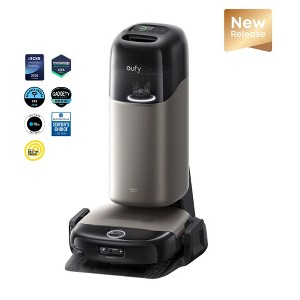
Products & versions



04Technology Stack: Strengths and the Work That Remains
eufy's technology stack has three layers: the edge devices (cameras, doorbells, vacuums), the local hub (HomeBase S380 with BionicMind, and now MindBase), and the optional cloud service. The architectural bet is that inference belongs on the hub or the device, not in a data centre.
On-device and on-hub inference. The HomeBase S380 runs BionicMind, eufy's on-device AI for face and object recognition 4. The MindBase extends this with a 26-TOPS inference chip and support for an on-device large language model, which the company positions as enabling natural-language control and local automation without cloud offload 6910. This is a credible architecture: 26 TOPS is sufficient for real-time video analytics and small language models, and local processing removes both the subscription cost and the privacy exposure of cloud inference.
Storage. Cameras use eMMC or micro-SD; the HomeBase expands to 16TB; MindBase supports up to 48TB 6910. Local storage at this scale is a genuine engineering commitment, not a checkbox, and it is the foundation of the no-monthly-fee proposition.
Detection and tracking. eufy cameras offer AI human detection, package guarding, mmWave-based fall detection, and OmniTrack AI tracking 2610. These features exist and are documented; the community complaints concern their reliability in practice rather than their existence 293133.
Robot-vacuum autonomy. The Omni series performs mapping, navigation, obstacle avoidance, vacuuming, mopping, self-emptying, mop washing and drying, and auto water refill without human intervention 7112427. The Omni E35 claims 35,000Pa of suction, a figure that is a company claim and not independently benchmarked in the dossier 11.
The work that remains. The gap is not in the architecture but in the execution. Independent reports describe failed video feeds, skipped recordings, laggy two-way talk and dead cameras 12930313334. These are firmware, networking and quality-control problems, and they are the kind of problem that a local-first architecture does not automatically solve. A camera that processes locally but fails to start a stream is not a privacy win; it is a broken camera. The MindBase's on-device LLM also raises an unanswered question: what the model actually does, how it is updated, and whether its accuracy has been independently tested. None of that is publicly disclosed.
05Research, Papers, Authors and Labs
This is the thinnest section of the report, and it should be read as a statement about eufy's public research posture rather than as a gap in the analysis.
eufy and Anker do not maintain a visible academic publication programme comparable to those of robotics-first companies. The dossier contains no peer-reviewed papers authored by eufy or Anker staff, no named research lab, and no public dataset releases. The four research sources in the dossier are academic works that use commercial robot vacuums as research platforms rather than works produced by eufy: a paper on adversarial robots as creative collaborators 19, a paper on piggyback cameras for visual surveillance using commercial robot vacuums 20, a paper on perception with an autonomous floor scrubber 21, and a paper on multi-robot task allocation for autonomous cleaning 22. These are relevant to the category and to the research community that builds on consumer cleaning robots, but they are not eufy research outputs.
The practical implication is that eufy's technical claims cannot be checked against a published literature. There is no paper describing BionicMind's architecture, no benchmark of the MindBase inference chip, and no published evaluation of the detection accuracy of the camera AI. A reader assessing eufy's technology is therefore dependent on vendor documentation, launch coverage and independent product reviews, with no peer-reviewed layer beneath them.
<!-- module: papers --> <!-- module: authors-labs --> <!-- module: repos --> <!-- module: datasets -->06Media Evidence Library: What the Videos Prove
The dossier contains six video sources: a teardown of a RoboVac 23, a review of the C28 robot vacuum and mop 24, a review of the dual-camera doorbell 25, a review of the SoloCam E42 26, a review of the Omni S2 27, and one additional video 28. There is also a vendor-produced product roundup from Anker Day NY 17.
The evidentiary value of these videos is real but bounded. A teardown 23 is genuinely useful evidence: it shows the physical construction, the battery, the brush assembly and the build quality, and it cannot be staged in the way a demonstration can. Independent reviews 24252627 are useful for observed behaviour under the reviewer's conditions, including video quality, detection performance and cleaning results, though reviewers vary in rigour and in the duration of their testing.
What these videos do not prove is field reliability. A review conducted over days or weeks cannot establish whether a camera will still be streaming in eighteen months, whether firmware updates will degrade performance, or whether the failure modes reported by long-term users will appear. The vendor roundup 17 is a marketing artefact and is treated as a company claim, not as evidence.
The most important media evidence in this dossier is therefore not the videos but the community reports in §7, which cover exactly the long-duration, multi-device experience that short reviews cannot.
Media library
07Commercial Reality
eufy's commercial position is best described as scale without a corresponding reputation for dependability. The company claims more than ten million users globally 2, sells through mainstream retail and direct channels, and prices from the low end of the camera market to the premium end of the hub market. That is a real business. The question is what the customer experience looks like after purchase.
The vendor position. eufy markets a dependable, private, subscription-free security system: local AI processing, no mandatory cloud fees, AI human detection, package guarding and fall detection 245. The architecture supports these claims, and the absence of a mandatory subscription is a genuine and verifiable commercial difference from Ring and Nest.
The independent position. Community reports converge on a different experience. Users describe video feeds that fail to start, event recordings that are skipped, two-way talk that lags, cameras that die, and automation they characterise as the most unreliable they have used 12930313334. One thread is titled, bluntly, "The Eufy camera system has become useless" 31; another asks whether eufy is a scam 32; another describes a user who has given up after seeing potential 34. These are not isolated complaints. They are multiple independent first-hand accounts, across multiple threads, describing overlapping failure modes.
How to weigh the two. For reliability, independent first-hand user reports are more credible than vendor marketing. The convergence of failure modes across independent users is the strongest evidence in this dossier, and it is better-supported than the vendor's implied dependability. This does not mean every eufy device fails, and the dossier contains at least one thread from users who are relieved with their purchase 1. It means the distribution of outcomes is wide enough that a buyer cannot assume the vendor's described experience.
What is not disclosed. eufy does not publish field failure rates, return rates, mean time between failures, or firmware rollback statistics. There is no independent teardown of the MindBase, no third-party security audit of the current architecture in the dossier, and no verified customer list for the business line 16. The unit economics of the hardware lines are not publicly disclosed. These are unknowns, and they matter: without failure-rate data, the reliability question can only be assessed through user reports, which are informative but not representative.
Customers & deployments
Sections 8 through 14 continue in the second part of this report.
08Markets and Use Cases
eufy sells into two distinct markets that share a brand but little else operationally: consumer home security and consumer floor care. The company's own framing increasingly treats these as one ecosystem stitched together by a local AI hub, but the buying logic, competitive set, and failure modes differ sharply between them. This section separates the two and assesses where eufy's positioning is defensible and where it is aspirational.
8.1 Consumer home security
The core market is the owner-occupied or rented home in North America and Western Europe, where the buyer wants camera coverage without a recurring cloud bill and without professional installation. eufy's pitch is local storage and local processing, with the HomeBase and now MindBase acting as the on-premises brain 46. The addressable buyer is price-sensitive to subscriptions but not necessarily to hardware: a four-camera MindBase kit at $999 is a premium outlay relative to a $42.99 single camera, and the company clearly wants to move buyers up the stack 26.
Three use cases recur in the evidence:
- Perimeter and entry monitoring. Cameras and video doorbells covering doors, driveways, and gardens, with AI human detection and package guarding as the headline features 22526.
- Indoor monitoring and fall detection. The mmWave fall-detection radar extends eufy from security into eldercare-adjacent monitoring, a use case with a different buyer (adult children of ageing parents) and a different tolerance for false negatives 618.
- Small-business and multi-site coverage. eufy operates a business channel and NVR systems (E50 from $1,200), positioning the same hardware for light commercial deployments 16.
The critical market question is whether "no monthly fee" is a durable wedge. It is a genuine differentiator against subscription-first competitors, and it is the single most consistent reason buyers cite for choosing eufy 14. But the reliability complaints documented in §7 and §11 attack precisely the value proposition that justifies the premium: a local system that fails to record is worse than a cloud system that works, because the buyer has paid upfront for capability they cannot recover. The market is therefore not won by the local-processing claim alone; it is won or lost on whether the local system is dependable.
8.2 Consumer floor care
The robot vacuum and mop market is more commoditised and more brutally competitive than home security. eufy competes on suction figures (the Omni E35 is marketed at 35,000 Pa 1112), dock automation (self-emptying, mop washing and drying, auto water refill), and price points in the €699 to €1,100 band 7811. This is a market where specification escalation is constant and where the buyer's decision is heavily influenced by independent review channels rather than brand loyalty.
The floor-care use case is simpler than security: autonomous cleaning of hard floors and carpet in a single home, with mapping and obstacle avoidance 112427. The autonomy is real and uncontested in the evidence; no source suggests a human drives the cleaning task. The competitive risk is not autonomy but differentiation, since suction and dock features are quickly matched.
8.3 The ecosystem play
MindBase is the strategic attempt to convert two separate product markets into one platform market 6910. If a household already owns eufy cameras and an eufy vacuum, a local AI hub that coordinates them and stores their data has switching costs that neither product line commands alone. This is a coherent strategy and it is the most interesting thing eufy is doing. It is also unproven: the hub shipped into a market where the brand's reliability reputation is the binding constraint, and a hub amplifies reliability problems because it becomes a single point of failure for every connected device.
8.4 Where the evidence is thin
Not publicly disclosed: eufy's revenue split between security and floor care, its geographic revenue mix, its installed-base retention or churn, and any independent market-share estimate. The "over 10 million users" figure is a company-stated cumulative number and does not indicate active, retained, or paying users 2. Any market-sizing claim beyond that is inference.
09Competitive Landscape
eufy competes in two arenas with different rivals, and its strategic problem is that it is a credible challenger in neither's top tier on brand, while being genuinely competitive on price and on the local-processing niche. The table below maps the competitive set by arena and by the axis on which each rival actually competes.
| Arena | eufy's position | Primary rivals | Rival's core axis | eufy's counter |
|---|---|---|---|---|
| Home security cameras | Mid-premium challenger | Ring, Arlo, Google Nest, Wyze | Ecosystem, cloud services, brand trust | No subscription, local storage, local AI 4 |
| Video doorbells | Mid-market | Ring, Google Nest | Integration, brand | Dual-camera hardware, local recording 25 |
| Robot vacuums | Mid-to-premium | iRobot (Roomba), Roborock, Dreame, Ecovacs | Navigation quality, dock automation, suction | Suction figures, dock features, price 1124 |
| Local AI hub | First mover among consumer brands | None directly; smart-home hubs (SmartThings, Home Assistant) | Openness, integration | On-device LLM, 26-TOPS chip, 48TB storage 69 |
9.1 The security arena
Ring and Google Nest compete on ecosystem lock-in and cloud services; Arlo on premium hardware and subscription; Wyze on aggressive price. eufy's differentiation is the absence of a mandatory subscription and the promise of local processing 34. That is a real and defensible niche, but it is a niche defined by what eufy does not charge for rather than by superior capability. The reliability record documented in §7 and §11 is the competitive vulnerability: rivals whose cloud pipelines are more mature can argue, credibly, that a working subscription beats a failing local system.
9.2 The floor-care arena
This is the harder fight. Roborock, Dreame, and Ecocacs iterate rapidly and are reviewed on navigation and dock reliability, not just suction. eufy's 35,000 Pa headline 11 is a specification arms-race entry, and specification leadership in this category is ephemeral. The evidence does not establish that eufy's navigation or obstacle avoidance leads the field; independent comparative testing would be required, and the dossier does not contain it.
9.3 The hub arena
MindBase has no direct consumer-brand equivalent in the evidence. SmartThings and Home Assistant occupy adjacent ground but compete on openness and integration rather than on-device AI. If MindBase works, it is a genuine differentiator and a platform moat. If it does not, it is an expensive accessory attached to a brand with a reliability problem. The competitive verdict on MindBase is therefore contingent on execution evidence that does not yet exist in the public record.
9.4 The structural disadvantage
eufy's parent, Anker Innovations, is a hardware and accessories company by origin, and the competitive set in both arenas includes firms whose core competence is software and services. The reliability complaints in the community evidence 2930313334 are consistent with a hardware-first organisation shipping software-defined products. That is an editorial inference, not a verified fact, but it is the most parsimonious explanation for a pattern of capable hardware paired with unreliable software.
Competitive comparison
| Robot | Maker | Autonomy | Conf. |
|---|---|---|---|
| iRobot Roomba Combo 10 Max | iRobot | Autonomous | 0.90 |
| Mobile ALOHA (Stanford) | Stanford University | Teleoperated | 0.90 |
| 1X NEO | 1X Technologies | Remote-Assisted | 0.90 |
10Geopolitical Context and Constraints
eufy's geopolitical position is unusual and, on balance, favourable. It is a Chinese-owned brand (Anker Innovations is headquartered in Shenzhen) selling into markets where Chinese-made cameras are subject to heightened scrutiny, yet its core marketing claim is local processing and local storage, which is precisely the mitigation that regulators and buyers in those markets demand 46. The company has, in effect, positioned its product to be less exposed to the geopolitical risk that attaches to its ownership.
10.1 The ownership question
Anker Innovations is a Chinese company and eufy is its sub-brand 67. One news source indicates Anker plans to retire the eufy sub-brand name, which, if accurate, is a branding decision with potential implications for how the security business is positioned relative to the parent 7. This is a company claim reported by a single outlet and should be treated as unconfirmed until corroborated.
10.2 Regulatory exposure
Not publicly disclosed: any regulatory action, import restriction, or government procurement ban specifically targeting eufy products. The dossier contains no evidence of eufy being named in a regulatory proceeding. This is a genuine gap rather than a clean bill of health; absence of evidence in this dossier is not evidence of absence.
10.3 The privacy history as a geopolitical liability
The documented past misrepresentation of end-to-end encryption 6 is a liability that compounds with the ownership question. In markets where Chinese-made cameras face political headwinds, a privacy misrepresentation is not merely a customer-trust problem; it is ammunition for critics who argue that local-processing claims from Chinese vendors cannot be taken on faith. eufy's response, overhauling the systems, is the right one, but the episode means the company's privacy claims carry a higher burden of proof than a Western competitor's would.
10.4 Data-residency as a selling point
The local-first architecture means that, in principle, no video leaves the home. That is a genuine geopolitical advantage: it sidesteps data-transfer concerns entirely for the on-device path. The constraint is that the claim is only as strong as the verification. Without independent teardown evidence confirming that no telemetry or imagery is transmitted, the geopolitical benefit rests on the same unverified foundation as the privacy marketing.
10.5 Supply-chain and tariff exposure
Not publicly disclosed: eufy's manufacturing footprint, component sourcing, or tariff exposure. Anker's scale gives it supply-chain leverage, but the dossier contains no specifics, and any claim about tariff resilience would be speculation.
11The Hype, the Real and the Ugly
This section is the report's accountability ledger. It separates what eufy says, what the evidence supports, and what independent users report. The pattern is consistent: the hardware and the architectural ambition are real; the reliability and the privacy track record are the problems.
11.1 Claim-versus-evidence
| Claim | Source type | Evidence status | Verdict |
|---|---|---|---|
| Local AI processing, no cloud offload | Company 469 | Consistent across vendor and news sources; no independent teardown | Plausible, unverified |
| Over 10 million users | Company 2 | Single commerce source, no contradicting figure | Company claim |
| Dependable home security | Company marketing | Contradicted by multiple independent user reports 29313334 | Contested |
| 35,000 Pa suction | Company 1112 | Vendor specification, no independent lab confirmation in dossier | Company claim |
| 48TB local storage, 26-TOPS chip | Company 9 | Vendor specification, reported by news | Company claim |
| End-to-end encryption | Company (past) | Documented misrepresentation, later overhauled 6 | Disproven as originally stated |
11.2 The hype
The hype is the ecosystem narrative: a local AI brain that coordinates cameras, vacuums, and sensors with no cloud dependency and no subscription 6910. It is a compelling story and it is architecturally coherent. It is also the kind of story that is easy to tell at a trade show and hard to deliver in a home, and the evidence for delivery is currently limited to vendor demonstrations and specification sheets.
11.3 The real
The real achievements are genuine and should not be dismissed. eufy ships autonomous cameras and robot vacuums that perform their core tasks without human operation, at prices that undercut subscription-dependent rivals, with local storage that competitors often charge for 2411. The autonomy verdict of Autonomous (confidence 0.75) reflects this: the tasks are performed by the machine, not by a person. The 10-million-user figure, even as a cumulative company claim, indicates real market traction 2.
11.4 The ugly
The ugly is the reliability record. Multiple independent users, writing without coordination, describe the same failure modes: video feeds that fail to start, event recordings that are skipped, two-way talk that lags, cameras that die, and a system that one user calls "the most unreliable automation system I've ever used" 2930313334. These are first-hand accounts, not vendor marketing, and their convergence across separate threads is what gives them weight. For a security product, a skipped recording is not an inconvenience; it is a failure of the product's only job.
The second ugly item is the privacy history. eufy claimed end-to-end encryption when the implementation did not always provide it, and the systems were later overhauled 6. This is a matter of record. It does not disprove current local-processing claims, but it establishes that the company's privacy marketing has, at least once, outrun its engineering.
11.5 The reconciliation
The honest reading is that eufy is a company with real hardware capability, a coherent and differentiated architectural strategy, a genuine price advantage, and a serious, well-documented reliability and trust deficit. The autonomy is not the contested axis; reliability and privacy history are. A buyer who needs a working security system should weigh the independent reliability evidence heavily, because it goes directly to whether the product does its job.
Claim tracker
Vendor videos and news sources describe autonomous cleaning, mapping and AI detection, and no source indicates a human teleoperates the task, though no independent teardown verifies the autonomy.
Multiple independent Reddit users converge on failed video feeds, skipped recordings, laggy two-way talk and dead cameras, directly contradicting the vendor's implied dependability.
Vendor and news sources agree local processing is core design, but no independent teardown or third-party test confirms the no-cloud-offload claim, and eufy's past encryption misrepresentation warrants skepticism.
The figure is stated only by a commerce source with no independent corroboration or contradicting data found.
A reputable news outlet documents the encryption misrepresentation as a matter of record, and no source contradicts it.
Specs come from vendor-aligned news coverage of IFA 2026 with no independent test or teardown confirming the LLM, TOPS or storage performance.
The suction spec and shipping date appear only in vendor press releases and derivative news, with no independent measurement or confirmed retail availability.
Vendor and news sources describe these detection features, but community reports question their reliability and no independent test confirms consistent performance.
12Future Scenarios
The scenarios below are editorial inferences built from the public evidence. They are not predictions with probabilities attached; they are structured ways to think about how the next 18 to 36 months could unfold, with the indicators that would distinguish them.
Scenario A: The ecosystem consolidates (moderate plausibility)
MindBase ships, works reliably enough, and becomes the anchor of a genuine eufy platform. Cameras, vacuums, and sensors share a local brain, switching costs rise, and the reliability complaints fade as software matures. eufy becomes the default local-first smart-home brand for privacy-conscious buyers.
- Indicators: sustained positive independent reviews of MindBase; declining reliability complaints in community forums; evidence of repeat purchases across product lines; third-party Matter integration working as claimed 6.
- What would falsify it: continued reliability complaints after MindBase's first year; hub-related outages affecting connected devices.
Scenario B: Hardware advances, software stalls (high plausibility)
eufy continues to ship competitive hardware at competitive prices, but the reliability and software-quality gap persists. The brand remains a value choice rather than a trusted one, and buyers who need dependable security migrate to rivals with mature cloud pipelines. The floor-care business continues on specification competition.
- Indicators: new product launches with unchanged community reliability complaints; review coverage that praises hardware and criticises software; no independent verification of local-processing claims.
- What would falsify it: a documented, sustained improvement in independent reliability reporting.
Scenario C: The privacy question returns (low-to-moderate plausibility)
A new privacy or security incident, or an independent teardown that contradicts a local-processing claim, reopens the trust deficit. Given the documented history 6, the reputational cost would be higher the second time.
- Indicators: security research publications examining eufy firmware; regulatory inquiries; changes to privacy policy or data-handling disclosures.
- What would falsify it: independent teardowns confirming the local-processing claims and no new incidents.
Scenario D: Brand consolidation under Anker (uncertain)
If Anker retires the eufy sub-brand name as one source suggests 7, the security and floor-care lines could be repositioned under the parent brand. This would be a marketing change with potential implications for how the security business is trusted in geopolitically sensitive markets.
- Indicators: official Anker announcements; changes to product branding; revised privacy and data-handling documentation.
- What would falsify it: continued eufy-branded launches through 2027.
Scenario E: The floor-care line outgrows security (moderate plausibility)
Robot vacuums are a less trust-sensitive category than security cameras. If the security business is constrained by reliability and privacy concerns, floor care could become the larger and healthier part of the eufy business, and the ecosystem strategy could quietly de-emphasise security.
- Indicators: product-launch cadence shifting toward floor care; reduced security-camera investment; MindBase positioned primarily as a cleaning-coordination hub.
13What to Watch: A Live Monitoring Checklist
The following checklist is designed for ongoing monitoring. Each item is a specific, observable signal that would confirm or disconfirm the assessments in this report. Items are grouped by the question they answer.
13.1 Does the reliability problem persist?
- Community reports in r/EufyCam and comparable forums: are failed feeds, skipped recordings, and dead cameras still recurring, or declining? 2930313334
- Independent long-term reviews (six months or more of use) of current-generation cameras and hubs.
- Whether eufy publishes reliability or uptime data, and whether it is independently audited.
13.2 Are the local-processing claims verifiable?
- Independent firmware teardowns or network-traffic analyses of MindBase and current cameras.
- Security-research publications examining eufy's data handling.
- Whether the company's privacy documentation has been strengthened since the encryption episode 6.
13.3 Is MindBase delivering?
- Independent reviews of MindBase after sustained use, not launch-day impressions.
- Evidence of Matter integration working as claimed 6.
- Whether the hub becomes a single point of failure for connected devices.
13.4 Is the commercial traction real?
- Any independently sourced installed-base or active-user figures, as distinct from the cumulative "10 million" claim 2.
- Evidence of repeat purchases across product lines.
- Named business or institutional customers, as distinct from partnership announcements 16.
13.5 What is the competitive response?
- Whether rivals match the no-subscription, local-storage positioning.
- Whether eufy's suction and dock specifications retain leadership in independent comparative testing 1124.
- Whether the local-AI-hub concept is copied by better-resourced competitors.
13.6 What is the corporate trajectory?
- Whether Anker retires the eufy sub-brand name 7.
- Regulatory or procurement actions involving eufy products in any market.
- Changes to the product-launch cadence across security and floor care.
14Sources and Methodology
14.1 Methodology
This report was assembled from a research dossier gathered on 2026-09-18. The dossier comprised 34 numbered sources across five categories: commerce (5), research (4), news (13), video (6), and community (6). No official company filings were present in the dossier, which is a material limitation: the report relies on company marketing pages, press coverage, vendor and third-party videos, and community reports.
Evidence was classified into four labels, applied consistently throughout:
| Label | Definition | Treatment in this report |
|---|---|---|
| Verified fact | Regulatory filing, official product documentation, named-customer confirmation, peer-reviewed or primary research, or multiple independent sources | Stated as fact with citation |
| Company claim | Stated by the company, not independently verified | Attributed to the company; not treated as fact |
| Editorial inference | Reasoned conclusion drawn from public evidence | Labelled as inference; reasoning shown |
| Unknown | Not publicly disclosed | Stated plainly as not disclosed; no padding |
Three evidentiary rules were applied without exception. A choreographed demonstration video was not treated as proof of autonomous work. A shipment or price listing was not treated as proof of productive deployment. A partnership or product announcement was not treated as proof of a paid customer.
The autonomy verdict of Autonomous (confidence 0.75) rests on the finding that eufy cameras and robot vacuums perform their core tasks, recording and detecting, and cleaning, without a human driving the task. Reliability complaints were classified as operational failures rather than as evidence of human operation, and therefore did not lower the autonomy level. The confidence is moderate rather than high because no independent teardown or third-party verification of the autonomy and local-processing claims was available in the dossier.
The overall confidence of 0.72 reflects strong convergence on the reliability complaints across independent community sources, offset by the absence of official filings, independent teardowns, and verified commercial-deployment evidence.
14.2 Sources
- Is anyone else relieved they bought Eufy? : r/EufyCam — https://www.reddit.com/r/EufyCam/comments/1ana2em/is_anyone_else_relieved_they_bought_eufy/
- 2026 eufy Security Camera Costs & Plans — https://www.security.org/security-cameras/eufy/
- eufy-plus-membership - eufy US — https://www.eufy.com/eufy-plus-membership
- Local Security with No Monthly Fees — https://www.eufy.com/eufy-local-security
- eufy Support | Troubleshooting & Customer Service — https://service.eufy.com/article-description/Are-there-any-subscription-fees-when-using-eufy-SmartDrop-T8790
- Anker's new MindBase is an AI-powered brain for your smart home | The Verge — https://www.theverge.com/tech/987936/anker-eufy-mindbase-ai-security-camera-system-matter
- Anker Eufy At IFA 2026: New Security Cameras, Plus A Robot Vacuum And A Robot Lawnmower — https://www.engadget.com/2249106/anker-eufy-at-ifa-2026-new-security-cameras-plus-a-robot-vacuum-and-a-robot-lawnmower/
- Anker Unveils Eufy MindBase Local AI Hub and 35,000Pa Robot Vacuums at IFA 2026 | GSMDome.com — https://www.gsmdome.com/anker-unveils-eufy-mindbase-local-ai-hub-and-35-000pa-robot-vacuums-at-ifa-2026
- Anker Unveils Eufy MindBase at IFA, a Local AI Home Hub With 26-TOPS Chip and 48TB Storage | AI Weekly — https://aiweekly.co/alerts/anker-unveils-eufy-mindbase-at-ifa-a-local-ai-home-hub-with-26-tops-chip-and
- Eufy's Latest Security System Is an All-Seeing, Local-First Camera Array — https://gizmodo.com/eufys-latest-security-system-is-an-all-seeing-local-first-camera-array-2000800042
- Eufy Omni E35 Robot Vacuum Debuts With 35,000 Pa Suction | Ubergizmo — https://www.ubergizmo.com/2026/09/eufy-omni-e35-robot-vacuum-debuts-wh-35000-pa-suction/
- eufy Omni E35 sets a September 25 shipping date in the US — https://inews.zoombangla.com/eufy-omni-e35-us-shipping-september-25/
- Anker eufy Robot Vacuum Omni E35 Brings Healthier Living Home | T — https://natlawreview.com/press-releases/anker-eufy-robot-vacuum-omni-e35-brings-healthier-living-home
- eufy Security News and Press Releases — https://www.prnewswire.com/news/eufy-security/
- What is down the pipeline for security cameras for Eufy ... — https://www.reddit.com/r/EufyCam/comments/1vg8dg7/what_is_down_the_pipeline_for_security_cameras/
- eufy-business - eufy US — https://www.eufy.com/business
- ALL New eufy Products for 2026 - As Seen at Anker Day NY! — https://www.youtube.com/watch?v=M611B5NWNAk
- Anker's Eufy Strides Into IFA With a New AI Ecosystem and ... — https://www.cnet.com/home/security/ankers-eufy-strides-into-ifa-with-a-new-ai-ecosystem-and-devices-to-match/
- Adversarial Robots as Creative Collaborators — https://arxiv.org/html/2402.03691
- Piggyback Camera: Easy-to-Deploy Visual Surveillance by Mobile Sensing on Commercial Robot Vacuums — https://arxiv.org/html/2507.04910v1
- [2002.10158] Robot Perception of Static and Dynamic Objects with an Autonomous Floor Scrubber — https://ar5iv.labs.arxiv.org/html/2002.10158
- [2303.06531] Towards Practical Multi-Robot Hybrid Tasks Allocation for Autonomous Cleaning — https://arxiv.org/abs/2303.06531
- Eufy RoboVac Teardown, Deep Clean, and Side Brush Replacement — https://www.youtube.com/watch?v=d1uo1Yipwak
- eufy C28 Robot Vacuum & Mop Review 2026|15,000Pa Suction, HydroJet Self-Cleaning Mop&Self-Empty Dock - YouTube — https://www.youtube.com/watch?v=RLF6YiVk_H8
- Eufy Dual Camera Video Doorbell Review - Unboxing, Features, Video Quality, Testing - WORTH IT? — https://www.youtube.com/watch?v=xWq9fOp1kwQ
- Anker Eufy SoloCam E42 Review – Best Wireless Security Camera of 2026? - YouTube — https://www.youtube.com/watch?v=-Ro0r9NDsHE
- Eufy Omni S2 Review: Is This Eufy's Best Robot Yet? — https://www.youtube.com/watch?v=LRzkqir_3JA
- https://www.youtube.com/watch?v=_DfwskOQFtk — https://www.youtube.com/watch?v=_DfwskOQFtk
- Is eufy that bad? : r/EufyCam - Reddit — https://www.reddit.com/r/EufyCam/comments/1v0tljz/is_eufy_that_bad/
- Honest opinions on Eufy? : r/EufyCam - Reddit — https://www.reddit.com/r/EufyCam/comments/1vhdc9l/honest_opinions_on_eufy/
- The Eufy camera system has become useless : r/EufyCam - Reddit — https://www.reddit.com/r/EufyCam/comments/1lpzuz7/the_eufy_camera_system_has_become_useless/
- Is eufy a scam : r/EufyCam - Reddit — https://www.reddit.com/r/EufyCam/comments/1uuo7hq/is_eufy_a_scam/
- Eufy system is the most unreliable automation system I've ever used ... — https://www.reddit.com/r/EufyCam/comments/16ckcob/eufy_system_is_the_most_unreliable_automation/
- Eufy had so much potential. Now I'm done. : r/EufyCam - Reddit — https://www.reddit.com/r/EufyCam/comments/1scled3/eufy_had_so_much_potential_now_im_done/
14.3 Limitations
The principal limitations of this report are the absence of official company filings, the absence of independent teardown or network-analysis evidence for the local-processing claims, and the reliance on community reports for the reliability assessment. Community reports are first-hand but self-selected and not statistically representative; their strength here lies in convergence across independent threads, not in their sample size. The "over 10 million users" figure is a company claim and should not be read as an active-user count. Where the dossier was thin, this report says so rather than estimating.