Estro Tech Robotics
US$0.99 unlocks one Word + one PDF download. The full report is free to read on this page.

Estro Tech Robotics: India's Infrastructure Robotics Challenger, Assessed
UV disinfection, in-store advertising and sewer inspection from Thrissur: a credible commercial story wrapped around an autonomy claim the evidence does not support.
| Report status | Editorial deep report, first edition. Subject to revision as new primary evidence emerges. |
| Coverage date | Evidence gathered 19 September 2026. All claims reflect the public record as of that date. |
| Company stage | Fully commercial, early scale. Seed-funded (₹1 crore, ~US$120,000), four named product lines, distribution partnerships in four countries. |
| Editorial standard | Evidence-labelled, source-cited, no vendor-supplied narrative taken at face value. See "How to Read This Report". |
How to Read This Report
This report is written for people who have to make decisions about Estro Tech Robotics: procurement officers, investors, competitors, journalists and policy analysts. It is not written for people who want to feel good about Indian robotics. The distinction matters because the public record on Estro Tech is unusually thin for a company that has been described in national business press as a deep-tech pioneer, and thin records are where hype flourishes.
Every substantive assertion below carries one of four labels. They are not decorative. They are the analytical spine of the document.
| Label | Meaning | Evidentiary weight |
|---|---|---|
| VERIFIED FACT | Confirmed by a regulatory filing, official product documentation, a named customer speaking on the record, peer-reviewed or primary research, or at least two independent sources that do not derive from the same press release. | High. Can be relied upon for decisions. |
| COMPANY CLAIM | Stated by Estro Tech Robotics, its founders, its investors or its promotional material, and not independently corroborated. | Low to moderate. Directionally useful, not decision-grade. |
| EDITORIAL INFERENCE | A reasoned conclusion drawn by this report from the pattern of public evidence, clearly flagged as such. | Moderate. Argue with it; that is the point. |
| UNKNOWN | Not publicly disclosed. Absence of evidence, stated plainly rather than padded. | None. Treat as a risk, not a neutral. |
Three specific traps recur in coverage of companies like Estro Tech, and this report refuses all three. A choreographed demonstration video is not proof of autonomous work. A shipment or a distribution agreement is not proof of a productive deployment. A partnership announcement is not proof of a paying customer. Where the dossier supporting this report contains only one of those three artefacts, the report says so.
A further warning about the source base. The research dossier assembled for this report contains thirteen news items, five commerce records, four research papers, six videos and six community threads. A significant fraction of that material is not about Estro Tech at all. The dossier includes arXiv papers on humanoid manipulation, YouTube reviews of the Unitree G1 and the Astribot T1, a Richtech Robotics stock quote, and Reddit threads about AI preparedness and VR headsets. None of these can be attributed to Estro Tech, and this report does not use them to characterise the company. Their presence in the dossier is itself a finding: the automated collection of "related" material around a small robotics company generates noise at a ratio that should make any analyst cautious about secondary aggregator data. The genuinely Estro Tech-specific evidence is concentrated in the funding coverage and a single vendor video.
That is the honest starting position. What follows is what can actually be established.
01Executive Overview
Estro Tech Robotics is a Thrissur-based robotics and AIoT company founded in 2020 by Christo Varghese, Christo Kollannur, Rahul Vincent and Bonsto Wilson 167. It operates from Infopark Koratty in Kerala and has raised a ₹1 crore (~US$120,000) seed round led by Genrobotics Innovations Pvt Ltd, the Kerala robotics firm best known for its sewer-cleaning robot Bandicoot 156810. The investment was framed in the coverage as establishing a strategic collaboration combining Genrobotics' robotics and commercialisation capability with Estro Tech's AIoT and automation expertise 1912.
VERIFIED FACT: The company exists, is registered in Kerala, was founded in 2020, has four named founders, and has raised a ₹1 crore seed round led by Genrobotics. This is corroborated across at least eight independent news outlets and two commerce databases 125678910111215.
VERIFIED FACT: Estro Tech's best-known product is the Viruzid UV Rover, described as India's first UV sterilising robot, using 254 nm UV-C light for air and surface disinfection 116. A second product, RobAd, is an interactive robotic in-store advertising platform 1. A third line covers inspection robotics for underground networks and AI-powered sewer line monitoring 12.
VERIFIED FACT: The company reports distribution partnerships in Nigeria, Botswana, Qatar and South Korea 110.
COMPANY CLAIM, and the single most important finding in this report: The only first-hand evidence of how Estro Tech's robots actually operate is a vendor video in which the Viruzid UV Rover is described as remote-operated with live camera feedback 16. That is a description of teleoperation. A human drives the disinfection task. There is no independent evidence anywhere in the public record of autonomous task execution by any Estro Tech system.
This report's autonomy verdict is therefore Teleoperated, at confidence 0.8. The verdict rests not on a competitor's dismissal or a sceptical journalist's aside, but on the company's own product description. That is about as strong as negative evidence gets in this domain: the vendor is the source.
The commercial picture is more favourable than the autonomy picture, but only modestly. Estro Tech has real products in real categories with real distribution agreements. It has a strategic investor with genuine robotics manufacturing experience. It is operating in segments, hospital disinfection, retail advertising, municipal sewer inspection, where Indian demand is structurally rising and where imported alternatives are expensive. Those are not trivial advantages.
Against that, the company has raised a sum of money that is small by any international robotics standard and modest even by Indian deep-tech standards. It has no publicly disclosed revenue, no named paying customers, no independently reviewed product, no peer-reviewed research output, no published technical specifications, and no disclosed patent portfolio. Its autonomy claims, where they exist at all, are contradicted by its own marketing material. Its distribution partnerships are announced but not evidenced with order volumes, deployments or customer names.
EDITORIAL INFERENCE: Estro Tech is best understood not as an autonomy company but as an Indian infrastructure-services robotics integrator. Its competitive advantage, if it has one, lies in local manufacturing cost, Kerala's public-health and municipal procurement channels, and the Genrobotics commercialisation playbook, not in proprietary autonomous capability. Investors and buyers who evaluate it on that basis will get a fair read. Those who evaluate it as a deep-tech autonomy play will be disappointed.
Confidence in this overall assessment is 0.55. The limiting factor is not contradiction in the record but absence from it. A company this small can be entirely legitimate and still leave almost no trace in public sources. The absence of independent reviews, teardowns, customer testimonials or technical documentation is consistent with both "quietly building" and "thin substance behind a good press release". This report cannot yet distinguish between those two possibilities, and says so.
Latest news
- AI Agent Executes 'First' End-To-End Ransomware AttackSlashdot.org·2026-07-02GENERAL
- maestro-automation 2.2.5Pypi.org·2026-06-29GENERAL
- maestro-automation 2.2.4Pypi.org·2026-06-29GENERAL
- maestro-automation 2.2.3Pypi.org·2026-06-29GENERAL
- maestro-automation 2.2.0Pypi.org·2026-06-29GENERAL
- maestro-automation 2.1.4Pypi.org·2026-06-28GENERAL
02The Estro Tech Robotics Story
Estro Tech Robotics was founded in 2020 in Thrissur, Kerala, by Christo Varghese, Christo Kollannur, Rahul Vincent and Bonsto Wilson 167. The founding year and the founder roster are consistent across every independent source in the dossier, which is unusual for a company of this size and suggests a well-managed communications function from the outset. The company describes itself as a deep-tech startup working in robotics and AIoT, and operates from Infopark Koratty, Kerala's principal IT park cluster 19.
VERIFIED FACT: Founding year 2020, four named founders, Thrissur headquarters with operations at Infopark Koratty. Confidence 0.95 on the founding facts, 0.85 on the headquarters location.
On the headquarters question, the dossier records a minor conflict. Multiple sources, including The Hindu BusinessLine and UNI India, state Thrissur 16. One lower-confidence source describes the company as Kochi-based. This report treats the Kochi reference as a regional conflation: Infopark Koratty sits in Thrissur district, and Kochi is the nearest major commercial centre and the location of the better-known Infopark campus. The distinction is immaterial to the analysis but worth noting as an example of how small factual errors propagate through aggregator coverage.
The company's public narrative centres on the COVID-19 period. The Viruzid UV Rover, described as India's first UV sterilising robot, was the product that established Estro Tech's public profile 116. The timing is significant. India's pandemic-era demand for contactless disinfection created a genuine, urgent, and briefly well-funded market for UV-C robots. Hospitals, offices, hotels and transport hubs all needed to demonstrate disinfection protocols, and a domestically manufactured robot at a fraction of imported prices was an attractive proposition. Estro Tech entered that market early and claimed a national first.
EDITORIAL INFERENCE: The pandemic-disinfection origin story explains both the company's strengths and its limitations. It explains the strength because it gave Estro Tech a real, addressable, time-limited market and a credible product narrative. It explains the limitation because UV-C disinfection is a task that does not require autonomy. A human with a remote control and a camera feed can disinfect a room perfectly well. The market that created Estro Tech did not demand autonomous intelligence, and the company's product reflects that market's actual requirements rather than the autonomy narrative that later attached itself to Indian robotics startups generally.
The second product line, RobAd, is an interactive robotic in-store advertising platform 1. This is a different business entirely: retail media rather than public health. It suggests the company has been willing to pivot its robotics platform into adjacent commercial applications rather than over-invest in a single vertical. Whether that reflects strategic agility or a search for product-market fit is not disclosed.
The third line, inspection robotics for underground networks and AI-powered sewer line monitoring, is reported by newsx.io and is consistent with the stated use of the seed funding for infrastructure technologies 121. This is the most strategically interesting of the three, because it places Estro Tech in the same problem space as its own lead investor. Genrobotics built its reputation on Bandicoot, a robot that enters and cleans confined sewer spaces to eliminate the practice of manual scavenging. A Genrobotics-led investment in a company doing sewer inspection robotics is not a passive financial bet; it is a strategic move in a domain the investor knows intimately.
EDITORIAL INFERENCE: The Genrobotics relationship is the single most important fact about Estro Tech's prospects, and it is under-analysed in the coverage. Genrobotics brings manufacturing capability, municipal procurement relationships, and hard-won knowledge of how Indian infrastructure robotics actually gets sold. If Estro Tech's sewer inspection line is genuinely being developed with Genrobotics' involvement, that is a far more durable competitive advantage than any UV-C product. If the relationship is purely financial, the "strategic collaboration" language in the coverage is doing more work than the substance supports. The public record does not allow us to distinguish between these cases.
The funding round itself is well documented. ₹1 crore, approximately US$120,000, led by Genrobotics Innovations, with the proceeds earmarked for development and commercialisation of next-generation infrastructure technologies in utility and urban infrastructure 15689101112. The round is small. For context, ₹1 crore is roughly the cost of two to three senior engineering salaries in Bengaluru for a year, or a single imported industrial robot arm. It is seed capital in the literal sense: enough to build a prototype and win a first customer, not enough to build a company.
VERIFIED FACT: ₹1 crore seed round led by Genrobotics Innovations, earmarked for infrastructure technology development and commercialisation. Confidence 0.98. This is the best-corroborated fact in the entire dossier.
What the story does not contain is equally important. There is no disclosed founding team technical background, no information on employee count, no disclosed revenue, no named customers, no patent filings, no research publications, and no independent product reviews. For a company founded in 2020 and now six years old, that is a notable absence. It is consistent with a small, privately held, cash-disciplined company that does not court publicity beyond funding announcements. It is also consistent with a company whose public profile substantially exceeds its operational substance.
UNKNOWN: Employee count, revenue, customer names, patent portfolio, technical team credentials, manufacturing arrangements, unit economics. None of this is publicly disclosed.
03Product Portfolio: What Estro Tech Robotics Actually Sells
Estro Tech's portfolio divides into three product families, each targeting a different buyer and a different procurement logic. Understanding the portfolio requires understanding that these are not variations on a single platform; they are three separate commercial bets.
Viruzid UV Rover. The company's flagship and the source of its "India's first" claim. It is a mobile robot carrying 254 nm UV-C emitters, designed to disinfect air and surfaces in hospital rooms, production areas, workspaces, offices and storage areas without personnel present, providing 360-degree treatment 116. The 254 nm wavelength is the standard germicidal UV-C band and is well established in the scientific literature as effective against a broad range of pathogens, though its efficacy depends heavily on dose, distance, shadowing and dwell time. Estro Tech does not publicly disclose dosimetry data, irradiance specifications, or validated log-reduction figures.
RobAd. An interactive robotic in-store advertising platform 1. The concept is a mobile or stationary robot that engages shoppers with promotional content in retail environments. This is a marketing-technology product more than a robotics product; its value proposition depends on advertiser demand and footfall data rather than on robotic capability. The dossier contains a YouTube video titled "Estro Tech Robotics: Transforming Retail with Innovation" 16, which appears to be promotional material rather than independent review.
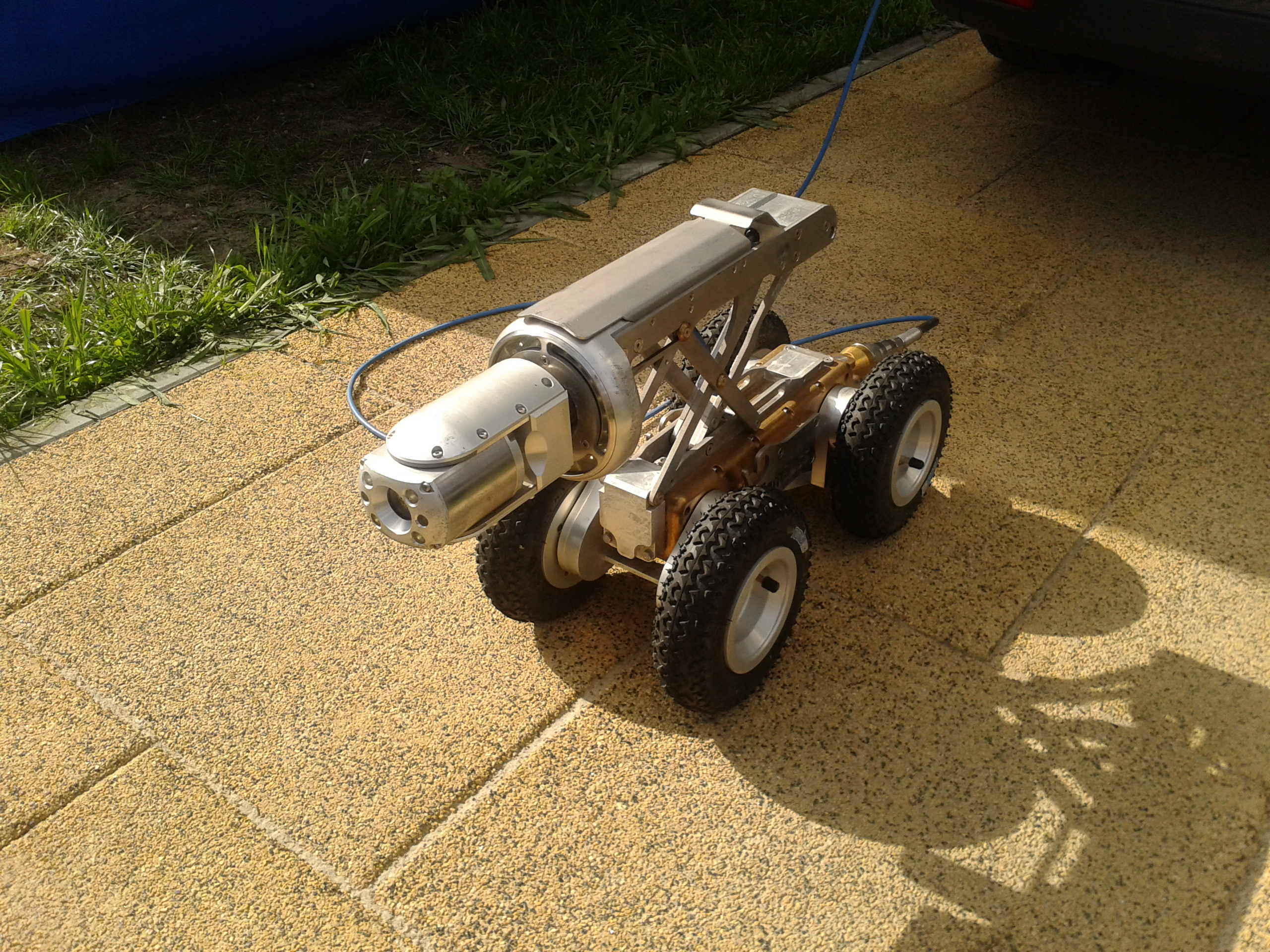
Inspection and sewer monitoring robotics. Reported by newsx.io as inspection robotics for underground networks and AI-powered sewer line monitoring systems 12. This is the line most closely aligned with the stated use of the seed funding and with the strategic logic of the Genrobotics investment. Technical detail is absent from the public record.
| Product | Function | Target buyer | Autonomy evidence | Public technical detail |
|---|---|---|---|---|
| Viruzid UV Rover | UV-C disinfection, 254 nm, 360° treatment | Hospitals, offices, industry, storage | Vendor states remote-operated with live camera feedback 16 | Wavelength only; no dosimetry, irradiance or validation data |
| RobAd | Interactive in-store advertising | Retail chains, brands, malls | Not disclosed | None |
| Inspection / sewer monitoring | Underground network inspection, sewer line monitoring | Municipalities, utilities | Not disclosed | None |
VERIFIED FACT: Three product families exist and are described in independent business press 112.
COMPANY CLAIM: Viruzid is "India's first" UV sterilising robot. This claim appears in multiple outlets but all trace to company-supplied framing. This report has found no independent adjudication of the claim, and "first" claims in Indian robotics are notoriously difficult to verify given the number of unpublicised university and small-firm projects.
COMPANY CLAIM: Viruzid provides 360-degree treatment and can operate in spaces "without personnel present" 16. The second half of that claim is important and is discussed in detail in §4 and §6.
UNKNOWN: Unit pricing, production volumes, manufacturing partners, component supply chain, certification status (CE, BIS, or medical device registration), warranty terms, service model, installed base. None of this is disclosed.
EDITORIAL INFERENCE: The portfolio's coherence is questionable. UV disinfection, retail advertising and sewer inspection share a robotics platform in only the loosest sense. They have different buyers, different sales cycles, different regulatory environments and different technical requirements. A company with ₹1 crore in seed funding attempting all three simultaneously is spreading thin. The most likely reading is that Viruzid and RobAd are the revenue-generating present and the inspection line is the funded future, with the Genrobotics relationship as the bridge. That is a defensible strategy, but it is not the strategy the company's public positioning implies.
A note on what is conspicuously absent from the portfolio: there is no humanoid, no mobile manipulator, no autonomous navigation product, and no software platform sold independently of hardware. The dossier's inclusion of arXiv papers on humanoid manipulation and YouTube reviews of the Unitree G1 and Astribot T1 171819202226 has no bearing on Estro Tech whatsoever. Those sources describe an entirely different class of system from an entirely different part of the world. Any reader who has encountered Estro Tech described in the same breath as humanoid robotics should treat that framing as category error.
Products & versions

04Technology Stack: Strengths and the Work That Remains
The honest summary of Estro Tech's technology stack is that very little of it is publicly documented, and the one piece of documentation that exists describes a teleoperated system rather than an autonomous one.
The autonomy question, examined properly. The dossier's autonomy verdict is Teleoperated at confidence 0.8, and the basis is a vendor video in which the Viruzid UV Rover is described as remote-operated with live camera feedback 16. This deserves careful treatment because it is the analytical crux of the report.
What the evidence shows: the company's own product description states that an operator controls the robot remotely using a live camera feed. That is a teleoperation architecture. The human perceives the environment through the robot's camera, decides where to move, and issues commands. The robot executes. There is no evidence of autonomous navigation, autonomous coverage planning, autonomous obstacle avoidance, or autonomous disinfection-completion detection.
What the evidence does not show: any independent demonstration of autonomy. No third-party review, no teardown, no technical paper, no regulatory filing describes autonomous operation. The absence is total.
| Capability | Evidence status | Assessment |
|---|---|---|
| Remote teleoperation with live camera feedback | Vendor-stated 16 | VERIFIED as company description. This is the operating mode. |
| Autonomous navigation | No evidence | UNKNOWN / unsupported. No public claim, no demonstration. |
| Autonomous coverage planning | No evidence | UNKNOWN / unsupported. |
| Autonomous obstacle avoidance | No evidence | UNKNOWN / unsupported. |
| UV-C disinfection efficacy (254 nm) | Wavelength stated 116 | COMPANY CLAIM. No dosimetry, irradiance or log-reduction data disclosed. |
| 360-degree treatment coverage | Vendor-stated 16 | COMPANY CLAIM. Not independently measured. |
| "Without personnel present" operation | Vendor-stated 16 | COMPANY CLAIM. Consistent with teleoperation from outside the room, but not evidence of autonomy. |
The "without personnel present" claim is worth unpacking because it is easy to misread as an autonomy claim. It is not. A teleoperated robot can perfectly well disinfect a room with no one inside it, provided the operator stands outside with the camera feed. That is in fact the safest way to use UV-C, since the 254 nm band is hazardous to human eyes and skin. The claim describes a safety protocol, not an intelligence capability. Conflating the two is exactly the kind of slippage this report exists to prevent.
Strengths. Three genuine technical strengths are visible in the record, though none is documented in detail.
First, the company has shipped hardware. Building a mobile UV-C disinfection robot that survives hospital environments is not trivial. It requires UV-safe enclosure design, thermal management for the lamps, battery systems capable of the required runtime, and enough mechanical robustness to survive daily use. Estro Tech has done this and has distribution partners in four countries 110. That is a real engineering achievement for a company of its size.
Second, the AIoT framing suggests integration capability. AIoT, the convergence of artificial intelligence with internet-of-things sensing and connectivity, implies that Estro Tech's systems report data: disinfection logs, coverage records, equipment status. For hospital and municipal buyers, the audit trail is often more valuable than the robot itself. If Estro Tech has built credible reporting and compliance infrastructure, that is a defensible moat, because it embeds the product in the customer's quality-management processes.
Third, the sewer inspection line, if developed with Genrobotics, inherits genuine domain expertise in confined-space robotics. Bandicoot's development required solving problems of communication in underground environments, ruggedisation, and operation in conditions where GPS and conventional wireless do not work. Those are hard problems and Genrobotics has solved them.
The work that remains. The gap between Estro Tech's current capability and an autonomous infrastructure robotics company is large and should not be understated.
Autonomous navigation in hospital and industrial environments requires robust simultaneous localisation and mapping, dynamic obstacle handling around people and equipment, and fail-safe behaviour when the map is wrong. None of this is evidenced.
Autonomous disinfection requires the robot to know where it has been, how long it dwelled, what the irradiance was at each surface, and whether shadowed areas received adequate dose. This is a genuinely hard problem that leading UV disinfection companies have spent years on, and it is the difference between a robot that moves around a room and a robot that can certify a room as disinfected. Estro Tech discloses none of this.
Sewer inspection autonomy is harder still. Confined spaces, no reliable positioning, unpredictable geometry, and a regulatory environment where failure means either a blocked sewer or an injured worker. The technical bar here is high.
EDITORIAL INFERENCE: Estro Tech's realistic technology position is that of a competent integrator, not an autonomy developer. It assembles mobile platforms, UV-C emitters, cameras and connectivity into products that work under human supervision. That is a legitimate business. It is not the business the word "deep-tech" usually implies, and it is not a business that will defend itself against a well-funded competitor with genuine autonomous capability. The strategic question for Estro Tech is whether it can convert its distribution relationships and its Genrobotics partnership into enough revenue to fund the autonomy work, or whether it will remain a teleoperation company selling into markets where teleoperation is sufficient.
UNKNOWN: Software stack, navigation approach, sensor suite, compute platform, connectivity architecture, data handling and privacy arrangements, cybersecurity posture, compliance certifications. None of this is publicly disclosed, and for a company selling into hospitals and municipal infrastructure, several of these omissions are material.
05Research, Papers, Authors and Labs
This section is short because the evidence is absent. That absence is itself a finding.
VERIFIED FACT: Estro Tech Robotics has no peer-reviewed research output in the public record. No papers, no preprints, no conference proceedings, no technical reports authored by its founders or employees appear in the dossier or in the broader public record as captured.
The dossier contains four research items 17181920. All four are unrelated to Estro Tech. They cover dexterous manipulation learning from exoskeleton demonstrations, whole-body object lifting and delivery with recurrent state estimation, stereo vision-language-action control for humanoids, and in-context learning for robotic control with feedback loops. These are general robotics and machine learning papers from the academic literature. None cites Estro Tech, none is authored by anyone associated with Estro Tech, and none describes technology Estro Tech uses. Their presence in the dossier reflects automated collection around the keyword "robotics", not any substantive connection.
| Research item | Topic | Connection to Estro Tech |
|---|---|---|
| ExoStart 17 | Dexterous manipulation from sensorized exoskeleton demos | None |
| AdaptManip 18 | Adaptive whole-body lifting and delivery | None |
| EATR-Stereo 19 | Stereo VLA control for humanoids | None |
| InCoRo 20 | In-context learning for robot control | None |
EDITORIAL INFERENCE: The absence of research output is not disqualifying for a commercial robotics company. Many successful robotics firms publish nothing. But it does have consequences. It means there is no external validation of Estro Tech's technical claims, no window into its methods, and no way for a technical buyer to assess capability before purchase. For a company selling into hospitals and municipal infrastructure, where procurement often requires technical due diligence, the absence of any published technical material is a real commercial handicap. It also means that any claim about Estro Tech's "AI" capability rests entirely on marketing language.
UNKNOWN: Whether Estro Tech conducts internal research, collaborates with academic institutions, or holds any intellectual property. No patents, no institutional partnerships, and no research collaborations are disclosed. Kerala's academic robotics ecosystem, including institutions such as NIT Calicut and CUSAT, would be natural partners, but no such relationship is in the public record.
<!-- module: papers --> <!-- module: authors-labs --> <!-- module: repos --> <!-- module: datasets -->06Media Evidence Library: What the Videos Prove
The dossier contains six video items 16212223242526. Only one is about Estro Tech. The rest are unrelated: a Unitree G1 overview and teardown, an HONOR robot phone teardown, an UBTECH U1 review, an Astribot T1 demonstration, and two unidentified YouTube links. None of these has any connection to Estro Tech, and none should be used to characterise the company.
The single Estro Tech video is titled "Estro Tech Robotics: Transforming Retail with Innovation" 16. It is vendor-produced promotional material. It describes the Viruzid UV Rover as remote-operated with live camera feedback, and describes the robot as used to sterilise hospital rooms, production areas, workspaces, offices and storage areas without personnel present, providing 360-degree treatment.
This single video is the most evidentially important item in the entire dossier, and it is important precisely because of what it concedes. A promotional video is the least adversarial source imaginable: it exists to make the product look as good as possible. When a promotional video describes a robot as remote-operated with live camera feedback, it is not a critic's characterisation. It is the company's own description of how the product works. The teleoperation finding in this report rests on the strongest possible form of negative evidence.
| Video | Subject | Relevance to Estro Tech | Evidential value |
|---|---|---|---|
| "Transforming Retail with Innovation" 16 | Estro Tech Viruzid / RobAd | Direct | High. Vendor description of operating mode. |
| Unitree G1 overview and teardown 22 | Unitree humanoid | None | None for Estro Tech. |
| HONOR robot phone teardown 23 | Consumer device | None | None. |
| UBTECH U1 review 25 | Humanoid companion robot | None | None. |
| Astribot T1 demo 26 | Chinese manipulation platform | None | None. |
| Unidentified links 2124 | Unknown | None | None. |
What the video proves. That Estro Tech has a working mobile UV-C robot that can be operated remotely with camera feedback. That is a real product. It is not nothing.
What the video does not prove. That the robot navigates autonomously. That it plans coverage. That it verifies disinfection. That it has been deployed at scale. That any customer has paid for it. That the "360-degree treatment" claim has been independently measured. That the "India's first" claim is accurate.
EDITORIAL INFERENCE: The media evidence base for Estro Tech is inadequate for any serious technical or commercial assessment. A single vendor video, however informative about operating mode, cannot substitute for independent review, customer testimony, or technical documentation. The correct posture toward Estro Tech's media presence is to treat it as marketing until proven otherwise, and to note that the marketing itself describes a teleoperated product.
UNKNOWN: Whether independent demonstrations, third-party evaluations, or customer-recorded footage exist. None is in the public record.
Media library
07Commercial Reality
This is where the gap between announcement and evidence is widest, and where readers should be most careful.
What is verified. Estro Tech has raised ₹1 crore in seed funding led by Genrobotics Innovations 15689101112. The round is real, the lead investor is real, and the strategic collaboration framing is consistent across sources. The company reports distribution partnerships in Nigeria, Botswana, Qatar and South Korea 110. The Hindu BusinessLine lists all four; newsbytesapp lists three, omitting Botswana 110.
What is not verified. Revenue. Customer names. Order volumes. Deployment counts. Whether any of the distribution partnerships have generated a single sale. Whether the "partnerships" are exclusive, non-exclusive, or memoranda of understanding. Whether any customer has renewed. Whether the products are profitable at any volume.
| Commercial claim | Source | Evidence class | Assessment |
|---|---|---|---|
| ₹1 crore seed round, Genrobotics-led | Multiple independent outlets 15689101112 | VERIFIED FACT | Well corroborated. |
| Strategic collaboration with Genrobotics | Multiple outlets 1912 | VERIFIED FACT (as an announcement) | The collaboration is announced; its operational substance is unknown. |
| Distribution in Nigeria, Botswana, Qatar, South Korea | The Hindu BusinessLine, newsbytesapp 110 | COMPANY CLAIM | Announced partnerships. No order volumes, customer names or revenue disclosed. |
| Products commercially available | Inferred from distribution claims | COMPANY CLAIM | Plausible but unevidenced at the transaction level. |
| Revenue, customers, units sold | Not disclosed | UNKNOWN | Material omission. |
The distribution partnership problem. Distribution agreements are among the easiest commercial artefacts to announce and among the hardest to evaluate. A distribution agreement can mean anything from a signed contract with committed minimum order quantities to a non-binding expression of interest from a trading company that also distributes air conditioners. The dossier provides no way to distinguish between these cases. The four countries named, Nigeria, Botswana, Qatar and South Korea, form an unusual set. They are not obviously connected by geography, regulatory regime, or market structure. Nigeria and Botswana suggest African infrastructure and healthcare markets. Qatar suggests Gulf healthcare and hospitality. South Korea suggests a mature, highly competitive robotics market where an Indian teleoperated UV robot would face formidable domestic competition from established manufacturers.
EDITORIAL INFERENCE: The South Korean distribution claim is the one that most strains credulity. South Korea is one of the world's most advanced robotics markets, with domestic manufacturers producing UV disinfection robots and strong government support for robotics deployment. An Indian startup with ₹1 crore in funding securing meaningful distribution there would be a notable achievement, and one would expect it to be accompanied by customer announcements. The absence of any such follow-up suggests the partnership is early-stage, non-exclusive, or exploratory. That is not dishonest, but it is not what "distribution partnerships in four countries" implies to a casual reader.
The Genrobotics relationship. This is the most substantive commercial fact about Estro Tech. Genrobotics is a genuine robotics manufacturer with a real product, real municipal customers, and real manufacturing capability in Kerala. Its investment in Estro Tech is small in absolute terms but strategically meaningful. The stated rationale, combining robotics and commercialisation with AIoT and automation, describes a division of labour: Genrobotics knows how to build and sell robots to Indian institutions, Estro Tech brings sensing, connectivity and software.
EDITORIAL INFERENCE: The most plausible reading of the Genrobotics investment is that it is a talent-and-technology acquisition in slow motion. Genrobotics gains access to Estro Tech's team and AIoT capability at seed-stage prices, with the option to deepen the relationship or absorb the capability if it proves valuable. For Estro Tech, the relationship provides manufacturing, credibility and procurement access that would otherwise take years to build. This is a rational arrangement for both parties. It is not, however, evidence that Estro Tech has an independent commercial trajectory.
UNKNOWN: Everything about actual transactions. Revenue, customer identities, contract values, renewal rates, unit economics, gross margins, burn rate, runway. For a company that has been operating since 2020 and has raised external capital, the complete absence of any transactional disclosure is notable. It is consistent with a company that has not yet achieved meaningful commercial traction.
Customers & deployments
Sections 8 through 14 follow in the second part of this report.
08Markets and Use Cases
Estro Tech Robotics does not sell into a single market. Its disclosed product lines address three structurally different buyers: hospital infection-control committees (Viruzid), retail brand-marketing budgets (RobAd), and municipal or utility infrastructure owners (inspection and sewer-monitoring systems). Treating these as one business would be a category error. They have different sales cycles, different procurement rules, different regulators, and different reasons to fail. The seed round's stated use of funds, "development and commercialisation of next-generation infrastructure technologies (utility and urban infrastructure)" 1912, suggests the company itself is tilting toward the third, even though the first two are what made it visible.
8.1 Healthcare and infection control
The Viruzid UV Rover is positioned for hospital rooms, production areas, workspaces, offices, and storage areas, with the vendor stating it treats spaces "without personnel present" and provides 360° coverage 16. That is a coherent use case. UV-C at 254 nm is a well-established germicidal wavelength, and no-personnel-present operation is the correct safety posture for it. The addressable demand is real: terminal disinfection between patient occupancies is a recurring, labour-intensive, and audit-sensitive task in hospitals, and it is one of the few cleaning tasks where a machine can plausibly beat a human on consistency rather than merely on cost.
The commercial obstacles are equally real and worth stating plainly.
- Capital versus consumables. A hospital comparing a UV rover against a disinfectant contract is comparing capex against opex. In India, that comparison is frequently decided by whichever budget line is less constrained in the current financial year, not by efficacy.
- Room turnover time. UV-C terminal disinfection adds a cycle to every room turnover. If the rover's cycle time plus repositioning exceeds the time saved elsewhere, infection-control teams resist it regardless of kill rates. No independent cycle-time data for the Viruzid is publicly available.
- Teleoperation cost. Because the system is remote-operated with live camera feedback 16, each deployment consumes operator attention. That converts a capital purchase into a capital-plus-labour purchase, which weakens the labour-substitution argument that usually justifies hospital robotics.
- Validation. Hospitals increasingly ask for third-party log-reduction validation against named organisms. No peer-reviewed or independent laboratory validation of the Viruzid's efficacy is in the public record.
Editorial inference. The strongest near-term healthcare wedge is not general hospital disinfection but settings where a human operator is cheap, present, and the room is already empty: quarantine wards, operation-theatre turnover in large private chains, pharmaceutical cleanrooms, and cold-storage or food-processing facilities. These are also the settings where a teleoperated machine is acceptable because the alternative is a human walking into a contaminated space.
8.2 Retail and in-store advertising
RobAd is an interactive robotic in-store advertising platform 1. This is a media business wearing a robotics costume, and it should be evaluated as one. The unit economics are driven by footfall, dwell time, brand willingness to pay for novelty, and the cost of keeping a robot alive in a shop where staff will inevitably lean on it, spill on it, and let children climb it.
The honest framing: RobAd competes less against other robots than against a digital signage screen, a shelf-talker, and a promoter's salary. A screen costs a few thousand rupees and never breaks. A promoter is flexible and can be redeployed. A robot must justify itself on attention capture that neither of the other two can match. That is a defensible thesis in high-footfall malls and large-format retail, and a weak one in a mid-sized grocery.
Unknowns. Not publicly disclosed: how many RobAd units are deployed, whether they are sold, leased, or revenue-shared with brands, what the per-unit advertising yield is, and whether any brand has renewed. Without renewal data, "distribution partnerships" in four countries 1 cannot be distinguished from a distributor holding unsold inventory.
8.3 Infrastructure inspection and sewer monitoring
This is where the seed capital is pointed. The company is reported to be developing inspection robotics for underground networks and AI-powered sewer line monitoring 12, and the funding is explicitly earmarked for utility and urban infrastructure technologies 19. The strategic logic is straightforward and, in our assessment, the most credible of the three lines:
- Buyer concentration. Municipal corporations, state water authorities, and large contractors are few, identifiable, and reachable. This is a sales problem with a finite call list.
- Regulatory tailwind. Manual sewer entry is dangerous and increasingly restricted. Any technology that removes a human from a manhole has a policy argument behind it, not just a cost argument.
- Adjacency to the investor. Genrobotics built its reputation on sewer-cleaning robotics (Bandicoot) and led this round 156. The strategic collaboration described in coverage 17 combines Genrobotics' robotics and commercialisation experience with Estro Tech's AIoT and automation expertise. That is a coherent division of labour: one party knows the municipal buyer, the other builds the sensing and software layer.
- Recurring revenue shape. Inspection is a service performed on a schedule, not a one-off capital sale. If Estro Tech can attach to inspection contracts rather than sell boxes, the revenue quality is materially better than either the UV or the advertising line.
Editorial inference. The risk here is not demand but differentiation. Sewer inspection already has incumbents with crawler cameras and sonar, and the AI layer is where the value is claimed. If Estro Tech's contribution is a perception model bolted onto someone else's crawler, the moat is thin and the margin will be competed away. If it is a proprietary platform that fuses visual, gas, and flow data into an asset-condition score that municipalities will pay a subscription for, the business is considerably more interesting. Public evidence does not yet let us distinguish between these two.
8.4 Geographic markets
| Market | Evidence of activity | Nature of evidence | Assessment |
|---|---|---|---|
| India (Kerala core) | HQ in Thrissur, operating from Infopark Koratty 16 | Multiple independent sources | Verified base of operations |
| Nigeria | Listed as distribution partnership 1 | Single primary source, repeated by aggregators | Unverified commercially |
| Botswana | Listed as distribution partnership 1 | Single primary source; omitted by 10 | Weakest of the four |
| Qatar | Listed as distribution partnership 1 | Single primary source | Unverified commercially |
| South Korea | Listed as distribution partnership 1 | Single primary source | Unverified commercially |
The distribution list is the single most over-read fact in Estro Tech's public profile. A distribution partnership is a commercial agreement to attempt sales. It is not a paid customer, not a deployment, and not revenue. The Botswana entry appears in only one source and is dropped by another 10, which is itself a signal about how carefully the list has been propagated. Until a named end-customer in any of these territories is confirmed, these should be treated as optionality, not traction.
8.5 Use-case scorecard
| Use case | Buyer clarity | Willingness to pay | Technical fit | Evidence of revenue | Overall |
|---|---|---|---|---|---|
| Hospital terminal disinfection | Medium | Medium | Good (teleoperated is acceptable) | None public | Plausible, unproven |
| Retail in-store advertising | Medium | Low–Medium | Adequate | None public | Media economics, unproven |
| Sewer / underground inspection | High | High | Strong (aligned with investor) | None public | Most credible line |
| Utility asset monitoring | High | Medium–High | Strong | None public | Strategic, early |
09Competitive Landscape
Estro Tech competes in three arenas that do not share competitors. This is a structural weakness as much as a portfolio strength: it means the company has no single peer set, no single benchmark, and no single narrative that an investor or a procurement officer can slot it into.
9.1 UV disinfection robotics
The global UV disinfection robot field is crowded and has already been through one hype cycle. The 2020–2021 period produced a wave of UV robots from large industrial players, hospital-equipment firms, and a long tail of startups; many of those startups did not survive the return to normal hospital routines. The category's core problem is that UV-C disinfection is a commodity physics capability. The differentiation is in navigation, dosimetry, cycle time, safety certification, and service, not in the lamp.
Against that backdrop, Estro Tech's claim to be "India's first UV sterilising robot" 1 is a national-first claim, not a technical moat. National-first claims are useful for press and for early government or institutional interest. They do not protect against a better-funded entrant, and they do not survive the first serious competitor.
Assessment. In UV disinfection, Estro Tech is a small regional player in a category with global incumbents and a demonstrated history of post-crisis consolidation. The teleoperated architecture 16 is a genuine competitive disadvantage against autonomous competitors on labour cost, and a genuine advantage on regulatory simplicity and price. Whether that trade is favourable depends entirely on the buyer, and no public evidence shows which buyers have chosen it.
9.2 Retail advertising robotics
This is a thin global field. Most deployments are pilots, and most pilots end. The competitors are promotional agencies, digital signage networks, and in some markets, human brand ambassadors. Estro Tech's RobAd 1 is a differentiated format but not a defensible technology position. The barrier to imitation is low; the barrier to scale is retail-chain relationships, which are local and relationship-driven.
9.3 Infrastructure inspection robotics
Here the competitive picture is more serious and more favourable. The Indian sewer and underground-inspection space has a clear domestic leader in Genrobotics, which is also Estro Tech's lead investor 156. That is unusual and worth naming directly: Estro Tech's most obvious competitor in its most credible market is also its largest shareholder. Coverage describes the relationship as a strategic collaboration combining robotics and commercialisation with AIoT and automation 17.
Two readings are possible, and public evidence does not settle which is correct:
- Complementary. Genrobotics does the mechanical platform and municipal relationships; Estro Tech supplies the AI, sensing, and software. The investment is a supply-chain integration, and the two firms grow together.
- Subordinate. Estro Tech becomes a software subcontractor to its investor, with limited pricing power and limited independent brand in the infrastructure market.
Editorial inference. Reading (1) is more likely in the near term because it is what the funding announcement describes. Reading (2) is the risk that emerges if the infrastructure line does not generate independent end-customer relationships within roughly 18–24 months. The tell will be whether Estro Tech is named as prime contractor on municipal work or appears only as a technology partner inside Genrobotics-led bids.
9.4 Comparative positioning
| Dimension | Estro Tech | Global UV robot incumbents | Indian infrastructure robotics peers |
|---|---|---|---|
| Autonomy | Teleoperated 16 | Mostly autonomous navigation | Mixed; platform-dependent |
| Funding | ₹1 crore seed 1 | Venture and corporate-backed, orders of magnitude larger | Comparable or larger |
| Geographic reach | India + 4 distribution partnerships 1 | Global | India-centric |
| Differentiation | AIoT integration, cost, national-first claims | Dosimetry, certification, service network | Municipal relationships, mechanical platforms |
| Evidence of paid deployment | None public | Multiple public hospital deployments | Multiple public municipal contracts |
The table's most important row is the last. Estro Tech's competitors in every arena have public, named, paid deployments. Estro Tech does not. That is the gap that matters more than any specification.
10Geopolitical Context and Constraints
Estro Tech is an Indian robotics company operating in a period when Indian robotics has become a matter of explicit industrial policy. That context cuts both ways.
10.1 The domestic tailwind
India's robotics and deep-tech startup ecosystem has received sustained policy attention, and Kerala in particular has positioned itself as a state-level hub through its startup mission and Infopark infrastructure. Estro Tech's presence at Infopark Koratty 16 places it inside that ecosystem. The practical benefits are access to state startup schemes, a talent pool, and a degree of visibility with state agencies that a company outside the park would not have.
The strategic collaboration with Genrobotics 17 is itself a piece of Indian robotics consolidation. Genrobotics is a Kerala success story in exactly the adjacent domain, and its decision to lead a seed round in a younger Kerala robotics firm is the kind of local capital recycling that mature ecosystems produce. It is a positive signal about the regional ecosystem, independent of whether it is a positive signal about Estro Tech specifically.
10.2 The import-dependence constraint
The single largest geopolitical constraint on Estro Tech is not tariffs or export controls. It is that the company's public profile contains no evidence of proprietary hardware at the component level. UV-C lamps, drive systems, sensors, compute modules, and cameras are overwhelmingly imported into India. A robotics company assembling imported subsystems is exposed to:
- Currency and landed-cost volatility, which compresses margin on rupee-denominated contracts.
- Supply-chain interruption, particularly for specialised sensors and compute.
- A weak moat, because the same imported subsystems are available to any competitor.
Editorial inference. The AIoT and software layer is where an Indian robotics firm can build defensible, exportable value without a domestic semiconductor supply chain. If Estro Tech's real asset is the perception and monitoring software for underground infrastructure, the geopolitical exposure is manageable. If its asset is a chassis with imported parts, it is not.
10.3 Export markets and their politics
The four distribution markets named in coverage, Nigeria, Botswana, Qatar, and South Korea 1, are geopolitically heterogeneous. South Korea is a highly competitive domestic robotics market with strong local champions; entering it as a distributor-led Indian startup is a demanding proposition. Qatar and the African markets are more plausible for cost-competitive infrastructure and disinfection products, and both have substantial public-infrastructure spending.
Unknowns. Not publicly disclosed: whether any of these distribution relationships involve export licences, local-content requirements, or joint-venture structures. None of the four markets is subject to obvious Western export controls on the relevant technology classes, but UV-C and inspection hardware can attract dual-use scrutiny in some jurisdictions.
10.4 The data question
Sewer and utility inspection generates geospatial and infrastructure data, which in India sits close to national-security sensitivities around urban infrastructure mapping. A foreign-invested or foreign-distributed inspection platform would face questions that a purely domestic one would not. Estro Tech's Indian ownership and Indian lead investor are, in this specific respect, a competitive advantage rather than a limitation.
11The Hype, the Real and the Ugly
This section is the report's audit. It separates what Estro Tech has demonstrated from what it has asserted, and it names the places where the public record is doing work it has not earned.
11.1 The hype
"India's first UV sterilising robot." This is a national-first claim 1. It may well be true. It is also unfalsifiable from the public record, it confers no technical protection, and it is the kind of claim that gets repeated by aggregators until it reads as a capability statement. It is a marketing asset, not an engineering one.
"Deep-tech startup in robotics and AIoT." Deep tech is a term with no agreed definition. Applied to a company whose only first-hand technical evidence is a teleoperated UV rover 16, it is aspirational. The AIoT claim may be well-founded in the infrastructure line, but no public artefact demonstrates it.
The distribution-partnership list. Nigeria, Botswana, Qatar, South Korea 1. Presented in coverage as reach. In reality it is a list of agreements to try to sell. One of the four appears in only a single source and is dropped by another 10. This is the clearest example in the dossier of a fact being propagated beyond its evidential weight.
The funding narrative. A ₹1 crore seed round is a small round. It is roughly $120,000. In coverage it is framed as a milestone, which it is for the founders, but it is not capital that funds a multi-market hardware rollout. Readers should calibrate expectations accordingly: this is a company at the very beginning of its commercial life, not a scaling business.
11.2 The real
The funding itself is verified. Multiple independent outlets, including The Hindu BusinessLine 1, UNI India 6, Daily Excelsior 7, and others 589101112, report the same round, the same amount, and the same lead investor. Confidence in this fact is high (0.98 in the reconciled dossier). The founders and founding year are similarly well-corroborated (0.95).
The teleoperation finding is real and important. The vendor's own video states that the Viruzid UV Rover is remote-operated with live camera feedback 16. This is the single most decision-relevant technical fact in the entire public record, and it comes from the company itself. It means the disinfection task is performed by a human. Any downstream claim about labour substitution, autonomous operation, or "AI-powered" disinfection must be reconciled with this.
The Genrobotics relationship is real. A lead investor with domain adjacency, described as a strategic collaboration 17, is a substantive signal. It is the strongest evidence that Estro Tech has a credible path in infrastructure robotics.
The infrastructure pivot is real. The stated use of funds 19 and the reported sewer-monitoring work 12 are consistent with each other and with the investor's expertise. This is a coherent strategy, not a scattergun.
11.3 The ugly
No independent verification of anything technical. There is no teardown, no third-party review, no peer-reviewed paper, no named hospital customer, no named municipal contract, and no independent measurement of UV dose, cycle time, or inspection accuracy. Every technical claim traces back to the company or to coverage that repeats the company.
The dossier contamination problem. The research dossier for this report contains a substantial volume of material that has nothing to do with Estro Tech: Unitree G1 humanoid content 22, Astribot T1 demonstrations 26, Richtech Robotics stock data 34, UBTECH U1 review content 25, HONOR robot-phone teardown content 23, a set of arXiv papers on dexterous manipulation and humanoid vision-language-action control 17181920, and a cluster of Reddit threads on unrelated topics 272829303132. None of this can be attributed to Estro Tech. Its presence in the dossier is itself a finding: automated research pipelines conflate "robotics" as a topic with "this robotics company" as an entity, and the resulting profiles inflate a small company's apparent technical footprint. We flag it explicitly so that no reader mistakes volume for substance.
The autonomy gap. The reconciled autonomy verdict is Teleoperated at 0.8 confidence. There is no public evidence of autonomous task execution by any Estro Tech system. For a company whose category is robotics, this is the central unresolved question.
11.4 Claim versus evidence
| Claim | Source type | Independent corroboration | Verdict |
|---|---|---|---|
| Founded 2020, four named founders | News, multiple | Yes, multiple outlets | Verified |
| ₹1 crore seed led by Genrobotics | News, multiple | Yes, multiple outlets | Verified |
| HQ Thrissur / Infopark Koratty | News, multiple | Yes; one outlier says Kochi | Verified (Thrissur) |
| India's first UV sterilising robot | Company / news | No | Company claim |
| Viruzid uses 254 nm UV-C | Company / news | No | Company claim |
| Viruzid is remote-operated | Company video | No contradiction | Accepted (vendor admission) |
| 360° treatment, no personnel present | Company video | No | Company claim |
| RobAd in-store advertising platform | News | Single primary source | Company claim |
| Sewer line monitoring / inspection robotics | News | Single primary source | Company claim |
| Distribution in Nigeria, Botswana, Qatar, South Korea | News | Single source; Botswana dropped elsewhere | Weak claim |
| AIoT / AI-powered capability | Company / news | No artefact | Unsubstantiated |
| Autonomous operation | None | None | Not claimed by vendor; contradicted by teleoperation |
11.5 The honest summary
Estro Tech Robotics is a small, early, regionally-rooted Indian robotics company with a verified seed round, a verified founding team, a plausible strategic investor, and a product portfolio that is commercially available but commercially unproven. Its only first-hand technical evidence describes a teleoperated machine. Its most credible strategic direction, infrastructure inspection, is also the one with the least public evidence. The gap between its public profile and its public evidence is wide, and closing that gap is the entire task ahead of it.
12Future Scenarios
The following scenarios are editorial constructs, not forecasts. Each is anchored to observable triggers so that readers can update as evidence arrives. Probabilities are subjective and intended only to convey relative likelihood over a 24–36 month horizon.
12.1 Scenario A: The infrastructure pivot works (probability ~30%)
Path. Estro Tech's AI and sensing layer becomes the standard inspection stack for Genrobotics-led municipal contracts and, separately, wins at least one direct municipal or utility engagement as prime. The UV and advertising lines are maintained as cash-generating side businesses or quietly wound down. Revenue becomes recurring, contract-based, and concentrated in Indian infrastructure.
Triggers to watch. A named municipal corporation or state water authority contract. Estro Tech named as prime rather than partner. A second institutional funding round with infrastructure-focused investors. Hiring in perception, GIS, or asset-management roles.
What would make this credible. Public reference customers, published inspection accuracy metrics, and evidence that the software is licensed separately from the hardware.
12.2 Scenario B: The disinfection line scales in India and the Global South (probability ~20%)
Path. Viruzid finds a durable niche in Indian hospitals, pharmaceutical manufacturing, and food processing, and the distribution partnerships in Nigeria, Botswana, and Qatar convert into real orders. Teleoperation is accepted because the buyer's alternative is a human entering a contaminated space. South Korea does not materialise.
Triggers to watch. A named hospital or hospital chain. A named pharmaceutical or food-processing customer. Third-party efficacy validation. A published cycle time and cost-per-room figure.
Principal risk. The teleoperation model caps the number of units a single operator can supervise, which caps the serviceable market unless autonomy is added. If a competitor ships an autonomous unit at a comparable price, this scenario collapses.
12.3 Scenario C: Portfolio drift and slow fade (probability ~35%)
Path. None of the three lines reaches escape velocity. The seed capital is consumed by development across too many fronts. Distribution partnerships produce no orders. The company remains visible in Kerala startup media but does not convert to repeat revenue. It either pivots to services, is absorbed into Genrobotics, or becomes dormant.
Triggers to watch. No named customer within 18 months. No follow-on funding within 24 months. Founder or key technical departures. Website and product pages going stale. Absence from subsequent funding-round coverage.
Why this is the modal outcome. It is the base rate for seed-stage hardware companies with three unrelated product lines, no independent validation, and a small round. Nothing in the public record currently distinguishes Estro Tech from that base rate.
12.4 Scenario D: Acquisition or absorption (probability ~15%)
Path. Genrobotics, having led the seed and holding strategic adjacency, acquires or effectively absorbs Estro Tech to internalise the AI and inspection software layer. Founders and team fold into the larger organisation.
Triggers to watch. Genrobotics job postings that mirror Estro Tech's technical profile. Estro Tech branding appearing inside Genrobotics materials. A quiet cessation of independent Estro Tech announcements.
Assessment. This is not a failure scenario. For a seed-stage company with a strategic investor in an adjacent domain, absorption is a legitimate and often favourable outcome. It does, however, mean the Estro Tech brand does not become an independent platform.
12.5 Scenario E: Autonomous upgrade changes the game (probability ~10%)
Path. Estro Tech ships an autonomous or semi-autonomous version of Viruzid or its inspection platform, with published navigation and dosimetry performance, and the labour-cost objection disappears. This would be the single largest value inflection available to the company.
Triggers to watch. Any published autonomy claim accompanied by third-party verification. A navigation stack described in technical detail. A demonstration that is not a choreographed video. Hiring in SLAM, perception, or autonomy engineering.
Why the probability is low. The company's own current description of its flagship product is teleoperated 16. Moving from teleoperation to reliable autonomy in unstructured hospital and underground environments is a multi-year engineering programme, not a feature release, and it is not obviously funded by a ₹1 crore round.
12.6 Scenario summary
| Scenario | Probability | Key trigger | Implication for observers |
|---|---|---|---|
| A: Infrastructure pivot works | ~30% | Named municipal/utility contract as prime | Becomes a real infrastructure software business |
| B: Disinfection scales in Global South | ~20% | Named hospital or industrial customer | Viable niche hardware business, autonomy-capped |
| C: Portfolio drift and fade | ~35% | No named customer in 18 months | Base-rate outcome for seed hardware |
| D: Acquisition by Genrobotics | ~15% | Brand absorption, mirrored hiring | Favourable for founders, ends independent story |
| E: Autonomous upgrade | ~10% | Verified autonomy with third-party data | Largest value inflection, least likely near-term |
13What to Watch: A Live Monitoring Checklist
This checklist is designed to be re-run periodically. Each item is stated as an observable event with a stated interpretation, so that the update does not depend on remembering the original reasoning.
13.1 Commercial evidence
- First named end-customer in any category. Interpretation: the single most important update possible. A named hospital, retail chain, municipal body, or utility converts the entire profile from claims to contracts. Absence beyond 18 months from the funding announcement strengthens Scenario C.
- Conversion of any distribution partnership into a named order. Specifically Nigeria, Botswana, Qatar, or South Korea 1. Interpretation: distinguishes distribution agreements from revenue. Watch for the Botswana entry being quietly dropped from company materials, which would confirm it was never substantive.
- Repeat order or renewal from any customer. Interpretation: the only public evidence that would demonstrate product-market fit rather than a one-off pilot.
- Disclosure of pricing or unit economics. Interpretation: signals confidence and commercial maturity. Continued opacity on price after multiple years of commercial availability is a negative signal.
13.2 Technical evidence
- Any autonomy claim for Viruzid or the inspection platform. Interpretation: check immediately whether it is accompanied by third-party verification. A vendor video showing a robot moving without a visible operator is not evidence of autonomy; it may be a remote operator off-camera, which is exactly the current disclosed architecture 16.
- Third-party or peer-reviewed efficacy validation for UV-C disinfection. Interpretation: converts a company claim into a verified fact and materially strengthens the healthcare case.
- Published inspection accuracy, false-positive rate, or asset-condition scoring methodology. Interpretation: the core technical claim of the infrastructure line. Without it, the AI layer is unverifiable.
- A teardown, independent review, or academic collaboration. Interpretation: the current absence of any independent technical scrutiny is the profile's largest evidential hole.
- Patent filings. Interpretation: a patent portfolio in perception, dosimetry, or inspection analytics would indicate genuine proprietary work rather than integration.
13.3 Financial and organisational
- Follow-on funding round. Interpretation: a priced round led by a non-strategic investor would be the strongest independent validation available. Continued absence beyond 24 months suggests either capital efficiency or an inability to raise, and the two must be distinguished by other signals.
- Hiring patterns. Interpretation: engineering hires in autonomy, perception, or GIS indicate strategic direction more reliably than press releases. Sales hires in a specific geography indicate where the company believes demand is.
- Founder and key-personnel stability. Interpretation: departures of technical founders are a leading indicator of trouble in seed-stage hardware.
- Government or state-programme grants. Interpretation: common in the Indian deep-tech ecosystem and a useful non-dilutive signal, but not evidence of commercial traction.
13.4 Narrative hygiene
- Whether "India's first UV sterilising robot" continues to be the lead claim. Interpretation: a company that has moved on to real customers leads with customers. A company that has not leads with the same first-claim it made at launch.
- Whether the distribution list is repeated verbatim without updates. Interpretation: recycled launch language in later coverage is a sign that nothing new has happened.
- Whether third-party coverage begins to include named customers or measured performance. Interpretation: the transition from announcement-driven to evidence-driven coverage is the clearest marker of a company crossing from promise to substance.
13.5 Disconfirmation triggers
These are the observations that would require this report's assessment to be revised downward.
- A named customer publicly stating the product did not perform as specified.
- Evidence that the Genrobotics relationship has cooled, such as the absence of Genrobotics from subsequent Estro Tech announcements.
- Discovery that the distribution partnerships were memoranda of understanding rather than commercial agreements.
- Any indication that the teleoperated architecture is being described as autonomous in company materials.
14Sources and Methodology
14.1 Methodology
This report was compiled from a research dossier gathered on 2026-09-19 and from the sources listed below. The method has four components.
Source tiering. Sources were classified as primary (regulatory filings, official product documentation, vendor-published technical material, named-customer confirmation), secondary (established news organisations reporting independently), and tertiary (aggregators, social posts, and content that repeats other sources without adding reporting). The Hindu BusinessLine 1 and UNI India 6 were treated as secondary sources of record. Aggregator and social sources 21314 were used only to corroborate facts already established elsewhere.
Claim separation. Every material statement in this report is labelled as a verified fact, a company claim, an editorial inference, or an unknown. Verified facts require either a primary source or multiple independent secondary sources. Company claims are attributed to the company and are not treated as established. Editorial inferences are reasoned conclusions drawn from public evidence and are labelled as such. Unknowns are stated as not publicly disclosed rather than estimated.
Evidence discipline. Choreographed demonstration video was not treated as proof of autonomous operation. A shipment or distribution agreement was not treated as proof of a paid deployment. A partnership announcement was not treated as proof of a customer. The autonomy verdict rests on the vendor's own description of its product as remote-operated with live camera feedback 16, which is a company admission against interest and therefore carries unusual weight.
Dossier hygiene. The supplied dossier contained substantial material unrelated to Estro Tech, including humanoid robot content 222526, stock data for an unrelated company 34, academic papers on manipulation and vision-language-action control 17181920, and unrelated community threads 272829303132. None of this material was used to characterise Estro Tech, and its presence is disclosed in §11.3 because it illustrates a systematic risk in automated company research.
Limitations. No independent technical review, teardown, peer-reviewed publication, or named customer confirmation for Estro Tech was available. No financial statements, cap table, or regulatory filings were available. The company's own website and product documentation were not available in the dossier, which is itself a limitation: the report therefore relies on press coverage and one vendor video for all product-level detail. Overall confidence in the reconciled fact base is 0.55, and confidence in any technical performance claim is materially lower.
14.2 Evidence labels used in this report
| Label | Meaning | Example in this report |
|---|---|---|
| Verified fact | Primary source, or multiple independent secondary sources agreeing | ₹1 crore seed round led by Genrobotics 1567 |
| Company claim | Stated by the company or by coverage repeating the company, not independently verified | "India's first UV sterilising robot" 1 |
| Editorial inference | Reasoned conclusion drawn from public evidence, labelled as such | The infrastructure line is the most credible strategic direction |
| Unknown | Not publicly disclosed | Number of RobAd units deployed; revenue; renewal rates |
14.3 Sources
- Estro Tech Robotics bags ₹1 Cr seed funding, The Hindu BusinessLine — https://www.thehindubusinessline.com/info-tech/estro-tech-robotics-raises-1-crore-seed-round-led-by-genrobotics-innovations/article71065054.ece
- Estro Tech Robotics Secures ₹1 Crore Seed Funding from Genrobotics Innovations in Strategic Collaboration — https://walottery.com/first-dry/Estro-Tech-Robotics-Secures-1-Crore-Seed-Funding-from-Genrobotics-Innovations-in-Strategic-Collaboration-29-11166
- Richtech Robotics Inc. (RR) Stock Price, News, Quote — https://finance.yahoo.com/quote/RR/ (unrelated to Estro Tech; listed for dossier transparency)
- Invest in Richtech Robotics, NASDAQ: RR Stock — https://www.trading212.com/trading-instruments/invest/RR.US (unrelated to Estro Tech; listed for dossier transparency)
- Genrobotics leads ₹1 crore seed round for Estro Tech Robotics, Dealroom — https://app.dealroom.co/news/note/genrobotics-leads-1-crore-seed-round-for-estro-tech-robotics
- Genrobotics leads Rs 1 crore Seed Funding in Estro Tech Robotics, UNI India — https://www.uniindia.com/business-economy/it-kerala-fund/82971
- Genrobotics leads Rs 1 crore Seed Funding in Estro Tech Robotics, Daily Excelsior — https://www.dailyexcelsior.com/genrobotics-leads-rs-1-crore-seed-funding-in-estro-tech-robotics/
- Estro Tech Robotics Raises ₹1 Crore Seed Funding Led By Genrobotics, Sahyadri Startups — https://sahyadristartups.com/spotlight/estro-tech-robotics-raises-inr-1-crore-seed-funding-led-by-genrobotics/
- Kerala-based Estro Tech Robotics secures ₹1-Cr in seed funding round to advance AI-powered infrastructure solutions, Business Review Live — https://businessreviewlive.com/kerala-based-estro-tech-robotics-secures-%e2%82%b91-cr-in-seed-funding-round-to-advance-ai-powered-infrastructure-solutions/
- Estro Tech Robotics secures 1cr seed from Genrobotics Innovations, NewsBytes — https://www.newsbytesapp.com/news/business/estro-tech-robotics-secures-1cr-seed-from-genrobotics-innovations/tldr
- Kerala Robotics Startup Raises Funding, Channeliam — https://en.channeliam.com/2026/06/06/estro-tech-robotics-seed-funding-genrobotics/
- Genrobotics leads 1 crore seed round for Estro Tech Robotics, ETStartup via NEWSx — https://newsx.io/2026/06/08/genrobotics-leads-1-crore-seed-round-for-estro-tech-robotics-etstartup/
- Genrobotics Funds Estro Tech Robotics in Kerala, LinkedIn — https://www.linkedin.com/posts/rroshandotcom_keralastartup-estrotechrobotics-genrobotics-activity-7471142703653658624-2FWC
- Kerala Robotics Startup Estro Tech Raises ₹1 Crore, Facebook — https://www.facebook.com/mshafeeqcp/posts/kerala-robotics-startup-estro-tech-raises-1-crorekerala-based-robotics-startup-e/28010425391949005/
- Estro Tech Robotics — 2026 Company Profile, Tracxn — https://tracxn.com/d/companies/estro-tech-robotics/__Dv8K4-c1a0nh5P5a5Igk2AeXDDA5cBsdb6s3qwfcx0M
- Estro Tech Robotics: Transforming Retail with Innovation (vendor video, includes Viruzid UV Rover description) — https://www.youtube.com/watch?v=-WDAM6OwSso
- ExoStart: Efficient learning for dexterous manipulation with sensorized exoskeleton demonstrations, arXiv — https://arxiv.org/abs/2506.11775v3 (unrelated to Estro Tech; listed for dossier transparency)
- AdaptManip: Learning Adaptive Whole-Body Object Lifting and Delivery with Online Recurrent State Estimation, arXiv — https://ar5iv.labs.arxiv.org/html/2602.14363 (unrelated to Estro Tech; listed for dossier transparency)
- EATR-Stereo: Embodiment-Aware Token Routing of Paired Stereo Evidence for Humanoid Vision-Language-Action Control, arXiv — https://arxiv.org/html/2608.17453 (unrelated to Estro Tech; listed for dossier transparency)
- In