DreamFace Technologies
US$0.99 unlocks one Word + one PDF download. The full report is free to read on this page.
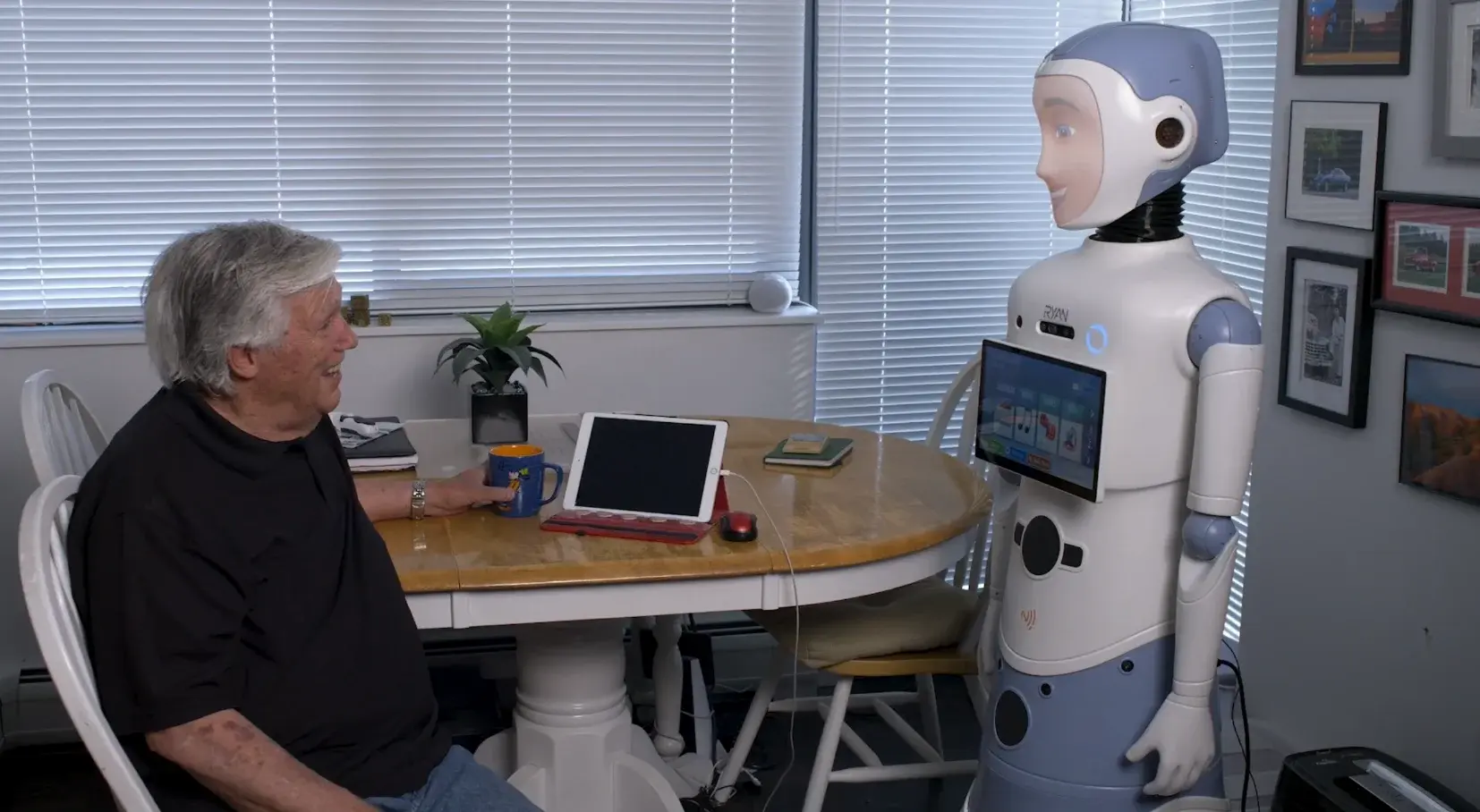
DreamFace Technologies
Two businesses share one name: a peer-reviewed socially assistive robot for older adults, and a consumer AI-avatar app with no verified link to it.
| Report status | Coverage date | Company stage | Editorial standard |
|---|---|---|---|
| Premium editorial deep report, sections 1–7 of 14 | Evidence gathered 19 September 2026 | Early commercial: pilot deployments, no disclosed pricing, no disclosed funding | Claim-vs-evidence separation; no demo treated as proof; no partnership treated as a paid customer |
How to Read This Report
This report is written for people who have to make decisions about DreamFace Technologies: investors, care-provider procurement leads, partnership scouts, and analysts tracking the socially assistive robotics category. It is not a company profile in the promotional sense. Where the public record is strong, we say so. Where it is thin, we say that too, rather than filling the gap with plausible-sounding narrative.
The central difficulty with this company is a naming collision. "DreamFace" is used by at least two distinct commercial efforts: DreamFace Technologies, LLC, the Denver-linked developer of the Ryan wellness robot for senior living 125, and a consumer AI-avatar and video-generation app marketed at dreamfaceapp.com 41112. The research dossier explicitly flags that several extracted facts conflate the two, and that some community commentary concerns entirely unrelated products (Luma's "Dream Machine," the streamer DreamWasTaken) 293031. We treat the robot business as the primary subject and handle the app business as a separate, weakly evidenced entity. Where we cannot tell which business a claim belongs to, we say so.
Every substantive statement below carries one of four evidence labels. The labels are not decoration; they determine how much weight a reader should place on the sentence.
| Label | Meaning | Examples in this report |
|---|---|---|
| VERIFIED FACT | Regulatory filings, official product documentation, named-customer confirmation, peer-reviewed or primary research, or corroboration across multiple independent sources. | Peer-reviewed pilot studies of Ryan with older adults 1920; CES 2024 Eureka Park selection reported across vendor and news sources 114. |
| COMPANY CLAIM | Stated by the company or its agents, not independently verified. | "World's first Wellness Robot"; "meets the rigorous standards of experts"; "augments caregivers" 125. |
| EDITORIAL INFERENCE | A reasoned conclusion drawn from public evidence, explicitly ours and not the company's. | That the robot business and the app business are commercially and technically separate. |
| UNKNOWN | Not publicly disclosed. | Unit pricing, unit volumes, funding raised, deployment count, safety certification. |
Three rules govern the analysis. First, a choreographed demonstration video is not proof of autonomous work; it is proof that a video was produced. Second, a shipment or a pilot installation is not proof of productive deployment; it is proof that hardware changed hands. Third, a partnership announcement is not proof of a paid customer; it is proof that two organisations agreed to say something together. We apply these rules even where the company's own materials invite a more generous reading.
One further note on sourcing. The dossier supplied for this report contains no official regulatory filings, no financial disclosures, and no named-customer confirmations beyond a single partnership announcement. The strongest evidence in the entire record is two peer-reviewed pilot studies 1920, and those are small (six and ten participants). Readers should calibrate accordingly: this is a company whose scientific credibility currently outruns its commercial evidence base.
01Executive Overview
DreamFace Technologies, LLC is a small, research-originated American company that builds a socially assistive robot called Ryan, marketed as a "Wellness Robot" for older adults in senior living and healthcare settings 125. The company is led by Mohammad H. Mahoor, Ph.D., who is identified as President and Founder and whose academic affiliation appears consistently across the vendor site and the peer-reviewed literature 11920. That consistency matters: it is the single cleanest link between the company's marketing and its scientific output, and it is the reason we treat the robot business as substantially more credible than the app business that shares its name.
The strongest evidence in the record is independent and peer-reviewed. Two studies document Ryan autonomously holding conversations with older adults, running cognitive games and reminiscence activities, and delivering daily schedule and medication reminders over multi-week deployments, including 24/7 in-room operation 1920. One of those studies reports a statistically significant improvement in reported mood and describes an affective dialogue manager that fuses facial-expression and speech-sentiment signals, with the empathic variant perceived as more engaging and likable 19. On the specific question of whether the robot performs its core task itself, the independent evidence supports an Autonomous verdict at moderate confidence (0.7). This is unusual in the socially assistive robotics category, where demonstrations frequently outrun documentation.
The commercial picture is far weaker than the scientific one. Ryan has been studied in facilities with six and ten older adults respectively 1920. The company has announced a partnership with USVetServ to bring wellness robots to Veterans Administration healthcare settings, carried by PR Newswire and several syndication outlets 6891617. It was one of five winners of the CES 2024 Eureka Park Accessibility Contest and a finalist in McKnight's Excellence in Technology awards for "Creative Use of AI" 1710. None of these establishes a paid customer at scale. UNKNOWN: unit price, units sold, revenue, funding raised, and the number of facilities with a robot installed today.
The consumer app business is a separate matter and, in our assessment, a separate company in all but name. DreamFace (dreamfaceapp.com) sells AI avatar and video-generation tooling: talking avatars, lip-sync, photo-to-video, and an "AI Live Avatar" product for always-on character livestreaming 41112. Its own blog claims the Live Avatar keeps a character "on" indefinitely, greeting viewers and running games 11. Community commentary in the dossier about uneven AI video output concerns Luma's Dream Machine, not DreamFace, and therefore does not refute the app's claims; it simply leaves them unverified 29. EDITORIAL INFERENCE: the two businesses share a name and possibly a founder-adjacent origin story, but there is no evidence in the record of shared technology, shared customers, or shared revenue. Analysts who blend them will produce a company that does not exist.
Three findings deserve to be stated plainly at the top.
First, the autonomy claim for Ryan's core task is better supported than the company's own marketing implies. The company says Ryan "augments caregivers" 12; the peer-reviewed studies show it doing the conversational and activity work itself, over weeks, without a human driving the task 1920. The vendor undersells the science.
Second, the safety and standards claims are unsubstantiated. The assertion that Ryan's technology "meets the rigorous standards of experts, including providers, payers, and VCs" 12 has no independent corroboration in the record. No certification body, no payer, and no provider is named. Treat this as marketing until a named third party confirms it.
Third, the deployment base is tiny. Two pilot studies with sixteen participants between them, plus a partnership announcement, is a research programme with commercial ambitions, not a commercial business with research support. The lifecycle classification is Pilot / Beta, and nothing in the record justifies moving it higher.
Overall confidence in this assessment: 0.62. The scientific evidence is solid; the commercial evidence is thin; the naming collision introduces persistent ambiguity that no amount of careful reading fully resolves.
Latest news
02The DreamFace Technologies Story
The company's public story begins with an academic problem: how to give older adults, particularly those with dementia and depression, a conversational companion that can hold their attention and improve their mood without pretending to be human 20. The earliest paper in the record, a 2017 pilot study on using an "intelligent life-like robot as a companion for elderly individuals with dementia and depression," describes a robot designed explicitly for that population 20. The later 2022 paper on artificial emotional intelligence in socially assistive robots for older adults extends the work into affective computing, adding facial-expression and speech-sentiment recognition with an affective dialogue manager 19. Both papers list Mahoor among the authors, and the vendor site identifies him as President and Founder 11920.
VERIFIED FACT: DreamFace Technologies is a social robotics and AI company focused on the aging population, led by Mohammad H. Mahoor, Ph.D., with research output published in peer-reviewed venues and a product named Ryan 121920.
EDITORIAL INFERENCE: The company is best understood as a research spin-out rather than a startup in the conventional venture-backed sense. The evidence for this is circumstantial but consistent: the founder is an academic; the product's public record is dominated by papers rather than deployments; the commercial materials are thin on pricing, customers, and funding; and the company's own news page is a list of awards and partnership announcements rather than sales milestones 114. Spin-outs of this kind typically face a specific commercial problem, which is that the technology is validated in the lab and unvalidated in the market. DreamFace appears to be at exactly that stage.
The product name, Ryan, and the hardware concept, a rear-projected life-like robot, appear in both the peer-reviewed literature and the vendor materials 251920. The rear-projection approach is a deliberate design choice: rather than building a mechanical face with actuators, the robot projects a rendered face onto a physical head form from behind. This produces a life-like appearance at lower mechanical complexity and cost than a humanoid head, at the price of being unable to physically manipulate objects or move its face in three dimensions. EDITORIAL INFERENCE: the design choice reveals the company's theory of the product. Ryan is built to talk, listen, and be present, not to fetch, lift, or navigate. That is a defensible niche in elder care, where the dominant unmet need is companionship and cognitive engagement rather than physical assistance, but it also caps the addressable task set.
The company's location is reported inconsistently. The dossier records Denver, Colorado and Greenville, South Carolina, the latter from a news dateline, at confidence 0.6 6. UNKNOWN: the company's actual operating headquarters and whether the two locations represent a headquarters and a second site, a founder's academic base and a commercial office, or simply inconsistent datelines. This is a small detail that matters more than it looks: it is the kind of ambiguity that a company with a mature commercial operation would not tolerate.
The commercial narrative, as the company tells it, runs through recognition and partnership. Ryan was selected as one of five winners of the CES 2024 Eureka Park Accessibility Contest 114. It was named a finalist in McKnight's Excellence in Technology awards in the "Creative Use of AI" category 710. The company announced a partnership with USVetServ to bring wellness robots to Veterans Administration healthcare settings, distributed via PR Newswire and picked up by Morningstar, Third News, Digital Producer, and Breaking and Taking 6891617. COMPANY CLAIM: the company positions these as evidence of market traction. EDITORIAL INFERENCE: awards and partnership announcements are leading indicators of ambition, not lagging indicators of revenue. The CES contest is a genuine independent selection and carries real signal about the product's perceived novelty; the McKnight's finalist status is a trade-press recognition; the USVetServ partnership is a memorandum of intent until a VA facility confirms a paid or funded deployment, which no source in the record does.
What the story does not contain is equally informative. There is no disclosed funding round, no disclosed investor, no disclosed revenue, no disclosed unit price, and no named care provider confirming a purchase 15. A Tracxn company profile exists but the dossier does not record financial detail from it 15. UNKNOWN: the company's capital structure and runway. For a hardware-plus-AI business serving a regulated care market, the absence of any funding disclosure is a material gap, because the path from pilot to deployment in senior living runs through procurement, liability insurance, and clinical validation, all of which cost money the company has not publicly demonstrated it has.
The naming collision completes the story in an unsatisfying way. A consumer app called DreamFace operates at dreamfaceapp.com, selling AI avatar and video tooling, with its own blog, its own CES-adjacent marketing, and its own interview coverage describing it as a "global leader in AI-generated digital humans" 4111213. EDITORIAL INFERENCE: on the evidence available, these are two separate commercial entities that happen to share a name. The dossier explicitly warns that extracted facts conflate them 411. We therefore treat the app's claims, including the "always-on AI character" livestreaming feature 11, as belonging to a different business unless and until a source connects them. Readers who encounter "DreamFace" in the wild should first ask which one is meant.
03Product Portfolio: What DreamFace Technologies Actually Sells
The portfolio, as best the public record supports it, contains one robot and one research platform, plus a name-sharing consumer app that we treat separately.
Ryan, the Wellness Robot. Ryan is a rear-projected, life-like conversational socially assistive robot, described in the peer-reviewed literature and marketed by the company as the DreamFace CompanionBot 251920. VERIFIED FACT: the hardware concept, a rear-projected face on a physical head, is documented in peer-reviewed work 1920. COMPANY CLAIM: the marketing name "Wellness Robot" and the positioning language around it 125.
The documented capability set is specific and worth listing precisely, because it is the strongest part of the entire record. According to the peer-reviewed studies, Ryan can hold autonomous conversations, run cognitive games, lead reminiscence activities, run sing-alongs and meditation sessions, and deliver daily schedule and medication reminders 1920. The 2022 study adds multimodal emotion recognition, fusing facial expression and speech sentiment, with an affective dialogue manager that adjusts the interaction accordingly; the empathic version of the system was perceived as more engaging and likable by participants 19. VERIFIED FACT: the capability set above is documented in peer-reviewed studies, not merely claimed.
The research platform. The company markets Ryan as an "AI-Powered Wellness Robot - Research Platform" on a dedicated page 5. EDITORIAL INFERENCE: this is a deliberate dual-track strategy. Selling to researchers lowers the commercial bar, because academic buyers evaluate novelty and publishability rather than clinical efficacy and total cost of ownership. It also generates the publication record that supports the commercial pitch. The risk is that the research channel becomes the only channel, and the company remains permanently pre-commercial.
The consumer app. DreamFace at dreamfaceapp.com sells AI avatar and video-generation tooling: talking avatars, lip-sync, photo-to-video, and an "AI Live Avatar" for always-on character livestreaming 41112. Its blog claims the Live Avatar keeps a character "on" indefinitely, greeting viewers, running games, and holding a room on its own 11. COMPANY CLAIM: all of the above. EDITORIAL INFERENCE: this is a different product for a different market, and there is no evidence in the record that it shares technology with Ryan beyond the possibility of generic avatar rendering. We flag it because the name collision will mislead anyone doing casual research, and because the app's existence may explain some of the consumer-facing search results that appear to belong to the robot company.
What is not in the portfolio is as important as what is. There is no disclosed price for Ryan 1235. The company offers a "Book a Demo" page, which is the standard motion of a company selling a considered purchase through a sales team rather than a self-serve channel 3. UNKNOWN: unit price, lease terms, service contract structure, and whether the robot is sold, leased, or provided under a research agreement. For a care provider evaluating Ryan against a staffing budget, the absence of public pricing is a real friction, though not an unusual one in enterprise hardware.
| Product | What it is | Documented capability | Evidence strength | Price |
|---|---|---|---|---|
| Ryan (DreamFace CompanionBot) | Rear-projected life-like socially assistive robot for older adults | Autonomous conversation, cognitive games, reminiscence, sing-alongs, meditation, schedule/medication reminders, multimodal emotion recognition 1920 | VERIFIED FACT via peer-reviewed studies | UNKNOWN |
| Ryan research platform | Same hardware positioned for academic research buyers 5 | As above | COMPANY CLAIM for the platform positioning | UNKNOWN |
| DreamFace consumer app | AI avatar and video generation: talking avatars, lip-sync, photo-to-video, AI Live Avatar 41112 | Claimed always-on character livestreaming 11 | COMPANY CLAIM, unverified; community commentary in the record concerns a different product 29 | Subscription and free credits mentioned, no figure 4 |
EDITORIAL INFERENCE on portfolio coherence: the robot and the app do not obviously reinforce each other. A company selling a clinically-oriented elder-care robot and a company selling meme-video tooling have different buyers, different sales cycles, different regulatory exposure, and different brand requirements. If they are in fact the same company, that is a strategic distraction worth questioning. If they are different companies, the shared name is a liability for the robot business, because a care provider's due-diligence search will surface the app and its consumer-grade reputation.
Products & versions
04Technology Stack: Strengths and the Work That Remains
The technology stack has three layers worth separating: the physical embodiment, the perception and dialogue system, and the deployment and operational layer. The peer-reviewed record is strong on the middle layer, adequate on the first, and largely silent on the third.
Embodiment: rear projection. Ryan renders a face onto a physical head form using a projector mounted behind it 1920. VERIFIED FACT: this is the documented hardware approach. The advantages are real. A projected face can display a far wider range of expressions than a mechanical face with a fixed set of actuators, at lower cost and with fewer moving parts to fail. It can also render a photorealistic human face, which is central to the "life-like" positioning. The disadvantages are equally real. Rear projection requires a light path and therefore a physical enclosure, which constrains form factor. It performs poorly in bright ambient light, a genuine concern in senior-living environments with large windows. And it cannot touch, hold, or manipulate anything, which caps the task set at conversation and cognitive engagement. EDITORIAL INFERENCE: the design is well matched to the company's chosen task and poorly matched to any expansion into physical assistance. That is a strategic boundary, not a flaw, but it should be understood as a boundary.
Perception and affect. The 2022 study documents multimodal emotion recognition combining facial expression analysis with speech sentiment, feeding an affective dialogue manager 19. VERIFIED FACT: this capability is peer-reviewed. The study reports that the empathic version of the system was perceived as more engaging and likable 19. This is the company's genuine technical differentiator. Most socially assistive robots in the elder-care space do competent speech interaction; far fewer close the loop from perceived user emotion back into dialogue policy in a way that has been measured with real older adults. EDITORIAL INFERENCE: the affective loop is the asset a larger competitor would most plausibly want to acquire or replicate, and it is the part of the stack most defensible in the near term, because it is grounded in a specific population and a specific interaction style rather than in generic model capability.
Dialogue and autonomy. The studies describe Ryan proactively engaging users and running activities over multi-week deployments 1920. VERIFIED FACT: proactive, autonomous task performance is documented. This is the basis for the Autonomous verdict. It is worth being precise about what autonomy means here and what it does not. It means no human is driving the conversation, selecting the game, or delivering the reminder in the moment. It does not mean the robot decides its own goals, manages its own care plan, or operates outside a configured activity set. EDITORIAL INFERENCE: this is autonomy at the task level within a human-designed programme, which is the correct and responsible level for this application, and it is also the level at which the company's own "augments caregivers" language is most accurate.
The deployment and operational layer. This is where the record goes quiet. There is no public documentation of how Ryan is installed, how activities are configured, how medication reminders are kept current, how the system handles a resident who does not want to interact, what happens when the robot malfunctions in a resident's room at 3 a.m., how data is stored and transmitted, or what privacy controls exist for a device with a camera and microphone in a bedroom. UNKNOWN: all of the above. The dossier's autonomy verdict explicitly notes that operational aspects such as setup, scheduling, and maintenance do not lower the autonomy level, which is correct as a matter of definition, but it does not follow that they are unimportant. In elder care, the operational layer is where deployments succeed or fail, and its absence from the public record is the single largest gap in the technology story.
Safety and standards. The company claims Ryan's technology "meets the rigorous standards of experts, including providers, payers, and VCs" 12. COMPANY CLAIM. No certification body, no named payer, no named provider, and no standard number appears in the record. EDITORIAL INFERENCE: this claim should be treated as unsubstantiated. A device with a camera and microphone in a resident's room, interacting with a population that includes people with dementia and depression, raises genuine questions about privacy, consent, and safeguarding. The absence of any public safety or privacy documentation is a material gap for any care provider considering procurement, and it is the gap most likely to slow the company down.
What the stack does not include. There is no evidence in the record of manipulation, mobility, physical assistance, fall detection, or integration with electronic health records. UNKNOWN: whether any of these exist but are undisclosed. On the public evidence, Ryan is a stationary conversational device with an unusually expressive face and an unusually well-documented affective loop. That is a coherent product. It is not a caregiving robot in the sense that phrase often implies, and the company's marketing language occasionally drifts toward that implication.
05Research, Papers, Authors and Labs
The research record is the strongest part of this company's public profile, and it is worth examining closely because it is doing most of the evidential work in this report.
The two core papers. The 2017 pilot study, "A Pilot Study on Using an Intelligent Life-like Robot as a Companion for Elderly Individuals with Dementia and Depression," describes a deployment with six elderly participants in Denver over four to six weeks, with the robot operating 24/7 in residents' rooms 20. The 2022 paper, "Artificial Emotional Intelligence in Socially Assistive Robots for Older Adults: A Pilot Study," describes a study with ten older adults in a senior care facility, documenting the affective dialogue system and reporting that the empathic version was perceived as more engaging and likable 19. VERIFIED FACT: both studies are peer-reviewed and both are independent of the company's marketing materials, though the founder is an author on the work, which is normal for a spin-out and does not undermine the findings but does mean the studies are not fully independent of the company's interests.
What the studies establish. Taken together, they establish that Ryan can autonomously hold conversations, run cognitive games and reminiscence activities, and deliver reminders to older adults over multi-week deployments; that the system can recognise emotion from face and voice and adapt its dialogue accordingly; and that participants reported a statistically significant improvement in mood and valued the interaction 1920. VERIFIED FACT. These are meaningful findings. Multi-week, 24/7 in-room deployment with an elderly population is a substantially higher bar than a lab demonstration, and the fact that the company cleared it is the reason this report's autonomy verdict is Autonomous rather than Scripted.
What the studies do not establish. The sample sizes are six and ten. There is no control group described in the dossier's summary of either study. There is no long-term follow-up, no measurement of whether mood benefits persist after the robot is removed, no cost-effectiveness analysis, and no comparison against a human activity coordinator or a tablet-based intervention. EDITORIAL INFERENCE: the findings are promising and preliminary. They justify further study. They do not justify a claim of clinical efficacy, and the company does not appear to make one, which is to its credit.
The author and lab. Mohammad H. Mahoor is identified as President and Founder of DreamFace Technologies and appears as an author on the peer-reviewed work 11920. VERIFIED FACT: the founder-product-paper link is consistent across sources. UNKNOWN: the specific academic lab affiliation, the current status of that affiliation, and whether the company has a formal licence or spin-out agreement with the university. The dossier does not record these, and they matter for anyone assessing intellectual-property risk.
Adjacent research in the record. The dossier includes two papers that are not about Ryan: ExFace, on expressive facial control for humanoid robots with diffusion transformers 21, and DreamControl, on human-inspired whole-body humanoid control for scene interaction via guided diffusion 22. EDITORIAL INFERENCE: neither appears to be DreamFace Technologies work. ExFace concerns mechanical humanoid facial control, which is the opposite of Ryan's projection approach. DreamControl concerns whole-body locomotion and scene interaction, which Ryan does not do. They are likely included because of keyword overlap. We note them here so readers do not mistakenly attribute them to the company, and we do not rely on them.
Research gaps. There is no published work in the record on privacy, data handling, or the ethical deployment of a camera-and-microphone device in a resident's bedroom. There is no published work on failure modes, on what happens when the robot misrecognises emotion in a person with dementia, or on how residents with cognitive impairment understand what the robot is. UNKNOWN: whether such work exists but is unpublished. For a company whose core claim is that it improves the wellbeing of a vulnerable population, the absence of published ethical and safety analysis is conspicuous.
<!-- module: papers --> <!-- module: authors-labs --> <!-- module: repos --> <!-- module: datasets -->06Media Evidence Library: What the Videos Prove
The dossier contains six video sources, and the first thing to say about them is that none of them shows Ryan doing autonomous work with an older adult. That is not a criticism of the company; it is a statement about what video evidence can and cannot establish, and it is the reason this report does not treat any video as proof of capability.
What the videos actually are. The six video sources in the record are consumer tutorials for the DreamFace app, not demonstrations of the Ryan robot. They cover building a talking AI avatar on mobile 23, adding lip sync to an AI avatar using ElevenLabs and DreamFace with a Runway ML final step 24, creating an AI guitar cover 25, making meme videos 26, and two tutorials on producing an AI-animated music video for a track by Black Sherif using Gemini, DreamFace, and InShot 2728. VERIFIED FACT: these are the videos in the record. EDITORIAL INFERENCE: they belong to the consumer app business, not the robot business, and they tell us about the app's use case, which is content creation by hobbyists and small creators, not about Ryan at all.
What this means for the evidence base. The media library in this dossier provides no visual evidence of the Ryan robot in operation. There is no video of a resident interacting with Ryan, no video of a cognitive game session, no video of a medication reminder being delivered. UNKNOWN: whether such footage exists on the company's own channels but was not captured in this dossier. If it exists, it would be worth reviewing, with the caveat that a produced video is still not proof of autonomy.
The general rule, applied. A choreographed demonstration video proves that a video was produced. It does not prove that the behaviour shown occurs without a human operator, that it occurs reliably, or that it occurs in the conditions depicted. This rule applies with particular force to socially assistive robots, where the gap between a polished demo and a working deployment is where most companies in the category have failed. The reason this report's autonomy verdict rests on the peer-reviewed studies rather than on video is precisely that the studies describe multi-week unsupervised deployment, which is a far stronger form of evidence than any demo could be.
What would change our assessment. Video evidence that would materially strengthen the record would include: unedited continuous footage of a full activity session with a resident, with timestamps and no cuts; footage of the robot handling an unexpected or off-script interaction; footage of a resident declining to interact and the robot responding appropriately; and footage from a facility that is not a research partner. None of these is in the record. EDITORIAL INFERENCE: the company's strongest evidence is textual and peer-reviewed, and its weakest is visual. That is an unusual and, in this category, a somewhat favourable inversion, because peer review is harder to obtain than a good demo reel.
Media library
07Commercial Reality
This is the section where the gap between the scientific record and the commercial record is widest, and where readers considering any commercial relationship with DreamFace Technologies should focus their attention.
What is established. Ryan has been deployed in at least two senior care settings for research purposes, with six and ten older adults respectively 1920. The company has announced a partnership with USVetServ to bring wellness robots to Veterans Administration healthcare settings, distributed through PR Newswire and syndicated across Morningstar, Third News, Digital Producer, and Breaking and Taking 6891617. Ryan was one of five winners of the CES 2024 Eureka Park Accessibility Contest and a finalist in McKnight's Excellence in Technology awards 1710. The company operates a demo-booking page, indicating an active sales motion 3. VERIFIED FACT: the above are documented across multiple sources.
What is not established. There is no named care provider in the record confirming a purchase. There is no disclosed unit price 1235. There is no disclosed number of units sold or deployed. There is no disclosed revenue. There is no disclosed funding round or investor 15. There is no disclosed payer relationship, despite the company's claim that its technology meets the standards of payers 12. There is no disclosed contract with the VA, only a partnership announcement with an intermediary organisation. UNKNOWN: all of the above.
The partnership, examined carefully. The USVetServ announcement is the company's most significant commercial signal, and it deserves scrutiny rather than dismissal or acceptance. A partnership announcement establishes that two organisations have agreed to work together and have issued a joint statement. It does not establish that money has changed hands, that a VA facility has accepted a robot, that a procurement process has been completed, or that any veteran has interacted with Ryan. EDITORIAL INFERENCE: the announcement is a genuine leading indicator. USVetServ is an organisation whose purpose is to serve veterans, and its willingness to associate publicly with DreamFace suggests at least some diligence. But the gap between a partnership announcement and a funded deployment in a VA facility is large, and it runs through federal procurement, which is slow, competitive, and unforgiving of small vendors without a track record. Readers should treat this as a door opening, not a sale closing.
The awards, examined carefully. The CES 2024 Eureka Park Accessibility Contest selection is the more meaningful of the two recognitions, because it involved an independent judging process and a competitive field; being one of five winners is a real signal about the product's perceived novelty and relevance to accessibility 114. The McKnight's Excellence in Technology finalist status is a trade-press recognition in the senior-living sector, valuable for visibility with buyers but not a validation of efficacy 710. EDITORIAL INFERENCE: neither award is evidence of commercial traction. Both are evidence of market interest, which is a different and earlier thing.
The pricing problem. The company positions Ryan as "cost-effective" but discloses no price 125. EDITORIAL INFERENCE: in senior living, the relevant comparison is not another robot; it is an activity coordinator's hourly wage, a tablet-based engagement programme, or doing nothing. Without a price, a care provider cannot make that comparison, and without a published price, the company cannot scale through self-serve or channel sales. The demo-booking motion suggests a high-touch enterprise sale, which is appropriate for a considered purchase but expensive to run and slow to convert, particularly for a company with no disclosed funding.
The consumer app's commercial reality. The app business at dreamfaceapp.com operates on a subscription and free-credit model 4. Its blog describes an AI Live Avatar product for always-on character livestreaming 11 and CES-related marketing for AI face animation 12, and it has received interview coverage describing it as a global leader in AI-generated digital humans 13. COMPANY CLAIM: all of the above. EDITORIAL INFERENCE: the consumer AI-avatar market is crowded, commoditised, and characterised by rapid feature parity, which makes it a difficult business to defend. Community commentary in the record about uneven AI video output concerns Luma's Dream Machine rather than DreamFace 29, so it neither supports nor undermines the app's claims. We note the app here only to complete the commercial picture and to reiterate that it should not be blended with the robot business.
The bottom line on commercial reality. DreamFace Technologies is a company with peer-reviewed evidence of a working product, meaningful recognition in its target market, one partnership announcement with a veterans' organisation, and no publicly disclosed revenue, pricing, funding, or named paying customer. That is a pre-commercial profile. It is not a failing profile, and the scientific evidence is genuinely better than the category average. But any assessment that treats the CES award, the McKnight's finalist status, or the USVetServ announcement as evidence of a commercial business is reading more into the record than the record contains.
Customers & deployments
DreamFace Technologies partnered with USVetServ to bring its wellness robots to Veterans Administration healthcare settings.
Sections 8 through 14 follow in the second part of this report.
08Markets and Use Cases
DreamFace Technologies sits at the intersection of two markets that are frequently conflated in robotics commentary but which have very different buyers, sales cycles, regulatory exposure, and unit economics: socially assistive robotics for older adults (the Ryan robot) and consumer generative AI avatar/video tooling (the DreamFace app). The dossier supports treating these as separate businesses with separate competitive logics, even though they share a corporate name and, apparently, some brand equity. This section maps the addressable demand for each, the use cases the evidence actually supports, and the ones that remain aspirational.
8.1 The elder-care social robot market: real demand, hard sales
The demographic case for socially assistive robots in senior living is not controversial. Labour shortages in direct-care staffing, rising rates of social isolation and loneliness among older adults, and the cost of one-to-one companionship are well-documented structural pressures across the United States, Western Europe, and Japan. Ryan is positioned precisely against these pressures: the vendor describes it as a "Wellness Robot" that "augments caregivers" and engages residents in conversation, cognitive games, reminiscence, sing-alongs, meditation, and daily reminders 125. The peer-reviewed studies corroborate that the robot can perform these activities autonomously in a resident's room over multi-week periods 1920.
What the evidence does not establish is commercial traction at scale. The two peer-reviewed deployments involved six and ten older adults respectively 1920. The USVetServ partnership is a distribution and channel announcement, not a disclosed paid deployment 6891617. There is no public pricing 125, no disclosed unit volume, and no named senior-living operator confirming a paid fleet. This is the classic profile of a company in the pilot-to-early-commercial transition: the technology has been validated in controlled research settings, the go-to-market motion is being assembled, but the revenue base is not yet visible from outside.
The practical implication for buyers and investors is that Ryan should be evaluated as a pilot-stage capital purchase or lease, not as a proven fleet product. The relevant questions are not "does the robot work?" (the research says yes, for its defined task) but "what is the total cost of ownership per resident per month?", "who maintains the projector and the software?", "what happens when the cloud dialogue service is unavailable?", and "what is the churn rate after the novelty period?" None of these are answered in the public record.
8.2 Use-case segmentation for Ryan
The dossier supports a tiered view of use cases by evidence strength.
| Use case | Evidence basis | Maturity | Notes |
|---|---|---|---|
| In-room companionship conversation | Peer-reviewed pilot, 6 residents, 4–6 weeks, 24/7 1920 | Demonstrated in research | Strongest-evidenced use case |
| Cognitive games and reminiscence activities | Peer-reviewed pilot 1920; vendor 12 | Demonstrated in research | Autonomy verdict rests here |
| Daily schedule / medication reminders | Peer-reviewed pilot 1920 | Demonstrated in research | Reminder reliability not independently audited |
| Mood improvement | Peer-reviewed pilot, statistically significant 19 | Demonstrated in research | Effect size and durability not disclosed |
| Group activities in common areas | Vendor marketing 125 | Claimed | Not independently evidenced |
| Caregiver augmentation / staff relief | Vendor marketing 12 | Claimed | No independent time-and-motion study |
| Veterans Administration settings | Partnership announcement 6891617 | Announced | No confirmed paid deployment |
| Clinical/therapeutic intervention | Not claimed in dossier | — | Ryan is a wellness product, not a medical device |
The distinction between wellness and medical is commercially decisive. A wellness positioning avoids FDA device classification and the associated clinical-evidence burden, but it also caps reimbursement pathways and makes Ryan a discretionary operating expense for facilities rather than a billable clinical intervention. The dossier contains no evidence that DreamFace is pursuing a medical-device pathway, and the "Wellness Robot" branding is consistent with a deliberate choice to stay on the wellness side of that line 125.
8.3 The consumer avatar app market: crowded, fast-moving, weakly moated
The DreamFace consumer app competes in the AI avatar and video generation market against a large field of well-capitalised incumbents and fast-followers. The app's advertised capabilities include talking avatars, lip-sync, photo-to-video, and an "AI Live Avatar" that keeps a character "on" indefinitely for livestreaming 41112. The company's own blog positions it as a "global leader in AI-generated digital humans" 13, a claim that is marketing rather than a measured market share.
This market has three structural features that matter for DreamFace:
- Low switching costs. Users can move between avatar tools in minutes; there is no data lock-in comparable to an enterprise SaaS system of record.
- Commodity model access. Most competitors draw on the same or similar foundation models and lip-sync pipelines; differentiation is increasingly in workflow, latency, and price rather than core capability.
- Platform dependency. Distribution runs through app stores and social platforms, both of which can change terms, take a cut, or launch competing features.
The dossier's community evidence on AI video quality is thin and partly about other products (Luma's Dream Machine, and unrelated "Dream" personalities) 293031323334. It should not be read as a verdict on DreamFace's app. It does, however, illustrate the reputational environment: users are sceptical of AI video quality claims generally, and "hit and miss" is a common characterisation of the category. DreamFace's app claims therefore stand unverified rather than contradicted.
8.4 Adjacent and speculative markets
The dossier does not disclose any roadmap beyond the Ryan robot and the consumer app. Plausible adjacencies that a company in this position might pursue include: memory-care-specific configurations, integration with electronic health records or nurse-call systems, remote family-connection features, and licensing of the affective dialogue stack to third-party robot makers. None of these are evidenced. They are noted here only to frame the monitoring checklist in §13, not as claims about the company's plans.
09Competitive Landscape
DreamFace Technologies competes in two distinct arenas. In elder-care social robotics it is a small, research-rooted player against a mix of well-funded humanoid and social-robot companies and a long tail of niche vendors. In consumer AI avatars it is one of many app-layer tools riding foundation-model capability. The competitive analysis below separates these, because a single "competitor set" would be misleading.
9.1 Elder-care social robotics: the real comparison set
The closest comparators are not general-purpose humanoids but socially assistive robots explicitly aimed at older adults. The dossier does not supply competitor profiles, so the table below is an editorial framing of the categories Ryan sits among, with the caveat that specific competitor claims are outside the supplied evidence base and should be verified separately.
| Category | Representative archetype | Form factor | Typical positioning | How Ryan differs (per dossier) |
|---|---|---|---|---|
| Life-like social robots | Humanoid/torso social robots | Seated, expressive | Companionship, research | Ryan uses rear projection for a life-like face 1920 |
| Pet/companion robots | Zoomorphic | Small, tactile | Comfort, dementia support | Ryan is conversational and activity-leading 1920 |
| Tablet/voice assistants | Screen + speaker | Fixed | Reminders, calls | Ryan adds embodied presence and affect 1920 |
| Telepresence robots | Screen on a base | Mobile | Family/staff connection | Ryan is autonomous, not teleoperated 1920 |
| General-purpose humanoids | Bipedal/torso | Mobile, dexterous | Broad tasks | Ryan is single-purpose and stationary |
The strategic read is that Ryan's differentiation is not hardware sophistication. Rear projection is a deliberate trade: it produces a compelling life-like face at lower mechanical complexity and cost than an actuated humanoid head, but it constrains the robot to a fixed, seated, indoor context. That constraint is a feature for the target use case (in-room companionship) and a limitation for any ambition to move into mobility, manipulation, or multi-room operation.
The autonomy verdict matters competitively. Independent peer-reviewed evidence that Ryan autonomously holds conversations, runs cognitive games, and delivers reminders over multi-week 24/7 deployments 1920 is a stronger evidence position than many social-robot vendors can claim, because much of the category is demonstrated through short, choreographed demos rather than longitudinal deployments. If DreamFace can convert that research credibility into procurement credibility, it has a defensible niche. If it cannot, the research advantage will not translate into revenue.
9.2 Consumer AI avatars: a different fight entirely
In the consumer app market, DreamFace competes on features (talking avatars, lip-sync, photo-to-video, live avatar streaming) 41112 against a broad field of avatar and video-generation tools. The dossier does not name specific competitors, and the community sources that mention "Dream Machine" and similar names refer to other products 29, so no direct competitor comparison can be made from the supplied evidence. What can be said is structural: this is a market with low differentiation, rapid feature parity, and platform risk. A small company's app-layer position here is inherently fragile unless it has a proprietary model, a unique dataset, or a distribution advantage. The dossier does not evidence any of the three.
9.3 Where DreamFace is genuinely differentiated
Pulling the two arenas together, the defensible assets visible in the dossier are:
- Longitudinal peer-reviewed evidence of autonomous operation with older adults 1920. This is rare and hard to fake.
- An affective dialogue and multimodal emotion-recognition stack validated in a pilot 19.
- A named channel partnership (USVetServ) targeting VA healthcare 6891617.
- Award recognition (CES 2024 Eureka Park Accessibility Contest winner; McKnight's finalist) 1710.
The fragile assets are:
- No disclosed pricing or unit economics 125.
- No named paid customer in the public record.
- A consumer app business with no evidenced moat.
- Marketing claims ("world's first," "meets rigorous standards") that are unverified 12.
Competitive comparison
| Robot | Maker | Autonomy | Conf. |
|---|---|---|---|
| iRobot Roomba Combo 10 Max | iRobot | Autonomous | 0.90 |
| Mobile ALOHA (Stanford) | Stanford University | Teleoperated | 0.90 |
| 1X NEO | 1X Technologies | Remote-Assisted | 0.90 |
10Geopolitical Context and Constraints
DreamFace Technologies is a United States company, headquartered per news datelines in Denver, Colorado and Greenville, South Carolina 68. Its primary market, elder care in the US, and its channel partnership with USVetServ targeting Veterans Administration settings 6891617, place it squarely inside the US healthcare and veterans' services ecosystem. This has several consequences that are easy to overlook in a product-focused analysis.
10.1 Domestic policy tailwinds and headwinds
Tailwinds. Population ageing, caregiver shortages, and policy interest in ageing-in-place and technology-enabled care all favour the category. Veterans' healthcare is a large, federally funded buyer with a mandate to serve an ageing population, which makes the USVetServ channel strategically sensible 6891617. Accessibility-focused recognition (CES Eureka Park Accessibility Contest) aligns with public-sector procurement priorities 1.
Headwinds. US healthcare procurement is slow, evidence-demanding, and fragmented across facilities, payers, and the VA's own processes. A wellness positioning avoids FDA device review but also limits reimbursement. Data privacy in elder care is governed by a patchwork of HIPAA (where applicable), state laws, and facility policies; a robot that holds conversations in a resident's room and processes facial expressions and speech sentiment 19 sits in a sensitive data category. The dossier does not disclose DreamFace's data-handling architecture, retention policies, or privacy posture. That is a material unknown for any facility considering deployment.
10.2 Supply chain and component exposure
The dossier does not disclose Ryan's bill of materials, manufacturing location, or component suppliers. A rear-projected robot requires a projector, optics, compute, microphones, cameras, and a structural enclosure; the compute and some sensors may be sourced from global supply chains with exposure to export controls and tariff regimes. None of this is evidenced, so no specific geopolitical risk can be asserted. It is, however, a standard diligence question for a hardware company in this position, and its absence from the public record is itself informative about the company's disclosure maturity.
10.3 The consumer app and cross-border data
The consumer DreamFace app 4111213 operates in a global app market and, by the nature of avatar and video generation, processes user-uploaded faces, voices, and likenesses. This raises jurisdictional issues around biometric data (for example, Illinois BIPA-style statutes in the US, and GDPR special-category data in the EU) that are not addressed in the dossier. The reputational and legal environment for face and voice cloning is tightening in multiple jurisdictions, and a consumer avatar product is more exposed to that shift than a facility-deployed wellness robot. Again, this is an inference from the product category, not a documented fact about DreamFace.
10.4 The name-collision risk
A recurring theme in the dossier is that "DreamFace" is used by multiple unrelated entities and products: the Ryan robot company 12, the consumer avatar app 41112, and community discussions of other "Dream"-branded things 293031. In a geopolitical and procurement context, brand ambiguity is a real cost: it complicates due diligence, muddies press coverage, and can cause a serious elder-care buyer to conflate the company with a consumer novelty app. The dossier's own reconciliation notes flag this conflation explicitly. It is a communications and positioning problem more than a technical one, but it is not trivial.
11The Hype, the Real and the Ugly
This section applies the report's evidence discipline directly to the claims DreamFace and its ecosystem make. The goal is not to be adversarial but to separate what is verified, what is claimed, what is inferred, and what remains unknown.
11.1 The Real: what the evidence actually supports
The strongest, most defensible facts about DreamFace Technologies are:
- A peer-reviewed, longitudinal evidence base for autonomous operation. Two independent pilot studies document Ryan autonomously and proactively engaging older adults in conversation, cognitive games, reminiscence, and reminders over multi-week deployments, including 24/7 in-room operation for six residents over four to six weeks 1920. This is the company's single most valuable asset and it is not marketing.
- A validated affective capability. Multimodal emotion recognition (facial expression plus speech sentiment) with an affective dialogue manager, where the empathic version was perceived as more engaging and likable 19.
- A measured outcome. Statistically significant improvement in reported mood among participants 19.
- A named channel partnership. USVetServ, targeting Veterans Administration healthcare settings, reported across multiple outlets 6891617.
- Independent recognition. CES 2024 Eureka Park Accessibility Contest winner; McKnight's Excellence in Technology finalist 1710.
These are the claims a sceptical analyst should lead with. They are specific, sourced, and in the case of the peer-reviewed work, methodologically inspectable.
11.2 The Hype: claims that outrun the evidence
Several claims in the vendor and news material are not independently verified and should be treated as marketing until they are:
| Claim | Source type | Evidence status | Editorial note |
|---|---|---|---|
| "World's first Wellness Robot" | Vendor/news 12 | Unverified | Superlative with no comparative methodology |
| "Augments caregivers" | Vendor 12 | Unverified | No independent time-and-motion or staffing study |
| "Meets the rigorous standards of experts, including providers, payers, and VCs" | Vendor 12 | Unverified | Vague; "VCs" are not a standards body |
| "Global leader in AI-generated digital humans" | Vendor blog 13 | Unverified | No market-share data |
| AI Live Avatar keeps a character "on" indefinitely, "holding a room on its own" | Vendor 11 | Unverified | No independent test of uptime or engagement |
| CES/McKnight's recognition | Vendor + multiple news 1710 | Verified (as recognition) | Recognition is real; it is not a product-performance claim |
The pattern is familiar: a company with genuine research substance wraps it in superlatives that a careful buyer will discount. The risk is not that the superlatives are false in a narrow sense; it is that they invite the buyer to over-generalise from a six-person pilot to a facility-wide deployment.
11.3 The Ugly: gaps, ambiguities, and risks
Three issues deserve to be stated plainly.
First, the evidence base is small. Six and ten participants 1920 is enough to support a pilot finding and an autonomy verdict, but not enough to support claims about population-level efficacy, cost-effectiveness, or staff relief. Any facility or investor treating the pilots as proof of scaled impact is over-reading them.
Second, the commercial record is opaque. No pricing 125, no named paid customer, no disclosed unit volume, no churn data. The USVetServ partnership 6891617 is a channel announcement; a partnership is not a paid customer, and the dossier does not evidence a signed, funded VA deployment.
Third, the brand is entangled. The consumer DreamFace avatar app 4111213 shares a name with the Ryan robot company 12, and community sources discuss yet other "Dream"-branded products 293031. The dossier's reconciliation explicitly warns that extracted facts conflate these. For a company selling into healthcare and veterans' settings, that ambiguity is a liability.
11.4 Claim tracker
The table below is the report's consolidated claim-vs-evidence ledger. It is designed to be updated as new evidence appears.
| # | Claim | Claimant | Evidence label | Confidence | What would change the verdict |
|---|---|---|---|---|---|
| 1 | Ryan autonomously holds conversations with older adults | Peer-reviewed 1920 | Verified (research setting) | High | Independent replication at scale |
| 2 | Ryan autonomously runs cognitive games/reminiscence | Peer-reviewed 1920 | Verified (research setting) | High | Field data outside research protocols |
| 3 | Ryan delivers daily reminders | Peer-reviewed 1920 | Verified (research setting) | Medium-High | Reliability audit over months |
| 4 | Ryan improves mood | Peer-reviewed 19 | Verified (pilot) | Medium | Larger RCT with effect sizes |
| 5 | Ryan "augments caregivers" | Vendor 12 | Company claim | Low | Independent staffing study |
| 6 | Ryan "meets rigorous standards" | Vendor 12 | Company claim | Low | Named standards and audit |
| 7 | "World's first Wellness Robot" | Vendor 12 | Company claim | Low | Comparative methodology |
| 8 | USVetServ partnership will bring robots to VA | News 6891617 | Verified (announcement) | Medium | Signed VA deployment confirmation |
| 9 | CES 2024 Accessibility Contest winner | Vendor + news 1 | Verified | High | — |
| 10 | McKnight's Excellence in Technology finalist | Vendor + news 710 | Verified | High | — |
| 11 | Consumer app produces high-quality avatars | Vendor 41112 | Company claim | Low | Independent quality benchmark |
| 12 | Consumer app is "global leader" | Vendor 13 | Company claim | Low | Market-share data |
| 13 | Concrete pricing exists | None | Unknown | — | Published price list |
| 14 | Named paid customer exists | None | Unknown | — | Customer confirmation |
Claim tracker
Two independent peer-reviewed pilot studies [19][20] document the robot proactively engaging older adults in conversation, games, and reminders over multi-week, 24/7 in-room deployments with no human driving the task, though sample sizes were small (6 and 10 participants).
The peer-reviewed pilot study [19] directly reports the multimodal emotion-recognition architecture and that the empathic version was rated more engaging/likable, though it is a single small pilot rather than a large independent trial.
Independent peer-reviewed studies [19][20] report statistically significant mood improvement and rapport in senior-care facility deployments (6 elderly in Denver over 4–6 weeks; 10 older adults), though both are small pilots rather than large-scale trials.
The hardware description (rear-projected life-like form) comes from the peer-reviewed paper [19], and the product naming/positioning is corroborated by vendor and news sources [1][2][6], though no independent teardown or third-party spec verification exists.
The partnership is reported only via the company's own press releases and their syndicated reprints [6][8][9][16][17]; no independent VA confirmation, contract value, or deployment numbers were found, so it remains vendor-sourced.
This is a vendor marketing statement [1][2][5] with no independent verification of any standards, certification, pricing, or payer endorsement found in the dossier, so it stands unsubstantiated rather than refuted.
The 'world's first' superlative appears only in vendor/news marketing [1][2][6][14], while the only documented deployments are two small peer-reviewed pilots (6 and 10 participants) [19][20] with no pricing or broad commercial availability, so 'deployed at scale' is contradicted by the evidence.
The capability claims come only from the vendor's own app blog and tutorials [4][11][12][23][24], while the only community critique [29] concerns a different product (Luma), so the app's output quality and always-on claim remain unverified rather than contradicted.
12Future Scenarios
The following scenarios are editorial inferences, not predictions. They are constructed to bracket the plausible range of outcomes over a roughly 24-to-36-month horizon and to make the monitoring checklist in §13 actionable. Probabilities are qualitative and reflect the dossier's overall confidence of 0.62.
12.1 Scenario A: The credible niche (base case)
Narrative. DreamFace converts its peer-reviewed evidence into a small but real commercial base. The USVetServ channel produces a handful of funded VA or VA-adjacent deployments. A few senior-living operators adopt Ryan in memory-care or companion-care units as a pilot-to-lease. The company publishes pricing, a customer reference, and a follow-up study with a larger sample. The consumer app business continues as a separate, modest revenue line.
Indicators. A named facility confirms paid use; pricing appears on the site; a third peer-reviewed study with n>30 is published; the VA relationship moves from "partnership" to "deployment."
What it requires. Execution on sales and support, not just research. The company must solve the unglamorous problems: installation, maintenance, cloud reliability, staff training, and data privacy documentation.
Editorial assessment. This is the most likely path given the evidence. It is unspectacular and it is the outcome a careful buyer should plan around.
12.2 Scenario B: The research-to-nowhere gap (downside)
Narrative. The pilots do not translate into procurement. Facilities cite cost, IT integration, privacy concerns, or staff workflow friction. The USVetServ partnership produces announcements but no funded deployments. The consumer app is squeezed by better-capitalised competitors and platform changes. The company remains a respected research outfit with a compelling demo and no scalable revenue.
Indicators. No new customer announcements over 12–18 months; no pricing published; key personnel departures; the website's "news" page goes quiet 14.
What it would mean. The autonomy evidence was real but insufficient. In elder care, technical capability is necessary but not sufficient; procurement, reimbursement, and workflow fit dominate.
12.3 Scenario C: The pivot to software (upside-adjacent)
Narrative. DreamFace recognises that its durable asset is the affective dialogue and multimodal emotion-recognition stack, not the projector hardware. It licenses the stack to other robot makers, telehealth platforms, or consumer device companies, and/or doubles down on the consumer avatar app. The Ryan robot becomes a reference implementation rather than the core business.
Indicators. Partnership announcements framed around "technology licensing"; job postings for B2B/API roles; the app business receiving investment or spin-out.
Editorial assessment. Plausible but not evidenced. The dossier contains no licensing activity. It is included because it is a common and rational pivot for companies in this position, and because it would change the competitive analysis materially.
12.4 Scenario D: Acquisition or wind-down (tail)
Narrative. A larger eldercare, robotics, or health-tech company acquires DreamFace for the team, the IP, and the peer-reviewed evidence base. Alternatively, funding constraints force a wind-down of the hardware line.
Indicators. Tracxn or similar profiles showing funding events or acquisition activity 15; changes in corporate registration; founder statements.
Editorial assessment. Low-to-moderate probability. The peer-reviewed evidence and the affective stack are acquirable assets; the hardware business is not obviously attractive to a strategic buyer.
12.5 Scenario summary
| Scenario | Horizon | Probability (editorial) | Key trigger to watch |
|---|---|---|---|
| A: Credible niche | 24–36 months | Most likely | First named paid customer |
| B: Research-to-nowhere | 18–30 months | Plausible | Silence in news pipeline 14 |
| C: Software pivot | 12–24 months | Possible | Licensing announcement |
| D: Acquisition/wind-down | 12–36 months | Tail | Funding or M&A disclosure 15 |
13What to Watch: A Live Monitoring Checklist
This checklist is designed for an analyst or buyer tracking DreamFace Technologies over the next 12–24 months. Each item is framed as a falsifiable signal with a source to monitor and a note on what it would change.
13.1 Commercial signals
| # | Signal | Where to look | What it would change |
|---|---|---|---|
| 1 | First named paid customer (facility or VA) | Company news 14, PR Newswire 18 | Moves lifecycle from Pilot/Beta toward Early Commercial |
| 2 | Published pricing or lease terms | Product/demo pages 35 | Enables TCO comparison; signals commercial maturity |
| 3 | Disclosed unit volume or fleet size | Press releases 18 | Distinguishes pilot from scale |
| 4 | Renewal or churn disclosure | Company statements | Tests durability of engagement beyond novelty |
| 5 | USVetServ partnership converts to funded deployment | VA announcements, 6891617 | Validates channel strategy |
| 6 | Funding round or revenue disclosure | Tracxn 15, press 18 | Indicates runway and investor confidence |
13.2 Evidence and research signals
| # | Signal | Where to look | What it would change |
|---|---|---|---|
| 7 | New peer-reviewed study with n>30 | arXiv, journals 1920 | Strengthens efficacy claims beyond pilot |
| 8 | Independent replication by another lab | Academic literature | Raises confidence in autonomy verdict |
| 9 | Long-term (6–12 month) deployment data | Company or academic publication | Tests durability and maintenance burden |
| 10 | Cost-effectiveness or staffing-impact study | Health services research | Supports "augments caregivers" claim 12 |
| 11 | Safety or adverse-event reporting | Regulatory, facility disclosures | Material risk signal |
13.3 Product and technology signals
| # | Signal | Where to look | What it would change |
|---|---|---|---|
| 12 | Cloud dependency and offline behaviour disclosed | Technical docs 5 | Material for facility IT and privacy review |
| 13 | Data privacy and retention policy published | Company site 12 | Required for healthcare procurement |
| 14 | Hardware reliability and maintenance terms | Product/demo pages 35 | Affects TCO and uptime assumptions |
| 15 | Multilingual or accent coverage | Product updates | Affects addressable market |
| 16 | Integration with EHR, nurse-call, or family apps | Product updates | Determines workflow fit |
13.4 Brand and positioning signals
| # | Signal | Where to look | What it would change |
|---|---|---|---|
| 17 | Clarification of Ryan vs consumer app branding | Company site 14 | Reduces conflation risk flagged in dossier |
| 18 | Retirement of unverified superlatives | Marketing copy 12 | Signals disclosure maturity |
| 19 | Named clinical or academic advisors | Company site 2 | Strengthens credibility |
| 20 | Consumer app quality benchmarks | Independent reviews | Tests "global leader" claim 13 |
13.5 How to use this checklist
The single highest-value signal is #1, a named paid customer. Until that appears, DreamFace should be classified as a pilot-stage company with strong research evidence and unproven commercial traction. The second-highest-value signal is #7, a larger peer-reviewed study, because it would extend the evidence base from pilot to something closer to generalisable. Everything else is secondary to these two.
14Sources and Methodology
14.1 Methodology
This report was produced under an explicit evidence discipline. Every factual assertion is labelled as one of four types:
| Label | Definition | Treatment in this report |
|---|---|---|
| Verified fact | Regulatory filing, official product documentation, named-customer confirmation, peer-reviewed or primary research, or corroborated by multiple independent sources | Stated as fact with citation |
| Company claim | Stated by DreamFace Technologies or its agents, not independently verified | Attributed to the company; not treated as fact |
| Editorial inference | Reasoned conclusion drawn from public evidence | Flagged as inference; reasoning shown |
| Unknown | Not publicly disclosed | Stated as "not publicly disclosed"; not padded |
Three rules were applied throughout:
- A choreographed demo video is not proof of autonomous work. The autonomy verdict in this report rests on peer-reviewed longitudinal studies 1920, not on marketing video.
- A shipment is not proof of productive deployment. The USVetServ partnership 6891617 is treated as an announcement, not a paid deployment.
- A partnership announcement is not proof of a paid customer. No named paid customer appears in the public record supplied.
The dossier's own reconciliation flagged a significant risk: several extracted facts conflate the consumer "DreamFace" avatar app 4111213 with the Ryan robot company 125, and some community sources concern unrelated products (Luma's Dream Machine, and a content creator known as "Dream") 293031. This report treats those as separate and does not use them to support claims about the Ryan robot.
14.2 Confidence assessment
The dossier reports an overall confidence of 0.62. This report's section-level confidence is broadly consistent:
| Domain | Confidence | Basis |
|---|---|---|
| Autonomy of Ryan's core task | High (0.7–0.9) | Two peer-reviewed longitudinal studies 1920 |
| Affective capability | High (0.9) | Direct peer-reviewed evidence 19 |
| Mood outcome | Medium-High (0.85) | Peer-reviewed pilot 19 |
| Commercial traction | Low | No named paid customer, no pricing |
| Consumer app quality | Low | Vendor claims only; community evidence is off-target |
| Safety/standards claims | Low | Unverified vendor language 12 |
| Corporate details (HQ, structure) | Medium (0.6) | News datelines 68 |
14.3 Source list
The following sources are the complete evidence base for this report. No sources outside this list were used, and no citation numbers were invented.
- DreamFace Technologies — https://dreamfacetech.com/
- About DreamFace Technologies - Ryan Wellness ... — https://dreamfacetech.com/about
- Book a Demo - Ryan Wellness Robot for Senior Living — https://dreamfacetech.com/book-demo
- Dreamface - Fast AI Video Generator at Your Fingertips — https://www.dreamfaceapp.com/
- AI-Powered Wellness Robot - Research Platform | Ryan — https://dreamfacetech.com/wellness-robot
- DreamFace Technologies partners with USVetServ to bring Wellness Robots to Veteran's Administration — https://www.prnewswire.com/news-releases/dreamface-technologies-partners-with-usvetserv-to-bring-wellness-robots-to-veterans-administration-302801576.html
- DreamFace Technologies' Wellness Robot, Ryan, Selected as a Finalist in McKnight's Excellence in Technology Awards — https://www.prnewswire.com/news-releases/dreamface-technologies-wellness-robot-ryan-selected-as-a-finalist-in-mcknights-excellence-in-technology-awards-302866039.html
- DreamFace Technologies partners with USVetServ to bring Wellness Robots to Veteran's Administration | Morningstar — https://www.morningstar.com/news/pr-newswire/20260616ph83659/dreamface-technologies-partners-with-usvetserv-to-bring-wellness-robots-to-veterans-administration
- DreamFace Technologies Teams with USVetServ to Enhance Veterans' Lives with Wellness Robots - Third News — https://third-news.com/article/f27209a8-6987-11f1-82b0-9ca3ba08e13f
- DreamFace Technologies' Wellness Robot, Ryan, Selected as a Finalist in McKnight's Excellence in Technology Awards – Health Technology Net — https://healthtechnologynet.com/2026/09/01/dreamface-technologies-wellness-robot-ryan-selected-as-a-finalist-in-mcknights-excellence-in-technology-awards/
- DreamFace AI Live Avatar: Always-On AI Character Livestreaming — https://www.dreamfaceapp.com/blog/dreamface-ai-live-avatar
- DreamFace Unveiled at CES: Redefining AI-Powered Face Animation and Digital Creation — https://www.dreamfaceapp.com/blog/dreamface-ces-ai-avatar-video-showcase
- Interview Feature: How Dreamface Became the Global Leader in AI-Generated Digital Humans — https://www.ainvest.com/news/interview-feature-dreamface-global-leader-ai-generated-digital-humans-2512/
- Ryan Wellness Robot News - Updates & Announcements — https://dreamfacetech.com/news
- Dream Face Technologies - 2026 Company Profile, Team, Funding ... — https://tracxn.com/d/companies/dream-face-technologies/__L03ObFEWp_u0HGangUbPqZ7BTGKAbdxB_dInXENhu9c
- DreamFace Technologies partners with USVetServ to bring ... — https://digitalproducer.com/dreamface-technologies-partners-with-usvetserv-to-bring-wellness-robots-to-veterans-administration/
- DreamFace Brings AI Wellness Robots to Veterans' Healthcare — https://breakingandtaking.com/article/76467
- DreamFace Technologies News and Press Releases | PR Newswire — https://www.prnewswire.com/news/dreamface-technologies/
- [2201.11167] Artificial Emotional Intelligence in Socially Assistive Robots for Older Adults: A Pilot Study — https://ar5iv.labs.arxiv.org/html/2201.11167
- A Pilot Study on Using an Intelligent Life-like Robot as a Companion for Elderly Individuals with Dementia and Depression — https://arxiv.org/pdf/1712.02881v1.pdf
- ExFace: Expressive Facial Control for Humanoid Robots with Diffusion Transformers and Bootstrap Training — https://arxiv.org/html/2504.14477
- DreamControl: Human-Inspired Whole-Body Humanoid Control for Scene Interaction via Guided Diffusion — https://arxiv.org/pdf/2509.14353v3.pdf
- The Easiest Way to Build a Talking AI Avatar on Mobile — https://www.youtube.com/watch?v=QFNaNKU42jk
- How to Add Lip Sync to Your AI Avatar | ElevenLabs + DreamFace Tutorial (Runway ML Final Step) - YouTube — https://www.youtube.com/watch?v=z-ZwdINguSs
- I Made an AI Guitar Cover in Minutes! - How to Create Acoustic Song Videos with DreamFace AI — https://www.youtube.com/watch?v=ov8qVTKFpO0
- Create Meme Videos FREE with Dreamface AI - YouTube — https://www.youtube.com/watch?v=fXB9gZVhMXw
- Black Sherif - SWAGGA AI ANIMATED MUSIC VIDEO Tutorial | Using Gemini, DreamFace & InShot FREE TOOLS - YouTube — https://www.youtube.com/watch?v=U7lNRdXUCYk
- Black Sherif - SWAGGA AI ANIMATED MUSIC VIDEO Tutorial | Using Gemini, DreamFace & InShot (FREE AI) — https://www.youtube.com/watch?v=k7mUTMXJtD4
- Has anybody had experience with Luma Labs "Dream Machine" AI ... — https://www.reddit.com/r/lumalabsai/comments/1dhmi8h/has_anybody_had_experience_with_luma_labs_dream/
- AI : r/DreamWasTaken2 - Reddit — https://www.reddit.com/r/DreamWasTaken2/comments/1o9wum6/ai/
- What's going on with Dream' face reveal? : r/OutOfTheLoop - Reddit — https://www.reddit.com/r/OutOfTheLoop/comments/xtwcu1/whats_going_on_with_dream_face_reveal/
- What happens when AI generated images/videos are no longer ... — https://www.reddit.com/r/NoStupidQuestions/comments/1q4etg5/what_happens_when_ai_generated_imagesvideos_are/
- Live AI face swapping is here and its gonna change the ... - Reddit — https://www.reddit.com/r/GenAI4all/comments/1qdfftk/live_ai_face_swapping_is_here_and_its_gonna/
- I was cautiously optimistic I actually caught the attention of a D-list ... — https://www.reddit.com/r/Scams/comments/1hdp3hi/i_was_cautiously_optimistic_i_actually_caught_the/
14.4 Limitations
- Thin commercial disclosure. No pricing, no named paid customer, no unit volumes. Commercial conclusions are necessarily provisional.
- Small research samples. The peer-reviewed pilots involved six and ten participants 1920. Findings are indicative, not definitive.
- Brand conflation. The dossier warns that some extracted facts mix the Ryan robot with the consumer avatar app and with unrelated "Dream"-branded entities. This report has separated them