Dnsys
US$0.99 unlocks one Word + one PDF download. The full report is free to read on this page.
Dnsys
Wearable exoskeletons sold direct to consumers on a promise of AI-adaptive powered assistance, whose commercial reality is a crowdfunded hardware brand with a CES award, a Kojima tie-in, and almost no independent verification of the numbers that matter.
| Report status | Coverage date | Company stage | Editorial standard |
|---|---|---|---|
| Premium editorial deep report; evidence-led, claim-skeptical | Dossier gathered 21 September 2026 | Fully commercial consumer hardware; crowdfunded origin; no disclosed institutional funding | Verified facts separated from company claims, editorial inference, and unknowns; no demo treated as proof of deployment |
How to Read This Report
This report is built from a deliberately narrow evidence base. The supplied dossier contains no official regulatory filings, no peer-reviewed research, no independent laboratory testing, and no named enterprise customer. It contains vendor commerce pages, vendor press releases, a small number of news items, and a handful of community forum posts. That asymmetry shapes everything below: most of what can be stated about Dnsys's performance is asserted by Dnsys, and the only counter-evidence is anecdotal.
Every substantive statement is labelled against one of four evidence classes.
| Label | Meaning | Example in this report |
|---|---|---|
| Verified fact | Confirmed by regulatory filing, official product documentation, named-customer confirmation, primary research, or multiple independent sources | The Indiegogo X1 campaign raised $1,501,684 from 1,919 backers 7 |
| Company claim | Stated by Dnsys or its agents; not independently verified | "Up to 1.2 hp / 900W of powered assistance" 8 |
| Editorial inference | Reasoned conclusion drawn from public evidence, flagged as such | The powered-assistance dispute is unlikely to be resolved without instrumented third-party testing |
| Unknown | Not publicly disclosed | Unit economics, manufacturing partner, component suppliers, warranty failure rates |
Three reading rules apply throughout. First, a choreographed demonstration video is not evidence of autonomous work; it is evidence that a device can be filmed. Second, a shipment or a crowdfunding fulfilment is not evidence of productive deployment; it is evidence of a transaction. Third, a partnership announcement is not evidence of a paid customer; it is evidence of a press release. Where the dossier is thin, this report says so rather than filling the gap with plausible-sounding narrative.
A note on the central ambiguity. Dnsys sits in a category where the marketing vocabulary ("AI-powered", "adaptive", "exoskeleton") is doing more work than the engineering evidence supports. The report therefore treats the powered-versus-passive question as the load-bearing issue it is, rather than a footnote.
01Executive Overview
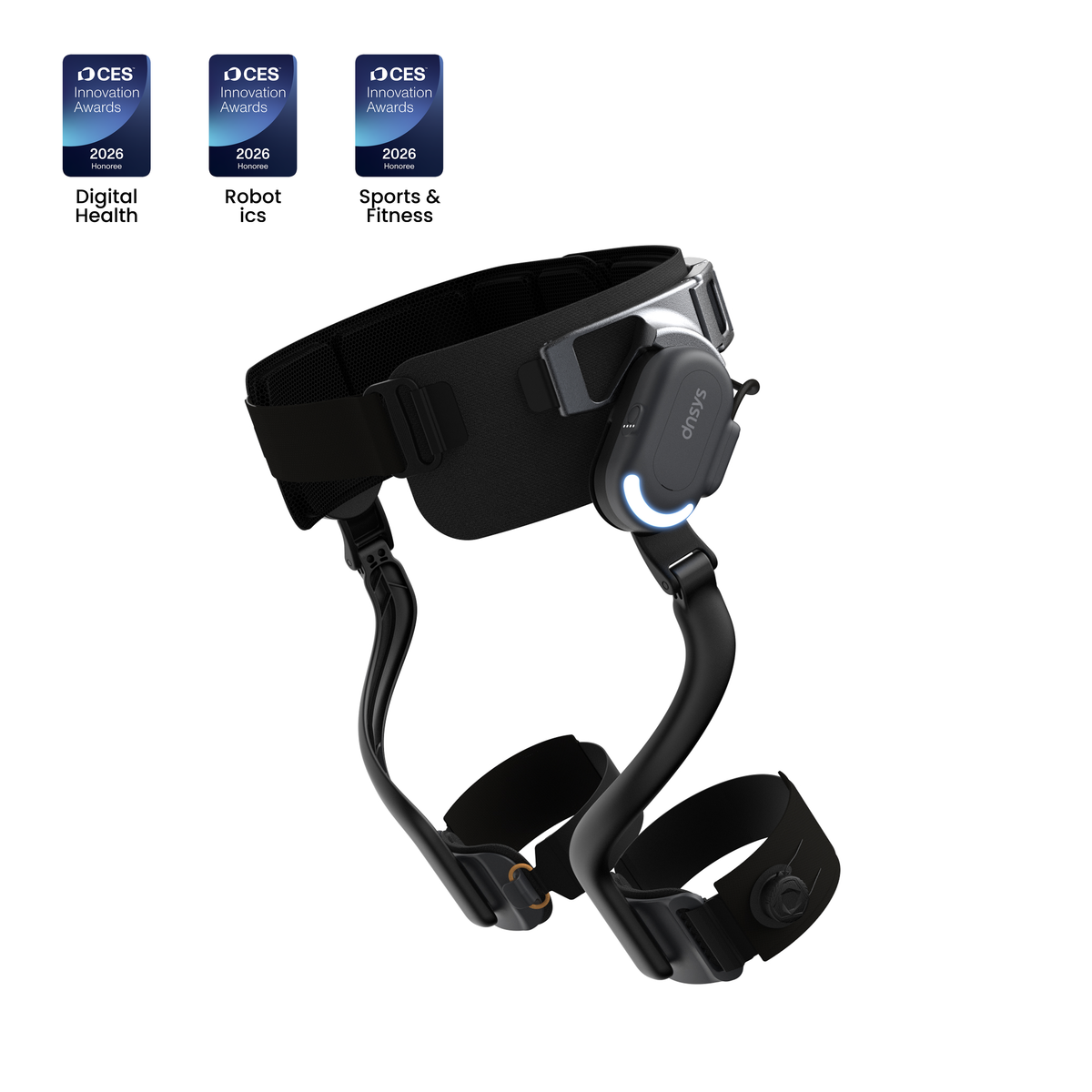
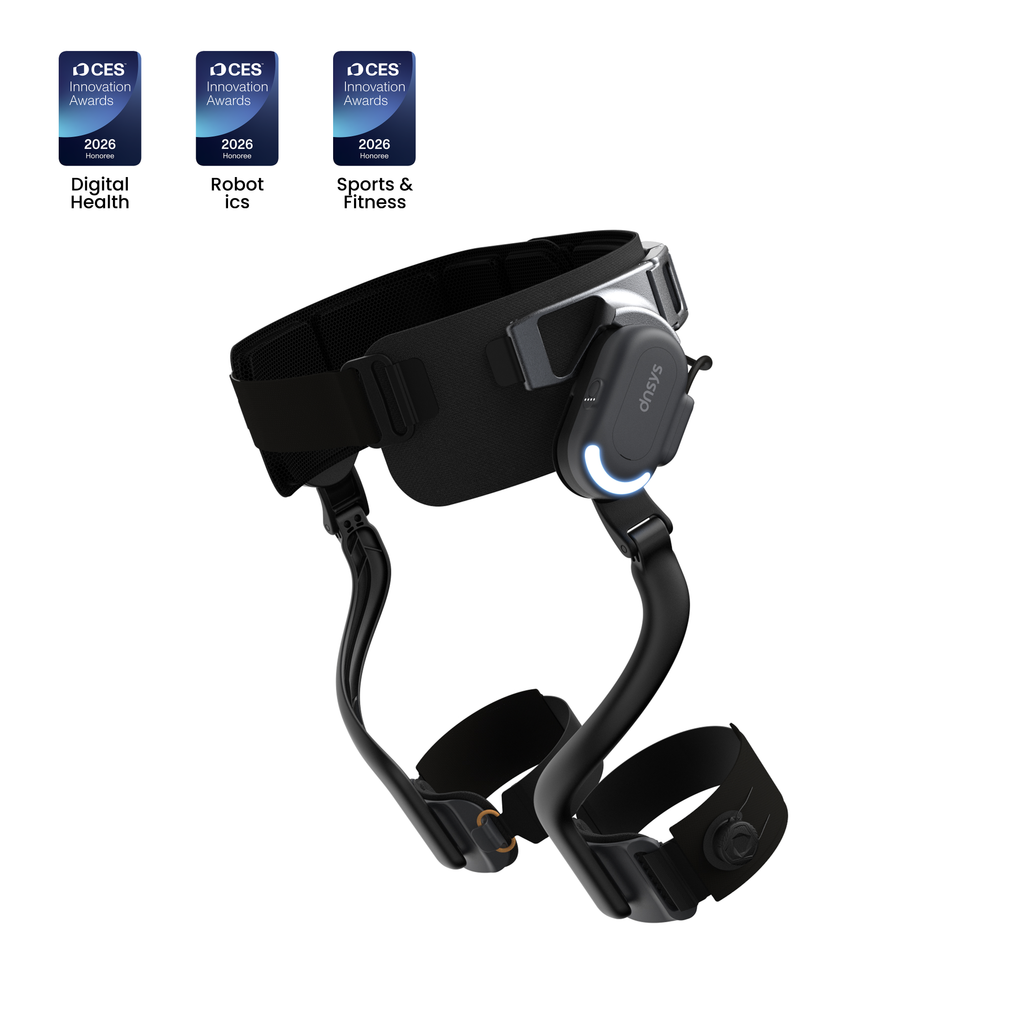
Dnsys is a consumer hardware brand selling wearable lower-limb exoskeletons: the X1, a hip-and-leg assist device, and the Z1, a knee-focused device, plus a limited-edition Z1 Pro produced in collaboration with Kojima Productions for Death Stranding 2: On the Beach 91. The products are sold direct to consumer at roughly $689 to $1,998 depending on model, configuration, and promotional pricing, with accessories priced between $99 and $279 14. The company's origin is crowdfunding: the X1 Indiegogo campaign raised $1,501,684 from 1,919 backers, and the Z1 was launched through Kickstarter 710. In late 2025 or early 2026 the Z1 was named a CES Innovation Awards 2026 Honoree across three categories: Digital Health, Robotics, and Sports & Fitness 9.
That is a coherent, verifiable commercial story. It is also a story with a large hole in the middle. The performance claims that define the product category, specifically "up to 1.2 hp / 900W of powered assistance", "up to 50% leg strength boost", "up to 150 kg weight offload", "20 kg lifting support", and "real-time / millisecond-level AI adaptive assistance", appear only in vendor-controlled channels 810. No independent test, no regulatory submission, and no peer-reviewed evaluation appears in the dossier. Meanwhile, at least one community source describes the devices as "basically passive spring braces, not powered exoskeletons" 12, a claim that, if accurate for any shipping configuration, would invalidate the core marketing proposition.
The safety framing is unusually candid and cuts against the marketing. Dnsys explicitly positions the products as mobility aids, not medical or rehabilitation devices, and states that they should be used only by people who can walk independently, lift their legs normally, and maintain balance, and are not recommended for people with skeletal, muscular, or neurological conditions 513. That is a responsible disclosure and a significant constraint on the addressable market. It also means the devices cannot be evaluated as medical interventions, and any clinical claim made about them by a reseller or affiliate would be unsupported.
Editorial inference. Dnsys is best understood as a consumer wellness and augmentation brand operating adjacent to, but deliberately outside, the medical device regulatory perimeter. The CES award and the Kojima collaboration are real credibility signals in the consumer-electronics and gaming-culture registers. They are not evidence of engineering performance. The gap between the two is the central analytical fact about this company.
The autonomy question resolves, on the current evidence, to "Autonomous" with low confidence (0.5). The device is worn by the user and assists the user's own movement; there is no evidence of teleoperation or of a remote human performing the task 8. But "autonomous" here means "the control loop runs on the device without a human in the loop", not "the device does the work for you". If the community claim of passive spring behaviour is correct for any SKU, then even that low-confidence verdict is generous.
Latest news
- Dnsys X1 Carbon Exoskeleton : The Robot Legs Everyone’s Talking AboutGeeky Gadgets·2026-06-30GENERAL
02The Dnsys Story
The public record of Dnsys begins, as far as the dossier shows, with crowdfunding rather than venture capital, institutional partnership, or academic spin-out. The X1 campaign on Indiegogo raised $1,501,684 from 1,919 backers 7. That is a meaningful sum for a hardware crowdfunding campaign and implies an average contribution of roughly $780, consistent with the X1's listed pricing band of $689 to $889 against a stated regular price of $1,299 147. The Z1 was subsequently launched via Kickstarter 10. The company is registered as "Dnsys (CO LTD doing business as Dnsys)" 79.
Editorial inference. The crowdfunding-first path is diagnostic. It means the company's earliest capital came from future customers rather than from investors who performed technical diligence. Crowdfunding backers are purchasing a promise; they are not, as a rule, commissioning instrumented torque testing. This does not make the products bad. It does mean that the company's early validation was commercial rather than technical, and that the marketing language was shaped by what converts on a campaign page rather than by what survives a laboratory.
The next visible milestone is the CES Innovation Awards 2026, where the Z1 was named an Honoree in three categories: Digital Health, Robotics, and Sports & Fitness 9. The award is announced via PR Newswire, a paid distribution channel, and the underlying submission materials are not public. CES Innovation Awards are judged on submitted documentation and, in some categories, on demonstration; they are a genuine signal of design and presentation quality and a weak signal of field performance. Editorial inference: the three-category spread is itself informative. Digital Health, Robotics, and Sports & Fitness are different claims about what the product is. A device that is simultaneously a health product, a robot, and sports equipment is, in regulatory terms, none of those things with any precision.
The most culturally visible moment in the company's history is the collaboration with Kojima Productions on a Death Stranding 2: On the Beach limited-edition Z1 Pro at $1,998 91. This is a verified partnership in the sense that both the PR Newswire release and the commerce listing exist 91. It is not evidence of a paid enterprise customer, a clinical deployment, or a technical milestone. It is a brand collaboration between a consumer exoskeleton maker and a game studio whose title features load-bearing exoskeletal imagery. Editorial inference: the collaboration is best read as a demand-generation play aimed at the gaming and transhumanist-adjacent audience that already discusses Dnsys on forums such as r/transhumanism 12. It is a marketing asset, and a clever one, but it tells the analyst nothing about torque, control latency, or battery behaviour.
What the dossier does not contain is equally important. There is no disclosed founding team, no named engineering leadership, no institutional investors, no manufacturing partner, no regulatory consultant, and no clinical advisory board. For a company making a device that sits one regulatory step away from a mobility aid with medical implications, the absence of any visible clinical or regulatory expertise is a material unknown. It is possible such expertise exists and is simply not public. It is not possible to verify that from the dossier.
The company's own framing of its products is notably careful. The FAQ and product pages state that the devices are mobility aids, not medical devices, and set explicit exclusion criteria: users must be able to walk independently, lift their legs normally, and maintain balance, and the devices are not recommended for people with skeletal, muscular, or neurological issues 513. Editorial inference: this is the language of a company that has taken legal advice and understands where the medical device boundary lies. It is also a tacit admission that the products are not rehabilitation tools, which is precisely the use case most likely to be assumed by a casual buyer who sees "exoskeleton" and "AI-powered" in the same sentence.
03Product Portfolio: What Dnsys Actually Sells
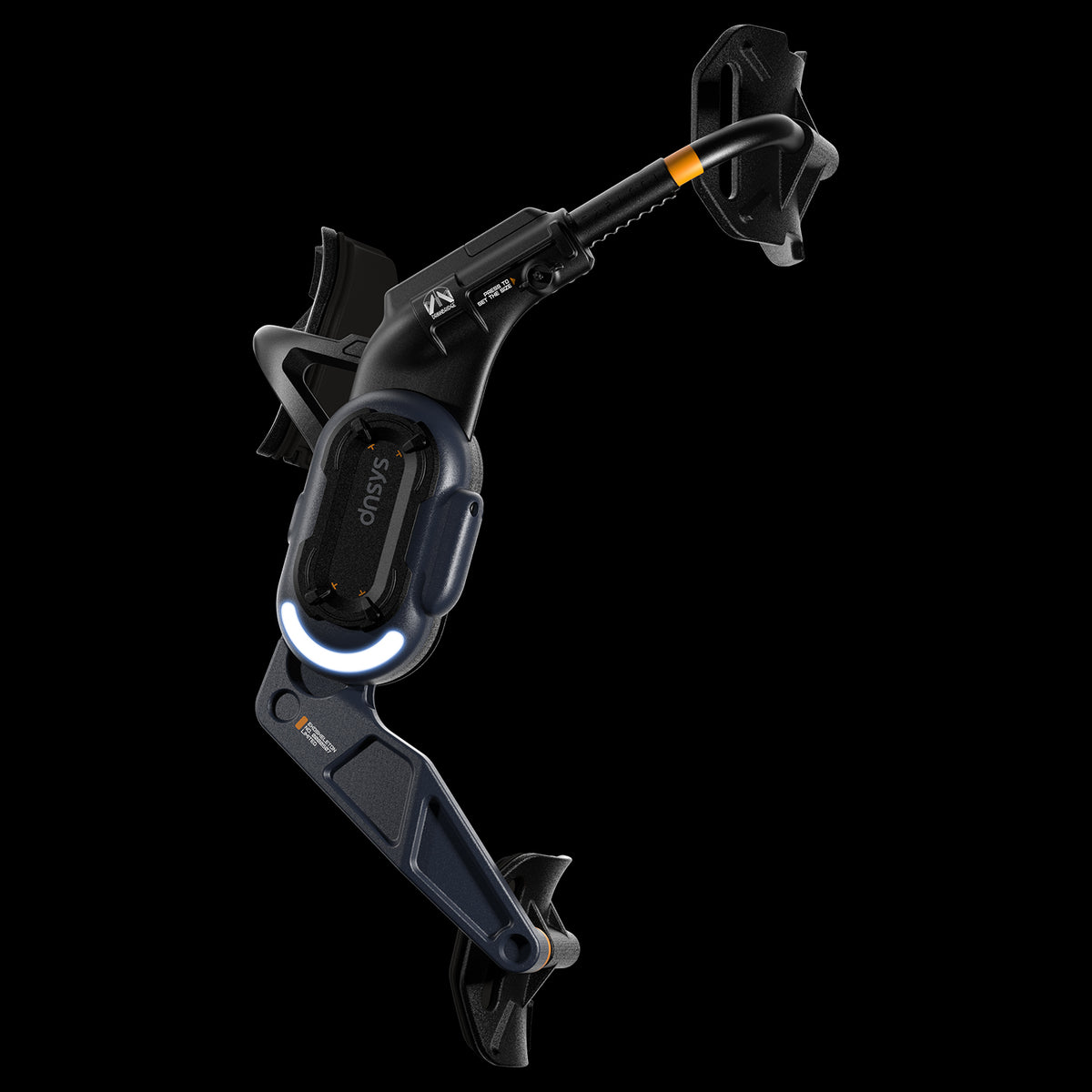
Dnsys sells two principal device lines and a supporting accessory catalogue. The X1 is a hip-and-leg exoskeleton; the Z1 is a knee exoskeleton; the Z1 Pro is a limited-edition variant tied to Death Stranding 2 189. Accessories include batteries, belts, straps, and a care kit, with the Knee Care Kit listed on pre-order while other items are available for immediate sale 1.
| SKU | Type | Listed price | Status | Notes |
|---|---|---|---|---|
| X1 | Hip/leg exoskeleton | ~$689–$889 (regular $1,299) | Available | Smart Battery + Black Charging Dock 145 |
| Z1 | Knee exoskeleton | $1,299 | Available | PowerPlus Battery + Orange-border Charging Dock Plus 15 |
| Z1 Pro (Death Stranding 2 LE) | Knee exoskeleton, limited edition | $1,998 | Available | Kojima Productions collaboration 91 |
| Accessories | Batteries, belts, straps, care kit | $99–$279 | Mixed; Knee Care Kit on pre-order | Highest listed price in catalogue $2,088 1 |
Verified facts. The SKU structure, the price bands, and the pre-order status of the Knee Care Kit are all confirmed across multiple commerce listings 14. The battery and charger incompatibility warning is confirmed on the vendor product page: the X1 uses the Smart Battery with the Black Charging Dock, the Z1 uses the PowerPlus Battery with the Orange-border Charging Dock Plus, and the two must not be mixed 5. This is a specific, checkable, and slightly awkward operational detail, and its presence in the documentation is a small point in the company's favour on documentation honesty.
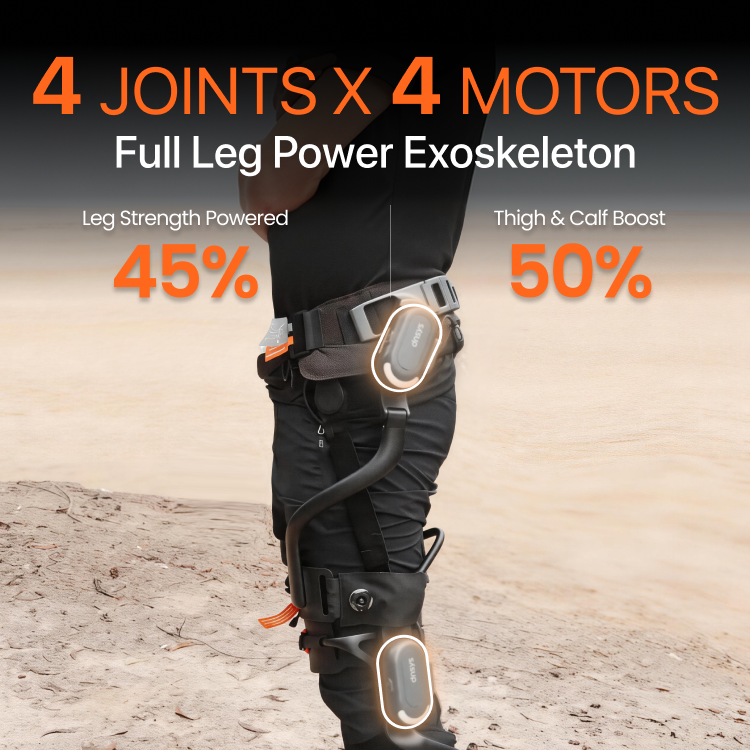
Company claims. The performance envelope is asserted consistently across vendor channels: up to 1.2 hp / 900W of powered assistance, up to 50% leg strength boost, up to 150 kg weight offload, 20 kg lifting support, real-time / millisecond-level AI adaptive assistance, full leg assistance, and a 15 km base range with a three-second battery swap 810. These numbers are internally coherent as a marketing package and are repeated across the product page, the PRWeb launch release, and the Amazon listing 4810. Repetition across channels is not independent verification; it is the same claim in three places.
Editorial inference. The pricing is the most revealing commercial fact in the portfolio. At $689 to $889 for the X1 and $1,299 for the Z1, Dnsys is priced well below clinical-grade powered exoskeletons, which typically run into the tens of thousands of dollars, and roughly in line with high-end consumer sports equipment. That price point is only achievable with a specific bill of materials: commodity brushless motors or, plausibly, no motors at all in some configurations, consumer-grade batteries, injection-moulded structures, and a phone-app-grade control stack. A device that genuinely delivered 900W of controlled assistive torque at $689 would be a remarkable piece of cost engineering. A device that delivers spring-like mechanical support with sensor-driven damping at $689 is entirely ordinary. The price point is, on its own, weak evidence for the passive interpretation and against the full powered interpretation, though it is not conclusive.
Unknowns. The dossier does not disclose motor type, peak versus continuous torque, control loop frequency, sensor suite, battery chemistry, ingress protection rating, weight of each SKU, or warranty terms. For a product whose entire value proposition is mechanical assistance, the absence of a torque curve is the single largest documentation gap.
Products & versions
04Technology Stack: Strengths and the Work That Remains
The technical story Dnsys tells is a control story. The claim is "real-time / millisecond-level AI adaptive assistance" 10, meaning the device senses the wearer's movement and modulates assistance within a control loop fast enough to feel natural. The company also claims "full leg assistance" and a 15 km base range with a three-second battery swap 8.
Editorial inference. The millisecond-level claim is the most technically specific and the most testable assertion in the entire dossier, and it is also the one most likely to be true in a trivial sense. Any digital control loop running at, say, 1 kHz has a 1 ms period. "Millisecond-level" therefore describes the loop rate, not the quality of the assistance, the accuracy of the intent detection, or the phase lag between the wearer's movement and the device's response. A device can have a 1 ms control loop and still feel sluggish if its intent-detection layer is slow or its actuator is underpowered. The claim is not false; it is unfalsifiable as stated.
The "AI" component is similarly under-specified. There is no published model architecture, no description of the training data, no indication of whether inference runs on-device or on a paired phone, and no accuracy or latency figures for gait-phase estimation 810. Unknown: the entire machine-learning stack. Editorial inference: in consumer wearables, "AI-powered" frequently denotes a small classifier or a rule-based adaptive controller marketed with contemporary vocabulary. That is not a criticism of the engineering; adaptive impedance control is genuinely difficult. It is a criticism of the labelling, which invites the reader to imagine a capability that has not been demonstrated.
The battery architecture is the one area where the dossier contains a concrete, verifiable engineering decision. The X1 and Z1 use different battery and charger systems and must not be mixed 5. Editorial inference: this is a normal consequence of two products developed on different timelines with different power requirements, and the explicit warning suggests the company has fielded support tickets from users who tried to interchange them. It is a small but real indicator that the products are separate engineering efforts rather than a single platform with cosmetic variation.
The 15 km range figure and the three-second battery swap are mutually reinforcing claims: a short range is tolerable if the swap is genuinely fast 8. Editorial inference: three seconds is plausible for a hot-swap design with a latching connector and a small internal buffer capacitor, but it is also the kind of number that is measured under ideal conditions and degrades with cold, sweat, or a stiff latch. No independent measurement exists.
What remains. The work that remains for Dnsys is not primarily actuation; it is evidence. The company needs, at minimum: a published torque-versus-speed curve for each SKU; a description of the sensor suite and control architecture; an independent laboratory measurement of assistive torque and control latency; and a transparent account of what "AI" does and does not do. None of these appear in the dossier. Until they do, the technology stack should be treated as described-but-unverified.
05Research, Papers, Authors and Labs
Not publicly disclosed. The dossier contains no peer-reviewed publications, no conference papers, no preprints, no patents, no named academic collaborators, and no laboratory affiliations associated with Dnsys. There is no evidence of a research programme in the conventional sense.
This is not unusual for a consumer hardware company, and it would be unfair to treat the absence as a failing in itself. Many successful consumer device makers publish nothing. But it matters for how the company's claims should be weighted. Exoskeleton research is an active academic field with established methodologies for measuring assistive torque, metabolic cost reduction, and gait-phase tracking accuracy. A company making quantitative claims about strength boost and weight offload has the option of submitting those claims to that literature or to a contract testing house. Dnsys has not, on the available evidence.
Editorial inference. The absence of published research also means there is no independent baseline against which to evaluate the "50% leg strength boost" and "150 kg weight offload" claims 8. Those figures are stated without a test protocol, without a definition of the measurement (isometric peak? dynamic average? single-joint?), and without a population. A 50% strength boost measured isometrically at a single joint angle in a healthy young adult is a very different claim from a 50% boost during normal walking in an older adult, and the marketing does not distinguish between them.
Unknowns. Whether Dnsys employs any research staff, whether it has commissioned third-party testing, whether it holds or has applied for patents, and whether it has any clinical partnerships. None of this is in the dossier.
<!-- module: papers --> <!-- module: authors-labs --> <!-- module: repos --> <!-- module: datasets -->06Media Evidence Library: What the Videos Prove
The dossier's media holdings are thin: a single YouTube review, "DNSYS Z1 Review - First Ai Powered Exoskeleton For Knees!" 3, plus the vendor's own product imagery and the Amazon listing's media 4. There are no independent instrumented tests, no teardown videos, and no long-duration field footage in the dossier.
Editorial inference. A consumer review video, even a favourable one, establishes three things and no more: that a unit exists, that it can be worn, and that a reviewer was willing to appear on camera using it. It does not establish assistive torque, control latency, battery endurance under load, or durability. The title's framing, "First Ai Powered Exoskeleton For Knees", is itself a marketing claim reproduced by the reviewer, not an independent finding.
The vendor's own media, including the Amazon listing imagery and the product pages, is by definition choreographed. Editorial inference: the appropriate use of vendor media is to establish product form factor, wearing position, and industrial design, all of which are visible and verifiable from a photograph. It should not be used to establish performance. A device filmed assisting a squat proves that the device was present during a squat.
What the media does not show. No video in the dossier demonstrates a blinded comparison against a passive brace, a measured reduction in muscle activation via EMG, a metabolic measurement, or a control-latency test. These are the experiments that would settle the powered-versus-passive dispute, and none of them appear to have been performed publicly.
Media library
07Commercial Reality
Dnsys's commercial reality is a direct-to-consumer hardware business with a crowdfunded origin, a modest but real revenue base, and no disclosed enterprise or institutional channel.
Verified facts. The X1 Indiegogo campaign raised $1,501,684 from 1,919 backers 7. The Z1 launched via Kickstarter 10. Products are listed for sale on the company's own store and on Amazon 14. The Knee Care Kit is on pre-order while other items ship 1. The Z1 Pro Death Stranding 2 limited edition is listed at $1,998 19.
| Commercial dimension | Status | Evidence class |
|---|---|---|
| Funding | Crowdfunded; $1,501,684 from 1,919 backers on Indiegogo for X1; Z1 via Kickstarter | Verified fact 710 |
| Revenue channel | Direct-to-consumer via dnsys.ai and Amazon | Verified fact 14 |
| Institutional/enterprise customers | None disclosed | Unknown |
| Clinical or care-home deployments | None disclosed | Unknown |
| Distribution partners | None disclosed beyond Amazon | Unknown |
| Returns policy | Defective units only; not for lack of performance | Company claim / community report 13 |
| Manufacturing | Not disclosed | Unknown |
| Unit economics | Not disclosed | Unknown |
Editorial inference. The crowdfunding totals are the best available proxy for demand, and they should be read carefully. $1,501,684 across 1,919 backers is a successful campaign by crowdfunding standards, but it is a one-time capital event, not recurring revenue. The transition from crowdfunding to sustained direct-to-consumer sales is where most hardware companies fail, and the dossier contains no data on post-campaign sales velocity, repeat purchase rates, or return rates.
The returns policy is the most commercially significant item in this section. According to a community report, returns are accepted only for defective units, not for lack of performance 13. Editorial inference: if accurate, this policy is a rational response to a product whose benefits are subjective and variable, and it is also a warning to buyers. It means a customer who spends $1,299 on a Z1 and finds it does not relieve their knee pain has, on this account, no recourse. The policy is consistent with the company's careful positioning of the product as a non-medical mobility aid: by disclaiming medical efficacy, Dnsys also disclaims the obligation to refund when medical efficacy is not achieved. This is legally coherent and commercially aggressive.
Unknowns. The dossier does not disclose revenue, margins, unit volumes, manufacturing partners, fulfilment logistics, warranty claim rates, or the size of the installed base. For a company at this stage, most of that is normal. The absence of any disclosed enterprise or clinical customer is more notable, because it suggests the business is entirely dependent on individual consumers, a segment with high return rates and low switching costs.
Customers & deployments
Sections 8 through 14 continue in the second part of this report.
08Markets and Use Cases
Dnsys sells into a market that does not have a settled name. The company's own framing is deliberately elastic: the X1 is a "walking-assist exoskeleton" in one piece of copy and a "human augmentation" device in another, while the Z1 is positioned around knee support for hiking, skiing, and occupational lifting. This elasticity is commercially rational and analytically inconvenient. It means Dnsys is simultaneously competing in three markets with different buyers, different willingness to pay, different regulatory exposure, and different evidence standards.
The three markets, stated plainly:
Assistive mobility. People with chronic conditions that impair walking endurance or leg strength but who remain ambulatory: multiple sclerosis, fibromyalgia, post-stroke recovery beyond the rehabilitation phase, osteoarthritis, and age-related sarcopenia. This is the market where the product's stated safety boundary matters most, because the vendor explicitly excludes people with skeletal, muscular, or neurological issues from recommended use 5. That exclusion is legally prudent and commercially self-limiting: it removes precisely the population with the strongest clinical need and the most plausible reimbursement pathway.
Recreational augmentation. Hikers, skiers, and campers who want to extend range or reduce quadriceps load on descents. The Reddit threads in the dossier sit largely here, including direct comparisons against SkiMojo and other passive ski knee braces 1416. This market is real, growing, and pays cash, but it is seasonal, fashion-sensitive, and populated by buyers who will return a product that does not visibly improve their day.
Occupational and industrial lifting. The claimed 20 kg lifting support and 150 kg weight offload point at warehouse, logistics, and construction use 410. This is the highest-value market per unit and the hardest to enter, because industrial buyers require duty-cycle data, safety certification, insurance sign-off, and integration with existing PPE programmes. There is no evidence in the dossier of any occupational pilot, let alone a paid industrial deployment.
A fourth market is implicit and worth naming because it explains a meaningful share of Dnsys's visibility: gaming and fandom crossover. The Death Stranding 2: On the Beach limited edition Z1 Pro at $1,998 is a collector SKU, not a clinical or industrial product 9. It is a marketing instrument that converts Kojima Productions' audience into a consumer-electronics audience. It is also, notably, the single highest-priced item in the catalogue.
| Market | Buyer | Stated price band | Evidence of traction | Principal obstacle |
|---|---|---|---|---|
| Assistive mobility | Individual with chronic condition | X1 $689–$889; Z1 $1,299 | Community reviews, mixed outcomes 1113 | Vendor excludes the core clinical population 5; no reimbursement |
| Recreational augmentation | Hiker, skier, camper | X1 $689–$889; Z1 $1,299 | Comparison threads, no purchase data 1416 | Seasonality; performance must be felt, not claimed |
| Occupational lifting | Employer / EHS manager | Not publicly quoted | None disclosed | Certification, duty-cycle data, insurance, procurement |
| Fandom / collector | Death Stranding 2 buyer | Z1 Pro LE $1,998 | Product listing and PR 9 | One-off; no repeat purchase logic |
The most important structural observation about Dnsys's market position is that its addressable assistive population and its stated safe-use population are close to disjoint. The FAQ language is unambiguous: use only if you can walk independently, lift your legs normally, and maintain balance; not recommended for skeletal, muscular, or neurological issues 5. A person who satisfies all of those conditions has, by definition, relatively preserved gait function. The device is therefore sold to people who need it least and excluded from people who need it most. That is not a criticism of the safety language, which is responsible. It is a criticism of a go-to-market story that borrows the emotional weight of disability assistance while contracting out of the clinical obligations that come with it.
On geography, the dossier is thin. Pricing is quoted in US dollars, the Indiegogo campaign was US-facing, and the Amazon listing is a US marketplace 47. There is no disclosed distribution in the EU, UK, or Japan, and no statement about CE marking, UKCA marking, or any equivalent conformity assessment. For a wearable device that applies force to a human body, that absence is material and is discussed further in §10.
09Competitive Landscape
Dnsys occupies a specific and crowded niche: lightweight, consumer-priced, lower-limb exoskeletons sold without a clinical channel. The competitive set splits into four tiers, and Dnsys's position differs in each.
Tier 1: Passive spring and cable braces. SkiMojo, and the broader class of mechanical knee-assist braces. These are unpowered, weigh little, have no battery, and cost a fraction of a powered unit. They are the most direct substitute for the Z1 in recreational use, and the Reddit comparison thread treats them as such 16. The critical competitive fact is that a single community reviewer described Dnsys devices as "basically passive spring braces, not powered exoskeletons" 12. If that characterisation is even partly accurate for some modes or models, Dnsys is charging a powered price for a passive experience, and Tier 1 becomes the most dangerous competitor in the set.
Tier 2: Consumer powered exoskeletons. Hypershell is the most frequently named peer in the dossier, appearing alongside Dnsys in a hiking-exoskeleton discussion 15. This tier is defined by direct-to-consumer sales, crowdfunding origins, aggressive specification claims, and limited independent validation. Competition here is fought on weight, battery life, peak assist torque, and price, and it is fought largely in marketing rather than in measured head-to-head testing.
Tier 3: Clinical and rehabilitation exoskeletons. ReWalk, Ekso Bionics, and similar. These are regulated medical devices with clinical evidence, trained-operator supervision, and price points an order of magnitude above Dnsys. They are not direct competitors for the same buyer, but they define the evidentiary standard against which any assistive claim will eventually be judged. Dnsys's explicit refusal of medical-device status 5 is a deliberate exit from this tier's obligations.
Tier 4: Industrial exoskeletons. Companies supplying powered and passive lift-assist systems to automotive, logistics, and aerospace employers. Dnsys's claimed 20 kg lifting support and 150 kg offload nominally place it here 410, but industrial procurement is gated by certification and field data that Dnsys has not publicly produced.
| Competitor / tier | Power | Typical price | Regulatory posture | Dnsys's relative position |
|---|---|---|---|---|
| SkiMojo and passive braces | None | Low hundreds | Consumer product | Dnsys claims powered advantage; one reviewer disputes it 1216 |
| Hypershell and consumer powered peers | Powered | Comparable to Dnsys | Consumer product | Direct rivalry on specs and price 15 |
| ReWalk, Ekso and clinical exos | Powered | Five to six figures | Regulated medical device | Dnsys explicitly outside this tier 5 |
| Industrial lift-assist vendors | Powered / passive | Quoted per site | Employer safety certification | No disclosed Dnsys entry |
The competitive picture that emerges is of a company with a genuine differentiator (price and form factor) and a genuine vulnerability (unverified performance). Dnsys's prices are low enough to make trial purchase plausible and high enough that a disappointing unit produces an angry review. In a category where the buyer cannot test before purchase and where returns are, per one community account, restricted to defective units rather than performance dissatisfaction 11, the reputational feedback loop is unusually tight. A competitor with identical hardware and a more generous returns policy would have a structural advantage.
Competitive comparison
| Robot | Maker | Autonomy | Conf. |
|---|---|---|---|
| iRobot Roomba Combo 10 Max | iRobot | Autonomous | 0.90 |
| Mobile ALOHA (Stanford) | Stanford University | Teleoperated | 0.90 |
| 1X NEO | 1X Technologies | Remote-Assisted | 0.90 |
10Geopolitical Context and Constraints
The dossier does not disclose Dnsys's country of incorporation, manufacturing location, or supply chain. The corporate suffix "CO LTD" appears in the reconciled facts, and the brand operates an .ai domain with English-language commerce and a US-facing Amazon listing 4. Beyond that, the jurisdictional picture is not publicly disclosed. This section therefore reasons from category constraints rather than from company-specific facts, and readers should treat the inferences as such.
Regulatory classification is the dominant constraint. Dnsys has chosen, explicitly and in writing, to sell a mobility aid rather than a medical device 5. That choice has three consequences. First, it removes the company from the FDA's 510(k) and De Novo pathways, from the EU Medical Device Regulation, and from equivalent regimes, along with their clinical evidence requirements. Second, it caps the claims the company can lawfully make in each jurisdiction, and those caps differ: the United States permits a relatively wide latitude for wellness and augmentation claims, while the EU and UK are stricter about implied therapeutic benefit. Third, it creates a live risk that a regulator or a plaintiff reclassifies the product by function rather than by label. A wearable that applies 900 W of assistance to a human leg is, in engineering terms, a powered orthosis. Whether it is a medical device is a legal question that the vendor's own disclaimer does not conclusively settle.
Export control and dual-use exposure is low but non-zero. Powered lower-limb exoskeletons appear on some national dual-use and military-interest lists, particularly where they intersect with load-carriage for dismounted soldiers. Dnsys's consumer form factor and low price point make it an unlikely controlled item, but a company selling powered human-augmentation hardware across borders should expect scrutiny of end users in sanctioned jurisdictions. No such issue is disclosed in the dossier.
Supply chain concentration. Consumer exoskeletons depend on brushless motors, harmonic or planetary gearboxes, lithium cells, and inertial measurement units. Several of these categories are concentrated in a small number of manufacturing geographies, and lithium cells in particular attract tariff and transport-regulation exposure. The dossier contains no bill-of-materials information, so no assessment of single-source risk is possible.
Standards and conformity. There is no disclosed evidence of CE marking, UKCA marking, FCC authorisation, or compliance with ISO 13482 (robots for personal care) or the machinery directive. For a battery-powered device strapped to a human body, the absence of any published conformity statement is the single largest unaddressed risk in the dossier. It is also the easiest to remedy, which makes its absence informative.
Data and privacy. The vendor claims millisecond-level adaptive assistance driven by AI 10. Any such system requires continuous kinematic sensing of the wearer. Whether that data is processed on-device or transmitted, and under what privacy regime, is not publicly disclosed. For a device worn against the body and used in the home, this is a material gap.
11The Hype, the Real and the Ugly
This section applies the claim-versus-evidence standard directly. The pattern across the dossier is consistent: the marketing is specific and quantified, the independent evidence is sparse and mixed, and the gap between them is where the reputational risk sits.
The hype. Dnsys's headline claims are unusually precise for a consumer wearable: up to 1.2 hp / 900 W of powered assistance, up to 50% leg strength boost, up to 150 kg weight offload, 20 kg lifting support, millisecond-level AI adaptive assistance, 15 km base range with a three-second battery swap 4810. Precision of this kind reads as engineering-derived, and it is repeated consistently across the vendor's own pages and its PR releases, which is a point in its favour on internal consistency. It is not, however, evidence of real-world performance. A peak power figure says nothing about sustained assistive torque at a joint during a gait cycle, which is the number that determines whether a user feels the device working.
The real. Several things are genuinely established. The products exist and ship; the X1 and Z1 are listed for sale with accessories, and only the Knee Care Kit is on pre-order 1. The crowdfunding record is verifiable: the Indiegogo X1 campaign raised $1,501,684 from 1,919 backers 7. The CES Innovation Awards 2026 Honoree designation in three categories is documented in a PR Newswire release 9. The Kojima Productions collaboration for the Death Stranding 2 limited edition is documented and corroborated by a commerce listing 9. The safety boundary is stated clearly and responsibly 5. These are real, checkable facts, and they establish that Dnsys is a functioning commercial entity rather than a vapourware campaign.
The ugly. Three items.
First, the powered-versus-passive conflict. A community reviewer states the devices are "basically passive spring braces, not powered exoskeletons" 12. This is a single Reddit comment, it may refer to a specific model or a specific assist mode, and it may reflect a misunderstanding of how the assistance is delivered. But it is the only independent statement in the dossier that speaks to the fundamental nature of the mechanism, and it directly contradicts the vendor's central claim. It cannot be dismissed, and it cannot be confirmed. It is the single most important unresolved question about Dnsys.
Second, mixed real-world outcomes. One user reports knee pain persisting after purchasing the Z1; another account describes a user who previously relied on a walker and could barely take steps 1113. These are anecdotes, and anecdotes about chronic conditions are noisy. But they point in the opposite direction from the vendor's curated testimonials, and the vendor's testimonials are, by construction, not a random sample.
Third, the returns posture. Per one community report, returns are accepted only for defective units, not for lack of performance 11. If accurate, this is a significant consumer-protection issue for a product whose value proposition is entirely about felt performance. It is also, from a purely commercial standpoint, a rational response to a high-return category. Both things can be true.
| Claim | Source type | Independent corroboration | Assessment |
|---|---|---|---|
| Up to 1.2 hp / 900 W powered assistance | Vendor 4810 | None | Unverified; peak figure, not duty-cycle |
| Millisecond-level AI adaptive assistance | Vendor 10 | None | Unverified; mechanism not disclosed |
| 50% leg strength boost | Vendor | None | Unverified; no test protocol published |
| 150 kg weight offload / 20 kg lift support | Vendor 410 | None | Unverified; no field data |
| 15 km range, 3-second battery swap | Vendor | None | Unverified; plausible for the form factor |
| Devices are passive spring braces | Community 12 | None | Contradicts vendor; unresolved |
| Knee pain persists after purchase | Community 11 | None | Anecdotal; contradicts curated testimonials |
| Returns only for defects | Community 11 | None | Material if accurate; not confirmed by vendor |
| CES 2026 Honoree, three categories | PR Newswire 9 | Trade press | Verified |
| $1.5m raised, 1,919 backers | Indiegogo 7 | Platform record | Verified |
| Kojima Productions collaboration | PR Newswire 9 | Commerce listing | Verified |
The honest summary is that Dnsys has verifiable commercial traction and unverifiable performance claims, and the independent evidence that does exist is thin enough that neither the vendor's enthusiasm nor the sceptic's dismissal can be treated as settled.
Claim tracker
These figures appear only on vendor commerce pages and PR releases [1][2][8][10], and one independent Reddit user describes the devices as 'basically passive spring braces, not powered exoskeletons' [14], so the powered-assistance spec is neither independently confirmed nor clearly refuted.
No source shows teleoperation, but the 'AI/real-time adaptation' behavior is asserted only by the vendor [2][8][10] and never verified by a third-party test or teardown, so autonomy rests on unverified vendor claims.
Independent commerce listings and news coverage corroborate purchasable SKUs and pricing, including the $1,998 Death Stranding 2 limited edition Z1 Pro [4][9], though only accessories are marked pre-order [1].
This limitation is stated on the vendor product page [5] and echoed by an independent community report [11], and it is consistent with the product being marketed as augmentation rather than therapy.
Vendor testimonials claim comfort and squatting ability [2][8], but independent users report persistent knee pain after buying the Z1 and one user who previously relied on a walker could barely take steps [11][13], directly contradicting the effectiveness claim.
The 'full leg assistance' and 20 kg lifting support claims come only from vendor pages [2][8], while independent community discussion frames the devices narrowly as hiking/skiing knee support or mobility aids [14][15][16], leaving the general-purpose scope unverified.
The award is reported by PR Newswire [9], an independent wire outlet, and is also referenced on the Indiegogo campaign page [7], giving third-party corroboration of the designation.
The Indiegogo project page [7] and a PRWeb release [10] independently document the crowdfunding totals and backer count, though these reflect campaign pledges rather than verified revenue.
12Future Scenarios
Four scenarios, with rough probabilities assigned as editorial judgement rather than forecast. They are not mutually exclusive, and the most likely outcome is a blend of the first two.
Scenario A: Quiet consolidation into a durable niche (40%). Dnsys continues selling X1 and Z1 to recreational and mildly impaired buyers, refines the hardware, and gradually accumulates enough user-reported data to substantiate a narrower, more defensible claim set. The company stops leading with 900 W and starts leading with battery life, weight, and comfort. Growth is modest and profitable. The Death Stranding collaboration remains a one-off marketing win rather than a strategic pivot. This is the modal outcome for consumer hardware companies that survive their crowdfunding phase.
Scenario B: The verification gap closes badly (25%). An independent tester with instrumentation measures the assistive torque and finds it materially below the headline claims, or finds that the device behaves as a passive brace in common modes. The community claim in 12 gets amplified. Returns spike, the returns policy becomes a public controversy, and the brand's premium pricing collapses toward the passive-brace tier. This scenario does not require the vendor to have lied; it only requires the gap between peak specification and typical experience to be large, which is common in this category.
Scenario C: Regulatory reclassification (15%). A regulator in a major market determines that a powered lower-limb device marketed for mobility assistance functions as a medical device regardless of the vendor's disclaimer. The consequence is either a forced withdrawal from that market or a costly conformity programme. The probability is highest in the EU and UK, where the functional definition of a medical device is broad, and lowest in the United States. This scenario is the reason the absence of any published conformity statement in §10 matters.
Scenario D: Industrial or clinical pivot (20%). Dnsys uses its consumer volume as a data-gathering exercise and moves upmarket into occupational lifting or supervised rehabilitation, where the price per unit is an order of magnitude higher and the evidence requirements are correspondingly stricter. This is the highest-value path and the hardest, because it requires clinical or field trials, certification, and a sales motion entirely unlike direct-to-consumer. The claimed 20 kg lifting support and 150 kg offload 410 suggest the company has at least considered it.
| Scenario | Trigger | Dnsys outcome | Watch indicator |
|---|---|---|---|
| A. Quiet niche | Incremental refinement | Modest, durable revenue | Narrower, more specific claims over time |
| B. Verification failure | Independent instrumented testing | Price collapse, reputational damage | Any third-party torque measurement |
| C. Reclassification | Regulatory action in EU/UK | Market withdrawal or conformity costs | Publication of CE/UKCA documentation |
| D. Upmarket pivot | Clinical or industrial partnership | Higher value, higher evidence burden | Named pilot with an employer or clinic |
13What to Watch: A Live Monitoring Checklist
The following items are the specific, checkable developments that would move the assessment in this report. Each is paired with the direction of movement it would imply.
Verification and evidence.
- Any independent, instrumented measurement of assistive torque or power at the knee or hip. A confirming result raises confidence substantially; a disconfirming result validates the passive-brace claim in 12. This is the highest-value single item on the list.
- Publication of a test protocol, methodology, or third-party laboratory report behind the 900 W and 50% strength claims. Absence over time should be read as informative.
- Peer-reviewed or conference publication involving Dnsys hardware. The dossier contains no research sources at all, which is itself a finding.
Regulatory and conformity.
- Any statement of CE marking, UKCA marking, FCC authorisation, or ISO 13482 compliance. Publication would materially reduce the risk in §10.
- Any regulatory communication, warning letter, or classification decision in the US, EU, or UK.
- Any change to the "not a medical device" language on the product page or FAQ 5. A tightening would signal regulatory pressure; a loosening would signal overreach.
Commercial.
- Named occupational or clinical customers. A single named employer pilot would be more informative than any specification claim.
- Changes to the returns policy. A move toward performance-based returns would signal confidence; a move away would signal the opposite.
- Pricing stability. Sustained discounting from the $1,299 Z1 list toward the $689 X1 floor would suggest demand weakness.
- Any second collaboration of the Kojima type, which would indicate that the first was a repeatable channel rather than a one-off.
Technical and product.
- Disclosure of whether sensor data is processed on-device or transmitted, and under what privacy regime.
- Any change to the battery architecture, particularly if the X1/Z1 incompatibility warning 5 is resolved or extended.
- Weight, noise, and thermal figures published as typical rather than peak.
Community signal.
- Volume and tone of independent reviews over the next two quarters. The current dossier rests on a small number of Reddit threads 111213141516; a shift in their tenor would be meaningful.
- Any credible report of a unit failing under load, which would be a safety rather than a performance issue.
14Sources and Methodology
Methodology. This report was assembled from a fixed research dossier gathered on 21 September 2026, comprising five commerce sources, five news sources, six community sources, and no official, research, or video sources. Every factual statement is labelled as a verified fact, a company claim, an editorial inference, or an unknown, in line with the evidence discipline set out in the preface. No source outside the dossier has been cited, and no source has been invented. Where the dossier is silent, the report says so rather than filling the gap.
Confidence. The overall confidence score for this report is 0.6. The principal drivers of that figure are: strong corroboration for the existence, pricing, and crowdfunding history of the products; strong corroboration for the CES award and the Kojima Productions collaboration; weak or absent independent verification for every performance claim; and a single unresolved community claim that contradicts the vendor's central technical proposition. The autonomy verdict of "Autonomous" carries a confidence of 0.5 and should be read as the highest level supported by the available evidence rather than as a confident finding.
Known limitations. There is no official documentation in the dossier, no peer-reviewed research, and no video evidence. The independent evidence base consists of six community threads, several of which are single-user anecdotes about chronic conditions and therefore inherently noisy. The powered-versus-passive conflict rests on one comment. No financial filings, no manufacturing information, and no conformity documentation were available. Readers should weight the verified facts in §11 heavily and the performance claims lightly.
Sources.
1 Products — https://dnsys.ai/collections/all?srsltid=AU7gw4VWv3BYVeGrEQDgG-wnigIF56Us7LWEVWJCr7bxazhqPlQozbwh 2 dnsys — https://dnsys.ai/?srsltid=AU7gw4WJs3KaLsqbVUjgpVOBMYHyoFv7fnRMuoiaEPKb3TaEB0CNHkvr 3 DNSYS Z1 Review - First Ai Powered Exoskeleton For Knees! — https://www.youtube.com/watch?v=QoaTrchtz-M 4 DNSYS X1 Carbon Exoskeleton, AI-Powered Leg ... — https://www.amazon.com/DNSYS-X1-Exoskeleton-AI-Powered-27-5-35-4in/dp/B0FRL97VG2 5 Frequently Asked Questions (FAQ) | DNSYS Support & ... — https://dnsys.ai/pages/faq?srsltid=AU7gw4W7hMox0_Q6Bvws32X2dXFq93SdXi4Wa2zM-LsNujIN7uTEFV4u 6 News — https://dnsys.ai/sv/blogs/news?srsltid=AU7gw4W6u1Thb0mUSJlL8ZLVVkbxaFFrAWhK58_wYiM7q_uGFg1DxShT 7 Dnsys X1 Exoskeleton: Unleash Superhuman Powers — https://www.indiegogo.com/en/projects/dnsys/dnsys-x1-exoskeleton-unleash-superhuman-powers--3 8 DNSYS X1 AI Exoskeleton: Walk Farther, Faster, with Less ... — https://dnsys.ai/cs/products/dnsys-x1-exoskeleton-every-step-is-a-leap-forward-carbon-carbon-pro?srsltid=AU7gw4WDYiqWa9onAqVqj5-oaA4rBu5HOIAUMen4fmUUYHLl9C7WDsAb 9 Dnsys named CES Innovation Awards® 2026 Honoree in ... — https://www.prnewswire.com/news-releases/dnsys-named-ces-innovation-awards-2026-honoree-in-three-categories-302651529.html 10 Dnsys launches lightweight knee exoskeleton offering AI ... — https://www.prweb.com/releases/dnsys-launches-lightweight-knee-exoskeleton-offering-ai-powered-adaptive-assistance-at-the-millisecond-level-302509089.html 11 Three-month review of a walking-assist exoskeleton dnsys X1 - Reddit — https://www.reddit.com/r/MultipleSclerosis/comments/1qweiy4/threemonth_review_of_a_walkingassist_exoskeleton/ 12 Using Dnsys exoskeleton as human augmentation : r/transhumanism — https://www.reddit.com/r/transhumanism/comments/1q56j0k/using_dnsys_exoskeleton_as_human_augmentation/ 13 Been using dnsys X1 mobility aid for a while, here's my experience — https://www.reddit.com/r/Fibromyalgia/comments/1n83bdy/been_using_dnsys_x1_mobility_aid_for_a_while/ 14 Powered pants or knee exoskeleton? : r/CampingGear - Reddit — https://www.reddit.com/r/CampingGear/comments/1m1xndc/powered_pants_or_knee_exoskeleton/ 15 [June 2025] Can hiking exoskeletons like Dnsys and Hypershell ... — https://www.reddit.com/r/Futurology/comments/1stc3ok/june_2025_can_hiking_exoskeletons_like_dnsys_and/ 16 Knee support exoskeletons for skiing: SkiMojo vs powered options ... — https://www.reddit.com/r/Skigear/comments/1q67uw0/knee_support_exoskeletons_for_skiing_skimojo_vs/