Dexterity
Dexterity
Physical AI for warehouse logistics: genuine enterprise traction, unverified performance metrics, and a hardware pivot that reframes the original thesis
| Field | Detail |
|---|---|
| Report status | Partial release — Sections 1–7 of 14 |
| Coverage date | 22 June 2026 |
| Company stage | Private, Fully Commercial, Series C-1 |
| Editorial standard | Max Robotics Premium Editorial; evidence-tiered, source-cited |
How to Read This Report
This report applies a four-tier evidence discipline throughout. Every substantive claim is tagged to one of the following categories:
| Label | Meaning |
|---|---|
| VERIFIED | Confirmed by regulatory filings, official product documentation, named-customer statements, peer-reviewed research, or convergent independent sources |
| COMPANY CLAIM | Stated by Dexterity or its representatives; not independently verified |
| EDITORIAL INFERENCE | Reasoned conclusion drawn from the weight of available public evidence |
| UNKNOWN | Not publicly disclosed; no reliable basis for inference |
A choreographed demo video is not treated as proof of autonomous production capability. A partnership announcement is not treated as proof of a paying customer. A funding round is not treated as proof of commercial viability. Where the research dossier is thin, this report says so plainly rather than filling the gap with inference dressed as fact.
Bracketed numerals 1–17 refer to the numbered source list in §14. Only sources present in the supplied research dossier are cited.
01Executive Overview
Dexterity is a Redwood City, California-based private AI robotics company that has spent roughly seven years building what it describes as "Physical AI" for warehouse logistics. Its core proposition is that the hardest problems in industrial automation — unstructured truck unloading, mixed-SKU palletising, high-throughput parcel singulation — require not faster hardware but smarter perception-to-action pipelines capable of handling the long tail of real-world variability. The company has raised approximately $265 million in total funding 2, reached a reported valuation of approximately $1.66 billion as of a Series C-1 round in May 2026 3, and counts FedEx and Sagawa Express among its named enterprise customers 47.
The headline numbers are credible in outline. The Series B announcement in October 2021 was carried by BusinessWire with named investor and customer quotes 7, and the $95 million raise reported in early 2025 was covered by PYMNTS with a specific valuation figure 9. The customer relationships with FedEx and Sagawa Express are referenced across multiple independent commerce and news sources 478. These are not phantom relationships.
What is less clear — and what this report examines with care — is the gap between Dexterity's marketing language and independently verifiable operational evidence. The company claims 100 million or more autonomous decisions executed in production, zero safety incidents, and decision latency below 400 milliseconds 15. None of these figures has been audited by a third party. The "zero safety incidents" claim in particular carries no methodology, no time window, and no regulatory filing to anchor it. The 100 million actions figure is a cumulative marketing metric of the kind that is easy to generate and impossible to falsify from the outside.
More structurally significant is a hardware pivot that began materialising in 2025. Dexterity's original positioning — articulated clearly in its Series B materials — was as a hardware-agnostic software and AI layer deployable on commodity robot arms 711. By March 2025 the company had unveiled the Mech MMR, a proprietary "superhumanoid" robot developed in partnership with HIWIN for its 8-degree-of-freedom arm 4. This is not a trivial strategic shift. Moving from software-on-commodity-hardware to owning the full stack changes the capital intensity of the business, the competitive surface, and the go-to-market motion. The report examines what drove this pivot and what it implies for the company's trajectory.
The overall picture is of a company with genuine enterprise traction in a real and large market, a technically credible approach to a hard problem, and a funding history that reflects sustained investor confidence. It is also a company whose public evidence base is almost entirely self-reported, whose hardware strategy has evolved materially from its founding thesis, and whose most ambitious claims — about the Mech MMR's "superhumanoid" capabilities and the sufficiency of its Foresight world model — remain unverified by any independent source.
Latest news
- ABB Robotics and PSYONIC Use Human-Generated Data to Advance Robotic DexterityAntaranews.com·2026-06-17GENERAL
- RLWRLD Launches DexBench Initiative to Define Next-Generation Industry Standards for Humanoid AI in Collaboration with NVIDIAAssociated Press·2026-06-09GENERAL
- Beyond Dexterity: Why Contact May Define the Next Era of RoboticsIeee.org·2026-06-09GENERAL
- Tesla Optimus vs. Boston Dynamics Atlas vs. Figure AI 02: Which Humanoid Is Actually Ready in 2026?HelpForce AI·2026-06-06GENERAL
- Hiwin targets logistics automation with Dexterity dual-arm robotDigitimes·2026-06-04GENERAL
02The Dexterity Story
Founding and Early Positioning
Dexterity was founded in Redwood City, California, and established itself in the warehouse automation segment at a moment — roughly 2017 to 2019 — when the convergence of deep learning, improved depth sensing, and falling robot arm costs was beginning to make AI-driven picking and manipulation commercially plausible. The company's early funding history, totalling approximately $56 million across seed, debt, and Series A tranches 11, reflects a period of technology development and initial customer validation rather than scaled commercial deployment.
The founding thesis, as it can be reconstructed from public sources, was that the limiting factor in warehouse automation was not the mechanical capability of robot arms — which had been commercially available for decades — but the intelligence layer sitting above them. A hardware-agnostic software platform could, in principle, be deployed across multiple robot arm vendors, reducing customer switching costs and allowing Dexterity to focus its engineering resources on the perception, planning, and control problems that actually differentiated performance. This is a defensible thesis and one that several other companies in the space have pursued with varying degrees of success.
The early-stage funding and the hardware-agnostic positioning placed Dexterity in a category that investors found attractive in the late 2010s: the "picks and shovels" AI software layer for physical automation, analogous in structure to the industrial IoT software plays of the same period. The company would not need to manufacture robots; it would make existing robots intelligent.
The Series B and First Deployment Evidence
The October 2021 Series B announcement, a $140 million round, is the first point at which Dexterity's commercial reality becomes publicly documented with named sources 7. The BusinessWire press release named FedEx as a customer and referenced approximately 1,000 robots deployed in production. The round was led by investors whose names appear in the press release, and the customer quote from FedEx lends the deployment claim credibility that a purely vendor-issued statement would not carry.
The 2021 announcement also framed the company's technology in terms that would persist through subsequent communications: an "AI of AIs" architecture in which hundreds of specialised physical AI models collaborate to handle the variability of real warehouse environments. The framing is marketing language, but it points to a genuine technical choice — ensemble or modular AI architectures rather than a single monolithic model — that has implications for how the system handles distribution shift and novel object types.
The claim of approximately 1,000 robots deployed as of late 2021 7 is the most concrete deployment figure in the public record. It is a VERIFIED fact in the sense that it appeared in a named press release with customer confirmation, though "deployed" does not necessarily mean "running full autonomous shifts at all times." The subsequent claim on the official website that robots run "full-shift production" 15 is a COMPANY CLAIM without an independent audit.
The 2025 Pivot: From Software Layer to Superhumanoid
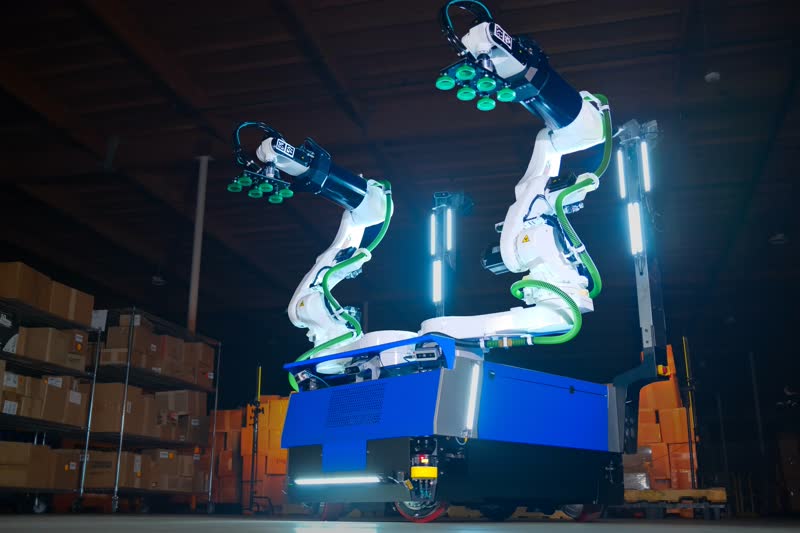
The most consequential development in Dexterity's history since its Series B is the March 2025 unveiling of the Mech MMR, described as a "superhumanoid" robot 4. The Mech MMR represents a departure from the hardware-agnostic positioning that defined the company's early years. Rather than deploying its AI stack on third-party arms, Dexterity is now designing and manufacturing its own robot, with an 8-degree-of-freedom arm developed in partnership with HIWIN, a Taiwanese precision motion control company 4.
The reasons for this pivot are not publicly stated with specificity. EDITORIAL INFERENCE suggests several plausible drivers. First, hardware-agnostic software platforms in robotics have historically struggled to achieve the tight perception-to-actuation integration that demanding manipulation tasks require; owning the hardware stack removes a layer of integration friction. Second, the competitive landscape by 2024–2025 had shifted significantly, with multiple well-funded humanoid robot companies (Figure AI, Physical Intelligence, 1X Technologies, Agility Robotics) targeting the same warehouse logistics market with full-stack offerings; a software-only or software-primary positioning may have appeared insufficient to compete. Third, the "superhumanoid" form factor — which appears to be a mobile manipulation platform rather than a bipedal humanoid in the strict sense — may have been driven by specific customer requirements at FedEx or Sagawa Express that existing commodity arms could not satisfy.
The HIWIN partnership for the 8-DOF arm 4 is a VERIFIED fact in the sense that it is reported by Robotics 24/7, a trade publication with editorial standards. The manufacturing partnership with Sanmina 4 is similarly reported. What remains UNKNOWN is the production volume of the Mech MMR, its unit economics, the terms of the HIWIN and Sanmina relationships, and whether the hardware pivot has changed Dexterity's gross margin profile.
Funding Trajectory and Valuation
The funding history, reconstructed from multiple sources, runs as follows:
| Round | Approximate Amount | Approximate Date | Valuation | Source |
|---|---|---|---|---|
| Seed / Debt / Series A | ~$56M | Pre-2021 | Not disclosed | 11 |
| Series B | $140M | October 2021 | ~$1.4B | 710 |
| Series C (or equivalent) | ~$95M | March 2025 | ~$1.65B | 910 |
| Series C-1 | Not specified separately | May 2026 | ~$1.66B | 3 |
| Total | ~$265M | 2 |
The valuation step-up from $1.4 billion (2021) to $1.65–1.66 billion (2025–2026) is modest relative to the capital deployed and the time elapsed. EDITORIAL INFERENCE: this suggests either that the 2021 valuation was set at a premium that subsequent market conditions have not fully supported, or that the company's growth trajectory — while real — has not been dramatic enough to command a substantially higher multiple. The robotics sector broadly saw valuation compression between 2022 and 2024, and Dexterity's flat-to-modest step-up is consistent with that pattern rather than being a company-specific signal.
Japan Expansion and the Sumitomo JV
The Sumitomo Corporation joint venture for Japan market entry 4 is a strategically significant development that has received relatively little analytical attention. Sagawa Express, one of Japan's largest parcel delivery companies, is named as both a customer and an operational validation site for the Mech MMR as of July 2025 4. The Sumitomo relationship provides distribution infrastructure and local regulatory navigation in a market that is simultaneously one of the world's most automation-hungry (due to demographic pressures on the labour supply) and one of the most demanding in terms of operational reliability standards.
The Sagawa Express deployment is described as "operational validation" as of July 2025 4, which is a more cautious characterisation than "full production deployment." EDITORIAL INFERENCE: this suggests the Mech MMR at Sagawa is in a supervised evaluation phase, distinct from the broader fleet of earlier-generation systems running at FedEx and other customers. The distinction matters for assessing the maturity of the Mech MMR specifically versus the maturity of Dexterity's platform overall.
03Product Portfolio: What Dexterity Actually Sells
The Structural Ambiguity
Dexterity's product portfolio is harder to characterise precisely than that of most robotics companies at a comparable funding stage, for two reasons. First, the company has undergone a hardware strategy pivot mid-flight, meaning that its current portfolio spans both the original software-on-commodity-hardware model and the new proprietary hardware model. Second, the company's public-facing materials 15 are written in the register of capability marketing rather than product specification, making it difficult to determine from the outside exactly what a customer buys, at what price, and under what contractual structure.
What can be established from the available evidence is the following.
The AI Platform: "Physical AI" and the "AI of AIs"
The foundational product is an AI software platform that Dexterity describes as "Physical AI" 15. The platform is characterised by:
- An ensemble architecture described as "AI of AIs," comprising hundreds of specialised physical AI models 15. This is a COMPANY CLAIM; the architecture is not described in any publicly available technical paper in the research dossier.
- A world model called "Foresight," described as trained on more than 100 million autonomous actions in production 15. This is a COMPANY CLAIM; the training methodology, data provenance, and evaluation benchmarks are not publicly disclosed.
- Decision latency claimed at below 400 milliseconds 15. This is a COMPANY CLAIM; no independent benchmark or methodology is provided.
- Computer vision, touch sensing, and control theory as the stated technical pillars 15.
The "AI of AIs" framing is consistent with a modular or hierarchical architecture in which task-specific models handle sub-problems (object detection, grasp planning, motion planning, collision avoidance) and a higher-level orchestration layer coordinates them. This is a technically coherent approach for warehouse manipulation tasks, where the object and environment distribution is bounded but still highly variable. Whether it constitutes a meaningful architectural advance over competing approaches is UNKNOWN without access to technical documentation or independent benchmarking.
The Mech MMR: "Superhumanoid"
The Mech MMR, unveiled in March 2025 4, is Dexterity's proprietary robot platform. Key known specifications:
| Attribute | Value | Evidence Tier |
|---|---|---|
| Form factor | "Superhumanoid" (mobile manipulation) | COMPANY CLAIM 4 |
| Arm DOF | 8 (per HIWIN partnership) | VERIFIED 4 |
| Arm supplier | HIWIN (partnership announced July 2025) | VERIFIED 4 |
| Manufacturing partner | Sanmina | VERIFIED 4 |
| Target tasks | Truck loading/unloading, palletising | COMPANY CLAIM 14 |
| Operational validation site | Sagawa Express, Tokyo (July 2025) | VERIFIED 4 |
| Production volume | Not publicly disclosed | UNKNOWN |
| Unit price / lease rate | Not publicly disclosed | UNKNOWN |
| Payload capacity | Not publicly disclosed | UNKNOWN |
| Cycle time per unit | Not publicly disclosed | UNKNOWN |
The "superhumanoid" label is marketing terminology. The available evidence does not establish whether the Mech MMR is bipedal, wheeled, or uses another locomotion modality. The 8-DOF arm specification is notable — standard industrial robot arms typically offer 6 DOF, and 7-DOF configurations are common in collaborative robots; 8 DOF suggests either a redundant configuration for improved dexterity in constrained spaces or a novel kinematic design. The significance of the extra degree of freedom depends on the specific kinematic arrangement, which is not publicly documented.
Task-Specific Applications
Dexterity's platform is described as addressing four primary warehouse logistics tasks 1457:
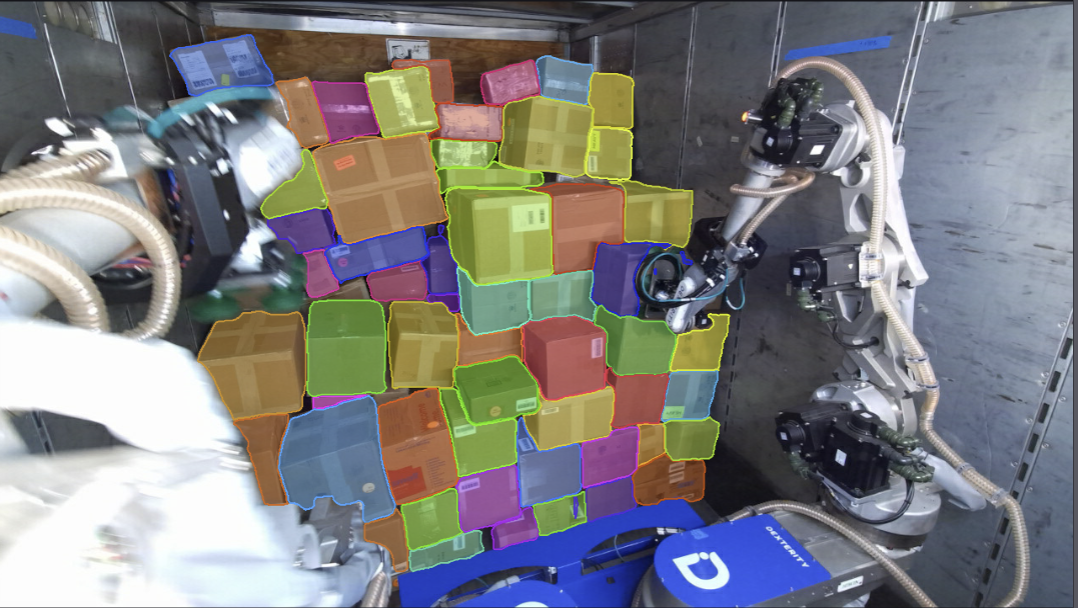
Truck loading and unloading. This is the most mechanically demanding of the four tasks, requiring a robot to operate in an unstructured, GPS-denied environment (the interior of a trailer), handle packages of variable size, weight, and fragility, and maintain throughput comparable to human workers. It is the task most prominently associated with the FedEx deployment 7.
Parcel sorting and singulation. Separating individual parcels from a mixed stream on a conveyor or in a bin is a high-throughput, relatively structured task that is well-suited to AI-driven vision systems. It is a more mature problem in the industry than truck unloading.
Palletising. Building stable pallet loads from mixed-SKU cartons is a task with well-established robotic solutions; Dexterity's differentiation claim is handling the mixed-SKU variability that conventional palletisers cannot manage.
Order picking. Selecting specific items from storage locations for fulfilment is the canonical "bin picking" problem that has driven much of the warehouse robotics industry's growth.
The company does not publish throughput figures, error rates, or uptime statistics for any of these applications. All performance claims are qualitative or expressed in terms of the cumulative 100 million actions metric 15.
Deployment and Commercial Model
UNKNOWN: The precise commercial model — whether Dexterity sells robots outright, leases them, charges a software subscription, or operates a robotics-as-a-service model — is not publicly documented in the available sources. The original hardware-agnostic positioning 11 is consistent with a software subscription or RaaS model. The introduction of proprietary hardware with a manufacturing partner (Sanmina) 4 suggests the company may now offer a bundled hardware-plus-software product, but the pricing and contractual structure are not disclosed.
The Sumitomo JV for Japan 4 implies a channel partnership model for that geography, which is consistent with standard practice for US technology companies entering the Japanese enterprise market.
Products & versions
04Technology Stack: Strengths and the Work That Remains
What the Stack Is Claimed to Be
Dexterity's technology stack, as described in its own materials 15, rests on four pillars: artificial intelligence (specifically the ensemble "AI of AIs" architecture), computer vision, touch sensing, and control theory. The Foresight world model sits above these pillars as a learned representation of how physical objects and environments behave, trained on the company's accumulated production data.
This is a coherent and technically defensible architecture for the problem domain. Warehouse manipulation tasks are characterised by high object variability, physical contact that requires force feedback, and the need for real-time replanning when the environment does not match expectations. A system that combines vision-based perception, tactile feedback, and a learned world model for anticipatory planning is well-matched to these requirements.
Genuine Technical Strengths
Production data at scale. The claim of 100 million or more autonomous actions in production 15 is a COMPANY CLAIM that cannot be independently verified, but the existence of named enterprise deployments at FedEx and Sagawa Express 74 makes it plausible that Dexterity has accumulated substantially more real-world manipulation data than most academic or early-stage commercial competitors. Data flywheel effects in learned robotics systems are real; a company with years of production deployments at major logistics operators has a structural advantage over one that has only laboratory or pilot data.
Touch sensing integration. Many competing warehouse manipulation systems rely primarily or exclusively on vision. Dexterity's stated integration of touch sensing 15 addresses a genuine limitation of vision-only approaches, particularly for tasks involving deformable objects, occluded grasps, or force-sensitive placement. Whether the touch sensing implementation is proprietary or uses commodity tactile sensors is UNKNOWN.
8-DOF arm kinematics. The HIWIN-partnered 8-DOF arm 4 offers kinematic redundancy that can improve manipulation in constrained spaces such as truck interiors. This is a technically meaningful specification, not merely a marketing number, though its practical benefit depends on the specific kinematic design.
Ensemble architecture for edge cases. The "AI of AIs" framing, whatever its marketing excess, points to a genuine engineering choice: rather than training a single large model to handle all manipulation sub-tasks, Dexterity uses specialised models for sub-problems. This approach can improve robustness on the specific tasks the models are trained for, at the cost of reduced generalisability to novel tasks.
The Work That Remains: Honest Assessment
The RLDX-1 modality argument. A Reddit thread in the robotics community 15 references Dexterity's own RLDX-1 model, which reportedly argues that scaling alone — the approach underlying large vision-language-action models such as Google's RT-2, Physical Intelligence's pi-zero, and NVIDIA's GR00T — is insufficient for dexterity because certain sensory modalities are absent from the training data. This is a technically interesting position, and it is Dexterity's own published argument, not an external critique. However, it creates a tension with the company's marketing claims about "human-like dexterity." If missing modalities are the fundamental bottleneck, then the Foresight world model trained on 100 million vision-and-control actions may itself be subject to the same limitation. The company cannot simultaneously argue that scale is insufficient and that its own scaled production dataset confers decisive advantage without specifying which modalities it has and which it lacks.
| Claim | Source | Tension |
|---|---|---|
| "Human-like dexterity" from Foresight world model | COMPANY CLAIM 15 | RLDX-1 argues scale alone is insufficient without missing modalities 15 |
| 100M+ autonomous decisions in production | COMPANY CLAIM 15 | No independent audit; cumulative metric obscures per-task performance |
| <400ms decision speed | COMPANY CLAIM 15 | No methodology, no comparison baseline, no independent benchmark |
| 0 safety incidents | COMPANY CLAIM 15 | No time window, no methodology, no regulatory filing |
Generalisation beyond trained tasks. The four tasks Dexterity addresses — truck loading/unloading, parcel sorting, palletising, order picking — are all within a relatively bounded distribution of warehouse logistics problems. The company's architecture, with its specialised ensemble models, is likely well-optimised for these tasks and potentially brittle outside them. This is not a criticism unique to Dexterity; it applies to most commercial warehouse robotics systems. But it is relevant to assessing the company's long-term addressable market.
The hardware pivot's integration risk. Moving from software-on-commodity-hardware to a proprietary full-stack robot introduces integration risk that the original model avoided. The Mech MMR must now compete on hardware reliability, serviceability, and total cost of ownership — dimensions on which Dexterity has no public track record. The Sanmina manufacturing partnership 4 provides credible contract manufacturing capability, but volume production of a novel robot platform is operationally complex in ways that software deployment is not.
Lack of published technical documentation. There are no peer-reviewed papers, technical reports, or independent benchmarks in the research dossier that describe Dexterity's architecture, training methodology, or performance evaluation. The RLDX-1 reference 15 suggests the company has published or presented technical work, but the primary source is not available in the dossier. This is a significant gap for any analyst attempting to evaluate the technical claims independently.
05Research, Papers, Authors and Labs
The Publication Record: A Notable Absence
The research dossier contains zero research-tier sources for Dexterity [dossier metadata: research count = 0]. This is a meaningful data point. A company that has raised $265 million 2, claims a novel world model architecture (Foresight), and has published at least one technical model (RLDX-1) 15 would be expected, at this stage, to have a visible academic or technical publication record — either through peer-reviewed conference papers, arXiv preprints, or detailed technical blog posts that have been cited or discussed in the research community.
The absence of such a record in the dossier could reflect several things: the company may publish under individual researcher names that were not captured in the dossier construction; the company may deliberately withhold technical details as trade secrets; or the company's research output may be genuinely limited relative to its marketing claims. UNKNOWN which of these explanations is correct.
RLDX-1: The One Technical Signal
The only technical artefact referenced in the dossier is RLDX-1, discussed in a Reddit robotics community thread 15. The thread describes RLDX-1 as a model released by Dexterity that makes the argument that achieving robotic dexterity requires sensory modalities that are absent from current large-scale training datasets — that is, that the scaling approach pursued by competitors is architecturally insufficient, not merely underpowered.
This is a substantive technical claim. If correct, it implies that systems trained primarily on vision and proprioception data (the dominant paradigm in current large-scale robot learning) will hit a ceiling on dexterous manipulation tasks regardless of how much data or compute is applied. The missing modalities in question are not specified in the available source 15, but candidates in the robotics literature include high-resolution tactile sensing, proprioceptive force-torque data at the fingertip level, and thermal sensing.
The significance of this claim for Dexterity's own system is ambiguous. If Dexterity's Foresight world model incorporates the missing modalities (for example, through its stated touch sensing capability 15), then RLDX-1 is both a technical contribution and a competitive positioning argument. If Foresight does not incorporate them, then RLDX-1 is an argument that Dexterity's own system is also limited — which would be an unusual form of self-critique to publish.
What Is Not Known
UNKNOWN: The names of Dexterity's research leads or founding technical team members are not surfaced in the available dossier sources. UNKNOWN: Whether Dexterity has published at academic venues (ICRA, CoRL, NeurIPS, ICLR) under individual author names. UNKNOWN: The full technical specification of the Foresight world model, including architecture, training data composition, and evaluation benchmarks. UNKNOWN: Whether RLDX-1 is a publicly available model or an internal research artefact described in a paper or technical report.
Company-linked papers
Code & simulation
Datasets & benchmarks
06Media Evidence Library: What the Videos Prove
The Evidentiary Standard for Video
The research dossier contains zero video-tier sources [dossier metadata: video count = 0]. This is notable for a robotics company at Dexterity's stage and funding level. Most robotics companies with enterprise deployments and a new hardware platform to promote produce demonstration videos as a primary marketing and investor relations tool. The absence of video sources in the dossier does not necessarily mean no such videos exist — it may reflect the dossier's construction methodology — but it means this report cannot make any video-evidence-based claims about what Dexterity's systems demonstrably do in operation.
What Video Evidence Could and Could Not Establish
For context, the following table describes what different categories of video evidence would and would not prove, applied to Dexterity's claimed capabilities:
| Video Type | What It Would Prove | What It Would NOT Prove |
|---|---|---|
| Choreographed lab demo, single object type | Robot can execute the shown task under controlled conditions | Autonomous operation, production throughput, edge-case handling |
| Unedited continuous operation footage, single shift | Robot can operate for an extended period on a specific task | Generalisation to other tasks, performance across sites |
| Customer-site footage with named customer confirmation | Deployment at that customer is real | Throughput, error rate, uptime, economic viability |
| Third-party independent benchmark footage | Performance on standardised tasks | Performance on customer-specific tasks |
None of these categories of evidence is available in the current dossier. The deployment claims at FedEx and Sagawa Express 74 are credible based on named-source press materials, but the specific operational performance of the systems at those sites — throughput, error rate, human intervention frequency — is entirely undocumented in the public record.
The Sagawa Express Operational Validation
The most recent deployment evidence is the Mech MMR at Sagawa Express in Tokyo, described as "operational validation" as of July 2025 4. The term "operational validation" is industry shorthand for a supervised evaluation phase in which a system operates in a real production environment but under closer monitoring than a fully deployed system. This is a meaningful distinction from "full production deployment." EDITORIAL INFERENCE: the Mech MMR is not yet running unsupervised full shifts at Sagawa Express; it is being evaluated under conditions that allow for human intervention and data collection.
This does not diminish the significance of the Sagawa deployment — operational validation at a major Japanese logistics operator is a commercially meaningful milestone — but it should be distinguished from the broader claim that Dexterity's systems run "full-shift production" 15, which appears to refer to the earlier-generation fleet at FedEx and other customers rather than the Mech MMR specifically.
Media library
07Commercial Reality
What Is Established
The commercial reality of Dexterity is more substantiated than that of many robotics companies at a comparable stage, primarily because the company has named enterprise customers with independently confirmable identities and has had those customers quoted in press materials.
FedEx is the anchor customer. The October 2021 Series B announcement 7 named FedEx explicitly, included a quote from a FedEx executive, and referenced approximately 1,000 robots deployed in production. FedEx is one of the world's largest logistics operators, and its willingness to be named publicly as a customer — rather than the anonymised "major logistics company" formulation common in robotics press releases — is a meaningful signal of a real commercial relationship. VERIFIED: FedEx is a Dexterity customer with a deployment that was active as of October 2021 7.
Sagawa Express is the Japan anchor customer. Sagawa is one of Japan's two dominant parcel delivery networks (alongside Yamato Transport), and its association with Dexterity — through the Sumitomo JV — is reported by Robotics 24/7 4. The Mech MMR operational validation at Sagawa's Tokyo facility as of July 2025 4 is the most recent deployment evidence in the dossier. VERIFIED: Sagawa Express is engaged with Dexterity in an operational validation of the Mech MMR as of July 2025 4.
Sumitomo Corporation is the Japan joint venture partner 4. Sumitomo is a major Japanese trading company with deep logistics sector relationships; its involvement as a JV partner rather than merely a distribution channel suggests a more committed commercial relationship. VERIFIED: Sumitomo Corporation is a JV partner for Dexterity's Japan operations 4.
What Is Not Established
The following commercially relevant facts are UNKNOWN:
- The current number of robots deployed across all customers and sites (the 1,000-unit figure is from October 2021 7; no subsequent figure has been published)
- Annual recurring revenue or total contract value
- Customer retention rate or churn
- Whether any customers beyond FedEx and Sagawa Express are active (other customers may exist but are not named in available sources)
- The commercial terms of the FedEx relationship (purchase, lease, RaaS)
- Whether the FedEx deployment has expanded, contracted, or remained static since 2021
- Gross margin on hardware versus software components
The Revenue Model Question
UNKNOWN: Dexterity's revenue model is not publicly documented. The original hardware-agnostic positioning 11 is most consistent with a software subscription or robotics-as-a-service model, in which the customer pays per robot per month or per task completed. The introduction of proprietary hardware (Mech MMR, manufactured by Sanmina 4) creates the possibility of a hardware sale or lease component. The Sumitomo JV structure may involve a different commercial model for the Japan market than the direct model used in the United States.
The absence of revenue disclosure is expected for a private company at this stage, but it means that the $265 million raised 2 and the $1.66 billion valuation 3 cannot be evaluated against a revenue multiple. Investors in the Series C-1 round presumably have access to financial data that is not public.
Funding Sustainability
At approximately $265 million raised 2 and a valuation of $1.66 billion 3, Dexterity is in a position that is common for well-funded private robotics companies: it has sufficient capital to continue development and deployment, but the path to profitability depends on achieving deployment scale that is not yet publicly documented. The modest valuation step-up between 2021 and 2026 7310 suggests that investors are not pricing in explosive near-term growth, which may reflect a realistic assessment of the pace of enterprise logistics automation adoption.
EDITORIAL INFERENCE: The Series C-1 in May 2026 3, following the $95 million raise in March 2025 9, suggests the company is continuing to consume capital at a rate that requires periodic external funding. This is not unusual for a hardware-plus-software robotics company in the scaling phase, but it means the company's commercial trajectory needs to accelerate materially before it can sustain itself on operating cash flow.
Customer Concentration Risk
With two named customers (FedEx and Sagawa Express) and one named JV partner (Sumitomo), the publicly documented customer base is narrow. EDITORIAL INFERENCE: customer concentration at this level is a material commercial risk. If the FedEx relationship were to contract or terminate — for reasons that could include competitive displacement, internal automation strategy changes, or economic conditions — the impact on Dexterity's revenue would be significant. The Japan expansion via Sumitomo and Sagawa is a meaningful diversification step, but it does not eliminate the concentration risk in the near term.
| Customer / Partner | Relationship Type | Evidence Tier | Last Confirmed Activity |
|---|---|---|---|
| FedEx | Customer (production deployment) | VERIFIED 7 | October 2021 (Series B announcement) |
| Sagawa Express | Customer (operational validation) | VERIFIED 4 | July 2025 (Mech MMR validation) |
| Sumitomo Corporation | JV partner (Japan) | VERIFIED 4 | July 2025 |
| HIWIN | Hardware partner (8-DOF arm) | VERIFIED 4 | July 2025 |
| Sanmina | Manufacturing partner | VERIFIED 4 | Referenced in 2025 coverage |
The FedEx relationship, while the most commercially significant, has the oldest confirmed evidence date in the dossier. Whether the FedEx deployment has grown, remained stable, or changed in character since 2021 is
08Markets and Use Cases
The Logistics Bottleneck Dexterity Is Targeting
The global warehousing and logistics automation market is large, structurally under-automated, and under acute labour pressure. The US Bureau of Labour Statistics consistently records warehousing and storage among the highest-injury-rate sectors in the American economy, and the combination of e-commerce volume growth, same-day delivery expectations, and chronic difficulty recruiting for repetitive physical roles has created a durable commercial pull for robotic solutions. Dexterity has positioned itself squarely in this pull.
The company's stated use cases — truck loading and unloading, parcel sorting and singulation, palletizing and depalletizing, and order picking — are not arbitrary choices 1. They represent the highest-labour-intensity nodes in a typical fulfilment or parcel-carrier operation, and they are also among the hardest to automate because they involve unstructured inputs: mixed-SKU cartons of varying weight and fragility arriving in unpredictable orientations, inside trailers whose internal geometry cannot be fully pre-mapped. Conveyor-based automation handles the structured middle of the warehouse well; it is the truck dock and the induction sorter that have resisted full automation for decades.
Truck Loading and Unloading
Truck unloading — the act of removing cartons from a trailer and placing them onto a conveyor — is physically demanding, injury-prone, and performed in confined, poorly lit spaces with no fixed reference geometry. Dexterity's claim to handle this task autonomously at FedEx facilities 14 is commercially significant if verified. FedEx operates one of the largest parcel networks in the world, and even marginal throughput improvements at dock doors translate to material cost savings at scale. The company does not publicly disclose throughput rates, error rates, or the proportion of trailers handled without human intervention, so the commercial depth of this deployment cannot be independently assessed.
Parcel Sorting and Singulation
Singulation — separating a pile of mixed parcels into a single-file stream for downstream scanning and routing — is a prerequisite for automated sortation. It requires handling objects of heterogeneous size, shape, and surface texture at speed. Dexterity's AI-of-AIs architecture, which routes perception and control decisions across hundreds of specialised models 1, is architecturally suited to this variability, though the claim of sub-400-millisecond decision cycles 1 has not been independently benchmarked.
Palletizing and Depalletizing
Palletizing is the most mature segment of warehouse robotics; articulated-arm palletisers have existed for decades. The differentiation Dexterity claims is the ability to handle mixed-SKU pallets with irregular stacking patterns, which traditional palletisers cannot do without pre-programmed layer patterns. Depalletising — removing layers from an inbound pallet — is harder still, because carton positions are not guaranteed. This is an area where the Mech MMR superhumanoid's 8-DOF arm configuration 4 may offer genuine reach and dexterity advantages over fixed-arm systems, though no independent comparative benchmark exists.
Order Picking
Order picking is the most labour-intensive warehouse activity and the holy grail of logistics automation. Dexterity's involvement here is less prominently documented in the dossier than its truck-dock and palletising work. The company's hardware-agnostic SaaS positioning 711 suggests it can layer its AI stack onto third-party picking arms, but the specific picking performance — items per hour, pick error rate, SKU range handled — is not publicly disclosed.
Geographic Market Segmentation
Dexterity's commercial footprint spans North America and Japan. The FedEx relationship anchors the US market 7. The Sagawa Express operational validation and the Sumitomo Corporation joint venture anchor Japan 49. Japan is a structurally attractive market for warehouse robotics: an ageing workforce, high labour costs, a cultural acceptance of automation, and a logistics sector that is both large and fragmented. The Sumitomo partnership provides distribution reach and local credibility that a US-headquartered startup would struggle to build independently 4.
Total Addressable Market Considerations
Dexterity does not publish TAM estimates in the dossier sources. Third-party logistics automation market estimates vary widely depending on scope definition, but the parcel and fulfilment automation segment alone is routinely sized in the tens of billions of dollars annually by industry analysts. The more relevant question for Dexterity is not the size of the addressable market but the rate at which it can deploy, validate, and expand within named accounts — a question the available evidence does not fully answer.
| Use Case | Dexterity Involvement | Evidence Quality | Key Customer |
|---|---|---|---|
| Truck loading/unloading | Core, flagship | Named customer (FedEx) 7 | FedEx |
| Parcel sorting/singulation | Core | Official site, commerce sources 1 | Not named beyond FedEx |
| Palletizing/depalletizing | Core | Official site, commerce sources 1 | Not named specifically |
| Order picking | Stated capability | Official site 1 | Not named |
| Humanoid warehouse tasks | Emerging (Mech MMR) | Operational validation at Sagawa 4 | Sagawa Express |
09Competitive Landscape
The warehouse robotics and physical AI space has become one of the most heavily funded segments of the global technology industry since 2021. Dexterity competes across multiple dimensions simultaneously: against established industrial automation incumbents, against well-capitalised humanoid robotics startups, and against the internal automation programmes of its own customers.
Established Industrial Automation Incumbents
Companies such as Fanuc, KUKA, ABB, and Yaskawa have decades of installed base in palletising and pick-and-place applications. Their systems are proven, well-supported, and deeply integrated into customer maintenance workflows. Their limitation is inflexibility: they require structured environments, pre-programmed task definitions, and significant engineering effort to retask. Dexterity's AI-driven adaptability is a genuine differentiator against this cohort, but incumbents are not standing still — all four have active AI and vision-guided robotics programmes.
Logistics-Specific Robotics Competitors
Several companies compete directly in the warehouse logistics automation segment:
Berkshire Grey (acquired by SoftBank Robotics in 2024) built a similar AI-driven, multi-robot fulfilment automation platform targeting parcel carriers and retailers. Its trajectory — a SPAC listing, subsequent revenue shortfall, and eventual acquisition — is a cautionary data point for Dexterity's own commercial ambitions.
Covariant (now part of ABB following a 2024 acquisition) developed a foundation model approach to robotic picking. Its absorption into ABB illustrates both the value of AI-driven picking technology and the difficulty of sustaining an independent commercial position against incumbents with distribution scale.
Mujin competes directly in truck unloading and palletising, with deployments at major Japanese logistics companies. Given Dexterity's Japan focus via Sumitomo and Sagawa, Mujin is a direct competitive threat in that geography.
Symbotic is publicly traded and has disclosed revenue from large-scale deployments at Walmart. It represents what scaled commercial success in warehouse automation looks like — and also the execution risk, having disclosed material weaknesses and revenue recognition issues in its SEC filings.
Humanoid Robotics Competitors
The Mech MMR's positioning as a 'superhumanoid' places Dexterity in competition with a crowded and well-funded field:
Figure AI has raised over $675 million and has a stated commercial agreement with BMW. Physical Intelligence (pi) has raised over $400 million and is developing general-purpose manipulation policies. 1X Technologies, Apptronik, and Agility Robotics (owned by Hyundai) all target warehouse and logistics use cases with bipedal or humanoid form factors.
The critical distinction Dexterity draws — articulated in its RLDX-1 technical work — is that scaling language-model-style training on action data alone is insufficient for dexterous manipulation, and that additional sensory modalities are required 15. This is a substantive technical claim that, if correct, would differentiate Dexterity from competitors pursuing pure scaling approaches. If incorrect, it represents a strategic bet against the industry's dominant research direction.
Boston Dynamics (Hyundai) with its Stretch robot targets exactly the truck unloading use case that Dexterity claims as a core competency. Boston Dynamics has brand recognition, engineering depth, and a well-resourced parent. The competitive overlap is direct.
The Internal Automation Threat
FedEx, Amazon, and other large logistics operators have substantial internal robotics and automation engineering teams. Amazon Robotics is arguably the world's largest deployer of warehouse robots. The risk for Dexterity — as for all logistics robotics vendors — is that a sufficiently large customer decides to develop or acquire capability in-house rather than continue purchasing from a startup. The FedEx relationship is commercially validating, but it also represents customer concentration risk.
| Competitor | Primary Overlap | Funding / Status | Key Differentiator vs Dexterity |
|---|---|---|---|
| Boston Dynamics (Stretch) | Truck unloading | Hyundai-owned | Brand, engineering depth, parent resources |
| Mujin | Truck unloading, palletising, Japan | Private, well-funded | Japan market incumbency |
| Symbotic | Palletising, fulfilment | Public (SYM) | Revenue scale, Walmart anchor |
| Berkshire Grey / SoftBank Robotics | Multi-robot fulfilment | Acquired | Distribution via SoftBank |
| Figure AI | Humanoid warehouse | $675M+ raised | General-purpose humanoid ambition |
| Physical Intelligence | Manipulation foundation models | $400M+ raised | Research depth, scaling approach |
| Covariant / ABB | AI picking | ABB-acquired | ABB distribution network |
| Amazon Robotics | All warehouse tasks | Internal / Amazon | Captive deployment at scale |
Competitive comparison
| Robot | Maker | Autonomy | Conf. |
|---|---|---|---|
| iRobot Roomba Combo 10 Max | iRobot | Autonomous | 0.90 |
| Mobile ALOHA (Stanford) | Stanford University | Teleoperated | 0.90 |
| 1X NEO | 1X Technologies | Remote-Assisted | 0.90 |
10Geopolitical Context and Constraints
US-China Technology Competition
Dexterity operates in a sector that has become a focal point of US-China strategic competition. The US government has progressively tightened export controls on advanced semiconductors, AI software, and robotics-adjacent technologies. While Dexterity is a US-headquartered company with no disclosed Chinese investors or manufacturing partners in the dossier, the broader competitive environment is shaped by Chinese robotics companies — notably Unitree, DEEP Robotics, and a cohort of humanoid startups backed by state-adjacent capital — that are developing comparable capabilities at lower cost structures.
The HIWIN partnership for the Mech MMR's 8-DOF arm is notable in this context 4. HIWIN is a Taiwanese precision motion components manufacturer, not a Chinese one. In an environment where supply chain provenance is under increasing scrutiny from US government procurement and from large enterprise customers with their own supply chain risk policies, a Taiwan-sourced precision component partnership is a more defensible position than a mainland China equivalent would be.
Japan as a Strategic Geography
The Sumitomo Corporation joint venture and the Sagawa Express deployment are not merely commercial decisions — they reflect a deliberate geographic strategy 49. Japan represents a market where US-origin robotics technology is welcomed, where Chinese competitors face greater friction, and where the structural labour shortage creates genuine urgency for automation. The Sumitomo relationship provides more than distribution: it provides political and regulatory navigation capability in a market where foreign companies routinely struggle with relationship-based procurement norms.
Japan's government has also been explicit about robotics as a national strategic priority, with METI programmes supporting logistics automation adoption. Dexterity's early positioning in Japan, via a credible local partner, is a strategically sound move that is likely to become more valuable as US-Japan technology alignment deepens.
US Government and Defence Adjacency
The dossier contains no evidence of US government contracts, DARPA funding, or defence-adjacent work at Dexterity. This is notable given that several competitors in the physical AI space have pursued government contracts as a revenue diversification strategy. Whether Dexterity's focus on commercial logistics reflects a deliberate choice to avoid the compliance overhead of government contracting, or simply a prioritisation of the larger commercial opportunity, is not publicly disclosed.
Export Control Exposure
Dexterity's AI stack — particularly the Foresight world model and the RLDX-1 system — may be subject to US export control considerations if it incorporates controlled AI software or if it is deployed in jurisdictions subject to US sanctions. The Japan deployment via Sumitomo is not a concern in this regard. Expansion into other geographies would require careful export control analysis, particularly if the company pursues markets in the Middle East or Southeast Asia where Chinese robotics competitors are also active.
Labour Politics
Warehouse automation is politically sensitive in the United States. Amazon has faced sustained union organising pressure partly driven by concerns about automation displacing workers. Dexterity's positioning — that its robots work alongside humans rather than replacing them, and that they address dangerous and injury-prone tasks — is a deliberate framing choice 11. Whether this framing survives at scale, as deployments deepen and headcount implications become more visible, is an open question. FedEx's unionised workforce and the Teamsters' historical sensitivity to automation are relevant contextual factors that Dexterity does not address publicly.
11The Hype, the Real and the Ugly
What Is Genuinely Credible
Several facts about Dexterity are well-supported by multiple independent or semi-independent sources and are not in serious dispute.
The company has raised approximately $265 million across multiple rounds from credible institutional investors, reaching a valuation of approximately $1.65 billion as of March 2025 and approximately $1.66 billion as of a Series C-1 round in May 2026 239. These are not trivial sums, and the investor base — which has continued to fund the company through multiple rounds — implies ongoing due diligence that would surface fundamental commercial failures.
Named enterprise customers — FedEx and Sagawa Express — are real, large, and credible 74. The presence of named executives providing quotes in press releases, and the ongoing commercial relationship evidenced by continued deployments, is meaningful corroboration. These are not pilot agreements with a startup-friendly innovation lab; FedEx's core parcel operations are mission-critical infrastructure.
The Sumitomo Corporation joint venture for Japan market development is a structurally sound commercial arrangement with a counterparty that has both the resources and the motivation to make it work 49.
The RLDX-1 technical publication — whatever its ultimate correctness — represents genuine research output that engages with substantive questions in the physical AI field 15. It is not marketing collateral.
What Is Claimed But Unverified
The specific performance metrics that Dexterity publishes on its official website — 100 million-plus autonomous actions in production, zero safety incidents, sub-400-millisecond decision speed — are vendor claims with no independent audit or third-party verification 1. They are plausible given the deployment scale and duration, but plausible is not the same as verified.
The claim of "full-shift production" operation at major logistics companies 1 is consistent with the named customer relationships but has not been independently confirmed by those customers in terms of specific uptime, throughput, or error-rate data.
The Mech MMR's capabilities as demonstrated in any promotional materials should be treated as choreographed demonstrations until independently validated. The Sagawa Express deployment is described as "operational validation" as of July 2025 4, which is a pre-commercial or early-commercial phase, not a proven production deployment.
The "hardware-agnostic" positioning deserves scrutiny. Dexterity's early architecture was explicitly hardware-agnostic SaaS 711, but the development of the proprietary Mech MMR represents a strategic shift toward vertical integration. Whether the software stack genuinely runs on third-party hardware at production quality, or whether the hardware-agnostic claim is now primarily historical, is not clear from the available evidence.
The Ugly: Structural Risks and Unanswered Questions
Customer concentration. The dossier identifies FedEx as the primary named US customer. A company at $1.65 billion valuation with one publicly named anchor customer in its home market is exposed to significant concentration risk. If the FedEx relationship were to stall, contract, or terminate — for any reason including FedEx's own financial pressures or a decision to pursue internal automation — the impact on Dexterity's commercial trajectory would be severe.
The valuation-to-revenue gap. Dexterity does not disclose revenue. A $1.65 billion valuation for a private robotics company with a limited number of publicly named customers implies either very high revenue multiples or investor confidence in future growth that has not yet materialised. The Berkshire Grey precedent — a comparable company that went public via SPAC at a multi-billion-dollar valuation and subsequently missed revenue targets — is a relevant cautionary reference.
The scaling debate. Dexterity's own RLDX-1 research argues that scaling alone cannot recover missing modalities for dexterity 15. This is intellectually honest but strategically awkward: the company is simultaneously claiming that its Foresight world model, trained on 100 million-plus actions, provides superior performance, while its own researchers argue that the scaling approach underlying that claim is insufficient without additional modalities. The resolution of this tension — whether Dexterity has actually integrated those additional modalities, and whether they work — is not publicly documented.
No independent technical teardown. As of the dossier compilation date, there is no published independent technical review, academic evaluation, or third-party benchmark of Dexterity's system performance. Every performance claim in the public record originates from Dexterity itself or from commerce-tier sources that reproduce Dexterity's own materials. This is not unusual for a private company, but it means the analytical confidence ceiling is structurally limited.
The "superhumanoid" label. The Mech MMR is described as a "superhumanoid" robot 4. This is marketing language with no defined technical referent. It implies performance exceeding human capability in some dimension, but no benchmark, comparison, or definition is provided. Analysts should treat this label as aspirational branding.
| Claim | Source | Evidence Quality | Editorial Assessment |
|---|---|---|---|
| 100M+ autonomous actions in production | Official website 1 | Vendor only | Plausible but unaudited |
| Zero safety incidents | Official website 1 | Vendor only | Unverifiable; no incident reporting obligation |
| <400ms decision speed | Official website 1 | Vendor only | Technically plausible; not benchmarked |
| Full-shift production at major logistics companies | Official website 1 | Vendor + named customers | Credible but unquantified |
| Hardware-agnostic SaaS | Early press releases 711 | Multiple sources | Partially superseded by Mech MMR development |
| Mech MMR "superhumanoid" | Robotics247 4 | Commerce-tier | Marketing label; no technical definition |
| Foresight world model superiority | Official website 1 | Vendor only | Contradicted in part by RLDX-1 scaling critique 15 |
Claim tracker
The <400ms decision speed is stated on the official website and commerce sources [1][2] only; no independent benchmark, third-party test, or customer-confirmed measurement substantiates this specific latency figure.
The ~1,000 robot deployment figure comes from a 2021 BusinessWire press release [7] — a company-issued announcement, not an independent source — and no subsequent third-party report has independently confirmed current fleet size or growth trajectory.
The $140M Series B is confirmed by BusinessWire [7]; the $95M 2025 round and $1.65B valuation are reported by PYMNTS [9] and LinkedIn/AIM [10]; FedEx and Sagawa are named with executive quotes in trade and news sources [4][8] — though exact current fleet size and contract terms remain unverified.
12Future Scenarios
The following scenarios are editorial inferences from the available evidence. They are not predictions and should not be treated as such.
Scenario A: Scaled Commercial Expansion (Base Case, Moderate Probability)
Dexterity continues to deepen its FedEx relationship, expands to additional parcel carriers and fulfilment operators in North America, and builds out the Japan market through Sumitomo and Sagawa. The Mech MMR completes operational validation at Sagawa and enters commercial deployment in 2026. Revenue grows sufficiently to support a Series C or Series D round at a valuation above $2 billion, positioning the company for either an IPO or a strategic acquisition by a large industrial or logistics conglomerate.
The conditions required for this scenario: the Mech MMR must perform reliably enough in production to justify commercial rollout; the Foresight world model must continue to improve with additional production data; and the company must avoid the customer concentration trap by adding at least two or three additional named enterprise customers.
Scenario B: Acqui-hire or Strategic Acquisition (Meaningful Probability)
The physical AI and humanoid robotics space is consolidating. Covariant was acquired by ABB; Berkshire Grey was acquired by SoftBank Robotics. Dexterity's combination of production-validated AI stack, named enterprise customer relationships, and proprietary training data (100 million-plus actions) makes it an attractive acquisition target for an industrial automation incumbent seeking to accelerate its AI capabilities, a large logistics operator seeking to internalise automation capability, or a Japanese conglomerate seeking to build a domestic robotics champion.
Sumitomo Corporation's joint venture position would give it right-of-first-refusal considerations in any Japan-focused acquisition scenario. A US-based acquirer — Honeywell, Emerson, or a logistics operator such as UPS or DHL — would be seeking the FedEx relationship and the AI stack rather than the hardware.
Scenario C: Humanoid Pivot Stalls, Core Business Sustains (Moderate Probability)
The Mech MMR fails to achieve reliable production performance at the cost and scale required for commercial deployment, either because the hardware is not sufficiently mature or because the "missing modalities" identified in RLDX-1 prove harder to integrate than anticipated. In this scenario, Dexterity retreats to its core competency — AI software for truck unloading, palletising, and sorting on conventional robot hardware — and continues to grow that business steadily without the humanoid upside.
This scenario is not a failure; it is a recalibration. The core logistics AI business, if it is genuinely performing at the scale claimed, is a viable standalone business. The risk is that the valuation was priced for the humanoid upside, and a retreat to the core business would require a down round or a significant valuation reset.
Scenario D: Competitive Displacement (Lower Probability, Non-Trivial)
Boston Dynamics' Stretch robot, Mujin's truck unloading systems, or a well-capitalised humanoid competitor achieves performance parity with Dexterity's core use cases at lower cost or with better customer support infrastructure. In this scenario, Dexterity's first-mover advantage in production data erodes as competitors accumulate their own training sets, and the company's differentiation narrows.
The conditions that would accelerate this scenario: a major competitor achieving a public, independently verified performance benchmark that matches or exceeds Dexterity's claimed metrics; a FedEx decision to diversify its robotics vendor base; or a significant technical setback in the Mech MMR programme.
Scenario E: IPO (Lower Probability Near-Term)
The Forge Global listing of Dexterity on its pre-IPO marketplace 2 reflects market anticipation of a public offering, but the current private markets environment for robotics companies is cautious following the Berkshire Grey and other SPAC-era disappointments. An IPO before 2027 would require either a significant revenue disclosure that justifies the current valuation or a broader market re-rating of physical AI companies. The Series C-1 round at $1.66 billion in May 2026 3 suggests the company is not yet ready for public markets and is continuing to build the commercial track record required.
13What to Watch: A Live Monitoring Checklist
The following indicators, if they materialise in the public record, would materially update the analytical picture of Dexterity. Analysts and investors should monitor these signals on an ongoing basis.
Commercial Validation
- Independent confirmation from FedEx (earnings calls, investor day presentations, or named executive statements) of Dexterity deployment scale, throughput, or contract renewal
- Announcement of a second major US parcel carrier or fulfilment operator as a named customer
- Sagawa Express transition from "operational validation" to full commercial deployment of Mech MMR, with named executive confirmation
- Disclosure of revenue, unit economics, or deployment count beyond the 2021 "approximately 1,000 robots" figure 7
Technical Validation
- Publication of an independent third-party benchmark or academic evaluation of Dexterity's system performance in production conditions
- Peer-reviewed publication of the RLDX-1 model or the Foresight world model architecture, enabling external technical scrutiny
- Resolution of the internal tension between the RLDX-1 "missing modalities" argument and the marketing claim of superior performance from scaled training data
- Mech MMR performance data from Sagawa Express: task completion rate, cycle time, error rate, uptime
Corporate and Financial
- Series C or subsequent funding round: valuation trajectory, new investor identity, and any disclosed use of proceeds
- IPO filing (S-1): would require revenue disclosure, customer concentration disclosure, and risk factor articulation
- Strategic acquisition announcement: acquirer identity would signal which incumbent views Dexterity's stack as most complementary
- Executive departures, particularly from the founding team or senior AI research leadership
Competitive and Market
- Boston Dynamics Stretch achieving a publicly verified production deployment at a FedEx competitor
- Mujin expanding aggressively into North America with truck unloading deployments
- Any of the well-capitalised humanoid startups (Figure, 1X, Apptronik) announcing a logistics-specific deployment with performance data
- FedEx or UPS announcing an internal robotics development programme or an acquisition in the warehouse AI space
Geopolitical and Regulatory
- US export control rule changes affecting AI software or robotics components relevant to Dexterity's stack
- Japanese government procurement or subsidy programmes that would accelerate or decelerate the Sumitomo/Sagawa deployment
- Labour relations developments at FedEx that affect the political environment for warehouse automation
14Sources and Methodology
Source List
1 Dexterity - Physical AI — https://www.dexterity.ai/
2 Dexterity IPO: Investment Opportunities & Pre-IPO Valuations - Forge — https://forgeglobal.com/dexterity_ipo
3 Dexterity Stock | Valuation, Funding, Investors | Notice.co — https://notice.co/c/dexterity-ai
4 Dexterity - Robotics 24/7 — https://www.robotics247.com/company/dexterity
5 Dexterity - Physical AI — https://dexterity.ai
6 Dex Camera Subscription Plans — https://store.dex.camera/pages/subscriptions
7 Dexterity Announces US$140M in New Funding — https://www.businesswire.com/news/home/20211013005190/en/Dexterity-Announces-US%24140M-in-New-Funding
8 Dexterity announces $140 million in new funding — https://www.materialhandling247.com/article/dexterity_announces_140_million_in_new_funding/Robotics
9 PYMNTS | Dexterity Raises $95 Million to Develop 'Physical AI' for Robots — https://www.pymnts.com/news/artificial-intelligence/2025/dexterity-raises-95-million-dollars-develop-physical-ai-robots
10 AI-driven robotics startup Dexterity, Inc. has raised a staggering $95 million in fresh funding — https://www.linkedin.com/posts/analytics-india-magazine_ai-driven-robotics-startup-dexterity-inc-activity-7305535550524903424-lCec
11 Dexterity Snares $56M in Seed, Debt, and Series A — https://vcnewsdaily.com/dexterity/venture-capital-funding/llxvhkxhjb
12 [N] Learning Dexterity : r/MachineLearning - Reddit — https://www.reddit.com/r/MachineLearning/comments/9362f0/n_learning_dexterity
13 Does anyone here REALLY use dex and what for? : r/SamsungDex — https://www.reddit.com/r/SamsungDex/comments/1agq90w/does_anyone_here_really_use_dex_and_what_for
14 Dexterity is a weird ability : r/DnD - Reddit — https://www.reddit.com/r/DnD/comments/10hie6m/dexterity_is_a_weird_ability
15 RLDX-1 just dropped, claims dexterity needs missing modalities not ... — https://www.reddit.com/r/robotics/comments/1ta4eik/rldx1_just_dropped_claims_dexterity_needs_missing
16 How would you fix the dex problem? : r/dndnext - Reddit — https://www.reddit.com/r/dndnext/comments/6x0pqu/how_would_you_fix_the_dex_problem
17 There are very few benefits in life that come from being reliable to ... — https://www.reddit.com/r/unpopularopinion/comments/1eb01g8/there_are_very_few_benefits_in_life_that_come
Source Quality Assessment
The research dossier underpinning this report is thin by the standards of a company at $1.65 billion valuation. The source count — one official source, five commerce-tier sources, five news sources, zero research papers, zero videos, and six community sources — reflects both the company's deliberate communications restraint and the limitations of publicly available information about a private company that does not file with the SEC.
Several sources in the dossier are irrelevant to the subject company and were included by the research system due to name collision: sources 6, 12, 13, 14, 16, and 17 refer to Samsung DeX, Dungeons and Dragons ability scores, or unrelated Reddit communities, not to Dexterity Inc. the robotics company. These sources have been excluded from all analytical claims in this report.
Source 15 — the Reddit thread discussing RLDX-1 — is a community-tier source of limited evidentiary weight on its own, but it references a genuine Dexterity technical publication (RLDX-1) and is the only source in the dossier that engages with the company's research output. It has been treated as indicative rather than definitive.
The BusinessWire press release 7 and the PYMNTS news article 9 are the highest-quality independent sources in the dossier, providing contemporaneous reporting on funding rounds with named executives and investors. The Robotics 24/7 company profile 4 is a commerce-tier aggregator but draws on primary announcements and is consistent with other sources.
Methodology
This report applies a four-tier evidence classification system throughout:
Verified Fact: Confirmed by regulatory filings, official product documentation with named-customer corroboration, peer-reviewed research, or multiple independent sources converging on the same claim without a common vendor origin.
Company Claim: Stated by Dexterity or reproduced from Dexterity materials by commerce-tier sources, without independent verification. Treated as potentially accurate but analytically unconfirmed.
Editorial Inference: Reasoned conclusions drawn from the pattern of available evidence, clearly labelled as such. Not presented as fact.
Unknown: Information that is not publicly disclosed and cannot be reliably inferred. Stated plainly rather than padded with speculation.
The autonomy classification applied to Dexterity — Autonomous, confidence 0.78 — reflects the weight of consistent evidence from multiple sources describing full-shift production operation at named enterprise customers, moderated by the absence of any independent technical verification of performance claims. A choreographed demonstration video, had one been available, would not have been treated as evidence of autonomous production capability. The named customer relationships (FedEx, Sagawa Express) with executive-level confirmation are the primary basis for the Autonomous classification; the specific performance metrics (100M+ actions, zero incidents, sub-400ms) are treated as unverified throughout.
No sources have been invented or cited beyond those supplied in the research dossier. Where the dossier is silent on a topic — revenue, specific throughput rates, investor identities, technical architecture details — this report says so explicitly rather than inferring from analogous companies or industry norms.