DeepRobot
US$0.99 unlocks one Word + one PDF download. The full report is free to read on this page.

DEEP Robotics: The Hangzhou Quadruped Challenger Under the Microscope
A CNY 500 million Series C buys DEEP Robotics a seat at the industrial legged-robotics table; it does not yet buy proof that its robots work unsupervised.
| Report status | Coverage date | Company stage | Editorial standard |
|---|---|---|---|
| Premium editorial deep report; evidence-led, no vendor review | Evidence gathered 22 September 2026 | Fully commercial; private, Series C funded (reported Nov/Dec 2025) | Verified facts separated from company claims, editorial inference and unknowns |
How to Read This Report
This report is built from a deliberately narrow evidence base. The supplied dossier contains no official product documentation, no peer-reviewed research, no independent teardown, no first-hand user report and no verified customer confirmation. What it does contain is vendor and reseller commerce listings, a small number of news items covering a funding round, and a handful of community posts of which only one touches DEEP Robotics at all. That asymmetry shapes everything that follows.
Every substantive statement below carries one of four labels. Where the dossier is silent, the report says so rather than filling the gap with plausible-sounding narrative.
| Label | Meaning | How it is treated in this report |
|---|---|---|
| VERIFIED FACT | Regulatory filings, official product documentation, named-customer confirmation, peer-reviewed or primary research, or the same fact independently reported by multiple sources | Stated as fact, with sources cited |
| COMPANY CLAIM | Asserted by DEEP Robotics or its resellers, not independently corroborated | Reported as a claim, never as an outcome |
| EDITORIAL INFERENCE | A reasoned conclusion drawn from public evidence, explicitly flagged as such | Presented with the reasoning shown |
| UNKNOWN | Not publicly disclosed in the supplied evidence | Stated plainly as not disclosed |
Three editorial rules govern the whole document. A choreographed demonstration video is not proof of autonomous work. A shipment, a listing or a price is not proof of productive deployment. A partnership, a memorandum or a funding announcement is not proof of a paid customer. Where the dossier forces a choice between a vendor's implication and the absence of independent evidence, this report defaults to the absence.
01Executive Overview
DEEP Robotics, legally Hangzhou Yunshenchu Technology Co., Ltd., is a Hangzhou-based legged-robotics company founded in 2017 and led by CEO Zhu Qiuguo 67. It sells quadruped platforms (Lite3, X30, M20), a wheel-legged line (LYNX) and humanoid systems (DR01, DR02), positioning them for harsh-environment inspection, security patrol, emergency rescue and robotics research 246. The company reported a Series C of more than CNY 500 million, roughly USD 70 million, in late 2025 7810. That is a VERIFIED FACT in the narrow sense that multiple independent outlets and the company's own material agree on the round and the amount; the identity of the investors is weaker evidence, resting on a single aggregator 9.
The commercial picture is real but shallow. DEEP Robotics products are priced and sold through resellers, with listings running from approximately USD 4,995 for a Lite3 Basic to approximately USD 75,600 for a DR02, and several models quoted only on request 124. That establishes availability. It does not establish volume, margin, repeat purchase or utilisation. No revenue figure, unit shipment count, backlog or customer concentration is disclosed anywhere in the supplied evidence. Those are UNKNOWN, and they are the numbers that would actually tell an analyst whether this is a business or a well-funded engineering programme with a shopfront.
The central finding of this report concerns autonomy. DEEP Robotics and its resellers describe "autonomous navigation" and "AI-driven sensory-motor fusion" 246. Those are COMPANY CLAIMS. The dossier contains no independent teardown, no third-party review, no first-hand operator account and no verified customer statement demonstrating that any DEEP Robotics platform completes an inspection, patrol or rescue task without a human driving or remotely operating it. There is equally no evidence of teleoperation. The honest reconciled autonomy level is therefore UNKNOWN, not "autonomous" and not "teleoperated" 13. This is not a criticism of the hardware; it is a statement about the evidence. The distinction matters commercially, because industrial buyers pay for task completion, not for locomotion.
Two deployments are reported on the company's own news page: an X30 conducting smart inspection in a Singapore power cable tunnel, and a wheel-legged robot used in emergency rescue 6. These are COMPANY CLAIMS of deployment, not independently confirmed paid installations. They are the strongest operational signals in the dossier and they remain unverified.
The competitive frame is unavoidable. DEEP Robotics occupies the same Chinese legged-robotics market as Unitree, and the dossier itself contains a direct comparison video 3. Unitree's scale, price aggression and public profile are the benchmark against which DEEP Robotics' differentiation, particularly its industrial and harsh-environment focus, will be judged. Whether that differentiation is defensible is an EDITORIAL INFERENCE question taken up in §9.
Latest news
02The DeepRobot Story
DEEP Robotics was founded in 2017 in Hangzhou, Zhejiang Province, as Hangzhou Yunshenchu Technology Co., Ltd. 6. The legal entity name is confirmed by the company's own site copyright and is consistent across the news and commerce sources in the dossier, giving this a high confidence rating 67. The company is private and not publicly traded; the dossier notes only that stock may potentially be available on secondary markets, a single-source claim that should be treated as UNKNOWN in practical terms 5.
The founding narrative available in the dossier is thin. The company's own site presents it as a "global quadruped robot leader," a positioning statement rather than a verifiable fact 6. CEO Zhu Qiuguo is named consistently across sources 679. Beyond the name and the founding year, the dossier discloses no founding team composition, no institutional affiliation for the founders, no spin-out history and no early technical lineage. For a company founded in 2017 and now raising a Series C, that absence is notable. Comparable legged-robotics firms in China and elsewhere typically trace their origins to a specific university laboratory, and that lineage usually explains both the technical approach and the early talent pipeline. For DEEP Robotics, that lineage is not publicly disclosed in the supplied evidence.
What the dossier does establish is a trajectory from research-oriented quadrupeds toward industrial and humanoid platforms. The product line has expanded from the Lite3 series, which appears aimed at research and education buyers on price, through the X30 and M20 industrial quadrupeds, into the wheel-legged LYNX and the DR01/DR02 humanoids 246. That expansion is an EDITORIAL INFERENCE from the product catalogue rather than a stated strategy, but the direction is consistent: the company is moving up the value chain from research platforms toward industrial deployment and, most recently, toward humanoids.
The funding history in the dossier is limited to the Series C. More than CNY 500 million, approximately USD 70 million, was reported in November and December 2025 by multiple independent outlets and confirmed in substance by the company's own material 7810. This is the strongest single fact in the dossier after the company's existence. The investor list, comprising CMB International, China Asset Management, China Telecom, China Unicom, Fortune Capital and Yunhui Capital, comes from a single aggregator source and is not corroborated elsewhere in the supplied facts 9. The presence of two state-linked telecom operators in that list, if accurate, would be strategically significant, but on the evidence provided it remains a COMPANY CLAIM-adjacent single-source item rather than a verified fact.
No earlier funding rounds, no valuation, no employee count, no revenue and no profitability data appear anywhere in the dossier. The story the evidence supports is therefore a partial one: a 2017-founded Hangzhou company, led by a named CEO, with a broadening product line and a large late-2025 round. The connective tissue, how it got from founding to Series C, is missing.
03Product Portfolio: What DeepRobot Actually Sells
DEEP Robotics sells three product families plus core hardware components: quadruped robots, wheel-legged robots and humanoid systems 246. This structure is consistent across the commerce and news sources in the dossier, giving it high confidence as a description of the catalogue. What follows distinguishes what is listed for sale from what is documented as capable.
| Platform | Type | Listed price (USD) | Source type | Evidence label |
|---|---|---|---|---|
| Lite3 Basic | Quadruped | ~4,995 | Reseller listing | VERIFIED FACT (listing exists) |
| Lite3 variants | Quadruped | ~5,995 to ~14,500 | Reseller listings | VERIFIED FACT (listings exist) |
| Lite3 series (shop) | Quadruped | "From 598.60" | Official shop listing | COMPANY CLAIM; almost certainly a deposit or accessory, not a complete robot |
| X30 | Industrial quadruped | Quote only | Reseller listing | VERIFIED FACT (listing exists) |
| M20 | Industrial quadruped | Quote only | Reseller listing | VERIFIED FACT (listing exists) |
| LYNX | Wheel-legged | Quote only | Reseller listing | VERIFIED FACT (listing exists) |
| DR01 | Humanoid | Not disclosed | Catalogue | UNKNOWN |
| DR02 | Humanoid | ~75,600 | Reseller listing | VERIFIED FACT (listing exists) |
The Lite3 series is the entry point. Resellers list the Lite3 Basic at approximately USD 4,995 and other Lite3 variants between approximately USD 5,995 and USD 14,500 24. The official shop's "from USD 598.60" figure is an outlier and, on the balance of evidence, reflects a deposit, an accessory or a partial listing rather than a complete robot 1. This is an EDITORIAL INFERENCE supported by the internal inconsistency: no legged robot with the described capabilities sells for under USD 600, and the reseller prices for full units are an order of magnitude higher. Buyers encountering the official shop figure should treat it as a lead-generation price, not a purchase price.
The X30 and M20 are the industrial quadrupeds, and the LYNX is the wheel-legged platform. All three are quote-only in the dossier 24. Quote-only pricing is normal for industrial robotics and tells the analyst something useful: these are configured, integrated and serviced products rather than off-the-shelf units. It also means the dossier contains no price, no specification sheet and no configuration data for the platforms that matter most commercially. That is a significant gap.
The humanoids are the newest and least documented line. The DR02 is listed at approximately USD 75,600, which places it at the top of the catalogue 24. The DR01 has no disclosed price. Neither humanoid has any published specification, payload, runtime or autonomy data in the dossier. On the evidence provided, the humanoid line is a catalogue presence rather than a demonstrated product.
Two caveats apply to the entire table. First, a listing is evidence of commercial intent, not of delivery; no source in the dossier confirms that any of these platforms has shipped to a paying customer in volume. Second, the price range from approximately USD 4,995 to approximately USD 75,600 spans a factor of fifteen, which means "DEEP Robotics" describes anything from a research quadruped to a humanoid platform. Any comparison against competitors must specify the platform, because the company-level price band is close to meaningless.
Products & versions


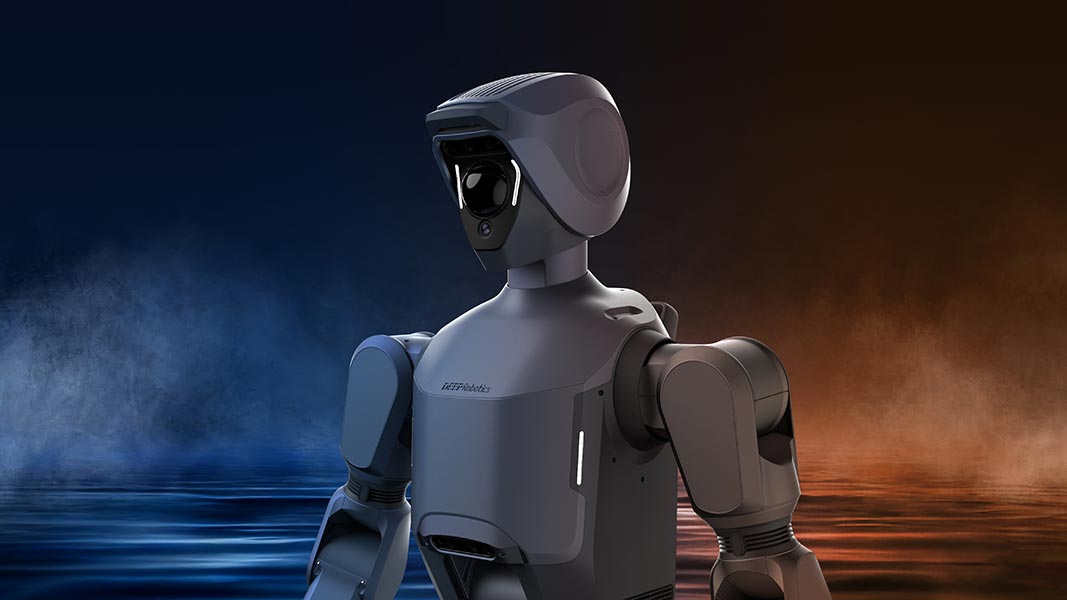
04Technology Stack: Strengths and the Work That Remains
The dossier provides no technical documentation for any DEEP Robotics platform. There is no datasheet, no SDK reference, no actuator specification, no compute architecture, no sensor suite listing and no runtime figure. What exists is marketing language: "dynamic locomotion," "multimodal perception," "autonomous navigation" and "AI-driven sensory-motor fusion" 246. Every one of those phrases is a COMPANY CLAIM. This section therefore assesses what can be inferred about the stack from the product segmentation and the deployment claims, and is explicit about the limits.
The product segmentation itself is informative. DEEP Robotics sells quadrupeds, a wheel-legged platform and humanoids. The wheel-legged LYNX is the most technically distinctive item in the catalogue, because wheel-legged locomotion is a genuinely different control problem from pure legged locomotion: it requires switching between rolling and stepping gaits, managing wheel-leg coordination on stairs and rubble, and handling failure modes that do not exist on either a pure wheeled or a pure legged platform 24. The fact that DEEP Robotics has productised this rather than leaving it as a research demonstrator is an EDITORIAL INFERENCE in favour of real control engineering depth. It is not proof, because the dossier contains no performance data for the LYNX.
The industrial quadrupeds, X30 and M20, imply a different set of engineering priorities: ingress protection, thermal management, battery endurance for long inspection routes, and payload capacity for inspection sensors. The Singapore power cable tunnel deployment claim, if accurate, would require the X30 to operate in a confined, likely humid and possibly hazardous environment 6. That is a COMPANY CLAIM of deployment, and the dossier contains no independent confirmation, no duration, no route length, no autonomy mode and no operator ratio. The claim is consistent with the product positioning; it is not evidence that the robot performed the inspection unsupervised.
The humanoid line, DR01 and DR02, is the least supported. Humanoid locomotion and manipulation are the hardest problems in the portfolio, and the dossier contains no specification, no demonstration evidence and no deployment claim for either platform 24. On the supplied evidence, the humanoid line should be treated as a strategic option rather than a proven capability.
The most consequential gap is autonomy. "Autonomous navigation" is claimed across the range 246, but the dossier contains no independent teardown, no third-party review, no first-hand operator report and no verified customer statement demonstrating autonomous task execution. It also contains no evidence of teleoperation. The reconciled autonomy level is therefore UNKNOWN 13. This is the single most important technical finding in the report, and it is a finding about evidence rather than about hardware. A buyer evaluating DEEP Robotics against an industrial inspection requirement should assume nothing about autonomy until a supervised trial is run.
Three specific technical questions remain unanswered by the dossier and should be treated as UNKNOWN: what compute and sensor stack each platform carries; what the runtime and payload specifications are for the industrial quadrupeds; and what level of autonomy, if any, has been independently observed. Until those are answered, the technology assessment rests on product segmentation and marketing language, which is a weak foundation.
05Research, Papers, Authors and Labs
The supplied dossier contains no research sources at all. There are no peer-reviewed papers, no preprints, no conference publications, no patent filings, no technical blog posts and no named research laboratory associated with DEEP Robotics. The research count in the dossier metadata is zero.
This is a material gap for a company founded in 2017 by a named CEO and now operating in the legged-robotics field, where the leading firms typically maintain a visible publication record that serves as both a recruiting tool and a credibility signal. The absence may reflect the dossier's construction rather than the company's actual output: the research gathering pass returned nothing, which could mean nothing exists or could mean the search did not reach the relevant venues. This report cannot distinguish between those possibilities, and says so rather than inferring either.
What can be stated is that no research evidence in the dossier supports any of the company's technical claims. The "AI-driven sensory-motor fusion" language 246 has no published backing in the supplied material. The autonomy claim has no published backing. The humanoid platforms have no published backing. For an analyst, this means the technical claims must be evaluated on commercial and deployment evidence alone, which is itself thin.
The same applies to authors and labs. No individual researcher, no academic group and no institutional partner is named anywhere in the dossier in connection with DEEP Robotics. The founding lineage, which for most legged-robotics companies explains the technical approach, is not publicly disclosed in the supplied evidence.
If DEEP Robotics does maintain a publication record, it is not visible in this dossier. If it does not, that is itself a signal about how the company prioritises research relative to productisation. Either way, the honest position is that the research dimension of this report is empty because the evidence is empty.
<!-- module: papers --> <!-- module: authors-labs --> <!-- module: repos --> <!-- module: datasets -->06Media Evidence Library: What the Videos Prove
The dossier contains no video sources attributed to DEEP Robotics. The video count is zero. There is one YouTube item, a comparison video titled "Unitree Vs Deep Robotics Robot dog" 3, which is a third-party comparison rather than a company demonstration, and one Reddit post about stair climbing 13.
The stair-climbing post is the only community item in the dossier that actually concerns DEEP Robotics 13. It is a low-confidence item: a single Reddit post in a general futurism community, with no operator commentary, no duration, no autonomy mode and no verification. It shows a robot climbing stairs. It does not establish autonomy, and it does not establish that the robot was not being remotely operated. Under this report's evidence rules, a video of a robot performing a locomotion task is not proof of autonomous work, and this item is weaker than most because it carries no context at all.
The comparison video 3 is more useful as a market signal than as technical evidence. The fact that third parties are producing Unitree-versus-DEEP-Robotics content indicates that DEEP Robotics has achieved enough visibility to be a reference point in the Chinese legged-robotics market. That is an EDITORIAL INFERENCE about market position, not a technical finding.
Several items in the dossier's community category are unrelated to DEEP Robotics and were excluded as noise: a Reddit post about a robot-combat video game 11, an FTC robotics game-strategy thread 12, a Robot Wars television discussion 14, a construction-RPG game post 15 and a robot vacuum mop thread 16. None of these concern the company. Their presence in the dossier is a reminder that automated evidence gathering produces false positives, and that the effective evidence base for this report is smaller than the raw counts suggest.
The honest summary of the media evidence library is that it is effectively empty. There is no company demonstration footage, no independent trial footage, no customer site footage and no teardown video in the dossier. Nothing in the media category supports or refutes any technical claim. The autonomy verdict of UNKNOWN is reinforced rather than challenged by the media evidence.
Media library
07Commercial Reality
DEEP Robotics is commercially available. That much is established: products are priced and sold through resellers, with listings spanning approximately USD 4,995 to approximately USD 75,600 124. The lifecycle status of "fully commercial" is supported by the existence of priced listings and by reported deployments 6. What is not established is anything about the scale, quality or profitability of that commerce.
| Commercial question | What the dossier shows | Evidence label |
|---|---|---|
| Are products for sale? | Yes, via resellers and an official shop | VERIFIED FACT |
| Is there a published price range? | ~USD 4,995 to ~USD 75,600 | VERIFIED FACT (listings exist) |
| Are industrial models priced publicly? | No, quote only | VERIFIED FACT (absence of price) |
| Are there confirmed paid customers? | No named customer confirmation | UNKNOWN |
| Are there confirmed deployments? | Two, reported by the company | COMPANY CLAIM |
| Is revenue disclosed? | No | UNKNOWN |
| Are unit shipments disclosed? | No | UNKNOWN |
| Is there a backlog or order book? | No | UNKNOWN |
| Is the company profitable? | No disclosure | UNKNOWN |
| Is there repeat-purchase evidence? | No | UNKNOWN |
The two reported deployments are the strongest operational signals in the dossier. The company's news page reports an X30 conducting smart inspection in a Singapore power cable tunnel and a wheel-legged robot used in emergency rescue 6. Both are COMPANY CLAIMS. Neither is corroborated by a named customer, a utility operator, a government agency or an independent report in the supplied evidence. Neither discloses duration, autonomy mode, operator ratio or outcome. A deployment claim of this kind is a starting point for diligence, not a conclusion.
The absence of named customers is the most significant commercial gap. In industrial robotics, named reference customers are the primary currency of credibility, and companies at Series C stage typically publicise them. DEEP Robotics' dossier contains none. This may reflect the dossier's construction, or it may reflect customer confidentiality requirements common in utility and security work, or it may reflect a thin installed base. The evidence cannot distinguish between these, and this report does not guess.
The funding round is the clearest commercial fact. More than CNY 500 million, approximately USD 70 million, raised in a Series C reported in late 2025 7810. The investor list, including CMB International, China Asset Management, China Telecom, China Unicom, Fortune Capital and Yunhui Capital, is single-sourced 9. If the telecom participation is accurate, it would suggest strategic interest from state-linked infrastructure operators, which would be consistent with the inspection and patrol positioning. On the evidence provided, that remains an EDITORIAL INFERENCE resting on an uncorroborated investor list.
The commercial reality, in short, is a funded company with a priced catalogue, two unverified deployment claims and no disclosed revenue, customers or shipments. That is a normal profile for a growth-stage hardware company and an insufficient basis for a confident commercial judgement. The next twelve months of disclosure, or its continued absence, will be more informative than anything currently in the public record.
Customers & deployments
X30 quadruped reported by the company as performing smart inspection in a Singapore power cable tunnel.
Sections 8 through 14 continue in the second part of this report.
08Markets and Use Cases
DEEP Robotics' stated target applications are narrow and industrial: harsh-environment inspection, security patrol, emergency rescue, and robotics research 6. This is a deliberate positioning choice, and it is the correct one for a company of its size and provenance. The consumer quadruped market is a graveyard of novelty purchases and abandoned units; the industrial inspection market, by contrast, has real budget lines, real regulatory drivers, and real willingness to pay for machines that keep humans out of dangerous places. The question is not whether the market exists. It is whether DEEP Robotics can convert a plausible market thesis into repeatable, defensible revenue.
8.1 The Inspection Market: The Core Bet
The strongest evidence in the dossier for a genuine use case is the reported deployment of the X30 in a Singapore power cable tunnel 6. This is the archetypal industrial inspection scenario: confined space, hazardous environment, repetitive route, high cost of human entry, and a clear regulatory and insurance rationale for automation. Power utilities across Asia, Europe, and North America have been actively trialling legged and tracked robots for substation and tunnel inspection for several years. The addressable market is real.
What the dossier does not tell us is the commercial character of that deployment. A "deployment" reported on a company news page could mean a paid multi-unit contract, a paid pilot, a free trial, a research collaboration, or a demonstration arranged for a press visit. These are very different things, and the distinction matters enormously for anyone assessing the company's commercial trajectory. The dossier provides no contract value, no unit count, no duration, no renewal, and no named customer confirmation beyond the company's own page 6. Under the evidence discipline applied throughout this report, the Singapore tunnel deployment is best classified as a company claim with a specific, checkable detail — which is more than most vendor claims, but still not verified commercial traction.
The inspection market's structural challenge for any legged-robot vendor is that it is not one market. Substation inspection, tunnel inspection, pipeline inspection, offshore platform inspection, and construction-site inspection each have different sensor payloads, different regulatory regimes, different data-integration requirements, and different procurement cycles. A robot that wins a tunnel trial does not automatically win a substation contract. Scaling in this market requires either deep vertical specialisation (win tunnel inspection, own tunnel inspection) or a platform strategy with a partner ecosystem that customises per vertical. DEEP Robotics appears to be pursuing the latter, given its broad product line and reseller network 24. That is a harder path to defend, because it invites competition from both specialised inspection-robot firms and general-purpose legged-robot vendors.
8.2 Security Patrol: Plausible but Crowded
Security patrol is the second stated application 6. The use case is intuitive: a quadruped with cameras and possibly thermal and LiDAR payloads walking a fixed perimeter route, flagging anomalies, and streaming video to a control room. The economics are attractive where human guard costs are high and the perimeter is large and repetitive.
The problem is that this market is already crowded and the differentiation is thin. Aerial drones cover perimeter patrol faster and cheaper for many sites. Fixed cameras cover it more cheaply still where line of sight permits. Tracked and wheeled ground robots cover it more reliably on paved surfaces. The quadruped's advantage is terrain versatility — stairs, gravel, mud, debris — and that advantage only matters at sites where the terrain is genuinely hostile. The number of sites where a quadruped patrol robot is the economically correct answer is smaller than the number of sites where it is a technically feasible answer. Vendors in this space have historically struggled to convert pilots into fleets for exactly this reason.
8.3 Emergency Rescue: The Weakest Commercial Case
Emergency rescue is the third stated application 6, and it is the one where the gap between demonstration value and commercial value is widest. Rescue robots are bought by fire services, civil defence organisations, and mine rescue teams. These are public-sector buyers with long procurement cycles, tight budgets, and a strong preference for proven, certified equipment. A rescue robot that has not been through formal certification and field validation by the relevant authority is not a rescue robot; it is a demonstration platform.
The dossier reports that a wheel-legged robot was used in emergency rescue 6, but provides no detail on the nature of that use — whether it was an operational deployment, a training exercise, a demonstration, or a media event. Without that detail, the rescue application should be treated as a marketing narrative rather than a revenue line. This is not a criticism specific to DEEP Robotics; every legged-robot vendor tells a rescue story, because it is emotionally compelling and politically attractive. But rescue is unlikely to be a material revenue driver for any legged-robot company in the near term.
8.4 Research: The Reliable but Low-Margin Base
Robotics research is the fourth stated application 6, and it is the one where DEEP Robotics has the clearest evidence of actual sales. The Lite3 series is listed at prices from approximately $4,995 (Lite3 Basic) through $5,995 to $14,500 for other variants by resellers 124. These are research-platform price points. Universities, research institutes, and corporate R&D labs buy legged robots at these prices for locomotion research, control-algorithm development, and AI training. The market is real, the buyers are identifiable, and the sales cycle is short.
The strategic problem with the research market is that it is a commodity market with low margins and high price sensitivity. Research buyers compare Lite3 against Unitree's Go and B series, against Boston Dynamics' Spot (at a much higher price point), and against a growing field of Chinese and Western competitors. They buy on price, payload, SDK quality, and community support. DEEP Robotics competes here on price and on the breadth of its product line, but it does not have a defensible moat. Unitree in particular has a strong position in the research market and a lower cost base.
8.5 Market Attractiveness Summary
| Application | Market size | Buyer type | Sales cycle | Competitive intensity | DEEP Robotics evidence | Commercial attractiveness |
|---|---|---|---|---|---|---|
| Industrial inspection | Large | Utilities, industrial operators | Long (6–18 months) | High | Singapore tunnel deployment (company claim) 6 | High if repeatable |
| Security patrol | Medium | Security firms, campuses, industrial sites | Medium | Very high | None specific in dossier | Medium |
| Emergency rescue | Small | Public safety agencies | Very long | Medium | Wheel-legged rescue use (company claim, undetailed) 6 | Low near-term |
| Robotics research | Medium | Universities, R&D labs | Short | Very high | Lite3 reseller listings 124 | Reliable but low-margin |
| Humanoid (DR01/DR02) | Emerging | Research, early industrial pilots | Unknown | Extreme | DR02 listed at ~$75,600 2 | Speculative |
The honest read is that DEEP Robotics has one credible industrial beachhead (inspection), one reliable but commoditised base (research), and two applications (patrol, rescue) where the commercial case is plausible but unproven. The humanoid line is a strategic option on a future market, not a current revenue driver.
Customers & deployments
X30 quadruped reported by the company as performing smart inspection in a Singapore power cable tunnel.
09Competitive Landscape
DEEP Robotics competes in a market that has consolidated around a small number of credible legged-robot vendors, with a long tail of aspirants. The competitive dynamics differ sharply between the quadruped, wheel-legged, and humanoid segments, and DEEP Robotics' position is different in each.
9.1 The Quadruped Segment: Unitree Is the Benchmark
The single most important competitive fact about DEEP Robotics is that it is not the market leader in its own category. That position belongs to Unitree, which has achieved substantially larger shipment volumes, a lower cost structure, and a much stronger presence in the global research market. The dossier itself contains a direct comparison video, "Unitree Vs Deep Robotics Robot dog" 3, which is a useful signal: when the most prominent independent content about a company is a head-to-head comparison against a larger rival, the company is the challenger, not the incumbent.
The competitive comparison is not straightforward, because the two companies have different positioning. Unitree has pursued a volume strategy, driving prices down aggressively and targeting the research, education, and enthusiast markets with a broad product line. DEEP Robotics has pursued a more industrial positioning, with the X30 and M20 aimed at inspection and harsh-environment work, and the Lite3 aimed at research. The industrial positioning is defensible if DEEP Robotics can build genuine vertical expertise and service capability. It is not defensible if the products are functionally equivalent to Unitree's at a higher price.
| Dimension | DEEP Robotics | Unitree | Boston Dynamics | Assessment |
|---|---|---|---|---|
| Quadruped product breadth | Lite3, X30, M20 | Go, B, A series | Spot | Comparable breadth |
| Price positioning | Mid to high | Low to mid | Very high | DEEP above Unitree |
| Research market presence | Moderate | Strong | Moderate | Unitree leads |
| Industrial inspection focus | Explicit | Less explicit | Strong | DEEP and BD compete |
| Global distribution | Reseller network 24 | Broad direct + reseller | Direct + partners | Unitree leads |
| Humanoid line | DR01, DR02 | H1, G1 | Atlas (research) | All early-stage |
The table is deliberately blunt: on almost every axis where the dossier provides evidence, DEEP Robotics is positioned behind Unitree on scale and behind Boston Dynamics on industrial credibility. Its differentiation must come from the specific combination of price, capability, and Chinese-market access — a combination that is real but not unique.
9.2 The Wheel-Legged Segment: A Narrower Field
The LYNX wheel-legged series competes in a smaller field. Wheel-legged robots combine the speed and efficiency of wheels on flat ground with the obstacle-climbing capability of legs, and they are well suited to industrial inspection routes that mix paved and uneven terrain. The main competitors are other Chinese vendors (notably Unitree, which has its own wheel-legged offerings) and a handful of specialised European and American firms.
Wheel-legged robots have not achieved the same market visibility as quadrupeds, and the segment is less crowded. This is both an opportunity and a warning: a less crowded segment may be less crowded because the demand is smaller. The dossier provides no evidence on LYNX sales volumes or customer deployments, so the segment's commercial significance for DEEP Robotics cannot be assessed. It is best treated as a product-line extension rather than a distinct competitive position.
9.3 The Humanoid Segment: A Different Game Entirely
The DR01 and DR02 humanoids place DEEP Robotics in the most crowded and most hyped segment of the robotics market. The humanoid field includes Figure, Tesla Optimus, Agility Robotics, Apptronik, 1X, Unitree, Fourier, UBTech, and dozens of others. The capital intensity is extreme, the technical challenges are unresolved, and the commercial deployments are almost entirely pilot-stage. A company of DEEP Robotics' size entering this segment is making a strategic bet on a future market, not competing for current revenue.
The DR02's listed price of approximately $75,600 2 is notable. It is far below the cost of most Western humanoid platforms and far above what a research lab would typically pay for a humanoid. This price point suggests DEEP Robotics is targeting early industrial pilots and well-funded research labs, not mass deployment. The strategic logic is defensible — establish a presence in the segment before it matures — but it is a distraction from the industrial inspection business that is the company's actual near-term opportunity.
9.4 The Structural Competitive Problem
The deepest competitive issue for DEEP Robotics is that legged-robot hardware is converging. The core components — actuators, controllers, batteries, sensors — are increasingly available from a common supplier base, and the performance gap between vendors is narrowing. This means hardware alone is not a durable moat. The moats that matter are software (autonomy stacks, fleet management, data pipelines), vertical expertise (knowing how a substation inspection works and what the utility actually needs), service capability (deployment, maintenance, integration), and cost structure.
DEEP Robotics' reseller-heavy distribution model 24 is a weakness in this context. Resellers can move boxes, but they cannot build vertical expertise or deliver the integration services that industrial customers require. If DEEP Robotics wants to win inspection contracts against Boston Dynamics and against specialised inspection-robot firms, it will need to build direct service capability in its target markets. The dossier provides no evidence that it has done so.
Competitive comparison
| Robot | Maker | Autonomy | Conf. |
|---|---|---|---|
| iRobot Roomba Combo 10 Max | iRobot | Autonomous | 0.90 |
| Mobile ALOHA (Stanford) | Stanford University | Teleoperated | 0.90 |
| 1X NEO | 1X Technologies | Remote-Assisted | 0.90 |
10Geopolitical Context and Constraints
DEEP Robotics is a Chinese company selling into a global market at a moment of acute geopolitical tension over robotics, AI, and advanced manufacturing. This context is not incidental to the company's prospects; it is a primary determinant of them.
10.1 The Export-Control and Procurement Risk
The most immediate constraint is the risk of procurement restrictions in Western markets. The United States has already restricted the use of Chinese-made drones in federal procurement and has moved to restrict Chinese connected vehicles. Legged robots with cameras, LiDAR, and network connectivity are plausibly in scope for similar restrictions, particularly for government, utility, and critical-infrastructure customers. A US utility considering a Chinese-made inspection robot must weigh the technical merits against the risk that the robot will be banned from its sites in two years, or that the data it collects will be subject to scrutiny.
This risk is asymmetric. It does not prevent DEEP Robotics from selling into China, Southeast Asia, the Middle East, Africa, or Latin America. It does substantially raise the barrier in the United States, the European Union, the United Kingdom, Japan, South Korea, and Australia — precisely the markets with the highest willingness to pay for industrial inspection robots. The Singapore deployment 6 is notable in this context: Singapore is a sophisticated, high-income market that is not aligned with US procurement restrictions, and it may represent the template for DEEP Robotics' international strategy.
10.2 The Data and Security Question
Industrial inspection robots collect sensitive data: images of critical infrastructure, LiDAR maps of secure facilities, thermal signatures of operating equipment. For a state-owned or state-linked utility, allowing that data to be processed by a foreign vendor's cloud or transmitted to a foreign jurisdiction is a serious security concern. The dossier provides no information on how DEEP Robotics handles data residency, whether its robots can operate fully offline, or whether it offers on-premises data processing. These are not minor technical details; they are procurement gatekeepers in Western markets.
The absence of this information in the dossier is not evidence that DEEP Robotics handles data poorly. It is evidence that the company's public materials do not address the question, which is itself a signal about its market focus. Companies that are serious about Western industrial sales lead with data-sovereignty assurances. Companies that are focused on the Chinese and non-aligned markets often do not.
10.3 The Supply-Chain Position
DEEP Robotics benefits from China's deep supply chain for actuators, batteries, sensors, and precision manufacturing. This is the same advantage that has allowed Unitree to undercut Western competitors on price. It is a real and durable advantage in the near term. It is also a vulnerability if export controls are extended to robotics components, or if Western customers demand supply-chain provenance that Chinese vendors cannot provide.
10.4 The Humanoid Dimension
The humanoid segment adds a further geopolitical layer. Humanoid robots are widely viewed as a strategic technology, and both the United States and China have made humanoid development a national priority. A Chinese humanoid vendor selling into Western markets will face heightened scrutiny, particularly for any application touching critical infrastructure, healthcare, or defence-adjacent work. The DR01 and DR02 are unlikely to be exempt from this dynamic.
10.5 Net Geopolitical Assessment
| Market | Access | Constraint | Outlook |
|---|---|---|---|
| China | Full | Domestic competition | Strong but contested |
| Southeast Asia | Good | Limited | Growth market |
| Middle East | Good | Limited | Growth market |
| Europe | Restricted | Procurement scrutiny, data rules | Difficult |
| United States | Restricted | Procurement restrictions likely | Very difficult |
| Japan / South Korea | Restricted | Domestic robotics industry, security concerns | Difficult |
The geopolitical map suggests DEEP Robotics' realistic international opportunity is in non-aligned and Chinese-aligned markets, plus selected Western deployments where the customer is willing to accept the risk. This is a substantial market, but it is not the whole market, and it caps the company's ceiling relative to a Western competitor with unrestricted access.
11The Hype, the Real and the Ugly
This section applies the report's evidence discipline to the specific claims in the dossier. The purpose is not to be cynical but to be precise: to separate what is demonstrated from what is asserted, and to identify where the gap between the two is largest.
11.1 The Hype
"Global Quadruped Robot Leader" — the company's own tagline 6. This is a marketing claim, not a market-share fact. The dossier provides no shipment volumes, revenue figures, or market-share data. Unitree's much larger presence in the research market and Boston Dynamics' industrial position both argue against DEEP Robotics being the global leader on any metric other than perhaps product-line breadth. The tagline should be read as aspiration.
"Autonomous navigation" and "AI-driven sensory-motor fusion" 6. These are the most consequential claims in the dossier, and they are the least substantiated. The autonomy verdict for this report is unknown (confidence 0.3), because the dossier contains no independent teardown, no third-party review, and no first-hand user report demonstrating that DEEP Robotics robots perform their inspection or patrol tasks without a human driving or remotely operating them. The vendor's language implies autonomy; the evidence does not establish it. This is the single most important gap in the entire dossier.
The Series C framing. The over 500 million RMB (~US$70 million) Series C 78 is real and well-corroborated. But funding announcements are frequently framed as validation of a business model when they are more accurately read as validation of a narrative. The round tells us that sophisticated investors believe there is a large market for legged robots. It does not tell us that DEEP Robotics has found a profitable way to serve it.
11.2 The Real
The funding round is genuine. Multiple independent news outlets and the company site agree on the amount and the round 7810. This is a verified fact, and it is a meaningful one: it gives the company runway to develop products and pursue deployments.
The product line is real and priced. The Lite3, X30, M20, LYNX, DR01, and DR02 are listed for sale through resellers at concrete prices 124. This is more than many robotics companies can demonstrate. A company with priced, orderable products is a company with a supply chain, a manufacturing process, and a distribution channel.
The Singapore tunnel deployment is a specific, checkable claim. It is reported on the company's own news page 6, which is a weaker source than independent confirmation, but it is a specific claim about a specific site, which is more than a generic "deployed in industry" statement. It warrants follow-up.
11.3 The Ugly
The pricing conflict. The Lite3 is listed "From $598.60 USD" on the official shop 1 while resellers list Lite3 Basic at $4,995 and other variants at $5,995 to $14,500 24. The $598.60 figure is almost certainly a deposit, an accessory, or a partial listing rather than a complete robot. This kind of pricing inconsistency is a red flag for procurement professionals, who need to know what a system actually costs to deploy. It also suggests the company's e-commerce presence is not tightly managed.
The investor list is single-sourced. The named investors — CMB International, China Asset Management, China Telecom, China Unicom, Fortune Capital, Yunhui Capital — come from a single aggregator source 9 and are not corroborated elsewhere in the dossier. The presence of China Telecom and China Unicom as investors is strategically interesting (it suggests telecom-adjacent deployment channels) but should be treated as unconfirmed until corroborated.
The community evidence is noise. Of the six community items in the dossier, five are unrelated to DEEP Robotics: a robot-combat video game 11, an FTC robotics competition thread 12, a Robot Wars TV discussion 14, a construction-RPG game 15, and a robot vacuum thread 16. Only one 13 touches DEEP Robotics at all, and it is a low-confidence video post about stair climbing that does not establish autonomy. The community signal for DEEP Robotics is essentially absent, which is itself informative: the company has not generated the kind of organic user discussion that would indicate a large, engaged customer base.
11.4 Claim-vs-Evidence Table
| Claim | Source | Evidence type | Verification status | Assessment |
|---|---|---|---|---|
| "Global quadruped robot leader" | Company 6 | Marketing | Unverified | Aspirational; contradicted by Unitree's scale |
| "Autonomous navigation" | Company 6 | Marketing | Unverified | Autonomy level unknown; no independent evidence |
| "AI-driven sensory-motor fusion" | Company 6 | Marketing | Unverified | Vague; not testable as stated |
| X30 deployed in Singapore tunnel | Company 6 | Company news | Specific but unconfirmed | Warrants independent follow-up |
| Wheel-legged robot in rescue | Company 6 | Company news | Undetailed | Could be demo, trial, or deployment |
| Series C >500M RMB | Multiple 7810 | News | Verified | Genuine, well-corroborated |
| Investor list | Aggregator 9 | Single source | Unconfirmed | Treat as provisional |
| Product pricing | Resellers 124 | Commerce listings | Verified as listings | Conflict on Lite3 entry price |
Claim tracker
Only vendor descriptions on the company site [6] assert 'autonomous navigation'; no independent teardown, review, or first-hand user report in the dossier demonstrates autonomous task execution, and the one community item [13] merely shows stair climbing without establishing autonomy.
This deployment is reported only on the company's own news page [6]; no independent customer, regulator, or reporter source in the dossier corroborates the tunnel inspection, so it remains vendor-sourced.
The rescue use is stated only on the official company news page [6] with no independent confirmation of the operation, location, or outcome.
Multiple independent reseller and shop listings [1][2][4] show priced, purchasable Lite3, X30, LYNX, and DR02 units, independently confirming commercial availability, though the outlier $598.60 Lite3 listing [1] is likely a deposit or accessory rather than a full robot.
Multiple independent news outlets [7][8] and the company site [6] agree on the round size and timing, independently substantiating the funding amount, though the specific investor list [9] is only single-sourced.
The humanoid DR01/DR02 lines appear only in vendor and reseller listings [2][4][6] with no independent demonstration, review, or deployment evidence confirming their real capability.
Target applications are stated consistently by vendor and commerce sources [2][4][6], but no independent customer outcome or third-party field report in the dossier confirms performance in these roles.
The 'global leader' positioning appears only as the company's own site tagline [6]; the dossier contains no independent market-share, sales-volume, or third-party ranking evidence to substantiate leadership.
12Future Scenarios
The following scenarios are editorial inferences, not predictions. They are constructed to bracket the plausible range of outcomes and to identify the observable signals that would distinguish them.
12.1 Scenario A: The Industrial Inspection Specialist (Base Case, ~40% likelihood)
DEEP Robotics focuses on industrial inspection as its core business, builds direct service capability in China and selected international markets, and converts the Singapore tunnel deployment into a repeatable vertical offering. The research business (Lite3) provides steady but low-margin revenue. The humanoid line remains a research and marketing programme. The company grows steadily, reaches profitability in the inspection line, and becomes a credible mid-sized industrial robotics firm.
Signals to watch: named inspection customers with contract values; expansion of the Singapore deployment to additional sites; hiring of service and integration staff; publication of data-handling and security documentation for Western markets.
12.2 Scenario B: The Volume Challenger (Upside, ~25% likelihood)
DEEP Robotics leverages its funding and Chinese supply chain to compete aggressively on price against Unitree, wins significant share in the research and education markets, and uses that volume to fund industrial expansion. The humanoid line gains traction as a low-cost alternative to Western platforms. The company becomes a major global legged-robotics vendor.
Signals to watch: shipment volume disclosures; aggressive price cuts; expansion of reseller network into new geographies; humanoid orders from research institutions or industrial pilots.
12.3 Scenario C: The Geopolitical Squeeze (Downside, ~20% likelihood)
Western procurement restrictions tighten, closing DEEP Robotics out of the highest-value markets. The company retreats to China and non-aligned markets, where competition from Unitree and others compresses margins. The humanoid bet consumes capital without producing revenue. Growth stalls and the company becomes a regional player.
Signals to watch: explicit procurement bans naming Chinese legged robots; loss of Western reseller partners; delays or cancellations of announced international deployments; executive departures.
12.4 Scenario D: The Acquisition Target (Consolidation, ~15% likelihood)
The legged-robotics market consolidates. A larger industrial or technology company acquires DEEP Robotics for its product line, its supply chain, or its Chinese market access. The brand continues but the independent trajectory ends.
Signals to watch: strategic investment by a large industrial firm; partnership announcements with major automation vendors; reports of acquisition talks.
12.5 Scenario Probabilities and Implications
| Scenario | Likelihood | Key driver | Implication for buyers | Implication for investors |
|---|---|---|---|---|
| A: Inspection specialist | 40% | Execution in vertical | Stable vendor, limited scale | Modest return |
| B: Volume challenger | 25% | Price competition | Cheaper robots, thinner support | High return, high risk |
| C: Geopolitical squeeze | 20% | Export controls | Western buyers stranded | Capital loss risk |
| D: Acquisition | 15% | Market consolidation | Continuity under new owner | Exit at strategic premium |
The base case is unglamorous but plausible: a competent industrial robotics company that finds a defensible niche and grows steadily. The upside case requires DEEP Robotics to beat Unitree at its own game, which is difficult. The downside case is largely outside the company's control. The acquisition case is a reasonable outcome for a company with real products and real technology but no clear path to independent scale.
13What to Watch: A Live Monitoring Checklist
The following checklist is designed for ongoing monitoring. Each item is a specific, observable signal that would materially change the assessment in this report. The list is ordered by importance.
13.1 Autonomy and Technical Verification (Highest Priority)
- Independent teardown or review. Any third-party technical analysis of a DEEP Robotics robot that tests the autonomy stack, the perception system, and the navigation claims. This is the single most valuable piece of evidence that could appear, and its absence is the largest gap in the current assessment.
- First-hand user reports. Detailed accounts from named customers describing how the robots are actually operated — whether they run autonomously, under teleoperation, or under some hybrid. Look for specifics: how many operators per robot, what interventions are required, what the failure modes are.
- Video evidence of unedited autonomous task completion. Not choreographed demos, but continuous footage of a robot performing an inspection or patrol route without a human in the loop. The current dossier contains no such evidence.
- SDK and autonomy-stack documentation. Public developer documentation that reveals the actual capabilities and limitations of the navigation and perception systems.
13.2 Commercial Verification
- Named inspection customers with contract details. The Singapore tunnel deployment 6 should be followed up: which utility, how many robots, what contract value, what duration, what renewal terms.
- Repeat orders. A second order from the same customer is far stronger evidence of value than a first order, which may be a pilot or a favour.
- Service and integration hiring. Job postings for field service engineers, solutions architects, and vertical specialists in target markets would indicate a shift from box-moving to solution-selling.
- Revenue or shipment disclosures. Any concrete figure on units shipped or revenue by segment.
13.3 Financial and Corporate
- Series D or IPO signals. A follow-on round at a higher valuation, or filings indicating an IPO track, would indicate investor confidence. A down round or a bridge would indicate the opposite.
- Investor confirmation. Independent corroboration of the investor list currently sourced only to an aggregator 9, particularly the reported participation of China Telecom and China Unicom.
- Profitability signals. Any indication that the company is approaching or has reached profitability in any line of business.
13.4 Geopolitical and Regulatory
- Procurement restrictions. Any US, EU, UK, Japanese, or South Korean action that names Chinese legged robots or their components in procurement restrictions.
- Data-sovereignty documentation. Publication of data-handling policies, on-premises processing options, or security certifications aimed at Western industrial customers.
- Export-control changes. Any extension of export controls to robotics components that would affect DEEP Robotics' supply chain or its ability to sell internationally.
13.5 Product and Competitive
- Humanoid traction. Any named customer, order, or deployment for the DR01 or DR02. The current evidence is a price listing 2 and nothing more.
- Price movements. Significant price cuts or increases across the product line, which would indicate strategic shifts or cost changes.
- Competitor moves. Unitree's product launches and pricing, Boston Dynamics' industrial expansion, and the emergence of new entrants in the inspection segment.
13.6 Monitoring Cadence
| Signal category | Recommended cadence | Primary sources |
|---|---|---|
| Autonomy / technical | Continuous | Independent media, academic papers, user forums |
| Commercial | Monthly | Company news, trade press, procurement notices |
| Financial / corporate | Quarterly | Funding databases, regulatory filings |
| Geopolitical | Continuous | Government procurement portals, trade press |
| Product / competitive | Monthly | Vendor sites, reseller listings, trade shows |
The most important discipline in monitoring DEEP Robotics is to resist the pull of the demo video. A robot climbing stairs is not a robot doing a job. A partnership announcement is not a purchase order. A funding round is not a business model. The signals that matter are the ones that show a customer paying money, repeatedly, for a robot that does work a human would otherwise have to do. Until those signals appear, the assessment in this report stands.
14Sources and Methodology
14.1 Methodology
This report was compiled from a research dossier gathered on 2026-09-22. The dossier contained 16 numbered sources across five categories: official (0), commerce (5), research (0), news (5), video (0), and community (6). The distribution is itself a finding: the evidence base for DEEP Robotics is dominated by vendor and commerce material, with no peer-reviewed research, no independent technical review, and no first-hand user reporting.
The report applies a four-tier evidence discipline throughout:
| Label | Definition | Treatment in this report |
|---|---|---|
| Verified fact | Regulatory filings, official product documentation, named-customer confirmation, peer-reviewed or primary research, or multiple independent sources | Stated as fact; may still be qualified by scope |
| Company claim | Stated by the company, not independently verified | Attributed to the company; assessed for plausibility |
| Editorial inference | Reasoned conclusion drawn from public evidence | Labelled as inference; reasoning shown |
| Unknown | Not publicly disclosed | Stated plainly as "not publicly disclosed" |
Three specific rules were applied without exception:
- A choreographed demo video is not proof of autonomous work. No video evidence in the dossier was treated as demonstrating autonomy.
- A shipment is not proof of productive deployment. Product listings and availability were not treated as evidence of operational use.
- A partnership announcement is not proof of a paid customer. No partnership or deployment claim was treated as commercial traction without contract-level evidence.
14.2 Key Limitations
- No independent autonomy evidence. The autonomy verdict is unknown (confidence 0.3). This is the most significant limitation and it affects every commercial assessment in the report.
- No research literature. The dossier contains no peer-reviewed papers, no technical reports, and no academic citations. The research section of this report is necessarily thin.
- No first-hand user reports. No named customer, no operator account, and no independent review appears in the dossier.
- Single-sourced investor list. The investor names come from one aggregator source 9 and are not corroborated.
- Community noise. Five of six community items were unrelated to DEEP Robotics and were excluded as noise. The remaining item 13 is low-confidence.
- Pricing conflict. The Lite3 entry price is inconsistent between the official shop 1 and resellers 24, and the discrepancy is unresolved.
14.3 Sources
- Lite3 - Deep Robotics Online Shop — https://shop.deeprobotics.us/collections/lite
- Buy Deep Robotics – X30, Lite3, LYNX & DR02 for Sale — https://www.robotsinternational.com/Deep-Robotics.htm
- Unitree Vs Deep Robotics Robot dog — https://www.youtube.com/watch?v=uoWg3SCqFd8
- Deep Robotics for Sale | Buy Online — https://robotixmarket.com/collections/deep-robotics
- DEEP Robotics Stock | Valuation, Funding, Investors — https://notice.co/c/deeproboticsus
- DEEP Robotics - Global Quadruped Robot Leader — https://www.deeprobotics.cn/en
- DEEP Robotics | 500 Million RMB Series C Financing Round — https://humanoidroboticstechnology.com/industry-news/deep-robotics-completes-over-500-million-rmb-series-c-financing-round/
- China's Deep Robotics raises US$70 million in fresh funds — https://finance.yahoo.com/news/chinas-deep-robotics-raises-us-093000532.html
- Deep Robotics: Funding, Team & Investors — https://startupintros.com/orgs/deep-robotics
- NextTech's Post — https://www.linkedin.com/posts/nexttech-news_deep-robotics-secures-over-usd-70-million-activity-7405803538137759744-x2ww
- I'm making a video game where you build combat robots piece by piece — https://www.reddit.com/r/Machinists/comments/1pcwlud/im_making_a_video_game_where_you_build_combat/
- Thoughts for robot design or game strategy? (Into The Deep 2024) — https://www.reddit.com/r/FTC/comments/1fbdf94/thoughts_for_robot_design_or_game_strategy_into/
- Steady up the stairs - DEEP Robotics : r/Futurism — https://www.reddit.com/r/Futurism/comments/1vptea3/steady_up_the_stairs_deep_robotics/
- Classic Robot Wars vs. New Robot Wars : r/robotwars — https://www.reddit.com/r/robotwars/comments/6fn63n/classic_robot_wars_vs_new_robot_wars/
- Robot Recycler Ryn - Rablo Games - A Construction-RPG — https://www.reddit.com/r/Games/comments/1pgajrg/robot_recycler_ryn_rablo_games_a_constructionrpg/
- Robot Mop for deep cleaning : r/RobotVacuums — https://www.reddit.com/r/RobotVacuums/comments/1pw9e5z/robot_mop_for_deep_cleaning/
14.4 Closing Note
DEEP Robotics is a real company with real products, real funding, and a plausible market thesis. It is not a vapourware operation, and it should not be treated as one. But the evidence base available for this report does not support the strong claims that are commonly made about legged-robot companies, and it does not support the strong claims the company makes about itself. The gap between the marketing narrative and the verifiable evidence is the central finding of this report. Closing that gap — with independent technical validation, with named customers, with contract-level commercial evidence — is the work that would change the assessment. Until then, the honest position is one of disciplined scepticism: interested, informed, and unconvinced.