Comtronix
US$0.99 unlocks one Word + one PDF download. The full report is free to read on this page.

Comtronix
An industrial-computer vendor with a credible edge-AI inspection story, and almost no public evidence that it is a robotics company at all.
| Report status | Coverage date | Company stage | Editorial standard |
|---|---|---|---|
| Premium editorial deep report, first edition | Evidence gathered 19 September 2026 | Fully commercial; privately held; 20+ years trading | Evidence-labelled; no claim treated as fact without independent corroboration |
How to Read This Report
This report is written for people who have to make a decision about Comtronix: whether to buy from it, partner with it, compete with it, or simply stop confusing it with a robotics company. That last point matters more than it should. Comtronix appears in robotics-adjacent news coverage because it co-exhibited with a FANUC cobot at Automate 2026. It does not, on the public evidence, build robots. It builds the computers that other people's robots and inspection systems run on.
Every substantive assertion below carries an evidence label. The labels are not decoration. They are the mechanism by which a reader can tell the difference between a price on a product page and a marketing sentence about "24/7 reliability".
| Label | Meaning | Example in this report |
|---|---|---|
| VERIFIED FACT | Regulatory filing, official product documentation, named-customer confirmation, primary research, or multiple independent sources agreeing | The IPC-300 base price of USD 975.00, published on the product page 2 |
| COMPANY CLAIM | Stated by Comtronix or its partners, not independently verified | "24/7 reliability" and similar uptime language on the company site 3 |
| EDITORIAL INFERENCE | Reasoned conclusion drawn from public evidence, clearly flagged as our judgement | That Comtronix's strategic value lies in the inspection stack, not the chassis |
| UNKNOWN | Not publicly disclosed | Unit volumes, revenue, customer names, contract values |
Two structural warnings before we begin. First, the research dossier underpinning this report is thin in specific places, and we say so rather than pad. There is no official Comtronix press page content beyond a stub 6, no financial disclosure, no named customer, and no independent teardown of a Comtronix unit. Second, the dossier contains a quantity of noise: arXiv papers on robotic manipulation 18192021, YouTube teardowns of unrelated hardware 222324252627, and Reddit threads about PC faults, fire alarms and aviation headsets 282930313233. None of these are attributable to Comtronix. We flag them explicitly in §5 and §6 rather than silently dropping them, because a reader who searches for "Comtronix" and finds these results deserves to know they are irrelevant.
01Executive Overview
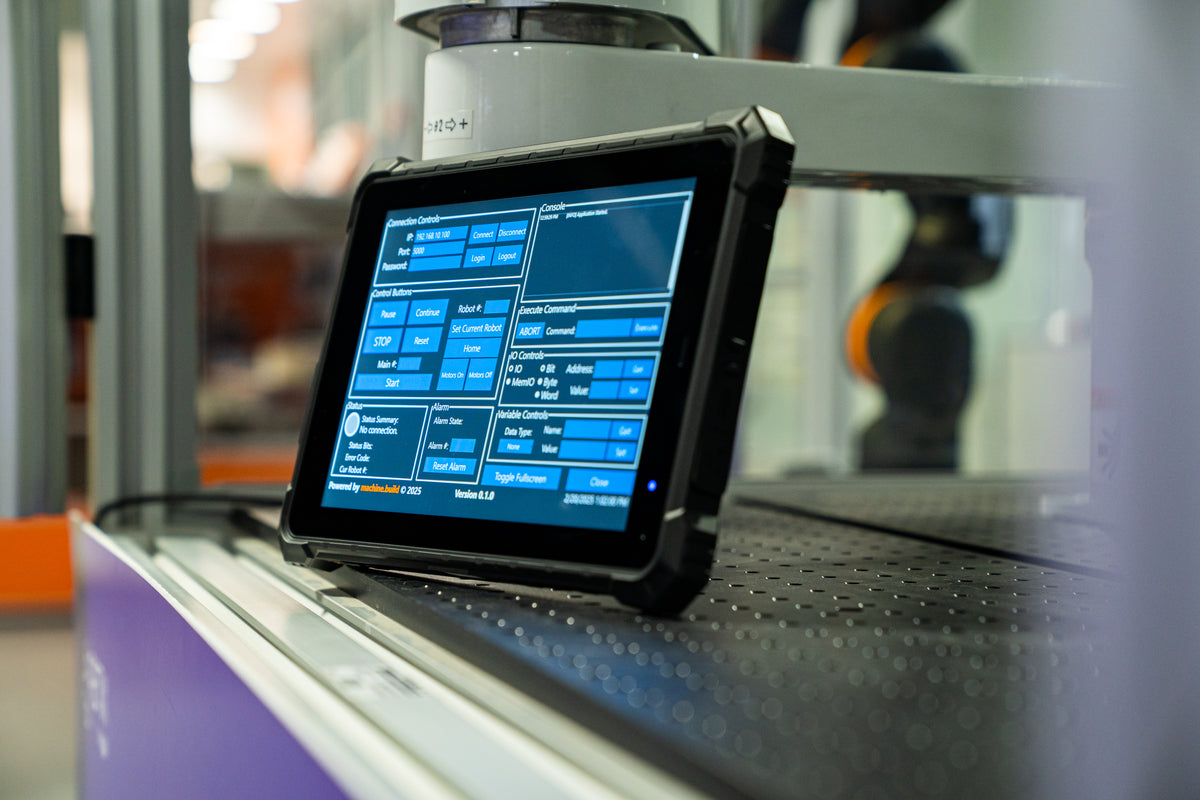
Comtronix is an industrial-computer designer and manufacturer. It sells rugged fanless panel PCs, forklift-mounted computers, and NVIDIA-based edge servers into factory automation, manufacturing and logistics environments 35. Its most concrete and best-evidenced recent activity is a three-way partnership with PTZOptics (cameras) and Detect-It (inspection software) to demonstrate an on-premise, offline-capable, multi-camera AI visual-inspection system at Automate 2026 in Chicago 7111213. The demonstration ran in three tiers: single-camera inspection, multi-camera gantry inspection, and a FANUC cobot carrying a PTZOptics camera 1112.
That is the whole of the story as the public record supports it. Everything else is either product-page specification, a vendor claim, or noise.
The single most important editorial finding is this: there is no evidence that Comtronix performs any task autonomously, and no evidence that it operates a robot. The autonomy verdict in the underlying analysis is "unknown" at 0.6 confidence, and that is the correct answer. The only robotic element anywhere in the evidence is a third-party FANUC cobot used as a camera platform in a trade-show demonstration 1112. A cobot holding a camera is not a Comtronix robot. It is a Comtronix-adjacent demonstration of somebody else's robot holding somebody else's camera, with Comtronix supplying the compute.
What Comtronix actually is, on the evidence, is a hardware integrator with a defensible niche. The NVIDIA Edge Server, which was named a finalist for the Automate 2025 Innovation Awards, is specified as carrying ten NVIDIA Orin NX nodes, each supporting up to ten cameras over Power over Ethernet 9. That is a real, checkable, specific piece of engineering. It is also the kind of product that matters enormously in the current industrial-AI moment, because the bottleneck in factory visual inspection is no longer the model. It is the deployment environment: no internet, no cloud, no tolerance for latency, and a security team that will not let a camera stream leave the building.
The partnership with PTZOptics and Detect-It is aimed precisely at that bottleneck. Multiple independent outlets describe the joint system as running behind the firewall with no internet requirement 781112. That is a genuinely useful proposition and it is corroborated across sources, which is more than can be said for most of the dossier.
The commercial reality is harder to assess. Comtronix has been trading for over twenty years 4, lists a base price for its IPC-300 panel computer at USD 975.00 2, and exhibits at Automate 4. Those are all markers of a real, operating business. But there is no disclosed revenue, no named customer, no unit volume, no contract value, and no independent verification that any of the demonstrated inspection systems has been deployed in production anywhere. A trade-show demonstration is not a deployment. A partnership announcement is not a paid customer. We hold that line throughout this report.
The competitive position is best understood by analogy rather than by direct comparison. Comtronix does not compete with Unitree, Boston Dynamics or any robot OEM. It competes with Advantech, Beckhoff, Siemens industrial PC lines, OnLogic, Cincoze, Neousys and a long tail of Taiwanese and German rugged-computer vendors. Its differentiation, to the extent it has one, is the vertical bundling of NVIDIA edge compute with an inspection software partnership rather than the chassis itself. Chassis are commoditised. Inspection stacks that run offline behind a firewall are less so.
Geopolitically, Comtronix sits on the right side of a genuine and widening split. It is a US vendor selling US-assembled or US-configured hardware into US industrial customers, at a moment when "no internet requirement" is not merely a technical convenience but a procurement criterion driven by both security policy and, increasingly, tariff and supply-chain considerations. The NVIDIA Orin NX dependency is the obvious exposure: Comtronix's flagship edge server is built on a component whose supply is controlled by a single US-listed but Taiwan-fabricated vendor, and whose export status is subject to ongoing policy churn. That is a real risk and it is not disclosed anywhere in the public record.
Our overall confidence in this assessment is moderate. The product facts are solid. The partnership facts are solid and multiply sourced. The commercial facts are absent. The autonomy question is answered, but only in the negative: we can say what Comtronix is not, with more confidence than we can say what it is worth.
Latest news
02The Comtronix Story
The public history of Comtronix is unusually sparse for a company that claims over twenty years of trading. That sparseness is itself a finding, and it shapes how much of this section can be written as narrative rather than as inventory.
What is established. Comtronix designs, manufactures, delivers and maintains industrial computers and supplies computer hardware 35. The Automate exhibitor profile states that the team has over twenty years of experience 4. The company exhibits at Automate, the principal North American automation trade show, which places it in the industrial-automation channel rather than the consumer or general IT channel 4. Its terms and conditions page states FOB Fort Myers, Florida, indicating that goods ship from a Florida origin 1. A separate news article lists the company at Young Harris, Georgia 7. Both locations appear in the record and neither is clearly more authoritative: the terms page is a shipping-origin statement, the news article is a company address. We preserve both and note the conflict rather than resolving it by preference.
What is claimed but not verified. The company presents itself as a long-standing, reliable supplier of industrial computing 3. The "24/7 reliability" language is vendor marketing and is labelled as such. There is no independent reliability data, no MTBF figure published, no field-failure statistics, and no third-party review of a Comtronix unit anywhere in the dossier.
What is absent. There is no founding date, no founder narrative, no funding history, no ownership structure, no employee count, no revenue figure, and no customer list in the public record. The Facebook post in the dossier referencing a founder named Allan Zoutendyk and a "Comtronix (Pty) Ltd" 15 is a South African entity naming pattern and does not align cleanly with the US industrial-computer vendor described everywhere else. We treat it as unverified and possibly a different corporate entity. It is not used as a basis for any claim in this report.
The arc, as best we can reconstruct it. Comtronix appears to have spent the bulk of its existence as a straightforward industrial-computer vendor: panel PCs, forklift terminals, ruggedised enclosures, the unglamorous plumbing of factory floors. The shift that makes the company interesting now is recent and datable. In 2025, Comtronix was named a finalist for the Automate Innovation Awards for an NVIDIA Edge Server solution 9. In 2026, it appeared at Automate in a three-way partnership with PTZOptics and Detect-It, demonstrating multi-camera AI visual inspection running on-premise and offline 7111213.
EDITORIAL INFERENCE. That sequence describes a company repositioning from "we sell boxes" to "we sell an inspection platform". The repositioning is sensible. Industrial panel PCs are a commodity business with thin margins and many competent competitors. Edge AI inspection is a growth market with a genuine deployment bottleneck that a hardware vendor with twenty years of factory-floor relationships is plausibly well placed to address. Whether the repositioning is working commercially is unknown, and the absence of any named customer or deployment reference is the single largest gap in this report.
The honest summary. Comtronix is a real company with a real product line and a real, recent, well-evidenced pivot toward edge AI inspection. It is not a robotics company, it has no public founding mythology, and its twenty-year history is asserted rather than documented. Readers should treat the longevity claim as plausible but unverified, and should treat the pivot as the actual story.
03Product Portfolio: What Comtronix Actually Sells
Comtronix sells three categories of hardware: industrial panel computers, vehicle-mounted computers, and NVIDIA-based edge servers. The portfolio is narrow, which is a strength for a buyer who wants a specialist and a weakness for a buyer who wants a single-vendor stack.
3.1 Industrial panel computers
The IPC-300 is the best-documented product in the entire dossier, because it has a product page with a published price and a specification table 2.
| Attribute | Specification | Label |
|---|---|---|
| Base price | USD 975.00 | VERIFIED FACT 2 |
| Processor | Intel Apollo Lake E3940, 1.80 GHz quad-core | VERIFIED FACT 2 |
| Display sizes | 15" to 23.8" LCD | VERIFIED FACT 2 |
| Touch options | Resistive or projected capacitive (PCAP) | VERIFIED FACT 2 |
| Cooling | Fanless | VERIFIED FACT 2 |
| Ingress protection | IP66 flat-panel HMI (company site) | COMPANY CLAIM 3 |
Two editorial observations on this table. First, the Intel Apollo Lake E3940 is a 2016-era Goldmont architecture part. It is a low-power, low-cost, long-lifecycle chip well suited to a fanless panel PC, and Intel's embedded roadmap keeps such parts in production for years precisely because industrial buyers demand long availability. But it is not a compute platform for AI inference. Any buyer reading the IPC-300 specification and imagining it runs vision models has misread the product. The AI work happens on the edge server, not the panel.
Second, the USD 975.00 base price is unusually transparent for this market. Most industrial-computer vendors quote on application. Publishing a base price signals a configured-to-order model with a visible entry point, which is a deliberate play for smaller integrators and end users who do not want to run a procurement cycle to get a number. It also anchors expectations low, which is a risk if the configured price for a 23.8" PCAP unit with IP66 sealing lands several multiples higher. The dossier does not disclose configured pricing.
3.2 Vehicle-mounted and forklift computers
Comtronix sells IP65-rated forklift-mounted computers with a 12-60V DC isolated supply 3. The isolated wide-range DC input is the substantive engineering detail here: forklifts and other material-handling vehicles have notoriously dirty electrical environments, with voltage spikes and sags that destroy consumer-grade DC-DC stages. A 12-60V isolated supply is the correct answer to that problem and it is a specification that separates a genuine industrial product from a repackaged panel PC.
The target application is transport and logistics 5, which in practice means warehouse management, forklift-mounted terminals, and vehicle-mount data capture. This is a mature, competitive, unglamorous market. It is also a market where twenty years of relationships and a US shipping origin are worth something.
3.3 The NVIDIA Edge Server
This is the flagship and the most interesting product in the portfolio.
| Attribute | Specification | Label |
|---|---|---|
| Compute nodes | 10 × NVIDIA Orin NX | VERIFIED FACT 9 |
| Cameras per node | Up to 10, via PoE | VERIFIED FACT 9 |
| Maximum camera count | Up to 100 (10 nodes × 10 cameras) | EDITORIAL INFERENCE from 9 |
| Award status | Finalist, Automate 2025 Innovation Awards | VERIFIED FACT 9 |
| Deployment model | On-premise, behind firewall, no internet required | VERIFIED FACT (multiple independent sources) 781112 |
The arithmetic is worth stating plainly because it is the product's entire pitch: ten Orin NX modules, ten cameras each, one hundred cameras in a single on-premise box. NVIDIA's Orin NX is a genuine edge-AI part with meaningful inference throughput, and PoE camera attachment is the correct industrial choice because it means one cable per camera and no separate power runs. This is a well-specified product aimed at a real problem.
The "no internet required" property is corroborated by multiple independent outlets 781112, which is why we label it a verified fact rather than a company claim. It is also the single most commercially significant thing about the product. In a manufacturing plant, the objection to cloud-based visual inspection is rarely technical capability. It is that the security team will not permit camera feeds of the production line to leave the premises, and the operations team will not accept an inspection decision that depends on a WAN link. A box that does the inference locally answers both objections at once.
3.4 What is not in the portfolio
There is no robot. There is no autonomous mobile platform, no manipulator, no drone, no AGV. There is no software product sold independently of the hardware. There is no disclosed cloud service. There is no disclosed fleet-management layer. Buyers who need any of those things are looking at the wrong vendor.
Products & versions


04Technology Stack: Strengths and the Work That Remains
Comtronix's technology stack is best understood as three layers, only one of which the company clearly owns.
Layer one: the enclosure and power stage. This is Comtronix's home ground. Fanless thermal design, IP65 and IP66 sealing, wide-range isolated DC input, resistive and PCAP touch integration, panel-mount mechanicals 23. Twenty years of doing this produces institutional knowledge that is genuinely hard to replicate quickly: which adhesives survive a washdown, which gasket compounds survive a freezer, which thermal solutions survive a foundry floor. This layer is not defensible in a patent sense, but it is defensible in a competence sense.
Layer two: the compute platform. Here Comtronix is an integrator, not a designer. The IPC-300 uses an Intel Apollo Lake E3940 2. The edge server uses ten NVIDIA Orin NX modules 9. Both are purchased silicon. The engineering contribution is board design, thermal management, power delivery, and the carrier infrastructure that lets ten Orin modules coexist in one chassis without thermal throttling each other. That last problem is non-trivial and is where a well-executed edge server earns its price.
Layer three: the inspection application. Comtronix does not appear to own this layer. The Automate 2026 demonstration paired Comtronix hardware with PTZOptics cameras and Detect-It software 7111213. Detect-It supplies the inspection intelligence. PTZOptics supplies the imaging. Comtronix supplies the compute and the enclosure.
EDITORIAL INFERENCE. This three-layer picture is the crux of the strategic assessment. Comtronix owns the layer with the least differentiation (enclosure), integrates the layer with the most supply risk (NVIDIA silicon), and partners for the layer with the most customer value (inspection software). That is a workable position, and it is a common one for hardware vendors in the AI era. It is also a position with limited margin capture and a structural dependency on partners who could, in principle, go direct.
The work that remains. Three things stand out as unresolved on the public evidence.
First, software ownership. If the inspection intelligence is Detect-It's, then Comtronix's customer relationship is mediated by a third party. Whether Comtronix has any software of its own, any management plane, any model-deployment tooling, is UNKNOWN. The dossier discloses nothing.
Second, fleet management at scale. A hundred-camera box is a serious piece of infrastructure. Managing a hundred camera streams, their health, their calibration drift, their model versions, and their inspection results over time is a software problem. No such product is disclosed.
Third, the FANUC integration. The third tier of the Automate demonstration placed a PTZOptics camera on a FANUC cobot 1112. This is the only robotic element in the entire evidence base. Whether Comtronix has any FANUC integration software, any robot-interface product, or any intention to develop one is UNKNOWN. On the evidence, the cobot was a camera mount, not a Comtronix capability.
A note on the Apollo Lake choice. Using a 2016-era Atom-class part in a 2026 panel PC is defensible for longevity and cost, but it does mean the IPC-300 cannot run modern vision workloads locally. Buyers who want inspection at the panel must buy the edge server. That is a coherent product segmentation, and it is also a constraint worth understanding before specifying.
05Research, Papers, Authors and Labs
This section is short because the evidence is absent, and we will not manufacture it.
Comtronix publishes no research. There is no arXiv presence, no peer-reviewed publication, no technical whitepaper in the dossier, no conference paper, and no named engineering staff. The company's public technical output consists of product pages and a press release 239. For an industrial-computer vendor this is entirely normal and not a criticism. It does mean there is nothing to assess on the research axis.
The dossier's research entries are noise. Four arXiv papers appear in the source list: RoboTron-Mani 18, a paper on robotic manipulation generalisation with minimal costly data 19, Robot Trajectron 20, and Robot Trajectron V3 21. None of these are authored by Comtronix personnel, none cite Comtronix, and none have any discernible connection to the company. They appear to have been captured by a keyword match on "tron" or similar. We list them here explicitly so that a reader who encounters them in a search result understands they are not part of the Comtronix evidence base.
The same applies to the repository, dataset and author-lab axes. The dossier contains no Comtronix GitHub organisation, no dataset, no model card, no lab affiliation, and no named researcher. Every entry in those categories is either absent or attributable to an unrelated party.
EDITORIAL INFERENCE. The absence of published research is not a weakness for this company. Industrial-computer vendors compete on reliability, lead time, certification and support, not on citations. The relevant question is not whether Comtronix publishes, but whether its engineering is competent. The published specifications 29 suggest it is, at the level of integration. There is no independent teardown or benchmark in the dossier to confirm it, and that is a genuine gap.
<!-- module: papers --> <!-- module: authors-labs --> <!-- module: repos --> <!-- module: datasets -->06Media Evidence Library: What the Videos Prove
The dossier contains six video entries. None of them are Comtronix videos. This section therefore does most of its work as a correction.
| Entry | Content | Relevance to Comtronix |
|---|---|---|
| 22 | Acemagic Kron Mini K1 teardown | None. Unrelated mini-PC. |
| 23 | Unlabelled YouTube video | None established. |
| 24 | Chronos 1.4 high-speed camera overview and teardown | None. Unrelated camera. |
| 25 | Endurabook Linux-optimised laptop prototype demo and teardown | None. Unrelated laptop. |
| 26 | HDMI Sega Mega Drive/Genesis clone review and teardown | None. Unrelated consumer hardware. |
| 27 | Unlabelled YouTube live stream | None established. |
VERIFIED FACT. There is no Comtronix product video, no Comtronix demonstration recording, and no Comtronix teardown in the evidence base.
What the Automate 2026 demonstration would and would not prove. The three-tier demonstration described by Embedded Computing and wedoany 1112 is the closest thing to media evidence in the record, and it is described in text rather than captured on video in the dossier. Even if a recording existed, our evidentiary standard would not change. A trade-show demonstration is a choreographed environment. A camera on a gantry inspecting a staged part under controlled lighting proves that the integration works under controlled lighting. It does not prove autonomous operation in a production environment, it does not prove reliability over a shift, and it does not prove that any customer has bought the system.
The general principle. A demonstration video is evidence that a system can be made to work once, on demand, in front of an audience. It is not evidence of productive deployment. This report applies that principle uniformly, and it is why the autonomy verdict for Comtronix is "unknown" rather than "demonstrated".
Media library
07Commercial Reality
This is the weakest section of the report, and the weakness is in the evidence, not the writing.
What is verified. Comtronix is a trading company with a published product price 2, a shipping origin 1, a trade-show presence 4, and a 2025 award finalist nomination 9. It has been operating for over twenty years according to its exhibitor profile 4. It has an active partnership with PTZOptics and Detect-It 7111213.
What is not disclosed. Revenue. Unit volumes. Customer names. Contract values. Employee count. Funding. Ownership. Profitability. Geographic revenue split. Backlog. Any of it.
| Commercial question | Status |
|---|---|
| Revenue | UNKNOWN |
| Units shipped | UNKNOWN |
| Named customers | UNKNOWN |
| Contract values | UNKNOWN |
| Funding or ownership | UNKNOWN |
| Deployed (not demonstrated) inspection systems | UNKNOWN |
| Partner revenue-share terms | UNKNOWN |
The partnership question. The PTZOptics and Detect-It collaboration is described across multiple independent outlets as a joint demonstration at Automate 2026 7111213. That is a verified fact about the demonstration. It is not evidence of a paid customer, a joint venture, a reseller agreement, or a revenue relationship. Trade-show partnerships are frequently informal: three vendors agree to share a booth, split the costs, and see what happens. Readers should treat the collaboration as a marketing and technical alignment until a contract or a named end customer appears.
The award finalist question. Being named a finalist for the Automate 2025 Innovation Awards is a genuine third-party signal 9. It means a panel of judges reviewed the NVIDIA Edge Server submission and found it credible. It does not mean the product shipped in volume, and it does not mean anyone bought it.
EDITORIAL INFERENCE. The commercial picture is consistent with a small, profitable, privately held hardware vendor that has found a promising adjacent market and is investing in it through trade-show presence and partnerships rather than through capital. That is a perfectly respectable business. It is not a growth story with disclosed traction, and any reader treating it as one is over-reading the evidence.
The honest bottom line. Comtronix sells real products at real prices to an undisclosed set of customers. The most commercially significant thing it has done recently is align itself with an offline, on-premise AI inspection proposition that answers a genuine and growing customer objection to cloud deployment. Whether that alignment has converted into revenue is not publicly knowable.
Customers & deployments
08Markets and Use Cases
Comtronix does not sell into a single market. It sells computing substrate into several, and the distinction matters when assessing both the durability of its revenue and the credibility of its positioning. The company's own site names two application areas explicitly: industrial automation and manufacturing, and transportation and logistics 5. Everything else in the public record is either an extension of those two or a demonstration context in which the hardware is a supporting actor rather than the subject.
8.1 Industrial Automation and Manufacturing
This is the market in which Comtronix has the clearest claim to relevance, because it is the market where the company's stated product characteristics map directly onto operational requirements.
The case for panel PCs in factory environments rests on a small number of hard constraints. Washdown areas require sealed enclosures; Comtronix advertises IP66 flat-panel HMIs 3. Ambient temperatures in foundries, food processing, and outdoor yards exceed the operating envelope of commercial-grade displays. Vibration and shock on machine frames destroy rotating storage and loosen connectors. Electrical noise from drives and welders corrupts unshielded signalling. None of these are exotic problems, and none are solved by consumer hardware with a rugged case bolted on.
The IPC-300, at a listed base price of $975.00, sits at the accessible end of the industrial panel PC market 2. Its specification is modest: an Intel Apollo Lake E3940 quad-core at 1.80GHz, fanless, with 15-inch to 23.8-inch LCD options in resistive or projected-capacitive touch 2. Apollo Lake is a 2016-era Atom-derived platform. For an HMI running a supervisory application, a terminal session, or a browser-based dashboard, that is adequate. For anything involving local inference, it is not, and Comtronix does not claim otherwise. The IPC-300 is a terminal, not an edge compute node.
The more consequential product line for manufacturing is the NVIDIA-based edge server. The 2025 Automate Innovation Awards finalist entry describes a system with ten NVIDIA Orin NX nodes, each supporting up to ten cameras over Power over Ethernet 9. That is a hundred-camera ceiling in a single chassis, which places the product in the territory of line-wide or plant-wide visual inspection rather than single-station monitoring.
Whether that architecture is the right one is an open engineering question. A ten-node Orin NX design is a scale-out approach: many modest accelerators rather than one large one. It has real advantages in fault isolation and in per-camera latency, and real disadvantages in aggregate cost per unit of compute and in the complexity of distributing inference workloads across nodes. Comtronix has not published benchmark data, throughput figures, or power draw for the system in any source in this dossier. The architecture is disclosed; its performance is not.
8.2 Transportation and Logistics
Comtronix maintains a dedicated page for transportation and logistics 5, and the product that anchors this segment is the IP65 forklift-mounted computer with a 12-60V DC isolated supply 3.
The 12-60V range is the tell. It spans nominally 12V and 24V vehicle systems and reaches into 48V and 60V architectures used on larger electric lift equipment. An isolated supply is not a luxury in this context: lift trucks generate substantial transients, and a non-isolated converter feeding a computer on a forklift is a warranty claim waiting to happen. The IP65 rating indicates protection against dust ingress and water jets, which is consistent with washdown and outdoor yard duty but not with full immersion.
The use case is straightforward. Forklift terminals run warehouse management system clients, pick confirmation, label printing, and increasingly camera-based pallet or trailer inspection. This is a mature, price-sensitive, replacement-driven market. Buyers are logistics operators and fleet managers who care about uptime, mounting compatibility, and whether the unit survives a three-shift operation for five years. They are not typically early adopters of novel compute architectures.
This has an implication for the AI inspection story. The logistics segment is where Comtronix has an installed base and a channel, but it is also the segment least likely to pay a premium for multi-camera AI inference. The manufacturing segment is where the AI inspection proposition has a natural home, but it is also where Comtronix faces the most competition from established machine vision vendors and from the automation OEMs themselves.
8.3 The AI Visual Inspection Use Case
The joint demonstration with PTZOptics and Detect-It at Automate 2026 is the clearest articulation of where Comtronix wants to be positioned 7111213. The system is described as on-premise, running behind the firewall, with no internet requirement 78. The demonstration is tiered: single-camera inspection, multi-camera gantry inspection, and a FANUC cobot carrying a PTZOptics camera 1112.
The offline, behind-the-firewall framing is a deliberate market choice, and it is the most commercially interesting thing in the dossier. A large fraction of manufacturers will not connect inspection infrastructure to the public internet, for reasons ranging from IT policy to intellectual property to contractual obligations with their own customers. Cloud-based visual inspection products have consistently run into this wall. A vendor that can deliver inference locally, with no egress, addresses a genuine and underserved requirement.
It also constrains the product. No cloud means no fleet learning, no remote model updates without an on-site mechanism, and no vendor-side telemetry. Model management becomes the customer's problem or requires an on-premise management layer that Comtronix has not described publicly.
The three-tier demonstration structure is worth reading carefully. Tier one, single-camera inspection, is a solved problem commercially; dozens of vendors sell it. Tier two, multi-camera gantry inspection, is harder and is where the ten-node Orin server earns its place. Tier three mounts a PTZOptics camera on a FANUC cobot 1112. This is the only robotic element anywhere in the dossier, and it is a third-party robot. Comtronix supplies the compute; PTZOptics supplies the camera; Detect-It supplies the inspection software; FANUC supplies the arm. Comtronix is one of four participants in a demonstration, and the least differentiated of the four in terms of the specific capability being shown.
That is not a criticism of the partnership. It is a clarification of what the partnership demonstrates. It shows that Comtronix hardware can host a multi-camera, on-premise inference workload and that the company can integrate with camera and software partners. It does not show that Comtronix has a defensible position in inspection software, nor that it has a robotics capability.
8.4 Market Segments Comtronix Does Not Serve
It is as useful to note absences as presences. Nothing in the dossier places Comtronix in consumer or prosumer markets, in mobile robotics, in autonomous vehicles, in medical devices, in defence, or in semiconductor front-end manufacturing. The company's own site lists two application areas 5, and the press coverage concerns one demonstration 7111213. There is no evidence of a segment expansion strategy, no evidence of geographic expansion beyond the United States, and no evidence of a channel programme.
The absence of any international footprint is notable given the presence of a similarly named entity. A Facebook post from Talk Radio 702 refers to "Comtronix (Pty) Ltd," founded by Allan Zoutendyk, described as designing and manufacturing something 15. The "(Pty) Ltd" suffix indicates a South African registered private company. This dossier contains no source establishing a relationship between that entity and the Fort Myers industrial computer vendor, and no source establishing that they are unrelated. It is a genuine unknown, and it is the kind of unknown that matters for anyone doing corporate due diligence. Two companies with the same name in the same broad industrial space, on two continents, is a coincidence that should be resolved rather than assumed away.
8.5 Market Position Assessment
| Segment | Evidence of activity | Evidence of revenue | Competitive intensity | Comtronix differentiation |
|---|---|---|---|---|
| Industrial panel PC / HMI | Product page with price 2; site 3 | None disclosed | High, fragmented | Price point, ruggedisation |
| Forklift / vehicle-mount computers | Site description 3; segment page 5 | None disclosed | Moderate | 12-60V isolated supply, IP65 |
| Edge AI inference servers | Award finalist 9 | None disclosed | High, consolidating | Ten-node Orin NX architecture |
| On-premise visual inspection | Joint demo 7111213 | None disclosed | Very high | Integration, not software |
| Robotics | None | None | n/a | None |
The table's most important column is the second. Across four segments in which Comtronix has demonstrable product activity, the dossier contains no evidence of a single paid customer, no named deployment, no contract value, and no revenue figure. This is not unusual for a privately held hardware vendor of this size, but it means that every statement about market position in this report is an inference from product characteristics rather than from commercial outcomes.
09Competitive Landscape
Comtronix competes in at least three distinct markets, each with a different competitive structure. Treating them as one market would produce a misleading picture, so they are separated here.
9.1 Industrial Panel PCs and HMIs
This is a mature, crowded, and geographically fragmented market. The competitive set divides into three groups.
The first group is the large automation vendors that sell panel PCs as an accessory to a control platform: Siemens, Rockwell Automation, Schneider Electric, Mitsubishi Electric. Their advantage is integration. A Siemens HMI talks to a Siemens PLC over a Siemens protocol with a Siemens engineering toolchain. Their disadvantage is price and, for some buyers, lock-in.
The second group is the specialist industrial computer vendors: Advantech, Beckhoff, Kontron, Aaeon, Cincoze, OnLogic, and a long tail of regional players. These companies compete on ruggedisation, certification, longevity commitments, and configuration flexibility. Advantech in particular operates at a scale Comtronix does not approach.
The third group is the low-cost import channel, largely Taiwanese and mainland Chinese manufacturers selling through distribution at price points that undercut Western assembly.
Comtronix sits in the second group, at the smaller end. Its disclosed specification for the IPC-300, an Apollo Lake E3940 with a $975 base price 2, is competitive on price but dated on silicon. Apollo Lake has been superseded multiple times. A buyer comparing on processor generation alone would find better options. The counter-argument, and it is a legitimate one in industrial markets, is that a proven platform with long-term availability and validated drivers is worth more than a newer chip with a shorter lifecycle. Industrial buyers routinely pay a premium for the known quantity. Whether Comtronix can sustain that argument across a product line without publishing lifecycle commitments is unclear; the dossier contains no end-of-life policy, no longevity statement, and no certification list.
9.2 Edge AI Inference Hardware
This is where the competitive picture is least favourable and changing fastest.
The NVIDIA Jetson ecosystem has produced a large number of integrators building Orin-based edge boxes. The barrier to entry is low: NVIDIA supplies the module, the carrier board reference design, and the software stack. Differentiation has to come from thermal design, enclosure, I/O configuration, certification, and support. Comtronix's ten-node Orin NX design 9 is a more ambitious configuration than most, and the density is a genuine engineering achievement if it works as described. But density is copyable.
The larger threat comes from two directions. First, NVIDIA's own higher-end products: a single larger GPU can replace several Orin NX modules for many workloads, and the cost curve has moved in that direction. Second, the industrial PC incumbents. Advantech, OnLogic, Cincoze, and others all ship Jetson-based edge systems, and they do so with established distribution, certification portfolios, and support organisations. Comtronix is competing against companies with more engineering resources and more channel.
The 2025 Automate Innovation Awards finalist recognition 9 is a genuine signal of peer regard. It is not a market position. Award juries evaluate novelty and engineering; buyers evaluate total cost, support, and whether the vendor will exist in five years.
9.3 On-Premise Visual Inspection
This is the most competitive of the three markets and the one where Comtronix's position is weakest.
The inspection software layer is where value accrues, and Comtronix does not own it. In the Automate 2026 demonstration, Detect-It supplies the inspection software 7111213. Comtronix supplies the compute platform. In a value chain where the software defines the customer outcome and the hardware is substitutable, the hardware supplier captures the smaller share of margin and has the weaker customer relationship.
The competitive set for on-premise visual inspection includes Cognex, Keyence, Basler, Omron, and a growing number of AI-native vision startups, several of which offer on-premise deployment as a standard option. Cognex and Keyence in particular have deep installed bases, direct sales forces, and application engineering teams that Comtronix cannot match. The "on-premise, no internet" framing 78 is a differentiator only against cloud-only competitors; against the established machine vision vendors, it is table stakes.
There is a plausible reading in which Comtronix's role in the partnership is the correct one: supply the compute, let partners own the application, and take a component margin on volume. That is a real business. It is also a business with limited pricing power and no customer lock-in.
9.4 Competitive Summary
| Market | Comtronix position | Principal competitors | Basis of competition | Assessment |
|---|---|---|---|---|
| Industrial panel PC / HMI | Small specialist | Advantech, Siemens, Beckhoff, Cincoze, OnLogic | Ruggedisation, lifecycle, price | Viable niche, dated silicon |
| Edge AI inference | Emerging entrant | NVIDIA integrators, Advantech, OnLogic, Cincoze | Density, thermals, support | Technically notable, commercially unproven |
| Visual inspection | Component supplier | Cognex, Keyence, Basler, AI vision startups | Software capability, application depth | Weakest position; does not own the value layer |
| Robotics | Not a participant | n/a | n/a | No presence |
The honest summary is that Comtronix competes in markets where it is smaller than its rivals, in one market where it does not own the differentiating layer, and in no market where it holds a structural advantage that the dossier can evidence. Its defensible assets, to the extent they exist, are twenty-plus years of operating history 4, a customer base in industrial and logistics that is not publicly enumerated, and the engineering capability implied by the ten-node Orin design. None of those are moats. All of them are foundations on which a moat could be built, and the question for the next three years is whether Comtronix builds one or remains a component supplier to other people's solutions.
Competitive comparison
| Robot | Maker | Autonomy | Conf. |
|---|---|---|---|
| iRobot Roomba Combo 10 Max | iRobot | Autonomous | 0.90 |
| Mobile ALOHA (Stanford) | Stanford University | Teleoperated | 0.90 |
| 1X NEO | 1X Technologies | Remote-Assisted | 0.90 |
10Geopolitical Context and Constraints
Comtronix's exposure to geopolitical factors is indirect but not negligible. The company does not sell weapons, does not operate in contested jurisdictions as far as the dossier shows, and does not appear on any export control list. Its exposure runs through its supply chain and through the policy environment surrounding the technologies it integrates.
10.1 The NVIDIA Dependency
The single largest geopolitical fact about Comtronix is that its most strategically positioned product, the ten-node Orin NX edge server 9, depends on NVIDIA silicon. NVIDIA is a US company, which is favourable from a US export-control perspective, but the dependency is absolute. There is no disclosed second source. If NVIDIA changes module allocation, discontinues Orin NX, or reprioritises the Jetson roadmap, Comtronix's edge AI product line is directly affected.
This dependency is not unique to Comtronix; it is the defining condition of the entire Jetson integrator ecosystem. But it means that Comtronix's ability to serve its customers is contingent on a supply relationship it does not control and has not publicly described.
10.2 Export Controls on Advanced Computing
US export controls on advanced computing semiconductors have expanded repeatedly since 2022, with periodic tightening and adjustment. The controls have primarily targeted the highest-end data centre accelerators and the equipment used to manufacture leading-edge logic. Edge inference modules in the Orin class have generally fallen below the performance thresholds that trigger the most restrictive controls, but the thresholds have moved, and the direction of travel has been toward broader rather than narrower coverage.
For Comtronix, the practical implications are three. First, if a future control action captures Orin-class modules, supply could tighten. Second, if Comtronix wishes to sell into jurisdictions subject to controls, it may face end-use and end-user screening obligations it does not currently have processes for. Third, and most subtly, customers in sensitive sectors may begin to demand supply-chain provenance documentation that a company of Comtronix's size may not be structured to provide.
The dossier contains no evidence that Comtronix has an export compliance function, a trade compliance statement, or any published policy on restricted end uses. That is an absence of evidence, not evidence of absence, but it is a gap worth noting for any counterparty conducting diligence.
10.3 Country of Origin and Tariffs
Comtronix describes itself as designing and manufacturing industrial computers 34. The dossier does not disclose where manufacturing occurs, where subassemblies are sourced, or what proportion of value is added domestically. The terms page states FOB Fort Myers, FL 1, which establishes the shipping origin point but not the manufacturing origin.
This matters for two reasons. First, tariff exposure: components sourced from Asia and assembled in the United States face different treatment than finished goods imported from Asia, and the difference can be material to landed cost. Second, procurement policy: a growing number of US public-sector and defence-adjacent buyers apply domestic content preferences or restrictions, and a vendor's ability to satisfy them depends on documentation that Comtronix has not published.
The headquarters discrepancy compounds this. The terms page gives Fort Myers, FL as the FOB point 1; a news article lists the company as being in Young Harris, GA 4. Both could be true, with one being a shipping facility and the other a corporate address, or one could be stale. The dossier does not resolve it. For a company whose value proposition includes ruggedised hardware sold into regulated industrial environments, an unclear corporate footprint is a small but real diligence flag.
10.4 The South African Namesake
As noted in §8.4, a Facebook post references "Comtronix (Pty) Ltd," founded by Allan Zoutendyk, described as a designer and manufacturer 15. The "(Pty) Ltd" designation indicates South African registration. The dossier contains no source connecting this entity to the Fort Myers vendor and no source establishing that they are separate.
If they are separate and unrelated, the risk is brand confusion in international markets and potential trademark friction. If they are related, the corporate structure is more complex than the public record suggests, with implications for revenue attribution, contracting entity, and jurisdiction. Neither possibility is established. This is an unresolved item, and it is flagged here rather than resolved because the evidence does not permit resolution.
10.5 The Offline Positioning as a Geopolitical Asset
There is one respect in which Comtronix's market positioning aligns with the geopolitical moment. The emphasis on on-premise, behind-the-firewall, no-internet-required operation 78 is attractive not only to manufacturers with IT policy constraints but also to buyers in critical infrastructure, defence supply chains, and any organisation subject to data residency or network segregation requirements.
A system that performs visual inspection without egress is a system that cannot leak process data, cannot be disrupted by a cloud outage, and cannot be subject to a foreign jurisdiction's data access laws. In a period of increasing scrutiny of cross-border data flows and supply chain trust, that is a genuine selling point. Whether Comtronix has recognised and marketed it as such is not evidenced in the dossier; the framing in the coverage is operational and cost-oriented rather than geopolitical 78.
10.6 Assessment
Comtronix's geopolitical exposure is best characterised as low-probability, moderate-impact, and poorly documented. The company is not a target of controls, does not operate in sanctioned markets as far as the record shows, and benefits from a US domicile in procurement contexts where that matters. Its vulnerabilities are supply chain concentration on a single vendor, an unstated manufacturing geography, an unresolved corporate identity question, and an absence of published compliance posture. None of these are acute. All of them are the kind of thing that becomes acute without warning.
11The Hype, the Real and the Ugly
This section separates what the evidence supports from what the surrounding language implies. The distinction is not between honesty and dishonesty; it is between what a company says, what a company has demonstrated, and what a company has sold. Those are three different things, and in Comtronix's case the gaps between them are instructive.
11.1 The Hype
"Industrial AI made easy." The Automate 2026 coverage frames the joint solution as making industrial AI easier to deploy 71112. This is a positioning statement, not a measured outcome. Ease of deployment is determined by integration effort, model training requirements, false positive rates, and maintenance burden, none of which are disclosed. The demonstration shows that a system can be assembled and run at a trade show. It does not show that a customer can deploy it in a production environment without substantial engineering support.
"24/7 reliability." The dossier records a vendor marketing claim of 24/7 reliability, contrasted against independent evidence that shows only inspection demonstrations 3. Reliability claims for industrial hardware are meaningful only when backed by MTBF data, field failure rates, or warranty terms. None are published. The claim is not implausible; fanless designs with solid-state storage are genuinely more reliable than alternatives in vibration environments. But the specific figure is unsubstantiated.
The award finalist framing. Being named a finalist for the Automate 2025 Innovation Awards 9 is presented in the press release as a significant validation. It is a real recognition and it reflects peer assessment. It is also a finalist position, not a win, and award juries assess novelty rather than commercial viability. The framing is standard industry practice; it should be read as a signal of engineering ambition, not of market traction.
The robotics adjacency. The presence of a FANUC cobot in the demonstration 1112 creates an implicit association between Comtronix and robotics. The dossier is explicit that this is a third-party robot used as a camera platform. Comtronix does not build robots, does not sell robots, and does not claim to. Any reader who comes away from the coverage believing Comtronix is a robotics company has been misled by proximity rather than by assertion.
11.2 The Real
The hardware is real and priced. The IPC-300 has a published specification and a listed base price of $975.00 2. This is a product, not a concept. The specifications are specific enough to be falsifiable: Apollo Lake E3940 at 1.80GHz, fanless, 15-inch to 23.8-inch, resistive or PCAP touch 2. Companies that publish falsifiable specifications are generally selling real things.
The edge server architecture is specific. Ten NVIDIA Orin NX nodes, up to ten cameras each over PoE 9. This is a concrete engineering claim with a concrete implication: a hundred-camera ceiling. It is the kind of claim that can be checked, and its specificity is a point in the company's favour.
The partnership is confirmed by multiple independent outlets. ManufacturingTomorrow 7, Vision Systems Design 8, Embedded Computing Design 1113, and Wedoany 12 all describe the PTZOptics, Detect-It, and Comtronix collaboration. Multiple independent sources agreeing on the participants, the event, and the technical framing is meaningful corroboration. The partnership exists.
The offline capability is consistently described. Across independent coverage, the system is described as running behind the firewall with no internet requirement 78. Consistency across outlets that are not simply reprinting a single release is a weak but real signal.
Twenty-plus years of operation. The exhibitor profile states the team has over twenty years of experience 4. This is a company claim, but it is the kind of claim that is easily falsified and rarely made falsely. It is consistent with a company that has survived multiple hardware cycles.
11.3 The Ugly
No customers are named. Anywhere. This is the most significant gap in the entire dossier. Across thirteen news items, five commerce sources, four research items, six videos, and six community threads, there is not one named customer, not one deployment site, not one contract value, not one revenue figure. For a company claiming twenty-plus years of operation 4 and selling priced products 2, the complete absence of any customer evidence in the public record is striking. It does not mean there are no customers. It means that no evidence of customers exists in the sources examined, and that any assessment of the company's commercial health is therefore an inference from product characteristics alone.
The autonomy verdict is unknown, and that is the correct answer. The dossier's reconciliation is explicit: no source establishes that Comtronix performs any task autonomously, and no source establishes that a human teleoperates it 1112. The only robot in the picture is a FANUC cobot in a demonstration. This is not a criticism of Comtronix, which does not claim autonomy. It is a warning against the category error of treating an industrial computer vendor as a robotics company because a robot appeared in a booth.
The headquarters conflict is unresolved. Fort Myers, FL 1 versus Young Harris, GA 4. Both are cited, neither is clearly more authoritative. This is a minor issue that becomes less minor in a diligence context.
The South African namesake is unresolved. Comtronix (Pty) Ltd, founded by Allan Zoutendyk 15, is not connected to or separated from the Fort Myers vendor by any source in the dossier. Unresolved corporate identity questions are a standard red flag in counterparty assessment.
The dossier contains substantial noise. RoboTron-Mani 18, Robot Trajectron 2021, a Chronos high-speed camera teardown 24, an Acemagic mini PC teardown 22, a Sega Mega Drive clone review 26, an Endurabook laptop teardown 25, and five unrelated Reddit threads 282930313233 appear in the source list. None are attributable to Comtronix. Their presence indicates that the automated gathering process matched on generic terms such as "industrial PC," "teardown," and "robot." This is a data quality observation, and it is disclosed here because a reader who sees those sources listed without explanation might reasonably assume they are relevant. They are not.
11.4 Claim vs Evidence
| Claim | Source type | Evidence status | Assessment |
|---|---|---|---|
| Designs and manufactures industrial computers | Company site, exhibitor profile 34 | Consistent across sources | Supported |
| 20+ years of experience | Exhibitor profile 4 | Company claim, unfalsified | Plausible, unverified |
| IPC-300 at $975 base | Product page 2 | Published price | Verified as published |
| IP66 HMI, IP65 forklift, 12-60V isolated | Company site 3 | Company specification | Plausible, untested |
| Ten Orin NX nodes, 10 cameras each | PR Newswire 9 | Specific technical claim | Specific, unverified |
| On-premise, offline, no internet | Multiple independent outlets 78 | Corroborated across outlets | Supported |
| Three-tier demo incl. FANUC cobot | Independent outlets 1112 | Corroborated | Supported as demo |
| 24/7 reliability | Vendor marketing | No supporting data | Unsubstantiated |
| Autonomous operation | None | No source makes this claim | Not claimed, not evidenced |
| Named customers | None | Absent from all sources | Not disclosed |
| Revenue | None | Absent from all sources | Not disclosed |
The pattern in this table is consistent: technical and product claims are specific and often corroborated; commercial claims are absent entirely. A company that publishes a $975 price and a ten-node architecture but no customer names is a company that is comfortable being evaluated on engineering and uncomfortable being evaluated on sales. That may reflect a deliberate policy of customer confidentiality, which is common in industrial supply. It may also reflect the absence of marquee customers. The evidence does not distinguish between these.
Claim tracker
Multiple independent outlets (ManufacturingTomorrow [7], Vision Systems Design [8], Embedded Computing Design [11][13], Wedoany [12]) describe the joint system running behind the firewall with no internet requirement, though all coverage stems from the same vendor-announced partnership.
Independent trade press (Embedded Computing Design [11][13], Wedoany [12]) confirms the tiered demonstration and the third-party FANUC cobot, but this is a trade-show demo, not a production deployment.
The specification appears only in Comtronix's own PRNewswire release [9] about its Automate 2025 Innovation Awards finalist status, with no independent test or customer confirmation of the node/camera counts.
This is vendor marketing language on Comtronix's own site [3][5], with no independent reliability data, uptime figures, or customer outcome evidence in the dossier.
The price and specs come solely from Comtronix's own product page [2]; no independent retailer, customer, or reviewer corroborates pricing or commercial availability.
The dossier's own autonomy verdict is 'unknown' and independent sources describe only inspection platforms plus a third-party FANUC cobot in a demo, contradicting any autonomy marketing.
The 20+ years figure appears in Comtronix's own exhibitor profile [4] and a Facebook post [15], with no independent corporate-history source confirming it.
The vendor terms page [1] gives FOB Fort Myers while a news article [4] lists Young Harris, GA, and the dossier flags this as an unresolved conflict with no authoritative third-party resolution.
12Future Scenarios
The following scenarios are editorial inferences, not predictions. They are constructed to span the plausible range and to identify what evidence would confirm or disconfirm each. Probabilities are qualitative and reflect the author's reading of the dossier, not any quantitative model.
12.1 Scenario A: The Component Supplier Consolidates (Base Case)
Narrative. Comtronix continues as a small, profitable industrial computer vendor. The panel PC and forklift lines provide steady replacement revenue from an installed base in manufacturing and logistics. The NVIDIA edge server finds a niche among customers who need dense, on-premise inference and who value the ten-node architecture. The PTZOptics and Detect-It relationship continues as a channel for the edge hardware into inspection applications. Comtronix remains a component supplier, does not develop inspection software, does not enter robotics, and grows modestly with its markets.
What supports this. Twenty-plus years of operating history 4 implies a durable business model. Priced products 2 imply an existing sales motion. The partnership structure 7111213 is consistent with a company that has chosen to integrate rather than to own the application layer.
What would disconfirm it. Evidence of a software acquisition, a named marquee customer, a revenue figure suggesting rapid growth, or an expansion into a new segment.
Indicators to watch. New product announcements, partner announcements, hiring patterns, trade show presence beyond Automate.
Assessment. Most likely. It is the path of least resistance and is consistent with everything in the dossier.
12.2 Scenario B: The Edge AI Line Scales
Narrative. Demand for on-premise, high-density inference grows faster than expected, driven by data residency requirements, cloud cost concerns, and the general reluctance of manufacturers to connect production systems to the internet. The ten-node Orin NX architecture turns out to be well-matched to multi-camera inspection at line scale. Comtronix wins design slots at system integrators and machine builders who need a compute platform and do not want to build one. Revenue grows, and the company becomes known primarily as an edge AI hardware vendor rather than a panel PC vendor.
What supports this. The offline positioning 78 addresses a real and underserved requirement. The architecture is specific and ambitious 9. The award finalist recognition 9 indicates peer regard.
What would disconfirm it. NVIDIA discontinuing or deprioritising Orin NX; a larger competitor shipping an equivalent product with better support; evidence that customers prefer single-GPU architectures.
Indicators to watch. Design win announcements, integrator partnerships, published benchmark data, second-source silicon.
Assessment. Plausible. The technical foundation exists; the commercial execution is unproven.
12.3 Scenario C: The Inspection Partnership Deepens into a Product
Narrative. The PTZOptics, Detect-It, Comtronix collaboration matures from a trade show demonstration into a packaged, sellable solution with a joint SKU, joint support, and joint go-to-market. Comtronix becomes the hardware standard within that solution and gains a defensible position through integration depth rather than through hardware differentiation.
What supports this. Multi-outlet coverage of the partnership 7111213 suggests genuine commitment rather than a one-off booth. The three-tier demonstration structure 1112 shows a level of preparation beyond a static display.
What would disconfirm it. The partnership not appearing at subsequent events; each party appearing with different partners; no joint product announcement within twelve to eighteen months.
Indicators to watch. Joint press releases naming customers, a joint product page, co-selling arrangements, reference deployments.
Assessment. Possible. Partnerships announced at trade shows frequently do not survive the following year.
12.4 Scenario D: Commoditisation Squeeze
Narrative. The edge AI hardware market commoditises faster than Comtronix can differentiate. NVIDIA reference designs and low-cost Asian integrators drive margins toward zero. The panel PC market continues to face price pressure from imports. The company's lack of scale, lack of published certifications, and lack of a software layer leave it without pricing power. Growth stalls and the company retrenches to its core industrial computer business.
What supports this. The competitive analysis in §9 identifies no structural advantage. The absence of any disclosed customer relationship means there is no visible switching cost protecting revenue. The Apollo Lake platform in the IPC-300 2 is dated, suggesting either deliberate lifecycle management or constrained development resources.
What would disconfirm it. Evidence of long-term customer contracts, proprietary technology, or certification-based barriers to entry.
Indicators to watch. Price changes on published products, product line contraction, reduced trade show presence, staff departures visible through professional networks.
Assessment. A real risk. The absence of evidence for moats is not proof of their absence, but it is the best available signal.
12.5 Scenario E: Robotics Entry
Narrative. Comtronix leverages its compute platform and its inspection partnerships to move into robotic inspection, supplying the perception and compute stack for mobile or articulated inspection robots. The FANUC cobot demonstration 1112 becomes the seed of a genuine robotics offering.
What supports this. Nothing in the dossier. The company has no disclosed robotics capability, no robotics hires, no robotics products, and no robotics claims.
What would disconfirm it. Everything currently known.
Indicators to watch. Robotics job postings, a robotics product page, partnerships with robot OEMs beyond demonstration use, autonomy-related patents.
Assessment. Unlikely on the current evidence. Included because the demonstration creates a superficial impression of robotics capability that the evidence does not support, and because readers encountering the Automate coverage may form that impression.
12.6 Scenario Summary
| Scenario | Probability | Key dependency | Earliest confirming signal |
|---|---|---|---|
| A: Component supplier consolidates | Most likely | Continued replacement demand | Steady product updates, no strategic shift |
| B: Edge AI scales | Plausible | On-premise inference demand | Design win announcements |
| C: Inspection partnership products | Possible | Partner commitment | Joint SKU or named customer |
| D: Commoditisation squeeze | Real risk | Margin pressure | Price cuts, line contraction |
| E: Robotics entry | Unlikely | Capability acquisition | Robotics hiring or product |
13What to Watch: A Live Monitoring Checklist
This section converts the analysis into observable indicators. Each item is framed so that its presence or absence is checkable against public sources, and each is tied to the scenario it would inform.
13.1 Commercial Evidence
Named customers. The single highest-value indicator. A single named customer with a described deployment would move the commercial assessment from inference to fact. Watch for case studies, press releases, conference presentations by end users, and trade publication features. Absence over a further twelve months would be informative in the opposite direction.
Revenue or funding disclosures. Any financing round, revenue figure, or headcount disclosure would allow the company to be sized. Watch for regulatory filings, press releases, and business press coverage.
Contract awards. Public-sector or large-enterprise contract awards are often published. Watch procurement portals and trade press.
Channel partners. Distributor or systems integrator relationships would indicate a scaling motion. Watch partner pages on the company site and distributor announcements.
13.2 Product and Technology
Second-source silicon. Any move away from exclusive NVIDIA Orin NX dependency would reduce supply risk. Watch product announcements for alternative accelerators.
Published benchmarks. Throughput, latency, and power figures for the ten-node edge server would allow the architecture to be assessed against alternatives. Watch technical documentation, white papers, and conference talks.
Certification portfolio. UL, CE, FCC, IEC 61131, and industry-specific certifications are barriers to entry and signals of seriousness. Watch product datasheets and compliance pages.
Lifecycle commitments. Published end-of-life and long-term availability policies would address the dated-silicon concern. Watch product pages and terms.
Software layer. Any move into inspection software, model management, or fleet tooling would change the competitive position materially. Watch product pages and partnership announcements.
13.3 Corporate and Structural
Headquarters resolution. Clarification of the Fort Myers, FL 1 versus Young Harris, GA 4 discrepancy. Watch the company website, filings, and press materials.
South African namesake. Clarification of whether Comtronix (Pty) Ltd 15 is related to the Fort Myers vendor. Watch corporate registries in both jurisdictions.
Leadership visibility. Named executives, published biographies, and conference appearances indicate a company comfortable with scrutiny. Watch the company site and event programmes.
Manufacturing location. Disclosure of where products are assembled would clarify tariff and procurement exposure. Watch terms pages, product documentation, and facility announcements.
13.4 Market and Partnership
Automate 2027 presence. Whether the PTZOptics and Detect-It collaboration continues to the next Automate event is a direct test of Scenario C. Watch the Automate exhibitor list and partner announcements.
Additional partners. New camera, software, or robot partners would indicate an expanding ecosystem play. Watch press releases and trade coverage.
Segment expansion. Entry into