Changingtek Robotics
US$0.99 unlocks one Word + one PDF download. The full report is free to read on this page.
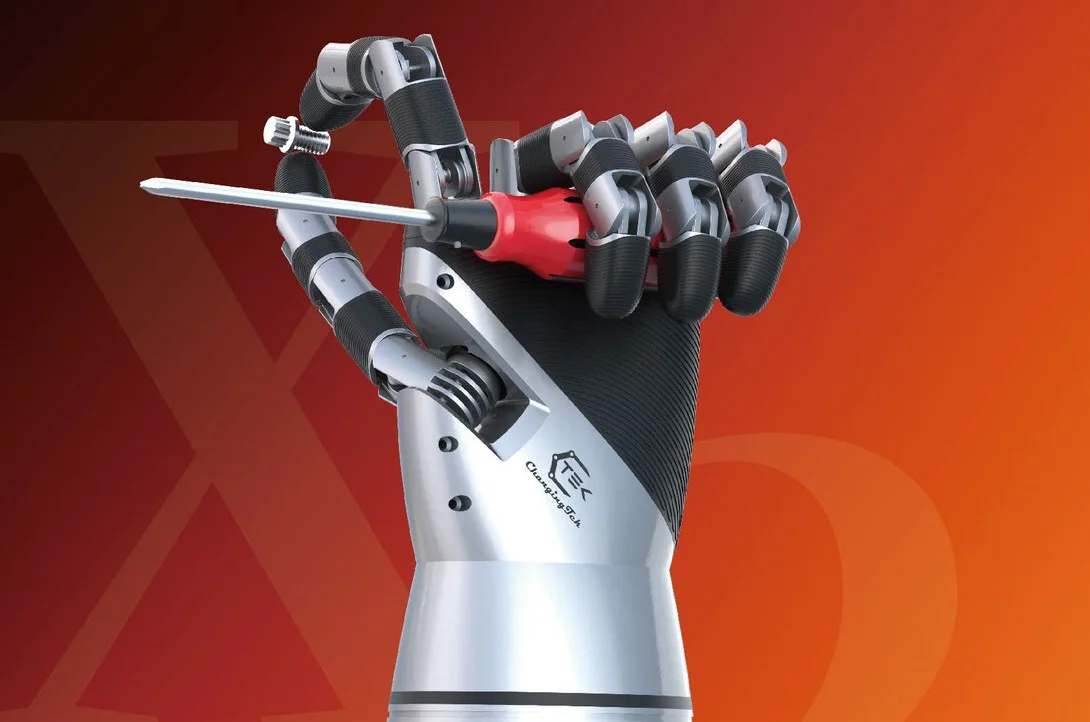
Changingtek Robotics
Component-first robotics from Suzhou: a credible dexterous-hand and gripper supplier whose autonomy story is thinner than its marketing implies.
| Report status | Coverage date | Company stage | Editorial standard |
|---|---|---|---|
| Premium editorial deep report, first edition | Evidence gathered 2026-09-19 | Fully commercial component vendor; multiple funding rounds to B+/B++ | Evidence-labelled; vendor claims separated from verified facts; no demo treated as proof |
How to Read This Report
This report is built from a fixed research dossier gathered on 2026-09-19. Every factual statement is labelled by its evidentiary basis, and every citation points to a numbered source in §14. Where the dossier is silent, this report says so rather than filling the gap with inference dressed as fact.
| Label | Meaning | Examples in this report |
|---|---|---|
| VERIFIED FACT | Confirmed by regulatory filings, official product documentation, named-customer confirmation, primary research, or multiple independent sources | Founding year and location; distributor-listed prices; funding round sequence |
| COMPANY CLAIM | Stated by Changingtek or its agents, not independently verified | "World's first" left-right adaptive hand; onboard AI grip adjustment; autonomy marketing |
| EDITORIAL INFERENCE | Reasoned conclusion drawn from public evidence, clearly flagged as such | Commercial positioning; likely buyer segments; competitive exposure |
| UNKNOWN | Not publicly disclosed in the dossier | Independent autonomy testing; unit economics; named paying customers |
Two discipline rules govern the whole document. First, a choreographed demonstration video is not proof of autonomous work. Second, a shipment or a distributor listing is not proof of productive deployment. Where Changingtek's own materials blur those lines, this report restores the distinction.
01Executive Overview
Changingtek Robotics (also rendered ChangingTek, and known in Chinese as Zhixing Robotics) is a Suzhou/Taicang-based robotics component company founded in August 2018 610. It sells intelligent robotic grippers, end-of-arm tooling (EOAT), servo motors and integrated actuators, and dexterous hands 1313. Its flagship component is the X2, marketed under the name "Shuqiao", a tendon/rope-driven dexterous hand that can mechanically reconfigure between left- and right-hand forms 7912. The company has raised a sequence of rounds from an angel round in May 2020 through Series B+/B++, totalling nearly RMB 100 million, and states it supplies core components to over 100 intelligent manufacturing enterprises 6.
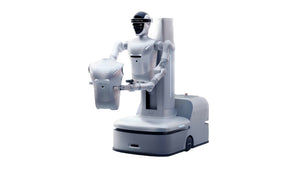
The central editorial finding is a category mismatch between the company's public framing and its actual product reality. Changingtek is, on the evidence available, a component supplier. It does not sell a complete autonomous robot as its primary product. The one complete robot referenced in the dossier, a wheeled omnidirectional humanoid, is explicitly described as teleoperation-first, meaning a human performs or drives the task remotely 11. That single source is not independent, and it is the only source in the dossier describing the humanoid at all. The reconciled autonomy verdict is therefore unknown at confidence 0.4: there is no single autonomous "task" to evaluate because the company sells parts, not systems, and the one system it does describe is teleoperated 11.
What is genuinely verifiable is narrower but real. Grippers, motors, and actuators are sold through distributors at listed prices, which is the strongest available signal of a fully commercial, shipping product line 13. The CTPM3F10 gripper is listed at $980 with a 10 mm stroke, 15 N grip force, ±0.02 mm repeatability, and Modbus RTU (RS485)/I/O control with programmable position, speed, and force feedback 3. The motor and actuator line spans roughly $140 to $1,490 1. Those are concrete, checkable commercial facts.
What is not verifiable is the autonomy narrative. The claim that the X2 hand "autonomously switches between left- and right-hand configurations and adjusts grip in real time using onboard AI" is vendor-only 79. Community reports confirm the hand physically morphs between left and right, but do not independently verify autonomous task execution or onboard AI grip adjustment 27. The mechanical reconfiguration is corroborated; the intelligence layer is not. That distinction is the spine of this report.
Latest news
02The Changingtek Robotics Story
Changingtek Robotics was founded in August 2018 and is headquartered at No. 99, Fuda Road, Ludu Street, Taicang Zhihuigu Technology Innovation Park, Suzhou, Jiangsu, China 610. The Taicang location places it inside the Yangtze River Delta manufacturing belt, within easy reach of Suzhou, Shanghai, and the dense industrial-automation supply chain that runs through Jiangsu. That geography matters commercially: it puts the company close to both component suppliers and the intelligent-manufacturing customers it targets 6.
The founder and CTO is Dr. Bai Guochao, described in company materials as having 18 years in robotics and a PhD from Heriot-Watt University 6. This is a COMPANY CLAIM in the sense that the biography is vendor-sourced, but the credential itself is the kind of specific, checkable fact that lends the founding story more credibility than a generic "experienced team" line. Heriot-Watt has a recognised robotics research tradition, and an 18-year tenure is consistent with someone who began in the field in the mid-2000s.
The funding trajectory is the clearest narrative arc in the public record. An angel round in May 2020 was followed by a Series A in December 2020 (approximately RMB 10 million), a Series A+ in July 2021, a Series B of tens of millions of RMB, and then B+/B++ rounds totalling nearly RMB 100 million 6. The cadence, roughly one round per year through the early 2020s and then a doubling-down at B+/B++, is typical of a Chinese hardware component company that has found product-market fit in a niche but has not yet scaled to a category-defining position. The company states it provides core components to over 100 intelligent manufacturing enterprises 6. That number is a COMPANY CLAIM and is not broken down by named customer, contract value, or repeat purchase, so it should be read as a breadth signal rather than a revenue signal.
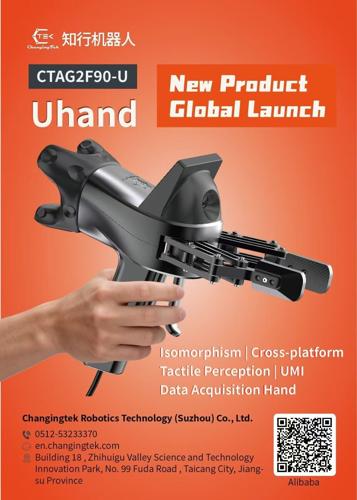
The product narrative has moved from grippers and motors toward dexterous hands. The X2/Shuqiao hand, launched with the "world's first left-and-right-hand adaptive dexterous hand" framing, is the company's most visible product 7912. The UHand, a high-precision tactile sensing data-collection hand, extends the line into the data-collection and teleoperation-tooling space 815. The wheeled humanoid, described in a single non-independent source, appears to be a platform play rather than a shipping product 11.
What the story does not yet contain is a named, paying, autonomous deployment. There is no disclosed customer running a Changingtek hand or humanoid in a lights-out process, no third-party benchmark, and no peer-reviewed evaluation. The story is a component-supplier story with a strong funding tail and a compelling mechanical trick, not yet an autonomy story.
03Product Portfolio: What Changingtek Robotics Actually Sells
Changingtek's portfolio is component-level. The dossier supports four product families: dexterous hands, grippers, servo motors and integrated actuators, and one wheeled humanoid platform. The company's own materials describe the focus as intelligent robotic grippers, end-of-arm tooling, servo motors/actuators, and dexterous hands 613.
Dexterous hands. The flagship is the X2, branded "Shuqiao", a tendon/rope-driven hand that mechanically reconfigures between left- and right-hand forms 7912. The vendor-stated specifications are a 50 N grip force, 10 N fingertip force, and ±0.1 N force accuracy 7. The UHand is a tactile-sensing data-collection hand with vendor-stated specifications of 2.34 taxels/cm², a 0-160 N sensing range, 0.1 N precision, 0.7 mm XYZ accuracy, 30 Hz sampling, 600 g mass, and up to 4 hours of battery 8. These specifications are COMPANY CLAIMS; the dossier contains no independent teardown or third-party measurement to corroborate them.
Grippers. The CTPM3F10 compact servo gripper is the best-documented product in the portfolio because it is listed by a distributor. It has a 10 mm stroke, 15 N grip force, ±0.02 mm repeatability, Modbus RTU (RS485) and I/O control, programmable position/speed/force with feedback, and a listed price of $980 3. The CTMG3F60 series is described as covering payloads from grams to over 60 kg 613. The full hand product matrix is stated to cover 0.1 kg to 150 kg load capacity, though this range spans multiple product lines and should not be read as a single gripper's specification 6.
Motors and actuators. The CTSM57/42/28 servo motors and CTMS/CTMSC integrated actuators and vacuum actuators are listed at roughly $140 to $1,490 through a distributor 1. This is the least glamorous but arguably most commercially mature part of the line: standard industrial components with published prices and a distribution channel.
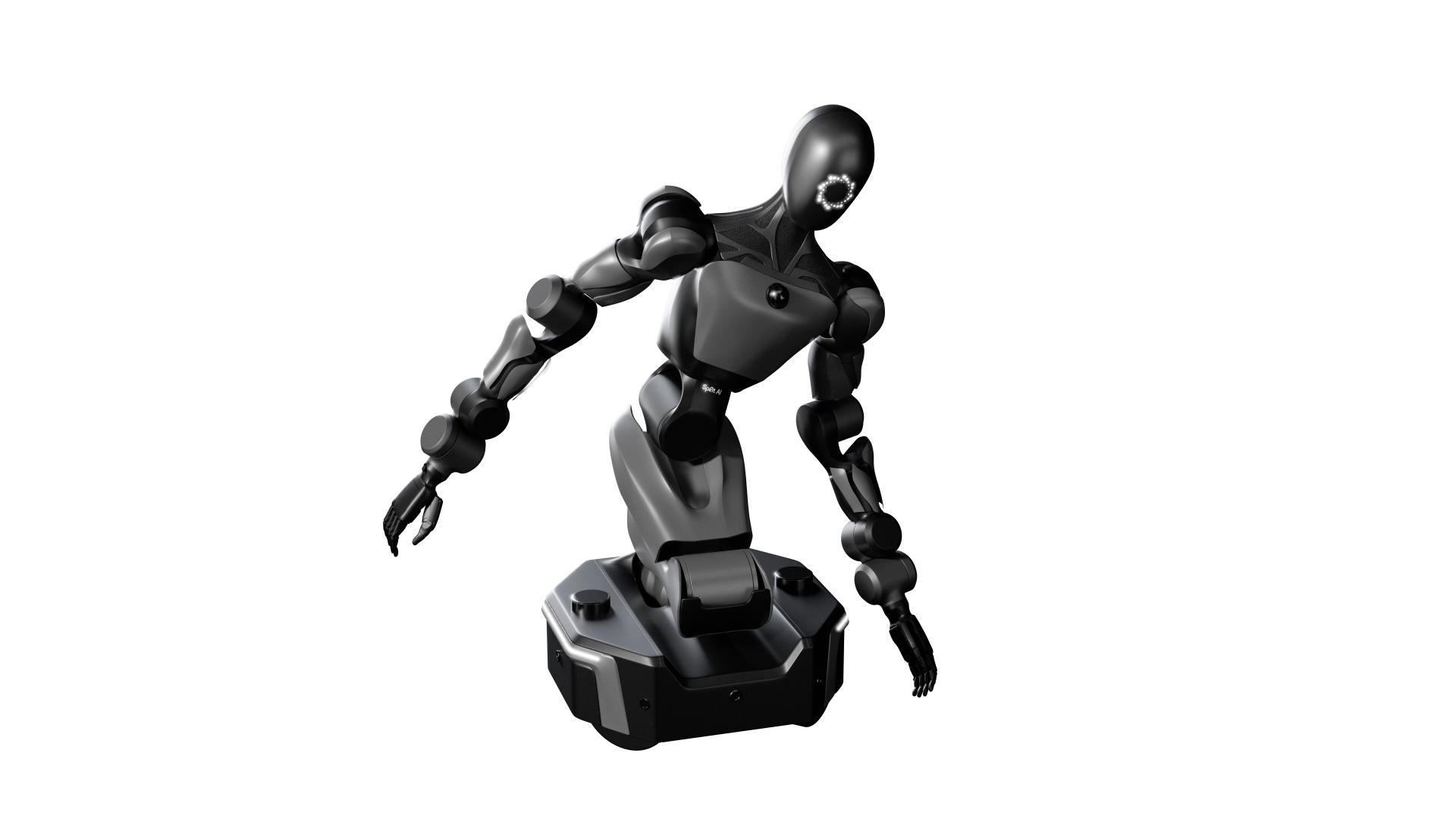
Wheeled humanoid. A wheeled omnidirectional humanoid with ROS2/Python APIs, LiDAR and visual SLAM, RGB/stereo cameras, LiDAR, ultrasonic, IMU, gyroscope, and force and temperature sensors is described in a single source 11. That source explicitly frames it as teleoperation-first. This is the only complete robot in the portfolio, and it is the least evidenced product in the dossier.
| Product | Type | Key stated specs | Listed price | Evidence quality |
|---|---|---|---|---|
| X2 / Shuqiao | Dexterous hand | 50 N grip, 10 N fingertip, ±0.1 N accuracy; left-right morphing | Not disclosed | Vendor claim; morphing corroborated by community 27 |
| UHand | Tactile data-collection hand | 2.34 taxels/cm², 0-160 N, 0.1 N, 0.7 mm, 30 Hz, 600 g, 4 h | Not disclosed | Vendor claim 8 |
| CTPM3F10 | Servo gripper | 10 mm stroke, 15 N, ±0.02 mm, Modbus RTU/I/O | $980 | Distributor listing 3 |
| CTSM57/42/28, CTMS/CTMSC | Servo motors, actuators | Not specified in dossier | ~$140-$1,490 | Distributor listing 1 |
| CTMG3F60 series | Gripper | Grams to >60 kg payload | Not disclosed | Vendor claim 613 |
| Wheeled humanoid | Mobile manipulator platform | ROS2/Python, LiDAR+visual SLAM, multi-sensor | Not disclosed | Single non-independent source 11 |
The portfolio's centre of gravity is clear: hands and grippers are the differentiated products, motors and actuators are the volume products, and the humanoid is a platform demonstration. A buyer evaluating Changingtek as an autonomy vendor would be evaluating the wrong catalogue.
Products & versions

04Technology Stack: Strengths and the Work That Remains
The most interesting technical claim in the dossier is the X2/Shuqiao hand's left-right reconfiguration. A tendon/rope-driven hand that can morph between left- and right-hand forms is a genuine mechanical achievement if it works reliably, because it collapses two SKUs into one and simplifies spare-parts logistics for integrators. Community reports confirm the hand physically morphs between left and right 27. That is the strongest independent technical signal in the entire dossier, and it is worth being precise about what it does and does not prove: it proves the mechanism moves between two configurations. It does not prove autonomous task execution, and it does not prove the onboard AI grip adjustment the vendor claims 79.
The tendon/rope-driven architecture is itself a design choice with trade-offs. Tendon drives concentrate actuation in the forearm or base, reducing distal mass and inertia, which helps with dynamic manipulation. They also introduce routing friction, stretch over time, and calibration drift, which is why tendon-driven hands are notoriously hard to keep calibrated in industrial duty cycles. The dossier contains no reliability data, no cycle-life figures, and no maintenance interval for the X2. That is an UNKNOWN, and it is the single most important unknown for any industrial buyer.
The UHand's tactile sensing specification, if accurate, is competitive: 2.34 taxels/cm² with a 0-160 N range and 0.1 N precision at 30 Hz 8. Tactile sensing at that density and rate is genuinely useful for data collection and for slip detection in grasping. But again, these are vendor numbers with no independent verification. The 600 g mass and 4-hour battery suggest a self-contained, wearable or handheld data-collection form factor rather than an integrated end-effector, which is consistent with the "data collection hand" positioning 8.
On the control and integration side, the CTPM3F10's Modbus RTU (RS485) and I/O interface with programmable position, speed, and force feedback is a pragmatic, industrial-friendly choice 3. Modbus RTU is not fashionable, but it is ubiquitous in factory automation, and a gripper that speaks it can be dropped into existing PLC architectures without a middleware layer. That is a real strength for the intelligent-manufacturing segment Changingtek targets.
The humanoid's stack, as described, is conventional: ROS2/Python APIs, LiDAR and visual SLAM, RGB/stereo cameras, LiDAR, ultrasonic, IMU, gyroscope, force and temperature sensors 11. Nothing in that list is differentiated. The teleoperation-first framing means the autonomy work, the perception-to-action loop that would let the robot act without a human, is either not done or not disclosed 11.
Where the work remains: independent verification of hand specifications; reliability and cycle-life data; a demonstrated autonomous manipulation task with no human in the loop; and any evidence that the humanoid's SLAM and sensor suite is used for autonomous navigation rather than operator assistance. None of these appear in the dossier.
05Research, Papers, Authors and Labs
This is the thinnest section of the report, and it should be stated plainly: the dossier contains no peer-reviewed papers, no primary research authored by Changingtek personnel, and no named academic lab partnership attributable to the company. The research sources in the dossier 17181920 are general robotics papers on topics such as real-time robot execution, agent-centred robot learning, and adaptive trajectory following in changing-contact manipulation. They are relevant to the field Changingtek operates in, but none is authored by or explicitly affiliated with Changingtek.
Dr. Bai Guochao's Heriot-Watt PhD is the only academic credential in the dossier 6. It is a COMPANY CLAIM in the sense that it is vendor-sourced, but it is the kind of specific, checkable credential that suggests a research-capable founding team. Whether that capability has translated into published work, patents, or open-source contributions is not disclosed.
There is no evidence in the dossier of an open-source repository, a dataset release, or a benchmark contribution from Changingtek. The UHand's positioning as a "tactile sensing data collection hand" 8 implies the company sees value in data collection, but whether it releases datasets or uses them internally is UNKNOWN.
For a component company, the absence of papers is not disqualifying. Many successful gripper and actuator vendors publish nothing. But it does mean that claims about "onboard AI" and "autonomous" behaviour 79 have no research trail behind them, and a skeptical buyer should weight them accordingly.
<!-- module: papers --> <!-- module: authors-labs --> <!-- module: repos --> <!-- module: datasets -->06Media Evidence Library: What the Videos Prove
The dossier contains six video sources 212223242526 and one community discussion 27. The two directly relevant videos are the Changingtek dexterous-hand launch video 21 and a short clip titled "This Robot Hand Changes Shape During Use" 22. The remaining videos cover Astribot and Unitree platforms 23242526 and are context, not Changingtek evidence.
What the Changingtek videos prove: the hand exists, it moves, and it changes shape during use 2122. The community discussion on Reddit corroborates that the hand morphs between left and right 27. That is a meaningful, independently observed mechanical capability.
What the videos do not prove: that the hand performs any task autonomously. A demonstration video is a choreographed sequence. It shows the mechanism under controlled conditions, typically with a human operator, a scripted motion, or a teleoperation rig. It does not show the hand deciding what to grasp, planning a motion, recovering from a failed grasp, or operating for an extended duty cycle. The dossier contains no video of the X2 hand completing a task without a human in the loop, and no video of the wheeled humanoid operating autonomously 11.
The distinction matters because the vendor's autonomy claims 79 and the video evidence are being conflated in some secondary coverage. The video proves the morphing. The morphing is a mechanical capability. The autonomy claim is a separate, unverified assertion.
| Media item | What it shows | What it does not show |
|---|---|---|
| Changingtek hand launch video 21 | Hand exists, moves, changes configuration | Autonomous task execution; duty-cycle reliability |
| "Changes Shape During Use" clip 22 | Morphing between left/right forms | Onboard AI grip adjustment; no human in loop |
| Reddit community thread 27 | Independent confirmation of morphing | Autonomous task execution; AI claims |
| Astribot/Unitree videos 23242526 | Competitor context | Changingtek capability |
Media library
07Commercial Reality
Changingtek is, on the evidence, a fully commercial component vendor. The strongest signal is that its products are sold through distributors at listed prices: the CTPM3F10 gripper at $980 3 and the motor/actuator line at roughly $140 to $1,490 1. A listed price through a distributor is a much stronger commercial signal than a partnership announcement, because it implies inventory, a sales channel, and a product that someone is willing to stock.
The company states it provides core components to over 100 intelligent manufacturing enterprises 6. This is a COMPANY CLAIM. It is not broken down by named customer, contract value, or repeat purchase. "Over 100 enterprises" could mean 100 companies that bought a sample, or 100 companies with production lines running the product. The dossier does not distinguish, and a skeptical reader should not assume the stronger interpretation.
The cited deployment domains are aerospace, intelligent manufacturing, laboratory automation, and service robotics 6. These are COMPANY CLAIMS and none is tied to a named customer. There is no disclosed case study with a verifiable customer, no third-party integration report, and no independent confirmation of a production deployment. That is a significant gap for a company that has raised nearly RMB 100 million 6.
The funding history is the most concrete commercial fact after the distributor listings: angel May 2020, Series A December 2020 (~RMB 10M), Series A+ July 2021, Series B tens of millions RMB, B+/B++ totalling nearly RMB 100M 6. The B+/B++ doubling-down is notable because it suggests existing investors saw enough traction to add capital rather than bridge. But funding is not revenue, and the dossier contains no revenue figure, no margin, and no unit-volume data. Those are UNKNOWNS.
The humanoid, if it is a product at all, is not commercially evidenced. It appears in a single non-independent source 11 with no price, no availability date, and no customer. It should be treated as a platform demonstration, not a commercial offering.
| Commercial signal | Strength | Basis |
|---|---|---|
| Distributor-listed prices ($980 gripper; $140-$1,490 motors) | Strong | 13 |
| Funding to B+/B++, ~RMB 100M | Strong | 6 |
| "Over 100 intelligent manufacturing enterprises" | Weak (unbroken claim) | 6 |
| Deployment in aerospace, manufacturing, lab automation | Weak (no named customer) | 6 |
| Wheeled humanoid as a product | Very weak (single source, no price) | 11 |
| Revenue, margin, unit volume | Unknown | Not disclosed |
The commercial reality is a component company with real distribution and real funding, but without disclosed named customers or revenue. That is a normal stage for a company of this size, but it is not the same as a proven deployment story, and the distinction should be preserved.
Customers & deployments
Vendor news states Changingtek provides core components to over 100 intelligent manufacturing enterprises.
Sections 8 through 14 continue in the second part of this report.
08Markets and Use Cases
ChangingTek's addressable market is not the humanoid robot market in the way that term is commonly used. It is the market for the parts that go inside robots: grippers, dexterous hands, servo motors, integrated actuators, and vacuum end-effectors. That distinction matters for every downstream judgement in this report, because it changes what "market" means, who the buyer is, and what evidence of success would actually look like.
The company's own stated deployment domains are aerospace, intelligent manufacturing, laboratory automation, and service robotics 6. These are broad enough to be nearly unfalsifiable as a list, but they are internally consistent with a component vendor's realistic customer base. A gripper with 10 mm stroke and 15 N grip force is not an aerospace structural assembly tool; it is a small-parts handling device. A 60 kg-payload gripper series is not a laboratory pipetting tool; it is an industrial material-handling device. ChangingTek sells across that whole span, which means it is not optimising for one vertical but spreading across many.
The four claimed domains, assessed
| Domain | What ChangingTek plausibly supplies | Evidence quality | Editorial read |
|---|---|---|---|
| Aerospace | Precision grippers, actuators for assembly or inspection tooling | Company claim only 6 | Plausible as a component sale; no named aerospace customer disclosed |
| Intelligent manufacturing | Grippers, servo motors, actuators for pick-and-place, machine tending | Company claim, plus distributor listings implying real SKUs 136 | Most credible domain; matches the product spec envelope |
| Laboratory automation | Small-stroke grippers, tactile hands for sample handling | Company claim only 6 | Plausible but unverified; lab automation buyers are conservative and rarely unnamed |
| Service robotics | Dexterous hands, humanoid end-effectors | Company claim, plus humanoid product line 611 | Speculative; service robotics is the least mature of the four |
The pattern here is a component company listing every domain its parts could conceivably enter, rather than a company reporting design wins. That is normal for a Chinese component vendor at this stage, but it should not be read as market penetration.
The humanoid adjacency
The one complete robot in the dossier, a wheeled omnidirectional humanoid with ROS2/Python APIs, LiDAR and visual SLAM, RGB and stereo cameras, ultrasonic sensors, IMU, gyroscope, and force and temperature sensing, is described by the only source covering it as teleoperation-first 11. That single-source framing is the most important market signal in the entire dossier. It tells us ChangingTek is positioning its humanoid not as an autonomous worker but as a remotely operated platform for human-centric spaces, which is a defensible niche but a much smaller one than the general-purpose humanoid narrative implies.
If that framing is accurate, the humanoid's realistic markets are inspection, teleoperated maintenance, remote presence, and hazardous-environment work where a human operator drives the machine. Those are real markets with real budgets, but they are not the "autonomous humanoid labour" market that drives most of the current valuation enthusiasm in the sector. ChangingTek's humanoid, on this evidence, competes for teleoperation contracts, not for autonomous task contracts.
Where the component business actually makes money
The distributor listings give the clearest picture of the commercial reality. The CTPM3F10 gripper sells for $980 with Modbus RTU (RS485) and I/O control, programmable position, speed and force, and feedback 3. The servo motor and actuator line runs roughly $140 to $1,490 1. These are commodity-adjacent price points. They are not premium prices that would support a high-margin, high-touch sales model. They are prices that support volume through distribution.
That has three consequences. First, ChangingTek's revenue is likely dominated by unit volume rather than contract value, which makes the "over 100 intelligent manufacturing enterprises" claim 6 more meaningful as a customer count than as a revenue figure. Second, the company's competitive moat, if any, is in manufacturing cost and supply-chain position rather than in proprietary technology, because at $980 a gripper is a substitutable part. Third, the dexterous hand line, which is the technically distinctive product, is unlikely to be the revenue driver at this stage; it is the brand and capability showcase.
Use-case realism check
The X2/Shuqiao hand's headline capability, autonomous reconfiguration between left- and right-hand forms, is a mechanical and onboard capability 7912. Community reports confirm the hand morphs 27, but do not independently verify autonomous task execution or onboard AI grip adjustment. In market terms, this means the hand's differentiation is real but narrow: it solves a logistics and inventory problem for integrators (one SKU instead of two) and a flexibility problem for researchers (one hand that can be mounted either side). It does not, on current evidence, solve the harder problem of autonomous dexterous manipulation, which is where the value in humanoid hands actually sits.
The UHand tactile sensing hand, with 2.34 taxels/cm², 0-160 N range, 0.1 N precision, 0.7 mm XYZ accuracy, 30 Hz sampling, 600 g mass, and up to 4 h battery 815, is positioned as a data-collection hand. That is a specific and sensible market: robot learning teams need tactile data at scale, and a hand that collects it is a tool sale, not a robot sale. This is arguably ChangingTek's most defensible use case because the buyer is technical, the requirement is clear, and the product matches the requirement.
Market verdict
ChangingTek is a component supplier with a genuine technical differentiator in adaptive hands, a broad but unverified deployment claim across four domains, and a humanoid that is teleoperation-first on the only available evidence. Its realistic markets are industrial small-parts handling, laboratory automation, tactile data collection for robot learning, and teleoperated service and inspection. The autonomous humanoid labour market, on current evidence, is not one it is actually selling into.
09Competitive Landscape
ChangingTek competes in three distinct arenas, and it is a different kind of company in each. Conflating them is the most common analytical error when looking at a firm like this, because the humanoid hand narrative invites comparison with humanoid robot companies, while the actual business is closer to a component vendor competing with other component vendors.
Arena one: dexterous hands and end-effectors
This is where ChangingTek's brand lives. The X2/Shuqiao hand's left-right morphing capability is, on the company's claim, a world first 79. Whether or not that claim survives scrutiny, the capability itself is unusual. Most dexterous hands are handed: a left hand and a right hand are separate SKUs with mirrored kinematics. A hand that reconfigures between the two is a genuine engineering achievement if it works reliably and if the reconfiguration does not compromise grip force, durability, or control complexity.
The competitive set here includes established dexterous hand vendors and the in-house hand programmes of humanoid companies. The strategic problem for ChangingTek is that the most valuable hand customers, the humanoid companies, increasingly build their own hands. A component vendor selling hands to humanoid makers is selling into a market that is vertically integrating away from it. That does not eliminate the market, because smaller humanoid teams, research labs, and integrators will still buy, but it caps the ceiling.
Arena two: industrial grippers and EOAT
This is where ChangingTek's revenue most likely sits, and it is the most crowded arena. The CTPM3F10 at $980 with Modbus RTU and programmable force control 3 competes against a deep bench of Chinese and international gripper vendors. At this price and specification, differentiation is marginal. Buyers choose on availability, integration effort, price, and support. ChangingTek's distributor network, visible through Aifitlab and Robotopian listings 13, is its route to market, and distribution reach is a real advantage in a commodity-adjacent category.
The honest assessment is that in grippers ChangingTek is one of many competent suppliers. Nothing in the dossier suggests a proprietary advantage in this arena beyond the ability to ship at competitive prices.
Arena three: servo motors and integrated actuators
The CTSM57/42/28 servo motors and CTMS/CTMSC integrated and vacuum actuators, priced roughly $140 to $1,490 1, put ChangingTek into the motion-control component market. This is the least differentiated arena of the three and the one with the most entrenched incumbents. It is also the arena where ChangingTek's vertical integration pays off internally: making its own motors and actuators lowers the cost of its grippers and hands. Whether it can sell those motors profitably to third parties against specialised motion-control vendors is a separate question, and the dossier offers no evidence either way.
Competitive positioning table
| Arena | ChangingTek position | Basis | Principal vulnerability |
|---|---|---|---|
| Dexterous hands | Differentiated on left-right morphing | Company claim 79, community confirmation of morphing 27 | Humanoid customers vertically integrating; autonomy claims unverified |
| Industrial grippers | Competent commodity supplier | Distributor specs and pricing 3 | Price competition; low switching costs |
| Motors and actuators | Vertical integration play | Distributor listings 1 | Entrenched motion-control incumbents |
| Complete humanoid | Teleoperation-first niche | Single source 11 | Crowded humanoid field; single-source evidence |
The comparison that matters most
The dossier includes video references to Astribot's T1 and S1 and Unitree's G1 232425, which are the natural comparison points in the public imagination. But those are complete humanoid robot companies with their own autonomy narratives, and ChangingTek is not competing with them head-on. ChangingTek is more plausibly a supplier to companies like them, or a competitor in the narrower teleoperation-first humanoid niche. Treating ChangingTek as a peer of Astribot or Unitree would be a category error, and the dossier does not support it.
The more instructive comparison is with other Chinese component vendors who have raised similar amounts and sell through similar distribution channels. Against that peer set, ChangingTek's differentiator is the adaptive hand, and its weakness is that the hand's most valuable application, autonomous dexterous manipulation, is exactly the application for which the evidence is thinnest.
Competitive comparison
| Robot | Maker | Autonomy | Conf. |
|---|---|---|---|
| iRobot Roomba Combo 10 Max | iRobot | Autonomous | 0.90 |
| Mobile ALOHA (Stanford) | Stanford University | Teleoperated | 0.90 |
| 1X NEO | 1X Technologies | Remote-Assisted | 0.90 |
10Geopolitical Context and Constraints
ChangingTek sits at the intersection of three geopolitical forces that shape its options more than any product decision it makes: export controls on robotics and AI technology, the China-plus-one supply-chain realignment, and the national industrial policy environment in Jiangsu province.
Export controls and the component trap
Robotics components occupy an ambiguous position in export-control regimes. Complete autonomous systems and certain AI capabilities attract scrutiny; commodity grippers and servo motors generally do not. ChangingTek's product line, being component-level, is largely outside the most restrictive categories. That is a commercial advantage in the short term, because it can sell into markets that complete-robot vendors cannot easily reach.
But it is also a trap. The moment ChangingTek's hands become capable enough to matter for autonomous manipulation, they move toward the controlled category. The company's own marketing, which emphasises onboard AI and autonomous grip adjustment 79, pushes it toward that boundary. There is a strategic tension between claiming autonomy for marketing purposes and remaining a low-friction exportable component. The dossier does not show ChangingTek resolving this tension, and it may not have had to yet.
The China-plus-one dynamic
ChangingTek's manufacturing base is Taicang, in Jiangsu, within the Yangtze River Delta manufacturing cluster 10. That location is a genuine cost and supply-chain advantage: component suppliers, machine shops, and electronics vendors are all within a short radius. It is also a liability for Western customers under pressure to diversify away from Chinese suppliers.
For a component vendor, this cuts both ways. Western integrators building robots for defence, critical infrastructure, or government markets increasingly need non-Chinese components. Western integrators building for commercial markets generally do not. ChangingTek's realistic Western customer base is therefore the commercial segment, which is large but price-sensitive and less willing to pay a premium for provenance.
Industrial policy and funding environment
The funding history, angel in May 2020, Series A in December 2020 at roughly RMB 10M, Series A+ in July 2021, Series B in the tens of millions of RMB, and B+/B++ rounds totalling nearly RMB 100M 6, is consistent with the Chinese robotics funding environment of that period. Government-guided funds and provincial industrial policy in Jiangsu have been active supporters of robotics component companies, and the "over 100 intelligent manufacturing enterprises" customer claim 6 fits the pattern of a company positioned as a domestic supply-chain champion.
That positioning is an advantage domestically and a constraint internationally. A company framed as a national supply-chain asset may find it harder to be seen as a neutral component vendor by non-Chinese customers, particularly in markets where supply-chain security is a live political concern.
Constraints summary
| Constraint | Effect on ChangingTek | Evidence |
|---|---|---|
| Export controls on autonomous systems | Caps the autonomy claims it can safely make; component status is protective | Editorial inference from product positioning 79 |
| China-plus-one procurement | Limits Western commercial and government customer base | Editorial inference from HQ location 10 |
| Domestic policy alignment | Supports funding and domestic sales; complicates neutral positioning abroad | Funding history and customer claim 6 |
| Single-source humanoid evidence | Makes it hard to assess whether the teleoperation-first framing is a strategic choice or a capability limit | 11 |
The most important geopolitical fact about ChangingTek is that it is a component company in a sector where the geopolitical action is at the system level. That gives it room to operate, but it also means it has limited ability to shape the rules it operates under.
11The Hype, the Real and the Ugly
This section separates what ChangingTek has demonstrated from what it has claimed, and from what remains unknown. The discipline here is simple: a press release is a claim, a distributor listing is a product, a community video is a partial confirmation, and none of them is proof of autonomous capability.
The hype
The strongest hype signals are the "world's first" framing on the X2/Shuqiao hand 79 and the autonomy language around onboard AI and real-time grip adjustment. The left-right morphing capability is genuinely unusual and the "world's first" claim may well be accurate for the specific capability of autonomous reconfiguration, but "world's first" claims in robotics are notoriously difficult to verify and are routinely made by multiple parties for overlapping capabilities.
The second hype signal is the humanoid robot. A wheeled omnidirectional humanoid with LiDAR and visual SLAM, RGB and stereo cameras, ultrasonic sensors, IMU, gyroscope, and force and temperature sensing 11 reads, in a product description, like an autonomous platform. The only source covering it, however, describes it as teleoperation-first. That gap between how a spec sheet reads and how the machine is actually intended to be used is the central hype problem in this dossier.
The real
Several things are genuinely established. The company exists, was founded in August 2018, is headquartered in Taicang, Suzhou, Jiangsu 10, and has raised multiple funding rounds totalling nearly RMB 100M 6. It sells grippers, motors, and actuators through distributors at listed prices 13, which means these are real, purchasable products, not concepts. The CTPM3F10 gripper's specifications, 10 mm stroke, 15 N grip, ±0.02 mm repeatability, Modbus RTU and I/O control, programmable position, speed and force with feedback, at $980 3, are concrete and checkable. The UHand tactile hand's specifications, 2.34 taxels/cm², 0-160 N range, 0.1 N precision, 0.7 mm XYZ accuracy, 30 Hz, 600 g, up to 4 h battery 815, are similarly concrete.
The left-right morphing of the hand is confirmed by community reports 27 as a mechanical capability. That is real. What is not confirmed is the autonomous task execution and onboard AI grip adjustment that the company claims alongside it.
The ugly
The ugliest feature of this dossier is the evidence asymmetry. The company makes strong autonomy claims, and the only independent source on the humanoid contradicts the autonomy framing by describing it as teleoperation-first 11. That is not proof the company is misrepresenting its products, but it is a signal that the marketing language and the design intent are not aligned.
The second ugly feature is the single-source problem. The humanoid robot rests on one non-independent source 11. The hand specifications rest on vendor press releases with no independent teardown 8915. The deployment claims across aerospace, manufacturing, lab automation, and service robotics rest on a company press release with no named customers 6. At a dossier confidence of 0.55, the honest position is that we know the company sells components and claims autonomy, and we do not know much more than that.
Claim versus evidence table
| Claim | Source | Evidence type | Verdict |
|---|---|---|---|
| X2 hand autonomously reconfigures left-right | 7912 | Company claim; community confirms morphing 27 | Mechanical capability confirmed; autonomy unverified |
| X2 hand adjusts grip in real time using onboard AI | 79 | Company claim only | Unverified |
| Humanoid is an intelligent robot with SLAM and full-body coordination | 11 | Single source, vendor-derived | Contradicted by same source's teleoperation-first framing |
| Deployed in aerospace, manufacturing, lab automation, service robotics | 6 | Company claim, no named customers | Unverified |
| Over 100 intelligent manufacturing enterprise customers | 6 | Company claim | Unverified; plausible as a customer count, not a revenue figure |
| Hand specs (50 N grip, 10 N fingertip, ±0.1 N accuracy) | 59 | Vendor specs | Unverified by independent teardown |
| UHand tactile specs | 815 | Vendor press release | Unverified by independent teardown |
| Gripper specs and price | 3 | Distributor listing | Concrete and checkable; strongest evidence in dossier |
The autonomy question, stated plainly
ChangingTek sells components. There is no single autonomous task to evaluate. The one complete robot in the dossier is teleoperation-first on the only available evidence. The hands' left-right reconfiguration is a mechanical and onboard capability, not evidence of autonomous task execution. The reconciled autonomy verdict is therefore unknown, at confidence 0.4. Any report that states otherwise is reading the marketing, not the evidence.
Claim tracker
Community video/Reddit reports [22][27] and independent write-ups [12] confirm the hand physically morphs between left and right, though the 'autonomous' framing rests on vendor PR [7][9].
Only vendor PR [7][9] asserts onboard-AI grip adjustment; independent community reports [22][27] confirm the morphing mechanism but conspicuously do not verify autonomous task execution or AI grip control.
The only substantive source [11] explicitly describes the humanoid as 'teleoperation-first' for assisted work, directly contradicting the autonomy implication of vendor marketing.
These figures appear only in vendor press releases [7][9] with no independent teardown, test or customer measurement to corroborate them.
Specs come solely from the company's PR Newswire release [8][15]; no third-party evaluation or datasheet verification exists in the dossier.
These specifications and the price come from a single distributor listing [3] rather than an independent test or the manufacturer's own verified datasheet.
Deployment sectors are asserted only in vendor PR [6][14]; no named customer, site count or independent deployment report substantiates shipping-at-scale claims.
Funding amounts are broadly consistent across vendor news [6] and CB Insights [10], but the '100+ enterprises' customer count is vendor-only and unverified by any independent source.
12Future Scenarios
The scenarios below are constructed from the evidence in the dossier, not from the company's stated ambitions. Each is given a rough plausibility weighting and a set of observable indicators that would confirm or disconfirm it.
Scenario A: Component supplier consolidates (most likely)
ChangingTek continues as a component vendor, growing gripper, motor, and actuator sales through distribution, with the dexterous hand as a brand differentiator and a modest revenue line. The humanoid remains a teleoperation-first platform sold into inspection and remote-presence niches. Revenue grows with the Chinese industrial automation market. The company does not become a household name in robotics.
Plausibility: high. This scenario requires no new capability and is consistent with every verified fact in the dossier.
Indicators: continued distributor listings, incremental product refreshes, no major autonomy announcements, funding rounds at modest valuations.
Scenario B: Hand business breaks out into robot learning
The UHand tactile data-collection hand and the X2 adaptive hand find a durable market among robot learning teams and humanoid developers who need tactile data and flexible end-effectors. ChangingTek becomes a recognised supplier to the embodied AI research and development ecosystem. Revenue grows faster than the industrial component baseline.
Plausibility: moderate. The UHand's positioning as a data-collection tool 815 is well matched to a real and growing need, and the adaptive hand's one-SKU flexibility is genuinely useful to integrators. The constraint is that humanoid companies are vertically integrating their hands.
Indicators: named research-lab or humanoid-company customers, published datasets collected with UHand, citations in robot learning papers, SDK and simulation support.
Scenario C: Humanoid becomes the main story
ChangingTek pivots toward its wheeled humanoid as the primary product, moving beyond teleoperation toward assisted autonomy. This would require capabilities the dossier does not evidence: independent demonstrations of autonomous task completion, named deployment customers, and a credible autonomy stack.
Plausibility: low on current evidence. The teleoperation-first framing 11 suggests the company itself does not currently claim full autonomy for this platform.
Indicators: independent video of autonomous task completion without a human operator, named deployment customers, autonomy benchmarks, safety certifications.
Scenario D: Acquisition or supply-chain absorption
A larger robotics or industrial automation company acquires ChangingTek for its hand technology, motor and actuator line, or manufacturing capacity. The adaptive hand capability is the most likely acquisition rationale.
Plausibility: moderate. Component companies with a distinctive technical capability and a sub-RMB 100M funding history are plausible acquisition targets, particularly for larger Chinese robotics groups building out end-effector portfolios.
Indicators: strategic investment from a larger robotics company, hiring patterns suggesting integration, changes in distributor relationships.
Scenario matrix
| Scenario | Plausibility | Key dependency | Falsifying indicator |
|---|---|---|---|
| A: Component consolidation | High | Continued industrial demand | Loss of distributor relationships |
| B: Robot learning breakout | Moderate | Research and humanoid demand for tactile hands | Humanoid makers all build in-house |
| C: Humanoid pivot | Low | Autonomous capability not currently evidenced | No independent autonomy demos |
| D: Acquisition | Moderate | Strategic value of hand technology | No strategic interest materialises |
The common thread across scenarios is that ChangingTek's future depends far more on the component and research markets than on the humanoid narrative. The company's own evidence supports the component story and does not support the humanoid autonomy story.
13What to Watch: A Live Monitoring Checklist
This checklist is designed to be revisited. Each item is a specific, observable signal that would change the assessment in this report. Items are ordered by how much they would move the confidence score.
Autonomy and capability
- Independent video of the X2/Shuqiao hand performing a manipulation task without a human driving it. This is the single highest-value signal. Vendor video 2122 does not count.
- Independent video of the wheeled humanoid completing a task without teleoperation. The current framing is teleoperation-first 11; a change would be significant.
- Third-party teardown or benchmark of the X2 hand confirming the 50 N grip, 10 N fingertip, and ±0.1 N force accuracy claims 59.
- Published evidence of the onboard AI grip adjustment claim, such as a technical paper or a reproducible demonstration.
Commercial and customer evidence
- Named customers in any of the four claimed domains 6. A single named aerospace or laboratory automation customer would materially raise confidence.
- Revenue figures or unit shipment volumes, as distinct from the "over 100 enterprises" customer count 6.
- Evidence that the humanoid has a paying deployment, not just a product page.
- Distributor expansion beyond the currently visible Aifitlab and Robotopian listings 13.
Research and ecosystem
- Peer-reviewed publications from ChangingTek authors, particularly on adaptive hand kinematics or tactile sensing.
- Adoption of the UHand in published robot learning datasets, which would validate the data-collection positioning 815.
- SDK, simulation, and ROS2 support documentation for the hand and humanoid lines.
- Citations of ChangingTek hardware in academic or industrial research.
Funding and corporate
- New funding rounds and their valuations, which would indicate investor confidence in the component versus humanoid narrative.
- Strategic investment from a larger robotics company, which would signal Scenario D.
- Changes in the founding team, particularly the founder and CTO 6.
- Any regulatory or export-control action affecting the product line.
Monitoring cadence
| Signal class | Suggested cadence | Why |
|---|---|---|
| Independent autonomy demos | Monthly | Highest impact on confidence |
| Named customers | Quarterly | Slow-moving but decisive |
| Research publications | Quarterly | Validates technical positioning |
| Funding and corporate | Quarterly | Indicates strategic direction |
| Distributor and pricing changes | Semi-annually | Tracks commercial health |
The discipline this checklist enforces is simple: do not upgrade the assessment on the basis of company announcements. Upgrade it on the basis of independent evidence, named customers, and reproducible demonstrations.
14Sources and Methodology
Methodology
This report was assembled from a research dossier gathered on 19 September 2026, comprising 29 numbered sources across official, commerce, research, news, video, and community categories. The dossier's overall confidence was assessed at 0.55, reflecting a thin independent evidence base relative to the volume of company-generated material.
The editorial method applies four evidence labels throughout:
| Label | Definition | Treatment in this report |
|---|---|---|
| Verified fact | Regulatory filings, official product documentation, named-customer confirmation, peer-reviewed or primary research, or multiple independent sources | Stated as fact |
| Company claim | Stated by the company, not independently verified | Attributed to the company; not treated as fact |
| Editorial inference | Reasoned conclusion drawn from public evidence | Labelled as inference; reasoning shown |
| Unknown | Not publicly disclosed | Stated plainly as not disclosed |
Three specific disciplines were applied without exception. A choreographed demo video was not treated as proof of autonomous work. A shipment or distributor listing was not treated as proof of productive deployment. A partnership or customer-count announcement was not treated as proof of a paid customer.
Where the dossier was thin, the report says so rather than padding. The humanoid robot section rests on a single non-independent source 11. The hand specifications rest on vendor press releases with no independent teardown 8915. The deployment claims rest on a company press release with no named customers 6. These limitations are stated in the relevant sections rather than smoothed over.
The autonomy verdict for ChangingTek is unknown at confidence 0.4. The company sells components rather than a complete autonomous system, so there is no single task to evaluate. The one complete robot referenced is described as teleoperation-first on the only available evidence. The hands' left-right reconfiguration is a mechanical and onboard capability, not evidence of autonomous task execution.
Sources
1 ChangingTek Robotics Motor — https://aifitlab.com/collections/changingtek-robotics-motor?srsltid=AU7gw4VVqiPGjM9ao1J6BEdLHAuw2nCUeJPxrFz90kbVUfyv8GIx9-7C
2 Changingtek Robotics Technology (suzhou) Co., Ltd. — https://changingtek.en.alibaba.com/company_profile.html
3 ChangingTek CTPM3F10 Compact Servo Robot Gripper — https://robotopian.com/products/changingtek-robotics-ctpm3f10-gripper
4 ChangingTek - Robotic Grippers | Suzhou — https://www.facebook.com/p/ChangingTek-Robotic-Grippers-61590761307013/
5 Changingtek X2 Humanoid Hand — https://humanoid.guide/product/x2-robotic-hand/
6 Providing Core Components to Over 100 Intelligent Manufacturing Enterprises, "Changingtek Robotics" Secures Nearly 100 Million RMB in Two Consecutive Funding Rounds - ChangingTek Robotics — https://en.changingtek.com/news/275
7 Changingtek Robotics Unveils "Shuqiao"—The World's First Left-and-Right-Hand Adaptive Dexterous Hand - ChangingTek Robotics — https://en.changingtek.com/news/268
8 Changingtek Robotics Launches High-Precision Tactile Sensing Data Collection Hand, Uhand — https://www.prnewswire.com/news-releases/changingtek-robotics-launches-high-precision-tactile-sensing-data-collection-hand-uhand-302786612.html
9 Changingtek Robotics Launches the World's First Adaptive "X2" Left-Right Dexterous Hand — https://www.prnewswire.com/news-releases/changingtek-robotics-launches-the-worlds-first-adaptive-x2-leftright-dexterous-hand-302698112.html
10 ChangingTek - Products, Competitors, Financials, Employees, Headquarters Locations — https://www.cbinsights.com/company/changingtek
11 ChangingTek Robotics' Universal Wheeled Humanoid Robot points to teleoperation-first humanoids for human workspaces — https://www.originofbots.com/news/changingtek-robotics-universal-wheeled-humanoid-robot-points-to-teleoperation-first-humanoids
12 Changingtek Robotics Launches Adaptive 'X2' Left-Right Dexterous Hand — https://theaiinsider.tech/2026/02/27/changingtek-robotics-launches-adaptive-x2-left-right-dexterous-hand/
13 Changingtek Robotics Technology (Suzhou) Co., Ltd. - RobotToday — https://robottoday.com/suppliers-discovery/changingtek-robotics-technology-suzhou-co-ltd
14 ChangingTek Robotics — https://en.changingtek.com/
15 Changingtek Robotics Launches High-Precision Tactile ... — https://finance.yahoo.com/sectors/technology/articles/changingtek-robotics-launches-high-precision-020000049.html
16 The Chinese company Changingtek Robotics just introduced ... — https://www.linkedin.com/posts/mikekalil_the-chinese-company-changingtek-robotics-activity-7439977144937631744-q-Yd
17 [2607.24008v1] FutureRTC: Real-Time Robot Execution with Anticipatory-Conditioned Action Chunking — https://arxiv.org/abs/2607.24008v1
18 Teach and Grow: An Agent-Centered Architecture for General Robot Learning — https://arxiv.org/html/2608.17209
19 https://arxiv.org/pdf/2512.14331 — https://arxiv.org/pdf/2512.14331
20 An Adaptive Framework for Reliable Trajectory Following in Changing-Contact Robot Manipulation Tasks — https://arxiv.org/pdf/2111.07753v1.pdf
21 Changingtek Robotics has launched the dexterous hand that supports adaptive left and right hands — https://www.youtube.com/watch?v=Ay3KCk7ZuWE
22 This Robot Hand Changes Shape During Use #robotics #futuretech #engineering — https://www.youtube.com/watch?v=tMgeeSWXHmw
23 This $13K Chinese Robot Just Changed Everything... Astribot T1 Full Demo - YouTube — https://www.youtube.com/watch?v=C8HS83e_lAQ
24 Unitree G1 Humanoid Robot: Overview & Upcoming Teardown - YouTube — https://www.youtube.com/watch?v=udhR37iq0RU
25 Chinas New FULLY AUTONOMOUS AGI Level Robot SHOCKS The Entire Industry! (Astribot S1) — https://www.youtube.com/watch?v=e5JKqVrHrUw
26 https://www.youtube.com/watch?v=91MhtVpaevM — https://www.youtube.com/watch?v=91MhtVpaevM
27 A dexterous hand that actually morphs between left and right hand ... — https://www.reddit.com/r/robotics/comments/1rrnbpu/a_dexterous_hand_that_actually_morphs_between/
Limitations
The dossier contains no official regulatory filings, no independently verified financial statements, and no named-customer confirmations. The company's own news pages and press releases dominate the source base. The single most consequential independent source, the teleoperation-first framing of the humanoid 11, is itself a single non-independent report. The research sources 17181920 are adjacent to ChangingTek's domain but do not appear to be authored by or about the company, and are included for context on the broader manipulation and robot-learning literature rather than as evidence about ChangingTek specifically.
Readers should treat every autonomy-related statement in this report as provisional until independent demonstrations, named customers, or third-party benchmarks appear. The component business, by contrast, is well evidenced by distributor listings and pricing, and the assessment of ChangingTek as a commercial component vendor is correspondingly more confident than the assessment of its autonomy claims.